At seventy-nine years old, Walter Bennett still kept a toolbox behind the kitchen door.
It was not decorative. It was not one of those shiny boxes retired men bought because they liked the idea of still being useful.
Walter’s toolbox was old, heavy, dented, and dark red, with scratches across the lid and a handle wrapped in black electrical tape.
Inside were wrenches, sockets, screwdrivers, pliers, fuses, clamps, wire, zip ties, a flashlight, a tire gauge, and a folded rag that had once been white.
His late wife, Margaret, used to say the toolbox was the third person in their marriage.
Walter always answered, “Fourth. You forgot the coffee pot.”
Margaret had been gone for eight years.
The coffee pot remained.
So did the toolbox.
Walter lived alone in a small white house outside Cedar Falls, Missouri, where the road curved past soybean fields, old barns, and mailboxes leaning like tired men. His house had a narrow front porch, a gravel driveway, and a detached garage with a sagging roof and two wooden doors that stuck whenever it rained.
Once, that garage had been the busiest place on the road.
Walter had repaired tractors, pickup trucks, lawn mowers, school buses, church vans, motorcycles, and anything else people dragged to him with a prayer and a strange noise.
Back then, folks knew him as Walt Bennett, the man who could hear a bad alternator before the hood was even opened.
But time had thinned the work.
Newer vehicles needed computers. Younger drivers went to dealership service centers. Farmers bought machines too complicated for an old man’s hands and eyes.
So Walter’s garage grew quieter.
He still changed oil for neighbors, fixed flat tires, sharpened mower blades, and replaced the occasional battery. But most days, he sat on the porch with coffee, listening to the wind move through the fields and pretending he did not miss the sound of engines.
On a stormy Thursday evening in April, Walter was heating soup on the stove when thunder rolled over the fields.
Rain struck the windows hard, driven sideways by wind. The road outside vanished beneath sheets of water. The weather radio on the counter warned of flash flooding in low areas.
Walter turned down the stove and looked toward the front window.
That was when he saw headlights.
A car had stopped on the shoulder near the old mailbox at the edge of his property. Its hazard lights blinked weakly through the rain.
Walter frowned.
Nobody stopped on that road in weather like this unless something had gone wrong.
He grabbed his coat, pulled a cap over his white hair, picked up a flashlight, and stepped onto the porch. Rain blew into his face immediately.
For a few seconds, he only saw the car.
Then the driver’s door opened.
A man stepped out and bent over the hood, one hand trying to shield his face from the rain. He looked to be in his early thirties, tall and lean, wearing a dark suit jacket already soaked through. His hair stuck to his forehead. He looked down the road, then at his phone, then back at the car with the helpless anger of someone who had no idea what to do next.
Walter sighed.
“Margaret,” he muttered to the empty house behind him, “looks like supper’s waiting.”
He pulled the hood of his coat tighter and walked down the gravel driveway.
The man turned when Walter approached.
“I’m sorry!” he called over the rain. “I didn’t mean to stop here.”
Walter lifted his flashlight. “Car didn’t ask permission either, I suppose.”
The man looked confused for a second.
Then embarrassed.
“It just died,” he said. “I tried calling roadside assistance, but I can’t get a signal.”
Walter shined the flashlight toward the car. It was a black sedan, expensive but not new. Steam rose lightly from the hood, though not enough to suggest a blown radiator.
“What happened before it died?” Walter asked.
The man blinked rain from his eyes. “It started losing power. The battery light came on. Then the steering got heavy. Then everything shut off.”
Walter nodded. “Alternator belt, maybe. Could be battery connection. Could be water in something it doesn’t belong in.”
The man looked at him. “You’re a mechanic?”
“Was.”
“Was?”
Walter looked at the rain pouring from the brim of his cap. “Son, in weather like this, grammar can wait.”
The man gave a tired, nervous laugh.
Walter pointed toward his garage. “Put it in neutral. I’ve got a slope and a chain. We’ll get it out of the road before somebody comes flying blind through this rain.”
“I can’t pay much,” the man said quickly.
Walter looked at him.
“I didn’t ask for money.”
The man swallowed. “Sorry. It’s just been a bad day.”
“Bad days are common. Getting run over on a dark road is avoidable. Neutral.”
Together, they pushed and guided the car slowly into Walter’s gravel driveway. The rain made everything harder. Walter’s knees ached. His back complained. The younger man slipped twice but kept apologizing, as if the weather were his fault.
By the time the car rolled under the open garage roof, both men were soaked.
Walter switched on the hanging light.
It flickered twice, then steadied.
The old garage smelled of oil, dust, rubber, and damp wood. Tools hung on pegboards along the wall. Old license plates lined one beam. A workbench sat beneath the window, scarred from decades of use.
The younger man looked around, surprised.
“This is quite a place.”
Walter set the flashlight down. “That is a polite way of saying old.”
“No,” the man said quickly. “I mean it. My grandfather had a garage like this.”
“Smart man?”
“He was.” The man’s voice softened. “He passed when I was twelve.”
Walter nodded once, then opened the hood.
“What’s your name?” he asked.
“Daniel Carter.”
“Walter Bennett.”
Daniel extended a wet hand, then seemed to realize how ridiculous it was.
Walter shook it anyway.
Daniel’s hand was cold.
Walter examined the engine with the flashlight. He found the issue in less than three minutes.
“Belt snapped.”
Daniel leaned closer. “Is that bad?”
“It’s inconvenient.”
“Can it be fixed?”
“Most things can be fixed. Question is whether you’ve got the part.”
Daniel gave a hopeless laugh. “I don’t even know what part that is.”
Walter looked at him over the hood.
“Where were you headed in this storm?”
Daniel’s face changed.
For the first time, Walter saw something beneath the frustration.
Fear.
“My daughter’s school,” Daniel said. “She’s at a music recital. Her mother was supposed to pick her up, but she got stuck at the hospital. I promised I’d be there before it ended.”
Walter checked the clock on the wall.
7:12.
“What time does it end?”
“Seven-thirty.”
Walter closed the hood halfway. “School in town?”
“Cedar Falls Elementary.”
“That’s twenty minutes in good weather. Thirty in this.”
Daniel dragged a hand over his wet face. “She’ll think I forgot.”
“How old?”
“Eight.”
Walter looked at him.
Daniel’s voice dropped. “Her mother and I are divorced. I already missed her last recital because of work. I told her this time nothing would stop me.”
Thunder shook the garage.
Walter listened to the rain pound the roof.
Then he grabbed his keys from a nail beside the door.
“Come on.”
Daniel stared. “What?”
“I’ll drive you.”
“No, Mr. Bennett, I can’t ask—”
“You didn’t.”
“My car—”
“Your car is not going anywhere. Your daughter still is. Come on.”
Walter took his old blue pickup from the side shed. It coughed twice before starting, then rumbled awake like a dog disturbed from sleep. Daniel climbed in, still soaked, still stunned.
The road into town was miserable.
Rainwater streamed across the pavement. Tree branches bent in the wind. The pickup’s wipers squeaked with every pass. Walter drove carefully, both hands on the wheel, eyes sharp despite his age.
Daniel sat beside him, phone in hand, trying again and again to get signal.
“Her name?” Walter asked.
“Lily.”
“Lily Carter?”
Daniel nodded.
“Good name.”
“She’s better than I deserve,” Daniel said quietly.
Walter glanced at him.
Daniel looked out at the road. “I work too much. That’s what my ex-wife says. She’s not wrong. I started a logistics company five years ago. It grew fast. Too fast. I kept telling myself I was building something for Lily, but mostly I was missing her life while paying for it.”
Walter said nothing.
Rain filled the silence.
Finally, Walter said, “My daughter once had a school play.”
Daniel looked at him.
“Third grade. She was a tree.”
“A tree?”
“Very convincing one.” Walter smiled faintly. “I missed it because a farmer’s tractor broke before harvest. I told myself that tractor mattered. And it did. But my daughter remembered the empty chair longer than the farmer remembered the repair.”
Daniel looked down.
Walter continued, “Work can be honorable. But it makes a poor excuse when a child looks for your face in a crowd.”
Daniel’s jaw tightened.
“I know.”
They reached Cedar Falls Elementary at 7:42.
The recital had just ended. Families were leaving under umbrellas. Children carried violins, paper programs, and flowers.
Daniel was out of the truck before Walter fully stopped.
Walter watched through the rain as Daniel ran toward the entrance.
A little girl in a navy dress stood near the doors, holding a small violin case. Her blond hair was tied with a blue ribbon. She looked around the crowd, face carefully still in the way children look when trying not to show disappointment.
Then she saw Daniel.
Her face broke open.
“Dad!”
Daniel dropped to one knee on the wet pavement and hugged her so tightly the violin case bumped against his shoulder.
Walter looked away.
Some moments did not need witnesses.
A few minutes later, Daniel returned to the truck with Lily and a woman in blue scrubs under a raincoat. The woman was Daniel’s ex-wife, Emma. She looked exhausted but relieved.
Daniel opened Walter’s passenger door.
“Mr. Bennett, this is Lily.”
Lily leaned forward. “You helped my dad?”
Walter smiled. “Mostly drove through rain while he worried.”
“Thank you,” Lily said seriously. “He made it before I cried.”
Daniel closed his eyes for a second.
Emma looked at Walter. “Thank you. Really.”
Walter nodded. “Glad I could help.”
Daniel insisted on having Emma take Lily home while he went back with Walter to handle the car. Before leaving, Lily handed Walter a folded program from the recital.
“I played the second song,” she said. “Not the first. I messed up the first.”
Walter took the program carefully.
“Second songs matter too.”
Lily smiled.
Back at the garage, Walter found an old belt that could work temporarily. Not perfect. Not permanent. But enough to get Daniel’s car safely into town the next morning.
“You keep spare belts?” Daniel asked.
“I keep everything.”
“I can see that.”
“People throw away useful things because they don’t know how to wait for the right problem.”
Daniel smiled faintly.
They worked together for almost two hours. Walter guided Daniel through each step, showing him how to loosen tension, seat the belt, check alignment, and test connections. Daniel’s suit was ruined. His hands were dirty. Rain still hammered the roof.
But his face looked calmer.
When the engine finally turned over, Daniel laughed with pure relief.
Walter shut the hood.
“That’ll get you to the parts store. Don’t trust it farther than necessary.”
“I won’t.”
Daniel reached for his wallet.
Walter shook his head.
“No.”
“Please. You fixed my car and drove me to my daughter.”
“I helped a man keep a promise. That’s not shop labor.”
Daniel’s eyes filled unexpectedly.
“I don’t know how to repay you.”
Walter picked up a rag and wiped his hands. “Show up next time.”
Daniel looked at him.
“For the girl,” Walter said. “Not me.”
Daniel nodded slowly.
“I will.”
Walter believed him.
Daniel came back the next morning with a proper belt, cash, and two cups of coffee.
Walter accepted the coffee.
Not the cash.
So Daniel stayed and helped install the new belt properly.
Then he came back the next Saturday with Lily.
She brought homemade cookies and a drawing of Walter’s truck in the rain. In the drawing, the truck looked heroic and far cleaner than it was.
Walter taped it to the garage wall.
After that, Daniel stopped by now and then.
At first, it was for car advice.
Then for coffee.
Then because Lily wanted to see “Mr. Walt’s garage.”
Walter pretended to be annoyed.
He was not.
Lily loved the old tools, though Walter kept her away from anything dangerous. Daniel learned basic repairs he had somehow reached thirty-three without knowing. Oil checks. Tire pressure. Battery terminals. Changing wiper blades. Replacing bulbs. Listening to a vehicle before it failed.
“You missed your calling,” Walter told him once.
Daniel laughed. “As a mechanic?”
“No. As a man who should have learned sooner.”
Daniel took the joke with grace.
Over time, something changed in him.
He stopped taking calls during Lily’s visits. He rearranged meetings around school events. He came to every recital after that, even the one where Lily played three wrong notes and cried afterward.
Walter attended two recitals himself.
He sat in the back row in his best brown coat, clapping loudly enough that Lily turned red.
“You’re embarrassing,” she told him.
“Good,” Walter said. “Keeps me young.”
Years passed.
Daniel’s company grew, but he changed how he ran it. He hired better managers. He stopped treating every emergency like only he could solve it. He began funding roadside assistance programs for rural areas after seeing how dangerous one broken car in bad weather could become.
Walter’s garage remained part of their lives.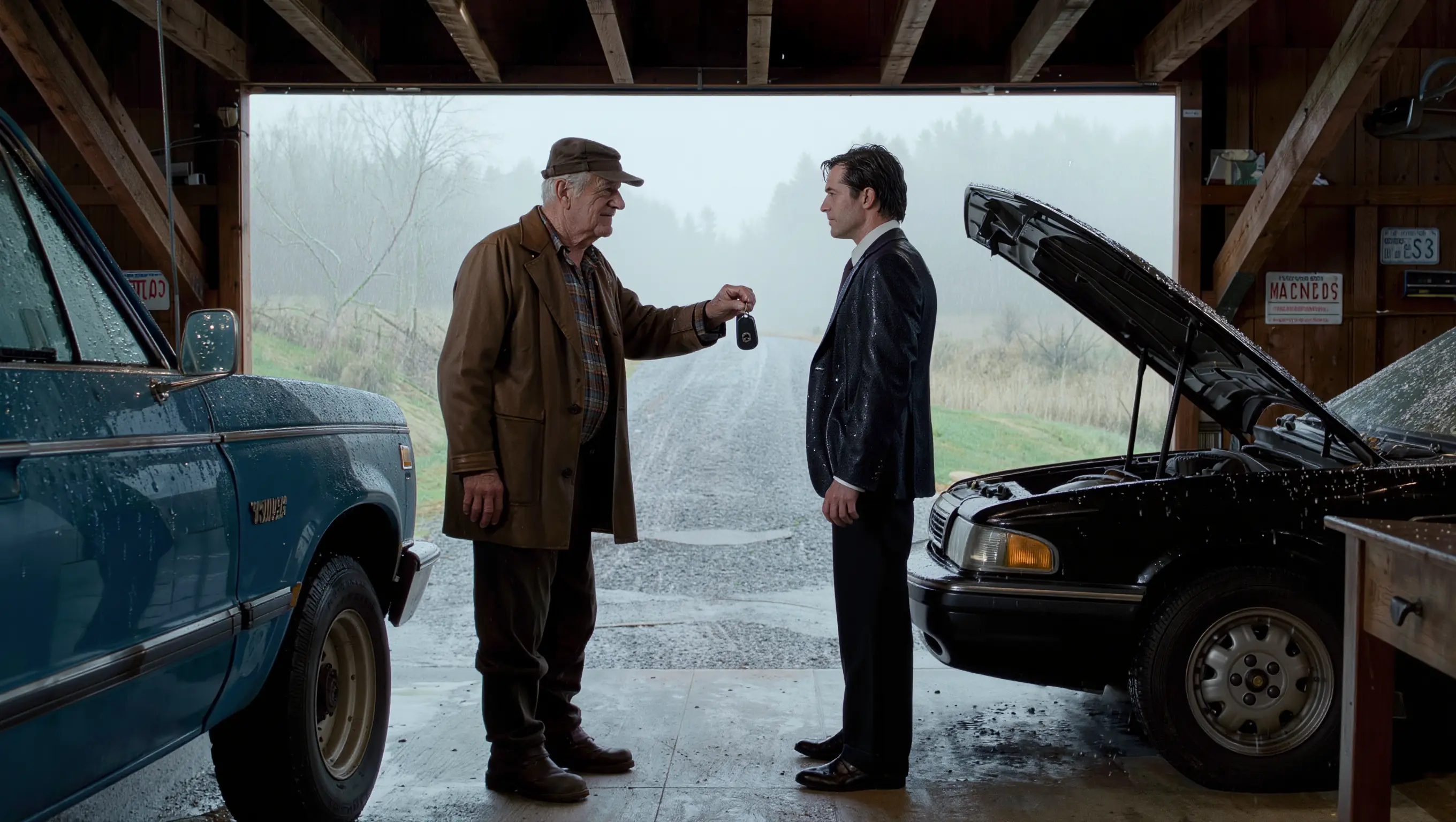
Lily became a teenager, then a college student studying music education. Daniel became less frantic and more present. Emma remarried eventually, kindly, and still sent Walter Christmas cards.
Walter aged.
At eighty-six, his hands shook slightly when tightening small bolts. His knees stiffened. The garage roof leaked in three places. The wooden doors warped badly. He stopped taking even small repair jobs because he feared making a mistake.
The quiet returned.
Worse than before.
One autumn storm damaged the garage roof. The repair estimate was more than Walter could afford. His daughter begged him to sell the property and move closer to her in St. Louis.
“Dad, you can’t keep that place forever.”
Walter looked at the garage, at Lily’s old drawing still taped inside a plastic sleeve on the wall, at the toolbox Margaret used to tease him about.
“No,” he said softly. “I suppose not.”
He did not call Daniel.
Daniel found out from Lily, who had visited Walter and noticed buckets under the roof leaks.
Two days later, Daniel Carter arrived in a black pickup truck with a folder, a hard hat, and a look Walter recognized immediately.
Determination.
Walter stood in the garage doorway.
“No,” he said before Daniel spoke.
Daniel smiled. “You don’t even know what I’m going to say.”
“I know that folder. Folders bring trouble.”
“This one brings a roof.”
Walter sighed. “Daniel—”
“Listen first.”
Daniel opened the folder on the workbench.
Inside were plans for the property.
The garage would be restored. The roof rebuilt. The doors replaced but matched to the old style. The tools preserved. The workbench repaired. The side shed expanded.
But there was more.
Daniel’s company was launching a rural roadside training and assistance program for young adults aging out of foster care and teens from low-income families who wanted practical mechanical skills. The old Bennett garage would become the first training site.
A place where students would learn basic auto repair, emergency roadside safety, and honest work.
A small fund would help stranded drivers in storms, especially elderly people, single parents, and families traveling with children.
At the top of the proposal was the name:
THE WALTER BENNETT ROADSAFE GARAGE
Helping People Keep Their Promises.
Walter stared.
His mouth opened, but nothing came out.
Daniel’s voice softened.
“When my car died in the rain, you didn’t just fix a belt. You helped me reach my daughter when she needed to know I would show up. That night changed the kind of father I became.”
Walter looked away, eyes wet.
“I was just doing what anyone should do.”
Daniel nodded. “Maybe. But you were the one who did it.”
The renovation took six months.
Walter complained about nearly everything.
The new roof was too clean.
The new doors opened too easily.
The young workers moved his tools incorrectly.
The safety signs made the garage look “official in a suspicious way.”
Daniel listened respectfully and ignored most of it.
But he kept what mattered.
The old red toolbox stayed behind the workbench.
Margaret’s coffee pot stayed in the corner.
Lily’s childhood drawing of the truck in the rain was framed and hung by the door.
On opening day, students, neighbors, former customers, and Daniel’s family gathered outside the restored garage. Lily, now twenty, played violin on the porch before the ribbon cutting.
Walter pretended the music made his eyes water.
No one believed him.
Daniel gave a short speech.
“Years ago,” he said, “I broke down on this road in a thunderstorm. I was late for my daughter’s recital, out of options, and ready to fail someone I loved. Walter Bennett came out in the rain, pulled my car into this garage, drove me to town, and then taught me how to fix what had broken.”
He paused.
“But the car was not the only thing he helped repair. He reminded me that being present is a promise, and promises matter most when the weather is bad.”
Walter lowered his head.
“This garage will now help others the way Walter helped me. With skill. With dignity. With no one left alone in the rain.”
The applause rolled through the yard like thunder, but gentler.
Walter stood beside the new sign, unable to speak.
Years later, the RoadSafe Garage became a trusted place in the county. Young people learned real skills there. Stranded drivers received help. Students drove out with instructors to assist elderly residents with dead batteries, flat tires, and storm breakdowns.
Walter no longer handled repairs himself, but he came every morning.
He sat on a stool near the workbench, correcting technique, telling stories, and warning students that “a wrench is not a hammer no matter how much you want it to be.”
One rainy evening, a young student named Marcus ran into the garage.
“Mr. Bennett,” he said, “there’s a woman stuck two miles down the road with two kids in the car. Battery’s dead.”
Walter looked at Daniel, who happened to be visiting that day.
Daniel smiled.
Walter reached for his coat.
Marcus frowned. “You’re coming?”
Walter stood slowly, old knees protesting.
“Rainy promises are the important ones,” he said.
Daniel laughed softly and grabbed the keys.
They drove out together through the rain.
And as the garage lights glowed behind them, Walter Bennett understood that he had not lost his purpose after all.
Years ago, he had helped one man fix a car in a storm.
But kindness, like a good engine, keeps moving when cared for properly.
A broken belt became a kept promise.
A kept promise became a better father.
A better father became a garage full of students.
And an old man who thought his working days were over lived long enough to see his hands teach a whole new generation how to help strangers find their way home through the rain.