The rain started just after sunset.
Not the gentle kind that made people slow down and enjoy the sound against the windows.
This was the kind of rain that erased the edges of the road, hammered against rooftops, and turned every passing headlight into a blurry streak of white and yellow. It flooded the ditches along Route 17 and sent cold water rushing across the pavement in silver sheets.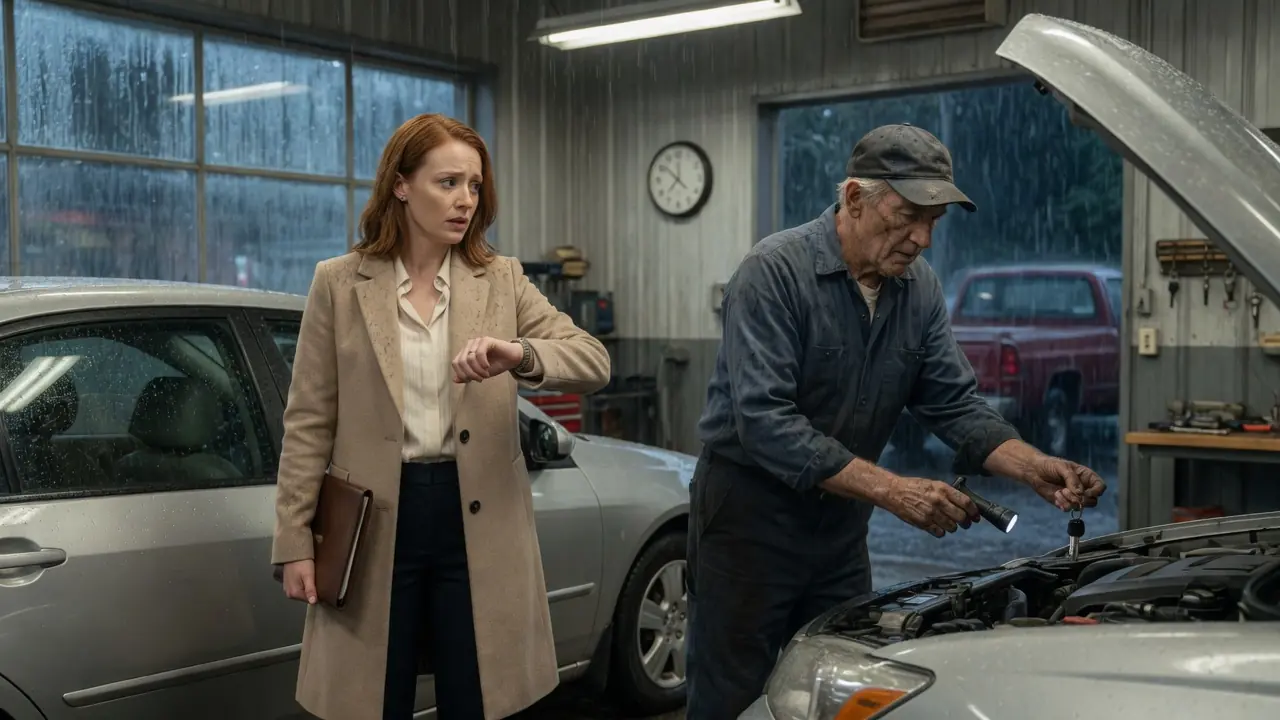
The small town of Willow Creek, Pennsylvania, had already gone quiet for the night. The hardware store had locked its front door. The pharmacy sign flickered weakly above an empty sidewalk.
Even Rosie’s Diner near the highway had turned off half its lights, leaving only a red neon coffee cup glowing in the front window like a tired warning to passing travelers.
But inside Harrison’s Auto Repair, an old man was still working.
Frank Harrison was seventy-two years old, and he had spent almost fifty years fixing things other people had given up on. Cars, trucks, old farm equipment, stubborn engines, cracked hoses, dead batteries, and sometimes, when a customer needed it, a little bit of their confidence too. His hands were wide and scarred, his shoulders slightly bent, and his gray hair stayed flattened beneath a navy work cap that had seen more winters than some men saw jobs.
His garage sat at the edge of town, a small brick building with two service bays, a narrow office, and a faded sign above the entrance.
HARRISON AUTO REPAIR
The paint had peeled from the sign years ago. The letters were uneven. The waiting room chairs were older than most of his younger customers, and the vending machine in the corner had been unplugged since 1999 because Frank said it made too much noise.
But the place still worked.
So did Frank.
That was all he cared about.
His wife, Margaret, had loved the garage in a way most people did not understand. She used to bring him lunch every afternoon in a brown paper bag, then sit in the corner of the office reading while he worked. Sometimes, when business was slow, she would sit on the old stool near the workbench and talk to customers like they had come to visit family instead of get their brakes checked.
“You know,” she once told him, “you spend more time with broken machines than with people.”
Frank had laughed, wiping his hands on a rag.
“Machines are easier.”
Margaret had smiled over the top of her book.
“That’s because machines tell you exactly what hurts.”
She was right.
People hid their problems.
Cars didn’t.
A strange sound. A warning light. A shaking engine. A smell that did not belong. Everything meant something if a man had the patience to listen. Frank liked that. He liked problems with bolts, wires, hoses, and answers.
After Margaret passed away eight years earlier, the garage became quieter.
Too quiet.
Her chair remained in the office beside the window. Her coffee mug still sat on the shelf above the filing cabinet, though Frank had washed it the week after the funeral and never used it again. The little ceramic bird she bought at a church craft sale still watched over the front desk with one chipped wing.
Their son, Russell, wanted him to retire and move closer to family in Harrisburg.
“Dad, you’re getting older,” Russell said every few months over the phone. “You can’t keep running that place forever.”
Frank always gave the same answer.
“This place still needs me.”
The truth was simpler.
He still needed the place.
The garage was where Margaret had laughed. Where his hands had built a life. Where his son had learned to ride a bicycle in the parking lot. Where every scratch on the workbench carried a memory. If Frank closed the garage, he feared the silence would follow him home and finally win.
But business was not what it used to be.
Modern repair shops had expensive diagnostic systems, bright waiting rooms, free coffee, online appointments, and young men in clean uniforms who spoke in rehearsed sentences. Frank still kept appointments in a spiral notebook. He still used the same red toolbox Margaret had bought him thirty years earlier. He still believed a good ear could diagnose half the trouble before any machine plugged in.
He did not advertise.
He did not chase customers.
He just fixed what came through the door.
That night, he was preparing to close when he heard it.
A car struggling outside.
The engine coughed.
Stopped.
Tried again.
Stopped.
Frank looked toward the garage door.
Then sighed.
“Of course,” he muttered.
He switched off the old radio, grabbed his flashlight from the bench, and pulled open the side door.
Rain rushed inside immediately, cold and hard, splashing across the concrete floor. A silver sedan sat near the entrance to the lot, hazard lights blinking weakly through the storm. Behind the wheel was a young woman, maybe thirty or thirty-one, gripping the steering wheel with both hands and staring through the windshield with the exhausted frustration of someone one problem away from breaking.
She stepped out quickly, pulling a thin coat over her head.
“Sorry!” she called over the rain. “I know you’re probably closed.”
Frank glanced at the clock above the service bay.
“Five minutes ago.”
“I’m really sorry. My car just stopped and I don’t know what happened. I tried starting it again, but it keeps dying.”
Frank looked at the sedan, then at the sky, then back at her.
“You picked a bad night to stop.”
She laughed nervously.
“That makes two of us.”
Within seconds, she was soaked.
Frank pulled his cap lower and walked toward the car. His knees protested with every step, but he ignored them the way he ignored most complaints from his body. He had learned long ago that pain liked attention, and he did not always feel like giving it any.
“What’s your name?” he asked.
“Emma,” she said. “Emma Whitaker.”
“Frank.”
“I really appreciate this, Frank.”
“Don’t appreciate anything yet. I haven’t fixed it.”
She smiled weakly, but her face remained tight with worry.
Frank opened the hood. Steam and rain blurred together in the beam of his flashlight. The engine compartment was damp, but not ruined. He leaned in, listened, touched a few parts, checked connections, and asked Emma to try starting it again.
The engine coughed, then died.
Emma stood beside him, shivering with her arms wrapped around herself.
“You can tell what’s wrong already?” she asked.
“No.”
She looked surprised.
“Then why do you look like you do?”
“Because pretending to know everything is how people make expensive mistakes.”
That made her smile for real.
Frank continued checking.
He noticed the battery terminal first. Loose connection. Corrosion around the clamp. Nothing grand. Nothing dramatic. Just one small failure that had stopped an entire car in the middle of a storm.
He went back inside, grabbed a wrench, a wire brush, and a rag, then returned to the car. Rain ran down the back of his neck and under his collar, but he worked carefully. He cleaned the terminal, tightened the clamp, checked the cable, and signaled for Emma to try again.
The engine turned.
Caught.
Held.
Emma let out a breath that sounded almost like a sob.
“That’s it?” she called.
“That’s it.”
She stepped closer, relief washing across her face.
“How much do I owe you?”
Frank closed the hood.
“Nothing.”
She frowned.
“No. You just worked in the rain.”
“I tightened a connection.”
“That still took time.”
Frank shrugged.
“Then consider it time I spent standing outside complaining about the weather.”
She laughed, though she looked like she might cry.
“No, really. Please. I can pay.”
Frank shook his head.
“Get somewhere warm before the rain gets worse.”
Emma hesitated.
“You’re sure?”
“Yes.”
“Why?”
Frank looked at her then.
Because he saw something familiar.
Not the car.
The person.
Someone having a bad night and trying not to show it. Someone standing in the rain with too much fear in her eyes and too much pride to ask for more than the smallest help.
“Because someone helped me once,” he said.
That was all he offered.
But Emma did not move right away.
She looked through the rain at the little brick garage, then at the old man standing beneath the weak yellow light, his cap dripping, his hands blackened with grease and water.
“I was supposed to be in Philadelphia tomorrow morning,” she said quietly. “I have a presentation. A big one. I thought I was going to miss it.”
Frank wiped his hands on the rag.
“Then don’t.”
She blinked.
“What?”
“Go home. Dry off. Sleep. Drive early if the roads clear. Worrying in my parking lot won’t help the presentation.”
Something about the plainness of his words steadied her.
She nodded.
Before leaving, she reached into her purse.
“Please take something.”
“No.”
“At least let me buy you coffee tomorrow.”
“I don’t drink coffee.”
She stared at him.
“Everyone drinks coffee.”
“Not me.”
“That might be the strangest thing I’ve heard tonight.”
Frank gave the smallest smile.
“Drive carefully, Emma.”
She looked surprised that he remembered her name.
“I will.”
Then she climbed into the sedan and drove away slowly, taillights glowing red through the rain until the storm swallowed them.
Frank watched until they vanished.
Then he went back inside, locked the door, and stood for a moment in the quiet garage with rainwater dripping from his sleeves onto the concrete.
“You would’ve liked her,” he said to Margaret’s empty chair.
The chair, as always, said nothing.
By morning, Frank told himself he had forgotten the encounter.
That was his way.
He helped people.
Then he moved on.
But three days later, Emma returned.
Frank was under the hood of an old pickup when the silver sedan pulled into the lot. The sun was out that afternoon, bright and cold, and the puddles from the storm had dried into dark stains near the garage door.
Emma stepped out carrying two paper cups.
Frank looked over his shoulder.
“I thought you said you had a presentation.”
“I did.”
“And?”
“I made it.”
“Good.”
She held up the cups.
“I also brought coffee.”
“I told you I don’t drink coffee.”
“I remembered.” She lifted the second cup. “That one is hot chocolate.”
Frank stared at her.
“You brought an old mechanic hot chocolate?”
“You don’t drink coffee.”
“That doesn’t mean I’m eight.”
Emma smiled.
“No. It means you’re difficult.”
Frank grunted, which was the closest he came to admitting amusement.
They stood near the workbench while she told him what had happened. She was an architect, still early in her career, working for a small firm that specialized in community spaces. Her presentation in Philadelphia had been about preserving old buildings instead of tearing them down. Warehouses. Train depots. Corner stores. Churches. Family businesses that developers called outdated because they did not know how to measure memory.
“It went well,” she said.
Frank sipped the hot chocolate reluctantly.
“Did you win something?”
“Not exactly. But they listened.”
“That’s something.”
“It is.”
She looked around the garage.
The peeling sign.
The old lift.
The worn wooden desk.
Margaret’s chair by the office window.
“You really work here alone?” she asked.
“Yes.”
“Doesn’t it get lonely?”
Frank looked at the tools, the cars, the old radio, the empty chair.
“Sometimes.”
Emma nodded, not with pity, but understanding.
Before she left, she placed a business card on the counter.
“If you ever need architectural help, I’m not expensive yet.”
Frank glanced at the card.
“Architects design buildings. They don’t fix leaky garage roofs.”
“Good architects do both.”
“My roof doesn’t leak.”
At that exact moment, a drop of water fell from the ceiling into a bucket near the storage room.
Emma looked at the bucket.
Frank looked at the ceiling.
Then he said, “That’s not a leak. That’s a collection system.”
Emma laughed so hard she had to wipe her eyes.
Frank kept the business card.
Not on purpose, he told himself.
He simply put it in the top drawer of his desk and never threw it away.
Months passed.
Then years.
Frank did not see Emma again.
Or at least, he did not think he did.
Life settled back into its ordinary rhythm. Oil changes. Brake pads. Belts. Alternators. Winter tires. Summer complaints about air-conditioning. Farmers bringing in machinery older than Frank’s apprentices would have been if he had any apprentices.
But Frank did not have apprentices.
Young people did not want to learn the trade from an old man in a brick garage with no website and a cash register that still made a bell sound when it opened. They wanted certifications, clean shops, digital tools, and career paths with glossy brochures.
Frank understood.
He did not like it.
But he understood.
Each year, the garage became a little harder to maintain.
The old lift began making a strange grinding sound that Frank pretended not to hear until it became too loud to ignore. His hands stiffened in winter. His eyesight weakened at night. The roof leaked in two places, then three. The office heater rattled like it was full of loose bolts. The waiting room floor dipped near the soda machine that no longer worked.
Customers still came, but not enough.
Some were loyal. Old farmers. Retired teachers. Men and women who remembered when Frank had stayed late to fix their cars so they could get to work the next morning. But loyalty did not always pay invoices on time, and invoices did not wait politely for pride to catch up.
The town around him changed too.
Willow Creek used to be the kind of place where everyone knew which garage to call, which bakery had the best rolls, and which porch lights stayed on for neighbors. Then the highway expanded. Chain stores appeared at the edge of town. A new development company bought the old textile mill and turned it into loft apartments with exposed brick and rent no local mechanic could afford.
One afternoon, a man in a navy coat came into the garage carrying a leather folder.
His name was Blake Carrow, and he represented Carrow Development Group.
Frank disliked him immediately.
Not because he was rude.
Because he was too smooth to be honest.
“Mr. Harrison,” Blake said, smiling around the garage like he was already imagining it gone, “you’ve got a valuable piece of property here.”
“I’ve got a garage.”
“Exactly. Right on the edge of the highway corridor. Excellent access. Great visibility.”
Frank wiped his hands on a rag.
“Visibility is helpful when people need repairs.”
Blake smiled wider.
“Of course. But I imagine running an independent shop at your age is not easy.”
Frank stared at him.
“My age changes depending on who wants something.”
Blake chuckled, though he did not find it funny.
“My company would be interested in making a generous offer. Very generous. Enough for a comfortable retirement.”
“I didn’t ask for one.”
“No, but perhaps it is time to consider it.”
Frank walked to the office door and opened it.
“We’re done.”
Blake’s smile thinned.
“You may want to discuss this with your family.”
“My family knows I don’t sell things because strangers wear nice shoes.”
The man left his card on the counter.
Frank threw it in the trash before the door closed.
But development companies are patient when they smell profit.
The letters started after that.
Formal offers.
Property assessments.
Market comparisons.
Then came calls from the bank.
Then a meeting.
Then words Frank hated.
Outstanding balance.
Deferred maintenance.
Risk.
Opportunity.
Financial prudence.
His son, Russell, drove down from Harrisburg after Frank finally admitted the situation.
Russell was forty-six, a high school principal with neat hair, kind eyes, and the weary posture of a man who spent his days trying to solve problems parents blamed on everyone but themselves. He loved his father, but he had learned long ago that Frank treated concern like an insult unless it was delivered carefully.
They sat in the office while rain tapped lightly against the window.
Margaret’s chair stood empty beside them.
“Dad,” Russell said gently, “maybe selling isn’t the worst thing.”
Frank did not answer.
“You built something good. No one can take that away.”
“They can take the building.”
“It’s not the same.”
Frank looked at him sharply.
“No. It’s not. But sometimes buildings hold things people don’t know how to carry any other way.”
Russell’s face softened.
“I miss Mom too.”
Frank looked away.
“That’s not what I said.”
“You didn’t have to.”
The old man stared at the workbench through the office window.
Russell sighed.
“I’m not trying to push you. I just don’t want you losing everything because you’re too proud to choose.”
“I’m not too proud.”
“Then what are you?”
Frank’s answer came slowly.
“Afraid.”
Russell went quiet.
That was not a word Frank used often.
“Of what?” he asked.
Frank looked at Margaret’s chair.
“If I close this place, I don’t know who I am when I wake up.”
Russell’s eyes filled, but he blinked the tears back.
“You’d still be my father.”
Frank smiled sadly.
“That’s your job to say.”
“And the truth.”
Maybe it was.
But truth did not pay the roof bill.
The final notice came in the winter.
Ninety days.
After that, the bank would begin the process of taking the property if Frank could not settle the overdue obligations or secure financing for repairs.
Frank read the letter twice.
Then he folded it carefully and placed it inside his red toolbox beneath a tray of sockets.
The same toolbox Margaret had bought him thirty years earlier.
Then he went back to work.
That was what Frank did when his life was falling apart.
He tightened bolts.
He changed oil.
He listened for strange sounds.
He tried not to think.
Two months later, on another rainy evening, a black SUV pulled into the lot just as Frank was closing the garage.
He frowned.
He did not recognize the vehicle.
The driver’s door opened, and a woman stepped out carrying an umbrella. She wore a long gray coat, dark trousers, and the kind of confidence that belonged to someone who had learned to enter rooms without apologizing for taking up space.
Something about her face felt familiar.
“Frank Harrison?” she asked.
Frank stared.
Then his eyes widened.
“Emma?”
She smiled.
“You remember.”
“You changed your car.”
“I changed a lot of things.”
“You fix your own battery now?”
She laughed.
“No. But I do know when one is loose.”
Frank looked past her at the SUV.
Three other people stepped out, each carrying folders, rolled papers, or camera equipment.
Frank immediately narrowed his eyes.
“I don’t like folders.”
Emma’s smile deepened.
“I remember.”
“What’s this?”
“Can we come in?”
“That depends.”
“On what?”
“Whether you’re here to buy my land or save me from my own good.”
Emma looked at him carefully.
“Neither.”
He snorted.
“That’s usually what people say before they try both.”
She lowered the umbrella slightly.
“Frank, I came because I heard the garage was in trouble.”
His face closed.
“Who told you that?”
“Small towns talk. Architects listen.”
“I don’t need charity.”
“I know.”
“I helped you once.”
“Yes.”
“You don’t owe me.”
“I know that too.”
“Then why are you here?”
Emma turned and looked at the old building.
The faded sign.
The cracked pavement.
The warm yellow light spilling from the service bay into the rain.
“Because one night, when my car died and I was scared I was about to lose the biggest chance of my life, you opened that door.”
Frank said nothing.
She continued.
“You didn’t ask if I deserved help. You didn’t ask what I could pay. You didn’t make me feel foolish for not knowing what was wrong. You just stepped into the rain and fixed what you could.”
“I tightened a battery cable.”
“No,” she said softly. “You gave me time.”
That quieted him.
Emma glanced back at the people with folders.
“May we come in?”
Frank hesitated.
Then he opened the garage door wider.
“Wipe your feet.”
Emma laughed.
“So you haven’t changed completely.”
“Don’t get hopeful.”
Inside, the group introduced themselves. Nora was Emma’s project manager. Luis was a structural engineer. Priya handled community development grants. Frank forgot the names immediately but remembered what they carried.
Plans.
Measurements.
Possibilities.
Emma placed a folder on the workbench.
Frank crossed his arms.
“If this is some polished pitch for turning my garage into luxury apartments, save your breath.”
“It isn’t.”
“Wine bar?”
“No.”
“Boutique hotel?”
“Absolutely not.”
“I hate boutique hotels.”
“I suspected that.”
Emma opened the folder.
Inside were drawings of the garage.
Not demolished.
Restored.
The brick cleaned but not replaced. The old sign preserved. The service bays updated. The roof repaired. The office expanded slightly. The back storage area converted into a classroom and training workshop. The waiting room redesigned with safer floors, better heat, and a wall displaying photographs from the garage’s history.
Frank stared.
His throat tightened before he could stop it.
There was Margaret’s chair in one drawing, still by the office window.
“You put the chair in,” he said.
Emma nodded.
“You mentioned your wife used to sit there.”
“I mentioned that?”
“Years ago. When I came back with hot chocolate.”
Frank looked at her.
“You remembered that?”
“I remembered everything.”
He looked down at the drawings again.
“What is this?”
Emma took a breath.
“At that presentation I made after you fixed my car, I received funding for my first major preservation project. That project led to another. Then another. Eventually, I started my own architecture firm. We specialize in saving places people think are outdated because they don’t understand what those places mean.”
Frank’s fingers touched the edge of the drawing.
“And you came here.”
“Yes.”
“Why?”
“Because this garage is one of those places.”
He shook his head.
“It’s a repair shop.”
“It is a repair shop that kept half this town moving for decades. It is a small business. It is a memory. It is a place where people learned they could be helped without being humiliated. That matters.”
Frank looked away.
Compliments made him uncomfortable.
Truth made him more uncomfortable.
Emma slid another document forward.
“My firm purchased the bank’s position on the property.”
Frank froze.
“What?”
“The debt has been resolved.”
“No.”
“Yes.”
“No, you can’t just—”
“We did.”
“I won’t accept that.”
Emma had clearly expected this.
She opened another folder.
“You are not being given charity. The property remains in your name. We established a preservation partnership and a community training trust. The garage will continue operating as Harrison Auto Repair. The back section will become the Harrison Mechanics Workshop, a low-cost training program for young people who want to learn the trade.”
Frank stared at her.
His voice came out rough.
“You bought my debt?”
“We cleared the threat against the property.”
“That’s a fancy way of saying you bought my debt.”
Emma smiled slightly.
“Yes.”
“I can’t repay you.”
“I’m not asking you to.”
“Then it’s charity.”
“No. It’s investment.”
“In what?”
“In the kind of future you once protected for me.”
The garage became very still.
Rain tapped against the roof.
Somewhere near the back, water dripped into Frank’s collection bucket.
Emma looked at the bucket.
“Still a collection system?”
Frank did not smile this time.
He was too close to tears.
“I don’t know what to say.”
“Say you’ll stay.”
He looked at her.
“That’s what this is really about?”
“Yes.”
“I’m old.”
“You’re experienced.”
“My hands hurt.”
“Then teach more and lift less.”
“I don’t know how to run a school.”
“You know how to fix things. We can help with the rest.”
Frank walked slowly to Margaret’s chair and rested one hand on the back of it.
For eight years, he had kept that chair in the office as if she might return at lunchtime with sandwiches and a book. For months, he had feared the chair would end up in a landfill when developers took the building. Now, in Emma’s drawings, it remained exactly where Margaret had always sat.
“You never met her,” he said.
“No.”
“She would’ve liked this.”
Emma’s voice softened.
“I hoped so.”
Frank lowered himself into the chair across from the desk.
He looked suddenly tired.
Not defeated.
Just tired from fighting alone for too long.
“I only fixed a car.”
Emma shook her head.
“No, Frank. You fixed a future.”
He looked down at his hands, grease in the lines of his skin, knuckles swollen from age and work.
Then he said the only thing he could manage.
“Margaret would tell me not to be stubborn.”
Emma smiled.
“She sounds wise.”
“She married me. So there’s debate.”
Emma laughed through her tears.
The restoration took six months.
Frank complained every day.
Not occasionally.
Every day.
He complained about the new diagnostic equipment.
“Too many screens.”
“It helps,” Emma said.
“I survived without it.”
“You also survived without a smartphone.”
“I still prefer that.”
He complained about the repaired roof.
“It doesn’t sound like rain anymore.”
“That means it works.”
“Rain had character.”
“Leaks have mold.”
He complained about the new waiting room chairs.
“They look too comfortable. People will want to stay.”
“That is generally the purpose of chairs.”
“The old ones kept visits efficient.”
Emma told him he was the most difficult client she had ever had.
Frank said that meant she had lived a soft life.
But beneath the complaining, he watched everything with quiet awe.
The brick was cleaned by hand. The old sign was restored rather than replaced. The workbench was sanded, sealed, and returned to the same place. Margaret’s chair was repaired, not moved. The service bays received updated lifts and safety equipment. The back storage area, once full of broken parts and boxes Frank had not opened in years, became a bright training room with tool walls, worktables, and large windows facing the yard.
On one wall, Emma installed a framed photograph.
Frank and Margaret, standing in front of Harrison’s Auto Repair in 1987, both younger, both smiling, Frank holding a wrench and Margaret holding a paper bag lunch.
Frank stared at it for a long time after it was hung.
“Where did you get that?” he asked.
“Russell sent it.”
“My son?”
“He helped.”
Frank turned away quickly.
Emma pretended not to see him wipe his eyes.
The opening day of the Harrison Mechanics Workshop arrived in early spring.
The rain held off that morning, though clouds hung low over Willow Creek. People gathered in the parking lot before Frank was ready for them. Old customers. Town council members. Former employees. Farmers. Teachers. Teenagers who had signed up for the first training class. Russell came with his wife and two children, who ran toward Frank and hugged his legs hard enough to nearly knock him off balance.
There was a ribbon across the service bay.
Frank hated the ribbon.
“I’m not a shopping mall,” he muttered.
Emma stood beside him, smiling.
“Just cut it.”
“With what?”
She handed him an oversized pair of ceremonial scissors.
He stared.
“No mechanic should be photographed holding these.”
“Too late. There are cameras.”
He glared at her.
“You planned this.”
“Yes.”
Russell stepped close to his father.
“Dad, say a few words.”
“No.”
“Please.”
Frank looked at the crowd.
He saw faces he had known for years. People whose cars he had fixed. People whose children he had helped get to school by repairing old engines for less than he should have charged. Young faces too. Nervous ones. Hopeful ones. A boy named Mason with grease already under his fingernails. A girl named Lena who said she wanted to rebuild engines because everyone told her she should not.
Frank cleared his throat.
“I’m not good at speeches.”
Someone in the crowd called, “We know.”
People laughed.
Frank pointed in the direction of the voice.
“Your truck still squeaks, Harold.”
More laughter.
He looked down at the ribbon, then at the garage behind him.
“This place started with one bay, one toolbox, and a wife who believed I could fix more than I thought I could. For a long time, I thought a garage was just where people brought cars. But I guess it’s also where they bring bad days, long worries, empty wallets, and sometimes dreams they don’t know how to name yet.”
The crowd grew quiet.
Frank glanced at Emma.
“Years ago, a young woman stopped here in the rain. Her battery cable was loose. I tightened it. That was all.”
Emma shook her head, smiling through tears.
Frank continued.
“She says it mattered. I still think she exaggerates. But maybe small things matter more than men like me admit.”
He looked toward the young students.
“So if you learn here, learn this first. Don’t laugh when somebody doesn’t know what you know. Don’t charge people for fear. Don’t call something useless because it’s old. And if someone knocks on the door in the rain, open it.”
For a moment, no one moved.
Then the applause started.
Not polite applause.
Real applause.
Frank looked embarrassed, annoyed, and deeply moved all at once.
He cut the ribbon quickly, as if escaping the moment.
The workshop opened.
The first class had twelve students.
Frank expected three.
The students came for different reasons. Mason wanted a job that used his hands. Lena wanted to prove her older brothers wrong. A quiet young man named Caleb had been failing in school but could take apart a lawn mower engine from memory. A single mother named Renee joined the evening program because she wanted to stop depending on repair shops that overcharged her.
Frank taught them all the same way.
Bluntly.
Patiently.
With no tolerance for laziness and surprising tenderness for honest mistakes.
“Listen first,” he told them on the first day, standing beside an old engine block. “Machines talk before they quit. So do people, but that’s a different class and I’m not qualified.”
Lena raised her hand.
“What if we break something?”
“You will.”
The students looked worried.
Frank continued.
“Then you’ll learn how to fix that too.”
The garage became alive again.
Not just busy.
Alive.
There were voices in the training room. Laughter near the tool wall. Questions shouted across the service bay. Emma visited often, sometimes for official reasons, sometimes with hot chocolate she pretended was not for Frank specifically. Russell came on weekends and helped with paperwork, gradually learning that his father’s stubbornness had always been grief wearing work boots.
Frank changed too, though he denied it.
He stood straighter when students asked questions. He laughed more often, usually when trying not to. He let Renee redesign the customer intake forms because she said his old ones looked like tax punishment. He allowed Lena to create a social media page for the garage under strict orders not to make him “look inspirational.”
She posted a photo of him holding a wrench with the caption:
Frank says engines are honest if you listen.
It went viral locally.
Frank was furious.
Then twelve new customers came in the next week.
He stopped complaining about the page.
Mostly.
One evening, a year after the reopening, Frank stayed late with Emma in the office. Rain fell outside, soft this time, tapping gently against the repaired roof. No buckets stood on the floor. No water dripped near the storage room. The garage was warm, bright, and quiet after a long day.
Emma sat in Margaret’s chair.
She had asked permission the first time.
Frank had pretended the question irritated him, then nodded.
Now it felt natural to see her there, reviewing papers with her shoes tucked beneath the chair the way Margaret used to sit with her books.
“You know,” Frank said, looking toward the rain-dark window, “I used to hate how quiet it got after she died.”
Emma looked up.
“I know.”
“No, you don’t. Not really.”
“You’re right.”
He appreciated that.
People said I know too quickly.
Emma did not.
Frank leaned back.
“I thought keeping the garage open meant keeping her here. Then when I almost lost it, I thought losing the building meant losing her again.”
Emma’s face softened.
“And now?”
He looked through the office window toward the training room, where twelve sets of tools hung neatly on the wall.
“Now I think maybe memory works better when you give it somewhere to go.”
Emma smiled.
“She went into the workshop.”
“Don’t make it poetic.”
“It is poetic.”
“It’s a garage.”
“It is also a garage.”
Frank shook his head, but he was smiling.
On his seventy-fifth birthday, the students surprised him.
Frank hated surprises almost as much as he hated ceremonial scissors.
They lured him into the training room by telling him the new compressor was making a sound.
“It better not be,” he muttered, walking in with a flashlight.
The lights came on.
“Happy birthday!”
Frank froze.
The room was full. Emma. Russell. His grandchildren. The students. Old customers. Rosie from the diner with three pies. Harold with the squeaky truck. Renee’s little boy holding a handmade card that said Mr. Frank Fixes Everything in crooked letters.
Frank looked around, overwhelmed.
“I’m going back to work,” he said.
“No, you’re not,” Emma said, blocking the door.
“I’m still your landlord in spirit.”
“You are not.”
“Feels like it.”
Russell stepped forward carrying a small wrapped box.
“This is from all of us.”
Frank took it suspiciously.
“If it’s another smartphone, I’m leaving.”
“Open it.”
Inside was a key.
An old brass key attached to a small metal tag engraved with three words.
Always Open It.
Frank stared at it.
Emma spoke softly.
“It’s for the front door. We replaced the lock last week, remember?”
“I remember complaining.”
“Yes. Extensively.”
He touched the engraved tag.
Russell said, “We wanted you to have the first key.”
Frank’s voice roughened.
“It’s my garage.”
Emma nodded.
“Yes. It is.”
He closed his hand around the key.
For a man who had been nearly forced out of his own life, the weight of that small brass key felt greater than money.
Greater than applause.
Greater than any thank-you he had ever received.
Years later, people still asked Frank why he never sold Harrison Auto Repair.
By then, his hair had gone fully white. His hands shook a little more. He no longer climbed under cars unless someone else was nearby to yell at him for doing it. But he still came in every morning, unlocked the door, checked the workbench, and looked at Margaret’s photograph before the first student arrived.
Whenever someone asked, Frank gave the same answer.
“Because one rainy night, I fixed a stranger’s car.”
Then he would pause, glance toward the training room, and smile.
“And apparently she was fixing my future the whole time.”
Emma remained part of the garage’s life.
Her architecture firm grew into one of the most respected preservation firms in the region. She restored libraries, train depots, firehouses, and old storefronts people had stopped seeing. But she always said Harrison Auto Repair was the project that mattered most.
Not because it was the biggest.
Because it was personal.
One rainy evening, nearly ten years after the night her car first died outside the garage, Emma stopped by after work. Frank was eighty-two then, slower but still sharp. A young mechanic named Lena, now certified and managing half the shop, was closing up the service bay. Mason had become an instructor. Renee ran customer relations with more authority than Frank ever had.
The garage had outgrown survival.
It had become a place that made other futures possible.
Frank sat in the office, looking tired but content.
Emma placed a cup of hot chocolate on the desk.
He looked at it.
“You still think I’m eight.”
“You still don’t drink coffee.”
“Coffee is bitter.”
“So are you.”
“Only before noon.”
She laughed and sat in Margaret’s chair.
For a while, they listened to rain strike the roof.
No leaks.
No buckets.
Just sound.
Frank looked at her.
“That night you came in, were you really that scared?”
Emma nodded.
“Yes.”
“Of missing the meeting?”
“Partly.”
“What else?”
She wrapped both hands around her cup.
“My father was sick then. My job was unstable. I was behind on rent. That presentation felt like the one door I could not afford to miss. When the car stopped, I remember thinking, of course. Of course this would happen now.”
Frank nodded slowly.
“Life likes bad timing.”
“Yes.”
She smiled faintly.
“Then this old man opened a garage door in the rain and acted like my disaster was ordinary enough to fix.”
“It was ordinary enough to fix.”
“That was the gift.”
He looked confused.
She continued.
“You didn’t make me feel dramatic. You didn’t make me feel helpless. You just found the loose connection.”
Frank looked toward the service bay.
“Loose connections cause trouble.”
“Yes,” Emma said. “They do.”
The words sat between them, carrying more than car talk.
Frank’s voice softened.
“You gave me more than I gave you.”
Emma shook her head.
“No. We just kept passing it back.”
The next morning, Frank arrived early.
A teenager was standing outside the garage door in the cold.
He was sixteen, maybe seventeen, wearing a thin hoodie and holding a cracked bicycle helmet under one arm. His name was Tyler, though Frank did not know that yet. His eyes were tired, defensive, and hopeful in the way young people’s eyes become when they have already been disappointed by too many adults.
“You open?” the boy asked.
Frank looked at the clock.
“Not for twenty minutes.”
The boy’s shoulders dropped.
“I can wait.”
Frank saw the bike leaning against the wall.
Flat tire.
Loose chain.
Bent brake lever.
He also saw the way the boy held himself, like he had practiced being turned away.
Frank unlocked the door.
“Bring it in.”
The boy blinked.
“For real?”
Frank stepped aside.
“Rain’s coming.”
The boy pushed the bike inside.
“What’ll it cost?”
Frank looked at him.
“First lesson is free.”
“Lesson?”
“You want it fixed or you want to learn?”
The boy looked at the bike.
Then at Frank.
“Learn, I guess.”
Frank handed him a wrench.
“Good answer.”
And just like that, another door opened.
Years after Frank was gone, Harrison Auto Repair remained.
The old sign still hung above the entrance, restored but not replaced. Margaret’s chair stayed in the office by the window. The red toolbox sat beneath a glass cover in the training room, not because tools should be worshiped, as Frank once complained, but because students deserved to know what a life of work looked like.
On the wall near the front desk was a framed photograph of Frank and Emma standing together on opening day.
Beneath it were his words:
Always open the door when someone needs help.
People came from surrounding counties to learn there.
Some became mechanics. Some opened shops. Some simply learned enough not to be afraid of engines, bills, or people who told them they were not capable. Every year, the workshop gave out the Margaret Harrison Scholarship to students who showed patience, honesty, and stubborn kindness.
Emma attended every ceremony.
Russell did too.
Whenever it rained, someone always told the story.
The old mechanic.
The young architect.
The silver sedan.
The loose battery connection.
The storm.
The refusal to take payment.
And the return years later with the one thing Frank Harrison never expected.
Not money.
Not praise.
Not a plaque on a wall.
A future.
A way for his hands to keep teaching after they grew tired.
A way for Margaret’s chair to remain beside the window.
A way for a small brick garage at the edge of Willow Creek to keep opening its door when someone needed help.
Because sometimes the smallest repairs create the strongest foundations.
Sometimes tightening one loose connection keeps an entire life from stalling.
And sometimes, when an old man steps into the rain for a stranger, he does not realize he is also stepping into the beginning of his own rescue.