The rain began falling over Pittsburgh, Pennsylvania, just before sunset, slow at first, then hard enough to turn the sidewalks into shining strips of black glass.
By seven o’clock, the streets outside Monroe Pharmacy were almost empty.
Cars moved carefully through the puddles, their headlights stretching long and pale across the wet pavement.
The wind pushed rain beneath awnings, rattled the metal trash cans near the curb, and made the old pharmacy sign swing above the door.
Inside the pharmacy, seventy-nine-year-old Thomas Bell stood near the back counter, waiting for his blood pressure medicine.
Thomas was a tall, thin old man with silver hair combed neatly to one side, tired blue eyes, and hands that had once been strong from forty years of repairing clocks and watches.
His brown coat was buttoned to the top, his cane leaned against the counter, and his old leather wallet sat in his hand because he always liked to be ready before the pharmacist called his name.
He did not enjoy being out after dark anymore.
His knees ached in wet weather. His eyesight was not what it used to be. And since his wife, Eleanor, had passed away eight years earlier, every errand felt lonelier than it should.
Still, medicine had to be picked up.
Bills had to be paid.
Life did not stop needing small things just because the house had become quiet.
Thomas had lived in the same narrow brick home on Alder Street for almost fifty years. He and Eleanor had raised two sons there.
They had planted roses by the front steps. They had eaten breakfast every morning at the little kitchen table beneath the window.
Now his sons lived far away, one in Ohio and one in Oregon.
They called. They cared. They worried.
But at night, when the house settled and the refrigerator hummed in the kitchen, Thomas was alone with the sound of his own breathing and the memory of Eleanor humming while she washed dishes.
The pharmacist finally called his name.
“Mr. Bell?”
Thomas stepped forward, signed the receipt carefully, paid for the medicine, and tucked the small white bag into his coat pocket.
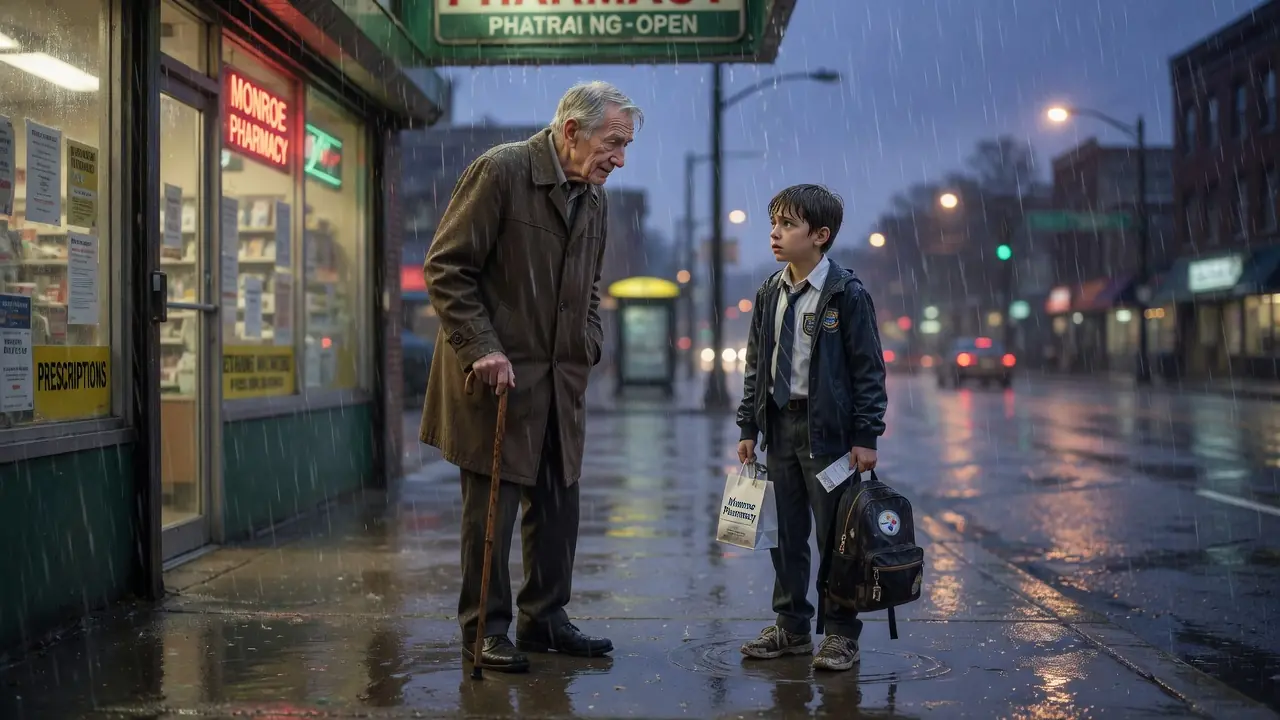
He was about to leave when he noticed the boy.
The child sat on the bench near the front window, half hidden behind a display of cough drops and umbrellas.
He looked about ten years old, with dark brown hair damp from rain, light brown skin, and a navy jacket zipped crookedly over a school uniform shirt. His backpack sat on his lap, gripped tightly by both hands.
Beside him was a small plastic pharmacy bag.
He was not looking at the shelves.
He was not looking at a phone.
He was looking at the door.
Every time the bell above it rang, he sat up straighter. Every time a stranger entered, disappointment crossed his face before he pushed it away.
Thomas paused.
At first, he thought the boy’s parent must be somewhere in the aisles.
But the pharmacy was small. Thomas could see the whole place from where he stood.
There was an elderly woman comparing vitamins, a young man buying cold medicine, the pharmacist behind the counter, and the cashier near the register.
No mother.
No father.
No adult watching the boy.
Thomas stepped closer slowly.
“Evening,” he said gently.
The boy turned quickly.
“I’m not doing anything,” he said.
Thomas lifted one hand. “I didn’t say you were.”
“I’m waiting.”
“So I see.”
The boy looked away.
Thomas stood a few feet from the bench, keeping space between them.
“What’s your name?”
The boy hesitated.
“Leo.”
“Leo what?”
“Leo Martinez.”
“I’m Thomas Bell.”
The boy glanced at the prescription bag in Thomas’s pocket. “You’re here for medicine too?”
“I am.”
“My mom sent me here for hers.”
Thomas looked at the small pharmacy bag beside him.
“Is she coming to get you?”
Leo nodded quickly.
“She said she would.”
“What time?”
Leo looked toward the clock above the register.
“She said before seven.”
Thomas looked too.
It was 7:26.
The boy saw him notice and tightened his grip on the backpack.
“She’s probably just late,” Leo said.
“Maybe.”
“She always comes.”
Thomas heard the fear beneath the words.
“I believe you.”
Leo looked up, surprised.
“You do?”
“Yes.”
The bell above the pharmacy door rang again. A woman came in with a wet umbrella, bought tissues, and left. Leo watched her closely until she disappeared into the rain.
Thomas sat slowly at the other end of the bench.
“My wife used to say rain makes every minute feel longer,” he said.
Leo did not answer.
Thomas nodded toward the pharmacy bag. “What did your mother send you to pick up?”
“Her inhaler.”
“Is she sick?”
“She has asthma. It got bad last week, but she still had to work.”
“Where does she work?”
“At a bakery downtown. She cleans at night too.”
Thomas looked at the boy’s wet sleeves.
“How did you get here?”
“Bus.”
“Alone?”
Leo’s shoulders rose.
“I know the route.”
Thomas did not scold him. Scolding never helped frightened children.
Instead, he asked, “Do you have a phone?”
Leo shook his head.
“My mom’s phone works, but she said she had to save the battery. I know her number.”
“Would you like to call her?”
Leo glanced at the pharmacist.
“I already asked. They let me call once. It went to voicemail.”
“When was that?”
“Before.”
Before could mean five minutes or an hour to a child in fear.
Thomas stood carefully and walked to the counter.
“Excuse me,” he said to the cashier. “Could the boy use the phone again? His mother is late.”
The cashier looked toward Leo with concern.
“Of course.”
Leo dialed with shaking fingers.
No answer.
He tried again.
Still no answer.
His face went pale.
“She’s probably on the bus,” he whispered.
Thomas looked outside.
Rain struck the window so hard it blurred the street beyond it.
“Do you know the bakery name?”
Leo nodded.
“Morning Star Bakery.”
Thomas knew the place. Eleanor used to buy cinnamon rolls there on Saturdays.
The cashier searched the number and called. After two transfers and several minutes of waiting, a tired voice answered from the bakery office.
Thomas explained the situation.
The woman on the phone grew quiet.
“Yes,” she said slowly. “Maria Martinez works here. She left about an hour ago. She was coughing badly. We told her to go to urgent care, but she said she had to pick up her son first.”
Thomas looked at Leo.
The boy was watching him with wide eyes.
The woman continued.
“Actually, wait. I just heard from one of the delivery drivers. Maria collapsed near the bus stop outside the bakery. Someone called an ambulance. She was taken to St. Agnes Hospital.”
Thomas closed his eyes for one second.
When he opened them, Leo had stood up.
“What happened?” the boy asked.
Thomas put the phone down slowly.
“Your mother had trouble breathing. Someone called an ambulance, and she was taken to St. Agnes Hospital.”
Leo’s face turned white.
“Is she dead?”
“No,” Thomas said immediately. “No, son. She is at the hospital. That means doctors are helping her.”
Leo grabbed the pharmacy bag.
“I have to go.”
Thomas stepped closer, still calm.
“We will go.”
Leo stared at him.
“We?”
“Yes.”
“I don’t know how to get there.”
“I do.”
“You don’t have to.”
“I know.”
The pharmacist came from behind the counter with a worried expression.
“I can call the hospital first,” she said. “And I can call the police non-emergency line to report that he’s with you.”
Thomas nodded. “Please do.”
Leo looked frightened again. “Police?”
Thomas turned to him.
“Not because you did anything wrong. Because when a child is being helped by an adult, other adults should know exactly where he is.”
Leo swallowed.
“My mom won’t get in trouble?”
“No.”
“She sent me because she couldn’t leave work early. She’s not bad.”
Thomas’s voice softened.
“I didn’t think she was.”
That answer seemed to steady the boy.
The pharmacist confirmed with the hospital that Maria Martinez was in the emergency department, alive, receiving treatment for a severe asthma attack complicated by exhaustion. She had asked about her son, but her phone had died before anyone could reach him.
Thomas gave his full name, address, and phone number to the pharmacist and the dispatcher. Then he buttoned his coat, tightened his scarf, and held the pharmacy door open.
“Come on, Leo,” he said. “Let’s get you to your mother.”
The rain hit them the moment they stepped outside.
Thomas had no car. He no longer drove after dusk. But a taxi stand sat two blocks away near the old hotel, and the pharmacy cashier called a cab for them before they left.
Leo walked beside Thomas under the old man’s black umbrella, clutching the inhaler bag and his backpack.
The boy’s shoes splashed through puddles.
Thomas moved slowly because of his knees, but Leo did not rush him. In fact, the boy kept looking back to make sure Thomas did not fall.
That small kindness touched him.
At the hospital, the emergency room was bright, crowded, and full of hard plastic chairs. People coughed, nurses moved quickly, phones rang, and rain tapped against the large windows near the entrance.
Leo stood frozen just inside the doors.
Thomas placed one hand lightly on the boy’s shoulder.
“Breathe,” he said.
Leo whispered, “What if she’s really bad?”
“Then we will find out one thing at a time.”
They checked in at the desk. The nurse already knew to expect them. After confirming Thomas’s name and Leo’s identity, she led them back through a hallway.
Maria Martinez lay in a hospital bed with an oxygen tube under her nose. She was thirty-two, with dark hair pulled back loosely, pale brown skin, and deep tired shadows beneath her eyes. Her work shirt was folded on a chair beside the bed. A hospital blanket covered her thin frame.
When she saw Leo, she began to cry.
“Leo.”
He ran to her and stopped just short of the bed, afraid to touch the wires.
She reached for him with one hand.
He took it.
“I got your medicine,” he said, holding up the pharmacy bag.
Maria sobbed.
“Oh, baby. I don’t care about the medicine. I care about you.”
“You told me to wait.”
“I know. I was coming. I tried.”
“I thought you forgot me.”
“No. Never.”
Thomas turned slightly away, giving them privacy.
But Maria looked past Leo at him.
“Sir,” she whispered, “thank you.”
Thomas nodded gently.
“He waited bravely.”
Maria squeezed her son’s hand.
“He has to be brave too much.”
The doctor came in and explained that Maria would need to stay overnight. The asthma attack had been serious, made worse by an untreated respiratory infection, long work hours, and not enough rest. She needed medication, follow-up care, and time away from work.
Maria closed her eyes.
Time away from work sounded impossible.
Leo heard it too.
His face changed.
Thomas saw the boy begin to carry the worry before anyone asked him to.
“Do you have family nearby?” Thomas asked.
Maria shook her head weakly.
“My sister is in New Jersey. My mother passed three years ago. Leo’s father is not involved.”
“Who can take Leo tonight?”
Maria looked at her son, and shame crossed her face.
“I can call my neighbor. Maybe Mrs. Ruiz. But it’s late, and she has three kids. I don’t know.”
Leo stood straighter.
“I can stay in the waiting room.”
“No,” Maria said immediately.
“I can.”
“No, Leo.”
Thomas looked at the boy, then at the mother, then at the pharmacy bag still in Leo’s hand.
He thought of his quiet house.
The kitchen table with one chair pulled out.
The guest room that still held a quilt Eleanor had sewn years ago.
The way the rain sounded against his windows when no one else was there to hear it.
Then he said, “Leo can stay at my house tonight.”
Maria looked startled.
“No. Mr. Bell, you’ve already done too much.”
“I have a guest room.”
“I can’t pay you.”
“I didn’t ask.”
“I don’t know you.”
“That is true. But the hospital has my information. The pharmacy has my information. The police non-emergency line has my information. And I will bring him back first thing in the morning.”
Maria’s eyes filled.
“I’m not a bad mother,” she whispered.
Thomas stepped closer to the bed.
“I did not think you were.”
She covered her mouth and cried.
Leo stayed with his mother until visiting hours ended. Then Thomas took him home in another taxi, carrying the boy’s backpack when Leo finally became too tired to hold it.
Thomas’s house on Alder Street was narrow and warm, with a small porch, a brass number plate beside the door, and rose bushes trimmed low for winter. Inside, the hallway smelled faintly of lemon polish and old books.
Leo stood just inside the doorway.
“I’m getting your floor wet.”
Thomas gave a quiet smile.
“Floors have survived worse than rain.”
“I don’t want to mess anything up.”
“This house could use a little messing up.”
Leo did not understand.
Thomas did not explain.
He gave the boy dry socks, one of his sons’ old sweatshirts from a closet, and a towel. Then he warmed soup on the stove and made toast with butter.
Leo sat at the kitchen table, his shoulders hunched.
“I’m not hungry.”
His stomach answered before Thomas could.
Thomas raised an eyebrow.
“Your stomach has filed a disagreement.”
Leo looked embarrassed.
He ate slowly at first, then with the steady hunger of a child who had spent hours afraid.
Thomas turned away to make tea, giving him dignity.
After dinner, Leo helped carry his bowl to the sink.
“You don’t have to,” Thomas said.
“I know.”
But the boy washed it anyway.
Thomas understood.
A child who could not fix his mother’s illness still wanted to fix something.
So Thomas handed him a towel.
“Then dry this one.”
Leo nodded seriously.
A little later, Thomas showed him the guest room. It had a narrow bed, a wooden dresser, a small lamp, and a faded blue quilt folded at the end.
“This was my son’s room when he was young,” Thomas said.
“Where is he now?”
“Oregon.”
“That’s far.”
“Yes.”
“Does he visit?”
“When he can.”
Leo looked around the room.
“Do you miss him?”
Thomas paused.
“Yes.”
Leo nodded, as if that made sense.
“I miss my mom when she works nights.”
“I imagine you do.”
Leo placed his backpack beside the bed but did not take off his shoes.
Thomas noticed.
“You can leave the hallway light on,” he said.
Leo looked at him.
“And if you wake up and need something, my room is at the end of the hall.”
Leo sat on the bed.
“Will you really take me back tomorrow?”
“Yes.”
“Promise?”
Thomas’s voice softened.
“I promise.”
The boy studied his face.
Then he nodded.
That night, Thomas slept lightly.
Twice, he heard movement. The first time, he found Leo standing in the hallway, looking toward the front door.
“You all right?” Thomas asked.
Leo wiped his eyes quickly.
“I thought I heard the hospital phone.”
“That was the heater.”
“Oh.”
“Would you like tea?”
“I’m not supposed to drink tea at night.”
“Wise. Hot chocolate, then.”
They sat at the kitchen table at two in the morning, Leo wrapped in the blue quilt, Thomas in his robe, both listening to the rain.
“My mom works too much,” Leo said.
Thomas nodded.
“Some people have to.”
“She says she’s fine even when she isn’t.”
“Adults do that.”
“Why?”
Thomas thought of Eleanor, who had hidden pain in her knees for months before telling him. He thought of himself telling his sons he was fine so they would not worry.
“Because we think protecting people means hiding what hurts.”
Leo stared into his mug.
“That doesn’t work.”
“No,” Thomas said softly. “It usually doesn’t.”
In the morning, Thomas made oatmeal, eggs, and toast. Leo ate with more appetite, though worry still sat behind his eyes.
At nine o’clock, they returned to the hospital.
Maria looked better but still weak. When Leo walked in, she opened her arms, and he climbed carefully beside her.
“I’m okay,” he said.
“I know,” she whispered. “I missed you.”
“Mr. Bell made hot chocolate.”
Maria looked at Thomas with tears in her eyes.
“He also made me wash dishes,” Leo added.
Thomas lifted a finger.
“One dish. Under supervision.”
Maria laughed weakly, and that small laugh changed the whole room.
For the next two days, Thomas visited the hospital with Leo. When Maria was discharged, she was too weak to return immediately to her third-floor apartment without help. Thomas drove them in a taxi, carried what he could, and called a church volunteer group he knew through Eleanor’s old friends.
Maria resisted every offer.
Thomas ignored every refusal that came from shame rather than safety.
He helped her arrange follow-up care, contact work, get replacement medicine, and speak to a social worker about temporary support. He did not solve everything, but he stood beside them long enough that the problems stopped looking like one giant wall.
Leo began stopping by Thomas’s house after school when Maria had late shifts or doctor appointments.
At first, it was temporary.
Then it became routine.
He did homework at the kitchen table. Thomas helped with reading assignments. Leo helped Thomas sort old clock parts in the little back room that had once been a workshop.
Thomas had repaired clocks and watches for most of his life, but his hands were no longer steady enough for fine work. Still, he kept drawers full of gears, springs, screws, cases, and tiny tools.
Leo loved that room.
“What does this do?” he asked one afternoon, holding up a small brass gear.
“That one helps transfer motion.”
“To what?”
“To the next gear.”
“And then?”
“To the next.”
“So one small thing moves another small thing, and then the whole clock works?”
Thomas smiled.
“That is the idea.”
Leo turned the gear between his fingers.
“That’s kind of like people.”
Thomas looked at him.
“How so?”
“If one person helps another person, and then that person helps someone else.”
Thomas did not answer right away.
Then he said, “Your mother has raised a thoughtful boy.”
Leo looked down, pleased but shy.
Weeks became months.
Maria slowly recovered. She found a slightly better position at the bakery, one with fewer night shifts. She still worked hard, but she stopped pretending she was fine when she was not. She began calling Thomas before emergencies became disasters.
That was not easy for her.
He knew that.
Each time she apologized, he said the same thing.
“Maria, asking before you break is wisdom, not weakness.”
Leo heard that sentence often enough to remember it.
Thomas’s house changed too.
The kitchen table no longer had only one chair pulled out. The guest room had extra blankets ready. The refrigerator held chocolate milk because Leo liked it. Maria brought rice dishes, soup, and bread whenever she could, insisting that Thomas accept help too.
One Sunday afternoon, Maria helped him prune Eleanor’s rose bushes.
“I don’t know if I’m doing this right,” she said.
“Neither do I,” Thomas replied.
“I thought these were your roses.”
“They were my wife’s. I was mainly in charge of admiring them.”
Maria laughed.
Leo, sitting on the porch steps with a homework book, smiled at the sound.
Years passed.
Leo grew taller, steadier, and curious about everything that moved in small hidden systems: clocks, public transit, hospitals, emergency contacts, school pickup plans, food pantries, community clinics.
He became the kind of teenager who noticed when something failed not because people did not care, but because one small part had broken.
A phone battery.
A bus delay.
A missed message.
A late shift.
A locked door.
A child waiting too long.
At fifteen, he created a school project called The Next Gear, a community support map for children whose parents worked unpredictable hours or had medical emergencies. It listed safe public places, phone numbers, bus routes, clinics, libraries, and trusted adult contacts.
When he showed it to Thomas, the old man sat very still.
“You named it after the gears?”
Leo nodded.
“You said one small thing moves the next.”
Thomas took off his glasses and cleaned them even though they were already clean.
“Eleanor would have liked you.”
“I wish I met her.”
Thomas looked toward the roses outside the kitchen window.
“You did, in a way.”
When Leo graduated high school, Thomas sat beside Maria in the front row. Leo received a scholarship to study public health and community planning.
After the ceremony, he handed Thomas a small box.
Inside was the brass gear from the first clock part he had ever held in Thomas’s workshop, now polished and mounted in a wooden frame.
Below it, Leo had written:
For Thomas Bell, who became the next gear when our clock stopped.
Thomas cried openly.
Maria cried too.
Leo hugged them both.
College took Leo away from Pittsburgh, but not away from Thomas.
He called every Sunday. He sent photos of community clinics, transit maps, food access projects, and once a badly designed hospital waiting room with the message:
You would hate this clock. Nothing connects.
Thomas replied:
Then redesign it.
Leo did.
By the time he was twenty-nine, Leo worked with a nonprofit that helped hospitals, schools, pharmacies, and local businesses coordinate safe support for children and families during medical emergencies. His program focused on the gap between crisis and care: the hours when a parent was in an emergency room, a child was waiting somewhere, a phone was dead, and no one knew how to connect the pieces.
He called the program Next Gear Family Network.
The first city pilot was in Pittsburgh.
The first partner pharmacy was Monroe Pharmacy.
Thomas was eighty-eight by then.
He moved more slowly. His cane had become necessary, not optional. His sons wanted him to move closer, and he was beginning to consider it because the house felt difficult to manage. The roof needed repair. The workshop window leaked. The roses needed more care than his knees could give.
He did not tell Leo how lonely he had become again.
Maria did.
Leo came home two weeks later with a folder, a contractor, and the same serious look he had worn as a boy holding the pharmacy bag.
Thomas opened the door and sighed.
“Your mother has never learned secrecy.”
Leo smiled.
“She learned from you that asking before you break is wisdom.”
“That sentence has returned to punish me.”
“It has returned to help you.”
Leo spread plans across the kitchen table.
Thomas saw his house.
But restored.
The roof repaired. The front steps made safer. The workshop window replaced. The kitchen widened slightly. The guest room updated. The back room turned into a small office and resource space for the neighborhood branch of Next Gear Family Network.
Then Leo showed him the second page.
A family waiting center would open beside Monroe Pharmacy in a vacant storefront. It would be a safe, staffed place where children could wait if a parent had a medical emergency, where pharmacies could contact approved adults, where families could charge phones, access bus help, get snacks, and connect with hospital social workers.
At the top of the design was the name:
THE THOMAS BELL FAMILY WAITING ROOM
When One Gear Stops, Another Helps Turn.
Thomas stared.
“No.”
“Yes.”
“I do not need my name on a waiting room.”
“I know,” Leo said. “That is why it belongs there.”
“I only helped you one night.”
Leo leaned closer.
“You helped us through the night that could have broken everything.”
Thomas looked away.
His eyes filled.
The renovation took months.
Thomas complained about nearly all of it.
The new steps were too smooth.
The waiting room chairs were too bright.
The phone charging station had too many cords.
The young volunteers spoke too quickly.
Leo listened and changed what mattered.
He made the signs larger so older people could read them.
He moved the children’s snack shelf lower.
He placed a small clock on the wall of the waiting room, repaired by Thomas himself with Leo’s help. Inside its glass case, one brass gear was engraved with Eleanor’s name.
Thomas cried when he saw it.
On opening day, Monroe Pharmacy was full of people.
The pharmacist came. Hospital staff came. Teachers came. Bakery workers came. Maria stood beside Thomas, holding his arm. Leo stood near the entrance of the new waiting room.
“When I was ten,” Leo said, “I waited alone at this pharmacy for my mother. She had collapsed from an asthma attack, her phone was dead, and I did not know where she was. Thomas Bell noticed me. He did not judge my mother. He did not send me away. He helped me find her, sheltered me, and became part of our family.”
Thomas lowered his head.
“This room exists because families should not fall apart in the hours between emergency and information. It exists because one person noticed a child waiting too long.”
The applause was gentle but strong.
Thomas cried, and this time he did not pretend to clean his glasses.
Years later, the Thomas Bell Family Waiting Room became a trusted place in the neighborhood.
Pharmacies, clinics, schools, and hospitals used the network. Children waited safely when parents were delayed by medical emergencies. Families charged phones, made calls, received snacks, found transportation, and connected with help before panic became danger.
Thomas no longer lived alone in the same way.
Maria visited every week. Leo came home often. Volunteers checked on the roses. His sons visited and finally understood that their father’s life had not become small. It had become rooted.
One rainy evening, Thomas sat in the waiting room near the clock when a little girl came in with a pharmacy clerk.
Her father had been taken to the hospital. Her phone was dead. She was trying very hard not to cry.
The clerk looked toward Thomas.
Thomas smiled gently at the child.
“What’s your name, sweetheart?”
She whispered it.
Then she added, “I don’t have money.”
Thomas’s eyes softened.
“I didn’t ask for money.”
Across the room, Leo stood watching, his eyes wet.
The clock ticked steadily on the wall.
One small gear moved another.
Then another.
Then another.
Long ago, Thomas had thought he was only helping a boy at a pharmacy on a rainy night.
But kindness had its own mechanics.
A phone call became shelter.
Shelter became family.
Family became a network.
And a lonely old man who once repaired clocks lived long enough to see his name above a room where frightened children learned that when one part of life stops working, another caring hand can help the whole thing move again.