Leonard Brooks was seventy-nine years old and still believed a good suit could change the way a person stood.
His tailor shop sat on a narrow street in Providence, Rhode Island, between a small bakery and an empty storefront that used to be a watch repair shop. The sign above his door read:
Brooks Tailoring & Alterations
Since 1978
The gold paint had faded. The front window had scratches near the bottom. Inside, the shop was filled with old wooden cabinets, bolts of fabric, spools of thread, measuring tapes, chalk, pins, and two sewing machines that Leonard treated like respected coworkers.
A full-length mirror stood near the fitting platform. Beside it hung a photograph of Leonard and his late wife, Elaine, standing in front of the shop on opening day. Leonard was young in the picture, wearing a dark suit he had made himself. Elaine stood beside him in a blue dress, laughing because the ribbon across the door had tangled around the scissors.
Elaine had been gone for ten years.
But Leonard still spoke to her sometimes when the shop was quiet.
He would look at a crooked hem and mutter, “Elaine, people are buying pants without mirrors again.”
Or he would hold up a jacket with terrible factory stitching and say, “You see what the world has come to?”
The shop had once been busy. Lawyers came for alterations. Grooms came for wedding suits. Church deacons brought jackets before Sunday service. Young men came before graduation, nervous and proud. Women came with dresses that needed shaping, coats that needed saving, and uniforms that had to fit before Monday morning.
Leonard had always liked urgent jobs.
Not impossible jobs.
Urgent ones.
A torn sleeve before a funeral. A hem before a first day at work. A zipper before a wedding. Those were not small things to him. They were moments where fabric stood between someone and confidence.
But business had slowed.
People bought cheaper clothes now. Some wore suits only for rare occasions. Some ordered online and accepted bad fit because returning things was easier than repairing them. Rent rose. Utilities rose. Leonard’s hands stiffened in winter. His eyesight tired faster under the lamp.
His daughter, Angela, called every week from New Jersey.
“Dad, you can close the shop,” she told him gently. “You’ve worked long enough.”
Leonard always answered, “Clothes still need fixing.”
“Not enough to keep you exhausted.”
“I am not exhausted.”
“Dad.”
“I am selectively tired.”
Angela would sigh, and Leonard would change the subject.
The truth was, he did not know who he would be without the shop.
At home, the evenings were too quiet. In the shop, there was still purpose. A loose seam. A crooked cuff. A customer standing in front of the mirror, suddenly realizing they looked ready.
That mattered.
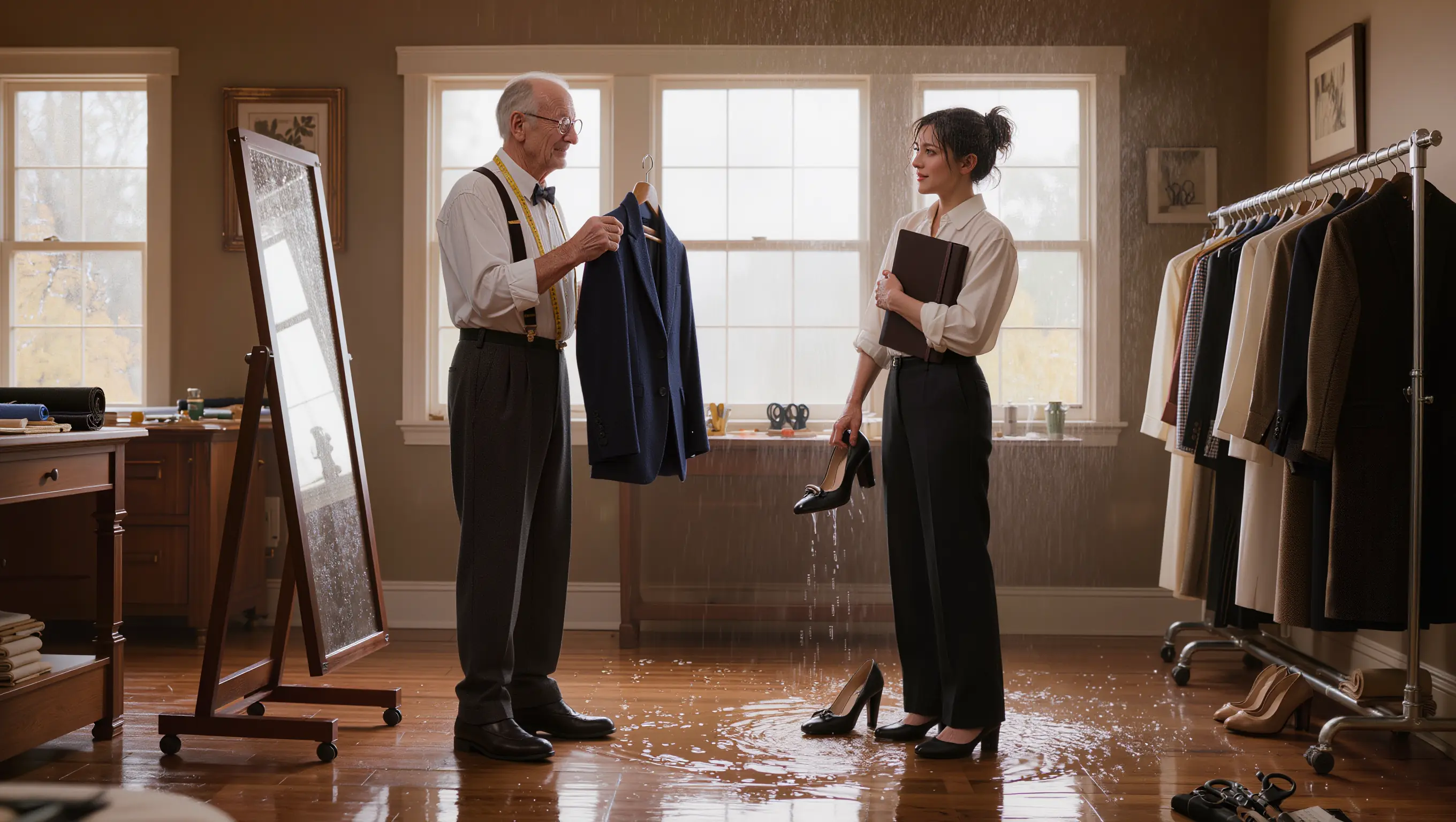
One Monday morning in early October, rain swept through Providence so suddenly that pedestrians scattered under awnings and bus shelters. Leonard had just opened the shop when he heard hurried footsteps outside.
Then the door flew open.
A young woman rushed in, soaked from the rain, holding a pair of high heels in one hand and a folder pressed against her chest.
She looked about twenty-four. Her dark brown hair had escaped from a neat bun and clung to her cheeks. She wore a white blouse, black slacks, and a thin gray blazer that had torn badly along the side seam. The sleeve was stained with muddy water. Her face was pale with panic.
“Please,” she said breathlessly. “Are you open?”
Leonard looked at the sign on the door.
“That is usually what the open sign means.”
“I’m sorry. I’m sorry. I just—” She stopped, trying to catch her breath. “I have an interview in forty minutes.”
Leonard’s expression changed.
“What happened?”
“I slipped getting off the bus. My blazer caught on the metal edge of the bench, and then a car splashed water everywhere.” She looked down at herself, humiliated. “I can’t go in like this.”
Leonard came around the counter slowly.
“What kind of interview?”
“Assistant manager at the Sterling Hotel downtown.”
“That’s a good hotel.”
“It’s my only chance.”
People said that often.
This young woman said it like she had counted every door behind her and found them closed.
“What’s your name?” Leonard asked.
“Natalie.”
“Natalie what?”
“Natalie Price.”
“Leonard Brooks.”
She looked at the torn blazer again.
“Can you fix it fast?”
Leonard examined the damage. The side seam had ripped from the lower rib to the waist. The lining had pulled loose. The fabric was cheap and thin, not made for emergency dignity. The muddy water stain had spread along one sleeve and part of the front panel.
He could close the seam quickly.
He could not make the blazer interview-ready in forty minutes.
Not properly.
Natalie watched his face.
“It’s bad,” she whispered.
“It is not dead,” Leonard said. “But it is not going to be ready in forty minutes.”
Her face crumpled before she could stop it.
She turned away quickly.
“I’m sorry. I’ll figure something out.”
Leonard glanced toward the clock.
8:22.
“Where is the interview?”
“Sterling Hotel. At nine.”
“Walking?”
“I was going to take the bus, but after this…” She looked at her wet shoes and folder. “I don’t know.”
Leonard looked at her more carefully.
Her blouse was damp but clean enough. Her black slacks could be brushed. Her folder was dry because she had protected it with her body. Her shoes could be wiped.
The problem was the jacket.
Leonard turned toward the back room.
“Wait here.”
Natalie wiped her eyes quickly.
“I can’t pay much. I have twenty dollars, but I can pay more next week if—”
“Did I ask?”
“No, but—”
“Then wait.”
He disappeared into the back room and opened the cedar cabinet where he kept special pieces.
Inside hung several old garments: Elaine’s blue dress, his wedding suit, a few jackets customers had never claimed, and one navy blazer Leonard had made for himself years earlier. It was wool, simple, elegant, and still beautiful. He had worn it to Elaine’s memorial service and hardly touched it since.
He stood there for a moment with his hand on the hanger.
Then he took it down.
When Leonard returned, Natalie was standing near the mirror, trying to smooth her wet hair with shaking fingers.
He held out the navy blazer.
“Put this on.”
She stared.
“What?”
“Put it on.”
“I can’t wear your jacket.”
“You can, unless your arms have unusual opinions.”
“No, Mr. Brooks, I can’t. That looks expensive.”
“It is old.”
“That doesn’t mean it isn’t valuable.”
Leonard looked at her.
“Do you want the interview?”
“Yes.”
“Then wear the jacket.”
Natalie swallowed, then carefully slipped into it.
It was too large in the shoulders and sleeves. Leonard immediately took a handful of pins from the counter, moved behind her, and began working with speed his age usually hid.
“Stand straight.”
She obeyed.
“Shoulders back.”
“I’m trying.”
“Try less. Stand.”
He pinned the back slightly, rolled the sleeves under, adjusted the front, and used a small hidden clip to shape the waist. Then he took a lint brush to the fabric, handed her a towel, and pointed to her shoes.
“Wipe those.”
She did.
He took her damaged blazer and placed it behind the counter.
“I’ll repair this later.”
“I can’t leave it.”
“You can. It is not going to the interview.”
Natalie looked at herself in the mirror.
The transformation was immediate.
She no longer looked like a woman who had been defeated by a bus stop and bad weather. She looked serious, composed, and ready. The navy blazer gave her structure. It made her stand taller. It made her look like someone who had walked in on purpose.
Her eyes filled.
Leonard pretended to adjust the sleeve so she would not feel watched.
“I look…” she whispered.
“Prepared,” he said.
She turned toward him.
“Why are you doing this?”
Leonard looked at her reflection in the mirror.
“Because sometimes the right jacket gets a person into the right room.”
“I don’t even know you.”
“Then make a good first impression.”
She laughed through tears.
He picked up the phone behind the counter and called the bakery next door.
“Tom, I need your nephew’s cab number. Yes, now. No, not for me. A young woman has an interview. Yes, it is urgent. No, I do not want a pastry.”
He hung up and wrote the cab number on a slip of paper.
“A cab will come in six minutes.”
“I can’t afford a cab.”
“I can.”
“No.”
“Yes.”
“I’ll pay you back.”
“You can pay me back by getting the job.”
“What if I don’t?”
“Then you still walk in like you deserve to be considered.”
Natalie pressed the folder against her chest.
“I’m scared.”
Leonard softened.
“Good. Fear means the moment matters. Just don’t let it do the talking.”
The cab arrived at 8:35.
Before Natalie left, she turned back at the door.
“Mr. Brooks?”
“Yes?”
“This jacket is very important to you, isn’t it?”
He paused.
“Yes.”
“Then I’ll bring it back. I promise.”
Leonard nodded.
“I know.”
She stepped into the rain and hurried into the cab.
Leonard stood at the window until it disappeared around the corner.
Then he picked up her torn gray blazer and carried it to the worktable.
The fabric was cheap.
The seam was badly made.
But he repaired it as if it mattered.
Because it did.
That afternoon, the shop bell rang at 3:12.
Natalie entered slowly, wearing the navy blazer and holding a paper cup of coffee.
Her hair was dry now, tied neatly. Her face was exhausted, but brighter.
Leonard stood from his sewing machine.
“Well?”
She smiled.
“I got a second interview.”
Leonard nodded.
“Good.”
“Good?” she repeated. “That’s all?”
“It is a strong word.”
She laughed.
Then she placed the coffee on the counter.
“Black. No sugar. Tom from the bakery said that’s how you drink it.”
“Tom talks too much.”
“He also said you don’t accept thank-yous very well.”
“Tom talks far too much.”
Natalie carefully removed the blazer and handed it to him.
“I don’t know how to thank you.”
“You already did. Coffee.”
“That’s not enough.”
“It depends on the coffee.”
She smiled, then saw her repaired gray blazer hanging behind him.
“You fixed it?”
“Yes.”
“How much do I owe you?”
“Twenty dollars.”
“That’s too little.”
“It is the amount you said you had.”
“But you did more.”
Leonard looked at her.
“Natalie, people do not always need the full bill on the day they are trying to stand up.”
Her eyes filled again.
She opened her wallet and gave him the twenty.
“I’ll come back after the second interview.”
“You should. That blazer needs better buttons.”
She laughed.
Natalie did come back.
The second interview became a job offer.
Assistant manager trainee at the Sterling Hotel.
She came to the shop in her repaired gray blazer, carrying a small box of pastries from the bakery.
Leonard said pastries were unnecessary.
He ate two.
Over the months, Natalie became a regular customer. Not because she had money to spend, but because Leonard made her clothes fit as she rose through the hotel ranks. A hem here. A sleeve adjustment there. A secondhand black suit reshaped so well it looked custom. A thrift-store dress altered for a networking dinner. A winter coat repaired instead of replaced.
She worked hard.
She worked early mornings, late nights, holidays, weekends, and double shifts when needed. She learned hospitality from the ground up: front desk, housekeeping schedules, guest complaints, event coordination, budgets, staff conflicts, emergencies no brochure mentioned.
Whenever she felt out of place, she came to Leonard.
“I have a meeting with the general manager tomorrow,” she said once, holding a blazer she had found at a consignment store. “Can this be saved?”
Leonard inspected it.
“Everything can be saved except those shoulder pads.”
She laughed.
He altered the blazer late that evening.
When she picked it up, she asked, “Do you ever get tired of helping me look like I know what I’m doing?”
“You do know what you’re doing.”
“Not always.”
“No one always knows. The clothes are just there to keep panic from showing.”
She remembered that.
Years passed.
Natalie moved from trainee to assistant manager, from assistant manager to operations director, then to general manager of a boutique hotel group. She became known for rescuing struggling small hotels, restoring old buildings, training staff with dignity, and understanding that service was not about luxury first. It was about care.
She credited Leonard more often than he knew.
In interviews, she would say, “The first person who made me understand presentation without shame was an old tailor who lent me his own jacket.”
Leonard would have hated that sentence.
So she never showed him the article.
But she never forgot.
Every October, on the anniversary of the rainstorm interview, she brought him black coffee and a new measuring tape.
“I have enough measuring tapes,” he said each year.
“No tailor has enough measuring tapes.”
“That is true.”
As Natalie rose, Leonard’s shop faded.
The street changed. The bakery next door closed when Tom retired. The empty watch shop became a real estate office. Rents climbed. The landlord renovated the upstairs apartments and began talking about “modernizing the block.” Leonard’s lease, once stable, became uncertain.
His hands grew worse.
Threading needles took longer. Long hours bent over the machine made his neck ache. Fewer customers came in for true tailoring. Most wanted quick hems or zipper fixes. The work mattered, but the money was not enough.
Then the letter arrived.
The landlord planned to convert Leonard’s shop into a high-end retail space. His lease would not be renewed at the end of the year unless he accepted a rent increase nearly triple what he paid.
Leonard read the letter behind the counter.
Then he folded it, placed it inside the cedar cabinet beside Elaine’s blue dress, and kept working.
He told no one.
Not Angela.
Not Natalie.
Especially not Natalie.
But she noticed.
She came in one Friday afternoon carrying coffee and found Leonard standing near the front window, looking at the faded sign above the street.
“You’re quiet,” she said.
“I am often quiet.”
“No. This is different.”
He turned.
“You became too observant.”
“You taught me fit. I notice when something is off.”
He smiled faintly.
“A dangerous skill.”
She looked around.
There were boxes near the back wall.
Not many.
But enough.
Her face changed.
“What are those?”
“Storage.”
“You hate storage.”
“Everyone hates storage.”
“Leonard.”
He sighed.
“Natalie.”
“What happened?”
He did not answer.
She walked to the cedar cabinet because she knew him well enough to know he kept important things where memory lived.
When she opened it, she saw Elaine’s dress, his old suit, the navy blazer, and the folded letter.
Leonard’s voice sharpened.
“That is private.”
Natalie looked at him gently.
“So was my panic the day I walked in here.”
He said nothing.
She read the letter.
Her face went pale.
“They’re pushing you out.”
“They are raising rent.”
“To push you out.”
“That seems to be the fashion.”
Natalie sat down slowly on the fitting platform.
“When were you going to tell me?”
“When I had solved it.”
“You can’t solve this alone.”
“I solved many things alone.”
“Not all things should be.”
Leonard looked toward Elaine’s photograph.
“I am old, Natalie. Maybe the shop had its time.”
“Do you believe that?”
He closed his eyes.
“No.”
The answer was barely audible.
Natalie folded the letter carefully.
“Then let me help.”
“I don’t want your money.”
“I know.”
“I mean it.”
“I know.”
“I will not become a charity case.”
Natalie stood.
“You never made me feel like one.”
“That was different.”
“No,” she said. “It wasn’t.”
He looked at her.
She stepped toward the navy blazer hanging in the cabinet.
“You gave me this jacket when I had nothing but a wet folder and a ruined blazer. You paid for a cab. You repaired my clothes. You made me stand in front of that mirror until I believed I could walk into the room.”
“That was tailoring.”
“That was dignity.”
He looked down.
Natalie’s voice softened.
“Let me return dignity the same way. Not with pity. With work.”
Natalie did not come back with vague promises.
She came back with a proposal.
Her hotel group had recently purchased a historic inn downtown, and they needed a uniform and alterations partner. Staff uniforms, guest-facing suits, event attire, repairs, custom fittings, seasonal wardrobe maintenance. Not mass production. Careful work. Consistent work. The kind of work Leonard had done his whole life.
But she proposed more than a contract.
The inn had an unused ground-floor space facing a side street. It had once been a small hat shop, with high windows and original wood floors. Natalie wanted Leonard to move Brooks Tailoring there under a long-term protected lease paid partly through the hotel uniform contract. The shop would remain open to the public, but it would also serve as a training space for young people interested in tailoring, alterations, and wardrobe care.
Leonard stared at the folder she placed on his counter.
“I told you I hate folders.”
“This folder is well-dressed.”
“I doubt that.”
He read the first page.
Then the second.
Then the third.
His hands trembled slightly.
“You arranged all this?”
“I started arranging it before I showed you.”
“That is manipulative.”
“That is operations management.”
“It is still manipulative.”
“Yes.”
He looked at the projected income from the hotel contract.
“This is too much work.”
“We hire assistants.”
“I do not like assistants.”
“You like teaching people who listen.”
“Those are rare.”
“We will find rare people.”
He turned the page and saw sketches of the proposed shop.
His cutting table near the window.
Elaine’s photograph behind the counter.
The cedar cabinet restored.
A small classroom in the back.
The sign:
Brooks Tailoring Studio
Fit. Repair. Dignity.
“No,” he said immediately.
Natalie smiled.
“I knew you’d hate the third word.”
“It is too sentimental.”
“It is the truth.”
“That makes it worse.”
She leaned forward.
“Leonard, the hotel needs you. Young workers need what you know. I need to know this place does not disappear because the world forgot how valuable it is.”
He swallowed.
“And what do you get?”
Natalie looked at the navy blazer.
“The chance to keep the jacket moving.”
He had no answer.
The move took three months.
Leonard complained through most of it.
He complained about paperwork, contractors, paint samples, lighting choices, modern card readers, and the fact that everyone kept calling the new space “beautiful” when it was clearly “not finished.”
Angela came from New Jersey to help pack. She cried when she saw how carefully Natalie had planned everything.
“I thought he was just going to close quietly,” Angela said.
Natalie shook her head.
“He taught me not to leave badly fitted things alone.”
The old shop’s final day was quiet.
Leonard stood in the empty room after the last cabinet had been moved. The walls looked strangely pale without fabric and thread. The mirror was gone. The chalk marks had been wiped from the fitting platform.
He stood by the window where he had first seen Natalie run through rain.
Natalie stood beside him.
“I’m sorry,” she said softly.
“For what?”
“That this place had to end.”
Leonard looked around.
“It did not end.”
She turned to him.
He held up the old key.
“It changed clothes.”
The new Brooks Tailoring Studio opened in early spring.
The space was brighter than the old shop, but Natalie had made sure it still felt like Leonard. Wooden cabinets. Warm lamps. The full-length mirror. The old sewing machines. Elaine’s photograph. The cedar cabinet. The navy blazer displayed inside it for opening week, with a small card Leonard did not approve but allowed.
The Jacket That Opened A Door
The first customers were hotel staff.
Front desk clerks, servers, managers, housekeepers, event coordinators. Leonard measured each person with the same seriousness he had given lawyers and grooms decades earlier.
A young bellman stood awkwardly in front of the mirror.
“I’ve never worn a jacket that fit,” he said.
Leonard adjusted the shoulder.
“Then today will be educational.”
A housekeeper worried that alterations were only for managers.
Leonard looked offended.
“Fit is not a rank.”
She smiled.
Word spread.
Hotel guests discovered the tailor shop. Locals found him again. Young apprentices applied. Leonard hired two: a quiet nineteen-year-old named Felix who had learned sewing from his grandmother, and a sharp twenty-two-year-old named Priya who could spot a crooked hem from across the room.
Leonard pretended not to be impressed by either of them.
He taught them everything.
How to measure without making someone feel examined.
How to pin with confidence.
How to repair cheap fabric without insulting the customer.
How to tell when a person needed encouragement more than a sharper crease.
“A tailor,” he told them, “does not only fit clothes. A tailor helps people meet themselves properly.”
Priya wrote that down.
Leonard told her not to.
She did anyway.
On the first anniversary of the new studio, Natalie organized a small event at the inn.
Leonard objected.
She ignored him.
Hotel staff, customers, apprentices, friends, and Leonard’s family gathered in the studio. A long table held coffee, pastries, and a cake shaped like a measuring tape, which Leonard called “an offense to geometry.”
Natalie stood near the cedar cabinet.
“No speeches,” Leonard said.
“Very short,” she replied.
“Impossible.”
People laughed.
Natalie held up the navy blazer.
“Years ago, I came into Leonard’s shop soaked from rain, late for an interview, with my own blazer torn and stained. He handed me this jacket.”
Leonard looked down.
“He pinned it quickly, paid for a cab, and told me fear meant the moment mattered, but not to let it do the talking. I walked into that interview wearing his jacket, and it became the first step toward everything I have now.”
Her voice softened.
“Leonard did not dress me like someone else. He helped me stand like myself.”
The room went quiet.
“When his own shop was at risk, we had a chance to do what he had done for so many others: help something valuable fit into its next life.”
Leonard blinked hard.
Natalie turned toward him and handed him a new key.
It was attached to a brass tag engraved with:
Brooks Tailoring Studio
The Door Still Fits
Leonard stared at it.
“That is a terrible pun.”
“I know.”
“Elaine would have laughed.”
“I hoped so.”
His eyes filled.
He closed his fingers around the key.
Years passed, and Brooks Tailoring Studio became known for more than alterations.
It became a place where workers came before promotions, interviews, graduations, weddings, and hard conversations. Hotel staff sent relatives. Guests returned from other states. Young apprentices learned not only stitching, but patience. Leonard worked fewer hours, but his knowledge filled the room even when he sat in the corner chair with tea.
Natalie visited often.
Sometimes for fittings.
Sometimes for business meetings.
Sometimes just to bring black coffee and argue with him about the display window.
On Leonard’s eighty-fifth birthday, she brought him a framed photograph.
It showed her on the morning of her first hotel interview, standing outside the Sterling Hotel in Leonard’s navy blazer. Someone at the hotel had taken the photo for her employee file after she was hired.
Leonard stared at it.
“You kept this?”
“It was the first time I looked like I belonged.”
“You always belonged.”
“I know that now.”
He looked at her.
“Good.”
She placed the photograph beside Elaine’s.
Leonard did not move it.
That evening, after everyone left, he stood alone in the studio and looked at the room.
His old machines.
His apprentices’ tools.
Elaine’s smile.
Natalie’s photograph.
The navy blazer.
The work still waiting for morning.
For years, Leonard had believed the shop existed because clothes needed fixing. Now he understood more clearly.
People came because they needed to stand differently.
They needed to feel ready.
They needed someone to see the person they were trying to become and adjust the world around them just enough to help.
Years earlier, Leonard Brooks had helped a young woman on a rainy morning by giving her his only good jacket, repairing her torn blazer, and paying for a cab so she could reach an interview.
He thought he was solving one urgent clothing problem.
But the kindness traveled farther than the cab.
Natalie built a life from that first opened door. And when Leonard’s own door was about to close, she returned with a contract, a studio, apprentices, and a future strong enough to keep his craft alive.
What Leonard received was not simply a saved business.
He received proof that dignity can be tailored and passed on.
He received a daughter of the heart, young hands to teach, Elaine’s memory preserved, and a shop that changed clothes without losing its soul.
And every time someone rushed into Brooks Tailoring Studio with a torn sleeve, a stained jacket, or fear written all over their face, Leonard would look over his glasses and say,
“Stand in front of the mirror. Let’s make sure you meet the room properly.”