Arthur Bell had owned Bell’s Corner Store for forty-six years.
It stood on the corner of Maple Street and 9th Avenue in a small Ohio town called Fairmont, squeezed between a laundromat and an empty flower shop. The building was old, the brick darkened by weather, and the green awning above the door had faded almost gray.
But every morning at 6:30, Arthur unlocked the front door, swept the sidewalk, turned on the coffee machine, and flipped the sign to OPEN.
At seventy-eight, Arthur was slower than he used to be. His back bent slightly when he walked. His hands shook whenever the weather turned cold. His white hair stuck out beneath his old brown cap, and his face carried the deep lines of a man who had spent most of his life worrying quietly and working anyway.
But his eyes were still sharp.
He noticed everything.
He noticed which children counted coins before buying candy. He noticed which mothers put items back when groceries cost more than expected. He noticed which old men came in for one newspaper and stayed twenty minutes because they were lonely.
Arthur had never called himself kind.
He simply believed a corner store should have corners soft enough for people to lean on.
When his wife, Eleanor, was alive, the store had been warmer. She remembered everyone’s birthdays, slipped extra oranges into grocery bags, and kept a little notebook behind the counter filled with names, allergies, favorite snacks, and who needed help but would never ask.
After she passed away seven years earlier, Arthur kept the notebook.
He kept the store too.
His daughter, Claire, begged him to sell.
“Dad, you’re tired,” she said on the phone from Cincinnati. “The neighborhood changed. You don’t have to keep doing this.”
Arthur always answered the same way.
“People still need milk.”
Claire would sigh.
But it was more than milk.
It was Mrs. Gomez needing bread on credit until Friday. It was Mr. Thompson buying cat food for the stray he pretended not to love. It was the schoolkids stopping in for cheap hot chocolate on winter mornings. It was the way people still said, “See you tomorrow, Arthur,” as if tomorrow needed him behind the counter.
So he stayed.
One stormy Thursday evening in November, Arthur was getting ready to close early.
Rain had been falling all day, but by six o’clock, it turned fierce. Water rushed along the curb. Wind pushed against the front window hard enough to rattle the glass. The streetlights blurred behind sheets of rain, and the sidewalk outside was almost empty.
Arthur had just turned off the coffee machine when the bell above the door rang violently.
A young woman stumbled inside, soaked from head to toe.
She was maybe twenty-four, with dark hair plastered to her cheeks, a thin gray coat, and a backpack clutched tightly against her chest. Her shoes were muddy. Her breathing was fast. One sleeve of her coat had torn near the wrist, and rainwater dripped onto the floor beneath her.
Arthur reached for the counter.
“Easy there,” he said. “You running from the weather or chasing it?”
The young woman looked at him, panicked.
“Please,” she said. “Do you have a phone charger?”
Arthur frowned.
“What kind?”
“Any kind. My phone died. I need to call a ride.”
He pointed toward the display rack near the register.
“Chargers are there.”
She hurried over, grabbed one, then froze.
Her face changed.
Arthur knew that face.
The price was too much.
“How much do you have?” he asked.
She swallowed.
“I’m sorry. I only have four dollars.”
The charger was twelve.
Arthur took it from her hand, opened the package, and plugged it into the outlet behind the counter.
“There,” he said. “Now it belongs to the store.”
Her eyes filled with relief.
“Thank you. I’ll pay you back.”
“People say that too quickly. Charge your phone first.”
She plugged in the phone and kept glancing toward the window.
Arthur noticed the backpack.
“You carrying something important?”
She held it tighter.
“Medicine.”
That word changed the air.
Arthur stepped closer.
“What kind of medicine?”
“For my neighbor’s little boy,” she said quickly. “He has a bad infection, and the pharmacy was closing. His mother doesn’t have a car. I picked it up after work, but the bus stopped running because of the flooding on 9th. I tried walking, but I’m still twelve blocks away, and my phone died.”
Arthur looked outside.
Rain hammered the street.
“You walked from the pharmacy in this?”
“I had to.”
“What’s your name?”
“Maya.”
“Maya what?”
“Maya Rodriguez.”
“I’m Arthur Bell.”
“I know,” she said. “Everyone knows this store.”
That would have made him smile on another day.
Instead, he looked at the backpack again.
“Is the medicine dry?”
Maya opened the bag just enough to check. Inside was a paper pharmacy bag wrapped in plastic. Still dry.
Arthur nodded.
“Good. Sit down.”
“I can’t. I have to get there.”
“You will. But not by running through flooded streets with a dead phone and shoes that look ready to quit.”
She looked toward the window again, desperate.
“I promised his mother.”
Arthur reached for his old raincoat hanging behind the counter.
“Then we’ll keep the promise properly.”
Maya stared.
“What?”
Arthur grabbed his keys.
“My truck is out back.”
“No, sir, I can’t ask you to—”
“You didn’t. I volunteered.”
“The streets are bad.”
“I’ve driven worse roads with worse vision and better sense than most people.”
“You don’t have to do this.”
Arthur looked at her over the counter.
“Maya, when medicine needs delivering, ‘have to’ becomes a simple thing.”
She stopped arguing.
Arthur turned off the lights in the front of the store, locked the door, and led her through the back. His old blue pickup sat beneath a weak security light, rain shining on its hood. The engine complained before starting, but it started.
Maya held the backpack in her lap with both arms.
Arthur drove slowly.
The streets were worse than he expected. Water covered the low parts of Maple Street. Branches lay near the curb. Twice, Arthur had to turn around because the road ahead was blocked by flooding. Maya gave directions, her voice tight with worry.
“He lives in the apartments on Birch,” she said. “Building C.”
“I know them.”
“You do?”
“I know every building within two miles that ever needed someone to buy milk after nine.”
Despite herself, Maya gave a small laugh.
Then the truck hit a deep puddle and water sprayed high against the doors.
Maya gripped the dashboard.
Arthur kept both hands steady on the wheel.
“Breathe,” he said.
“I’m sorry.”
“For breathing?”
“For dragging you into this.”
Arthur glanced at her.
“You didn’t drag me. I drove.”
They reached the apartment complex at 6:52.
Maya jumped out before Arthur could tell her to wait, clutching the backpack beneath her coat. Arthur followed more slowly with a flashlight. The stairwell lights in Building C flickered. Maya ran up to the second floor and knocked hard on apartment 214.
A tired young mother opened the door.
“Maya!”
“I got it,” Maya said, breathless. “I got the medicine.”
The woman covered her mouth with both hands.
Arthur stood at the top of the stairs, rain dripping from his cap, watching as the mother took the pharmacy bag and began crying with relief.
A little boy lay on the couch inside, wrapped in a blanket, cheeks flushed, eyes half-open.
Arthur looked away to give them privacy.
Maya turned back toward him.
Her eyes were wet.
“Thank you,” she whispered.
Arthur nodded once.
“Tell her to call the doctor if the fever doesn’t come down.”
The mother looked at him through tears.
“God bless you, sir.”
Arthur shifted awkwardly.
“Just follow the instructions on the label.”
That was Arthur.
He could accept responsibility.
He could not accept praise.
On the ride back, Maya was quiet.
Arthur parked behind the store and unlocked the back door. The rain had softened slightly, but it was still too heavy for her to walk home easily.
He made coffee, then remembered she was young and soaked.
“Tea?” he asked.
“Tea would be nice.”
He made tea badly.
Maya drank it anyway.
They sat at the small table in the storage room, surrounded by boxes of canned soup, paper towels, and extra bags of dog food.
“You always help people like that?” she asked.
Arthur shrugged.
“People usually don’t sprint into my store with medicine.”
“But you didn’t even hesitate.”
“My wife would have scolded me forever if I had.”
Maya looked toward the front of the store.
“Was this her store too?”
“More hers than mine,” Arthur said quietly. “I sold things. Eleanor knew people.”
Maya smiled softly.
“My grandmother was like that. She used to say, ‘If you notice someone struggling, you have already been invited to help.’”
Arthur looked at her.
“Smart woman.”
“The best.”
Maya wrapped both hands around the cup.
“I’m trying to get into nursing school,” she said. “That’s why I work at the pharmacy. I want to be useful.”
“You were useful tonight.”
“I was almost late.”
“Almost is not the same as failed.”
She looked down.
“I don’t have money for school yet. I’m taking classes slowly. Sometimes it feels like I’ll never get there.”
Arthur leaned back.
“Most worthwhile places are farther than they look.”
Maya absorbed that silently.
Before she left, Arthur gave her the charger.
She tried to refuse.
He put it in her hand.
“Medicine delivery equipment,” he said.
“I’ll pay you back.”
“You can pay me back by becoming the kind of nurse who doesn’t forget what it felt like to be soaked, scared, and trying anyway.”
Maya’s eyes filled again.
“I won’t forget.”
She didn’t.
Maya came back the next week with homemade empanadas from her grandmother’s recipe.
Arthur said he did not need food.
He ate three.
After that, she stopped by often after work. Sometimes she bought coffee. Sometimes she helped carry boxes when Arthur’s hands were stiff. Sometimes she sat at the counter and studied anatomy flashcards while he rang up customers.
Arthur quizzed her badly.
“What’s this bone?” he asked once, pointing to a diagram.
“That’s the femur.”
“Looks like a plumbing part.”
“It is not.”
“Human beings are badly designed houses.”
She laughed so loudly that Mrs. Gomez asked what was funny.
Maya became part of the store.
She helped translate for Spanish-speaking customers when Arthur’s small vocabulary failed him. She showed him how to use the card reader when it froze. She convinced him to stock better tea because, as she said, “You should not punish people with hot leaf water.”
Arthur complained but ordered the tea.
Over the next few years, Maya worked hard.
She finished her prerequisites. She got into nursing school. She studied late, worked early, and sometimes came to Bell’s Corner Store looking so tired Arthur quietly slid a sandwich across the counter without asking.
“I can pay,” she would say.
“You can pass exams.”
“That’s not currency.”
“It is here.”
When she graduated, Arthur attended the ceremony wearing his best jacket and the same brown cap Maya had begged him not to wear.
“You wore the cap,” she said afterward.
“It has supported me for fifteen years.”
“It has oil stains.”
“So do many important things.”
Maya hugged him tightly.
Arthur stood stiff for one second, then patted her back.
“Don’t wrinkle the graduate.”
She became a nurse at a community clinic.
Then a clinic supervisor.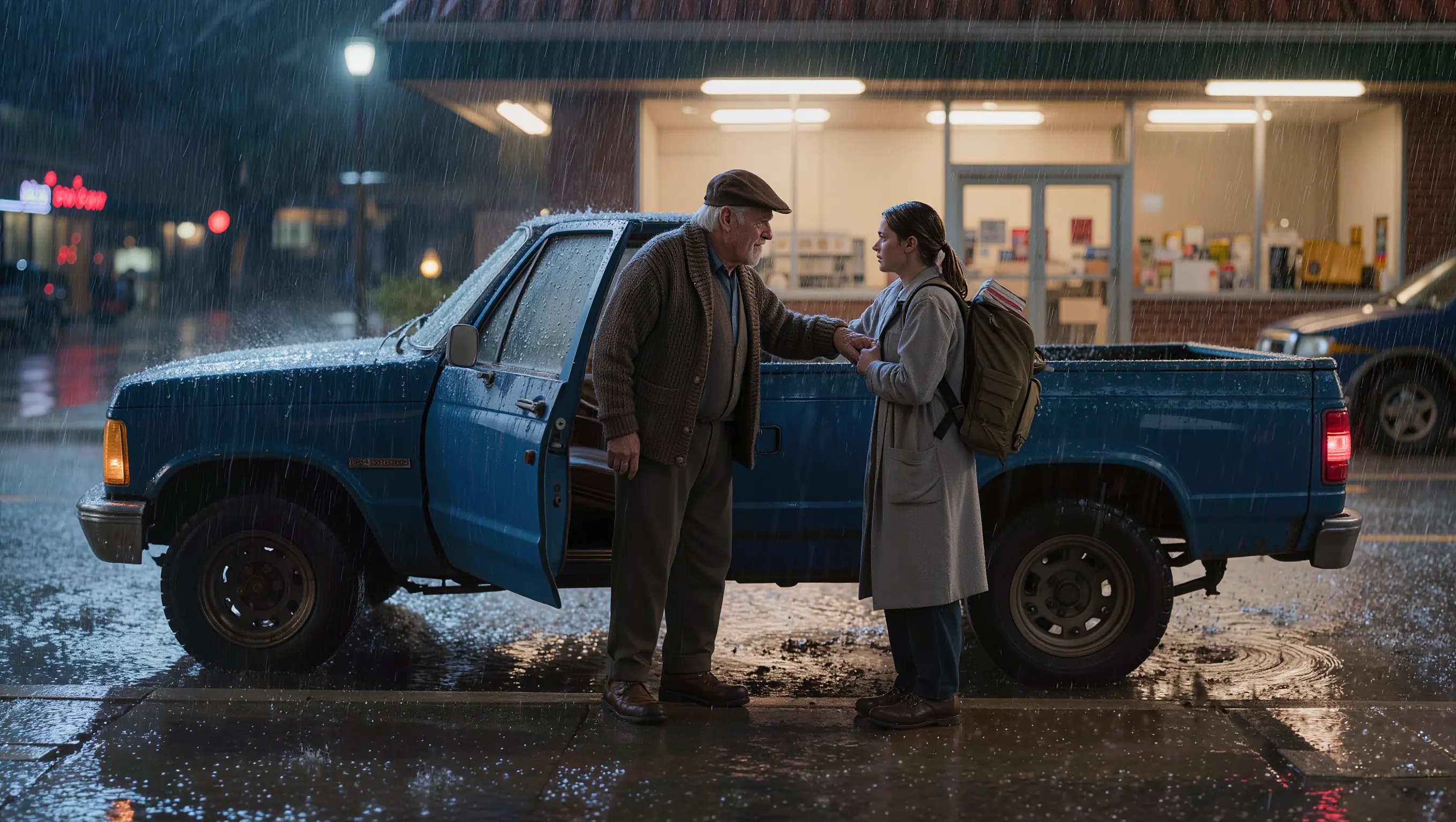
Then, years later, she helped run mobile health programs for neighborhoods where people could not easily reach doctors, pharmacies, or transportation.
But she never stopped visiting Arthur.
Every November, on the anniversary of that storm, she brought him empanadas and a phone charger as a joke.
He kept every charger in a drawer behind the counter.
By the time Arthur turned eighty-four, Bell’s Corner Store was struggling badly.
A new convenience store had opened near the highway, bright and clean, open twenty-four hours, with gas pumps, hot food, lottery machines, and digital coupons. Arthur’s store could not compete. His refrigerator units were old. His roof leaked. The sidewalk outside needed repair. The landlord planned to sell the building.
Arthur owned the business, but not the property.
One morning, a letter arrived.
The new owner intended to renovate the block. Bell’s Corner Store would have to vacate within six months unless Arthur agreed to a rent increase he could never afford.
He folded the letter and placed it inside Eleanor’s old notebook.
Then he kept opening the store.
Maya noticed within two weeks.
She came in one evening and found him standing behind the counter, staring at the empty coffee station.
“You forgot to start the coffee,” she said.
“No one came for it.”
“That has never stopped you before.”
Arthur looked at her.
“You’re too observant.”
“I learned here.”
She walked behind the counter and saw Eleanor’s notebook open beside the register. The letter was tucked inside.
Arthur reached for it too late.
“Maya.”
She read it.
Her face changed.
“They’re forcing you out?”
“They’re raising rent.”
“To force you out.”
Arthur sighed.
“Same result.”
“You weren’t going to tell me?”
“No.”
“Why?”
“Because you are busy saving people properly now.”
Her eyes softened.
“You were saving people before I had a license.”
“I sold canned beans.”
“You drove medicine through a flood.”
“That was one night.”
“That night became my compass.”
Arthur looked away.
“I’m old, Maya.”
“Yes.”
“The store is old.”
“Yes.”
“Maybe that is how things go.”
“Is that what you want?”
He looked around the store.
At the shelves Eleanor had once arranged.
The counter worn smooth by thousands of hands.
The coffee machine.
The notebook.
The bell above the door.
“No,” he said.
Maya nodded.
“Then I have an idea.”
Arthur immediately frowned.
“I dislike it already.”
“You haven’t heard it.”
“That has never stopped me.”
She smiled.
But her idea was serious.
Maya had been working with the community clinic to expand neighborhood health access. Many residents near Maple Street lacked transportation. Some needed blood pressure checks, medication guidance, basic health screenings, or help understanding prescriptions. Bell’s Corner Store already served those people daily.
“What if this became more than a store?” she asked.
“It is already more than a store.”
“Exactly. We make that official.”
Maya proposed a partnership: Bell’s Corner Store would become a community health and grocery hub. Part of the store would remain a corner shop with essentials. The back storage room would be converted into a small clinic room for scheduled weekly nurse visits, health education, medication support, and resource referrals. The clinic network could lease space from Arthur’s business, bringing in steady income. Grants could help repair the roof, update refrigeration, and make the building accessible. Local donors could support a fund for emergency groceries and medicine delivery.
Arthur listened silently.
Then he said, “That sounds like paperwork disguised as kindness.”
“It is.”
“I hate paperwork.”
“I know. I love forms.”
“That is a character flaw.”
“It saved lives.”
“Still suspicious.”
Maya leaned forward.
“Arthur, you and Eleanor built the place everyone already comes to when they need something. Let us help keep it open.”
“I don’t want charity.”
“This is not charity. This is rent, partnership, service, and the correct use of your stubbornness.”
He looked at her for a long moment.
“You became bossy.”
“You gave me tea that tasted like wet cardboard and told me to keep going.”
“So this is my punishment?”
“This is your legacy.”
That word made him quiet.
The next months were full of meetings, forms, inspections, repairs, arguments, and hope.
Arthur hated most of it.
Maya loved enough of it for both of them.
The clinic network agreed to lease part of the building if the landlord would extend the lease. A local nonprofit offered renovation support. A neighborhood association gathered signatures. Customers wrote statements about what Bell’s Corner Store meant to them.
Mrs. Gomez wrote that Arthur had let her buy groceries on credit when her husband lost work.
Mr. Thompson wrote that Eleanor had helped him after his wife passed by pretending he needed to carry boxes every Wednesday.
A schoolteacher wrote that Arthur had quietly supplied snacks for children who came to class hungry.
Maya wrote about the night of the storm.
She wrote:
He did not ask whether the errand was his responsibility. He saw that a child needed medicine, and he drove.
The story spread through the neighborhood.
People came in with donations, repair offers, old photographs, and memories.
Arthur became deeply uncomfortable.
“You made me famous in a three-block radius,” he told Maya.
“That’s about as much fame as you can tolerate.”
“Less would be better.”
The landlord, seeing community pressure and the clinic partnership, agreed to a long-term lease at a manageable rate if repairs were supported through grants.
The renovation began in spring.
The roof was fixed.
The refrigerators replaced.
The front door widened.
The old storage room became a small, clean clinic space with a handwashing sink, exam chair, locked cabinet, and cheerful curtains Maya chose over Arthur’s objections.
“Too bright,” he said.
“They’re yellow.”
“Exactly.”
“The room needs warmth.”
“It has heat.”
“Emotional warmth.”
“I don’t sell that.”
“You do. Constantly.”
The sign outside was repainted.
Bell’s Corner Store
Groceries, Coffee, Community Health
Arthur stared at the second line.
“No.”
“Yes,” Maya said.
“It’s too long.”
“So is your life story. Still worth keeping.”
He grumbled, but he did not make her change it.
Opening day came on a clear Saturday morning.
The store filled before Arthur had even finished brewing coffee. Customers came for groceries, blood pressure checks, free fruit samples, clinic information, and the joy of seeing the old green awning bright again. Maya wore her nurse badge and stood beside Arthur behind the counter.
At noon, she tapped a spoon against a coffee mug.
Arthur narrowed his eyes.
“No speeches.”
“Very short.”
“Lies begin that way.”
People laughed.
Maya faced the crowd.
“Years ago, I came through that door soaked from rain, carrying medicine for a sick child, with a dead phone and no way to finish the delivery.”
The store grew quiet.
“Arthur opened a charger, gave me tea, drove through flooded streets, and helped me keep a promise. I was trying to become a nurse then, but that night taught me something no classroom could.”
She looked at him.
“Care is not only what happens in hospitals or clinics. Care is noticing. Care is driving. Care is keeping the store open because someone might still need milk, medicine, coffee, or a place to be seen.”
Arthur looked down at the counter.
Maya’s voice softened.
“Today, Bell’s Corner Store becomes what it always was: a place where the neighborhood can come before the need becomes an emergency.”
The applause filled the small store.
Arthur did not cry.
At least, he insisted he did not.
The first clinic day was the following Tuesday.
Maya checked blood pressure in the back room. Another nurse helped people understand medication labels. A social worker connected families with food programs. Arthur ran the register, made coffee, and pretended not to watch proudly.
An older man came in just for a newspaper and left with an appointment to see a doctor.
A young mother picked up diapers and got help finding a pediatric clinic.
Mrs. Gomez bought bread and had her blood pressure checked because Maya threatened to tell Arthur she was being stubborn.
“That is unfair,” Mrs. Gomez said.
“Effective,” Maya replied.
The store became busy again.
Not rich.
Busy.
Alive.
Arthur hired a part-time clerk. Then another. He reduced his hours, though he still opened most mornings because he did not trust anyone else to brew coffee “with proper disrespect for sleep.”
Maya visited weekly, sometimes as clinic director, sometimes as Arthur’s friend, sometimes as the woman who still brought empanadas every November.
On Arthur’s eighty-eighth birthday, the neighborhood threw a small celebration in the store.
He objected.
Everyone ignored him.
There was cake beside the register, flowers near Eleanor’s photograph, and a table full of handwritten notes from customers. Maya gave him a framed copy of the old charger receipt from the night they met.
Arthur stared at it.
“You saved a receipt?”
“You gave me a charger and called it store property.”
“It was.”
“It still is.”
Inside the frame, beneath the receipt, Maya had placed a small engraved plate:
The First Tool That Helped Me Keep Going
Arthur touched the frame.
“You are sentimental.”
“Yes.”
“Dangerous condition.”
“Terminal, probably.”
He laughed.
Then he looked around the store.
At the clinic room.
At Eleanor’s notebook in a glass case near the counter.
At neighbors talking near the coffee station.
At children picking fruit from a basket.
At Maya, grown from a soaked young woman into a leader who had brought care back to the corner.
“You saved my store,” he said quietly.
Maya shook her head.
“You saved my path first.”
“I drove a truck.”
“You made sure the promise arrived.”
Arthur’s eyes softened.
Outside, rain began to fall lightly against the green awning.
Both of them noticed.
Maya smiled.
“Good weather for chargers.”
Arthur looked toward the drawer behind the counter, now filled with chargers of every kind.
“Good weather for keeping the door open.”
Years earlier, Arthur Bell had helped a young woman deliver medicine through a storm because someone needed it, and because his wife’s old notebook had taught him that noticing was a kind of duty.
He thought he had only opened a charger, driven an old truck, and saved one urgent errand.
But years later, Maya returned with a clinic partnership, a renovation plan, a community, and the determination to save the store that had once saved her faith in becoming useful.
What Arthur received was not just a renewed lease, a repaired roof, or new customers.
He received proof that his corner still mattered.
He received a living continuation of Eleanor’s quiet kindness.
He received a place where groceries, coffee, medicine, and dignity could meet beneath the same old green awning.
And every time a stranger stepped through the door looking worried, wet, tired, or unsure, Arthur would glance toward Maya’s yellow-curtained clinic room and say,
“Come in. Let’s see what you need before the storm gets worse.”