Elias Mercer had repaired violins for nearly fifty years, but he still listened to every broken instrument as if it had something private to say.
His small shop, Mercer’s Strings, sat on a quiet street in Burlington, Vermont, between an old bookstore and a coffee shop that changed owners every few years. The sign above his door had faded from black and gold to gray and yellow. In the front window, three violins rested on velvet stands beneath a soft layer of dust. Inside, the walls were lined with instruments, bows, old cases, wooden shelves, jars of varnish, carved bridges, and small tools that looked delicate enough for surgery.
At seventy-six, Elias moved slowly, but his hands still carried a lifetime of skill. His fingers were bent slightly from age, his knuckles swollen from years of carving, tightening, polishing, and repairing. His gray hair was thin at the crown, his face deeply lined, and his eyes had the steady patience of a man who had spent more time listening than speaking.
The shop used to be busy.
Music teachers brought students to him. Parents trusted him with first violins. Orchestra players came in with urgent repairs before performances. There had been years when the bell above the door rang all day, when Elias had three weeks of work waiting and barely enough time to drink his coffee before it went cold.
But those years had faded.
Now many families bought cheap instruments online. Some replaced broken violins instead of repairing them. Younger musicians moved away. School music programs shrank. Rent climbed. Heating bills rose. Customers came less often.
Still, every morning at nine, Elias unlocked the door, turned the sign from Closed to Open, brewed bitter black coffee, and sat beneath the lamp at his workbench.
The shop was more than a business to him.
It was the last place where he still heard his wife Ruth.
Ruth had been a violinist. She had played with a warmth that could make strangers stop outside the window just to listen. When they were younger, she would stand near the front of the shop after closing, lift her violin beneath her chin, and play while Elias cleaned tools or swept the floor.
She had been gone for nine years.
Her violin still lay in its case near the back room, waiting for a repair Elias had never finished.
He could restore other people’s instruments with patience and precision. But Ruth’s violin was different. Every time he opened the case, he saw her hands, her smile, the way she used to close her eyes before the first note.
So he kept working on other people’s broken things instead.
One rainy afternoon in March, just before closing, the bell above the door rang.
Elias looked up from a cracked cello bridge.
A young girl stood in the doorway, soaked from the rain, holding a violin case tightly against her chest.
She looked about sixteen. Her dark brown hair was tied into a loose braid, but strands had slipped free and stuck to her wet cheeks. She wore a thin navy jacket, faded jeans, and sneakers darkened by rain. Her eyes were wide, frightened, and determined all at once.
Elias set down his tool.
“Can I help you?”
The girl stepped inside carefully.
“I hope so.”
Her voice was quiet, but something in it trembled.
She walked to the counter and placed the violin case down with both hands, as if laying down something fragile and sacred.
“What happened?” Elias asked.
The girl swallowed.
“My violin broke.”
“Open it.”
She hesitated, then unlatched the old black case.
Inside lay a violin with a snapped bridge, loose strings, and a visible crack near the lower side of the body. The instrument was not expensive, but it was old enough to have character. The varnish had worn thin where years of hands had touched it. The fingerboard showed signs of long practice. A small cloth was tucked neatly beside the bow. Several folded sheets of music rested under the lid.
Elias leaned closer.
He did not touch it yet.
“Who does this belong to?”
The girl answered immediately.
“Me.”
He glanced at her.
“I mean before you.”
“My grandfather.”
Her fingers tightened on the edge of the case.
“He passed away three years ago. He used to play it when I was little. He taught me my first song.”
Elias nodded slowly.
That explained the way she held the case.
“What’s your name?”
“Clara.”
“Clara what?”
“Clara Bennett.”
“I’m Elias Mercer.”
“I know,” she said. “My music teacher told me to come here. She said if anyone could fix it, you could.”
Elias looked back at the violin.
“Your teacher has a dangerous amount of confidence.”
“She said you were the best.”
“That was probably years ago.”
“She said it last week.”
Elias almost smiled, but only almost.
“How did it break?”
Clara looked down.
For a second, she seemed to consider giving a simple answer. Then she told part of the truth.
“It fell.”
Elias had repaired enough instruments to know when a violin had simply fallen and when it had been handled carelessly, angrily, or by someone who did not understand what it meant to the person who owned it.
This one had not just fallen.
But he did not press.
“Can you fix it?” Clara asked.
“Yes.”
Her shoulders dropped with relief.
Then he added, “But not quickly.”
The relief vanished.
“How long?”
“To repair it properly, several days. Maybe more.”
Her face turned pale.
“I need it tomorrow.”
“For what?”
“An audition.”
“What kind of audition?”
“The Vermont Youth Conservatory program. It’s only once a year. If I get in, I could take weekend classes with real instructors. They help with scholarships later. My teacher said it could change everything.”
Elias looked at her.
“That important?”
Clara nodded, and tears gathered in her eyes before she could stop them.
Then she said the sentence that stayed with him for years.
“This violin is very important to me.”
She said it simply.
Not dramatically.
Not as a performance.
As if those six words were all she had left to protect herself from losing something bigger than wood and strings.
Elias looked at the violin again.
The repair would take work. A new bridge. New strings. Stabilizing the crack. Resetting the soundpost. Adjusting the pegs. Cleaning the top plate. It could be made playable by morning if he worked all night, but it would not be perfect. It would still need a full repair after the audition.
He glanced at the small envelope Clara was pulling from her jacket pocket.
“I only have forty-two dollars,” she said. “I know it’s not enough. I can pay more later. I can work. I can clean. I can do anything.”
Elias stared at the envelope.
The rent for the shop was overdue. The heating bill sat unopened on his desk. His hands hurt more each week. He had no reason to take a difficult repair for almost nothing.
But Clara was looking at the violin the way Ruth used to look at music.
As if life made more sense when it was in her hands.
Elias pushed the envelope back toward her.
“Keep it.”
Clara blinked.
“No, I have to pay.”
“You will.”
“How?”
“Bring me coffee tomorrow morning.”
She stared at him.
“That’s not enough.”
“It depends on the coffee.”
Her mouth trembled.
“I’m serious.”
“So am I. Black coffee. No sugar. No milk. If you bring me something with foam on it, the deal is off.”
A shaky laugh escaped her.
“Can it really be ready?”
“Ready enough.”
“By tomorrow?”
“Come at seven.”
“The shop opens at nine.”
“I am aware of my own hours.”
Clara carefully closed the empty case.
“Thank you, Mr. Mercer.”
“Don’t thank me yet. If the repair fails, your violin may sound like a door hinge with ambition.”
She smiled through tears.
“I trust you.”
Elias looked away.
Trust was heavier than payment.
After Clara left, the shop became quiet except for the rain tapping against the window.
Elias carried the violin to his workbench and turned on the lamp.
The crack was not hopeless. The bridge was ruined, but he had good blanks. The soundpost had shifted, but not fallen completely. The strings were useless. The body had taken a shock, but the violin had survived.
“You are stubborn,” Elias murmured to the instrument.
He worked through the evening.
He removed the broken bridge, loosened the remaining strings, cleaned the damaged area, and stabilized the crack enough for temporary strength. He carved a new bridge by hand, slowly shaping the feet to match the curve of the violin’s body. He checked the soundpost position, adjusted it carefully, and selected a set of strings he had been saving for a better-paying customer.
At midnight, his hands ached.
At two in the morning, his back burned.
At three, he thought of Ruth.
She would have told him to sit down, drink tea, and stop pretending age was only a rumor. Then she would have looked at Clara’s violin and told him to keep going.
So he did.
By five, the instrument held tune.
By six, it made sound.
Not perfect sound. Not rich, polished, professional sound. But alive sound.
The G string had warmth. The E string was nervous but clear. The violin’s voice was still wounded, but it could sing if the player knew how to help it.
At seven exactly, the bell above the door rang.
Clara stepped inside holding a paper cup of coffee with both hands and a small paper bag.
“I brought a muffin too,” she said quickly. “Blueberry. I didn’t know if you eat breakfast.”
“I eat when people stop breaking instruments.”
“That sounds like never.”
“Correct.”
He took the coffee and nodded toward the bench.
Clara saw the violin.
For a moment, she did not move.
Then she walked toward it slowly, as if afraid it might disappear.
“Oh,” she whispered.
Elias picked it up and handed it to her.
“Careful. It is playable, not invincible.”
She lifted it beneath her chin. Her hands trembled so badly that the first note scraped.
She stopped, embarrassed.
“Again,” Elias said.
She tried again.
This time, the note held.
Her face changed.
She played a scale, then a few bars of her audition piece. The sound was uneven at first, but as she adjusted, the violin began to answer her. She softened her bow, listened, and played with a tenderness Elias had not expected from someone so young.
When she finished, she looked at him with wet eyes.
“It still sounds like him.”
“Your grandfather?”
She nodded.
Elias sat on the stool beside the bench.
“Then don’t waste him by rushing.”
Clara wiped her cheek quickly.
“I’m scared.”
“Good.”
“Good?”
“Fear means you know it matters. Just don’t let it hold the bow.”
She looked down at the violin.
“What if I’m not good enough?”
Elias pointed toward the music stand.
“Play the first page.”
“I just did.”
“No. You survived the first page. Now play it.”
For the next hour, he coached her.
He did not call it a lesson. Elias did not give free lessons. That was what he told himself.
But he corrected her bow pressure, her breathing, her tempo, and the way she attacked the opening notes as if trying to prove she deserved to be there before the music had even begun.
“Stop fighting the violin,” he said.
“I’m not.”
“You are. You are playing like the room is already against you.”
Clara went quiet.
Elias saw that the words had touched something true.
“Listen,” he said more gently. “Music is not a courtroom. You do not have to defend yourself in every note.”
Clara swallowed.
Then she played again.
This time, she let the first phrase breathe.
Elias nodded.
“There. That is better.”
At eight-thirty, Clara packed the violin into its case.
“How much do I owe you after the audition?”
“We’ll discuss that later.”
“I can’t just take this.”
“You are not taking it. You are borrowing time. Pay it back by playing well.”
Clara held the case tightly.
“I’ll come back.”
“You had better. That crack needs proper work.”
“I will.”
She paused at the door.
“Mr. Mercer?”
“Yes?”
“This violin is very important to me. But today, it feels like someone else thinks it matters too.”
Elias looked at her for a long moment.
“Go to your audition, Clara.”
She nodded and ran into the morning.
That afternoon, Elias tried not to think about her.
He failed.
He repaired a bow. He answered a phone call. He drank cold coffee. He rearranged tools that did not need rearranging.
At four-thirty, the bell rang.
Clara walked in.
Her face was unreadable.
Elias set down his file.
“Well?”
She placed the violin case on the counter, pressed both hands over her mouth, and nodded.
“I got in.”
Elias allowed himself one small smile.
“Good.”
“Good?” she cried. “That’s all?”
“It is a strong word.”
She laughed and cried at the same time.
Then she hurried around the counter and hugged him before he could object.
Elias stood stiffly for one second.
Then, awkwardly, he patted her shoulder.
“Don’t crush the repairman.”
“I’m sorry.”
“You should be. I am fragile and expensive.”
She laughed harder.
That was how Clara Bennett became part of Mercer’s Strings.
She came every Saturday morning with her violin, sheet music, and coffee. Elias repaired the violin properly over several weeks, but even after the repair was complete, she kept coming. Sometimes he adjusted her bridge or tuned her instrument. Sometimes he listened to her audition pieces. Sometimes she swept the floor or organized old sheet music while he worked.
He told himself she was not his student.
She told herself she was only stopping by.
Neither of them believed it.
Clara came from a small apartment across town, where money was always short and quiet was rare. Her mother worked long shifts at a grocery store. Her father had left years earlier. Her older cousin, who stayed with them sometimes, mocked her music and told her violin would never pay bills.
But at Mercer’s Strings, nobody laughed at her for caring.
Elias took her seriously.
That mattered more than praise.
He taught her how to care for the violin properly. How to loosen the bow after playing. How to clean rosin from the strings. How to protect the wood from heat and cold. How to hear when a bridge leaned too far. How to listen before assuming something was broken.
He also taught her how to play with patience.
“Again,” he would say.
“I already played it five times.”
“Then the sixth may be less offensive.”
“You could just say it’s getting better.”
“I could. But then you might relax.”
She complained, but she always played again.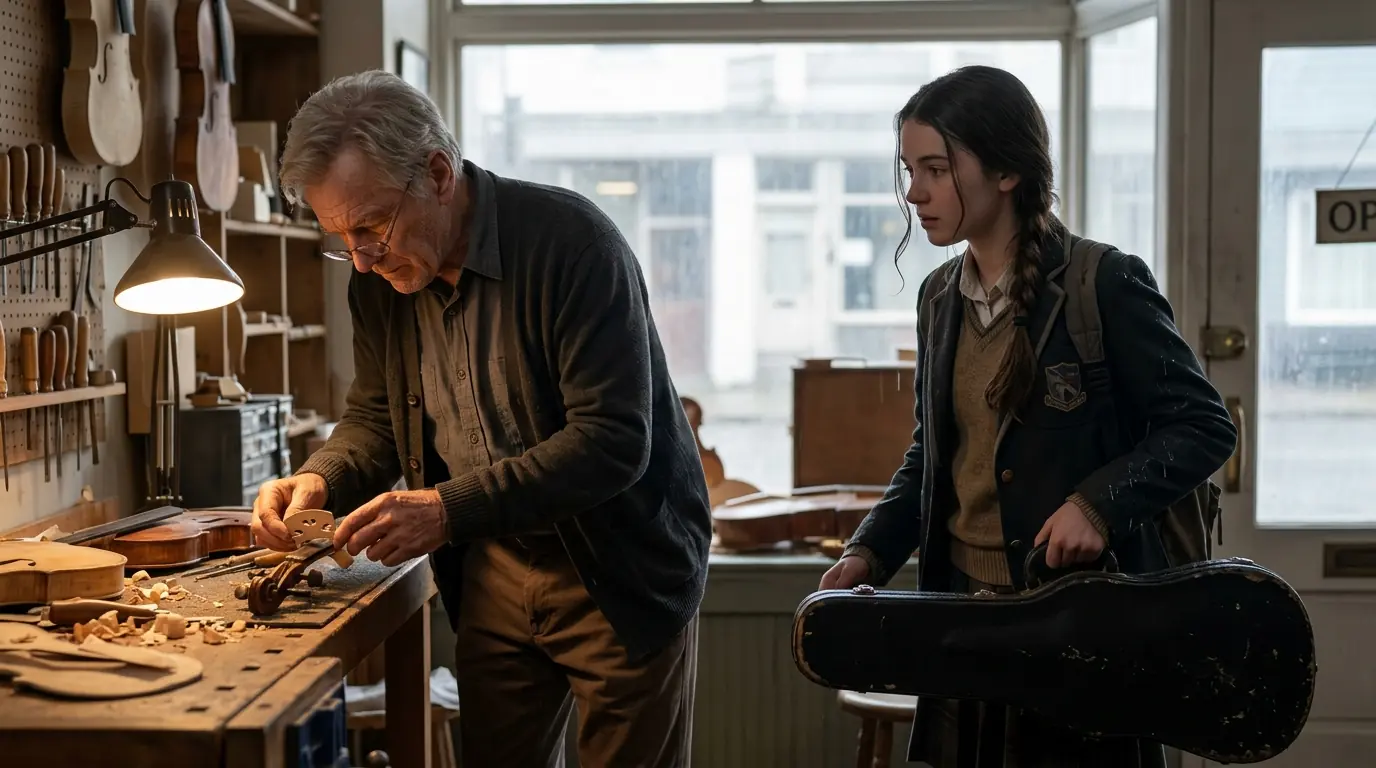
Years passed.
Clara grew from a frightened sixteen-year-old into a focused young musician. She earned a place in the youth conservatory program, then a scholarship to a summer music academy, then admission to a respected conservatory in Boston.
Each step frightened her.
Each time, she brought the fear to Elias.
When she was accepted into the conservatory, she ran into the shop holding the letter.
“I got in.”
Elias read it slowly.
“With scholarship money,” Clara added.
“I can read.”
“Well?”
“Well what?”
“Say something.”
“Pack warm socks. Boston winters enjoy humiliation.”
“Elias.”
He looked at her over his glasses.
“You earned this.”
The words were simple.
They nearly broke her.
“I don’t know if I can do it.”
“You can.”
“What if everyone is better than me?”
“Good. Then you will have something to learn.”
“What if I fail?”
“Then fail honestly. But do not quit before you have earned the right to know.”
She hugged him again.
By then, he hugged her back.
Before Clara left for Boston, she came to the shop one final time.
She stood near the front window, where Ruth had once played, and lifted her violin.
“This is for you,” she said.
Elias frowned.
“I did not request a concert.”
“You’re getting one.”
She played a melody she had written herself.
It was quiet and unfinished, but beautiful. It began with a fragile phrase that reminded Elias of rain on glass, then grew warmer, steadier, braver. It sounded like a girl walking into a shop with a broken violin and leaving with more than a repair.
When she finished, Elias looked away.
“What is it called?” he asked.
“Mercer’s Light.”
“Sentimental.”
“Yes.”
“Dangerous habit.”
“I learned from an old man who pretends not to care.”
He cleared his throat.
“Boston will be good for you.”
“I’ll call.”
“I dislike phone calls.”
“I know.”
“I may not answer.”
“You will.”
He did.
For years, Clara called from Boston, then New York, then other cities where music carried her. Sometimes she called to ask about her violin. Sometimes she called to play a passage badly through the phone and ask what was wrong.
Elias always complained about the sound quality.
Then he answered.
Her career did not happen overnight. She struggled through auditions, rejections, part-time jobs, and tiny apartments. She played in small ensembles, taught children, recorded for other musicians, and took every opportunity that kept her close to music.
But she kept rising.
By twenty-eight, Clara Bennett had become a respected violinist and composer. She was not a household name, but in music circles, people knew her. She played with emotional clarity. She wrote pieces that sounded intimate and unforgettable. She performed across the country, recorded an album, and founded a small program that helped young musicians from low-income families access lessons and instrument care.
She still played the old violin.
The repaired crack remained visible if one looked closely.
Clara never hid it.
She said it reminded her that broken things could still carry music.
While Clara’s life expanded, Elias’s shop slowly collapsed inward.
Mercer’s Strings became quieter every year.
The rent rose again. The landlord sold the building. A large music retailer opened a service counter outside town and advertised “fast, affordable repairs.” Customers who once trusted craftsmanship began choosing convenience.
Elias’s hands worsened.
Some mornings, he had to soak them in warm water before he could hold a carving knife. His eyesight blurred after long hours under the lamp. He stopped accepting large restoration jobs. Then he stopped opening on Mondays. Then Tuesdays.
He told Clara none of this.
When she called, he spoke about weather, bad coffee, careless students, and the decline of decent violin cases. He did not mention the unpaid rent notices. He did not mention the repair bench he had considered selling. He did not mention that the landlord had given him three months to leave.
One cold morning in January, Elias stood outside his shop and stared at the notice taped to the door.
The building would be renovated.
The lease would not be renewed.
Mercer’s Strings had to vacate by April 30.
Elias took the notice inside, placed it on the counter, and sat beneath the front window.
For the first time in nearly fifty years, he did not turn the sign to Open.
The shop was silent.
Too silent.
The violins on the wall seemed to watch him. The tools lay neatly in their places. Ruth’s violin rested in its case near the back, finally restored years earlier with Clara’s help during one of her visits. The shop had held so much life, so much music, so many frightened beginners and hopeful parents and urgent repairs.
Now it was ending in legal language printed on white paper.
Elias told himself he was old.
He told himself shops closed.
He told himself the world had changed.
But none of those truths made it easier to breathe.
Two weeks later, Clara arrived without warning.
The bell above the door rang at ten in the morning.
Elias looked up from a half-packed box of sheet music.
A woman stood in the doorway wearing a long dark coat, her hair pinned neatly at the back, violin case in one hand, leather folder in the other.
For one strange second, he saw both versions of her at once: the famous musician standing before him, and the soaked sixteen-year-old girl clutching a broken violin.
“Clara,” he said.
She looked around the shop.
Boxes lined the walls. Empty hooks showed where instruments had already been taken down. The front display was cleared. His tools were wrapped in cloth.
Her face tightened.
“You weren’t going to tell me.”
Elias looked back at the box.
“I did not want to bother you.”
“Bother me?”
“You have concerts.”
“You have my childhood in boxes.”
“That is an overstatement.”
“No, it isn’t.”
She stepped inside and closed the door behind her.
“I heard from Mrs. Alvarez. She said the shop was closing.”
“She talks too much.”
“She cares.”
“Same problem, different name.”
Clara walked to the counter and picked up the notice.
She read it carefully.
Then she looked at him.
“Why didn’t you ask for help?”
“Because I am not one of your charity projects.”
Her eyes flashed.
“Don’t do that.”
“Do what?”
“Make help sound insulting.”
Elias’s jaw tightened.
“I repaired instruments. I did not build an empire. The lease is ending. The building is changing. I am old. Some things finish.”
Clara placed her violin case on the counter.
“This place is not finished.”
“You cannot fix everything with emotion.”
“No,” she said. “That’s why I brought a plan.”
He looked at the leather folder in her hand.
Elias frowned.
“What is that?”
“An offer.”
“I don’t want your money.”
“You haven’t heard the offer.”
“I can guess.”
“No, you can’t.”
She opened the folder and placed several pages on the counter.
Elias looked down.
There were sketches of the shop. Financial projections. A program outline. Partnership letters. A proposed lease agreement for another building two streets away, larger than his current shop but still downtown. There were plans for a repair studio, lesson rooms, a small recital space, and a scholarship fund for young musicians who could not afford instrument maintenance.
At the top of the first page were the words:
Mercer House For Young Strings.
Elias stared at it.
“What is this?”
Clara’s voice softened.
“It’s a music foundation. I started the paperwork last year. I was going to surprise you later, but the situation changed.”
He looked at her sharply.
“You started this before you knew about the shop?”
“Yes.”
“Why?”
“Because of what you did for me.”
Elias said nothing.
Clara continued.
“When I was sixteen, I walked in here with a broken violin and forty-two dollars. You stayed up all night to make it playable. You taught me without calling it teaching. You protected my dream before I even knew how to protect it myself.”
She touched the old counter gently.
“I built my life from what started in this room.”
Elias looked away.
“Clara…”
“No. Let me finish.”
He closed his mouth.
“I want to fund a new space. Not as charity. As a partnership. You would be the master repairer and mentor. You would work as much or as little as your hands allow. We would hire younger repair technicians to learn from you. Students could come for low-cost lessons, instrument care, repairs, workshops, and small performances. Your name would be on the door.”
Elias stared at the pages.
He felt suddenly unsteady.
“I cannot run something like this.”
“You don’t have to run it alone. I have a board. I have donors. I have an operations director ready to help. I have three teachers interested. The conservatory in Boston wants to partner with us for summer workshops.”
“This is too much.”
“It is exactly enough.”
“I am old.”
“Yes,” Clara said gently. “That is why your knowledge matters now.”
He looked at her then.
Her eyes were wet, but her voice did not break.
“You once told me broken did not mean finished. You said it meant something needed care. I believed you then. Believe me now.”
The shop went quiet.
Outside, people walked past the window without knowing that an old man’s life was being offered back to him.
Elias looked at the plans again.
“Mercer House,” he said.
“If you hate the name, we can change it.”
“I hate most names.”
“I expected that.”
“It sounds formal.”
“It should. Your work deserves to be preserved.”
He ran one hand over the paper.
“What do you get from this?”
Clara smiled softly.
“The chance to keep my promise.”
“What promise?”
She opened her violin case.
Inside lay the same violin he had repaired all those years ago. Its wood had aged beautifully. The crack near the lower body remained faintly visible beneath the varnish, a scar instead of a wound.
“I promised I would come back,” she said.
Elias could not speak.
Clara lifted the violin and stood near the front window.
“May I?”
He nodded.
She placed the violin beneath her chin and began to play.
The first notes of Mercer’s Light filled the shop.
But it was no longer the simple melody of a young girl leaving for Boston. It had grown. It carried years now. Auditions, train stations, lonely apartments, crowded concert halls, rejections, applause, grief, discipline, gratitude. The melody rose through the half-packed room and moved around the empty hooks on the walls like music refusing to let the place disappear quietly.
Elias sat slowly on the stool behind the counter.
His eyes filled.
He saw Clara at sixteen, rain on her jacket, saying, “This violin is very important to me.”
He saw himself pushing back the envelope of forty-two dollars.
He saw Ruth by the window, smiling at the sound.
When Clara finished, she lowered the violin.
“I’m offering you what you offered me,” she said. “A way to keep playing.”
Elias pressed his fingers against his eyes.
For a long moment, he said nothing.
Then he whispered, “I don’t know how to accept this.”
Clara stepped closer.
“You start the way I did.”
“How?”
“You trust someone.”
The new space opened that autumn.
It was not far from the old shop, in a brick building with tall windows and wooden floors that creaked in a friendly way. Above the front door, freshly painted letters read:
Mercer House For Young Strings.
Below it, in smaller letters:
Repair. Lessons. Mentorship. Music For Every Child Who Needs A Door Opened.
Elias complained about the second line.
“It’s too sentimental.”
Clara smiled.
“You say that when something is true and makes you uncomfortable.”
“It is still too long.”
“We’ll keep it.”
The building held a repair studio at the front, where Elias’s old workbench sat beneath a bright lamp. His tools hung on a new wall, arranged exactly as they had been in the old shop. There were two lesson rooms, a small recital space, a storage room for donated instruments, and a corner with chairs where parents could wait.
Young repair apprentices came to learn from him. Children came with rented violins, cracked violas, loose pegs, broken bows, and nervous faces. Some families paid full price. Some paid what they could. Some paid nothing at all, though Elias never let them feel the difference.
He still grumbled.
He still insulted bad bridges.
He still said modern cases looked like luggage designed by people who hated music.
But he came alive again.
One afternoon, a twelve-year-old boy brought in a violin with a collapsed bridge and tears in his eyes.
“My audition is tomorrow,” the boy said.
Elias looked across the room at Clara, who had arrived for a visit and was standing near the doorway.
She smiled.
Elias turned back to the boy.
“Come here,” he said. “The violin won’t fix itself.”
Years passed, and Mercer House grew into something larger than either of them had imagined.
Students who had no money found instruments there. Young musicians learned how to care for what they had. Apprentices learned repair work from Elias before his hands became too tired to demonstrate every step. Clara returned between concerts to teach masterclasses, perform benefit recitals, and sit with Elias over terrible black coffee.
On the wall near the recital room hung a framed photograph.
It showed sixteen-year-old Clara standing beside Elias in the original shop, holding her repaired violin. Elias looked stern, almost annoyed, but anyone who looked closely could see pride in his eyes.
Beneath the photo was a small brass plaque:
It Began With One Broken Violin.
On the tenth anniversary of Mercer House, Clara performed a special concert in the recital room.
Elias sat in the front row, older now, thinner, with a cane resting against his chair. His hair was nearly white. His hands shook when he folded them in his lap. But his eyes were clear.
The room was filled with students, parents, teachers, donors, former customers, and young musicians whose lives had been changed by the place.
Clara stepped onto the small stage holding her old violin.
Before she played, she spoke.
“When I was sixteen, I came to Mr. Mercer with this violin broken in its case. I had very little money, very little confidence, and one sentence I kept repeating because I didn’t know how else to explain myself.”
She looked at Elias.
“I told him, ‘This violin is very important to me.’”
The room was silent.
“He understood. Not because the violin was expensive. It wasn’t. Not because I was special. I was only a scared girl with an audition the next day. He understood because he knew that sometimes an instrument carries more than music. Sometimes it carries memory. Hope. A future.”
Elias looked down.
Clara continued.
“He repaired it overnight. Then he did something even more important. He took my dream seriously.”
Her voice softened.
“Years later, when his shop was about to close, I finally had the chance to return what he gave me. Not by repaying a debt, because kindness does not work that way. But by continuing it.”
She lifted the violin.
“This piece is called Mercer’s Light.”
Then she played.
The music filled the room, warm and clear, rising from the same repaired violin that had once arrived broken in a rainstorm. Around Elias sat children who had found their own beginnings there. Some held violins. Some leaned forward with wide eyes. Some had no idea yet how far one opened door could carry them.
Elias listened.
He no longer felt like a man watching his life close.
He felt like a man hearing it continue.
When the final note faded, the room stood in applause.
Clara came down from the stage and sat beside him.
“Well?” she asked softly.
Elias wiped his eyes with a handkerchief.
“You rushed the middle section.”
She laughed through tears.
“That’s what you’re saying?”
“It was true.”
“You loved it.”
“I tolerated it with emotion.”
She took his hand carefully.
“Thank you for fixing my violin.”
He looked around the room.
Students. Music. Light. A future he had not believed he was allowed to receive.
“No,” Elias said quietly. “Thank you for bringing it back.”
Clara smiled.
“I brought back more than the violin.”
“Yes,” he said. “You did.”
Elias Mercer had once helped a sixteen-year-old girl because she walked into his shop with a broken violin and said it was very important to her.
He thought he was repairing wood, strings, and one desperate audition.
But years later, that girl returned as a woman, successful and strong, carrying plans, resources, music, and gratitude. She did not simply save his shop. She transformed it into a place where other young musicians could find the same belief he had once given her.
And every time a frightened child came through the door holding a damaged instrument, Elias would look at the case, then at the child’s face, and remember the rainy afternoon that had changed everything.
Then he would say, in his dry old voice,
“Let’s see what still wants to sing.”