Walter Hayes first noticed the little girl because she was standing too still.
In a busy train station, children usually moved. They tugged at sleeves, chased pigeons, asked too many questions, dragged backpacks across the floor, or pressed their faces against vending machines. But this girl stood near Platform 4 of Union Station in Denver, Colorado, with both hands wrapped around the straps of a pink backpack, her eyes fixed on the crowd as if she were searching for someone who had promised to come back.
Walter was seventy-nine years old, tall but slightly stooped, with a weathered face, white hair combed neatly beneath a brown wool cap, and gentle gray eyes that had spent a lifetime noticing small things. He wore a heavy tan coat, dark trousers, and polished brown shoes. In one hand, he carried a paper bag from the bakery. In the other, he held a train ticket he had not yet decided whether to use.
He had come to the station that afternoon because staying home had become too quiet.
His wife, Evelyn, had died four years earlier. Since then, Walter often took short train rides to nearby towns, not because he had somewhere important to go, but because the sound of moving wheels and passing landscapes made the loneliness feel less permanent. Evelyn had loved trains. She used to say stations were full of beginnings, even when people looked like they were leaving.
That afternoon, Walter had planned to ride to Boulder, eat soup at a café Evelyn once liked, and return before dark.
Then he saw the girl.
She was maybe eight years old. Her hair was black and braided into two neat plaits, though one ribbon had come loose. She wore a yellow coat that looked too thin for the winter air drifting through the station doors. Her sneakers were clean but worn, and her backpack looked heavy for her small shoulders. She kept glancing at the large clock above the platform.
Walter slowed.
A woman rushing past nearly bumped into the child, and the girl stepped back quickly, frightened but silent.
Walter watched for another minute.
No parent came.
No older sibling called her name.
No one seemed to claim her.
He walked over carefully, stopping at a respectful distance so he would not scare her.
“Hello there,” he said gently. “Are you waiting for someone?”
The girl looked up at him at once. Her eyes were wide, dark, and alert.
“I’m not lost,” she said quickly.
Walter nodded. “I didn’t say you were.”
“I know where I am.”
“That’s good.”
“I’m not supposed to talk to strangers.”
“That is also good.”
She narrowed her eyes. “Then why are you talking to me?”
Walter almost smiled. “Because you look like someone trying very hard not to need help.”
The girl looked away.
For a moment, the loudspeaker crackled overhead, announcing a delayed train. People groaned. A suitcase wheel squeaked nearby. Somewhere, a baby cried.
Walter looked toward the platform, then back at the girl.
“What’s your name?”
She hesitated.
“Lena,” she said at last.
“I’m Walter Hayes.”
She did not answer.
“Lena,” he said gently, “how long have you been standing here?”
She looked at the clock. “Not long.”
Walter knew a child’s version of “not long” could mean anything from five minutes to three hours.
“Who brought you here?”
“My aunt.”
“Where is she?”
“She went to get coffee.”
Walter looked around. There were three coffee stands visible from where they stood, and none had a woman looking back toward Platform 4 with concern.
“How long ago?”
Lena tightened her grip on her backpack. “She’ll come back.”
Walter did not argue.
Instead, he said, “Would you like to sit on that bench over there while you wait? Standing makes waiting feel longer.”
“I have to stay where she left me.”
“Then I’ll stand here too.”
Lena looked surprised. “Why?”
Walter shifted the bakery bag from one hand to the other. “Because I’ve already done all my walking for the day.”
That was not entirely true, but it made her less defensive.
They stood side by side without speaking for several minutes.
Walter watched the crowd. Lena watched the clock.
After a while, her stomach growled.
She immediately pressed one hand against it, embarrassed.
Walter opened his bakery bag. “I bought two cinnamon rolls. My doctor would prefer I eat zero, which means one is already an act of rebellion. Would you help me hide the evidence?”
Lena stared at the bag. “I can’t take food from strangers.”
“Smart rule,” Walter said. “How about this? I’ll take it to the security desk, and they can give it to you.”
She thought about that carefully.
“Is there raisins?”
“No raisins.”
“Good. Raisins ruin things.”
Walter laughed softly. “Evelyn used to say the same thing.”
“Who’s Evelyn?”
“My wife.”
“Where is she?”
Walter’s smile faded gently. “She passed away.”
Lena looked down. “My mom passed away too.”
The words came so quietly Walter almost missed them.
His heart tightened.
“I’m sorry,” he said.
Lena shrugged, but her chin trembled.
Before Walter could say more, a man in a dark jacket approached from behind the bench area. He had a thin face, restless eyes, and the kind of smile that did not reach anything honest.
“Hey, sweetheart,” the man said to Lena. “Your aunt sent me. Come on.”
Lena froze.
Walter turned slightly, placing himself between the man and the girl.
“You know him?” Walter asked.
Lena shook her head, barely moving.
The man’s smile sharpened. “She’s shy. Family friend.”
Walter looked at him. “What is her aunt’s name?”
The man blinked. “What?”
“Her aunt’s name.”
The man’s expression hardened. “Old man, this doesn’t concern you.”
Walter’s voice stayed calm. “A child alone in a train station concerns everyone decent.”
People nearby began to glance over.
The man stepped closer. “Move.”
Walter did not.
He was old. His knees hurt. His hands were not as strong as they had once been. But something in him became steady, the way it had when he was young and his younger sister needed him to stand between her and a cruel father. Some instincts never aged.
Walter raised his voice. “Security.”
The man’s eyes flicked toward the uniformed guard near the ticket counter.
Then he stepped back.
“Crazy old fool,” he muttered, and disappeared into the crowd.
Lena had gone pale.
Walter turned to her. “Are you all right?”
She did not answer. Her breath came fast.
Walter crouched slowly, ignoring the pain in his knees, so he was closer to her eye level.
“Lena, listen to me. You did the right thing. You did not go with him.”
Her eyes filled with tears. “My aunt said stay here.”
“I know.”
“She said she’d be right back.”
“I know.”
“She always says that.”
Walter’s chest tightened.
A security officer approached, a woman in her forties with a kind but serious face.
“Sir, is everything okay?”
Walter stood carefully. “This child has been waiting here alone. A man just tried to take her.”
The officer’s expression changed immediately.
She turned to Lena. “Sweetheart, what’s your name?”
Lena looked at Walter first.
He nodded. “You can tell her.”
“Lena Brooks.”
The officer radioed for assistance and guided them to a small security office near the main hall. Walter walked with them because Lena reached for the sleeve of his coat and did not let go.
Inside the office, the officer gave Lena a bottle of water. Walter placed the cinnamon roll on a napkin.
This time, Lena ate it.
Slowly at first, then with the focused hunger of a child who had missed more than one meal.
The officer asked questions gently.
Lena’s aunt’s name was Marcy. She had been caring for Lena since Lena’s mother died the year before. Lena did not know where her father was. Aunt Marcy had brought her to the station after an argument with a landlord. She said they were going to Colorado Springs. Then she told Lena to wait while she got coffee.
That had been almost two hours earlier.
The officers searched the station. They found no Marcy.
They called the number Lena gave them. No answer.
A social worker arrived near sunset, a woman named Denise Porter with warm eyes and a tired briefcase. She spoke softly to Lena, then to Walter.
“You’re not family?” Denise asked.
“No,” Walter said.
Lena looked at him quickly.
Denise noticed.
Walter added, “But I can stay until someone safe comes.”
Denise studied him for a moment, then nodded. “That would help.”
Walter missed his train.
He did not care.
He stayed in the security office while phone calls were made, reports were filed, and Lena grew quieter and smaller in the chair. When Denise explained that Lena would need to stay with an emergency foster family for the night, the girl began crying.
“I didn’t do anything wrong,” Lena sobbed.
Walter’s heart broke.
He sat beside her. “No, sweetheart. You did nothing wrong.”
“Then why does everyone leave?”
Walter had no answer that would be fair to a child.
So he gave the only truth he could.
“I don’t know,” he said softly. “But I know someone stayed today.”
She looked at him through tears.
“You,” she whispered.
Walter nodded. “Me.”
Before Denise took Lena to the car, Walter wrote his phone number on a piece of paper and gave it to the social worker.
“If she needs anything,” he said.
Denise smiled gently. “That may not be possible right away, but I’ll keep it in the file.”
Lena stood in front of Walter, clutching her backpack.
“Are you going to forget me?” she asked.
Walter felt his throat tighten.
“No,” he said. “I promise.”
“Adults promise things.”
“Yes,” he said. “Some break them. Some don’t.”
Lena looked at him for a long second, then hugged him around the waist.
Walter held her carefully.
The next day, he called Denise.
She could not share much, but she told him Lena was safe.
The day after that, he called again.
Then again.
Two weeks later, Denise asked if Walter would be willing to attend a supervised visit. Lena had been asking about “the train station grandpa.”
Walter put on his best coat and arrived thirty minutes early.
Lena ran to him the moment she saw him.
From then on, Walter became part of her life in the only way the system allowed at first: supervised visits, letters, small gifts approved by Denise, and phone calls when permitted.
Lena entered a foster home with a kind couple named Helen and Marcus Bell. They had two older children and a quiet house with yellow curtains. They cared for Lena well, but trust did not come quickly for her.
She had nightmares.
She hid snacks in her backpack.
She stood too still in crowded places.
Walter understood that stillness now.
Every Saturday afternoon, he met Lena and the Bells at the public library or a park. He brought books, puzzles, or sometimes cinnamon rolls without raisins. They walked slowly. She told him about school. He told her about Evelyn, who had loved trains, tulips, and terrible mystery novels.
One afternoon, Lena asked, “Did your wife leave you?”
Walter shook his head. “No. She died.”
“Is that better or worse?”
He thought carefully. “It is different. When someone dies, they did not choose to go. But they are still gone.”
Lena nodded as if this made sense.
“My mom didn’t choose,” she said.
“No.”
“My aunt did.”
Walter looked at her gently. “Yes.”
Lena kicked a pebble along the sidewalk. “Sometimes I miss her anyway.”
“Your aunt?”
She nodded, ashamed.
Walter stopped walking. “Lena, missing someone does not mean what they did was okay.”
She looked up at him.
“Feelings are not courtrooms,” he said. “They don’t always make fair judgments.”
She smiled faintly. “You say weird things.”
“Evelyn said that too.”
Months became years.
The Bells eventually adopted Lena. Walter sat in the courtroom when it became official, wearing his best tie and crying openly when the judge said her full new name: Lena Brooks Bell.
Afterward, Lena gave Walter a drawing.
It showed a train station, a tall old man in a brown cap, and a little girl in a yellow coat. Above them, she had written:
HE STAYED.
Walter framed it and placed it on his mantel.
Lena grew into a bright, serious girl who asked sharp questions and trusted slowly. She loved order, schedules, and rules that protected people. When other children wanted to play princess or astronaut, Lena wanted to play detective. She made notebooks full of observations: license plates, street names, descriptions of strangers in cafés.
At twelve, she announced she wanted to work in law enforcement.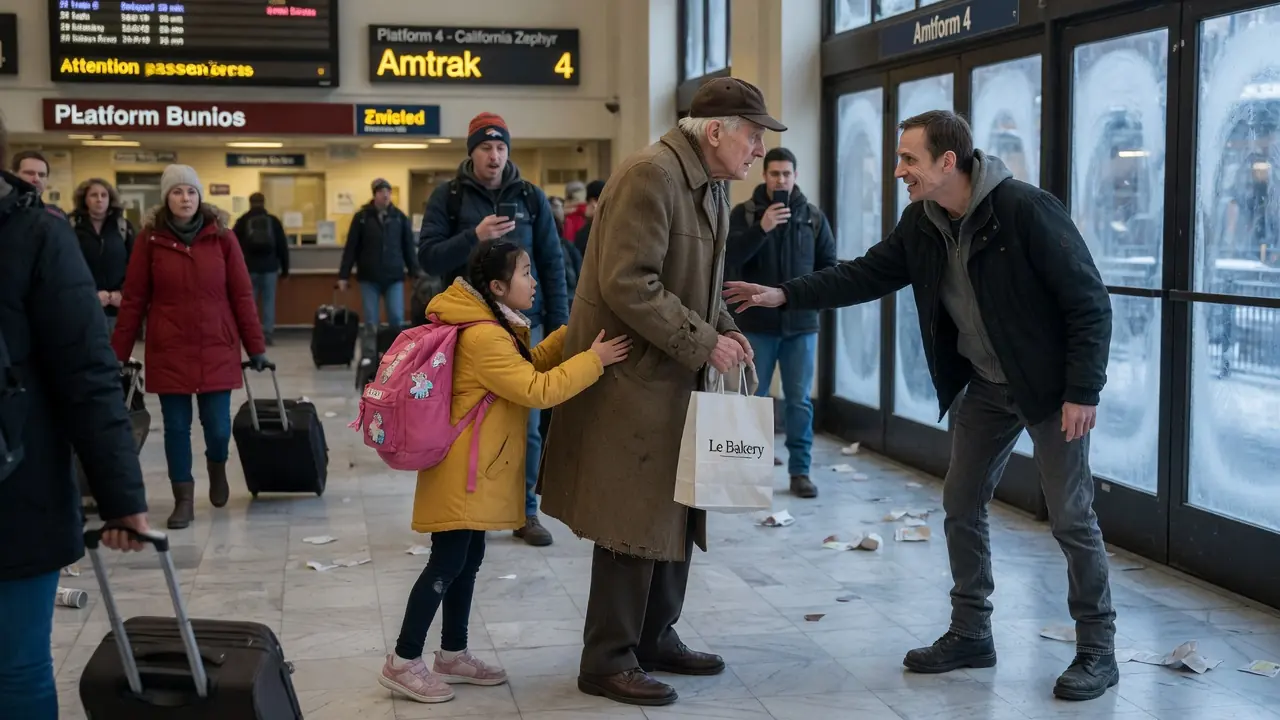
Helen Bell looked nervous.
Walter said, “Then learn the law before you carry the badge.”
Lena did.
She studied hard. She joined debate club. She volunteered with youth safety programs. She wrote a high school essay titled The Man Who Stood Between Me And The Crowd, which Walter could not finish reading the first time because his eyes blurred.
At graduation, Lena wore a blue dress beneath her gown. Walter sat beside Helen and Marcus, holding a bouquet of tulips because he remembered she liked them.
When Lena walked across the stage, she looked directly at him.
He pressed one hand to his heart.
After the ceremony, she hugged him.
“I’m going to the academy,” she said.
“I know.”
“You’re not worried?”
“I’m terrified.”
She laughed.
Walter smiled. “But proud.”
She became Officer Lena Bell at twenty-three.
Then Detective Lena Bell at thirty-one.
She worked missing-child cases whenever she could, though they took a piece of her heart every time. She was known for noticing small details, for staying late, for never dismissing a frightened child as dramatic or confused.
Whenever someone asked why she cared so much, she said, “Because someone once noticed I was standing too still.”
Walter grew older.
At first, aging was only a slower walk, a stronger pair of glasses, a little more effort getting out of chairs. Then came the fall in his kitchen. Then the hospital stay. Then the doctor telling him he should not live alone without support.
Walter hated that.
He had spent decades in the house he shared with Evelyn. The wallpaper was faded, the porch needed paint, and the garden had grown wild, but it was home. Evelyn’s blue teacup still sat in the cabinet. Her mystery novels still filled the shelf beside the fireplace. The thought of leaving felt like losing her a second time.
Lena visited after his fall and found him sitting in the living room with unpaid bills stacked beside his chair.
“Walter,” she said softly.
He tried to smile. “Detective Bell.”
“Don’t do that.”
“Do what?”
“Act charming when you’re hiding something.”
He sighed. “You became too observant.”
“You encouraged it.”
She sat across from him and picked up one bill.
“Medical expenses?” she asked.
“Temporary.”
“Home repairs?”
“Optional.”
“The porch railing is loose.”
“I don’t dance on the porch.”
“The kitchen floor is uneven.”
“I walk carefully.”
“Walter.”
He looked away.
Lena softened. “Why didn’t you call me?”
“You have important work.”
“You are important.”
He closed his eyes.
“I didn’t want to become another case,” he whispered.
Lena’s face changed.
She knelt beside his chair, just as he had knelt in front of her in the station years before.
“You were never a case to me,” she said.
His eyes filled.
“I’m old, Lena.”
“I know.”
“I can’t do what I used to.”
“I know.”
“I don’t want to leave this house.”
“Then we’ll make it safe.”
He looked at her.
“We?” he asked.
Lena smiled through tears. “Some people stayed, remember?”
The next months brought more change than Walter expected.
Lena organized everything with the calm authority of someone who had spent years handling emergencies. Helen and Marcus helped. Neighbors volunteered. A local contractor, whose missing nephew Lena had once helped find, repaired the porch at a discount. The police department’s community fund helped install safety railings and better lighting. A church group fixed the garden. A retired electrician rewired the dangerous old outlets.
Walter complained about all of it.
The railing was too shiny.
The new porch light was too bright.
The garden people trimmed the rose bush wrong.
Lena listened patiently and ignored him when necessary.
Then she did something he did not expect.
She turned Evelyn’s unused sewing room into a small guest room for children in emergency situations who needed a safe place to wait with a social worker for a few hours. Not overnight. Not unofficially. Everything was done properly through the county’s child services office. The room had soft chairs, blankets, books, snacks, and a little wooden train set Walter had found in the attic.
At first, Walter resisted.
“I’m too old to be useful like that,” he said.
Lena looked at him. “You don’t have to fix their whole life. You just have to stay until someone safe comes.”
He knew those words.
They had once been his own actions.
The first child came on a rainy evening.
A boy named Mateo, seven years old, found wandering outside a closed grocery store while his mother was taken to the hospital. He sat in Walter’s living room, silent and frightened, clutching a toy truck.
Walter lowered himself slowly into the chair across from him.
“Do you like trains?” Walter asked.
Mateo shrugged.
“Trains are better than trucks,” Walter said.
Mateo frowned. “No, they’re not.”
Walter nodded seriously. “A strong argument.”
Within twenty minutes, they were building tracks on the rug.
Lena watched from the doorway.
Walter looked up and saw tears in her eyes.
He smiled softly.
Years passed, and Walter’s house became known quietly among social workers as The Waiting House. Children did not stay long, but they stayed safely. They received cocoa, books, blankets, and an old man’s calm voice telling them that being scared did not mean they were weak.
Walter was not a foster parent. He was not a caseworker. He was simply a safe adult in a warm house.
And for some children, that was enough to get them through the worst hour of their lives.
On Walter’s eighty-eighth birthday, Lena arrived in uniform.
She wore her detective badge clipped to her coat.
Walter sat on the porch in a thick sweater, watching the late afternoon light touch Evelyn’s restored garden. His steps were slower now. His hands shook more often. But his eyes were still gentle.
Lena carried a box.
“What’s that?” he asked.
“A birthday gift.”
“If it’s another safety device, I’m calling your captain.”
“It’s not.”
She sat beside him and opened the box.
Inside was the framed drawing Lena had made as a child: the train station, the old man, the little girl in the yellow coat, and the words HE STAYED.
Walter stared.
“I thought that was on your mantel,” she said.
“It was.”
“I borrowed it.”
“Detectives call that evidence tampering.”
She laughed, then lifted another frame from the box.
It was a certificate from the city.
THE WALTER HAYES CHILD SAFETY ROOM
In honor of the man who proved that one person staying can change a child’s life.
Walter read it once.
Then again.
His mouth trembled.
“Lena…”
She took his hand.
“The county approved the expansion,” she said. “The room here inspired a new program at the station and three community centers. Children waiting for safe placement will have rooms like yours. Not cold offices. Not plastic chairs under bright lights. Warm rooms. Books. Cocoa. Trains if we can manage it.”
Walter could not speak.
Lena’s voice softened. “You stood between me and danger when I was eight. But more than that, you stayed after. You kept your promise. You taught me what safety feels like. Now children all over the city will have a place built from what you gave me.”
Walter looked toward the garden, blinking hard.
“I missed my train that day,” he whispered.
Lena smiled. “Good.”
He laughed through tears.
That evening, people gathered at Walter’s house: Lena’s adoptive parents, neighbors, social workers, officers, children who had passed through The Waiting House, and families who remembered his kindness. There were tulips on the table in Evelyn’s honor and cinnamon rolls without raisins because Lena insisted tradition mattered.
After dinner, Lena stood in the living room.
“No long speeches,” Walter warned.
“You always say that.”
“And no one respects it.”
Everyone laughed.
Lena looked at him.
“When I was a little girl, I believed adults left,” she said. “Some left because they died. Some left because they chose to. Some left because life was too hard and they did not know how to stay. Then Walter Hayes stood beside me in a train station. He did not know me. He did not owe me anything. But he stayed.”
The room grew quiet.
“He taught me that safety is not just a locked door or a uniform or a rule. Safety is a person who notices. A person who asks the second question. A person who does not walk away when staying becomes inconvenient.”
Walter wiped his eyes with a handkerchief.
Lena continued, “Every child I have helped, every missing child I have searched for, every frightened kid I have sat beside, carries a piece of what Walter gave me. His kindness did not end at Platform 4. It became my life’s work.”
She turned to him.
“You once told me some adults keep promises. You were right.”
Walter reached for her hand.
The room blurred around him.
Later, after everyone left, Walter and Lena sat on the porch under the soft glow of the new light he had complained about for months.
“Too bright?” Lena asked.
“Yes.”
“Good. It keeps you from tripping.”
He smiled.
Across the street, the neighborhood was quiet. The garden smelled faintly of damp earth and roses. Somewhere inside the house, the little wooden train set waited for the next frightened child who might need it.
Walter looked at Lena’s badge.
“Do you ever get tired?” he asked.
“Yes.”
“Do you ever wish you had chosen something easier?”
She thought about it.
“No,” she said. “Because when I find a child in time, I remember the station.”
Walter nodded slowly.
“I was afraid that day,” he admitted.
“You were?”
“Of course. That man was younger than me. Stronger. Meaner.”
“But you stood there anyway.”
Walter looked at her. “You were smaller than my fear.”
Lena’s eyes filled.
She leaned her head against his shoulder, just as she had when she was a child.
He closed his eyes.
Long ago, Walter Hayes had gone to Union Station because his house was too quiet and his heart was too lonely. He had planned only to ride a train and come home before dark. Instead, he noticed a little girl standing too still.
He bought her a cinnamon roll.
He called security.
He stayed until someone safe came.
He thought he had given her one afternoon of protection.
But kindness, like a train, keeps moving long after it leaves the platform.
That little girl grew up, put on a badge, and built safe rooms for children who had nowhere to stand. She repaired Walter’s house, restored Evelyn’s garden, and filled his final years with purpose instead of silence.
And every time a frightened child entered one of those rooms and found cocoa, books, warmth, and someone who would not walk away, Walter’s promise lived again.
Some adults leave.
Some adults stay.
And for Lena Bell, for Walter Hayes, and for every child who came after them, staying made all the difference.