At seventy-eight years old, Henry Whitaker still swept the front steps of Whitaker Hardware every morning, even when the sidewalk was already clean.
The store sat on a quiet corner in Springfield, Missouri, between a small barber shop and a family-owned pharmacy.
The sign above the door had faded from deep red to soft brown over the years, but Henry refused to replace it.
His late wife, Margaret, had painted those letters herself the year they opened the shop.
WHITAKER HARDWARE
Underneath, in smaller letters, she had added:
If It’s Broken, Don’t Give Up Yet.
Henry read those words every day.
He was a tall, thin man with white hair, a neatly trimmed gray beard, and patient blue eyes behind square glasses. His hands were rough from decades of nails, wood, paint, tools, and winter repairs.
He had spent most of his life helping people fix things: loose hinges, leaking pipes, broken lamps, cracked chair legs, stubborn locks, stuck windows.
But after Margaret died eight years earlier, Henry realized the hardest things to fix were the quiet ones.
An empty kitchen.
A silent bedroom.
A shop bell that rang less often every year.
His daughter lived in North Carolina. His son lived in Texas. They called, visited when they could, and told him gently that he should sell the store and rest.
Henry always smiled and said, “Not yet.”
The truth was, he did not know who he would be if he stopped opening the door.
One cold morning in late February, Henry was restocking boxes of nails near the front window when he noticed a little girl standing outside.
She was small, maybe nine years old, with curly brown hair tucked beneath a red knit hat and a thin purple coat zipped up to her chin. Her cheeks were pink from the cold. She held a folded paper in both hands and kept staring at the hardware store door as if deciding whether courage could be bought inside.
Henry watched her for a moment.
She stepped forward.
Then back.
Then forward again.
Finally, he opened the door.
The bell above it jingled softly.
“Morning,” Henry said. “You need something, sweetheart?”
The girl startled. “I’m not stealing.”
Henry blinked.
“Well, that’s good to know. I wasn’t accusing you.”
“I just need tape.”
“Tape?”
She nodded quickly. “Strong tape.”
Henry looked at the paper in her hands. It was creased, damp at the edges, and held together in one corner by a torn strip.
“What kind of strong?”
“The kind that makes paper stay together.”
Henry glanced at the shelves behind him. “We have many things that make things stay together. But why don’t you come in out of the cold first?”
The girl hesitated. “I don’t have much money.”
“I didn’t ask how much money you had.”
She looked suspicious but stepped inside.
Warm air wrapped around her, carrying the smell of sawdust, metal, coffee, and old wood. She stood near the entrance, careful not to touch anything.
“What’s your name?” Henry asked.
“Abigail.”
“Abigail what?”
“Abigail Turner.”
“I’m Henry Whitaker.”
She nodded toward the sign. “I know.”
“So you can read signs. Very useful skill in a hardware store.”
Her mouth twitched, but she did not smile.
Henry led her to the tape aisle. “Now, what are we repairing?”
Abigail clutched the folded paper tighter. “Just a paper.”
“Important paper?”
Her eyes dropped.
“Yes.”
“May I see?”
She shook her head immediately.
Henry held up both hands. “All right. No need.”
She looked at the shelf, overwhelmed by rolls of masking tape, duct tape, electrical tape, packing tape, painter’s tape.
Her lips pressed together.
“How much is the cheapest one?” she asked.
Henry picked up a small roll of clear tape. “This one is ninety-nine cents.”
Abigail opened her pocket and pulled out coins. Two quarters, three dimes, five pennies.
Eighty-five cents.
Her face flushed.
“I can come back,” she said quickly.
Henry looked at the coins, then at the little girl’s trembling fingers.
“What happened to the paper?” he asked gently.
She swallowed. “It got wet.”
“In the snow?”
She nodded.
“And you need to fix it before showing someone?”
Her eyes lifted, full of fear.
“How did you know?”
“People don’t stand outside hardware stores in February for ordinary paper.”
For a moment, Abigail looked like she might run.
Then the paper slipped from her hands and fell open on the floor.
Henry saw the bold words at the top.
NOTICE TO VACATE
His heart sank.
Abigail dropped to her knees and grabbed it quickly, as if the paper itself had betrayed her.
“It’s not mine,” she said. “It’s my mom’s. I mean, it’s ours. But she doesn’t know I took it.”
Henry crouched slowly, his knees protesting. “Why did you take it?”
Tears filled Abigail’s eyes.
“Because she cried when she read it. Then she put it in the drawer and went to work. I thought if I fixed it, maybe it wouldn’t be so bad.”
Henry felt the words settle heavily in the quiet store.
A child is trying to repair an notice with tape.
He gently sat back on his heels.
“Where is your mother now?”
“At the motel. Cleaning rooms.”
“You live at the motel?”
Abigail nodded. “We used to have an apartment. Then Mom got sick and missed work. Then we moved to the motel. She says it’s temporary.”
Henry looked at the damp notice in her hand.
“How long do you have?”
She unfolded the paper with shaking fingers.
“Three days,” she whispered.
The bell above the door jingled as a customer entered. Henry stood slowly and called toward the back.
“Sam, can you help Mr. Baker with his order?”
His part-time assistant came out from the storeroom and nodded.
Henry turned back to Abigail.
“Come with me to the counter.”
She stiffened. “Am I in trouble?”
“No.”
“My mom will be mad.”
“She may be worried,” Henry said. “That’s different.”
Behind the counter, Henry pulled out a stool.
“Sit.”
Abigail sat carefully.
Henry took the notice and placed it flat on the counter. He did not tape it. Instead, he gently dried it with a clean cloth, flattened the creases beneath a heavy catalog, and made a photocopy on the old machine in his office.
Abigail watched anxiously.
“Why are you copying it?”
“So your mother has one that is readable.”
“Can tape fix it?”
Henry looked at her softly.
“Not this kind of broken.”
Her face crumpled.
“But,” he said quickly, “some things need tools other than tape.”
“What tools?”
“Phones. People. Time. Sometimes a stubborn old man.”
She looked at him through tears.
Henry picked up the store phone. “Do you know your mother’s number?”
Abigail hesitated, then recited it.
A woman answered after several rings, breathless and tired.
“Hello?”
“Mrs. Turner? My name is Henry Whitaker. I own Whitaker Hardware. Your daughter Abigail is here, safe.”
There was immediate panic on the other end.
“Abigail? Is she okay? What happened?”
“She is all right. She came in because she was worried about a paper she found.”
Silence.
Then the woman’s voice broke.
“Oh no.”
Henry spoke gently. “She is not in trouble. She is cold, frightened, and trying to help.”
The woman began to cry quietly.
“I’m coming,” she said. “I’m leaving now.”
Fifteen minutes later, Rachel Turner hurried through the door wearing a motel housekeeping uniform under a thin coat. She was in her early thirties, with tired green eyes, dark hair pulled into a messy bun, and hands chapped from cleaning chemicals and winter air.
When Abigail saw her, she slid off the stool.
“Mom, I’m sorry.”
Rachel dropped to her knees and hugged her. “Baby, you scared me.”
“I wanted to fix it.”
“I know.”
“The paper got wet.”
“It’s okay.”
“But we have to leave.”
Rachel closed her eyes, holding her daughter tighter.
Henry looked away.
Some sorrows deserved privacy.
When Rachel finally stood, shame filled her face.
“Mr. Whitaker, I’m so sorry. She shouldn’t have taken that paper. She shouldn’t have bothered you.”
“She didn’t bother me.”
“I can pay for the tape.”
“No tape was purchased.”
Abigail whispered, “He said it needs different tools.”
Rachel gave a broken laugh that turned into tears.
Henry placed the readable copy of the notice on the counter.
“May I ask what happened?”
Rachel wiped her face. “I got pneumonia last month. Missed eight days of work. The motel let me stay as long as I could pay weekly, but I got behind. I found another job starting Monday, but it won’t help in time.”
“Do you have family nearby?”
She shook her head. “My mother passed two years ago. Abigail’s father left when she was little.”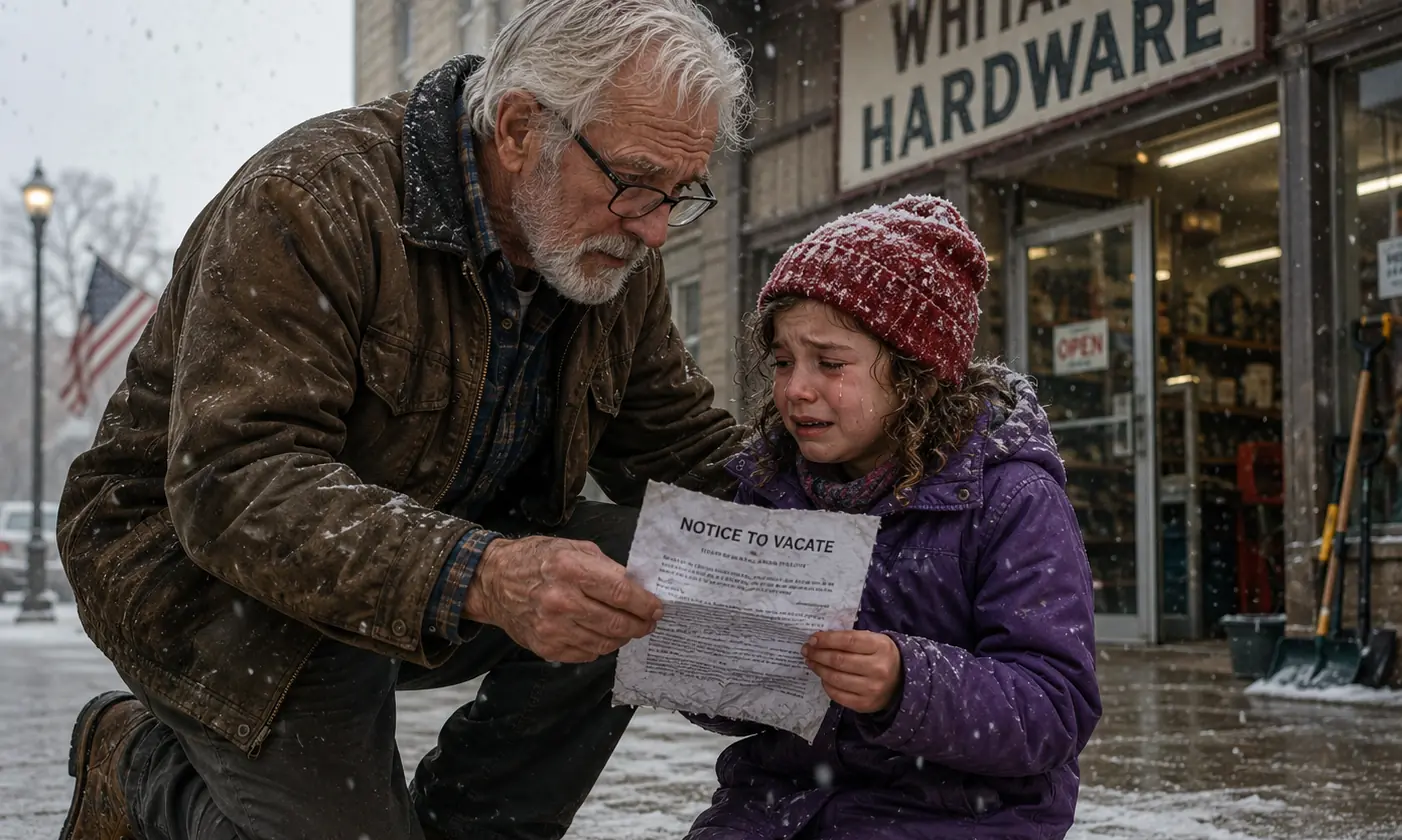
Henry nodded slowly.
He knew what he should do next.
Call a hotline. Give them a number. Offer sympathy. Send them on their way.
But he also knew three days was not enough time to solve a crisis alone.
And a child had come to his store believing tape might save her home.
Henry walked to the front door and flipped the sign to CLOSED FOR LUNCH, even though it was only ten in the morning.
Rachel looked alarmed. “Mr. Whitaker, you don’t have to—”
“Yes,” he said. “I do.”
He called a local housing advocate he knew from repairing shelves at a community center. Then he called Pastor Williams from the church two blocks away. Then he called the motel manager and spoke in a voice so calm and firm that Abigail stared at him as if he had turned into a different person.
By noon, he had negotiated three extra days.
By afternoon, the church emergency fund had covered part of the balance.
By evening, the housing advocate had arranged a meeting to help Rachel apply for rental assistance and temporary family support.
It did not solve everything.
But it stopped the fall.
Rachel sat in the store office, crying into her hands.
“I don’t know why you’re doing this,” she whispered.
Henry looked at Abigail, who had fallen asleep in a chair holding a roll of tape she had not paid for.
“Because she thought paper could be repaired,” he said. “And I couldn’t bear to tell her no without trying.”
Rachel looked at him.
“Thank you.”
Henry nodded. “Tomorrow, come back after work. Bring every document you have.”
“Why?”
“Because I have a filing cabinet, a copier, and more stubbornness than sense.”
That was the beginning.
For the next several weeks, Henry helped Rachel organize paperwork, make calls, copy documents, and find resources. He let Abigail sit at the front counter after school while Rachel worked. He gave her pencils, scrap paper, and small repair tasks that made her feel useful: sorting screws, labeling drawers, counting washers.
Abigail loved the store.
She loved the tiny boxes of nails, the smell of lumber, the wall of keys, and the way Henry knew exactly where everything belonged.
“Why do people need so many kinds of screws?” she asked one afternoon.
“Because not every problem has the same shape.”
She thought about that.
“People too?”
Henry smiled. “Especially people.”
Rachel eventually found a small apartment through a housing program. It was not perfect, but it was safe. Abigail had her own bed. Rachel had a job with steadier hours. The crisis passed, but they did not disappear.
Every Saturday, Abigail came to Whitaker Hardware.
At first, she came because Rachel worked.
Then she came because she wanted to.
Henry taught her how to repair loose hinges, patch small holes in walls, sand wood, paint neatly, and choose the right tool for the job. Abigail learned quickly. She had steady hands and sharp attention. She liked fixing things because repaired things told the truth.
“They don’t pretend nothing happened,” she once said while sanding a scratched chair leg. “They just keep going.”
Henry looked at her with quiet pride.
“That is a very fine definition of repair.”
Years passed.
Abigail grew taller, confident, and practical. She became the kind of teenager adults trusted with keys, schedules, and responsibility. She helped neighbors fix small things. She started a school club that repaired donated furniture for families moving out of shelters.
Rachel watched her daughter and often shook her head in wonder.
“She got that from you,” Rachel told Henry.
Henry smiled. “She already had it. I just gave her a toolbox.”
When Abigail graduated high school, Henry sat in the front row beside Rachel. Abigail received a scholarship to study civil engineering and community development. Her final school project was called The Three-Day Notice, a design proposal for emergency repair and housing support centers in low-income neighborhoods.
In the dedication, she wrote:
For Mr. Whitaker, who taught me some things need tools other than tape.
Henry read it three times.
Then he took off his glasses and wiped his eyes.
Before she left for college, Abigail came to the hardware store one evening after closing.
She placed a small wrapped package on the counter.
Inside was the original roll of clear tape.
The ninety-nine-cent one.
She had kept it all those years, still in its packaging.
“I never paid for it,” she said.
Henry laughed softly. “Then my accounting has been off for years.”
“I’m going to pay you back one day.”
“You already did.”
“No,” she said. “Not yet.”
College took Abigail away, but never completely. She called Henry every Sunday. She sent photos of bridges, housing projects, tool libraries, community workshops, and once a picture of a drawer full of screws with the message:
Not every problem has the same shape.
Henry printed it and taped it behind the counter.
As Abigail’s life grew wider, Henry’s narrowed.
At eighty-six, his hands shook when cutting keys. His knees hurt behind the counter. Big chain stores took most of his customers. The building’s roof leaked near the paint aisle. The heating system failed twice. His children begged him to sell.
Then a developer offered to buy the entire row of shops.
Henry resisted.
Then the repair estimate for the roof arrived.
He placed it in the same drawer where he kept Margaret’s old paintbrushes and sat in silence for a long time.
For the first time, he thought, Maybe it’s broken beyond fixing.
He did not tell Abigail.
Rachel did.
A week later, Abigail walked into Whitaker Hardware wearing a navy coat, carrying a folder under one arm and the old roll of tape in her hand.
She was twenty-nine now, composed, elegant, with the same careful eyes that had once studied rows of screws like secrets.
Henry looked up from the register.
“Your mother has become very poor at keeping secrets.”
“She learned from you.”
“That sounds rude.”
“It was meant lovingly.”
She placed the roof estimate on the counter.
“You were going to close?”
“I was going to consider my options.”
“That means close.”
Henry sighed. “I’m old, Abigail.”
“I know.”
“The store is old.”
“I know.”
“Some things can’t be repaired forever.”
She looked at him gently.
“Maybe not forever,” she said. “But this can.”
She opened the folder.
Inside were plans for the building. Whitaker Hardware would be restored, not replaced. The front would remain a small hardware store. The back would become a community repair and housing resource center where families could get help with basic home repairs, paperwork, emergency housing referrals, and tool loans.
A workshop classroom would teach teenagers practical repair skills.
A small office would provide document copying and support for families facing .
At the top of the plan was a new sign:
THE WHITAKER REPAIR HOUSE
If It’s Broken, Don’t Give Up Yet.
Henry stared.
“You kept Margaret’s words.”
Abigail nodded. “They saved me before I understood them.”
“No, sweetheart. I saved a piece of paper.”
“You saved a family,” she said.
His eyes filled.
“I can’t let you spend this kind of money.”
“It isn’t just me. My firm is partnering with the community center. The church is helping. The city approved a grant. Your children are helping too.”
“My children?”
“They love you. They were waiting for someone to show them how to help without taking the store away from you.”
Henry looked down at the plans, his hands trembling.
Abigail placed the roll of tape beside them.
“I brought this back,” she said. “Not because tape fixed everything. Because it reminds me where the work started.”
The renovation took five months.
Henry complained about the noise, the new office furniture, the computer system, and the fact that young volunteers kept calling him “sir” like he was a museum exhibit.
Abigail ignored him with affection.
But she preserved the important things. Margaret’s painted sign stayed above the door, carefully restored. Henry’s counter remained. The key wall stayed. The drawer where Abigail had first sorted washers was labeled with a small brass plaque:
ABIGAIL’S FIRST TOOLBOX.
On opening day, the store was full.
Families came for repair kits. Seniors came for help fixing steps and railings. Teenagers came to learn tools. Parents came with documents in trembling hands, facing notices they did not understand.
Henry stood near the counter, overwhelmed.
Abigail gave a short speech.
“When I was nine,” she said, “I walked into this store with a wet notice and eighty-five cents, trying to buy tape because I thought I could fix the paper and save my mother from crying. Henry Whitaker did not laugh at me. He did not send me away. He showed me that some problems require different tools: phones, people, time, and stubborn kindness.”
Rachel wiped tears from her cheeks.
“This place exists because no family should face a crisis alone with a piece of paper they don’t understand. And no child should believe they have to fix an adult problem by themselves.”
Henry cried quietly.
Later that day, a young mother came in holding a notice in one hand and a toddler on her hip. Her face was pale with fear.
“I don’t know what this means,” she whispered.
Henry looked at Abigail.
Abigail nodded.
He stepped out from behind the counter, took the paper gently, and said, “Let’s find the right tools.”
Years passed, and the Whitaker Repair House became one of the most trusted places in the neighborhood. It still sold nails, tape, paint, hinges, and keys. But it also helped families repair homes, understand notices, access resources, and stay housed when possible.
Henry no longer worked full days, but he came every morning to sweep the front step.
Even when it was clean.
One afternoon, he found Abigail beside the old sign, watching a group of teenagers learn how to fix cabinet doors in the workshop.
“I thought the store was finished,” he said softly.
She smiled. “It was waiting for a new repair.”
He looked at her, no longer the frightened little girl with the damp paper, but still somehow carrying that child inside her.
“You did pay me back,” he whispered.
Abigail shook her head.
“No,” she said. “I passed the tools on.”
Henry looked at Margaret’s words above the door.
If It’s Broken, Don’t Give Up Yet.
Long ago, he had believed those words were only about hinges, pipes, chairs, and locks.
Now he knew better.
They were about homes.
Families.
Children.
Old men.
And the fragile moments when someone walks through a door holding a broken piece of life, hoping someone will know what to do.
Henry Whitaker had known enough to try.
And because he did, Abigail Turner grew up to make sure many others would never have to face their broken moments alone.