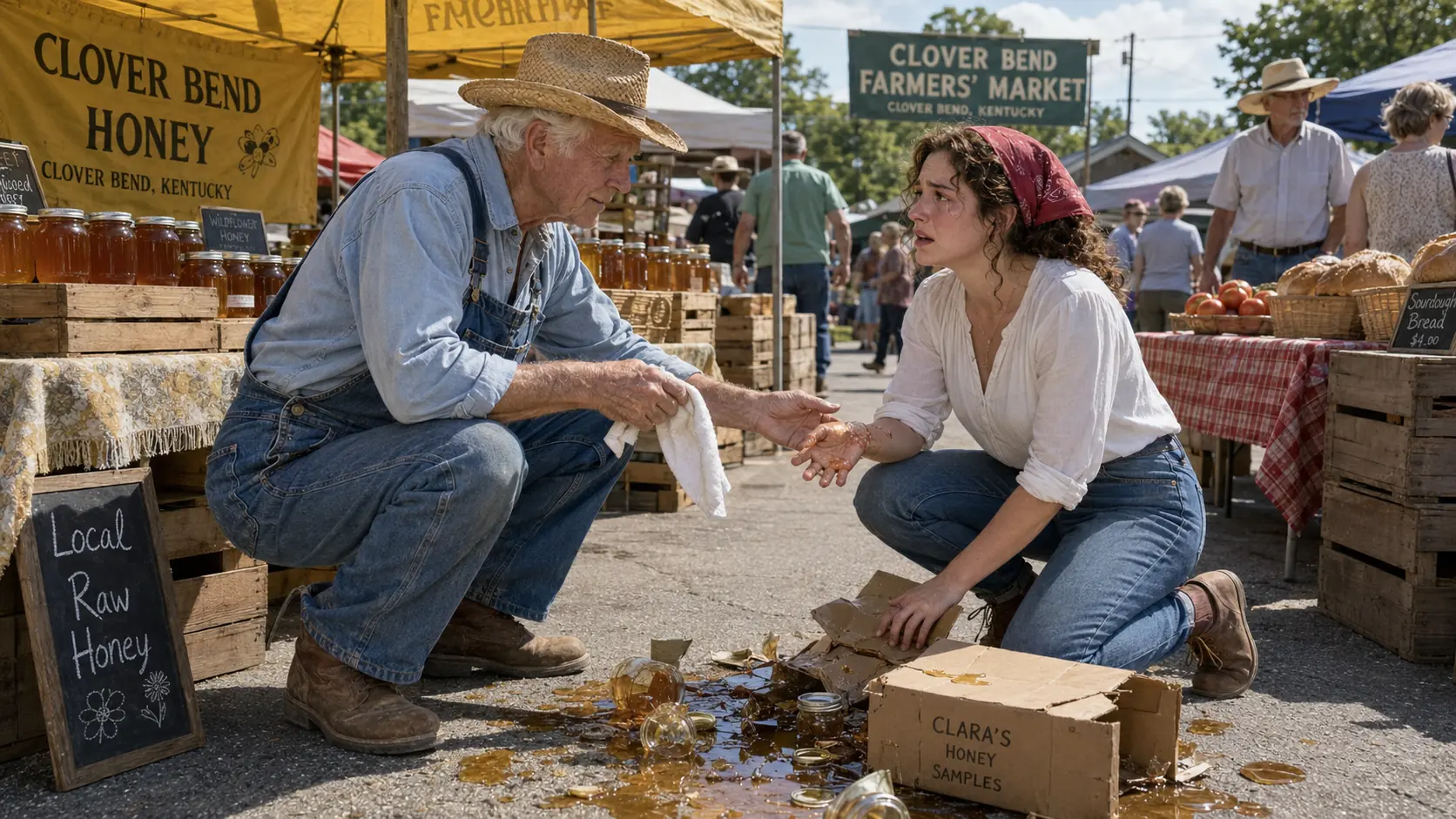
George Whitman was seventy-nine years old and still believed bees could tell when a person was worried.
His small bee farm sat outside Clover Bend, Kentucky, past two miles of winding road, a creek bridge, and a line of walnut trees that had been old before George was born.
The house was small and white, with a screened porch, a tin roof, and a kitchen that smelled faintly of toast, wax, and strong coffee.
Behind the house stood his honey shed, his storage barn, and thirty-two hives arranged in careful rows beneath the morning sun.
George had kept bees for fifty years.
His wife, Helen, used to say he talked to them more politely than he talked to most people.
George always answered, “Bees listen better.”
Helen had been gone for eight years.
But the bees remained.
So did her handwriting on the jars stacked in the honey shed.
Clover Honey. Wildflower Honey. Spring Batch. Late Summer Batch.
George could have printed proper labels years ago, but he never did. Helen’s handwriting had sold more honey than any fancy design ever could. People at the farmers’ market recognized those jars. They recognized the neat blue script, the tiny hand-drawn bee in the corner, and the way George tied every lid with a strip of brown paper.
Whitman Honey had once been a busy little business. Families stopped by the farm. Local stores bought cases. Restaurants used his honey in desserts and salad dressings. Market customers came early because his wildflower honey sold out before noon.
But time had thinned everything.
The hives needed more care than his knees liked. The honey shed roof leaked. The old extractor groaned every summer. Some seasons were too hot, some too wet, some too strange for the bees. Younger producers came to the market with bright labels, social media pages, and card readers that worked faster than George’s patience.
His daughter, Lily, called from Louisville every Sunday.
“Dad, you can retire,” she said gently. “You don’t have to keep doing markets.”
George always answered, “People still need honey.”
“They can buy honey at the grocery store.”
“That is syrup wearing a costume.”
“Dad.”
“I said what I said.”
Lily would sigh, then laugh because she knew arguing was useless.
The truth was, George was tired.
His hands shook when he lifted heavy supers. His back ached after loading the truck. His eyes blurred when reading invoices. The bills came steadily, while the harvest did not always cooperate.
Still, every Saturday in season, George loaded jars into wooden crates, drove to the Clover Bend Farmers’ Market, and set up his small table beneath a faded yellow canopy.
One August Saturday, the heat arrived early.
By eight in the morning, the market pavement already shimmered. Vendors fanned themselves with cardboard. Tomatoes softened in their baskets. Flowers drooped. Customers moved slowly between stalls, buying peaches, bread, eggs, herbs, and iced lemonade.
George sat behind his honey table in his straw hat, watching the crowd with quiet eyes.
That was when he saw the young woman running.
She was maybe twenty-five, with curly brown hair tied under a red scarf, a white blouse tucked into jeans, and panic written across her face. She pushed a small metal cart loaded with glass jars, but one wheel wobbled badly. Every few steps, the cart jerked sideways.
Behind her, a cardboard box had split open on the ground.
Golden liquid spread across the pavement.
Honey.
George stood slowly.
The young woman stopped, turned, saw the broken jars, and froze.
“No, no, no,” she whispered.
Then she dropped to her knees and began picking up pieces of glass with her bare hands.
George moved faster than his age preferred.
“Stop that,” he called. “You’ll cut yourself.”
She looked up, startled.
“I have to clean it. I have to save what I can.”
“You can’t save honey from pavement.”
Her face crumpled.
“I know.”
George knelt with effort beside the broken box and took a folded cloth from his pocket.
“Hands.”
“What?”
“Show me your hands.”
She hesitated, then held them out. A small line of blood appeared near her thumb.
George frowned.
“Told you.”
“It’s nothing.”
“People say that when something is already something.”
He pulled a small first-aid tin from his market crate. Beekeepers learned to carry useful things. Bandages, tweezers, sting ointment, tape, a pocketknife, string, patience.
He cleaned her thumb quickly and wrapped it.
“What’s your name?” he asked.
“Clara.”
“Clara what?”
“Clara Bennett.”
“George Whitman.”
She glanced at his table.
“You sell honey too.”
“I noticed you do as well.”
Her eyes filled again.
“I’m trying to.”
George looked at the cart.
The jars that remained were beautiful. Small round jars with handwritten labels reading:
Clara’s Infused Honey
Lavender Lemon. Chili Orange. Vanilla Fig. Rosemary Peach.
Interesting.
Risky.
Not the kind of thing George made, but carefully done.
“What happened?” he asked.
Clara swallowed hard.
“I have a meeting at nine with the owner of Maple House Café. She asked me to bring samples. If she likes them, she might buy my honey for their tea bar and desserts. It would be my first wholesale order.”
George looked at the broken box.
“And those were the samples?”
“Half of them.”
“How many left?”
Clara checked the cart with trembling hands.
“Six jars. I had twelve.”
“What does she need?”
“A full sample set. Six flavors, two jars each. One for tasting, one for testing recipes.”
“What time?”
Clara checked her phone.
8:26.
“In thirty-four minutes.”
“Where?”
“Two blocks down. Across from the library.”
George glanced at his table.
Rows of Whitman Honey sat neatly beneath the yellow canopy. Clover. Wildflower. Buckwheat. Comb honey.
Then he looked at Clara’s cart again.
The wobbling wheel.
The broken jars.
The blood on her thumb.
The face of someone watching a first real chance spill across hot pavement.
George knew that face.
Farmers wore it after hailstorms.
Beekeepers wore it after a hive collapsed.
Small makers wore it when hard work broke before anyone saw it.
He stood carefully.
“Bring the cart to my table.”
Clara blinked.
“What?”
“My canopy has shade. My crates are stronger than that cart. And I have jars.”
“I can’t use your jars.”
“You can if they are clean.”
“But my labels—”
“We’ll fix labels.”
“My honey flavors—”
“You have six jars left. We divide some into sample jars, pair them properly, and make the set look intentional instead of tragic.”
She stared at him.
“You can do that?”
“I’ve been making jars look respectable since before you were born.”
“I don’t have much money.”
“Did I mention money?”
“No, but—”
“Then stop charging yourself before I do.”
Clara almost laughed through her tears.
George guided her cart to his table. He pulled out a clean cloth, cleared space, and set aside one crate of his own honey. Then he reached beneath the table and brought out a box of small empty tasting jars he used for market samples.
Clara looked stunned.
“You just have those?”
“Bees make a man prepare for chaos.”
They worked quickly.
George cleaned the outside of the remaining jars. Clara opened each one and confirmed the flavors. George found small labels from his supply box and wrote carefully in black marker:
Lavender Lemon
Chili Orange
Vanilla Fig
Rosemary Peach
Ginger Pear
Cinnamon Apple
His handwriting was not as pretty as Helen’s, but it was steady.
Clara filled two tasting jars from each remaining jar, measuring carefully so she still had enough to show. George arranged them in a small wooden honey crate lined with brown paper.
The sample set looked rustic, warm, and surprisingly professional.
Clara stared at it.
“It looks better than before.”
“Don’t insult your broken box too loudly. It already suffered.”
She gave a real laugh.
Then her face tightened again.
“The cart wheel is still bad.”
George looked at the cart, then at the crate.
“You’re not using the cart.”
“I can carry it.”
“In this heat, with shaking hands and glass jars?”
“I have to.”
“No. You have to arrive with the honey intact. I’ll drive you.”
Her eyes widened.
“No, Mr. Whitman, I can’t ask you to leave your market table.”
“You didn’t ask.”
“But your honey—”
George waved to the neighboring bread vendor, a woman named Mabel who had known him for thirty years.
“Mabel, watch my table.”
Mabel shouted back, “Don’t sell anything interesting while you’re gone?”
“Just keep people from stealing the buckwheat.”
“Nobody steals buckwheat honey, George.”
“Because they lack character.”
Clara looked between them, overwhelmed.
George picked up the crate.
“Come on. First chances dislike waiting.”
His old pickup sat behind the market stalls. The passenger seat was cluttered with twine, paper bags, a thermos, and a bee veil. George moved everything to the floor and placed the honey crate carefully between them.
Clara sat stiffly, holding her folder of price sheets and product notes.
“You okay?” George asked as he started the truck.
“No.”
“Good. Honest answer.”
“I was up until two labeling everything.”
“That explains the tired face.”
“I thought if this order came through, I could finally rent space in a certified kitchen and stop making everything in my aunt’s back room.”
“Your aunt like honey?”
“She says my chili orange is too bold.”
“Then make her clover honey and keep the chili orange for people with courage.”
Clara smiled nervously.
They pulled up outside Maple House Café at 8:54.
George helped carry the crate inside.
The café was bright and busy, with plants in the window and chalkboard menus behind the counter. The owner, a woman in her forties named Elaine, came out to meet them.
Clara opened her mouth, but fear took the first word.
George quietly stepped back.
He would not speak for her.
Clara noticed.
She took a breath.
“I’m Clara Bennett. Thank you for meeting with me. I had an accident at the market this morning, but I rebuilt the sample set so each flavor is still here for tasting and recipe testing.”
Elaine looked at the wooden crate.
“This is lovely.”
Clara’s eyes flicked toward George.
He gave one small nod.
Elaine tasted the lavender lemon first.
Then vanilla fig.
Then chili orange.
Her eyebrows rose.
“That one is bold.”
Clara held her breath.
“In a good way,” Elaine said. “I can use this with biscuits and chicken.”
Clara’s shoulders loosened.
George stayed until he saw the conversation settle into business. Then he returned to the market without waiting for thanks.
When Clara came back an hour later, her face told him everything.
“She wants a trial order,” she said breathlessly. “Twenty-four jars. If customers like it, more.”
George nodded.
“Good.”
“Good?” she repeated, laughing. “That’s all?”
“Good is a sturdy word.”
She threw her arms around him.
George froze, then patted her shoulder awkwardly.
“Careful. I’m old and full of joints.”
She stepped back, wiping her eyes.
“I don’t know how to repay you.”
“You can start by buying a better cart.”
“I will.”
“And never pick up broken glass with bare hands again.”
“I won’t.”
“And keep making the chili orange.”
She smiled.
“You liked that one?”
“It has attitude.”
“Like you.”
George frowned.
“That honey is much younger.”
Clara laughed.
That was how Clara Bennett entered George Whitman’s life.
She came back the next Saturday with a proper cart, a new box of sample jars for him, and a jar of chili orange honey labeled:
For George — Because Character Matters
He said it was too fancy.
Then he put it on his kitchen shelf and did not sell it.
Over time, Clara became a regular at the market. Her infused honey gained customers quickly. Some people came for the novelty, then returned for the quality. She learned how to talk about flavors, how to price properly, how to handle wholesale orders, how to pack jars safely, and how to avoid losing her mind when one small thing went wrong.
George taught her things no business course would.
“Never apologize for a fair price.”
“Pretty labels are good. Good honey is better.”
“If a customer says exposure is payment, tell them bees do not accept exposure.”
“Hot weather makes fools of bad packaging.”
“Do not argue with a jar. Replace the lid.”
Clara wrote many of his sayings in a notebook.
“Don’t make me sound wise,” he said.
“Too late.”
She also learned from his bees.
At first, she was afraid of them.
George noticed.
“Bees dislike panic.”
“So do I.”
“Then you have something in common.”
He taught her how to stand near hives calmly, how to watch the entrance, how to recognize healthy activity, how to respect the work without romanticizing it. Clara did not become a beekeeper, but she came to understand honey differently.
“It’s not just sweet,” she said one afternoon.
George nodded.
“It’s weather, flowers, timing, and labor in a jar.”
She wrote that down too.
Years passed.
Clara’s business grew from infused honey jars into a full specialty food brand. She rented certified kitchen space. Then a small production room. She sold to cafés, gift shops, farm stores, and restaurants. Her products expanded: honey glazes, tea syrups, honey caramel, spiced honey, and seasonal gift boxes.
But she always credited George.
Not publicly at first, because he hated attention.
But always in practice.
She bought base honey from him whenever his harvest allowed. She paid fair prices. She sent customers to his market table. She used Helen’s old wildflower honey in her most popular blend, Golden Porch Honey, named after George’s screened porch where she had once sat learning about bees while he complained about modern jar shapes.
By the time Clara turned thirty-three, Clara’s Honey Table had become known throughout Kentucky and beyond.
George’s farm, however, was becoming harder to keep alive.
The hives needed investment. The honey shed roof was worse. The extractor finally broke during a late summer harvest, forcing George to rent time from another beekeeper. The county reassessed land values after a developer bought nearby acreage. Property taxes climbed. Insurance costs rose. A company began sending letters offering to buy the farm.
George ignored them.
Then came a bad winter.
Several hives died.
The spring bloom came strangely early.
The summer was brutally hot.
His honey crop dropped by nearly half.
George sat in the honey shed one evening, looking at empty shelves where full jars should have been. Helen’s handwriting stared back from the remaining labels.
For the first time, he thought seriously about selling.
Not because he wanted to.
Because the bees deserved someone with stronger hands.
He folded the latest offer letter and placed it inside Helen’s old label box.
For weeks, he told no one.
Not Lily.
Not Clara.
But Clara noticed.
She arrived one September morning to pick up wildflower honey and found George standing outside the honey shed, staring at the hives without his veil on.
“George?”
“I’m thinking.”
“That usually means trouble.”
“That usually means you’re nosy.”
She walked closer.
“What happened?”
“Bees had a hard year.”
“I know.”
“So did the bank account.”
She looked at him carefully.
He sighed.
“You learned too much from me.”
“No. I learned to notice.”
Inside the honey shed, she saw the offer letter sticking out of Helen’s label box.
George did not stop her from reading it.
Her face changed.
“They want the land.”
“They always do.”
“This says luxury cabins.”
“People like pretending cabins are farms.”
“Are you considering it?”
George looked toward the hives.
The late sunlight moved across the boxes. Bees came and went steadily, still working, because bees did not care about property values or development plans.
“I don’t want to,” he said.
That was answer enough.
Clara sat on an overturned crate.
“Then we need a plan.”
“I don’t want charity.”
“I know.”
“I mean it.”
“I know.”
“I will not let people donate to save an old man who should have retired.”
Clara leaned forward.
“You didn’t save a young woman at the market by calling her helpless. You saved the honey order because it deserved a chance. Let me do the same.”
George looked away.
“That was different.”
“No,” Clara said. “It was the same thing in smaller jars.”
Despite himself, he almost smiled.
Clara returned one week later with a proposal.
A serious one.
Not a rescue.
A partnership.
Clara’s Honey Table needed a permanent home for production, tastings, classes, and agritourism events. George’s farm had history, hives, land, a honey shed, and the kind of authenticity brands spent fortunes pretending to have. She proposed creating Whitman Honey House, a joint venture that would preserve the bee farm, repair the honey shed, replace equipment, and open the property for controlled seasonal events.
There would be honey tastings, beekeeping demonstrations, pollinator garden workshops, tea-and-honey afternoons, school visits, and small-batch production days. Clara would invest in the production side and use the farm as the official home of her brand. George would remain owner of the land and senior beekeeper, working only as much as he could. Younger beekeepers would be hired and trained.
A portion of profits would support hive health, farm maintenance, and pollinator education.
George stared at the folder.
“You made a folder.”
“Yes.”
“I distrust folders.”
“This one has honeycomb drawings.”
“That improves nothing.”
He turned the pages.
The honey shed restored.
The old sign repainted.
Helen’s handwritten labels preserved in a display.
A new extractor room.
A small tasting porch.
A pollinator garden near the walnut trees.
A farm stand with shelves for both Whitman Honey and Clara’s products.
The proposed sign read:
Whitman Honey House
Bees, Flowers, Weather, Labor, And Sweet Second Chances
“No,” George said immediately.
Clara smiled.
“I knew you’d hate the last part.”
“It’s too long.”
“Your explanation of honey was long.”
“That was educational.”
“So is the sign.”
“It is sentimental.”
“So are you.”
“I am not.”
“You kept my first chili orange jar on your kitchen shelf.”
George frowned.
“That is inventory.”
“It is eight years old.”
“Long-term inventory.”
Clara laughed.
The plan grew.
Lily came from Louisville and, after reading everything, sat quietly on George’s porch.
“Dad,” she said, “this could let you stay without doing everything alone.”
“I don’t like doing things not alone.”
“Yes, you do. You just don’t like admitting it.”
Clara helped apply for a small agricultural tourism grant. A local carpenter repaired the honey shed roof. A beekeeper named Marcus came to help manage the hives. Clara invested in a new extractor and bottling equipment. A group of volunteers planted the pollinator garden with native flowers, clover, lavender, bee balm, and sunflowers.
George complained constantly.
“The garden is too colorful.”
“It’s for pollinators,” Clara said.
“Pollinators have managed without interior decorating.”
“The children will like it.”
“The bees are not in show business.”
He complained about the tasting porch.
“People do not need chairs to taste honey.”
“People enjoy sitting.”
“Standing builds character.”
“You sit all the time.”
“I have completed my character.”
Clara laughed and kept building.
The first Whitman Honey House event took place the following June.
George expected twenty people.
More than a hundred came.
Families walked through the pollinator garden. Children watched bees safely from behind a screened observation hive. Clara led honey tastings on the porch, explaining how flower sources changed flavor. Marcus demonstrated hive tools. Lily sold jars at the stand. George sat beneath the yellow canopy from the old market, answering questions with the reluctant authority of a man pretending not to enjoy himself.
A little girl pointed at a jar.
“Why is this honey darker?”
George leaned forward.
“Because the bees found stronger flowers.”
The girl’s eyes widened.
“Flowers can be strong?”
“The best ones are.”
Clara heard it and wrote it on the chalkboard.
George told her to erase it.
She did not.
By the end of the day, the farm had sold more honey and Clara products than George usually sold in a month of markets. More importantly, people signed up for future workshops, the grant funds cleared, and the new equipment was fully paid.
That evening, George and Clara sat on the porch after everyone left.
The hives hummed softly in the distance.
“You were right,” George said.
Clara turned to him.
“About what?”
“The chairs.”
She laughed.
“That’s all I get?”
“It is a major concession.”
Years passed, and Whitman Honey House became beloved across the region.
Not huge.
Not flashy.
Careful.
Seasonal.
Real.
Visitors came to learn about bees, taste honey, walk the pollinator garden, and sit on the porch where George told stories about weather, flowers, and Helen’s labels. Clara’s brand grew stronger because it had roots. George’s farm survived because it had help.
The hives recovered.
The shed no longer leaked.
The old extractor became a display piece with a sign that read:
Retired After Many Loud Opinions
George liked that sign.
He would not admit it.
On George’s eighty-fifth birthday, Clara and Lily organized a dinner on the tasting porch.
George said he did not want a party.
They called it a “honey inventory meeting with cake.”
He attended.
There was cornbread, chicken, roasted vegetables, biscuits with honey butter, and a cake sweetened with wildflower honey. Lanterns hung from the porch beams. The pollinator garden glowed in the evening light. The hives were quiet, settled for the night.
After dinner, Clara brought out a small wooden box.
George sighed.
“Gifts are suspicious.”
“Open it.”
Inside was a jar.
Not full of honey.
Full of handwritten labels.
Helen’s original labels had been carefully preserved, copied, and organized. On top was one new label, written by a professional calligrapher to match Helen’s style.
It read:
Whitman Honey House
Still Sweet. Still Here.
George stared at it.
His hand trembled.
Clara spoke softly.
“We kept her handwriting in every new label. Not copied perfectly. Just honored.”
Lily touched his shoulder.
“Mom’s still on every jar.”
George looked down at the label.
For once, he had no joke ready.
Finally, he whispered, “She would have corrected the spacing.”
Clara laughed through tears.
“I know. We left room.”
Later that night, after the guests left, George and Clara sat near the hives under a sky full of stars.
“You know,” George said, “when I saw your jars break at the market, I almost stayed at my table.”
Clara looked at him.
“Why didn’t you?”
He thought about it.
“Because you were picking up glass with bare hands.”
She smiled.
“That was foolish.”
“Very.”
“And?”
“And because you looked like the day had decided against you.”
She was quiet.
“I felt that way.”
“I know.”
He looked toward the hives.
“Bad days don’t always get the final vote.”
Clara leaned back in her chair.
“No. Sometimes an old beekeeper does.”
He smiled.
Years earlier, George Whitman had helped a young woman save her honey order after her jars shattered at the market. He thought he was only offering clean jars, a crate, a ride, and practical sense.
But that urgent kindness became the first stable shelf in Clara’s future.
She built a business from it.
And when George’s farm was the thing cracking under pressure, she returned with jars, labels, equipment, flowers, plans, customers, and gratitude strong enough to keep the bees working beneath the Kentucky sun.
What George received was not only a repaired honey shed or relief from selling the land.
He received help without humiliation.
He received a future for Helen’s labels.
He received younger hands for the hives, laughter on the porch, children learning that flowers could be strong, and proof that sweetness was not weakness.
It was labor.
Weather.
Timing.
Memory.
And care.
And every time someone came to Whitman Honey House with a broken box, a ruined plan, or panic in their eyes, George would lift one eyebrow, reach for a clean jar, and say,
“Well, let’s see what we can still bottle.”