Harold Bennett opened his barbershop every morning at seven, even when he knew there might not be a single customer until noon.
Bennett’s Barbershop sat on the corner of Ash Street and Monroe Avenue in a small town outside Cleveland, Ohio.
The building was narrow, brick-faced, and old enough to remember better traffic.
A striped barber pole hung beside the door, its motor tired but still turning on most days. Above the front window, faded gold letters read:
Bennett’s Barbershop
Haircuts, Shaves, Conversation — Since 1968
Harold had painted those words himself when he was twenty-eight years old, newly married, and certain he could build a life with a pair of clippers, two chairs, and enough stubbornness to outlast bad weather.
His wife, Ruth, had stood on the sidewalk with her hands on her hips and told him the letters were crooked.
“Not crooked,” Harold had said. “Handmade.”
“Crooked,” Ruth replied. “But handsome.”
She had been gone for nine years now.
Harold still heard her sometimes when he unlocked the door and stepped into the shop. Not as a ghost, not in any frightening way, but in the habits she had left behind. The little bell above the door. The coffee tin on the back shelf. The framed photograph of her sitting in the second barber chair with a towel around her shoulders, laughing because Harold had pretended to give her a serious businessman’s haircut.
The shop smelled of talcum powder, shaving cream, coffee, aftershave, leather chairs, and old wood. There were two barber chairs, though Harold only used one now. A row of waiting chairs lined the wall beneath photographs of local Little League teams, factory workers, fathers with sons, grandfathers with grandsons, and customers who had grown old under Harold’s scissors.
Once, Bennett’s Barbershop had been busy from opening until closing. Men came before work. Boys came before school pictures. Fathers brought sons. Teenagers came in nervous before first dates. Older men sat in the waiting chairs long after their haircuts were finished because they needed someone to talk to and Harold knew how to listen without making a performance of it.
Back then, Ash Street had life.
There was a bakery next door, a hardware store across the street, a shoe repair shop, a small diner, a pharmacy, and a movie theater two blocks down. Now the bakery was a phone repair place that never seemed open, the hardware store was empty, the movie theater had been turned into storage, and the diner served breakfast only three days a week.
The town had changed.
The customers had changed.
Haircuts had changed too.
Younger men went to salons with online booking, loud music, and walls painted black. Some cut their hair at home. Some drove to chain shops near the highway. Harold’s regulars still came, but fewer every year. Some moved away. Some passed on. Some lost the hair that once brought them in every three weeks.
His daughter, Elaine, called from Columbus every Sunday evening.
“Dad, you could retire,” she said gently. “Nobody would blame you.”
Harold always answered, “Retire to what?”
“You could move closer to me.”
“And abandon the shop?”
“It’s a shop, Dad.”
“No,” Harold said. “It’s where your mother made coffee for half the town when the factory closed.”
Elaine would go quiet then.
She understood more than she wanted to.
The shop was not only a business to Harold. It was the place where Ruth had helped sweep hair off the floor, where Elaine had done homework behind the counter, where customers had laughed, cried, argued about baseball, announced births, mourned deaths, and admitted fears they would never say anywhere else. It was where Harold had learned that a man sitting under a barber cape was often willing to tell the truth if the scissors moved slowly enough.
But the bills did not care about memory.
The roof needed repairs. The back room had water damage. The old heater worked only when it felt respected. The landlord had passed away, and his son, who lived three states away, wanted to sell the building. Harold had received the letter in March.
Property will be listed for sale at the end of the lease term. Tenant may submit purchase offer before public listing.
Harold had read the letter behind the counter while the morning sun came through the front window.
Then he folded it and placed it beneath Ruth’s photograph.
He did not have enough money to buy the building.
He barely had enough to stay open.
Still, every morning, he unlocked the door.
Still, he turned the barber pole on.
Still, he swept the floor before anyone walked across it.
One November evening, rain came down hard enough to empty the street before sunset.
Harold had planned to close early. His last customer, Mr. Alvarez, had left at four-thirty with a clean trim and the same story he told every time about meeting his wife at a church picnic in 1962. Harold had laughed in all the right places because good stories deserved respect even when they became familiar.
By five, the sky was almost black.
Rain struck the front window in fast silver lines. The streetlights flickered on. Water ran along the curb, carrying leaves into the storm drain. Harold stood near the front chair, folding a towel, when the bell above the door rang.
He looked up.
A boy stood in the doorway.
He was maybe ten years old. Thin, soaked, and shivering so badly his shoulders jerked under a dark green school jacket. His backpack hung from one shoulder, wet and heavy. His hair was plastered to his forehead. His cheeks were pale, and his eyes were wide with the frightened focus of a child trying very hard not to cry.
Harold stepped forward immediately.
“Come in, son. Close that door before the rain rents a chair.”
The boy obeyed quickly, pushing the door shut with both hands.
He stood on the mat, dripping onto the floor.
“I’m sorry,” he said. “I didn’t mean to come in. I just…”
His voice broke.
Harold softened his tone.
“You just needed to get out of the weather.”
The boy nodded.
“What’s your name?”
The boy hesitated.
“Caleb.”
“Caleb what?”
“Caleb Turner.”
“I’m Harold Bennett. This is my shop, which means if you drip on the floor, I’m legally allowed to complain while helping you.”
Caleb blinked, confused by the joke.
Then he almost smiled.
Harold took a clean towel from the shelf and wrapped it gently around the boy’s shoulders.
“You lost?”
Caleb looked down.
“I got on the wrong bus.”
Harold waited.
“My mom told me to take Route 14 after school because she had to work late. But I got on Route 41 because I saw the four and I thought…” He swallowed. “Then I got off when I realized it was wrong, but I didn’t know where I was. My phone died.”
“You know your mom’s number?”
Caleb nodded quickly.
“Good. That means we’ve got more than nothing.”
Caleb’s eyes filled.
“I tried asking someone at the gas station, but the man said I couldn’t stay there unless I bought something.”
Harold’s jaw tightened.
“You hungry?”
Caleb answered too quickly.
“No.”
Harold looked at him over his glasses.
“Son, I cut hair for a living. I can tell when a man lies by the way his ears move. Children are even worse at it.”
Caleb’s mouth trembled.
“I didn’t have lunch today.”
Harold did not ask why. Not yet.
Questions could wait.
Warmth could not.
He pointed toward the second barber chair.
“Sit there.”
“I’m wet.”
“The chair has survived men with worse manners than rain.”
Caleb sat carefully, still clutching the towel.
Harold went to the back room, where he kept a small refrigerator, a microwave, coffee, and the food his daughter kept begging him to eat instead of forgetting lunch. He took out a bowl of chicken soup Ruth’s church friend had brought him the day before, a dinner roll, and a small carton of milk. He heated the soup, placed everything on a tray, and carried it to the boy.
Caleb stared.
“I can’t pay for that.”
“Did I show you a menu?”
“No, sir.”
“Then eat.”
“My mom says not to take things from strangers.”
“Your mom is right. So let’s fix that. I’m Harold Bennett. I have owned this barbershop for fifty-five years. My daughter says I’m too stubborn. My late wife said the same thing but with better pie. Now I’m not a stranger. Eat.”
Caleb looked at the soup.
His hunger won slowly, then all at once.
He picked up the spoon and took one careful bite. Then another. Then he ate with quiet desperation, trying to remain polite while his body remembered it needed food. Harold turned away and busied himself wiping the counter so the boy would not feel watched.
When Caleb finished half the bowl, he slowed down.
Harold sat in the first barber chair, facing him.
“Now,” he said, “give me your mom’s number.”
Caleb recited it from memory.
Harold dialed on the shop phone.
The first call went to voicemail.
Caleb’s face tightened.
Harold tried again.
No answer.
“Maybe she can’t pick up at work,” Caleb said quickly, as if defending her.
Harold nodded.
“Could be.”
“She works at the hospital laundry. Sometimes she can’t have her phone.”
“That makes sense.”
Harold left a calm message.
“Ma’am, this is Harold Bennett at Bennett’s Barbershop on Ash and Monroe. Your son Caleb is safe here. He got turned around on the bus in the rain. He’s warm, fed, and sitting in my shop. Call this number when you can.”
Caleb listened with tears in his eyes.
“You said I’m safe.”
Harold looked at him.
“You are.”
The boy looked down at his soup.
For the first time since he had entered, his shoulders lowered.
Rain kept hitting the window.
The shop seemed warmer now, the kind of warmth that came from light, soup, and someone adult enough to decide the world would not be frightening for the next hour.
Caleb looked around the room.
“Are you a real barber?”
Harold pretended to be offended.
“No, I just keep the chairs for decoration.”
Caleb almost laughed.
“My grandpa used to go to a barber.”
“Smart man.”
“He died when I was six.”
“I’m sorry.”
Caleb touched his wet hair self-consciously.
“My hair is bad.”
“Your hair is wet. Different crime.”
“My mom was going to cut it this weekend because school pictures are Monday, but her scissors are dull, and she said she didn’t want to mess it up.”
Harold studied him.
The boy’s hair did need cutting. It had grown unevenly around his ears and neck, probably from rushed trims at home. School pictures on Monday. A mother working late. No lunch. Wrong bus. Dead phone. Pride trying to stand up inside a child.
Harold stood.
“Well,” he said, “since you are already in a chair…”
Caleb looked startled.
“No. I can’t. We can’t pay for a haircut.”
“Good thing I didn’t say haircut.”
“What did you say?”
“I said since you are in a chair. That is a barber’s legal opening.”
Caleb shook his head.
“My mom will be mad if I take something.”
“Your mother will be relieved you are not standing in the rain under a gas station awning. As for the haircut, we will call it storm damage repair.”
“That’s not real.”
“It is in my shop.”
Caleb hesitated.
“I don’t want to get in trouble.”
Harold’s voice softened.
“Then we’ll do it properly. Nothing fancy. Just clean around the ears, neck, and front. Enough for school pictures. If your mom doesn’t like it, she can come yell at me, and I’ll make coffee.”
Caleb finally nodded.
Harold placed a booster cushion on the chair, then wrapped a barber cape around the boy’s shoulders. He turned the chair gently toward the mirror.
Caleb looked at himself and seemed embarrassed.
Harold began working slowly.
Snip.
Comb.
Snip.
The sounds settled the room.
Outside, the storm continued. Inside, the old barber moved with the patient rhythm of a man who had cut hair through weddings, funerals, graduations, first jobs, army send-offs, job interviews, and school picture days.
Caleb watched him in the mirror.
“Did you always want to cut hair?” he asked.
Harold smiled faintly.
“No. When I was your age, I wanted to play center field for Cleveland.”
“What happened?”
“I could not hit a curveball.”
Caleb smiled.
“So you became a barber?”
“Eventually. My uncle owned a shop. I started sweeping hair after school. Then I learned clippers. Then shaves. Then how to listen.”
“Listen?”
“That’s most of the job.”
“I thought cutting hair was most of the job.”
“The hair is just why people sit down.”
Caleb looked thoughtful.
Harold trimmed carefully around his ear.
“My mom says people don’t listen much.”
“Your mom is smart.”
“She’s tired.”
“That too.”
Caleb’s chin trembled slightly, and he tried to hide it by looking at his lap.
Harold pretended not to notice.
When the cut was finished, Harold brushed loose hair from Caleb’s neck, removed the cape, and turned the chair fully toward the mirror.
The boy stared.
He looked younger and older at the same time. His face was still pale, but the clean haircut brought out his eyes. His hair lay neatly, not fancy, not styled beyond recognition, just cared for.
Caleb touched the side of his head.
“I look…”
“Like you know where you’re going,” Harold said.
Caleb swallowed.
“I don’t always.”
“Nobody does.”
The phone rang.
Caleb jumped.
Harold answered.
“Bennett’s Barbershop.”
A woman’s voice came through, breathless with panic.
“My son. Caleb. You said he’s there?”
“Yes, ma’am. He’s safe.”
“Oh my God.” The woman’s voice broke. “Is he hurt? Is he okay?”
“He’s warm, fed, and recently better-groomed.”
There was a pause.
“What?”
Harold looked at Caleb, who suddenly looked worried.
“He needed a little trim for school pictures. No charge. You may inspect and object.”
The woman let out a sound between a sob and a laugh.
“I’m leaving work now. I’ll be there as fast as I can.”
“Drive carefully. We’re not going anywhere.”
Twenty-five minutes later, a woman rushed into the shop with rain in her hair and fear still on her face.
She was in her early thirties, wearing dark work pants and a gray hospital laundry jacket. Her name tag read Maria. She saw Caleb and dropped to her knees in front of him.
“Baby.”
Caleb threw his arms around her neck.
“I’m sorry, Mom. I got on the wrong bus. I tried to call, but my phone died.”
“I don’t care about the bus.” She held him tightly. “I only care that you’re safe.”
Harold looked away, giving them a moment.
Maria finally stood, wiping her face quickly.
“Mr. Bennett?”
“Harold.”
“Thank you. I don’t even know what to say.” She looked at the empty soup bowl, the towel, the clean haircut. Her face filled with embarrassed gratitude. “I’ll pay you Friday. I promise.”
Harold shook his head.
“No.”
“Please. I don’t want people thinking—”
“I don’t care what people think. Your boy was cold, hungry, and lost. My shop was warm. That is the entire story.”
Maria’s eyes filled again.
“It doesn’t feel like the entire story.”
“Most true things don’t.”
She looked at Caleb’s hair.
“You cut it.”
“Storm damage repair.”
Caleb quickly said, “He said you could yell at him.”
Maria laughed through tears.
“I’m not yelling.” She touched Caleb’s hair gently. “It looks wonderful.”
Harold nodded.
“School picture ready.”
Maria turned back to him.
“You did all this for a child you didn’t know.”
Harold looked toward Ruth’s photograph.
“My wife used to say a town is only as good as the door someone opens when a child is scared.”
Maria pressed one hand over her mouth.
Caleb stepped forward.
“I’ll pay you back someday,” he said.
Harold looked down at him.
“Don’t make a grown-up promise just because you’re grateful.”
“I mean it.”
“I believe you.” Harold smiled faintly. “But for now, make sure you learn your bus numbers.”
Caleb nodded seriously.
“I will.”
Harold took one of his old appointment cards and wrote the shop number on the back.
“If you ever get lost again, you call here. Even if the shop is closed, the phone forwards to my house.”
Maria tried to protest, but Harold held up one hand.
“This is not negotiable.”
She accepted the card.
That night, after they left, Harold swept the floor.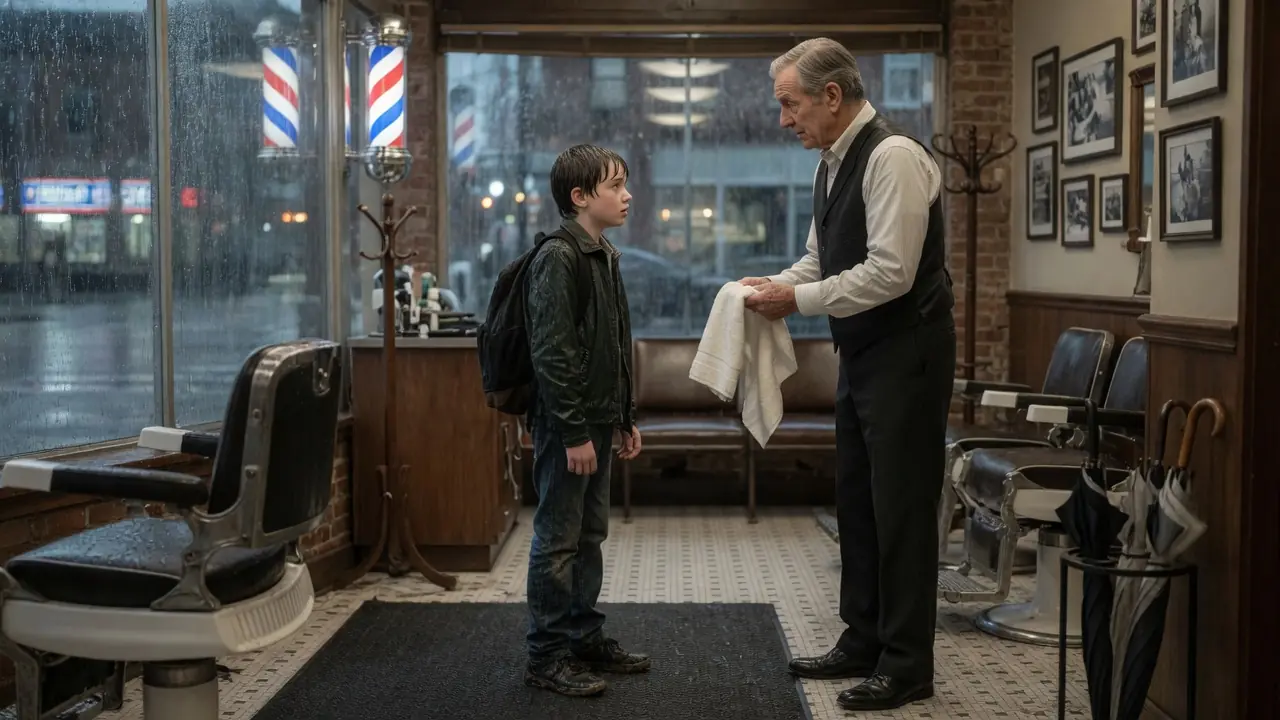
A small pile of Caleb’s dark hair gathered beneath the chair, ordinary and meaningful in the way small things often are. Harold swept it into the dustpan, then paused.
The shop felt different.
Not busy.
Not saved.
Just warmer.
As if Ruth’s old saying had briefly become real inside the room.
The next Monday, Caleb and Maria came by after school.
Caleb wore a blue button-up shirt and carried an envelope. Inside was a school picture order form and three dollars.
“My mom said we can pay something,” he said.
Harold looked at Maria.
Her chin lifted with quiet dignity.
Harold understood.
Pride, when healthy, needed room to stand.
He took one dollar and pushed two back.
“Storm repair fee,” he said. “Discounted because the customer sat still.”
Caleb smiled.
After that, they came sometimes.
Not every week, not even every month. Maria worked long shifts, and money stayed tight. But before school picture days, before Christmas, before Caleb’s middle school graduation, he sat in Harold’s chair. Sometimes Maria paid full price. Sometimes Harold invented a discount. Sometimes Caleb swept the floor afterward, not because Harold asked, but because he had learned where the broom was.
As Caleb grew, he spent more time in the shop.
At twelve, he came to watch.
At thirteen, he came to sweep properly.
At fourteen, he learned to clean clippers.
At fifteen, he learned to fold towels, answer the phone, and book appointments in Harold’s old paper calendar.
Harold never called him an apprentice.
Caleb never asked to be one.
But slowly, the shop made room for him.
He listened to men talk about factories closing, marriages cracking, children moving away, knees hurting, jobs changing, and life disappointing them in ordinary ways. Harold taught him that a barber never forced conversation, never repeated private pain, never mocked a customer’s hairline, and never let a boy leave the chair feeling smaller than when he sat down.
“The haircut matters,” Harold told him one Saturday while cleaning scissors. “But the feeling matters more.”
Caleb nodded.
“What feeling?”
“That someone took time with you.”
Caleb wrote that down in a notebook.
Harold frowned.
“Don’t write down everything I say.”
Caleb smiled.
“Then stop saying useful things.”
Harold grunted, but secretly, he was pleased.
Years passed.
Caleb became tall, steady, and observant. He had his mother’s determined eyes and Harold’s habit of noticing when people were pretending to be fine. He went to community college first, studying business because Maria insisted he should have options. Then he surprised Harold by enrolling in a barber program.
Maria cried when she found out.
Harold pretended to be annoyed.
“You sure about this?” he asked Caleb one evening after closing.
Caleb stood near the second chair, running his hand over the leather armrest.
“Yes.”
“It’s hard work.”
“I know.”
“Your feet hurt.”
“I know.”
“People expect miracles from bad hair decisions.”
“I know.”
“Some men talk too much.”
“You trained me for that.”
Harold looked at him for a long moment.
“Why barbering?”
Caleb’s answer came quietly.
“Because the first time I felt safe after getting lost, I was sitting in that chair.”
Harold looked away.
“Sentimental reason.”
“True one.”
“Those are dangerous.”
“I’ll risk it.”
Caleb trained seriously. He worked in different shops, learned modern cuts, fades, beard shaping, sanitation, scheduling software, social media, and business systems Harold found unnecessary until Caleb proved they brought in customers. Still, no matter where he trained, he returned to Bennett’s whenever he could.
He cut Harold’s hair for the first time when he was twenty-one.
Harold complained the entire time.
“You’re holding the comb like an artist.”
“I am using a comb.”
“Use it like a barber.”
“I am a barber.”
“Not until I say.”
When Caleb finished, Harold inspected himself in the mirror.
Then said, “Acceptable.”
Caleb grinned.
Maria framed his barber license and brought it to the shop.
Harold hung it beside his own.
“You sure?” Caleb asked.
“It’s a wall,” Harold said. “It can hold paper.”
That was his way of saying he was proud.
Caleb eventually moved to Chicago, where he worked in a respected barbershop and learned how to manage a busy modern business. He built a following. Customers liked him because his cuts were sharp, but they returned because he remembered details: job interviews, new babies, sick parents, bad weeks, good news. He carried Bennett’s Barbershop inside him more than he realized.
Every few months, he visited Harold.
The old shop was quieter each time.
The barber pole turned slower. The chairs looked more worn. The waiting chairs sat empty more often. Harold’s hands had begun to stiffen, though he hid it by moving slower and pretending patience was a stylistic choice.
Then came the sale notice.
The landlord’s son listed the building publicly.
A developer wanted the whole corner. The plan was to tear down the barbershop and the empty storefront beside it to build a small medical office with parking. Harold had the first right to buy if he could match the offer within forty-five days.
He could not.
Elaine begged him not to destroy his health fighting it.
“Dad,” she said over the phone, crying softly, “it’s not your fault.”
Harold sat in the dark shop after closing, the letter on the counter.
“It feels like it.”
“It’s a building.”
“No,” he said. “It’s where people knew your mother.”
Elaine had no answer.
Harold folded the letter and placed it beneath Ruth’s photograph.
For two weeks, he did not tell Caleb.
But Caleb knew something was wrong when Harold stopped answering calls during business hours and returned messages late at night with short replies.
So Caleb drove in from Chicago without warning.
It was raining when he arrived.
Of course it was.
He parked outside Bennett’s Barbershop and sat for a moment, looking through the wet windshield at the old sign. The gold letters were faded. The barber pole light flickered. The front window displayed the same handwritten sign Harold had used for years:
Walk-ins Welcome
Caleb remembered standing in that doorway as a lost ten-year-old, soaked to the bone, certain he had done something wrong by needing help.
He stepped out into the rain and opened the door.
The bell rang.
Harold looked up from the first chair.
He was alone.
“You get lost again?” Harold asked.
Caleb smiled.
“Maybe.”
Harold’s eyes softened despite himself.
“Chicago run out of hair?”
“Not yet.”
Caleb removed his coat and looked around.
The shop smelled the same.
That almost hurt more.
“What’s going on?” he asked.
“Nothing.”
“Harold.”
“You learned that tone from your mother.”
“And from you.”
Harold looked away.
Caleb saw the letter beneath Ruth’s photograph.
He walked to it.
Harold said, “Don’t.”
Caleb stopped.
Then Harold sighed.
“Go ahead.”
Caleb read the notice.
His face changed slowly.
“They’re selling the building.”
“Yes.”
“You have forty-five days.”
“Less now.”
“How much?”
Harold named the amount.
It was high, but not impossible in the way Harold believed.
Caleb set the letter down.
“Why didn’t you call me?”
“Because you are not responsible for saving an old man’s shop.”
Caleb turned to him.
“You sheltered a lost boy in this room.”
“That was one night.”
“No,” Caleb said. “That was my beginning.”
Harold’s jaw tightened.
“I don’t want charity.”
“I know.”
“I mean it.”
“I know.”
“I fed you soup and cut your hair. That does not make you owe me a building.”
Caleb walked to the second chair and touched the leather armrest.
“You didn’t just feed me soup. You taught me what a chair could mean.”
Harold looked away.
Caleb continued, voice thick but steady.
“You taught me that a barbershop can be a place where a scared kid becomes calm enough to go home. Where men can talk without falling apart. Where people leave looking like someone took time with them.”
The old shop went quiet.
Rain tapped against the window.
Harold whispered, “It’s too late.”
Caleb shook his head.
“No. It’s just forty-five days.”
He returned to Chicago that night, but not to forget.
He returned to prepare.
Within a week, he came back with a plan, a lawyer, Elaine on a video call, Maria beside him, and three folders that made Harold instantly suspicious.
“You made folders,” Harold said.
Caleb nodded.
“Several.”
“I dislike folders.”
“You dislike being rescued.”
“Correct.”
“This is not rescue. This is business.”
Harold looked unconvinced.
Caleb explained.
He had spent years building a reputation in Chicago. He had investors interested in small, community-rooted barbershops, but Caleb had rejected every idea that felt soulless. Now he wanted to create something different: a training barbershop and mentorship center for young people who wanted to learn the trade but could not afford expensive programs.
Not a chain.
Not a trendy salon.
A real barbershop.
The first location would be Bennett’s.
Caleb and two partners would purchase the building through a small business preservation fund. Harold would remain in the shop as founder and master barber, working only as much as he wanted. Caleb would renovate the empty storefront next door into a classroom and training space. Young apprentices would learn haircuts, sanitation, customer care, small business basics, and the kind of listening Harold had taught without calling it curriculum.
The name would remain:
Bennett’s Barbershop
Under it, a smaller line:
The Chair Project — Training, Mentorship, Community
Harold stared at the proposal.
“The Chair Project?”
Caleb nodded.
“Because the chair was where it started.”
“That is sentimental.”
“Yes.”
“I dislike sentimental.”
“No, you dislike admitting when something matters.”
Elaine laughed through the video call.
Harold glared at the screen.
“Don’t encourage him.”
Maria stood near the counter, eyes wet.
“Mr. Bennett,” she said softly, “you opened your door for my son when I could not get to him. Let him open one for others.”
Harold looked at her.
For a moment, he saw the young mother rushing into the shop years ago, rain in her hair, fear on her face. He saw Caleb with a towel around his shoulders, soup on the tray, a fresh haircut, and eyes that finally looked safe.
He looked at the folder again.
“What do you get out of this?” he asked Caleb.
“A place to build what you taught me.”
“That sounds like charity in nicer clothes.”
Caleb shook his head.
“I get a business. I get a training center. I get apprentices. I get to preserve the place that made me a barber. And you get to stop pretending you can carry this building alone.”
Harold sighed.
“You always talk too much now.”
“I learned in your waiting chairs.”
The purchase was not easy.
The developer raised pressure. The landlord’s son hesitated, then leaned toward Caleb’s offer when he saw the preservation plan and community support. Former customers wrote letters. The town council supported a small heritage business grant. Elaine contributed money. Maria organized a fundraiser at the hospital. Caleb’s customers in Chicago bought advance haircut vouchers, even though many lived too far away to use them.
Harold complained through all of it.
He complained about lawyers.
“They use twelve words where two would do.”
He complained about contractors.
“They measure like the wall insulted them.”
He complained about the design plans.
“No black walls. No loud music. No chairs that look like spaceships.”
Caleb agreed.
He complained about social media photos.
“If you take a picture of my scissors next to coffee, I will throw something.”
Caleb took no such picture.
When the purchase finally closed, Harold sat in the shop alone for nearly an hour.
The building was safe.
The shop was safe.
Ruth’s photograph still stood by the register.
The barber pole still turned.
He placed one hand on the counter and whispered, “Well, Ruth. The boy came back.”
Renovation began in spring.
Caleb did not erase the shop.
He restored it.
The original floor was refinished, not replaced. The barber chairs were repaired and reupholstered in deep brown leather. The mirror frames were restored. The old photographs were cleaned, copied, and arranged on a memory wall. Ruth’s coffee station remained in the back, with a small plaque Caleb installed despite Harold’s protests:
Ruth’s Corner
Coffee, Kindness, No Nonsense
Harold called it ridiculous.
Then he dusted it every morning.
The empty storefront next door became the training room. There were stations for apprentices, lockers, sanitation equipment, a small classroom table, and a wall where Harold’s old rules were painted in clean letters:
Listen First. Cut Second.
Never Let A Customer Leave Feeling Smaller.
The Hair Is Why They Sit Down. It Is Not Always Why They Came.
Harold stood in front of the wall when he first saw it.
“You wrote down my complaints.”
Caleb smiled.
“I wrote down your lessons.”
“Same thing.”
“No.”
Harold said nothing after that.
Opening day came in September.
Rain threatened in the morning but held off until afternoon. Customers lined up before the door opened. Old regulars came first, some with canes, some with sons and grandsons. Former classmates of Caleb came. Hospital workers came because Maria had told everyone. Barbers from Chicago came. Town reporters came. Elaine came with her children, who had never seen the shop so full.
At noon, Caleb stood near the first chair and tapped a comb against a mug.
Harold immediately said, “No speeches.”
“One,” Caleb said.
“Too many.”
“Necessary.”
The shop quieted.
Caleb stood beside the chair where he had once sat shivering under a towel.
“When I was ten years old,” he began, “I got on the wrong bus in a storm. I ended up on Ash Street, soaked, hungry, scared, and too ashamed to ask for help properly.”
Harold looked down.
“I walked into this barbershop because the light was on. Harold Bennett gave me a towel, soup, a phone call to my mother, and a haircut for school pictures. He told me I was safe before I knew I needed to hear it.”
Maria wiped her eyes.
Caleb continued.
“That night did not only help me get home. It showed me what a room like this could be. A chair. A mirror. A steady pair of hands. A place where people sit down carrying more than hair and leave with a little more dignity.”
The shop was completely silent now.
“This place taught me a trade. But more than that, it taught me how to see people. So today, Bennett’s Barbershop remains open, not as a memory, but as a beginning for the next lost kid who needs someone to open the door.”
Applause filled the room.
Harold pretended to inspect his scissors.
No one believed him.
Caleb handed him a small box.
“I dislike boxes,” Harold said.
“I know.”
Inside was a key attached to a small brass tag shaped like a barber chair.
Engraved on it were the words:
The Door Was Open
Harold stared at it.
His hand trembled.
“You kept your promise,” he said quietly.
Caleb smiled.
“You told me not to make a grown-up promise just because I was grateful.”
“And you ignored me.”
“Yes.”
“Good.”
That was the first time Harold said it plainly.
Good.
Years passed, and Bennett’s Barbershop became busier than it had been in decades.
Not because it became trendy.
Because it became necessary again.
Young apprentices came through The Chair Project. Some were fresh out of high school. Some were single parents. Some were former factory workers starting over. Some were young men and women who had grown up believing respectable work belonged to other people. Harold taught them slowly, sharply, and without patience for nonsense.
“Don’t spin the chair like you’re hosting a game show.”
“Comb with purpose.”
“Clean your station before you clean your pride.”
“If a customer goes quiet, don’t rush to fill it. Silence may be what they came for.”
Caleb turned those lines into training cards.
Harold objected to every card.
The cards stayed.
The shop served customers, trained barbers, and offered free back-to-school haircuts every August. Caleb insisted on that program because he remembered the school picture haircut. Harold pretended it was bad business. Then he stayed late every year to help.
One rainy afternoon, a boy about nine stepped into the shop alone, soaked and frightened, holding a dead phone.
Everyone looked up.
Harold was older now, slower, sitting near Ruth’s Corner with a cup of coffee. Caleb stood behind the first chair, scissors in hand.
For a moment, the room seemed to pause.
Then Harold called out, voice rough but steady.
“Come in, son. Close that door before the rain rents a chair.”
Caleb looked at him.
Harold looked back.
Neither needed to say anything.
The boy stepped inside.
An apprentice brought a towel.
Caleb reached for the phone.
Someone warmed soup in the back.
The door had been open once.
Now it knew how to stay open.
Harold lived long enough to see the first class of Chair Project apprentices graduate. On the wall beside his barber license hung Caleb’s, and beside Caleb’s hung the licenses of young people who had learned in the rooms Harold thought might disappear.
At the graduation, Caleb asked Harold to say a few words.
Harold said no.
Then he stood anyway.
He looked at the apprentices, the old customers, his daughter, Maria, Caleb, and Ruth’s photograph near the coffee station.
“I don’t have much to say,” he began.
Everyone smiled because they knew this was not true.
“A barber’s job is simple. Don’t make it fancy. People come in needing a haircut. Give them a good one. But while they’re in your chair, remember this: you may be the first person all week who has time for them.”
The room grew still.
“So take time.”
That was all.
It was enough.
Later that evening, after the shop emptied, Harold and Caleb sat in the two barber chairs, facing the mirror. Rain tapped softly against the front window.
“You saved my shop,” Harold said.
Caleb shook his head.
“You sheltered my life first.”
“I gave you soup and a haircut.”
“You gave me safety.”
Harold looked toward Ruth’s photograph.
“She always said the door mattered.”
“She was right.”
“She usually was.”
Caleb smiled.
The barber pole turned outside, bright against the rainy street.
Years earlier, Harold Bennett had opened his barbershop door to a lost boy in a storm. He gave him warmth, food, a phone call, a haircut, and the quiet certainty that he was safe until his mother arrived.
He thought he was only helping a frightened child get home.
But some doors open wider than the person holding them realizes.
Caleb carried that night into his work, his trade, his business, and his life. And when Bennett’s Barbershop went up for sale, he returned with plans, lawyers, apprentices, customers, and gratitude strong enough to keep the pole turning.
What Harold received was not only a saved shop.
He received Ruth’s kindness alive in a new generation.
He received a son of the heart in Caleb, a room full of apprentices, and proof that legacy is not a building frozen in time. It is a door that keeps opening.
And every time someone nervous, lost, tired, ashamed, or lonely stepped into Bennett’s Barbershop, Caleb would look toward Harold’s old chair and say the words that started everything.
“Sit down. You’re safe here.”