Amid a blizzard swallowing the silent highway, inside a run-down diner buried in overdue bills, Darius Cole stood with his hand hovering over the light switch, wondering if this was the night he finally gave up.
Route 17 stretched through the Montana wilderness like a forgotten promise, its cracked asphalt disappearing beneath layers of fresh snow that fell harder with each passing hour.
The yellow center lines had faded years ago into barely visible ghosts, and tonight, with the wind howling across the open land and visibility dropping to almost nothing, the road felt less like a highway and more like the edge of the world.
The Northstar Diner sat alone beside that highway, a small square building that looked like it had been fighting the elements for too long and was finally losing.
The wooden siding had weathered to a dull gray. Paint peeled in long strips from the boards, curling away like old skin.
The roof sagged slightly in the middle, and the gutters hung crooked, clogged with ice that glittered whenever the tired parking lot lights flickered on. The neon sign outside still glowed, but only barely.
Pink letters spelling Northstar Diner buzzed weakly in the storm, casting uncertain light across the empty parking lot.
Once, that sign had meant something.
Once, truckers had seen it from miles away and felt relief loosen their shoulders.
Once, the lot had been full of eighteen-wheelers, their engines rumbling like thunder while drivers crowded inside for coffee, pie, breakfast plates, road gossip, and a few minutes of being treated like human beings instead of delivery schedules.
Once, the Northstar Diner had been alive.
Now the parking lot held only one vehicle: Darius’s old battered pickup truck, rust eating through the wheel wells, snow already piling against the tires.
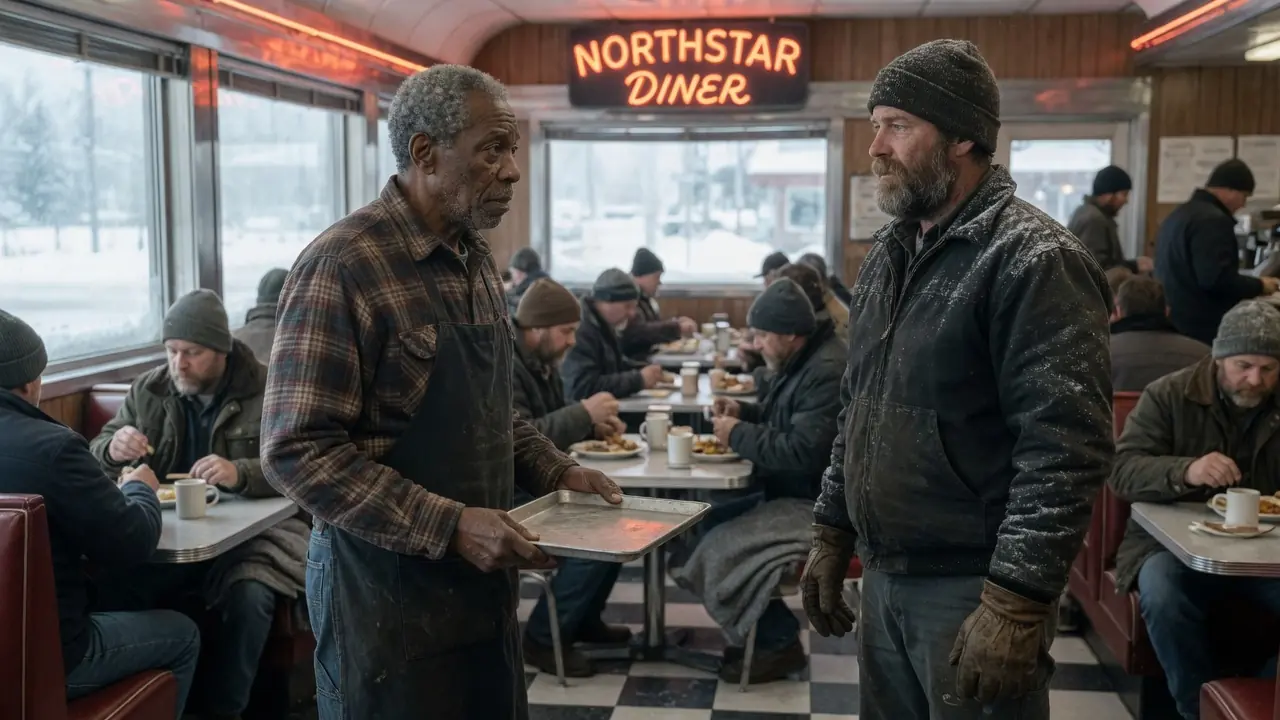
Inside, the diner wore its age in every corner.
The booths lining the walls were covered in faded red vinyl, cracked and split where gray foam padding pushed through. Someone had patched a few of them with duct tape years ago, but even the tape had started peeling loose.
The wooden counter ran the length of the room, its dark surface scarred by decades of coffee rings, elbow marks, and cigarette burns from a time when people smoked indoors and nobody thought twice about it.
The glass pie case was empty. The chrome napkin dispensers had lost their shine. The floor was old patterned linoleum, worn smooth by boots, sneakers, and years of people coming in from the cold.
A smell lingered in the place, old coffee, lemon cleaner, bacon grease, and something harder to name.
Maybe memory.
Maybe grief.
Behind the counter stood Darius Cole, both hands planted flat on the worn wood, staring toward the front windows where snow lashed against the glass.
He was fifty-two years old, a tall Black man with broad shoulders, dark brown eyes, and close-cropped hair going silver at the temples.
He had the build of someone who had spent most of his life working with his body, hauling freight, loading docks, fixing engines, lifting things other people could not. His hands were large and calloused, the hands of a man who had never been afraid of hard labor.
But tonight, those hands looked tired.
Everything about him looked tired.
The final notice lay beneath the counter where he had shoved it twenty minutes earlier, as if hiding the paper might soften the truth printed on it.
Thirty days.
Three months of back mortgage payments.
Penalties.
Interest.
A total that might as well have been a mountain.
Darius did not have the money. He did not have half the money. He did not have enough cash to restock eggs, bacon, bread, and coffee for another week without calling the supplier and begging for one more extension.
He had begged too many times already.
The supplier had been kind at first. Then patient. Then uncomfortable. Then firm.
No more deliveries until payment.
The bank had followed the same pattern. Sympathetic voice, official letters, final notice.
Darius knew what was coming. He had watched businesses die before. He had passed abandoned diners all over the country back when he still drove long-haul. Empty parking lots. Painted-over signs. Windows boarded up. Dreams left to rot beside highways that had once fed them.
He just never thought the Northstar would become one of them.
He never thought Maya’s dream would die on his watch.
Maya.
Her name moved through him like warmth and pain at the same time.
Maya Cole had been the heart of the Northstar. She had been small and fierce, with quick hands, a quicker smile, and a way of making every person who walked through the door feel like she had been expecting them all along.
Darius had met her twenty-three years ago in a diner outside Billings. He had been a road-weary trucker then, thirty years old, running too many miles on too little sleep. He had come in for coffee and a meal. Maya had been waiting tables, laughing with an old farmer at booth four while balancing three plates along one arm like it was nothing.
When she came to his table, she looked at his face for half a second and said, “You look like a man who needs coffee before he makes any important decisions.”
Darius had laughed, even though he had not planned to.
Six months later, they were married.
Two years after that, they bought the Northstar Diner.
It had not looked like much even then, but Maya saw what it could be. She saw drivers stopping in for hot meals. She saw families passing through during summer trips. She saw locals coming in after church. She saw birthdays, late-night conversations, pie slices, fresh coffee, and a place where lonely people could sit down and feel less lonely.
“Everybody needs somewhere to land,” she used to say. “Especially people who spend their lives moving.”
For fifteen years, she had been right.
The Northstar thrived. Truckers knew it by name. Some called ahead over CB radio. Some came in every week. Some only came through twice a year, but Maya still remembered who took sugar in their coffee, who liked extra onions in their hash browns, whose daughter had just graduated, whose mother was sick, whose marriage was struggling, who needed silence and who needed a joke.
Darius worked the grill. Maya worked the room.
Together, they made the Northstar more than a diner.
They made it a haven.
Then Maya got sick.
Cancer.
She fought it with everything she had. She worked longer than she should have, still pouring coffee when her hands shook, still remembering names when pain stole her breath. Darius begged her to rest. She would smile and say, “If I sit still too long, I’ll start feeling sorry for myself.”
But cancer did not care how brave she was.
Three winters ago, Maya died in the upstairs apartment with Darius holding her hand and snow falling quietly outside the window.
After that, the Northstar changed.
At first, people still came. They brought casseroles. They left notes. They hugged Darius awkwardly because he was not an easy man to hug, though Maya had been. Drivers stopped in and told stories about her. Locals filled the booths for a few weeks out of love and grief.
Then life moved on.
It always did.
Traffic changed. New truck stops opened along newer routes. Big stations offered showers, Wi-Fi, loyalty cards, fuel discounts, and bright stores filled with everything a driver could need. The Northstar had coffee, eggs, worn booths, and a widower who did not know how to smile the way his wife had.
Slowly, fewer trucks stopped.
Slowly, the parking lot emptied.
Slowly, the bills stacked higher.
Darius kept opening the doors because he could not bear the thought of closing them. But some mornings, he stood in the kitchen before dawn, staring at the old grill, and wondered if he was preserving Maya’s dream or dragging its body behind him.
Tonight, the answer felt too heavy to avoid.
He looked at the clock.
6:45 p.m.
Fifteen minutes until closing.
Outside, the storm screamed.
The radio on the shelf crackled with weather alerts.
Severe winter storm warning.
Blizzard conditions.
Travel not advised.
Darius had not seen a customer in three hours. Nobody was foolish enough to be out in this.
Nobody except him.
He wiped his hands on a towel and walked toward the light switch.
Maybe tonight was the night.
Maybe he would turn the lights off, lock the door, climb the stairs, and admit that love was not enough to keep a building warm.
His fingers touched the switch.
Then he heard Maya’s voice.
Not real.
Not exactly.
But memory could be powerful enough to stop a man in place.
“One more night, Darius.”
He closed his eyes.
“Keep the light on one more night. You never know who might need it.”
Darius swallowed hard.
His hand dropped.
“All right, Maya,” he whispered. “One more night.”
He walked back behind the counter, picked up a rag, and started wiping down wood that was already clean.
At 7:03, the door slammed open.
The bell above it gave a sharp, startled jingle, and a blast of freezing air swept into the diner, carrying snow across the floor.
Darius looked up.
A young man stood in the doorway, bent slightly against the cold, snow caked across his shoulders and cap. His canvas jacket was dark with moisture. His cheeks were red from windburn, and his eyes held a mixture of exhaustion and hope.
“Evening, sir,” the young man said, his voice rough. “Any chance you’re still serving?”
Darius felt the answer form automatically.
Sorry, closed.
But the words never came.
The young man stood there like he had prepared himself for rejection and was not sure what he would do if it came.
Darius reached for a mug.
“Coffee’s still hot,” he said. “Take a seat anywhere.”
The relief that moved across the young man’s face was almost painful.
“Thank you,” he said. “I mean it. Thank you.”
He stepped inside, pulled the door shut against the wind, and stamped snow from his boots onto the worn rubber mat. Then he removed his cap, revealing dark hair plastered to his forehead, and moved to the counter with tired, careful steps.
Darius set the coffee in front of him.
The young man wrapped both hands around the mug as if it were a lifeline.
“Name’s Evan,” he said after taking a long sip. “Evan Ward. Been driving since Ohio.”
“Darius Cole.”
“You own this place?”
“Depends who you ask,” Darius said dryly. “Bank might disagree soon.”
Evan glanced at him, unsure if he was joking.
Darius did not explain.
“Where you headed?”
“Spokane. Delivery was supposed to be there by morning.” Evan looked toward the windows, where snow moved sideways through the darkness. “That’s not happening now.”
“No,” Darius said. “It’s not.”
For a moment, they sat in quiet company, the kind that settles naturally between men used to long roads and fewer words.
“You want something to eat?” Darius asked.
Evan looked up quickly.
“If it’s not too much trouble.”
“No trouble.”
Darius moved to the grill.
His hands fell into the old rhythm before his mind caught up. Crack eggs. Lay down bacon. Drop bread into the toaster. Flip. Plate. Pour more coffee.
The smell rose through the diner, bacon fat, hot bread, eggs sizzling against steel. It struck Darius harder than expected. For a second, he could almost see Maya moving between booths, coffee pot in hand, calling someone “honey” in that way that made even the hardest drivers soften.
“How long you been driving?” Darius asked.
“Two years,” Evan said. “Started right after high school. Always wanted to see the country. Figured this was a way to get paid for it.”
“It is that,” Darius said. “You see everything. Good and bad.”
“You drove?”
“Used to. Long time ago.”
“You miss it?”
Darius plated the food and slid it across the counter.
“Some days.”
Evan picked up his fork, then hesitated.
“How much do I owe you?”
“Eat first.”
“I’ve got money,” Evan said quickly, as if afraid of being mistaken for a burden. “Just not much until payday.”
Darius studied him.
Young. Proud. Tired. Trying not to show fear.
He had seen that look before in mirrors, in diners, in truck stop bathrooms, in men trying to survive on coffee and grit.
“Coffee’s two dollars,” Darius said. “Breakfast is five. Refills free.”
Evan’s shoulders loosened.
“Thank you.”
He ate with the focused hunger of someone who had been running on vending machine snacks and bad coffee too long.
Darius leaned against the counter and watched the snow.
By all logic, he should have closed once Evan finished.
Instead, he poured himself a cup.
Just one more hour, he told himself.
One more hour would not hurt anything.
At 7:21, the door opened again.
Two men stumbled in, both wearing heavy jackets with freight company logos. Snow crusted their beards and eyebrows. One had hands so cold he could barely remove his gloves.
“You open?” the first asked.
Darius looked at Evan.
Then at the storm.
“Come in,” he said. “Coffee’s hot.”
The two men introduced themselves as Carl and Dennis, hauling auto parts north toward Calgary. Highway patrol was talking about shutting the route down completely. Motels were full. Truck stops were packed. Drivers were being told to pull over wherever they could.
“Storm caught everybody wrong,” Carl said, both hands around his mug. “Forecast said bad weather, not this.”
“Forecast always lies in Montana,” Darius replied.
By 7:45, three more drivers came in.
By 8:00, every booth had someone in it.
By 8:30, the Northstar Diner looked more alive than it had in years.
Wet jackets hung over chairs. Boots left puddles by the door. Coffee cups steamed. Low voices filled the room. Drivers called families, dispatchers, and other drivers. Someone laughed for the first time that night, and the sound startled Darius because it belonged here so completely.
Then Lila Hart walked in.
She was sixty-four, small and wiry, with steel-gray hair pinned in a bun and a face that could soften a room or silence one depending on what was needed. She had worked at the Northstar for twelve years. She had been Maya’s closest friend. After Maya died, Lila stayed on part-time, though Darius knew he could not pay her what she deserved.
He had told her not to come in tonight.
She had ignored him.
“Looks like you could use a hand,” she said, shaking snow from her coat.
“Lila, roads are bad.”
“They were bad ten minutes ago, too. Didn’t stop me then.”
“You shouldn’t have come.”
“And you shouldn’t be running this place alone in a blizzard, but here we are.”
She tied on an apron and looked around the crowded room.
“Coffee first?”
“Coffee first,” Darius said, and for the first time that evening, he almost smiled.
Together, they moved into the work.
Darius cooked. Lila poured coffee, took orders, soothed nerves, and somehow remembered which driver had already eaten and which one was still waiting. Evan finished his plate and immediately stood.
“What can I do?”
“You know how to use a toaster?” Lila asked.
“Yes, ma’am.”
“Then congratulations. You work here now.”
Evan blinked, then grinned.
The old energy returned in strange flashes. The grill sizzling. Lila calling out orders. Drivers shifting to make room for new arrivals. Someone offering a spare phone charger. Someone else checking road conditions. The CB radio crackling faintly behind the counter like an old heart waking up.
But the problem came soon enough.
Supplies.
Darius pulled Lila into the kitchen and opened the freezer.
Two dozen eggs.
Half a loaf of bread.
A pack of sausage.
Pancake mix.
Two cans of beans.
Some coffee.
Not enough.
Lila crossed her arms and stared into the freezer like she could shame it into producing more.
“How many out there?”
“Twenty-six,” Darius said.
“How many more coming?”
He did not answer.
The CB radio crackled before he could.
“Breaker one-nine. Anybody got ears on Route 17? Highway’s shutting down. Got drivers stuck at the junction with nowhere to go.”
The whole diner went quiet.
Darius walked slowly to the radio.
For years, that radio had sat there mostly silent. Maya used to keep it on all day. Drivers called in for road updates, jokes, orders, warnings. After she died, Darius had turned the volume lower and lower until most days he forgot it existed.
Now the green light glowed through the static.
He picked up the microphone.
“This is Northstar Diner, mile marker 32. We copy. What’s your twenty?”
Static hissed.
“Northstar? Didn’t think anybody was still open. We’re about ten miles out. Fifteen, maybe twenty rigs backed up. No shelter. Visibility’s gone. Couple drivers running low on fuel.”
Darius looked at the people already packed into his diner.
Carl stood near the counter, listening. Evan’s face had gone serious. Lila’s mouth tightened.
“How many people?” Darius asked into the mic.
“Hard to say. Maybe twenty-five total. Some doubled up in cabs.”
Darius closed his eyes.
He saw the foreclosure notice.
He saw the empty freezer.
He saw Maya.
“How bad are the roads between here and there?”
“Bad. But maybe passable if we crawl.”
Darius opened his eyes.
“You crawl,” he said. “Get as close as you can. We’ll keep the lights on.”
A long pause.
Then the voice came back, softer.
“Copy that, Northstar. God bless you.”
Darius set the microphone down.
The diner was silent.
Carl stood first.
“You know we don’t have room.”
“I know.”
“And we don’t have food.”
“I know that, too.”
Darius looked around the room.
“But I’m not sending anyone back into that storm.”
For one breath, nobody moved.
Then Carl nodded.
“All right. Then we make room.”
That was when the diner changed.
Not loudly.
Not all at once.
But completely.
Drivers began standing, moving tables, pushing chairs closer together. Those who had eaten offered their seats to new arrivals. Those who still had snacks from their rigs went out in pairs to retrieve them, tied together by visibility and common sense. Granola bars appeared. Bottled water. A few oranges. Crackers. Instant soup packets. A thermos of chili. Blankets. Spare socks. Gloves.
Roxy, a woman driver with short dark hair and grease-stained hands, produced a deck of cards and began organizing the floor space like she had been born for emergency logistics.
“Booths are for people who can’t sit on the floor,” she declared. “Older drivers, injured knees, anyone sick. Everyone else, rotate.”
Nobody argued.
Evan helped Darius at the grill. He burned the first batch of toast and apologized six times.
Darius shook his head.
“Burnt toast still eats.”
By 9:30, the second wave arrived.
The door opened again and again, each time bringing in wind, snow, and another exhausted driver. Some looked embarrassed. Some looked half-frozen. Some were too tired to speak.
Lila met every one with coffee.
“Sit where you can, honey.”
“Warm your hands first.”
“Don’t worry about money right now.”
“Bathroom’s in the back.”
“Blankets are by the jukebox.”
The Northstar held more people than it had any right to hold.
Forty-two by Darius’s rough count.
The final food stretched as far as it could go. Eggs were scrambled because scrambled eggs could be divided. Toast was cut into small pieces. Pancakes became thinner and thinner until Lila whispered that they were more memory than pancake.
Nobody complained.
Not one person.
Near 11:00 p.m., the last plate went out.
Darius stood in the kitchen, staring at the empty shelves.
Lila came up beside him.
“That’s it.”
“I know.”
“Not even bread.”
“I know.”
“You all right?”
Darius laughed once without humor.
“No.”
Lila leaned her shoulder against the doorframe.
“Maya would be proud.”
That nearly broke him.
He looked away quickly.
“Don’t.”
“She would.”
“Lila.”
“She would be standing right here, bossing everyone around, giving away food she couldn’t afford to give, and telling you to stop looking so tragic.”
Darius wiped his face with both hands.
“I’m about to lose this place.”
“I know.”
“I fed them with food I needed to sell.”
“I know.”
“I don’t know how I’m going to open tomorrow.”
Lila looked into the dining room.
Drivers were settling in. Some asleep at tables. Some sharing blankets. Some talking softly. The storm raged outside, but inside there was warmth, breath, life.
“You opened tonight,” she said. “That matters more than tomorrow right now.”
Through the night, Darius did not sleep.
He walked the room. Checked the heater. Refilled coffee until even the coffee ran low. Made sure no one slipped outside alone. Helped an older driver with his medication. Found extra towels for drivers whose clothes were soaked. Listened as people shared pieces of their lives in the half-dark.
Frank, an older driver with trembling hands, told him about his wife who had died two years earlier.
“Cancer,” Frank said quietly.
Darius nodded.
“Same as Maya.”
They sat in silence after that, because some grief did not require explanation.
A young driver named Jaime admitted it was his first winter running Montana alone. His father had driven trucks, too, and had died on the road after pushing too hard through fatigue.
“I keep thinking I can’t quit because he didn’t,” Jaime said. “But maybe he should have stopped more.”
Darius placed a hand on his shoulder.
“Stopping isn’t quitting. Sometimes stopping is how you make it home.”
At 2:00 a.m., Roxy taught three exhausted drivers a card game to keep them awake until their clothes dried.
At 3:00, Evan fell asleep sitting upright with his arms crossed and his chin on his chest.
At 4:00, the wind began to ease.
At 5:30, the world outside turned pale gray.
Morning came slowly, like the sun was uncertain it wanted to look at what the storm had left behind.
Inside the Northstar, drivers stirred with groans and stiff movements. Coffee cups were empty. Plates were scraped clean. Blankets were folded. People checked phones and road reports. Some stepped outside and came back shaking their heads at the snowdrifts.
Darius stood behind the counter, exhausted beyond words.
He had nothing left to feed them for breakfast.
Nothing.
He looked at Lila.
“We need to tell them.”
Before he could speak, Carl stood.
“Listen up, folks.”
The room quieted.
Carl turned toward Darius.
“Before anybody starts talking about leaving, we need to talk about what happened here last night.”
Darius frowned slightly.
Carl continued, his voice carrying through the packed diner.
“This man kept his doors open when he had every reason to close them. He fed us with the last food he had. He gave us shelter when we had nowhere else to go. He didn’t ask where we came from, what company we drove for, whether we could pay, or whether helping us made sense. He just helped.”
Murmurs of agreement moved through the room.
“I’ve been driving twenty years,” Carl said. “I’ve seen places lock doors in storms. Seen people look through drivers like we’re machines. Seen men nearly freeze because nobody wanted the inconvenience of helping. The Northstar didn’t do that.”
Roxy stood next.
“How many of us have been saved by places like this?” she asked. “A small diner, a family truck stop, a waitress who noticed we were too tired, a cook who gave us coffee even when we were broke. How many?”
Hands went up around the room.
Almost every hand.
Roxy nodded.
“That’s what I thought.”
Evan rose from the back, rubbing sleep from his eyes.
“I made some calls when the signal came back,” he said. “Dispatchers. Other drivers. Fleet managers. I told them what happened here.”
Darius stared at him.
“You what?”
Evan looked almost sheepish.
“I told them the truth. That there’s a place on Route 17 that kept the light on when everybody else was closed. People are coming, Mr. Cole.”
“Coming where?”
“Here.”
Darius opened his mouth, but no words came.
Then the drivers began approaching the counter.
One by one.
Frank came first. He placed three twenties on the counter.
“I stopped here thirty years ago with my wife,” he said. “Maya remembered our names every time after that. I lost my wife to cancer two years ago. Places like this remind me there’s still good in the world.”
Sarah, a younger driver with tired eyes and a steady voice, came next.
“I stopped here three years ago,” she said. “I was on my first solo run after leaving a bad marriage. Maya sat with me for an hour while I cried in booth five. She told me the road would teach me I was stronger than I thought. She was right.”
Hector came forward with folded bills in his hand.
“You helped me outside Cheyenne five years ago,” he told Darius. “Frozen fuel line. I was panicking, and you stopped in the cold for two hours. You wouldn’t take money. You told me to pass it on. I have been passing it on ever since.”
Teresa, another driver, placed a small stack of bills down.
“My company card declined here once,” she said. “You fed me anyway. Said I could pay next time. I was too proud to admit I was hungry. You gave me dignity.”
Jaime came last, holding a few wrinkled bills.
“I don’t have much,” he said quietly. “But my dad died on the road. Maybe if he’d had a place like this to stop, he’d still be alive. So this is for him. And for every driver who needs the Northstar to exist.”
By the time they finished, the pile of money on the counter was enough to catch up part of the mortgage and restock the kitchen.
Darius stared at it through blurred vision.
“I can’t take this.”
Carl shook his head.
“You already gave more than this.”
“I just did what anyone should do.”
“But not everyone does.”
Darius swallowed.
“I don’t know what to say.”
Carl’s voice softened.
“Say you’ll keep the light on.”
Before Darius could answer, the ground began to tremble.
At first, he thought it was thunder.
Then he realized the storm had passed.
This was engines.
Diesel engines.
Lots of them.
Everyone moved toward the windows.
Outside, through the gray morning light, trucks were pulling in.
Not the ones that had stayed overnight.
New ones.
Three semis with matching logos came first. Then five more. Then a line of independent rigs, custom painted and polished. Then refrigerated trailers, flatbeds, tankers, old trucks, new trucks, trucks from companies Darius knew and companies he had never heard of.
They filled the parking lot.
Then the shoulder.
Then the highway in both directions.
More kept arriving.
Darius stepped outside, coat forgotten, and stood in the snow as truck after truck rolled in with air brakes hissing and engines rumbling.
By noon, more than two hundred trucks were parked outside the Northstar Diner.
Two hundred.
The sight stole the strength from his knees.
Drivers climbed down from cabs and gathered in the cold. Some were strangers. Some were faces from years ago. Some had brought supplies. Some had brought cash. Some had brought tools. Some had brought contracts. Some had simply come because they had heard what happened and wanted to stand in front of the man who had kept the light on.
A man in his fifties approached first, wearing a heavy jacket embroidered with Porter Logistics.
“Will Porter,” he said, extending his hand. “I run a regional fleet. Sixty trucks across five states.”
Darius shook his hand in a daze.
“Heard what you did last night,” Will continued. “Heard what you’ve been doing for years, actually. My drivers have been talking. I want to make the Northstar an official stop for my company. Regular route station. Fifteen, twenty trucks a week minimum. We’ll work out steady payments, supply support, maybe even a fuel partnership if you’re open to it.”
Darius blinked.
“I don’t understand.”
“It’s good business,” Will said. “And it’s the right thing.”
A woman with steel-gray hair stepped forward.
“Linda Morrison. I coordinate supply chains for a regional food distributor. We can set you up with regular deliveries at cost for the next year. No markup.”
A mechanic offered free labor on the heating and wiring.
A fuel company representative talked about installing a small fuel island.
An association officer mentioned grants for historic highway businesses.
Fleet managers offered route commitments.
Independent drivers pledged to stop every time they passed through.
A local contractor offered roof repair at material cost.
Then Carl pressed a thick envelope into Darius’s hands.
“From the drivers,” he said. “The ones here last night and the ones who heard. Should be enough to clear the back mortgage and get repairs started.”
Darius opened it just enough to see the stack inside.
His hands shook.
Then Frank approached, carrying something wrapped in an old shop rag.
“I got one more thing.”
He unfolded the rag carefully.
Inside was a battered CB radio handset.
Darius stared at it.
Frank held it out like something sacred.
“You gave me this outside Cheyenne in ’97,” he said. “My radio died during a snowstorm. You gave me your backup and told me you’d always keep the line open.”
Darius remembered it then.
A younger version of himself. A frozen roadside. A stranded driver. A spare handset handed over without much thought.
Frank’s eyes shone.
“I carried it all these years. Used it every run. Figured it was time it came home.”
Darius took the handset.
The weight of it was familiar.
He walked back inside the diner without speaking.
Everyone followed.
Behind the counter sat the old CB base unit, dusty and silent. Darius clicked Frank’s handset into place.
It fit perfectly.
When he keyed the microphone, the green transmit light glowed steady.
Static cracked.
Then voices came through.
Road reports.
Warnings.
Jokes.
Drivers checking on other drivers.
The heartbeat of the highway.
Darius stood there with one hand on the counter and the microphone in the other, and something inside him opened.
He had thought he was alone.
He had thought Maya’s dream was dying because he could not carry it by himself.
But maybe dreams were never meant to be carried alone.
Maybe they were meant to be handed from person to person, mile to mile, heart to heart.
“Northstar Diner,” he said into the microphone, voice thick but steady. “We’ve got our ears on.”
Cheers erupted inside the diner.
Darius lowered the mic and looked at the faces around him.
Lila was crying openly.
Evan grinned like a man who had just watched a miracle become official.
Carl nodded once.
Frank wiped his eyes with the back of his hand.
Darius looked toward Maya’s photograph on the wall.
“We’re keeping it on,” he whispered.
The transformation took six weeks.
Not a rebuild. A restoration.
Everyone insisted on that.
The Northstar did not need to become something slick and soulless. It needed to become itself again.
The parking lot was expanded and properly paved with long pull-through spaces. New lights were installed, bright enough to guide drivers in but angled carefully so they would not blind anyone on the road. The roof was repaired and insulated. The siding was restored and painted cream with forest green trim, the same colors Maya had chosen years ago.
The old neon sign was rebuilt by a retired signmaker who had once eaten at the Northstar during cross-country hauls. He refused full payment.
“Your wife gave me free pie once when my mother died,” he told Darius. “Call it even.”
The sign glowed pink again, steady and strong.
Beneath Northstar Diner, new letters were added in warm gold.
A Haven for All Travelers.
Inside, the booths were reupholstered in the same red vinyl, fresh but familiar. The counter was refinished, keeping every old burn mark and scar but sealing the wood properly. The kitchen received a commercial refrigerator that actually held temperature, a grill with even heat, a dishwasher that saved Lila’s hands, and storage shelves full of supplies bought through Linda Morrison’s distributor contract.
A small truckers’ lounge was added to the side, simple but practical. Couches. A washer and dryer. Two showers. Lockers. A quiet room where drivers could rest when the road had taken too much out of them.
Behind the counter, the CB radio was mounted on a polished wooden plaque.
Frank’s handset stayed connected permanently.
A brass plate beneath it read:
Maya Cole — She Kept the Light On.
Next to it hung a photograph of Maya behind the counter, coffee pot in hand, laughing at something outside the frame.
The grand reopening was scheduled for a Saturday in late spring.
Darius wanted it quiet.
A few customers. Coffee. Maybe pie.
The trucking community had other plans.
By ten in the morning, the parking lot was full.
Trucks lined both sides of Route 17 for half a mile in each direction. Drivers came with families, friends, dogs, banners, photographs, and food from their home states. Texas barbecue sat beside Wisconsin cheese curds. Carolina pulled pork beside homemade pies. Someone brought a portable speaker. Someone else brought a guitar. Children ran between parked rigs under the watchful eyes of parents who never stopped counting heads.
Frank sat near the door telling younger drivers stories about the old days.
Roxy introduced her wife and kids to everyone who would listen.
Sarah arrived in her own rig, newly purchased, proud and polished.
“I’m an owner-operator now,” she told Darius. “Maya was right. The road taught me I was stronger than I thought.”
Will Porter came with several fleet managers.
Linda Morrison brought enough supplies to stock the kitchen for a week.
The local news came.
Then trucking magazines.
Then a documentary crew.
Darius hated cameras, but Lila told him to stop being stubborn and speak from the heart.
At noon, the crowd gathered outside the diner.
Darius stood on the front step, feeling awkward and exposed.
“I’m not much for speeches,” he began.
Warm laughter moved through the crowd.
“But I need to say thank you. Six weeks ago, I was ready to give up. I thought I was out of time, out of money, out of hope. Then the storm came.”
He paused, looking at Evan in the crowd.
“When the first driver walked through that door, I almost told him I was closed. But I heard my wife’s voice in my head telling me to keep the light on one more night. That one choice changed everything.”
The crowd quieted.
“This place was never really about food or coffee. It was about people. Maya understood that better than I did. She knew every traveler needs somewhere warm to land. I forgot that for a while. You all helped me remember.”
His voice grew stronger.
“So from now on, the Northstar stays open the right way. Coffee hot. Doors unlocked. CB on. Light burning. That’s a promise.”
The applause began softly, then rose until it rolled across the parking lot like thunder.
Lila handed him a glass of water.
“Good speech,” she said.
“Too long?”
“For you? Practically a novel.”
Maya would have laughed.
Darius could almost hear it.
Six months later, the Northstar was no longer dying.
It had become a landmark.
Drivers planned routes around it. Companies listed it as an official rest stop. Travelers came because they had heard the story. The walls filled with photographs, patches, notes, postcards, and thank-you letters. The bulletin board near the entrance became crowded with memories from drivers across the country.
But the heart stayed the same.
Darius still worked the counter.
Lila still ruled the floor.
Evan stopped by whenever his route brought him close, which somehow became often. He claimed it was coincidence. Nobody believed him.
The CB radio stayed on.
Always.
One December night, winter returned hard.
Snow swept across Route 17, not as terrible as the blizzard that had changed everything, but bad enough to make drivers cautious. The Northstar glowed through it, pink sign steady, parking lot plowed, kitchen stocked, coffee fresh.
Darius stood behind the counter wiping wood that was already clean.
Some habits survived success.
The diner held a comfortable crowd. Roxy was at a booth, arguing playfully with Carl over pie. Lila trained a new server named Rosa. Evan sat at the counter filling out his logbook between bites of meatloaf.
Then the CB crackled.
“Northstar Diner, you still open?”
The voice was young.
Nervous.
Darius smiled.
He picked up the handset.
“Northstar here. We’re open. Where are you?”
“About five miles out. Snow’s coming down hard. It’s my second week driving solo and I’m not sure I should keep going.”
“You shouldn’t,” Darius said gently. “Come on in. We’ve got hot coffee and a warm place to rest.”
A shaky breath came through the radio.
“Thank you, sir.”
“We’ll be waiting. Drive slow.”
Darius hung the handset back in place.
Evan looked up from his logbook and grinned.
“Here we go again.”
Darius reached for the coffee pot.
“Here we go again.”
Ten minutes later, the door opened.
A young driver stepped inside, snow on his shoulders, fear still in his eyes. He looked around at the warmth, the light, the full tables, the smell of coffee and food, and his face slowly relaxed.
Darius set a mug on the counter.
“Come on in,” he said. “Take any seat you like.”
Outside, the storm thickened.
Inside, the Northstar burned bright.
The coffee flowed. The CB crackled. The grill stayed hot. Laughter rose from the booths. Tired people found rest. Frightened people found welcome. Lonely people found conversation.
Darius looked toward Maya’s photograph.
“We did it,” he whispered.
And maybe it was only memory.
Maybe it was only the heater humming, the storm pressing against the windows, and the murmur of voices inside a diner that had refused to die.
But for one brief second, Darius could almost hear Maya answer.
“No, Darius. We’re still doing it.”
He smiled then.
A real smile.
The kind that reached his eyes.
Because the Northstar was more than a diner now.
It was a promise.
A promise that no traveler on that lonely stretch of Montana highway would be forgotten if they could make it to mile marker 32.
A promise that the light would stay on.
Not just tonight.
Not just through this storm.
Always.