At seventy-nine years old, Franklin Hayes still opened Hayes Family Grocery every morning at six-thirty.
The store sat on the corner of Willow Street and 9th Avenue in Dayton, Ohio, squeezed between a closed shoe repair shop and a little pharmacy that had been there almost as long as Franklin had.
The front window was old and slightly scratched, but Franklin washed it every morning anyway. The wooden floor creaked near the cereal aisle.
The bell above the door sounded tired. The produce section was small, the freezer hummed too loudly, and the cash register sometimes needed a firm tap before it opened.
Franklin loved every inch of it.
His wife, Dorothy, had helped him build the place into more than a grocery store. She knew which customers needed credit without asking.
She kept peppermints in a jar for children. She slipped extra apples into bags when mothers counted coins too carefully.
Dorothy had been gone for eight years now.
Franklin kept the peppermint jar full.
He kept the little handwritten sign she had taped near the counter too.
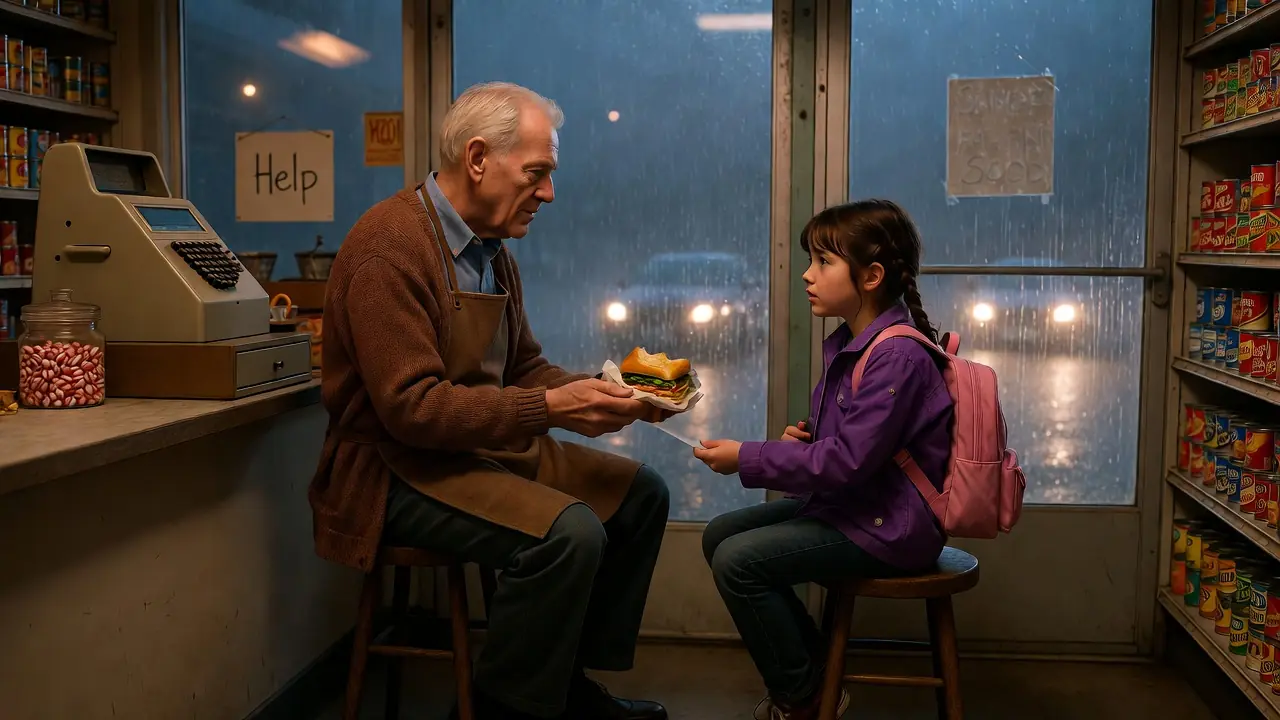
If You Need Help, Tell Us. Quietly Is Fine.
Some people thought it was strange for a grocery store.
Franklin thought it was the truest thing in the building.
One cold November evening, rain began falling over Dayton just before rush hour.
It was the kind of rain that made the city look tired. Car headlights blurred in the puddles. People ran from parking lots with bags over their heads. The wind pushed water under the grocery store door every time someone came in.
Franklin was behind the counter, counting change and listening to the storm, when he noticed a little girl standing near the canned soup aisle.
She looked about nine years old.
She had dark brown hair tied into two loose braids, a purple jacket with one missing button, and a small pink backpack hanging from both shoulders. Her face was calm, but too calm for a child alone. She kept looking toward the front door every few seconds.
At first, Franklin assumed her mother was somewhere in the store.
Ten minutes passed.
Then twenty.
The girl picked up a can of soup, looked at it, then put it back exactly where it had been. She walked to the window and stared out into the rain. Then she returned to the soup aisle.
Franklin stepped out from behind the counter.
“Hello there,” he said gently.
The girl turned quickly.
“I’m not stealing.”
Franklin stopped several feet away.
“I didn’t say you were.”
She looked down. “I was just looking.”
“Looking is allowed in grocery stores.”
She hugged the straps of her backpack.
“What’s your name?” Franklin asked.
She hesitated.
“Grace.”
“Grace what?”
“Grace Miller.”
“I’m Franklin Hayes.”
She glanced toward the sign over the counter. “I know. It says Hayes.”
“So it does.”
Grace looked toward the door again.
Franklin followed her gaze.
“Are you waiting for someone?”
“My mom.”
“What time was she supposed to come?”
Grace swallowed.
“After work.”
“And what time was that?”
“She said before it got dark.”
Franklin looked out the front window.
It had been dark for nearly an hour.
He kept his voice calm.
“Does your mom have a phone?”
Grace nodded. “But it doesn’t always work.”
“Do you know the number?”
She nodded again.
Franklin pointed toward the counter.
“You can call her from the store phone.”
Grace did not move.
“I don’t have money.”
Franklin smiled softly. “The phone does not charge children.”
She followed him to the counter, still cautious, still watching the door like every second away from it might make her mother disappear.
Franklin handed her the old landline.
Grace dialed from memory.
No answer.
She tried again.
Still no answer.
Her hand tightened around the receiver.
“She’s probably on the bus,” Grace said quickly.
“Maybe.”
“She takes two buses.”
“That can take time.”
“She always comes.”
Franklin nodded.
“I believe you.”
Grace looked up at him.
“You do?”
“Yes.”
The bell above the door jingled as a customer came in, shook off an umbrella, bought milk, and left. Grace turned hopefully each time the bell rang, then tried to hide her disappointment.
Franklin noticed.
He also noticed she was shivering.
“Have you eaten dinner?”
Grace immediately said, “Yes.”
Her stomach made a small sound that betrayed her.
Her face flushed red.
Franklin pretended not to hear it.
“I made too many sandwiches for myself today,” he said.
Grace frowned. “How do you make too many sandwiches?”
“By being old and unrealistic about appetite.”
That made her almost smile.
He went into the small back room and brought out a turkey sandwich wrapped in paper, an apple, and a carton of milk from the cooler.
Grace stared at them.
“I can’t pay.”
“I didn’t ask.”
“My mom will pay when she comes.”
“Your mom can tell me whether I used too much mustard.”
Grace hesitated.
Then hunger won.
She sat on the stool near the counter and ate carefully, almost politely, as if someone might take the food away if she seemed too eager. Franklin wiped the counter, turned away, and gave her the dignity of not being watched.
When she finished, she whispered, “Thank you.”
“You’re welcome.”
At seven-thirty, Franklin called the number himself.
No answer.
At seven-forty, he called again.
Nothing.
Grace’s eyes filled with fear.
“She wouldn’t leave me,” she said.
Franklin’s heart tightened.
“I know.”
“She said to wait here because the rain was too bad to walk to Aunt Lisa’s apartment. She said she’d come right after her shift.”
“Where does she work?”
“At the hotel by the highway. She cleans rooms.”
“What is her name?”
“Marina Miller.”
Franklin called the hotel.
The front desk clerk sounded annoyed at first, then concerned. Yes, Marina Miller worked there. No, she had not left at the usual time. There had been a problem. A shuttle van that carried several workers had been delayed after a minor accident near the highway exit. No one was badly hurt, but Marina’s phone had been damaged, and the workers were waiting for another van.
Franklin closed his eyes with relief.
Then he asked to speak to Marina if possible.
Ten minutes later, the phone rang.
Franklin answered.
A woman’s voice came through, breathless and terrified.
“Is Grace there?”
“She is safe,” Franklin said. “She is here at Hayes Family Grocery.”
A sob broke through the line.
“Oh God. I told her to wait there. I couldn’t call. My phone broke when the van hit the guardrail. I thought she’d be scared.”
“She is scared,” Franklin said gently. “But she is safe.”
Grace stood up.
“Mom?”
Franklin handed her the phone.
Grace held it with both hands.
“I waited,” she whispered. “I didn’t leave. Mr. Hayes gave me a sandwich.”
Then her face crumpled.
“I thought you forgot.”
Franklin looked away.
Some words were too heavy for a grocery store.
Marina could not come for several more hours. The replacement van had not arrived, and the hotel staff were still stuck near the highway with police and supervisors sorting out transportation.
“I’ll find a way,” Marina said when Franklin took the phone again. “I’ll walk if I have to.”
“In this rain?” Franklin asked.
“I don’t have a choice.”
“You do tonight,” Franklin said. “Grace can stay here until closing. If you are still not back, she can stay at my house next door. I’ll call the police non-emergency line and give them my information so everything is proper.”
“No, sir. I can’t ask you to do that.”
“You didn’t ask.”
“I don’t even know you.”
“That can be fixed faster than walking six miles in a storm.”
There was a silence.
Then Marina whispered, “I’m not a bad mother.”
Franklin looked at Grace, who stood near the counter with red eyes and a milk carton in her hand.
“I didn’t think you were.”
Marina cried quietly.
Franklin called the police non-emergency line, explained the situation, and gave his name, store address, and home address. He called the hotel again. He wrote Marina’s name and number on a paper by the register.
Grace watched everything.
“You’re not going to send me away?” she asked.
Franklin shook his head.
“No.”
“What if my mom takes long?”
“Then we wait long.”
The grocery store closed at nine.
Outside, rain still fell hard.
Franklin locked the front door, turned off the main lights, and led Grace through the side door into the small house attached behind the store. He had lived there with Dorothy for nearly forty years. After she passed, he had kept the house neat, but too still.
The kitchen smelled faintly of coffee, bread, and old wood.
Grace stood near the doorway, clutching her backpack.
“I don’t want to get anything dirty.”
“Child, I own a grocery store. Dirt and I have made peace.”
He gave her a towel, dry socks, and one of Dorothy’s old cardigans. It was too big, but Grace wrapped herself in it like a blanket.
Franklin warmed soup and made toast. Grace insisted she was not hungry, then ate the whole bowl.
After dinner, he set up the couch with a clean sheet and a quilt.
“You can sleep here until your mom comes,” he said.
“I should stay awake.”
“Why?”
“So she knows I waited.”
Franklin sat in the armchair across from the couch.
“Sleeping does not mean you stopped waiting. It means you trusted someone else to keep watch for a while.”
Grace looked at him.
“You’ll wake me up?”
“I promise.”
She studied his face, searching for the lie.
She did not find one.
A little after midnight, Marina arrived.
Franklin opened the door before she could knock twice.
She stood on the porch soaked from the rain, wearing a hotel housekeeping uniform beneath a thin coat. Her hair was pulled back messily, and her face was pale with exhaustion. A bruise darkened one cheek from the shuttle accident.
Grace woke at the sound of her voice.
“Mom!”
She ran into Marina’s arms.
Marina dropped to her knees and held her daughter tightly.
“I’m sorry,” she sobbed. “I’m so sorry, baby.”
“I waited.”
“I know. You did so good.”
“I was scared.”
“I know. I was scared too.”
Franklin stood quietly in the hallway, eyes wet.
When Marina finally looked up at him, shame and gratitude crossed her face at the same time.
“Mr. Hayes, thank you. I don’t know what would have happened if you hadn’t stayed with her.”
“She was very brave.”
Marina held Grace closer.
“She has to be brave too often.”
The sentence was so honest it made the kitchen go still.
Franklin warmed soup for Marina too. She tried to refuse, then sat when he pointed to the chair with an authority learned from decades of running a store.
Over soup, Marina explained more.
She was a single mother. Grace’s father had left years earlier. They lived in a small apartment with Marina’s sister, but the sister worked nights too. The hotel job paid barely enough, and transportation was always a problem. Marina usually brought Grace to the grocery store after school because it was safer than having her walk home alone in the winter dark.
“I thought it would only be an hour,” Marina said. “I thought I could trust one hour.”
Franklin nodded.
“Sometimes one hour turns into a whole crisis.”
Marina covered her face.
Franklin said softly, “You did not fail because a van crashed and a phone broke.”
She looked at him.
“You really think that?”
“I do.”
One night should have been the end of it.
It was not.
After that, Marina began calling Hayes Family Grocery whenever her shift ran late. Grace would wait near the counter, doing homework on a small stool while Franklin worked. He kept snacks behind the register and said he had “accidentally ordered too many crackers.”
Grace stopped believing that after two weeks.
She ate them anyway.
She loved the store.
She loved the rows of cans, the fruit baskets, the old register, and the peppermint jar Dorothy had left behind. She liked helping Franklin straighten shelves and tape price tags. She liked watching him greet customers by name.
At first, she called him Mr. Hayes.
Then Mr. Franklin.
Then, one afternoon when she was ten, she accidentally called him Grandpa Frank.
She froze immediately.
Franklin froze too.
Then he reached for the peppermint jar and said, “Grandpas usually give candy, I think.”
Grace smiled with relief.
The name stayed.
Years passed.
Grace grew from a frightened little girl into a thoughtful teenager who noticed everything. She noticed when customers counted coins. She noticed when mothers looked embarrassed at the register. She noticed when children stared at food they knew they could not ask for.
She began keeping a small basket near the counter labeled:
After-School Snacks. Free For Kids Waiting For Family.
Franklin pretended to object.
“That sign is going to make every child in town wait here.”
Grace smiled. “Good.”
Marina’s life slowly improved. She became a housekeeping supervisor at the hotel, then later moved into a better apartment with Grace. But the grocery store remained part of their life.
Every Thursday evening, Marina and Grace came for dinner in Franklin’s kitchen. They helped him clean, brought food when they could, and filled the quiet house with voices again.
Franklin never said how much that meant.
He did not need to.
Grace knew.
At sixteen, Grace started a school project about safe waiting places for children whose parents worked late shifts. She interviewed working mothers, store owners, school staff, and bus drivers. She mapped places where children already waited unofficially: grocery stores, laundromats, libraries, diners, church lobbies.
Her project asked a simple question.
What if those places were supported instead of ignored?
She called it The Waiting Light Project.
Franklin read the title and had to take off his glasses.
“Dorothy would have liked that,” he said.
Grace asked, “Did she like helping people?”
Franklin looked toward the old sign near the counter.
“She believed help should be easy to ask for.”
Grace nodded.
“I want to make it easier.”
When Grace graduated high school, Franklin sat beside Marina in the front row. Grace received a scholarship to study social work and community development.
After the ceremony, she handed Franklin a framed photograph.
It showed the front window of Hayes Family Grocery on a rainy night. Through the glass, Grace could be seen as a little girl sitting near the counter with a sandwich in front of her.
Marina had taken it quietly years earlier after arriving that first night.
At the bottom, Grace had written:
For Grandpa Frank, who kept the light on.
Franklin cried openly.
College took Grace away from Dayton for a few years, but she called every Sunday. She studied family support systems, childcare gaps, food access, and working-parent safety networks. She returned every summer to help at the grocery store.
By the time she was twenty-eight, Grace had built a nonprofit program that partnered with small businesses to create safe, verified waiting places for children and teens whose parents worked unpredictable hours.
She called it Waiting Light.
The first official partner was Hayes Family Grocery.
Franklin was eighty-seven by then.
His knees hurt. His hands shook slightly at the register. The freezer needed replacement. The roof leaked near the cereal aisle. A chain market had opened four blocks away, pulling customers with bright lights and low prices.
Franklin tried to hide the bills.
Marina found them first.
Grace came home the next week.
She walked into the store carrying a folder, wearing a long tan coat over a blue dress, her hair pulled back neatly. She looked professional, grown, steady.
But when Franklin saw her, he still saw the little girl in Dorothy’s cardigan.
“You came to scold me,” he said.
“Yes,” Grace replied.
“At least you’re honest.”
She placed the folder on the counter.
“You were going to close?”
“I was going to think about it.”
“That means close.”
Franklin sighed.
“I’m old, Grace.”
“I know.”
“The store is old.”
“I know.”
“Old things don’t last forever.”
Grace looked around the store, at the peppermint jar, the sign, the worn floor, the counter where she had done homework for years.
“No,” she said softly. “But some old things become foundations.”
She opened the folder.
Inside were plans.
Hayes Family Grocery would be restored through a partnership between Waiting Light, local donors, and a small-business community grant. The store would remain open, but part of the back room would become a family waiting space with tables, snacks, phone chargers, emergency contact cards, and trained volunteers during after-school and evening hours.
The program would help working parents register safe pickup plans. Children would have somewhere verified, warm, and public to wait if shifts ran late, buses broke down, phones died, or plans failed.
At the top of the design was the new front window lettering.
HAYES FAMILY GROCERY & WAITING LIGHT ROOM
For Every Child Waiting To Be Found.
Franklin stared at it.
His mouth trembled.
“No.”
“Yes.”
“I don’t need my name on anything.”
“It’s already on the store.”
“You know what I mean.”
Grace reached across the counter and took his hand.
“When I was nine, my mother was stuck after an accident, her phone was broken, and I was alone in the rain. You kept me safe. You believed my mother. You gave me food, warmth, and a place to wait without shame. That night became my life’s work.”
Franklin looked down.
“I only gave you a sandwich.”
“You gave me proof that waiting can be safe.”
The renovation took six months.
Franklin complained about nearly everything.
The new freezer hummed too quietly.
The waiting room chairs were too colorful.
The phone charging station looked too modern.
The volunteers organized snacks “like librarians with crackers.”
Grace listened lovingly and ignored most of it.
But she preserved what mattered.
Dorothy’s sign stayed near the counter, framed but still visible.
The peppermint jar remained full.
The old register was kept on display even after a new system was installed.
The stool where Grace had once done homework was placed in the Waiting Light Room with a small plaque:
The First Safe Seat.
On opening day, the store was full.
Parents came. Children came. Teachers came. Hotel workers came. Bus drivers came. Mr. Patel from the pharmacy came with flowers. Marina stood beside Franklin, crying before Grace even began to speak.
Grace stood near the front window.
“When I was a little girl,” she said, “I waited in this store during a rainstorm because my mother could not get to me. Franklin Hayes did not treat me like a problem. He did not judge my mother. He did not send me away. He kept the light on.”
Franklin lowered his head.
“This room is for every child whose parent is working, delayed, injured, stuck, exhausted, or trying their best. It is for every family that needs one safe hour before everything falls apart. It is named for the man and woman who believed help should be easy to ask for.”
Then she looked at Dorothy’s sign.
“If you need help, tell us. Quietly is fine.”
The applause filled the grocery store.
Franklin cried.
He did not try to hide it.
Years later, Hayes Family Grocery became more than a store.
Children came after school to wait safely. Parents checked in by phone. Volunteers helped with homework. Snacks were free for kids. Working mothers sat in the back room after long shifts and drank coffee without being judged.
Franklin no longer ran the register all day, but he came every morning at six-thirty and washed the front window.
One rainy evening, he saw a little boy standing outside under the awning, clutching a backpack and staring down the road.
Franklin opened the door.
“You waiting for someone, son?”
The boy looked up nervously.
“My dad.”
“Come inside where it’s dry.”
The boy looked down.
“I don’t have money.”
Franklin smiled gently.
“I didn’t ask for money.”
Across the store, Grace heard him and turned.
For a moment, she saw herself.
Nine years old.
Cold.
Waiting.
Afraid her mother had forgotten her.
Then she saw Franklin opening the door wider.
The boy stepped inside.
The bell above the door rang softly.
And the light in the front window stayed on.
Long ago, Franklin Hayes thought he was only keeping one little girl safe until her mother arrived.
But kindness had become a system.
A store.
A room.
A promise.
And a little girl who once waited in fear grew into a woman who made sure no child in her neighborhood had to wait alone again.