Arthur Whitman was seventy-nine years old and still kept the fireplace ready every winter night.
His house sat near a lonely mountain road outside Silver Creek, Colorado, where pine trees crowded the hillsides and snow arrived whenever it pleased.
It was not a fancy house, though tourists sometimes mistook it for one from a distance.
It had dark wooden siding, a stone chimney, a wide porch, and a faded sign near the driveway that read:
Whitman Ridge Lodge
Rooms, Coffee, Firewood, Open Since 1976
The lodge had once been full nearly every weekend.
Back then, travelers stopped on their way through the mountains. Hikers rented rooms. Families stayed during ski season. Couples drank coffee beside the fireplace.
Bikers passing through in summer filled the gravel lot with motorcycles and laughter. Arthur’s wife, Elise, would make stew in a pot big enough to feed an army of hungry guests, though she always said she cooked for “weather, not people.”
“Mountain weather brings appetites,” she used to say.
Elise had been gone for nine years.
Since then, the lodge had become quieter.
The highway had been rerouted. New hotels opened closer to the ski town. Travelers booked rooms online, and Arthur had never learned to trust websites. The old sign faded. The porch boards loosened. The roof needed work. Two guest rooms were closed because the heating pipes groaned and leaked when the temperature dropped too low.
Arthur’s son, Daniel, called from Denver every week.
“Dad, you can sell the lodge,” he said gently. “Mom wouldn’t want you freezing up there alone.”
Arthur always answered, “I’m not alone. I’ve got the fireplace.”
“That is not the same thing.”
“It talks less than most people. That’s a benefit.”
Daniel would sigh.
Arthur knew his son worried. He also knew the lodge was not just a business. It was the place where he and Elise had built their life. It was where their children had grown up carrying towels down the hall, where guests had become friends, where winter storms had turned strangers into temporary family.
He could not sell it easily.
Even when money ran thin.
Even when the roof leaked near room three.
Even when his knees complained every time he carried firewood.
So every winter evening, Arthur stacked logs beside the stone fireplace, checked the porch light, and kept a pot of coffee ready.
“Just in case,” Elise used to say.
On a bitter February afternoon, the weather turned ugly before sunset.
Snow had fallen lightly all morning, but by four o’clock, freezing rain joined it. The mountain road became slick. Wind pushed ice against the windows. The sky darkened early, heavy and gray. Arthur stood near the lobby window, watching the road disappear and reappear through sheets of snow.
He should have gone to bed early.
Instead, he made stew.
Old habit.
At 5:20, he heard a motorcycle.
That made no sense.
No sensible person rode that road in weather like this.
The engine came from the bend below the lodge, loud at first, then uneven. It coughed, roared, slipped into a lower growl, then cut out completely.
Arthur stepped closer to the window.
Through the snowy dusk, he saw a single headlight wobble near the edge of the road. A motorcycle had stopped near the ditch, tilted awkwardly but not fallen. Beside it stood a biker in black riding gear, helmet on, shoulders hunched against the wind.
The man tried to push the motorcycle forward.
The rear tire slid.
He tried again.
The bike barely moved.
Arthur muttered, “Fool.”
Then he grabbed his coat.
By the time he reached the porch, the biker had removed his helmet. He was a large man in his early thirties, with a short dark beard, wet hair flattened to his head, and a face pale from cold. Snow clung to his jacket. His gloves looked soaked. One saddlebag hung loose where the strap had snapped.
Arthur called from the porch.
“You planning to fight the mountain by yourself?”
The biker looked up quickly.
“I’m sorry, sir. I’m not trying to block your drive.”
“You’re not blocking my drive. You’re blocking your own survival.”
The man gave a weak laugh, then shivered hard.
“My bike lost traction. I think something’s wrong with the rear brake too. I was trying to get to Silver Creek before dark.”
Arthur looked at the road.
“Silver Creek is twelve miles ahead.”
The biker closed his eyes.
“Of course it is.”
“What’s your name?”
“Caleb.”
“Caleb what?”
“Caleb Morgan.”
“Arthur Whitman.”
Caleb looked toward the lodge sign, barely visible in the snow.
“Are you open?”
Arthur almost said no.
Technically, the lodge was not taking guests that week. Two rooms had heating problems, and one upstairs window needed repair. He had no bookings, no staff, and no patience for paperwork.
But then Caleb’s shoulders shook again.
Not from fear.
From cold.
Arthur heard Elise’s voice in his memory.
Weather first. Questions later.
He pointed toward the lodge.
“Get inside.”
Caleb hesitated.
“I don’t want to trouble you.”
“You already are. At least do it where there’s heat.”
“My bike—”
“Will not freeze to death. You might.”
Caleb looked at the motorcycle, then at the darkening road.
Another gust of snow hit them.
That made the decision.
Caleb grabbed the loose saddlebag and followed Arthur up the drive. His boots slipped twice. Arthur moved slowly but steadily, one hand gripping the porch railing.
Inside, warmth wrapped around them.
The lodge lobby had old wooden floors, a stone fireplace, a long front desk, faded photographs on the walls, and a row of empty coat hooks. The fire snapped and glowed. The air smelled of woodsmoke, coffee, and stew.
Caleb stood dripping near the door, looking too big and too ashamed for the quiet room.
Arthur pointed to the rug.
“Boots there. Jacket on the hook. Don’t drip on the floor unless you plan to mop.”
“Yes, sir.”
“And stop calling me sir. Makes me feel like I should own a horse.”
Caleb almost smiled.
“Yes, Arthur.”
Arthur brought him towels, then disappeared down the hall and returned with dry clothes: sweatpants, a thick flannel shirt, wool socks, and an old sweater that had belonged to Daniel years ago.
“Bathroom’s first door on the left. Change before your bones file a complaint.”
Caleb took the clothes carefully.
“I can pay for the room.”
“Did I mention a room?”
“No, but—”
“Then change.”
When Caleb returned, he looked younger. Still broad, still tattooed along the forearms, still rough around the edges, but the dry clothes made him look less like a stranger and more like someone’s tired son.
Arthur set a bowl of stew on the table near the fireplace.
Caleb stared at it.
“I don’t want to take your dinner.”
“It’s stew. It improves when more people need it.”
“I haven’t got much cash.”
Arthur sat across from him.
“Eat before I start charging for conversation.”
Caleb obeyed.
At first, he ate slowly, politely. Then hunger caught up with him. The second piece of bread disappeared quickly. Arthur placed another beside the bowl without comment.
For a while, the storm spoke for them.
Wind pressed snow against the windows. The fire popped. The old lodge creaked in familiar places.
Finally, Arthur asked, “What possessed you to ride over Whitman Pass in February?”
Caleb looked embarrassed.
“Bad judgment.”
“That’s obvious. Try details.”
Caleb set down the spoon.
“My younger brother runs a small repair shop in Silver Creek. He called this morning. His wife went into early labor, and he needed someone to watch the shop tomorrow so he could stay with her. I was two towns over. Weather looked bad, but not this bad. I thought I could make it before dark.”
“You thought wrong.”
“Yes.”
“Brother know where you are?”
“My phone died twenty minutes before the bike gave out.”
Arthur grunted.
“Efficient disaster.”
Caleb gave a tired laugh.
“I guess so.”
“You got anyone worrying?”
“My brother will, once he realizes I didn’t make it.”
Arthur stood and walked behind the front desk. The old landline still worked because Arthur trusted mountain storms more than cell towers.
“Number?”
Caleb blinked.
“What?”
“Your brother. Call him before he imagines you at the bottom of a ravine.”
Caleb gave him the number.
The call connected after several rings. Caleb spoke quickly.
“Evan? I’m okay. Bike trouble near Whitman Ridge Lodge. Yeah, I’m inside. Arthur—Mr. Whitman—he took me in. No, don’t come out. Roads are bad. Stay with Jenna. I’ll figure it out in the morning.”
He listened.
His face softened.
“She’s okay? The baby?”
A long pause.
Then Caleb smiled.
“A girl? You’re kidding.”
Arthur looked away, giving him privacy.
Caleb’s voice cracked slightly.
“Tell Jenna I love her. Tell her I’ll get there when the mountain lets me.”
When he hung up, he sat quietly for a moment.
“Niece,” he said.
Arthur nodded.
“Good reason to stay alive.”
Caleb laughed softly.
“Yeah.”
Arthur poured coffee into two mugs.
“Your bike can go in the barn once the wind drops. I’ve got tools. We’ll see what’s wrong in the morning.”
“You work on motorcycles?”
“I work on things that break near my house.”
“That’s broad.”
“Mountain life is broad.”
Caleb smiled into his coffee.
Later that night, after the worst of the wind calmed, Arthur insisted they move the motorcycle into the old barn beside the lodge. Caleb protested, but Arthur handed him a flashlight and ignored him.
Together, they pushed the bike carefully up the snowy drive. It was heavy, and Arthur’s knees hated every step. But the barn was dry, and once the motorcycle was inside, Caleb seemed relieved in a way that told Arthur the machine mattered.
“Nice bike,” Arthur said.
Caleb looked surprised.
“You think so?”
“I said nice. Not wise.”
“It was my father’s.”
Arthur understood then.
Not just a motorcycle.
A memory with wheels.
“He ride a lot?”
“Every summer. He took me and my brother on trips when we were kids. He passed four years ago. I rebuilt this bike after.”
Arthur looked at the old machine.
“Then it deserves better than a ditch.”
Caleb nodded.
“I know.”
Back inside, Arthur showed him room two.
The bed was made. The quilt was old but clean. A small lamp sat beside the bed. Snow tapped against the window.
“This room used to be my wife’s favorite,” Arthur said. “Morning light comes in there.”
Caleb stood at the doorway.
“I can sleep on the couch.”
“You can sleep in the room.”
“I don’t want to take—”
“You’re not taking it from anyone. The room’s been waiting to be useful.”
Caleb swallowed.
“I don’t know how to thank you.”
“Start by sleeping. Gratitude is exhausting when overdone.”
Caleb laughed quietly.
“Goodnight, Arthur.”
“Morning comes early.”
“Does it?”
“In old houses, yes.”
The next morning, the storm had passed, but the world outside was buried in white.
Sunlight touched the snow. Pines stood heavy and bright. The road had not yet been fully cleared. Caleb came downstairs wearing his own clothes, now dry, and found Arthur already in the kitchen making eggs and coffee.
“You’re up early,” Caleb said.
“I live here. The house reports to me at dawn.”
They ate breakfast near the fireplace.
Then they went to the barn.
Arthur brought tools, old rags, and a portable heater. Caleb knew motorcycles, but the cold had made everything harder. Together, they inspected the bike. The rear brake line had a problem, the chain needed attention, and one of the saddlebag brackets had cracked. Nothing impossible, but nothing safe to ignore.
“You’re not riding this over icy roads today,” Arthur said.
Caleb looked toward the barn door.
“I need to get to Silver Creek.”
“You will. Not on that.”
“How?”
Arthur pointed toward an old pickup parked beside the barn.
“My truck.”
“No, Arthur.”
“Yes.”
“You already gave me a room and food.”
“And now a ride. Try to keep up.”
“I can’t ask you to drive twelve miles in snow.”
“You didn’t ask. I decided.”
Caleb looked at him, overwhelmed.
Arthur softened slightly.
“Your brother has a newborn and a shop. You need to be there. I know the road. I’ll drive.”
By ten o’clock, the plow had cleared enough for careful travel. Arthur drove Caleb to Silver Creek in the old pickup. The road twisted through white hills and dark pines. Caleb sat beside him, quiet, holding the repaired saddlebag strap in his lap.
“You always help strangers like this?” he asked.
Arthur kept his eyes on the road.
“My wife did.”
“And you?”
“I learned late.”
Caleb looked at him.
“She must have been something.”
Arthur’s voice softened.
“Elise made strangers feel guilty for staying strangers.”
Caleb smiled.
At Silver Creek, Arthur dropped him outside a small repair shop with a blue door.
Caleb’s brother came out immediately, tired and grinning, hugging Caleb hard. Then he turned to Arthur and shook his hand with both of his.
“Thank you for getting him here.”
Arthur shrugged.
“He was blocking the mountain.”
Caleb laughed.
Before Arthur left, Caleb walked him back to the truck.
“I’ll come back for the bike when the road clears,” he said.
“You should. It’s taking up barn space.”
“I’ll pay you for the room, food, tow, everything.”
“No.”
“Arthur—”
“No.”
“I owe you.”
Arthur looked at him.
“Then be the kind of man your new niece can count on. That’s enough.”
Caleb’s face shifted.
“I’ll try.”
“Don’t try. Show up.”
Caleb nodded slowly.
“I will.”
He did.
Two days later, Caleb returned with his brother and a trailer. They repaired the motorcycle in Arthur’s barn, and Caleb brought a box of pastries from Silver Creek as thanks.
Arthur said pastries were unnecessary.
He ate three.
After that, Caleb came back often.
Sometimes he rode through in summer and stopped for coffee. Sometimes he brought parts for the lodge generator. Sometimes he fixed things Arthur had been ignoring: a loose porch rail, a broken hinge, a sticking barn door, a sputtering snowblower.
Arthur complained every time.
“I did not ask you to fix that.”
“It asked me.”
“Doors don’t ask.”
“This one squealed.”
Arthur had no answer.
Caleb became part of the lodge slowly, naturally. He brought his brother, Evan, and later his little niece, Lily, who toddled around the lobby and pointed at the stone fireplace like it was a castle.
Arthur pretended not to love her visits.
He failed.
As years passed, Caleb built a life around engines, roads, and repair. He opened a motorcycle and small-engine shop with Evan in Silver Creek. They called it Morgan Road Works. Riders trusted them because they were honest. Farmers trusted them because they could fix old machines without mocking them. Travelers trusted them because Caleb always remembered what it felt like to be stranded.
Whenever winter came, Caleb called Arthur more often.
“You got firewood?”
“Yes.”
“Generator working?”
“Yes.”
“Roof leaking?”
“Depends who asks.”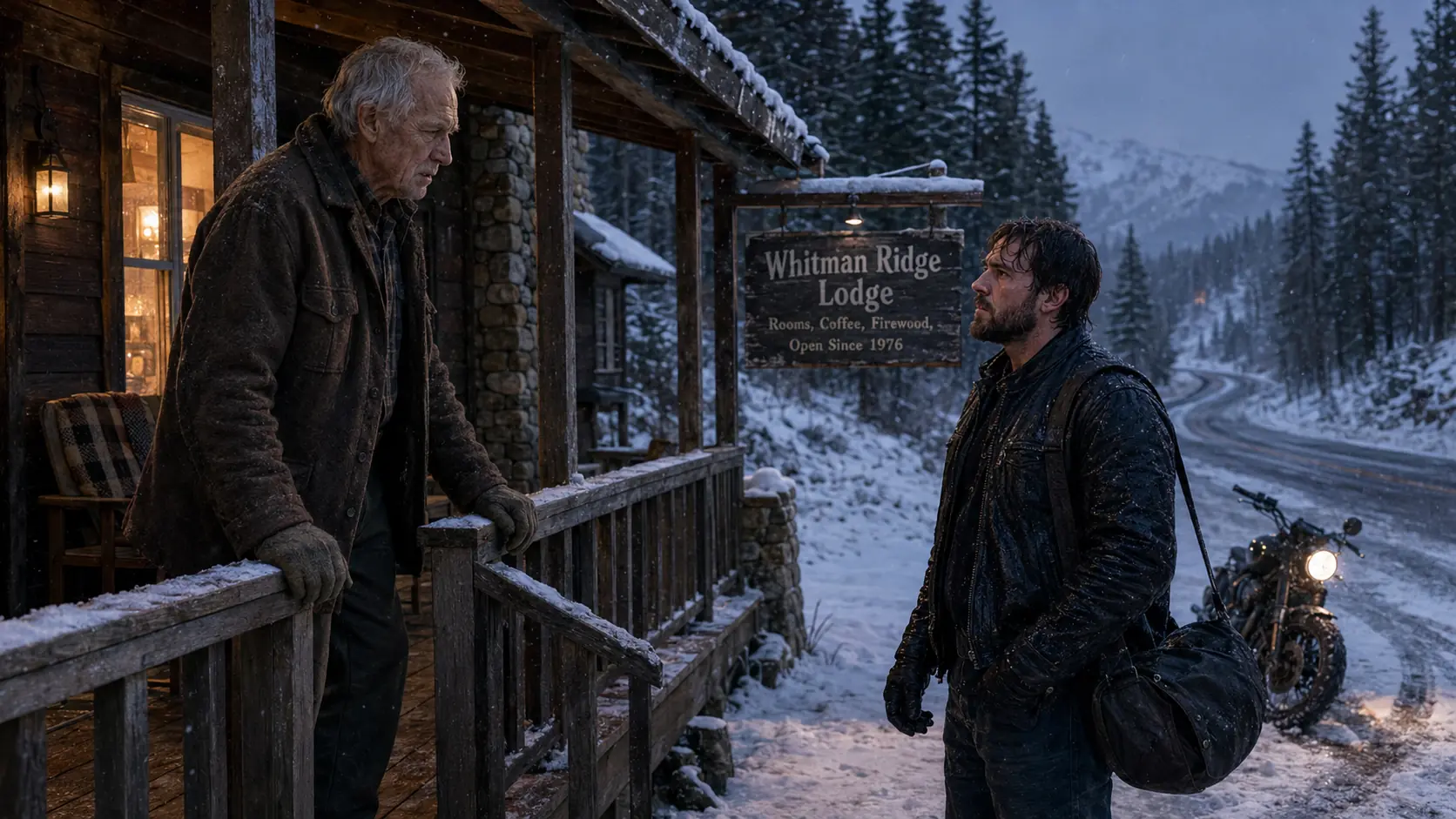
“I’m asking.”
“Then no.”
“That means yes.”
Arthur would grumble and hang up.
Caleb always came anyway.
By the time Arthur turned eighty-four, Whitman Ridge Lodge was in serious trouble.
Not just quiet.
Trouble.
The roof over the west wing needed replacement. Two guest rooms could no longer be rented. The insurance company demanded safety repairs on the porch stairs and the old chimney. The heating system needed major work. The county sent inspection notices. A developer had offered to buy the property and turn it into luxury cabins with private hot tubs.
Arthur hated that phrase.
Private hot tubs.
As if mountains existed to soak in.
His son Daniel came up from Denver one weekend and walked through the lodge with him.
“Dad,” he said softly, “you can’t keep fighting this place.”
Arthur stood in the lobby beneath the old photographs.
“I know.”
That answer frightened Daniel.
“You know?”
Arthur looked toward the fireplace, where Elise had once warmed her hands every morning.
“I know it’s winning.”
The repair estimate arrived the next week.
Arthur opened it at the front desk.
The number was impossible.
He folded it, placed it beneath Elise’s old guest book, and sat in silence for a long time.
He did not tell Caleb.
But Caleb noticed.
He came by that Friday and found Arthur taking framed photographs off the lobby wall.
“What are you doing?” Caleb asked.
“Dusting.”
“You hate dusting.”
“I hate dust more.”
“You’re lying badly.”
Arthur sighed.
“You learned that from me.”
Caleb walked to the front desk and saw the estimate beneath the guest book.
Arthur did not stop him.
Caleb read it.
His face hardened.
“They’re pricing you out.”
“The roof is pricing me out. The chimney is assisting.”
“And the developer?”
Arthur looked away.
Caleb saw the offer letter too.
“No.”
“That word doesn’t fix roofs.”
“Do you want to sell?”
Arthur’s jaw tightened.
“No.”
“Then we don’t start there.”
“It’s too much, Caleb.”
“No. It’s a lot. That’s different.”
Arthur sat slowly in the old chair near the fireplace.
“I’m tired.”
Caleb’s expression softened.
“I know.”
“I don’t have Elise anymore. I don’t have staff. I don’t understand online bookings. I can’t carry enough firewood. I can’t repair the roof. Rooms sit empty. The place is too big for one old man.”
Caleb sat across from him.
“You took me in when I was too cold to think straight. You didn’t ask if I deserved it. You didn’t ask if I could repay it. You just opened the door.”
“That was one night.”
“That night taught me how a place should treat a stranded person.”
Arthur looked at him.
Caleb leaned forward.
“Let me bring people back to this place.”
“What does that mean?”
“It means I have a plan.”
Arthur groaned.
“I hate plans from men with toolboxes.”
“This one has both tools and numbers.”
“Worse.”
Caleb returned the following week with Evan, Daniel, and a folder thick enough to make Arthur suspicious.
The plan was not to turn Whitman Ridge Lodge into a luxury resort.
Caleb knew better.
Instead, he proposed a partnership between Morgan Road Works and the lodge.
In summer and fall, the lodge would become a rider-friendly mountain stop: safe rooms, secure bike parking, repair tools, coffee, simple meals, route maps, and emergency support for travelers crossing the pass. In winter, it would operate as a small storm shelter lodge with limited rooms, hot meals, and support for stranded travelers when roads became dangerous.
Caleb’s shop would sponsor a small repair barn on the property for motorcycles and snow equipment. Riders would come for weekend maintenance workshops, mountain safety classes, and charity rides supporting lodge repairs. Daniel would help set up online booking and manage finances. Evan knew contractors who could work at reduced cost. Several riders Caleb had helped over the years were willing to volunteer labor and donate.
The lodge would stay Arthur’s.
But he would not run it alone.
Arthur stared at the proposal.
“You want bikers sleeping in Elise’s rooms again.”
Caleb smiled.
“They used to, right?”
“In summer. Not in blizzards.”
“We’ll have rules.”
“Bikers and rules?”
“You like rules.”
“I like my rules.”
“That’s what we’ll use.”
Arthur turned the page and saw a sketch of the restored barn.
Whitman Ridge Road Barn
Repairs, Coffee, Safe Roads
Then a sketch of the front sign restored:
Whitman Ridge Lodge
Rooms, Fire, Coffee, Shelter Since 1976
Arthur’s hand stopped on the word Shelter.
“Elise would like that,” Daniel said quietly.
Arthur looked at his son.
Daniel’s eyes were wet.
“She always said the lodge was for whoever the weather brought in.”
Arthur looked toward the fireplace.
The room was quiet.
Finally, he said, “No hot tubs.”
Caleb smiled.
“No hot tubs.”
“No fake rustic nonsense.”
“Agreed.”
“No renaming the rooms after mountain animals.”
“Fine.”
“No website photos of me looking wise beside the fireplace.”
Caleb hesitated.
Arthur pointed at him.
“No.”
“Fine. No wise fireplace portrait.”
The work began in spring.
Arthur complained every day.
He complained about contractors.
He complained about online booking.
He complained about new fire alarms.
“The old ones worked.”
“The old ones were disconnected,” Daniel said.
“They worked emotionally.”
He complained about the repaired porch.
“The new boards are too smooth.”
“They’re safe.”
“Safe boards lack personality.”
Caleb repaired the barn first.
Then the porch.
Then the chimney.
The roof took longer, but a group of riders organized a benefit ride called Ride To The Ridge. More than eighty motorcycles came up the mountain in June, filling the gravel lot with engines, laughter, and people carrying donations, tools, and stories.
Arthur stood on the porch, arms crossed.
“This is too many motorcycles.”
Caleb grinned.
“You once had bikers here all summer.”
“That was before they organized.”
“They brought money.”
“That improves the noise.”
The first official Ride To The Ridge weekend sold out every available room.
The lodge felt alive again.
Riders sat by the fireplace drinking coffee. Evan ran basic maintenance checks in the barn. Daniel helped guests check in using a tablet Arthur referred to as “the glowing clipboard.” Caleb led a route safety talk before a mountain ride. Arthur made stew, though he insisted he was only making enough for “reasonable people,” then fed everyone.
That evening, after dinner, Caleb stood in the lobby and tapped a spoon against a mug.
Arthur immediately said, “No speeches.”
“One.”
“Too many.”
People laughed.
Caleb stood beside the fireplace.
“Years ago, I was stranded on this mountain in freezing rain. My bike had trouble, my phone was dead, and I was too cold to make good decisions.”
Arthur looked down.
“Arthur Whitman opened this door. He gave me dry clothes, stew, a room, a landline, a barn for my father’s bike, and a ride to my brother’s shop the next morning.”
The room grew quiet.
“He told me I could repay him by showing up. That became the rule I built my life around.”
Arthur’s throat tightened.
Caleb looked around the lodge.
“This place was built for showing up. For travelers, riders, families, storm nights, and anyone the mountain catches unprepared. We are not saving an old building because it is old. We are keeping a door open because every road needs one.”
The applause filled the lodge.
Arthur turned toward the fireplace and poked the logs unnecessarily.
No one believed he needed to.
Years passed.
Whitman Ridge Lodge became known again, not as a fancy destination, but as something better: a safe place.
Riders stopped there all summer. Families came in fall. Stranded travelers found warmth in winter. The repair barn helped people with flat tires, dead batteries, broken chains, and frozen equipment. The lodge hosted safety weekends, simple dinners, and charity rides for mountain rescue funds, road awareness, and community support.
Arthur worked fewer hours but had more purpose.
Daniel handled bookings.
Caleb and Evan managed the repair barn partnership.
A local cook helped with meals.
A college student worked weekends at the desk.
Arthur still made stew when weather turned bad.
He still kept the fireplace ready.
He still checked the porch light every night.
On Arthur’s eighty-seventh birthday, Caleb, Daniel, and the lodge regulars organized a dinner in the lobby.
Arthur said he did not want a party.
They called it “a lodge maintenance meeting with cake.”
He attended.
The fireplace glowed. Snow fell gently outside. The lobby walls were filled again with photographs: old guests from the 1980s, Elise smiling beside a stew pot, Caleb’s motorcycle in the barn after the storm, the first Ride To The Ridge weekend, families by the fireplace, riders on the porch.
After dinner, Caleb handed Arthur a small wooden box.
Arthur sighed.
“Gifts are dangerous.”
“Open it.”
Inside was a brass key attached to a piece of polished metal from Caleb’s old broken saddlebag bracket.
Engraved on it were the words:
The Door Stayed Open
Arthur stared at it.
“This from your father’s bike?”
Caleb nodded.
“The bracket that broke the night I got stranded.”
Arthur closed his fingers around it.
“Elise would call this sentimental.”
“Yes.”
“She would keep it.”
“I hoped so.”
Arthur looked around the room.
At Daniel.
At Caleb.
At the riders and neighbors.
At the fire.
At the lodge no longer dying quietly.
He cleared his throat.
“I suppose,” he said, “the mountain brought me some useful trouble.”
Everyone laughed.
Later that night, after the guests went to bed, Arthur and Caleb sat by the fireplace.
Snow tapped softly against the windows.
“You saved my lodge,” Arthur said.
Caleb shook his head.
“You gave me shelter first.”
“I gave you stew and a room.”
“You gave me a rule.”
“What rule?”
Caleb smiled.
“Show up.”
Arthur looked into the fire.
For years, he had feared the lodge would become only a place full of old echoes. But now it held new voices, new boots by the door, new stories drying out beside the fire.
Elise’s lodge was still doing what she had built it to do.
Weather brought people in.
Warmth kept them alive.
Kindness gave them somewhere to remember.
Years earlier, Arthur Whitman had taken a frozen biker into his house during a mountain storm. He gave him dry clothes, hot stew, a bed, a working phone, shelter for his motorcycle, and a ride the next morning.
He thought he was helping one reckless rider survive one bad night.
But one open door can become a road back.
Caleb built his life around that night, and when Arthur’s lodge was the thing stranded, aging, and nearly out of time, Caleb returned with riders, tools, repairs, bookings, family, and gratitude strong enough to keep the fire burning.
What Arthur received was not just a restored roof or a rescued business.
He received Elise’s dream alive again.
He received a chosen son in Caleb, a road family in the riders, and proof that a lodge is not measured by how many rooms it has, but by how many people find warmth there when the road turns cruel.
And every winter night after that, when snow covered Whitman Pass and a lonely headlight slowed near the drive, Arthur would set another log on the fire, turn on the porch light, and mutter,
“Well, Elise, let’s see who the mountain sent us this time.”