“You’re in the wrong line, sir.”
Harold Whitcomb stood beneath the crystal chandelier of Whitcomb National Bank with a weathered envelope held carefully in both hands. He was eighty-one years old, wearing a brown corduroy jacket shiny at the elbows, a faded white shirt, loose gray trousers, and shoes that had seen more winters than most people in that lobby had seen hard days. Around him, the private banking floor gleamed with marble, brass rails, velvet ropes, fresh lilies, and gold letters that reflected in the polished floor like a promise of money. Harold looked out of place only to people who believed dignity had a dress code.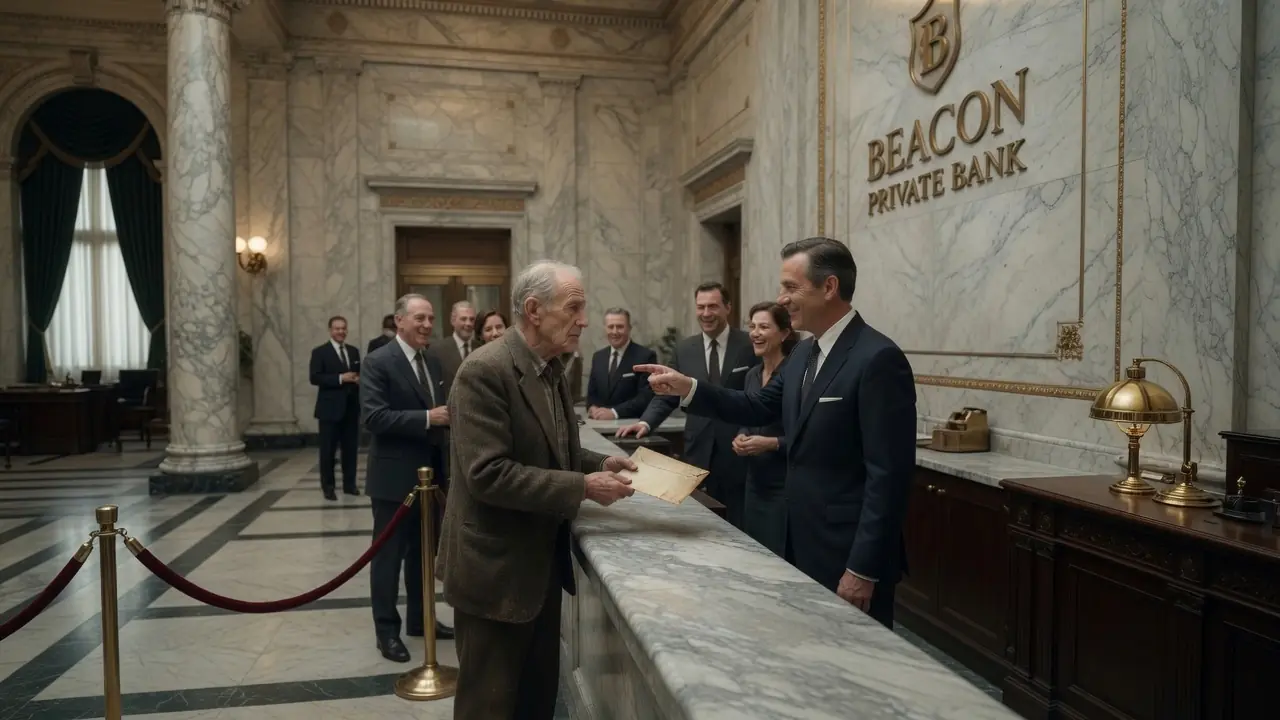
The man speaking to him was Richard Vale, the branch manager, dressed in a navy suit that fit like money had tailored it personally. Richard stood on the other side of the velvet rope with one hand lifted toward the public teller area, his smile polished but cruel at the edges. Behind him, two younger employees tried not to laugh, while a blonde woman in a cream suit covered her smile with her fingers. A few wealthy clients turned their heads, entertained by the interruption in their quiet morning.
Harold looked at the velvet rope, then back at Richard. “Is that so?”
Richard’s smile tightened. “Yes, sir. This side is reserved for private clients.”
“I am aware.”
Richard glanced at Harold’s worn jacket, the old envelope, and the frayed cuff at his wrist. “Then you should also be aware that private clients have scheduled appointments, managed portfolios, and account verification.” He lowered his voice, but not enough to hide the insult. “They don’t walk in off the street clutching old mail.”
Harold did not answer immediately. He looked past Richard at the tall marble columns, the gold bank seal above the reception desk, and the balcony where executives sometimes stood during charity events. He remembered the lobby before the gold trim, before the luxury lighting, before young men like Richard decided they could measure a person’s worth by shoes. The building had changed, but Harold knew every inch of it.
“I came to see the branch director,” Harold said.
Richard laughed softly. “You and everyone else with a complaint.”
“I don’t have a complaint.”
“Then what do you have?”
Harold lifted the envelope slightly. “A reason.”
That made one of the younger employees laugh under his breath. Richard turned just enough to silence him with a look, but the damage had been done. Harold saw the amusement spread across their faces, the quick glances, the quiet assumption that he was confused, poor, or lonely. He had lived long enough to know when people were laughing at him without fully opening their mouths.
Richard leaned closer. “Sir, this bank handles serious business. If you need basic account help, the retail counter is on the left.”
Harold’s eyes stayed steady. “Who decided which customers deserve respect?”
The question cut through the lobby more sharply than Richard expected. A man near the coffee bar lowered his cup. A woman at the private reception desk stopped typing. Richard’s smile faded for half a second, then returned thinner than before.
“Respect is earned by behaving appropriately,” Richard said.
Harold nodded slowly. “And what have I done wrong?”
“You are disrupting a private client area.”
“I asked one question.”
“You refused direction.”
“I asked to see the branch director.”
Richard’s face hardened. “Clients like you don’t belong in this lobby.”
The silence that followed was heavy enough to make several people look down. Harold did not flinch, but something in his expression changed. It was not anger exactly. It was the look of a man who had found the answer he came searching for and hated that the answer was worse than he expected.
He lowered the envelope to the counter. “Say that again.”
Richard blinked. “Excuse me?”
“Say it again clearly, Mr. Vale.”
Richard’s eyes narrowed. “You don’t belong here.”
Harold opened the envelope.
Inside were several folded papers, yellowed with age but protected in a plastic sleeve. Harold removed the top document slowly, giving the room enough time to notice the embossed seal at the bottom. Richard glanced at it with irritation first, then confusion. The blonde woman behind him stopped smiling.
Harold placed the document on the marble counter. “Then you should have checked whose name is on the building before you said that.”
Richard looked down.
The first words on the page read: Whitcomb Family Land Trust.
The manager’s expression changed so quickly that the employees behind him noticed before he could hide it. His eyes moved over the legal language, the property address, the trust seal, and the signature dated forty-seven years earlier. The private banking lobby sat inside a building leased from the Whitcomb Family Land Trust, and Richard Vale had just told Harold Whitcomb he did not belong there.
Richard swallowed. “Where did you get this?”
Harold looked at him. “From my father’s desk.”
“This could be a copy.”
“It is a copy.”
Richard exhaled, almost relieved.
Harold reached back into the envelope and placed another document beside the first. “This is the original trustee certification.”
The relief left Richard’s face.
A security guard near the front doors stepped closer, unsure whether to intervene or disappear. The lobby had gone perfectly still. The old man in the worn jacket was no longer entertainment. He had become a problem with paperwork.
Richard lowered his voice. “Mr. Whitcomb, perhaps we should step into a private office.”
Harold looked around the lobby. “Why?”
“To discuss this matter properly.”
“You were comfortable discussing whether I belonged here in public.”
Richard’s jaw tightened.
Harold slipped a third paper from the envelope. This one was newer, printed on heavy cream paper, with a clean signature line and a gold notary seal. “I came here today because my niece told me something I didn’t want to believe.”
Richard said nothing.
“She said this branch had started turning away elderly clients, small depositors, and people who didn’t look wealthy enough for your lobby.” Harold’s voice remained calm, but every word carried. “She said a retired schoolteacher was told to use the outside ATM because her coat looked dirty. She said a man with a factory pension was asked whether he was lost. She said respect had become a premium service.”
A woman sitting near the private lounge looked away.
Richard’s face flushed. “Those are isolated misunderstandings.”
Harold turned toward the receptionist. “Are they?”
The young woman behind the desk froze. Her name tag read Julia. She looked at Richard first, then at Harold, then at the security guard. Fear moved across her face before honesty did.
Harold’s voice softened. “You won’t lose your job for telling the truth.”
Richard cut in. “Mr. Whitcomb, this is inappropriate.”
Harold looked at him. “So was your first sentence.”
Julia’s hands trembled over her keyboard. “There have been complaints,” she said quietly.
Richard turned on her. “Julia.”
She flinched, then kept going. “Mostly older customers. Some people who came in for trust questions. Some people asking about small business loans. If they looked… not private banking material, they were redirected before anyone checked their files.”
The lobby remained silent.
Harold nodded once. “Thank you.”
Richard’s voice dropped. “This is a gross mischaracterization.”
Harold lifted the newer document. “This is a notice of lease covenant review. My family’s trust owns the ground and the building structure. The bank owns the fixtures, branding, and interior build-out, but it operates here under a lease agreement that includes a public-service covenant written by my father in 1976.”
Richard’s face turned pale.
Harold continued, “The covenant says the bank must maintain nondiscriminatory access for lawful customers and community members seeking financial services. It was added because my father believed a bank with his family name on the stone should never become a palace that frightened ordinary people away.”
The man near the coffee bar whispered, “Oh my God.”
Richard reached for the document. Harold pulled it back before his fingers touched it.
“No,” Harold said. “You had your chance to handle paper respectfully.”
The words struck Richard harder than shouting would have.
A side elevator opened near the far wall. Meredith Lane, the senior branch director, stepped out with two executives beside her. She had been called by someone from the reception desk, and her face showed the controlled alarm of a person walking into a disaster already in progress. Her eyes landed on Harold first, then the papers, then Richard.
“Mr. Whitcomb,” she said quickly. “I’m Meredith Lane. I’m so sorry I wasn’t informed you had arrived.”
Harold looked at Richard. “Neither was I.”
Meredith understood immediately. “What happened?”
Richard spoke first. “There was confusion at the private banking line.”
Harold turned to him. “Confusion is when both people lack information. You had arrogance.”
The security guard lowered his eyes.
Meredith stepped closer to the counter. “Mr. Whitcomb, I apologize for any discourtesy.”
Harold looked at her. “You don’t know yet what you’re apologizing for.”
That stopped her.
He placed the covenant review notice on the counter and slid it toward her. “I came here to decide whether this bank deserves renewal of its flagship lease.”
The words emptied the color from Meredith’s face. Behind her, one executive whispered something to the other. Richard went completely still.
“This building,” Harold continued, “was never meant to be a monument to rich clients. My father built it after the old neighborhood bank denied him a farm expansion loan because he walked in wearing work pants. He said if our family ever had the chance to own a bank building, the first rule would be that no honest person would be made to feel small inside it.”
Harold’s voice wavered for the first time.
He looked at the chandelier above them. “My father laid the first stone here with cracked hands. My mother polished the original brass doors herself before opening day because the contractor left streaks. I was twenty-nine when this lobby welcomed its first customer, and that customer was a janitor depositing seventeen dollars.”
No one moved.
Harold turned back to Richard. “Would you have let that man stand in this line today?”
Richard’s mouth opened, but no answer came.
“That is why I came,” Harold said.
Meredith looked at the document in front of her. “Mr. Whitcomb, may we speak upstairs?”
Harold studied her for a long moment. “Only after Mr. Vale answers my question.”
Richard stiffened. “What question?”
Harold placed both hands on the counter. “Who decided which customers deserve respect?”
Richard looked at Meredith. She gave him nothing.
“I did not mean—”
“That is not an answer.”
Richard’s polished confidence had cracked completely now. He looked around the lobby, but the people who had laughed earlier were no longer his audience. They were witnesses.
“I made a judgment,” Richard said finally.
“Based on what?”
Richard swallowed.
Harold waited.
Richard looked down at Harold’s shoes, then away. “Appearance.”
“And age?”
Richard closed his eyes briefly. “Yes.”
“And whether you believed I had money?”
“Yes.”
Harold nodded slowly. “There. Now we have honesty.”
Meredith’s voice was quiet. “Richard, step away from the desk.”
He looked at her, startled. “Meredith—”
“Now.”
Richard stepped back.
The movement changed the room. Power shifted, not loudly, but visibly. The manager who had pointed toward the exit now stood beside the wall, silent, while the old man he dismissed remained at the counter with the building’s future in his envelope.
Harold turned to Julia. “Would you please call upstairs and inform the board liaison that Harold Whitcomb has arrived?”
Julia nodded quickly. “Yes, sir.”
“And ask whether they still want the lease renewal meeting.”
Her hands paused.
Harold looked toward Meredith. “Because I am no longer sure I do.”
Meredith inhaled sharply. “Mr. Whitcomb, the bank’s relationship with your family trust is essential to this institution.”
Harold smiled sadly. “Funny. Ten minutes ago, your manager believed I was not essential enough to stand here.”
That sentence seemed to echo against the marble.
Upstairs, the meeting room filled within minutes. Harold sat at the end of a long glass table with his envelope placed neatly in front of him. Across from him sat Meredith, two regional executives, a legal counsel, and a board liaison whose perfectly calm face could not hide the panic in his eyes. Richard was not invited into the room.
Before anyone began, Harold asked for Julia to be present.
Meredith hesitated only briefly before agreeing. Julia entered quietly, looking terrified, and sat near the wall with a notebook in her lap. Harold gave her a small nod, as if to remind her that truth had already entered the building and did not need permission to stay.
The board liaison began with formal apologies.
Harold listened.
He heard phrases like “deep regret,” “client experience failure,” “isolated incident,” and “corrective review.” The words were smooth, expensive, and mostly empty. Harold had heard men use language like that when they wanted consequences to dissolve into process.
When the liaison finished, Harold opened the envelope again and removed a fourth document.
“My father wrote something on the back of the original lease,” Harold said.
The room quieted.
“It was not legally required. It was not even witnessed properly. But he wrote it because he wanted every trustee after him to understand the spirit of what he had built.”
Harold unfolded the page and read slowly.
“No bank carrying our name shall become a place where polished shoes matter more than honest hands. If the marble ever forgets the dirt it came from, take back the keys.”
No one spoke.
Harold folded the page carefully. “I am the last living trustee who knew my father. My children want to sell the building to a real estate fund. The bank wants a thirty-year renewal. This morning was my final visit before deciding whether to sign.”
Meredith’s face tightened. “And now?”
“Now I know the marble has forgotten.”
Julia looked down, eyes wet.
The legal counsel leaned forward. “Mr. Whitcomb, with respect, a single employee’s misconduct may not reflect the entire institution.”
Harold turned toward Julia. “How many complaints?”
The room froze.
Julia looked at Meredith, then at Harold.
Meredith said softly, “Answer.”
Julia opened her notebook with trembling fingers. “Formal complaints? Twenty-six in the past eighteen months.”
The legal counsel closed his mouth.
Julia continued, voice stronger now. “Informal incidents? More. A lot more. Older customers redirected. Working-class clients discouraged from entering private reception. People told they needed appointments when they didn’t. Small business applicants made to wait while wealthier clients were served first.”
Harold looked at Meredith. “Did you know?”
Meredith’s face was pale. “Not the full extent.”
“That is not no.”
“No,” she admitted. “It is not.”
The room sat inside that answer.
Harold looked out the window toward the city. “My father used to say a bank does not reveal its soul when a millionaire walks in. It reveals its soul when a tired woman asks for help with a fee, when a widower brings a small check, when a farmer comes in muddy, when an old man stands in the wrong line.”
Meredith whispered, “What do you want us to do?”
Harold turned back. “Earn the renewal.”
The board liaison sat straighter. “What would that require?”
Harold had already prepared the answer. He removed one final document from the envelope. This one was typed, recent, and marked Draft Conditions for Lease Renewal.
“Independent audit of client access practices,” Harold said. “Public apology from this branch. Removal of Richard Vale from client-facing authority pending investigation. A new service desk for elderly and low-income customers, staffed by trained employees, not hidden in the back. Quarterly reporting to the trust. Protection for employees who report discriminatory treatment. And a community lending fund named after my father and mother.”
The legal counsel looked at the list as if it were a storm forecast.
Meredith did not argue. “How large a fund?”
Harold’s eyes stayed steady. “Twenty million dollars.”
The board liaison nearly choked. “Mr. Whitcomb—”
Harold lifted a hand. “The bank announced a record executive bonus pool last quarter. Do not tell me dignity is too expensive.”
Meredith looked at the liaison, then at Harold. Something changed in her face. Maybe she understood the moral weight of the moment. Maybe she understood the financial risk. Maybe, for the first time in too long, both pointed in the same direction.
“I will recommend acceptance,” she said.
Harold nodded. “No. You will recommend more than acceptance. You will recommend belief.”
By evening, Richard Vale was gone from the branch. The official language said administrative leave pending review, but everyone knew what had happened. Julia was interviewed by HR and legal, along with several tellers, security staff, and customers who had submitted complaints. By the next morning, the bank issued a public apology that did not use the word confusion.
Harold read it at his kitchen table in the small house where he had lived since his wife died. The apology was better than he expected and not as good as his father would have demanded. Still, it was a start. He placed the newspaper beside the old envelope and stared at his father’s handwritten line.
If the marble ever forgets the dirt it came from, take back the keys.
Two weeks later, Harold returned to the bank.
This time, no one stopped him at the velvet rope. Julia met him at the door personally, now wearing a small gold pin that identified her as Client Access Supervisor. Meredith stood near the reception desk, not smiling falsely, not overperforming apology, simply present.
“Good morning, Mr. Whitcomb,” Julia said.
“Good morning.”
The lobby looked the same at first glance, but Harold noticed the changes. A new desk had been placed near the entrance, with chairs instead of standing counters. The sign above it read Community Client Services. An elderly couple sat there speaking with a patient banker. Near the private reception line, the velvet rope had been moved back, no longer forming a barrier that looked like a quiet warning.
Harold watched for several minutes without speaking.
Meredith approached. “It is not enough yet.”
“No,” Harold said. “It is not.”
“But it is moving.”
He nodded. “Yes.”
She handed him a folder. “The board approved the Whitcomb Community Lending Fund. Twenty million dollars initial allocation. Annual review. Your parents’ names attached, as requested.”
Harold took the folder but did not open it. “My father would have pretended not to cry.”
Meredith smiled faintly. “Would you like to see the plaque?”
He followed her to the main lobby wall, where a new brass plaque had been installed beneath the bank seal. It read:
Founded on the belief that honest hands deserve open doors.
In honor of Samuel and Ruth Whitcomb.
Harold stood before it for a long time.
He thought of his father’s cracked hands, his mother polishing brass doors, the first janitor depositing seventeen dollars, and Richard Vale pointing toward the exit. He thought of how quickly institutions forget their own beginnings when money teaches them arrogance. Then he thought of the old envelope, worn soft by years in a drawer, carrying enough memory to make marble answer for itself.
Julia stood nearby. “Mr. Whitcomb?”
He turned.
“I wanted to thank you,” she said. “For asking me to speak.”
Harold looked at her kindly. “You already knew the truth.”
“I was afraid to say it.”
“That happens.”
She looked down. “I wish I had said it sooner.”
Harold nodded. “Then say it sooner next time.”
She smiled through tears. “I will.”
Months passed, and the bank changed slowly, then visibly. The audit revealed patterns no one could dismiss. Employees who had been ignored began speaking. Customers who had once felt unwelcome returned cautiously. The community lending fund approved its first loans to a small bakery, a neighborhood repair shop, a retired nurse starting a home-care service, and a young farmer buying equipment after two larger banks turned him away.
Harold attended the first fund ceremony only because Julia insisted.
He wore the same brown jacket.
This time, nobody laughed.
A young banker offered him coffee before asking his name, and Harold accepted because respect offered before recognition deserved encouragement. Meredith introduced him quietly to the first loan recipients, but Harold refused to make a speech. He only shook their hands and told each one, “Pay it forward when you can.”
Near the end of the ceremony, an old janitor approached him. He had worked in the building for twenty-three years and had never spoken to Harold before.
“Mr. Whitcomb,” the man said, holding his cap in both hands, “my father was the first customer here.”
Harold stared at him.
“He deposited seventeen dollars,” the janitor said. “He told that story until the day he died.”
Harold’s eyes filled. “What was his name?”
“Thomas Reed.”
Harold smiled slowly. “My father remembered him.”
The janitor looked surprised. “He did?”
“He said Mr. Reed made the bank real.”
The old man’s face crumpled with emotion. For a moment, the two men stood together under the chandelier, both connected to a morning long before the marble forgot and long before an envelope had to remind it. Julia watched from the desk, wiping her eyes.
A year later, Harold signed the lease renewal.
Not for thirty years. For ten, with review rights and strict covenant enforcement. The board did not love the terms, but they signed because the building mattered, the public story mattered, and because Harold had learned not to give long trust to people who had only recently remembered how to earn it.
After the signing, Meredith walked him to the lobby.
“Do you ever regret not selling the building?” she asked.
Harold looked around at the people waiting in line. A construction worker in dusty boots. A woman with a cane. A young couple holding a folder. A man in a suit. No one had been moved aside. No one was being quietly judged out of place.
“No,” Harold said. “Buildings are like people. Sometimes they need correction more than replacement.”
Meredith nodded. “And Richard Vale?”
Harold’s expression did not change. “What about him?”
“He wrote a letter. He asked that it be forwarded.”
Harold accepted the sealed envelope but did not open it until he got home. Richard’s apology was longer than expected. It admitted arrogance, class judgment, cruelty, and fear disguised as professionalism. It said he had mistaken wealth for worth because the bank rewarded him for doing so.
Harold read it twice.
Then he placed it inside the old envelope with the deed, the covenant, and his father’s note. Not because Richard’s apology erased what happened, but because it belonged with the evidence. A building’s history should include both its failures and its repairs.
Years later, people still told the story of the old man in the worn brown jacket who was mocked in the private banking line and then opened an envelope that made every confident face lose its color. Some told it like revenge. Some told it like a business lesson. Some told it like a warning that you never know who someone is.
Harold disliked that version most.
To him, the lesson was not that Richard should have respected him because he was a Whitcomb. The lesson was that Richard should have respected him before he knew. Respect that arrives only after proof of power is not respect. It is calculation.
The old envelope stayed in Harold’s desk after that.
Sometimes he would take it out, unfold his father’s handwritten note, and read the line again. If the marble ever forgets the dirt it came from, take back the keys. Then he would look out his window toward the city and think of every person standing in the wrong line, waiting for someone to decide whether they belonged.
And because one old man had refused to step aside, the doors stayed open a little wider for all of them.