In a small garage in a stormy harbor town, an old mechanic sat sipping his coffee after a long, tiring day.
Then a soaked young man walked in, begging for a job.
At first, the old man felt irritated.
His rare, quiet afternoon was gone.
But the boy’s determination and the reason behind his request were impossible to ignore.
The old man handed him a wrench, testing what he could do.
What he didn’t know was that this moment would change his life forever.
The rain had been falling since dawn, the kind that came steady and fine, stitching the gray sky to the gray earth in one endless thread.
Harborfield, Maine, was half asleep beneath it.
Streetlights still burned long past sunrise, casting their amber halos over puddles that trembled with every drop.
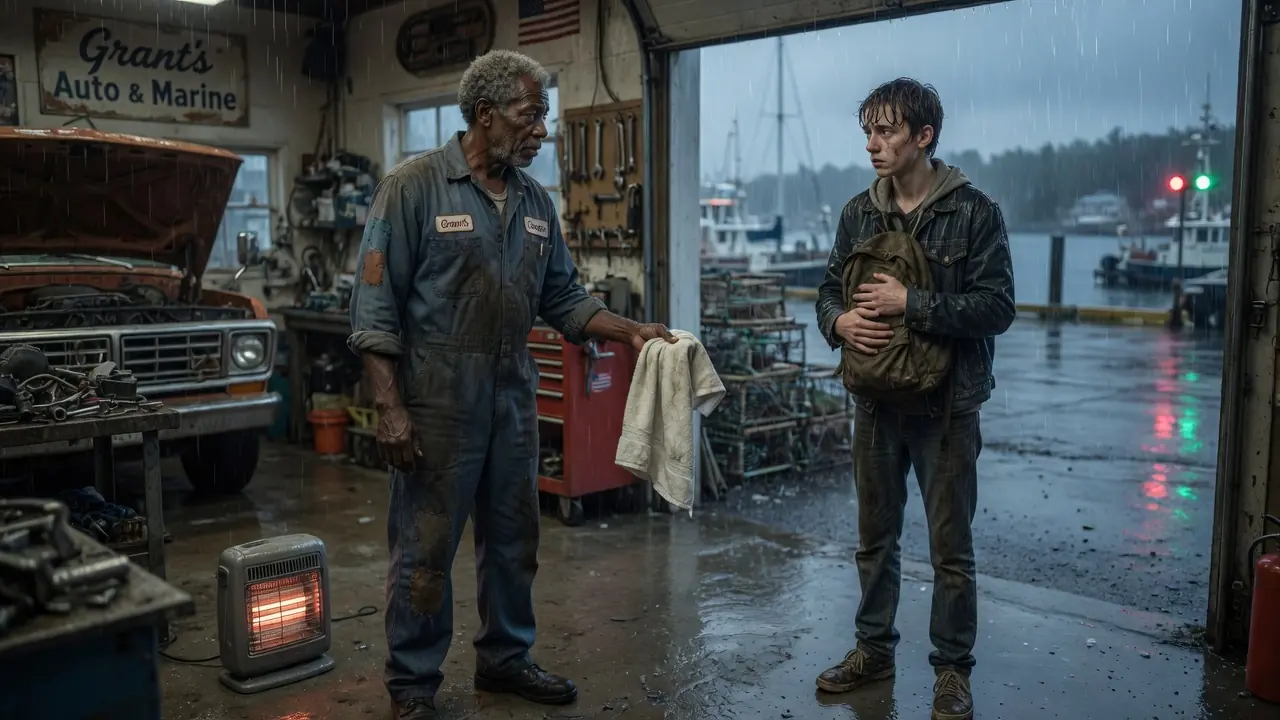
Inside a narrow auto repair shop near the docks, Samuel Grant stood over the hood of a rusted pickup, his breath misting in the cold air.
The space smelled of oil, iron, and salt.
A small radio played old swing tunes through static.
The rain drummed on the tin roof, slow and hypnotic.
Samuel was 68, a man carved out of silence and steel.
His hands were scarred and steady.
The blue coveralls he wore were patched in places no one else would notice, but he did, because he fixed things, and fixing was what kept him from falling apart.
A kettle whistled softly from the corner of the shop.
He poured himself a mug of coffee and stared through the fogged window at the wet street outside.
Then he saw him.
A boy.
No, a young man, maybe 18, standing in the rain, thin shoulders hunched beneath a denim jacket dark with water.
He hesitated near the door, shifting from foot to foot, glancing at the faded sign.
Grant’s Auto and Marine Repair.
Samuel frowned.
He set his mug down, wiped his hands on a rag, and watched as the boy finally stepped forward and knocked.
“Come in,” Samuel called, voice gravelly, but not unkind.
The door creaked open, letting in a gust of damp air and the smell of the sea.
The boy entered, dripping onto the concrete floor, clutching a worn backpack to his chest.
“Sir,” he said softly. “Are you Samuel Grant?”
“That’s what it says on the door,” Samuel replied. “What’s the trouble? Your car give up?”
The boy swallowed hard.
“No, sir. I don’t have a car.”
He hesitated, then blurted,
“I need a job.”
Samuel blinked.
“In this weather?”
“I can do anything. Clean tools, sweep floors, whatever you need. I just really need to work.”
The boy’s voice trembled, but not from the cold.
Samuel recognized that kind of tremor, the one that came from holding too much fear inside for too long.
“What’s your name?”
“Eli. Eli Turner.”
Samuel gestured toward a stool near the heater.
“You’re soaked through, Eli Turner. Sit down before you catch pneumonia.”
Eli obeyed, perching awkwardly, eyes darting around the shop at the rows of neatly hung wrenches, the half-dismantled engine block on the workbench, and the -and-white photograph taped to the cabinet.
A younger Samuel stood beside an older man with an Irish grin and a grease-stained cap.
“That your father?” Eli asked.
Samuel followed his gaze.
“No. My teacher. Declan O’Rourke.”
His tone softened briefly, then turned brisk again.
“So, what kind of work are you looking for?”
“Any kind. I can learn fast.”
Samuel raised an eyebrow.
“You ever held a wrench before?”
Eli looked down.
“Not really. I fix things at home sometimes. Our heater, our old microwave. But not cars.”
Samuel took a sip of coffee, studying him over the rim.
“And what brings you to me? There are other garages in town.”
“I heard you don’t turn people away,” Eli said. “That you help folks when you can.”
The words landed like a pebble dropped into still water.
Samuel said nothing.
The rain outside filled the silence.
Eli swallowed.
“It’s my mom. She’s sick. Real sick. The hospital in Portland said there’s a treatment, some kind of trial, but insurance won’t cover it. I tried everywhere. I just need to earn enough to...”
He broke off, his throat closing around the rest.
Samuel rubbed a hand across his chin.
The boy’s voice carried a desperation he knew too well.
The sound of someone standing at the edge with nowhere left to go.
“How much are we talking about?”
“Twenty thousand,” Eli whispered. “We’ve got less than two.”
Samuel let out a low whistle.
“That’s a mountain, son.”
“I’ll climb it,” Eli said fiercely. “If you let me start here, I’ll work day and night.”
Samuel turned away, pacing slowly.
He could almost hear Declan’s voice in his head, that soft Irish lilt.
“You never go broke by being kind, lad. But kindness will cost you more than money sometimes.”
He stopped by the old truck and looked back at Eli.
The boy’s hands were clenched together so tightly his knuckles were white.
“You any good with your hands?”
“I can learn,” Eli said again.
Samuel tossed him a wrench.
“Then let’s see. That truck there needs new brake pads. You mess it up, you’ll owe me double. You get it right, maybe we’ll talk about a job.”
Eli caught the wrench awkwardly, but nodded, eyes bright with determination.
For the next two hours, the rain didn’t stop.
Neither did Eli.
Samuel watched in silence as the boy crouched beside the truck, following instructions Samuel gave in curt sentences.
His movements were hesitant at first, then steadier, guided by sheer focus and fear of failing.
He slipped once, scraping his knuckles, but didn’t complain.
He double-checked every bolt, cleaned every part as though it mattered more than anything else in the world.
When he finished, Samuel ran a practiced eye over the work.
The pads were aligned, bolts tightened, grease applied properly.
Not perfect, but more than decent.
“Well,” Samuel muttered. “You didn’t kill the truck. That’s something.”
Eli grinned, the first real light on his face all morning.
“So, I passed?”
“You passed enough to get dirty again tomorrow. Start at eight sharp.”
Eli exhaled shakily.
“Thank you, sir.”
Samuel nodded toward the small space heater.
“Warm yourself before you go. No sense freezing to death after earning a job.”
Eli obeyed, stretching his hands toward the heat.
The rain’s rhythm softened, turning from relentless to gentle.
“Your mother’s name?” Samuel asked suddenly.
“Maya.”
“She’s lucky to have you fighting for her.”
Eli looked down, voice small.
“Sometimes I wish I could do more.”
He turned back to the bench, picking up a rusted carburetor that had been giving him trouble all week.
His hands trembled slightly, not from age, but from something older.
As Eli packed up to leave, Samuel called out,
“Eli.”
The boy turned.
“You said twenty thousand, right?”
“Yes, sir.”
Samuel nodded slowly.
“Leave it with me. We’ll find a way.”
Eli blinked.
“I don’t understand.”
“You don’t have to. Just show up tomorrow. On time.”
The boy’s voice broke.
“Thank you, Mr. Grant. I won’t forget this.”
When the door closed behind him, Samuel stood motionless for a long time, staring at the rain-streaked window.
His reflection looked older, lonelier.
On the workbench beside him lay a faded envelope, an unopened bank statement.
He picked it up, turned it over, then set it down again.
Declan’s photo watched from the wall, smiling that familiar, knowing smile.
That night, the storm deepened.
Thunder rolled over the bay, and the power flickered twice before steadying.
Samuel sat alone in the cramped office behind the shop.
A single lamp burned low, its light catching dust motes in the air.
Papers lay scattered across the desk.
Invoices, repair orders, and a small ledger half filled with tight, precise handwriting.
He stared at the numbers until they blurred.
Then he reached into a drawer and pulled out an old cigar box.
Inside were memories.
A folded photograph of a young woman laughing beside a 70s Camaro.
A Navy badge.
And at the bottom, a letter yellowed with time.
He unfolded it carefully.
Declan’s handwriting curled across the page in faded ink.
“If you’re reading this, lad, I’ve gone on ahead. Don’t let fear make you stingy with your heart. Machines can be rebuilt. People can’t, unless someone believes in them first.”
Samuel closed his eyes, the words echoing like a ghostly engine still running somewhere deep inside him.
Outside, the rain beat harder, like fists against the roof.
For a moment, he thought he heard Declan’s voice again, a murmur beneath the thunder.
“Go on, Sam. Take the risk. The world’s built on hands that help each other.”
He opened his eyes and exhaled.
Then, with a quiet resolve, he reached for the checkbook.
Morning broke pale and silver.
The storm had passed, leaving the air smelling of salt and earth.
Eli arrived early, his clothes still damp from the long walk across town.
He was surprised to find Samuel already at the counter, coffee steaming beside a folded piece of paper.
“You’re early,” Samuel said.
“So are you,” Eli replied, trying to smile.
Samuel nodded toward the paper.
“That’s for your mother’s treatment. Fifteen thousand. The rest we’ll figure out later.”
Eli froze.
“Mr. Grant, you can’t. I can’t take this.”
“You can and you will.”
“But it’s not charity. You’ll work it off here with me. Every hour you put in, every bolt you tighten. That’s payment. Deal?”
Tears welled in Eli’s eyes.
“Why would you do this for me? You don’t even know me.”
Samuel shrugged, eyes glinting beneath his weathered brow.
“Maybe I know enough. Maybe someone once did the same for me.”
The boy couldn’t speak.
He reached out, took the check with trembling hands, and nodded once, a vow more than a gesture.
“Then I won’t waste it,” he said. “Not a single dollar, not a single day.”
Samuel gave a short nod, then turned to the bay doors, pulling them open.
Morning light poured in, glinting off the metal and the puddles that still mirrored the sky.
The rain was gone, but its memory lingered in the air, in the smell of wet pavement and in the quiet connection between an old man and a desperate boy who didn’t yet know he had just found his future.
By noon, the shop was alive with noise.
The rhythmic clatter of tools, the low hum of engines, the hiss of the air compressor.
Eli worked with steady focus, his face streaked with grease and determination.
Customers came and went, nodding politely at the new helper.
Some whispered questions to Samuel, but he gave no explanations.
“Hard worker,” he said simply. “Good hands.”
When lunch came, Samuel and Eli ate sandwiches on the back steps overlooking the misty harbor.
Gulls wheeled overhead.
Boats creaked against their moorings.
“You ever think about leaving this town?” Samuel asked suddenly.
Eli looked out at the gray horizon.
“Every day. But not while Mom’s here.”
Samuel nodded, remembering a time when he had said the same words about someone else.
Eli broke the silence again softly.
“She used to say, ‘Kindness is like a chain. It keeps the world from falling apart.’”
Samuel smiled faintly.
“Your mother sounds like a wise woman.”
“She is.”
He didn’t ask what it meant when Eli used the present tense for someone so ill.
A gust of wind swept through, carrying the smell of rain-soaked pine.
Samuel’s gaze drifted to the photo of Declan in his mind.
The grin.
The grease.
The faith in people.
He realized something then.
Maybe kindness wasn’t about saving others.
Maybe it was about saving what was left of yourself.
That night, after Eli had gone, Samuel locked up the shop and stood for a long moment under the dim streetlight.
The rain had begun again, light and cleansing.
He tilted his head back, letting the drops strike his face.
Somewhere across town, a hospital room glowed with faint fluorescent light, where a woman named Maya Turner was fighting for her life, unaware that a stranger had just wagered his future on hers.
Samuel smiled to himself, small and tired, but real.
“All right, Declan,” he murmured to the rain. “Your turn to keep watch.”
He turned off the lights, the sound of the sea filling the silence, and walked home through the mist, an old man carrying the first spark of something that would soon burn through the years.
Morning came as a sheet of pearl light over Harborfield.
The rain finally thinned to a wet hush that left the town rinsed and raw.
The hospital in Portland rose from the mist like a ship of glass.
Automatic doors breathed.
Elevators sighed.
Fluorescent halos hummed with their own weather.
People moved through these corridors with a choreography of caution.
Nurses pushed IV poles that clicked softly like knitting needles.
The smell of antiseptic turned the air sharp and lemon-bitter.
Samuel’s truck rattled into the patient drop-off.
He killed the engine and sat a beat, listening to the cooling tick of metal like a heart calming after a sprint.
Beside him, Eli clutched a folded hospital letter the way a deckhand clutches rope in a gale.
His hoodie was two sizes too big, sleeves dark at the cuffs from nervous palms.
“You don’t have to come inside,” Eli said, voice flat with sleeplessness.
Samuel studied the rain stippling the windshield.
“I know what a waiting room is for.”
He pulled a knit cap over his gray hair, opened the door, and the world rushed in, damp and bright.
“Let’s go meet the people who intend to keep your mother breathing.”
They found Maya Turner in a pre-op bay where curtains were the only walls.
The light caught the curve of her cheekbones, newly delicate, and the small dark freckles by her eye that Eli also wore like constellations he had inherited.
Monitors flickered.
Her hospital gown looked like paper, like something that could tear from a single unkind word.
“Morning, gentlemen,” Maya smiled, making space for humor where fear should be. “Sam, is it? The man with the miracle wrench?”
“Just a man with a shop,” Samuel said.
He set a paperback on her tray table.
An old mystery with bent corners.
“They make you wait too much in these places. This one’s worth it.”
A nurse with calm hands scanned Maya’s wrist, and words like immunotherapy and protocol and tolerance floated through the room like bright medical birds no one could net.
Eli stood, then sat, then stood again.
When the nurse wheeled Maya toward the infusion suite, Eli walked beside her, fingertips grazing the bed rail like he was guiding a ship away from rocks.
Samuel took the waiting room chair that faced a window and not a TV.
Rain braided down the glass.
He unwrapped the memory he had kept folded too small to see clearly.
How many times had he watched someone roll away from him under lights like these?
How many times had he pretended the coffee was strong enough to hold a man together?
There was a weight in his coat pocket.
The checkbook.
He didn’t need it now.
The money had moved already, part of the hospital’s hidden machinery.
Still, his thumb found the stitched edge as if touching proof.
Declan, if you’re still anywhere, watch this woman. I’m paying a debt you once told me wasn’t money at all.
Across the room, Eli hovered at a vending machine, staring at his reflection trapped among candy bars.
His jaw worked.
He pressed no buttons.
“You eat,” Samuel said, appearing at his shoulder like a kindly haunt. “People don’t think well on an empty stomach.”
“I can’t swallow.”
“You can. You just forgot.”
Eli almost laughed, the sound like a cough.
He chose crackers and something that promised to be soup when hot water met powder.
They stood at a round table whose wobble was carefully managed by a folded napkin.
“Will she be okay?” Eli asked, whispering as if the walls had ears.
“I don’t know. But I know a fight when I see one. Your mother looks like she’s already won a few.”
Eli nodded, eyes red.
“She says, ‘Kindness is like a tide. It goes out, but it always comes back in.’”
“She’s not wrong.”
Hours later, a doctor appeared.
The words were cautious, but carried an ember.
Responding so far.
We’ll see.
Initial markers promising.
Eli sagged into a chair, palms over eyes, while a heat unfurled in Samuel’s chest.
He hadn’t planned on feeling something like hope seasoned with fear.
Through the window, the rain lightened to a courteous drizzle.
A gull rode an updraft, laughing like coins ringing on metal.
Blue coveralls.
Twenty-four-year-old Samuel.
A service door.
A toolbox that suddenly weighed like shame.
“Positions filled,” a manager said, having never glanced up.
Outside, rain.
He walked until a hand-painted sign arrested him.
O’Rourke’s Auto.
Honest work fairly done.
He hesitated under the awning, then pushed in to the music of a bell.
“Help you?” said a man with eyes the color of the sky after storm. “Looking for work or looking for a reason to stop moving?”
The man grinned.
“I’m Declan. Put those tools down before they break your back, lad.”
The bell’s chime became the hospital code chime.
The waiting room monitor pinged.
Samuel exhaled, pressing a hand to his sternum the way a man notes a pain he will get to later.
“Come on,” he said. “Let’s go see your mother’s eyes when she hears good news.”
They walked toward the infusion suite.
Rain ghosted the windows like a blessing pressed from the outside.
Two weeks later, a Monday came the color of steel.
The shop’s big bay door was rolled up to a gray morning.
The air smelled of seaweed and brake cleaner.
A line of cars waited.
A delivery van sighed like an old dog.
A cherry red sedan had an engine light that glowed like a guilty conscience.
A battered Subaru wore decals that said, “Be kind and take only memories.”
A kettle whistled in the office.
The radio was tuned to local news about the harbor dredge and a high school fundraiser for new uniforms.
Eli moved with the quickness of someone who had discovered work could be prayer.
He diagnosed a misfire, his hands steady, then crossed to help a woman whose toddler threw goldfish crackers like confetti.
He knelt to pick them up without being asked, and the woman’s eyes softened with the relief of being seen.
A man in a crisp jacket entered, phone pressed to cheek.
“Need tires rotated, oil change. Half an hour tops. You guys still cheaper than Hartley’s?”
Samuel wiped his hands and stepped forward.
“We’re thorough,” he said. “Sometimes thorough takes longer.”
“Yeah, well, I’ve got a meeting.”
“We’ll do our best.”
Eli pulled the car onto the lift.
He moved like he was listening to the vehicle’s complaints in a language he had just begun to understand.
Samuel watched the way the kid double-checked a torque value, not because he was unsure, but because he knew someone’s life rode on these bolts.
Halfway through the job, Eli frowned.
“Mr. Grant.”
Samuel joined him beneath the car.
A hairline crack at the brake hose connection glinted like a serpent.
“Good eye.”
The man with the meeting checked his watch theatrically.
“How much longer?”
Samuel studied the fracture.
“Sir, you’ve got a compromised brake line. I can’t let you leave with it. We can replace it now.”
The man’s face tightened.
“I didn’t come for upsells.”
“It’s not an upsell,” Eli said too quickly, too earnest. “It’s dangerous.”
“My regular place never said a word.”
“Maybe they didn’t look,” Samuel said calmly. “Or maybe it happened since.”
“How much?”
Samuel quoted a number that covered parts, not profit.
The man’s eyes flashed.
“Highway robbery.”
He yanked out his phone.
“I’m leaving. Put the tires back on. I’ll take my business to Hartley’s.”
“You can’t drive this out safely,” Samuel said. “I won’t release it.”
The room tightened.
The toddler stopped mid-cracker toss, as if even children could smell tension.
Eli’s pulse thundered in his neck.
He felt the heat of old humiliations he didn’t technically own.
“Fine,” the man snapped. “Call me when you’re done. If you price gouge, I’ll blast this place online so hard you’ll feel it in Boston.”
He stormed out.
The bell slapped the door on his way.
Eli swallowed, fists clenched.
“He thinks we’re lying. He thinks we’re the kind of people who’d trade a man’s safety for twenty bucks.”
He pictured Maya in a hospital bed connected to machines made by people he had to trust without seeing.
Trust, Eli realized, was a bridge built by strangers and used by everyone.
Samuel laid a hand on the frame, letting the steel ground him.
“Declan used to say, ‘You don’t argue with a man’s fear. You leave him room to turn around without losing his pride.’”
“We do it?” Eli asked.
“We do it,” Samuel said. “Call him with the price when it’s done. The real one, the one we’d charge our own. And if he trashes us online, then he trashes us online. Let him. Sometimes the only answer is the work.”
Eli breathed out.
“I wanted to yell.”
“I know,” Samuel said. “Yelling’s a fine way to be right and alone.”
When the job was finished, Eli left the invoice on the counter with a note.
Replaced compromised brake line. No charge for labor. Safety concern.
He signed it E.T. because the initials made him laugh like a private joke with his younger self.
The man returned, bristled and suspicious, then stared at the bill.
His expression faltered, confused where anger had been.
“You didn’t charge labor.”
Samuel lifted a shoulder.
“We looked, we found, we fixed.”
The man picked up his keys slowly.
“I... thanks.”
He looked like a person whose script had been torn from his hands.
“Maybe I’ll be back for the other stuff.”
“We’ll be here.”
The bell chimed again.
A representative from Hartley’s Auto strode in with a laminated coupon and a smile slick as rain on asphalt.
“Heard you boys are doing charity now. Bold strategy.”
He turned to leave, then added too loudly,
“Word of advice, charity doesn’t pay the light bill.”
Eli bristled.
Samuel’s voice remained even.
“Sometimes it does. Just not on paper.”
The rep’s smile hardened.
“This town’s getting bigger. People want speed and apps and lounges with espresso machines.”
He eyed the cracked linoleum, the wall calendar smeared with greasy fingerprints.
“Nostalgia is lovely until the rent comes due.”
After he left, Eli stared at the door as if it had insulted his mother.
“He’s wrong,” he said.
“About coffee, possibly,” Samuel answered.
Then, after a beat, softer,
“About everything else, we’ll see.”
Declan flipped the open sign while rain freckled the glass.
“Some folks will tell you dignity is a luxury,” he said to a much younger Samuel, handing him a towel and a lesson. “They’ve never been hungry enough to know it’s food.”
Eli noticed the movement, felt how the smallest rituals could be anchors.
He wiped his hands and called the hospital, heart jumping until the nurse’s words unwound him.
Stable.
Fatigued, but hopeful.
He closed his eyes and let the hope settle where anger had been.
A year dressed in sepia rain on a different roof.
The old O’Rourke’s Auto stood with its painted sign letters and window full of wrenches arranged like a clock that knew older time.
Late evening lamps haloed bolts with honeyed light.
A radio whispered Irish folk under the hiss of solder.
The world smelled of flux, pipe tobacco, and hot iron.
Declan and young Samuel stood over a carburetor laid open like a book mid-sentence.
Declan’s hands, scarred maps of all the places he had been and refused to go, moved sure and slow.
“You’ve got the touch,” Declan said, pride tucked in the corners of his mouth. “Some can turn bolts. You listen. The difference is the size of a life.”
Samuel glanced at the ledger perched near the register.
Columns, neat as hymn lines.
Income and outgo balanced with the nerve of a tightrope walker.
“You make it look easy.”
“It isn’t,” Declan said. “But easy’s overrated.”
The bell jangled and a woman in a kerchief peeked in.
“Heard you’re open late. My husband’s truck won’t start, and he’s due at the docks at four.”
Declan nodded.
“Bring it round. If you can’t, I’ll come fetch it.”
After she left, he leaned against the bench and studied Samuel.
The radio song faded.
Rain took the solo.
“We should talk,” he said gently. “About the shop.”
Samuel’s shoulders lifted, wary.
“What about it?”
“I’m not getting younger. Arthritis is counting my knuckles like a miser. I have a notion.”
He gestured to the tools, the walls, the sign that bore his name like a blessing and a burden.
“You and me, partners. Then, when the time’s right, you buy me out for a number that won’t make either of us ashamed.”
The room tilted.
Samuel gripped the edge of the bench as if the wood was the only honest thing left.
Dreams arrived like a tide faster than he could brace.
His name on glass.
Him at the counter giving someone the exact truth and watching it change them.
Then the countercurrent fear in a voice that sounded like his mother’s.
Be safe, Sammy. Don’t go getting big ideas. Big ideas fall hard.
A ledger in his mind wrote in red.
Rent.
Heat.
The invisible debts men carry in their bones.
If I fail, I fail a man who called me son who never had to.
Declan read him like a gauge.
“You’re doing sums that haven’t happened yet.”
He smiled, half sad.
“I did them, too, when Mr. Fallon offered me this place for pennies and a promise.”
“How did you decide?” Samuel asked.
“I didn’t.”
Declan’s eyes gleamed.
“My Bridget, God rest her, said, ‘We’ll be poor either way, Declan. Might as well be poor doing work that lets you sleep.’ Woman had a gift for rearranging a man’s fear.”
Samuel looked at his hands.
Oil tucked under nails as permanent as ink.
I could say yes.
I could be brave.
I could.
I could.
He heard, faint and terrible, another music.
The sound of a heart he loved stopping in a hospital room where he was the only one awake.
He remembered promising a young wife he would never gamble what little safety they had managed to find.
“Declan,” he said, throat tight. “I can’t.”
Declan didn’t blink.
He nodded once as if he had already rehearsed both answers.
“Because you’re scared.”
“Because I’m married,” Samuel said.
The words chipped his teeth.
“Because rent don’t care about dreams.”
“Neither does time,” Declan said softly. “It eats them when you aren’t looking.”
“I’m sorry.”
“The door’s not locked,” Declan answered with a mercy that broke something tender. “Walk through it when you’re ready.”
A year passed in the space of a page turning.
Declan’s laugh grew smaller.
His hands shook when he lifted kettles.
Then one morning, an ambulance lit the shop purple-red.
Samuel arrived to find the bell still ringing from the paramedics’ hurry.
Declan left quietly, the way he entered everything, sleeves rolled, a man of work.
At the funeral, the priest said words like goodness and neighborcraft.
Samuel heard only door.
He held Bridget’s hand and promised he would keep the shop open.
Lawyers, however, were immune to promises.
There was no will.
A cousin appeared like fine print.
O’Rourke’s closed two months later.
The sign with the honest letters came down.
Samuel walked home under a hard, bright sun that felt like an insult.
I could have said yes.
The door was open, and I failed the man who found me in the rain.
This was the scar he learned to hide.
Beneath competence.
Beneath silence.
Beneath the habit of never asking for more than what could not be denied.
Samuel jolted from the memory.
The whistle threaded the years together, the tune unchanged.
He lifted it off the flame and stared at the dent near the handle.
He had patched it with solder the week after Declan died.
As if mending tin could mend time.
Winter edged in early.
The harbor wore a collar of white foam where wind scoured the water.
In the shop, breath ghosted in the cold.
A space heater glowed orange like a small, stubborn sun.
An evergreen air freshener dangled from a rearview mirror, absurdly cheerful.
Eli’s phone buzzed while he was under a hood.
He wiped his hands and answered, mouth already forming a question.
“Hey, how’s she...”
Whatever was said on the other end turned him into sculpture.
He walked to the back alley and into the wind.
Samuel gave him ten heartbeats, then followed, coat thin against the cold.
Eli’s face was too calm.
The kind of calm that happens after the wave has already hit.
“It’s back,” he said. “The cancer. Not just back. Meaner. Lungs and...”
He swallowed.
“They said more words, but all I heard was worse.”
Samuel’s breath left in a sound like a boat line slipping its cleat.
He wanted to fix something.
Wanted a bolt, a hose, a gasket to point at and say, “There, this is where the loss is leaking. Let me stop it.”
There was only wind and a boy trying not to be ten years old again.
“I’m sorry,” Samuel said.
It was not big enough, those words, but they were clean and true.
“We did everything right,” Eli said, voice small with fury. “Paid what they asked. Showed up early. Prayed. I thought I understood the rules.”
Samuel looked at the wintering harbor.
“The tide doesn’t answer to rules. It answers to the moon.”
“Then what does kindness answer to?” Eli asked.
The question was a knife he didn’t intend for Samuel, but couldn’t help aiming.
“To people,” Samuel said after a long time. “Only ever to people.”
This was the part of a life there was no training for.
Samuel thought about how to be next to someone who was drowning and not confuse saving them with not letting them learn to swim.
He remembered Declan at Bridget’s bedside, the way he had sat in a chair and held a hand and said nothing helpful.
Only true things.
I’m here.
I’m not afraid of this room, even if I am afraid of the reason we’re in it.
Inside, a customer tapped a credit card on the counter, oblivious to the weather of other people.
Samuel and Eli returned to the bright bay as if entering from a storm.
In the shop, the storm continued, but got called by other names.
Misfire.
Delay.
Back order.
Days compressed.
Maya weakened, but refused the drama of it.
She joked with nurses and asked Samuel for more paperbacks, the kind where the bad man gets caught, but nobody’s too cruel.
Eli moved between shop and hospital fluidly.
He forgot to eat.
Remembered to bring his mother clementines because the smell made the room feel like an orange grove for five minutes.
One night in a hospital room lit so gently it hurt less, Maya asked Samuel for a favor.
“When I’m not here to be mad at, make sure he forgives himself faster than I did everything else.”
“I’m not going anywhere,” Samuel said.
“I know.”
She smiled.
“That’s my point.”
On the drive home, Eli stared through the windshield at the reflected streetlights racing across the glass like meteors that suddenly remembered gravity.
“I can’t lose her.”
Samuel gripped the wheel.
“You can, and you might. And if you do, you will still be breathing.”
“And then what?”
He watched the wipers carve and silver into something the eye could cross.
“No one tells you this part,” he said. “Surviving is a job.”
In January, the call came at dawn.
Winter light stumbled against the blinds.
Eli’s voice on the phone was very old.
“Sam,” he said, because he couldn’t say Mr. Grant through the grief that had reverted him to childhood. “Can you?”
“I’m on my way.”
He found Maya looking like she had already begun to leave before her body got permission.
She waited until Eli’s hand was in hers and Samuel’s chair scraped near the window, where the sky was a white sheet tacked above the world.
The last thing she said was not advice, not story, but a small, unrushed instruction.
“Be brave. Be kind.”
Eli made a sound that didn’t have language.
Samuel reached not to fix, but to hold, which is a skill men learn too late, if at all.
The monitor did its indecent singing, then surrendered to a single line of winter.
Days lengthened or collapsed.
Eli couldn’t tell.
He worked because the body needed a metronome.
He did the tasks.
Torque to spec.
Fluids topped.
Invoices in a stack.
Every sheet of paper was a way to keep from falling through.
Customers said sorry for your loss with an earnestness that felt both necessary and impossible.
At night, he sat in a kitchen that refused to warm, reading the notebooks Maya filled for him.
Recipes.
Opinions on laundry.
Love letters to a future she refused to stop believing he would have.
When Samuel suggested he take time, Eli shook his head.
“If I stop, I’ll stop.”
He said it flat, like a bolt snapped off inside a thread that no tool could reach.
One April morning, rain returned in straight gray stitches.
In bay two, a transmission waited with its insides flowered across a bench.
Eli was meant to reassemble it.
Instead, he sat on a crate and stared at the parts as if they were pieces to a life he no longer recognized.
Samuel stood in the doorway, the shape of him steady as a piling in a tide.
He didn’t speak at first.
The radio had gone to static.
Even it seemed to be waiting.
“I can’t do this,” Eli said, not looking up. “Not this. Not anything.”
“Which part?”
“The part where any of this matters. People go. Cars break. The world keeps chewing.”
He swallowed a jag of breath.
“I kept thinking if I was good enough, fast enough, grateful enough, the universe would bargain. It doesn’t bargain.”
Samuel stepped in slow.
He sat on an overturned bucket opposite the crate, a king on a foolish throne, solemn as a priest could only hope to be.
“No,” he said. “It doesn’t.”
“Then why try?”
“Because trying is how we tell each other we’re still here.”
Eli’s laugh broke and never landed.
“I’m tired of being noble.”
“Good,” Samuel said softly. “Noble’s performative. Try being stubborn instead.”
Eli finally looked up.
His eyes were washed so pale they were almost the blue of a cold noon sky.
“I don’t know who I am if I’m not her son.”
Samuel felt the sentence crack through him like ice giving way.
“Then we’ll learn it,” he said. “Like any new system. Slow. With the manual open. With someone watching your hands.”
He nudged a gear toward Eli across the bench.
“Start with this. It won’t fix anything that matters most, but it might remind your fingers that you still know how to make a thing go from not working to working. Sometimes that’s enough to get through the hour.”
Eli picked up the gear.
It was shockingly heavy for its size, like grief.
He placed it where it belonged, because belonging was still a thing the world knew how to do.
The rain that fell in April never quite stopped.
It only changed its voice.
Some days it whispered against the tin roof of the shop like a secret Samuel wasn’t ready to hear.
Other days it beat down hard, impatient, as if it wanted through metal, through skin, through memory.
By May, Eli Turner had turned 19.
He had a new quiet in him.
Not the stunned silence of grief, but the low, steady hum of a machine that keeps running even after a crucial part has been replaced.
He worked.
He ate.
He slept in fitful intervals.
Samuel watched from across the bay, saying little.
He had seen that look before on soldiers who came home to towns that no longer spoke their language.
On himself in mirrors after Declan’s funeral.
It was the expression of a man still waiting for permission to live.
One morning, the shop was washed in the soft blue of a storm not yet begun.
Samuel stood by the open door, watching the sky fold itself in layers of slate.
Eli was beneath a hybrid sedan, tracing wiring harnesses with gloved fingers.
The boy had grown into his movements, cleaner now, confident.
But every once in a while, Samuel would see him pause mid-task, his mind caught somewhere that tools could not reach.
Samuel said nothing, only passed him a socket wrench and returned to his own project, an old outboard motor that smelled of varnish and brine.
His hands trembled slightly.
He blamed the chill.
After an hour, Eli slid from beneath the car.
“She’s done,” he said.
“Test it.”
Eli climbed in and turned the key.
The engine murmured awake, smooth and obedient.
Samuel gave a short nod.
“Good work.”
The words used to make Eli beam.
Now they barely stirred the air between them.
He removed his gloves, wiped sweat from his brow, and said quietly,
“Mr. Grant, do you ever think about what happens after?”
Samuel looked up.
“After what?”
“After the work’s done. After the day ends. After...”
Eli hesitated, searching for a shape that would fit the question.
“After the people you were working for aren’t here anymore?”
Samuel stared at the motor, the small heartbeat of metal and fuel.
“Every day.”
Eli waited, but Samuel didn’t elaborate.
Then the old man said,
“When Declan died, I thought the world had lost its axis. But it hadn’t. It just spun without waiting for me, so I built something to hold on to.”
He gestured around the shop.
“This? It’s not much, but it’s steady. That’s what you do. You build steadiness where the loss used to live.”
Eli looked at the concrete floor.
“And if steadiness feels like standing still?”
“Then you build something new.”
The wind caught the door and slammed it shut, rattling the tools on their hooks.
Both men startled.
The sound was so sudden, so final, that for a heartbeat, it felt like an ending, though neither knew of what yet.
Two days later, Samuel didn’t come to work.
Eli assumed he had overslept.
The old man had been coughing more, moving slower, taking longer pauses between sentences.
But when noon came and the shop remained quiet, a weight pressed into Eli’s stomach.
He called.
No answer.
He drove to Samuel’s small apartment above the shop and found the door unlocked.
The air inside was warm, almost stale, scented faintly of coffee and the sea.
Samuel sat at the table, a folder open before him, a half-drunk cup cooling beside it.
He looked up, startled but not ashamed.
“You should have called,” Eli said.
“Doctor beat you to it,” Samuel answered, voice thin.
Eli frowned.
“Doctor?”
“Yeah.”
Samuel closed the folder gently, as if it were a fragile thing.
“Turns out my insides have decided they’ve done their share of the work. Pancreatic, they say. Quick one. Six months, if I’m lucky.”
The world tilted.
The fluorescent light hummed too loud.
The rain started again, soft but insistent, as though it had been listening for its cue.
Eli took a step forward.
“You’re serious?”
Samuel chuckled once, a dry, empty sound.
“I’m many things, son, but I’m not a comedian.”
He reached for his mug, found it too far, and let his hand fall.
“I didn’t tell you because I didn’t want you to start looking at me like that.”
“Like what?”
“Like I’m already gone.”
Eli sank into the chair across from him.
For a long time, the only sound was the clock ticking somewhere behind the fridge.
Slow mechanical mercy.
“You can fight it,” Eli said finally. “There are treatments.”
Samuel shook his head.
“Not the kind that fix old engines like me. I’d rather spend what time I have turning wrenches than counting pills.”
“That’s not... that’s not fair.”
“No,” Samuel said softly. “But it’s honest.”
He pushed a sheet of paper across the table, a legal form typewritten and signed.
Eli stared at the words until they swam.
Last Will and Testament of Samuel Grant.
“No,” he whispered. “No, no, no.”
“Listen to me,” Samuel said. “The shop stays open. You’ll run it, or sell it, or burn it down if that’s what peace looks like. But it’s yours now.”
“I can’t take this.”
“You already did the day you walked through that door in the rain.”
The boy’s throat worked soundlessly.
“You’re doing what Declan did for you.”
Samuel’s eyes glistened.
“Yeah. Only this time, I’m making sure the door stays open.”
Later that night, Eli went down to the bay.
The tide was low, the air sharp with brine.
Boats rocked in their slips, ropes creaking like tired bones.
He leaned against the railing, letting the sea mist dampen his face.
The world felt cruelly symmetrical, as if every kindness demanded repayment in sorrow.
He thought of his mother.
Of Samuel.
Of the chain of giving that seemed to end with him.
A gull screeched overhead.
The sound fractured the silence.
He pressed his palms to the railing until his knuckles went white.
Why him?
Why now?
In his mind, he saw Samuel’s face, lined, calm, resigned, and Declan’s name on that old photograph.
He imagined the three of them standing at different points of the same shoreline, all staring out to the same horizon.
The wind picked up, bringing the faint hum of the shipyard siren.
It reminded him of something Maya used to say.
“The wind carries what we can’t.”
Eli whispered into it,
“Then carry him.”
When he returned to the shop, the lights were still on.
Samuel was sitting by the open bay door, a blanket around his shoulders, watching the rain fall into puddles that shimmered like liquid glass.
“Couldn’t sleep?” Eli asked.
Samuel smiled without turning.
“Rain’s louder than sleep.”
Eli joined him, pulling up an overturned crate.
For a while, they said nothing.
The air smelled of oil and ozone.
Finally, Samuel spoke.
“You ever think maybe we don’t fix cars at all?”
Eli frowned.
“What do you mean?”
“Maybe we fix the world in small, temporary ways. Give it enough time to keep moving.”
Eli looked at the puddles, each one holding a reflection of light.
“Then who fixes us?”
Samuel exhaled through his nose, the hint of a laugh there.
“If we’re lucky, someone who needs fixing, too.”
The rain eased.
A freight train howled somewhere beyond the hills, its sound stretching into the dark like a memory refusing to fade.
Samuel leaned his head back, eyes closed, face turned toward the smell of wet air.
“I’ve been thinking,” he said softly. “Maybe we rename the place.”
Eli turned to him.
“To what?”
“Grant and Turner. Equal names. Two men trying to keep the wheels turning.”
Eli’s voice caught.
“You don’t have to do that.”
“I don’t have to do a lot of things,” Samuel said. “But I’d like to see it before I go.”
The words hung there, fragile as mist.
Then slowly, Eli nodded.
“We’ll paint it tomorrow.”
Samuel smiled.
The lines around his mouth deepened like cracks in old wood that only made it stronger.
“Tomorrow.”
Then they sat until dawn lightened the edges of the clouds.
Gray turning silver, silver to pale gold.
For the first time in months, Eli felt something like peace, though it came braided with fear.
He’s leaving, he thought. And I can’t stop it. But I can make it mean something.
The next morning, true to his word, Samuel was already outside at dawn, a paintbrush trembling slightly in his grip.
The old sign over the shop door, its letters faded by 30 years of weather, read Grant’s Auto and Marine Repair.
Eli stood beside him, a can of navy blue enamel in one hand, a rag in the other.
The early light spilled down the street, soft on their faces, though the air still carried the bite of sea wind.
Samuel dipped the brush and traced the new letters slowly, carefully, like a prayer.
Grant and Turner Automotive.
Each stroke was a conversation between past and future.
When the last curve of the R was finished, Samuel stepped back, breath coming shorter than it should have.
Eli saw the tremor first.
“Sit down,” he said.
“I’m fine.”
“You’re not.”
Samuel chuckled weakly.
“You sound like Declan.”
“Maybe he was right about easy being overrated.”
The old man smiled at that, eyes bright with the reflection of the wet street.
“It is,” he said. “But look at it, son. It’s good work.”
He reached out, resting a paint-spotted hand on Eli’s shoulder.
The touch was light, but it carried the weight of everything they had built together.
Brake pads and engines.
Laughter and loss.
“Promise me something,” Samuel said quietly.
“Anything.”
“When I go, don’t bury this place with me. Keep the doors open. Teach someone else what it means to fix things that other people think are broken beyond use.”
Eli swallowed hard.
“You’re not gone yet.”
“No,” Samuel said. “But I can see the corner coming, and I’d rather hand you the wheel before it turns.”
The summer that followed was long and bright and cruel.
Samuel’s health began to fail faster than either of them admitted aloud.
The cough deepened.
His weight dropped.
His movement slowed until every gesture looked rehearsed in pain.
Yet he came to the shop each morning, same as ever.
He would sit by the bay door with a clipboard on his knee, calling out instructions, correcting torque values from memory, arguing gently about methods.
Eli worked harder than ever, partly out of pride, partly to drown the panic that kept rising whenever Samuel coughed.
By August, Samuel had stopped driving.
Eli picked him up each day, sometimes carrying a thermos of soup made from Maya’s recipe, scrawled in one of the notebooks she had left behind.
“Smells like home,” Samuel would say, sipping slowly.
“That’s the point,” Eli would answer.
One afternoon, the wind turned violent.
A thunderstorm rolled over Harborfield, wind hurling rain sideways, thunder shaking windows in their frames.
The power flickered out, leaving the shop lit only by the ghost-green glow of a battery lantern.
Eli was working on an electrical relay when he heard the crash, a sound of metal against floor.
He spun around.
Samuel had dropped a wrench and was gripping the edge of the workbench, breathing raggedly.
His face had gone gray, eyes unfocused.
Eli rushed over.
“Sam, sit down.”
The old man waved him off.
“Don’t now.”
He guided him into the office chair, grabbing the oxygen tank they kept for emergencies.
Samuel resisted until the dizziness forced surrender.
He took the mask, inhaling with a hiss that sounded like the sea drawing back before a wave.
For a minute, only the storm spoke.
Rain hammering the roof.
Wind keening through the cracks.
“I told you to stay home,” Eli said, voice shaking.
“And miss the rain?” Samuel smiled faintly behind the mask. “You think it sounds the same without me?”
“This isn’t funny.”
“No,” Samuel admitted. “But if I can’t laugh, what else is left?”
“You could rest.”
“I’ll rest when the storm does.”
Eli turned away, fists clenched, chest tight with helpless love.
“You’re killing yourself trying to prove you’re not dying.”
Samuel didn’t answer right away.
He looked toward the window where lightning split the sky in white ribs.
“Maybe,” he said softly. “But dying’s easier when the work’s still worth doing.”
Outside, thunder rolled deep and steady.
Eli closed his eyes.
He thought of his mother’s last words.
Be brave.
Be kind.
He didn’t know which to choose.
The storm lasted all night.
They worked through it side by side.
Samuel instructing.
Eli executing.
When the final bolt turned and the generator kicked back to life, dawn broke behind them, pale and clean.
Samuel slumped back against the wall, exhausted, but smiling.
“There,” he said. “Still standing.”
Eli looked at him, tears gathering in the corners of his eyes.
“Yeah,” he whispered. “Still standing.”
It wasn’t clear if he meant the shop, the man, or himself.
September came with golden afternoons and long shadows.
The maple across the street turned the color of rusted copper.
Samuel grew quieter, as though the effort of speaking were an extravagance he could no longer afford.
One evening, Eli found him in the office, a letter half-written on the desk.
“What’s that?”
“Paperwork,” Samuel said.
Eli glanced at the top line.
To whom it may concern.
He stopped reading.
“You’re writing goodbye letters.”
Samuel smiled.
“Someone’s got to.”
“Not yet, Eli. Not yet.”
The silence that followed was thick as oil.
Then Samuel said gently,
“You can’t stop the tide, son.”
“Maybe not, but I can hold the line.”
Days later, the inevitable came.
Samuel didn’t wake easily that morning.
His breath was shallow, uneven.
When Eli arrived, he found him in bed, sunlight painting stripes across his blanket.
“You still here?” Samuel rasped.
“Of course I am.”
“Good. I was afraid I’d have to haunt the place to keep you working on time.”
Eli tried to smile, but couldn’t.
He sat beside the bed, gripping Samuel’s hand.
The old man’s fingers were cool, the skin thin as parchment.
“Listen,” Samuel whispered. “There’s a folder in the drawer. Legal things. The deed, bank account numbers, everything you’ll need to keep the lights on.”
“I don’t care about that.”
“I know, but it cares about you.”
Eli bowed his head, shoulders shaking.
“I’m not ready.”
“No one ever is.”
Samuel’s eyes drifted toward the window.
Outside, the rain had started again, slow and steady.
“Fitting,” he murmured. “Seems I came in with the rain, and I’ll go out with it.”
“Don’t talk like that.”
“I have to, or I won’t get through it.”
He turned his gaze back to Eli.
“You remember what I told you about Declan?”
“Everything.”
“He gave me a door I was too afraid to walk through. Don’t make my mistake.”
Eli squeezed his hand tighter.
“What door?”
Samuel smiled faintly.
“Whatever one scares you most.”
Then his eyes softened.
“You made me proud, son.”
The word landed between them like a benediction.
A moment later, his grip loosened.
The clock on the wall ticked once, twice, then seemed to hesitate as if time itself were bowing its head.
Outside, the rain intensified, beating down in applause or grief.
Eli could not tell which.
He buried Samuel a week later beside the small cemetery overlooking the harbor.
The townsfolk came.
Customers, neighbors, people who had once been strangers until he fixed something they thought unfixable.
They spoke of his honesty, his humor, his quiet faith in ordinary kindness.
Eli stood apart under an umbrella that dripped a slow rhythm onto his shoes.
He listened to the sea beyond the hill, to the gulls circling overhead.
When the pastor finished, Eli stepped forward and placed a wrench, Samuel’s favorite, worn smooth at the handle, on the coffin lid.
“Keep the world running,” he whispered.
That night, back at the shop, Eli sat alone under the buzzing light.
The walls felt too wide, the silence too deep.
On the desk lay the folder Samuel had mentioned.
Inside was everything.
Bank papers.
Keys.
A letter.
He opened it.
“Eli, if you’re reading this, I’m probably chasing Declan for a cup of coffee somewhere warm. Don’t mourn me too long. The world needs hands like yours more than tears like mine. You think you owe me, but you don’t. We only ever owe forward. Find someone who needs what you have to give. When you do, you’ll understand what I meant about the door. Sam.”
Eli sat very still, the words glowing faintly in the lamplight.
Then slowly, he smiled through the tears.
Outside, the rain had stopped.
The street gleamed silver under the lamppost.
The new sign Grant and Turner Automotive shone wet and clean, the letters catching light like the edge of a new dawn.
He whispered into the empty shop,
“Door’s open, Sam.”
Then he turned off the lights and stepped into the night.
The smell of rain and oil followed him like memory.
The first weeks after Samuel’s funeral tasted of dust and metal.
Eli opened the bay doors each morning out of muscle memory, the way a widow keeps setting a place at the table.
The air inside the shop had changed, thinner somehow, as if a note in the music were missing.
Tools hung obediently on their hooks, waiting for a voice that would never call their names again.
Customers still came.
They brought pies, condolences, small jobs that didn’t really need doing.
They talked too softly, tipped too much.
Eli nodded through it, finishing each repair with a precision that bordered on penance.
At night, he slept on the cot in the office, waking to the smell of oil and the sound of the sea scraping the pilings outside.
He told himself he was guarding the shop.
What he was really guarding was the silence that held Samuel’s ghost.
Rain came and went.
He stopped counting the days.
September’s first cold wind rattled loose a sheet of tin on the outer wall.
When Eli climbed the ladder to hammer it back, he noticed an envelope wedged behind a beam, brittle with age and grease-smudged at the edges.
He pried it free.
The handwriting was unmistakably Declan’s, looping, confident, old-world cursive.
The letter had never been opened.
It was addressed to Samuel Grant.
He sat on the workbench, heart steadying itself for something it didn’t yet understand, and slit the envelope.
“Sam, if I go before you find your courage, don’t think the door’s closed. The world doesn’t need another shop. It needs another man who believes that work is a language of love. You’ll teach that to someone one day, and when you do, you’ll know what this all meant. If you ever doubt it, stand in the rain and listen. It always sounds like beginning. Declan O’Rourke.”
The paper shook in Eli’s hands.
Stand in the rain and listen.
He looked up.
Outside, clouds were gathering again over Harbor Bay.
It was as if the sky had been waiting for him to read those words.
He left the ladder where it was, stepped into the drizzle, and tilted his face toward the gray.
The drops hit his eyelids, cold and pure.
For the first time since Samuel’s death, he didn’t flinch.
He whispered,
“All right. Beginning, then.”
Two months later, a battered pickup pulled into the drive.
A young man climbed out, tall and thin, his sweatshirt hood soaked dark.
He looked around with cautious reverence, like someone entering a church.
“You open?” he asked.
Eli wiped his hands.
“Depends who’s asking.”
“Name’s Alex Thompson. Dr. Martinez said I should come. Said you might be hiring.”
Eli blinked.
Martinez, the doctor who treated Maya.
Who treated Samuel.
The circle flexed wider.
“What can you do?” he asked.
“Not much,” Alex admitted. “But I can learn. And I need work. My mom’s sick. They say there’s a treatment in Boston, but...”
He trailed off, eyes dropping to the wet concrete.
The same desperate music Eli had once played now came from this boy’s voice.
The air between them tightened, heavy with recognition.
Eli glanced at the framed photo of Samuel and Declan on the wall.
The same photo that had started everything.
And something in him clicked into place.
“Come back tomorrow,” he said. “We’ll start with changing brake pads.”
Alex blinked.
“You mean I’m hired?”
Eli nodded once.
“No time like the present.”
By winter, Alex had become part of the rhythm.
He showed up early, stayed late, learned fast.
His hands were clumsy at first, but his heart was steady.
He talked about his mother often.
About her laughter.
Her stubborn hope.
Her insistence that small kindnesses counted, even when the world wasn’t watching.
Eli listened, recognizing every syllable of that kind of love.
When Alex’s mother’s condition worsened, Eli didn’t hesitate.
He opened the shop safe, wrote a check, and slid it across the counter.
Alex stared at it, shaking his head.
“I can’t take this.”
“You can,” Eli said. “It’s a loan. You’ll pay it back in work.”
“Why would you do this for me?”
Eli smiled the same tired, bright smile Samuel once wore.
“Because somebody did it for me. And because you’ll do it for someone else.”
Alex pressed the paper to his chest as if it were a heartbeat.
“I won’t let you down.”
“I know,” Eli said. “You’ll make it mean something.”
The months that followed blurred into one long act of faith.
The shop’s lights burned late each night.
Eli and Alex worked side by side under their hum.
Teacher and student.
Past and future.
Outside, snow fell in white silence, softening the world’s edges.
On the wall, the sign Grant and Turner Automotive gleamed under frost.
Some mornings, Eli would catch sunlight on the letters and imagine Samuel standing there, head tilted, proud.
One evening, Alex asked,
“Do you ever miss him?”
“Every day,” Eli said. “But missing is how I know he’s still working through me.”
They kept at it.
The small music of socket wrenches filled the air.
The smell of grease and rain mixed like incense.
The world outside their doors kept spinning its indifferent miracles.
Inside, they were busy making deliberate ones.
Five years later, the shop had grown into a modest empire of decency.
A training program for at-risk kids.
A reputation for fairness that stretched beyond the county line.
On a spring morning brimming with gull cries and lilac scent, Eli stood at a podium in the newly built workshop classroom.
A banner hung behind him.
The Samuel Grant Memorial Scholarship.
Building Futures with Honest Hands.
The audience overflowed into the doorway.
Mechanics in oil-stained uniforms.
Mothers in Sunday dresses.
Students in borrowed ties.
Alex stood to the side, holding a plaque with the names of the first recipients.
Eli cleared his throat.
“This place started because one man refused to believe kindness was outdated. He said he fixed people by fixing their cars. He taught me that work done with care is a form of love. Today, we pass that love forward.”
He paused, eyes glistening.
“Some of you didn’t know him, but you know what he stood for. You’re proof that the line continues.”
Outside, rain began again.
Gentle.
Approving.
It drummed the roof like applause.
Eli looked up and smiled.
“Guess he’s listening.”
The room laughed softly through tears.
That evening, after the ceremony, Eli walked the quiet shop.
The bays were dark except for one lantern glowing over a half-finished engine Alex had been rebuilding with the students.
He trailed his fingers along the metal surfaces, feeling the life that pulsed through every bolt and wire.
He thought of Declan’s words.
Stand in the rain and listen. It always sounds like beginning.
Outside, the storm had eased to a whisper.
The pavement shimmered like glass.
Eli stepped into it, tilted his face upward, and closed his eyes.
He spoke softly so the rain could carry it.
“Declan. Sam. Maya. We kept it running.”
Thunder murmured far out at sea, low and content.
Years later, how many no one quite remembers, people in Harborfield still spoke of the small garage by the bay where the lights never seemed to go out.
They said the man who ran it always found time to help.
That he listened more than he talked.
And that when he smiled, it was like weather clearing after long rain.
Sometimes on nights when storms rolled in from the Atlantic, passersby swore they heard laughter echoing from inside the closed shop.
Three voices overlapping, rough with age and sea wind.
If you listened closely, you could make out the rhythm of tools striking metal like a heartbeat passed from hand to hand.
Twilight settled over the harbor sky, lavender with retreating storm.
Inside the bay, Alex, now a teacher himself, showed a new apprentice how to fit a caliper bolt.
The boy’s hands shook.
He was afraid of breaking something.
Alex steadied him.
“Easy. Machines forgive more than people think.”
Eli, older now, watched from the doorway.
His hair was threaded with gray.
His eyes held whole oceans.
Outside, rain began again, soft as memory.
He smiled.
The same quiet smile Samuel once wore.
The same that Declan might have.
“Let it rain,” he murmured. “Every beginning needs washing.”
The camera of the mind pulled back.
The small glowing shop.
Rain in the street.
The bay breathing beyond.
The sign caught one last glint of evening light.
Grant and Turner Automotive.
And beneath it, smaller letters, newly added.
Established by kindness, restored by hands.