“Mister, please.”
The voice came through the rain before Booker Tate saw the men clearly.
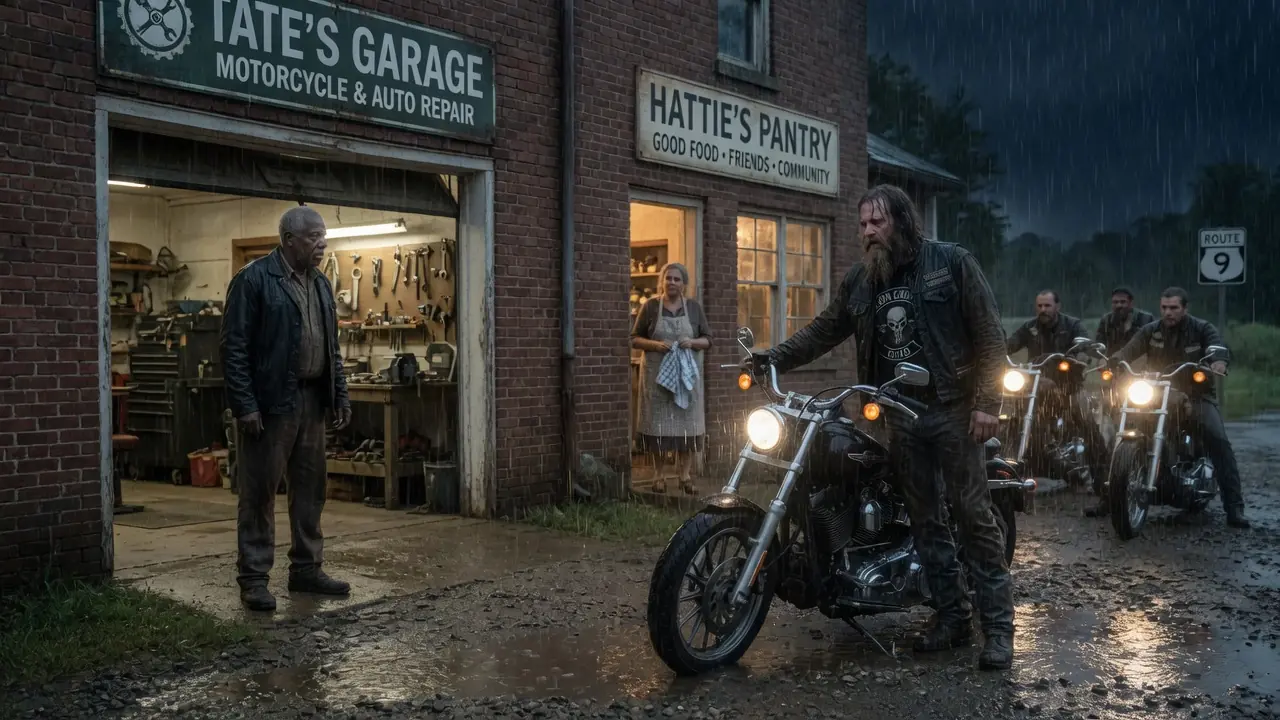
It was late Saturday evening on Route 9, and the storm had turned the gravel lot outside Tate’s Garage into a dark mirror of puddles and oil streaks.
Four men stood near the edge of the driveway, soaked through their leather vests, pushing four dead Harleys that looked like they had been dragged out of a river.
Behind them were six closed doors.
Booker knew that before they said it. He could read it in the way the men stood a few feet from his porch, not daring to come closer until invited. Big men, tattooed arms, heavy boots, rain dripping from their beards, and yet every one of them looked like a boy waiting to be turned away one more time.
“Is there anybody in this whole town who’ll help us?” one of them asked.
Booker was sixty-eight years old, with arthritis in both hands and forty-three dollars in the cash box beside his workbench. A bank notice sat folded on his desk, the final warning that said Tuesday. By then, if nothing changed, the bank would take the garage his father built, the pantry his wife ran, and the little house behind both buildings where Booker and Hattie Tate had grown old together.
But the man in front of him was swaying.
“How sick?” Booker asked.
The tallest biker answered before anyone else could. “Heart. He needs to sit down now.”
Booker glanced back.
Hattie was already in the doorway of the pantry, a dish towel in one hand and a look on her face that meant the matter had been decided before he opened his mouth. She was sixty-seven, small, round-shouldered from years over a griddle, and stronger than most people understood. Her eyes moved over the men once, then went straight to the one leaning hard against his handlebars.
“Bring them in, Booker,” she said.
“Hattie—”
“I see what they are,” she said. “Bring them in.”
The biker’s voice cracked. “Ma’am, five houses said no. One called the sheriff.”
Booker stepped into the rain and took the sick man’s arm. “This one says yes, son. Come on.”
Five days later, sixty Harleys would roll up that same driveway.
By then, the Tate name would be spoken across four states.
But none of that had happened yet.
All Booker knew in that moment was that a man was cold, wet, and struggling to breathe, and Hattie Tate had never let a hungry or hurting soul stand outside her door.
Forty-eight hours earlier, Booker had started his day the way he had started nearly every day for forty-three years. He flipped the garage sign from closed to open at five in the morning, touched the corner of his father Ezekiel’s photograph above the workbench, and whispered, “Morning, Daddy.” Then he crossed the breezeway to Hattie’s Pantry, where bacon was already sizzling and biscuits were already rising in the oven.
“Morning, sugar,” Hattie said without looking up.
“Morning, baby.”
“Sleep all right?”
“Roof leaked again.”
“I know,” she said. “Heard the bucket.”
That was their marriage in one small exchange. They had spent more than four decades learning each other’s silences, aches, worries, and rhythms. They did not need long conversations to know when the other was afraid.
The Tate property sat four miles outside Blainboro, Ohio. On one side stood Tate’s Garage, built in 1954 by Booker’s father with borrowed tools and hands that never stopped working. On the other side stood Hattie’s Pantry, added in 1982 after Hattie left her job at a diner in town because she wanted to spend her days close to her husband.
The narrow breezeway between the buildings was their favorite place in the world.
Every day at noon, Booker walked over from the garage, and Hattie brought out two plates. Sometimes they ate pork chops, sometimes soup, sometimes just biscuits with gravy when money was tight. It was not a fancy life, but it was theirs, and for many years that had been enough.
Now the life was slipping away.
Booker had three steady customers left.
Mrs. Hollister, whose husband had passed in the spring. The Peterson boys, who brought in their father’s old truck when it coughed too hard on Sundays. And Russ from the gas station, who came once a month for an oil change and stayed for Hattie’s biscuits.
That was not enough to save anything.
Hattie’s Pantry did a little better, but not much. Truckers stopped for her sweet tea, which had a reputation all the way to Cleveland. Still, the pantry had a tin on the counter that read, “Coffee. Pay what you can,” and most days Hattie gave more away than she took in.
Booker counted the cash box that morning.
Forty-three dollars.
He closed it slowly and looked at his hands. Those hands had rebuilt thousands of engines, splinted a child’s wrist during a storm, buried his father, buried his mother, and buried his only son. Now those same hands were going to hand over the keys to everything his family had built.
He had not told Naomi yet.
Naomi was their granddaughter, seventeen years old, bright-eyed, stubborn, and gifted with engines in a way that made Booker believe Ezekiel Tate’s spirit still lived in the bloodline. A week earlier, her letter had come from Purdue University. She had been accepted into the College of Engineering.
She had run down Route 9 holding the letter like it was a miracle.
Booker had cried right there in the garage, grease still on his palms.
The tuition was more money than he could imagine paying.
That morning, Naomi sat at Hattie’s counter eating a biscuit and talking about thermodynamics. Booker sat across from her, smiling so she would not see the truth sitting heavy in his chest. Hattie watched him from the griddle, and when his face almost broke, she gave the smallest shake of her head.
Not yet, baby.
So he smiled.
He laughed at Naomi’s jokes.
He told her Purdue would be lucky to have her.
Then he went back to the garage and turned the bank notice face down again.
By Saturday afternoon, the rain had started. Not a fast Ohio shower that came hard and quit, but the kind that stayed. It filled the ditches by two o’clock, turned the low places on Route 9 into streams by three, and by four, the weather radio was warning about flooding and possible tornadoes.
Booker stood in the open bay door and watched water run off the roof in silver sheets.
He had a transmission half apart on the bench for a job that might pay eighty dollars. The customer was not coming in that weather. Maybe not Monday either.
At five, Hattie pulled in her open sign and began wiping the counter.
Booker was about to close the garage when he heard the sound.
Not engines.
Something heavier.
Something dead.
Four motorcycles came into view through the rain, not ridden, but pushed. Four men leaned into the handlebars, shoulders lowered, boots sliding in the mud. The lead man was huge, but he moved like he was holding himself upright by sheer will.
Later, Booker learned what had happened.
A mile back, Route 9 dipped into a hollow where a creek ran under a low concrete bridge. By noon, the hollow had become a lake. By the time the four riders saw it, the water was high enough to hide the road.
The lead rider, Dalton, known as Diesel by his brothers, thought he could ease across.
He could not.
Water got into the engine halfway through. The three behind him followed too far before realizing the depth, and one by one, the Harleys died in the storm. Four machines stalled, four men trapped in rising water, and one of those men carrying a heart condition that cold and shock could turn deadly.
They pushed the bikes out of the hollow.
Then they started knocking.
At the first house, a curtain moved, then closed. At the second, an old farmer opened the door with a shotgun visible behind him and told them to keep moving. At the third, nobody answered, though they saw a face in an upstairs window.
The fourth place was an auto repair shop.
The owner saw them through the glass, walked to the door, and flipped the sign to closed.
The fifth was a gas station. A rider named Reaper went in alone, hoping one man looked less threatening than four. The clerk said the tow truck was unavailable, the air pump was broken, and there was nothing he could do.
Then a pickup came in, and the clerk walked outside to fill it himself.
The sixth house was the worst.
A woman opened the door only three inches with the chain still on. She did not listen long enough to hear the word heart. She slammed the door and called the sheriff, saying four dangerous-looking men were outside her home.
The deputy arrived fifteen minutes later.
He checked all four IDs and found nothing. They were a welder, a long-haul trucker, a contractor, and a former combat medic. Good men, tired men, frightened men, but men whose vests and beards had already convicted them in the eyes of the town.
The deputy was respectful, almost apologetic.
But his final words were, “This isn’t a friendly stretch for folks who look like you. I’d keep pushing.”
So they pushed.
They pushed until they saw the warm yellow light of Hattie’s Pantry.
They pushed until Diesel coughed so hard he nearly dropped.
They pushed until they reached the seventh door.
Booker met them in the rain.
“What’s your name, brother?” he asked the sick man.
“Dalton,” the man rasped. “Diesel.”
“All right, Dalton. We’re getting you inside.”
“Heart,” Dalton whispered. “Pills in the saddlebag.”
Booker looked toward the rider with a medic patch on his vest. “Son, get his pills now.”
“Yes, sir.”
Inside the pantry, Hattie had already lit the wood stove in the back room and pulled quilts from the shelf. She walked straight to Dalton and put one small hand against his cheek. He was six-foot-three, nearly two hundred eighty pounds, with a beard down to his chest and a tattoo of his daughter’s name across his throat.
To Hattie, he was simply someone’s child.
“Oh, baby,” she said. “You’re freezing. Sit down before you fall down.”
Dalton obeyed like a little boy.
She removed his soaked vest and folded it carefully across the back of a chair. She wrapped him in a quilt she had sewn the winter Naomi was born. When Hammer returned with the pills, Hattie gave one to Dalton with warm water, then checked his pulse with fingers steadier than any of the men expected.
“Booker,” she called, “he’s running hot.”
“I see it.”
She never asked if they were dangerous.
She never asked what club they belonged to.
She only asked Dalton if he had a wife at home.
“Yes, ma’am,” he whispered.
“A child?”
His eyes filled. “Lily. She’s seven.”
Hattie brushed wet hair from his forehead. “Pretty name. You picture her face, baby. You’re going to see her again.”
Dalton nodded, tears slipping into his beard.
Out front, the other three bikers stood dripping on Hattie’s clean floor. Hattie came out, looked at them, and pointed to the counter.
“You. You. You. Sit.”
Tank, six-foot-four and tattooed up the neck, sat down like a scolded schoolboy.
“You’re soaked and scared for your friend,” Hattie said. “You can’t help him better than I can right this second, so you’re going to eat.”
She set down plates of fried chicken, biscuits, gravy, and glasses of sweet tea.
Tank took one bite of a biscuit and stopped.
His huge hand trembled as he lowered it. His jaw tightened. He wiped his face with the back of his wrist, but tears had already disappeared into his beard.
“Ma’am,” he said, voice breaking, “I’m sorry. I haven’t eaten like this in a while.”
Hattie pushed the plate closer. “Then eat it slow, son.”
Reaper sat in silence, watching Hattie move between the men and the back room. At last, he spoke quietly.
“Five doors said no to us today.”
Hattie stirred soup without looking up. “Folks see what they decide to see.”
“You didn’t ask if we were dangerous.”
“You were cold and hungry,” she said. “That was all I needed to know.”
Reaper turned toward the window, but everybody saw the tears anyway.
Nobody mocked him for it.
The ambulance came after ten, when the water finally lowered enough for emergency vehicles to cross the bridge. The paramedic checked Dalton and told Hattie that the pills, the warmth, and the speed with which she had acted might have saved his life.
Hattie only nodded.
At the door, Dalton caught her hand before they loaded him into the ambulance.
“Mrs. Tate?”
“Yes, baby?”
“What’s your full name? I need to remember.”
“Hattie Tate. And that’s my husband, Booker.”
Dalton repeated both names under his breath three times.
Booker.
Hattie.
Tate.
Like a prayer.
Reaper tried to leave two thousand dollars on the counter before he left. It was all four men had between them. Hattie pushed it back without hesitation.
“Honey, put that away.”
“Ma’am—”
“We helped because you needed help. Money has nothing to do with it.”
Reaper looked at her for a long moment. “Nobody stops for us.”
Booker opened the door and looked out at the rain. “Somebody should have.”
The men left before midnight, but the bikes stayed behind, tarped under the overhang. When the pantry was quiet again, Booker and Hattie sat in the breezeway with two mugs of coffee. They did that every night, even when there was nothing to say.
“You think he’ll be all right?” Booker asked.
Hattie looked toward the empty road. “He’ll be all right, sugar.”
Neither of them knew that Dalton was lying in a hospital bed sixty miles away, calling a man named Bones Sutton, vice president of the Iron Crows Motorcycle Club.
Neither of them knew that Dalton was telling the story of five closed doors, a sheriff’s visit, an old mechanic in the rain, and a woman with biscuits who called him baby before she knew his last name.
Neither of them knew that when Dalton finished, Bones said only, “Rest. Let me make some calls.”
By Sunday evening, phones were ringing across four states.
By Monday morning, men were packing tools.
But Booker and Hattie thought the story was over.
On Monday before dawn, Hattie found a plain cardboard box on the pantry porch. Inside were oil filters, brake cleaner, electrical tape, fresh shop rags, and other supplies Booker used every week. There was no note.
She brought it inside and showed Booker.
“Who left this?”
He frowned. “Maybe a customer.”
“Maybe.”
They both knew it was not.
That evening, two men Hattie had never seen came in, ordered sandwiches, and asked how long the pantry had been there. One asked if he could take a picture of the sign because his wife collected old roadside signs. Hattie said yes.
They left fifty dollars on a twelve-dollar order.
Tuesday morning, the bank deadline arrived.
Booker drove to Russ’s gas station for milk and paused by the corkboard near the register. For years, he had passed the same faded flyer without reading it.
Iron Crows MC Annual Toy Run.
Under the logo, small print said the club had raised money for children’s hospitals since 1996.
Booker stood there a long time.
Russ came over with the milk. “That flyer’s been up forever. Probably some kind of biker thing.”
Booker looked at the crow and skull logo.
Then he walked out without answering.
Tuesday night at 11:46, Hattie’s phone buzzed on the kitchen table.
The message was from Hammer.
Mrs. T, open at 6 tomorrow morning, please. Got some brothers coming through. Don’t be scared. They look worse than they are.
Hattie read it twice and carried it to Booker.
He read it too.
“How many brothers?”
Hattie looked at the pantry, then at the old coffee pot on the counter.
“I don’t know,” she said. “But I think we’re going to need more coffee.”
At 5:58 Wednesday morning, Hattie brewed three pots.
By 6:15, she understood it was not enough.
Booker stood outside with the folded bank notice in his back pocket. The mist hung low across Route 9, thick and gray, and for several minutes there was nothing but silence. Then came the sound.
A low rumble from the south.
Then another.
Then more.
The noise became too large to be separate engines. It rolled toward them like weather, like a storm with chrome in its bones. Hattie stepped into the breezeway with her dish towel pressed against her chest.
The mist broke.
Sixty Harleys came up Route 9 in formation.
Behind them came three pickup trucks filled with toolboxes, two contractor vans, a flatbed stacked with lumber and shingles, and a food truck carrying enough supplies to feed an army. The motorcycles pulled into the lot in perfect order, engines idling for a moment before every one of them cut off at the same time.
The silence after that was enormous.
A bald man with a silver beard climbed off the lead bike. His vest carried the Iron Crows patch, and his sunglasses remained on though the sun had barely risen. He walked toward Booker with a hand extended.
“You Booker Tate?”
“Yes, sir.”
“Name’s Harrison Sutton. Everybody calls me Bones.” His grip was like iron. “You the man who pulled Diesel out of that storm?”
Booker swallowed. “I helped him inside.”
Bones held his hand a moment longer. “Then shake my hand properly before I get emotional and shame myself in front of sixty grown men.”
Booker did.
Bones turned toward the lot. His voice boomed like a foreman calling a crew to order.
“All right. You know why we’re here. Tools out, mouths shut, work clean. Nobody scares Mrs. Tate’s customers. We are guests on this property, so act like it.”
The whole convoy moved.
Ladders came down. Tarps came off. Toolboxes opened. Men in leather became roofers, plumbers, electricians, mechanics, carpenters, and cooks with the efficiency of people who had prepared all night.
Then Hattie saw Dalton.
He came out of a pickup with a crutch under one arm, pale but smiling. When he reached her, he stopped and bowed his head.
“Mrs. Tate,” he said. “My daughter’s name is Lily. She turned seven last month. Saturday night, I was supposed to leave her without a daddy.”
His voice broke.
“You gave her her daddy back.”
Hattie pulled him into her arms.
Dalton, huge and tattooed and feared by strangers, wept into her apron while sixty men suddenly found the gravel, the tools, and the sky very interesting.
Bones stood beside Booker with his sunglasses in his hand.
“That is the toughest man I know,” he said quietly. “Two tours overseas, survived more than most people could imagine. Hasn’t cried in front of anyone since his mother died.”
Booker stared at his wife holding Dalton and could not speak.
Bones clapped a hand on his shoulder.
“Y’all broke him in the best way a man can be broken.”
Then he took a breath.
“Mr. Tate, my brother told me five doors said no. One called the sheriff. But two old folks on Route 9 took one look at four bikers in the rain and opened the door anyway.”
Booker looked at the men already working on his roof.
“Bones, we just helped a man.”
Bones turned sharply. “Don’t say just to me. You helped a man everybody else walked away from.”
The work began that morning.
It did not stop for eleven weeks.
On the first day alone, sixty men cleared rotten siding, hauled away broken shingles, repaired the garage gutter, and poured a new concrete pad before sundown. Reaper, who owned Brooks Construction, supervised the garage rebuild. Another member with a roofing company brought a crew for the pantry and the little house in back.
The bedroom roof no longer leaked by Friday.
Hattie cried when they carried the old buckets out to the trash.
The garage was rebuilt from the studs. A modern hydraulic lift went in, donated by a parts warehouse owner from two counties over. New lights brightened the bays, a new compressor hummed in the corner, and every old tool Ezekiel Tate had hung on the back wall in 1954 was photographed, moved, and later rehung in the exact same place.
Bones had given the order himself.
“Nobody touches the father’s wall.”
The pantry changed too.
Six new booths. A real coffee station. A griddle large enough to feed half the county. The breezeway became a covered porch with benches, a long table, and three raised garden beds because one biker had overheard Hattie mention, just once, that she always wanted a little porch garden.
She had forgotten saying it.
The Iron Crows had not.
The town noticed.
At first, people drove by slowly and stared. Then they began stopping. Some were curious. Some were ashamed. Some came with pies, bottled water, old tools, or awkward apologies they barely knew how to speak.
Mrs. Hollister brought lemonade.
The Peterson boys showed up with work gloves.
Russ from the gas station came by with a donation jar he had started on his counter, though he could not quite look Booker in the eye when he handed it over.
Booker took it anyway.
“Thank you, Russ.”
Russ nodded, red-faced. “I should’ve done more sooner.”
Booker looked toward Hattie, who was serving biscuits to three bikers and two truckers at the same counter. “Sooner is gone. Today is still here.”
By the third week, Bones dropped a manila folder on the lunch table where Booker sat eating a ham sandwich.
“One more thing.”
Booker opened it.
His eyes blurred before he finished the first line.
The Iron Crows MC Trade and Engineering Fund.
Recipient: Naomi Tate.
Four years of tuition, books, housing, and living expenses at Purdue University.
Booker put the paper down.
For a moment, he could not breathe.
Bones shifted uncomfortably. “Don’t go soft on me, Tate.”
Booker wiped his face with the back of his hand. “We can’t take this.”
“You can.”
“No,” Booker said. “Not like this.”
Bones frowned. “What does that mean?”
Booker pushed the paper back halfway. “Make it permanent.”
Bones stared at him.
“One scholarship every year,” Booker said. “For a kid from a county like this one. Trade school, engineering, culinary, nursing, whatever honest work calls them. One rule: they do one free job every year for somebody who can’t pay.”
Bones was silent for a long moment.
Then he pulled a pen from his vest and dropped it on the table.
“You are a hard man to help.”
Booker smiled through tears. “So are you.”
Bones tapped the paper. “Sign.”
Booker signed.
The reopening happened eleven weeks after the storm.
The whole town came.
There were banners across the breezeway, a red ribbon at the entrance, and eighty Iron Crows lined up in formation outside the rebuilt garage. The mayor gave a speech about community, though everyone knew the real speech had already been given in labor, lumber, and love.
Naomi cut the ribbon.
Hattie cried.
Booker shook hands until his arm hurt.
At the end of the day, Dalton came in carrying a small framed picture. He handed it to Hattie without saying a word.
It was a child’s crayon drawing.
A giant man with a beard stood beside a woman in an apron. Above them was a house with a heart on the roof. At the bottom, in careful seven-year-old handwriting, it said:
Thank you for saving my daddy. Love, Lily.
Hattie hung it behind the counter that same afternoon.
It stayed there.
The story did not stay local for long.
A newspaper in Columbus printed a front-page photo of Hattie hugging Dalton in the breezeway. The headline read: “Six Doors Said No. The Seventh Said Yes.” By the end of the week, the story had traveled across state lines.
People came.
Bikers from four states stopped to shake Booker’s hand. Couples drove from Cleveland just to eat at Hattie’s Pantry. Truckers rerouted their trips for sweet tea in mason jars.
Within six months, Booker had a four-week waiting list for major repairs.
He hired his first apprentice in twenty years, a young man named Devon Wilson who showed up at the bay door and said, “Mr. Tate, I want to learn the right way.”
Booker hired him before lunch.
Hattie hired two single mothers from the trailer park down the road. She paid them fairly, taught them the griddle, and sent them home with leftover food every night. One of them had been days from moving her children into her sister’s crowded spare room.
She did not have to.
Naomi started at Purdue that fall.
She hung Ezekiel Tate’s old work apron on her dorm wall. Beside it, she pinned an Iron Crows patch Dalton had mailed her with a note that read: Honorary member. Lifetime.
Every Sunday, she called home.
Hattie held the phone.
Booker waved from behind an engine.
One year after the storm, the first official Tate-Iron Crows Scholarship was awarded to a nineteen-year-old single mother studying diesel mechanics. The second went to an eighteen-year-old girl training to become a chef. Hattie handed each of them a peach pie and the same instruction.
“Go on, baby. And don’t forget the rule.”
A bronze plaque went up beside the front door.
It read:
This place stayed open because two people answered the door when others would not. With gratitude forever, the Iron Crows MC.
On a cold October morning, almost exactly one year after the storm, a rusted sedan limped into Tate’s Garage just after dawn. Steam curled from under the hood, and the driver stepped out trembling. She was young, early twenties, wearing a thrift-store blazer and cheap flats, holding a folded paper in one hand.
“Sir,” she said, voice shaking, “I don’t have any money. I have a job interview in Columbus in two hours. A real one. Please, is there any way—”
Booker held up a hand.
“Pop the hood, sweetheart.”
Hattie appeared in the breezeway with a towel over her shoulder.
“Honey,” she called, “when’s the last time you ate?”
The girl’s face crumpled.
Hattie nodded once. “Come sit at the counter. Biscuits are coming up.”
Forty minutes later, the car was running. Booker had tightened a hose, replaced a belt from his scrap pile, and topped off the fluids. Hattie had fed the girl biscuits with sausage gravy, packed her a brown paper bag with food for the road, and told her to eat the boiled egg before the interview because protein helped nerves.
The girl tried to leave her phone as collateral.
Booker pressed a business card into her palm instead.
On one side was the new Tate’s Garage logo. On the other, in Booker’s handwriting, were five words.
You don’t owe us. Pass it on.
The young woman drove into the fog with tears in her eyes.
Naomi was home for fall break, working in the bay beside her grandfather. She looked up from a transmission spread across the floor.
“Granddaddy,” she said, “you didn’t charge her anything?”
Hattie leaned against the breezeway doorway.
“A year ago,” she said, “sixty men everyone else was afraid of came down this road and saved us. You think we charge that girl for a belt and a biscuit?”
Booker chuckled.
Naomi smiled and went back to her tools.
Somewhere down Route 9, faint through the fog, came the sound of Harleys.
Saturday riders were on their way.
The fog burned off by nine. Booker and Hattie sat in the breezeway with two mugs of coffee, the way they had every morning for forty-four years now. The bronze plaque caught the sunlight behind them, and the new porch garden was full of late-season flowers.
A single Harley passed on Route 9.
The rider tapped his horn twice.
Hattie lifted her mug.
“Morning, sugar.”
Booker touched his coffee cup to hers.
“Morning, baby.”
Six doors had said no.
The seventh had said yes.
And one yes from an old mechanic and a wife who did not flinch at strangers in the rain had saved a man, rebuilt a business, sent a girl to college, changed a town, and started a promise that would keep moving down the road long after all of them were gone.