In a small, forgotten town, a weary Black mechanic spent his afternoon fixing an old car in his garage. Suddenly, a young drifter walked in, thin and exhausted, with a torn backpack and weary eyes. He did not ask for food, only for a job.
Moved by compassion, the mechanic offered him a burger and a chance to earn a living. Everything seemed to be getting better until, months later, a wealthy stranger arrived with an offer that could change the young man’s life. What happened afterward left everyone in the garage stunned.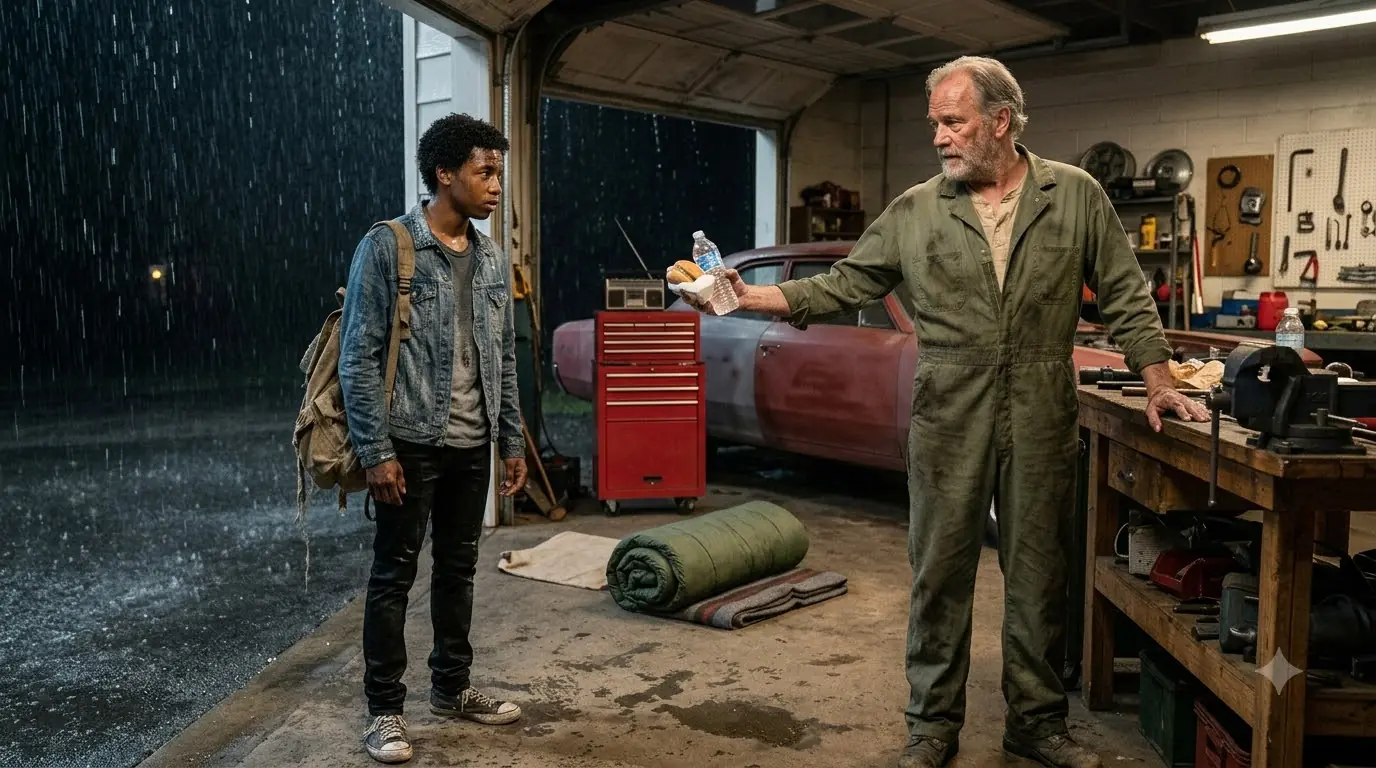
The afternoon sun hung low over the industrial district, casting long shadows between the weathered buildings. Eli Thompson walked slowly down Parker Street, his thin frame barely filling out the faded denim jacket that had seen better days. His sneakers, worn through at the toes, scuffed against the cracked pavement as he approached another potential workplace.
The hand-painted sign read Joe’s Auto Parts. Eli took a deep breath, pushed his shoulders back, and knocked on the glass door. A heavyset man in grease-stained coveralls looked up from behind the counter. His expression shifted from neutral to cold in an instant.
“We’re not hiring,” Joe said flatly, not even setting down the invoice in his hand.
“Sir, I’m a hard worker. I can…”
“I said we’re not hiring.” Joe’s voice was harder now. “And even if we were, it wouldn’t be you. Word gets around, kid. I don’t want that kind of trouble here.”
The door closed before Eli could respond. He stood there for a moment, feeling the familiar sting of rejection settle into his chest. That made seven places that day. Seven doors had closed in his face.
Down the street, he tried the hardware store. The owner took one look at him and shook his head.
“Sorry, son. Can’t help you.”
At the lumberyard, the foreman did not even let him finish his sentence.
“Get out of here before I call the cops.”
By the time Eli reached Martinez Grocery, his last hope on that block, his hands were shaking, not from fear, but from hunger. He had not eaten anything substantial in two days.
Mrs. Martinez, an older woman with kind eyes, at least had the decency to look apologetic.
“I’m sorry, mijo. I would help if I could, but my customers talk. They say you bring bad luck, that everywhere you go, something breaks. After what happened with the councilman’s nephew…”
She shook her head.
“I have a business to protect. I have grandchildren to feed.”
“I didn’t do anything wrong,” Eli said quietly. “I was trying to help that woman. The guy was robbing her.”
“I believe you,” Mrs. Martinez said, and she seemed genuine. “But it doesn’t matter what I believe. It matters what they believe. Right now, this whole town believes you’re trouble.”
She pressed a small bag into his hands. Inside were a sandwich and an apple.
“I can’t give you work, but I can give you this. Now go before someone sees.”
Eli took the bag with trembling hands.
“Thank you.”
As he walked away, he heard voices behind him. Two men stood outside the barbershop, watching him.
“That’s the kid,” one of them said, not bothering to lower his voice. “The one who put Tommy Douglas in the hospital.”
“Heard he’s on something. Pills or worse.”
“Someone should run him out of town before he hurts somebody else.”
Eli kept walking, his jaw clenched, fighting the urge to turn around and defend himself. What was the point? Nobody would listen. Nobody ever did.
The evening air grew cooler as the sun continued its descent. Neon signs flickered to life above the bar, the pawnshop, and the check-cashing place. They were businesses that thrived in the forgotten corners of town. Trash skittered across the street, pushed by the wind. Somewhere in the distance, a dog barked.
Eli pulled his jacket tighter and kept moving, searching for somewhere, anywhere, that might offer him a chance.
Night fell quickly, bringing with it a cold drizzle that soaked through Eli’s thin jacket. He found shelter under an old railroad bridge at the edge of town, where the highway overpass created a small dry space among the concrete pillars.
He sat with his back against the cold stone, pulled his backpack close, and carefully removed the only thing that mattered to him, a photograph protected by a plastic sleeve.
Even in the dim light, he could make out his mother’s face. She was smiling in the picture, standing in front of their old trailer with her waitress uniform crisp and clean. That had been a good day. One of the few.
“I’m trying, Mama,” he whispered to the photograph. “I’m really trying.”
His stomach growled. He had eaten the sandwich Mrs. Martinez had given him hours earlier, saving the apple for the next day.
Would tomorrow be any different? Would anyone give him a chance?
The rain picked up, drumming against the concrete above. Water began to seep through the cracks, dripping onto his shoulders. Eli closed his eyes, but sleep would not come. His body was too cold, too hungry, and too worn down by rejection.
Through the rain, he noticed something he had not seen before, a light in the distance about two blocks away. It glowed yellow against the darkness, steady and unwavering. Unlike the flickering neon signs he had passed earlier, this light felt different, almost inviting.
Eli squinted through the rain. It appeared to be coming from some kind of garage or workshop. Even from where he stood, he could hear the faint sound of tools and the rhythmic clang of metal against metal.
Someone was working late. Someone who might need help. Someone who might not have heard the rumors yet.
It was probably foolish to hope. Hope had failed him so many times. But what else did he have?
Eli carefully tucked his mother’s photograph back into his backpack, protecting it from the rain. He stood, his joints stiff and aching, and started walking toward the light.
With each step, the sound grew clearer. It was not just tools, but something else, an engine, old and struggling, coughing and sputtering as it fought to stay alive.
The sound reminded him of his own heartbeat lately. Tired and barely holding on, but still running.
Henry Carter stood under the hood of a 1967 Chevrolet Impala, his hands black with grease and his back aching from hours of bending over the engine. The fluorescent light above him buzzed and flickered, casting unstable shapes across the cluttered garage.
He adjusted the carburetor one more time and stepped back.
“Come on now,” he muttered, reaching for the ignition.
The engine turned over, coughed twice, and died.
Henry sighed deeply, the sound of a man who had become accustomed to disappointment. He wiped his hands on a rag that was already too dirty to be useful and glanced at the old radio on the workbench. The late-night DJ was playing Muddy Waters, and the blues guitar filled the empty spaces of the garage.
The car had belonged to Henry’s father. Then it had sat in the garage for twenty years, waiting for Henry to have the time, the money, and the heart to bring it back to life.
Now Henry had time. Too much of it.
Customers had grown scarce. The larger shops on the other side of town had newer equipment, younger mechanics, and better reputations. Henry was just the old Black man with the small garage on the wrong side of the tracks.
He was the man who had once been turned away from every decent job in town because of the color of his skin. The man who had built the garage with his own hands, only to watch it slowly die.
He looked around at the walls lined with tools that had become extensions of his hands. The smell of oil and metal had soaked into everything, including his skin. This place was all he had left.
After his wife left, after his boy…
Henry closed his eyes, pushing the memory away.
Some engines could not be fixed. Some things, once broken, stayed broken.
The radio DJ announced the time.
“Eleven forty-seven,” Henry said to the empty garage. “Another day gone.”
He should close the garage and return to the small apartment above it, where his sister Louise kept telling him he was wasting away. But the thought of lying awake in that empty room, staring at the ceiling and listening to his own thoughts, was worse than remaining downstairs with the tools, the oil, and the ghosts of what the place used to be.
At least there, surrounded by broken things, he felt less alone in his own brokenness.
Henry picked up a wrench and turned back to the Impala.
“Let’s try one more time, old friend.”
The knock was so soft that Henry almost did not hear it over the radio. He looked up, confused. Nobody came by that late.
Through the grimy window in the garage door, he could make out a figure, young, thin, and soaked by the rain.
Henry’s first instinct was to ignore it. Nothing good came from late-night visitors in that neighborhood. But something made him walk to the door and open it a few inches.
The kid standing outside looked about eighteen, perhaps younger. He was white, with shaggy brown hair plastered against his forehead. He wore a jacket that seemed to be made of more holes than fabric. His eyes were wide and desperate, but not dangerous. He looked more like a wounded animal hoping not to be kicked again.
“We’re closed,” Henry said.
“I know, sir. I’m sorry to bother you.” The kid’s voice shook from the cold, fear, or both. “I was just looking for work. Any kind of work. I can clean. I can organize. I can…”
“No.”
“Please, sir. I’m a fast learner. I won’t cause any trouble. I just need…”
“I said no.”
Henry started to close the door.
“I’ll work for free.”
The desperation in the kid’s voice made Henry pause.
“Just for a few days,” the boy continued. “For food. I won’t ask for money. I just need somewhere to…”
His voice broke. He looked down, clearly fighting tears.
Henry should have closed the door. He should have told the kid to go to the shelter on Fifth Street. He should have protected himself from whatever trouble the stranger might bring. The last thing he needed was another problem.
But there was something familiar in the way the kid stood with his shoulders hunched, trying to make himself smaller and less threatening.
“What’s your name?” Henry found himself asking.
“Eli, sir. Eli Thompson.”
Recognition flickered in Henry’s mind.
“I didn’t do anything wrong,” Eli said quickly. “I know what people say, but I was trying to help. This woman was getting robbed, and I just… Everything went wrong. It always goes wrong, but I didn’t mean…”
He stopped, realizing he was rambling.
Henry studied him for a long moment. The kid was shaking now, and not only from the cold.
“Come inside,” Henry said. “Get out of the rain.”
Eli’s eyes widened in disbelief.
“Really?”
“Before I change my mind.”
Eli practically stumbled into the garage, water dripping from his clothing onto the concrete floor. He looked around with a mixture of awe and relief, as though he had entered a sanctuary.
“There are rags over there,” Henry said, pointing. “Dry yourself off. Then start with that corner. It needs sweeping.”
“Yes, sir. Thank you, sir. I’ll do a good job. I promise.”
Eli hurried toward the corner, but his hands were shaking from cold, hunger, and nervous energy. He accidentally knocked over a container of motor oil.
It spilled across the floor in a dark puddle, spreading toward the toolbox.
“Damn it,” Henry snapped.
Eli froze, staring at the spreading oil with horror.
“I’m sorry. I’m so sorry. I’ll clean it up. I’ll…”
His hands were shaking so badly that he could barely hold the rag Henry thrust toward him. He bent down and started cleaning, but his movements were clumsy and panicked. He only spread the oil farther.
“Stop. Just stop.”
Henry’s voice was sharp with frustration.
Eli stopped, still crouched on the floor. Henry saw the kid’s shoulders begin to shake, not from cold this time, but from the effort of trying not to cry.
“I’m sorry,” Eli whispered. “I’m sorry. I always mess things up. I’ll leave.”
Henry stood there, looking down at the kid kneeling in motor oil, shaking and apologizing for existing. Something cracked inside his chest.
He saw himself at twenty-three, standing outside the Peterson Manufacturing Plant and being told they did not hire people like him. He saw himself at twenty-five, turned away from job after job while his mother became sicker and he remained unable to afford her medicine.
He remembered what hunger felt like. He remembered desperation. He remembered what it was like when the entire world treated him as though he were nothing.
“Stay here,” Henry said quietly. “Don’t touch anything.”
He walked out of the garage and allowed the door to close behind him.
Eli remained on the floor, convinced he had ruined his last chance. He was ready to gather his backpack and disappear into the night.
Ten minutes passed. Then fifteen.
The rain drummed steadily on the garage roof. Eli slowly stood, preparing to leave.
The door opened.
Henry walked back in carrying a paper bag. He said nothing, setting it on the workbench and gesturing toward it.
Eli approached cautiously. Inside the bag was a burger from the twenty-four-hour gas station down the road. It was already cold, but it might as well have been a five-star meal. Beside it was a bottle of water.
“Eat,” Henry said simply.
Eli’s hands trembled as he picked up the burger. He tried to eat slowly and preserve some dignity, but his body had other ideas. He devoured half of it before realizing what he was doing.
Then he stopped, embarrassed.
“It’s all right,” Henry said, his voice softer. “Finish it.”
Tears started rolling down Eli’s cheeks as he ate. He could not stop them. The food, the shelter, the warmth of the garage, and the simple fact that someone had finally shown him kindness came crashing down on him at once.
“Thank you,” he managed between bites. “Thank you so much.”
Henry said nothing. He pulled up an old stool and sat, his body language no longer defensive. He allowed the silence to stretch between them, broken only by the sound of rain, the distant blues playing on the radio, and Eli’s quiet eating.
When Eli finished, he wiped his eyes with the back of his hand, smearing grease and tears across his face.
“When was the last time you slept?” Henry asked.
“I’m not sure. Two days ago, maybe.”
Henry nodded slowly, as if confirming something he already suspected. He stood, walked into a storage room at the back of the garage, and returned with an old blanket and a rolled sleeping bag.
“The floor is hard, but it’s dry. You can stay tonight. Tomorrow, we’ll talk.”
Eli stared at him in disbelief.
“I don’t know what to say.”
“Don’t say anything. Just sleep. We’ll figure out the rest in the morning.”
Henry turned off the main lights, leaving only a small lamp glowing in the corner. Eli spread the sleeping bag across the cleanest patch of floor he could find.
He lay down, and his body finally began to relax. For the first time in weeks, he felt safe.
Morning light filtered through the grimy windows, turning the dust motes into floating specks of gold. Eli woke to the smell of coffee and the sound of tools being organized.
Henry was already working, arranging wrenches by size on the pegboard wall. He glanced over when Eli stirred.
“There’s coffee on the workbench. Black. Hope that’s all right.”
“That’s perfect. Thank you.”
Eli stood, folded the sleeping bag carefully, and reached for the chipped mug Henry had set out. The coffee was strong and bitter, but it was warm, and that was enough.
“You said you wanted to work,” Henry said without looking at him. “Is that still true?”
“Yes, sir. Absolutely.”
“Then start with that corner. The tools need organizing. Everything has a place, and you put it back where it belongs. Understand?”
“Yes, sir.”
For the next hour, Eli worked in silence. He sorted through boxes of bolts, organized socket sets, and scrubbed oil stains that had probably been on the floor for years.
Henry watched him from the corner of his eye, noticing the careful way the kid handled every tool and how he paused to determine where each item belonged before placing it there.
“Come here,” Henry finally said, gesturing toward the Impala. “Do you know anything about cars?”
“Not really, sir, but I want to learn.”
Henry handed him a wrench.
“The first thing you need to know is that a car isn’t just metal and parts. It has a heartbeat. You listen to the engine. You can hear what it’s trying to tell you, where it hurts, and what it needs.”
He started the Impala. The engine turned over but ran roughly, coughing and sputtering.
“You hear that?” Henry asked. “That irregular rhythm? The engine is telling us something is wrong. It could be the timing. It could be the fuel mixture. It could be a dozen things. But you don’t just start replacing parts. You listen first. You pay attention.”
Eli leaned closer, his ear almost touching the hood. His eyes closed in concentration.
“It sounds sad,” he said quietly. “Like it’s trying really hard, but something is holding it back.”
Henry looked at him with surprise. Most people heard noise. This kid heard emotion.
“Yeah,” Henry said softly. “That’s exactly what it sounds like.”
For the first time in longer than he could remember, Henry felt something other than emptiness. It was small and fragile, but undeniably real.
Hope.
That afternoon, Henry walked to Martha’s Corner Store, a small shop two blocks from the garage. Martha Rodriguez had run the place for thirty years, and she knew everyone’s business.
“Well, well,” she said when Henry entered. “Henry Carter in daylight and before closing time, no less. What miracle is this?”
“Just need some sandwiches, Martha. Two.”
Martha raised an eyebrow.
“Two? You have company?”
“I have someone helping at the garage.”
“Helping?” Martha leaned on the counter, her eyes sharp with curiosity and concern. “Henry, I heard about that Thompson kid. People are saying…”
“People say a lot of things,” Henry interrupted. “Most of it is none of their business.”
Martha studied his face for a long moment. Then her expression softened.
“You’re different today.”
“What are you talking about?”
“Your eyes. They’re clearer. When was the last time you smiled, Henry?”
“I smile.”
“No, you don’t. I haven’t seen you truly smile in five years. Not since…”
She trailed off, not wanting to mention his son.
“But today, just now, the corners of your mouth went up. Only a little.”
Henry touched his face, almost surprised.
“Sandwiches, Martha. That’s all I came for.”
But as he walked back to the garage with the paper bag warm in his hands, he realized Martha was right. Something inside him had shifted. The weight he had been carrying felt just a little lighter.
Over the next several weeks, a routine developed. Eli woke before sunrise, swept the garage, organized tools, and watched Henry work. Gradually, Henry allowed him to do more, handing him tools and teaching him how to check oil levels and identify different engine sounds.
One morning, they stood together over the open hood of the Impala, Henry’s father’s car and the project that had consumed him for months.
“This car meant everything to my dad,” Henry said, his hands resting on the fender. “He bought it new in 1967, right after the riots. He said he wanted something beautiful in the world, something that ran smoothly and truly even when everything else was falling apart.”
Eli listened without interrupting.
“He died when I was twenty. He left me this car, this garage, and a lot of debt.”
Henry picked up a wrench and turned it over in his hands.
“I tried to make it work. I got married young and had a son. But people with money don’t come to this neighborhood for repairs, and the people who live here don’t have much money to spend.”
“But you kept going,” Eli said quietly.
“What else was I going to do? This is all I know.”
Henry’s jaw tightened.
“But knowing how to fix things doesn’t mean you can fix everything. My wife left after our boy died. She said I cared more about strangers’ cars than my own family. Maybe she was right.”
Eli looked down at his oil-stained hands.
“My dad left too. Different reason, same result. He drank until there was nothing left of him. One day, he just didn’t come home. Mom tried to hold things together, but it was too much. She worked herself to death, literally. She had a heart attack at forty-six, behind the counter of a truck-stop diner.”
“How old were you?”
“Sixteen. After that, I just drifted. I tried to find work, but nobody trusts a kid with no family, no references, and no address.”
His voice cracked slightly.
“I only wanted someone to give me a chance. Just one chance to prove I wasn’t worthless.”
Henry looked at Eli, truly looked at him, and saw past the dirty clothes and thin frame. He saw himself, the younger version before the years had worn him down.
“You’re not worthless,” Henry said firmly. “And you’re not drifting anymore. You’re here. You’re learning. That counts for something.”
Eli’s eyes shone with unshed tears.
“Why are you helping me? Everyone else in this town wants me gone.”
Henry was quiet for a long moment.
“Because somebody should have helped me when I needed it, and nobody did. I’m not going to be the person who turns away when someone is drowning.”
They stood in silence as the morning sun streamed through the garage door and dust danced in the light. They were two broken people finding something resembling family in the space between wrenches and engine parts.
“Now, come on,” Henry said, clearing his throat. “This carburetor isn’t going to rebuild itself. It’s time I taught you how to do it properly.”
By afternoon, they had made progress. Eli’s hands, now more confident with tools, moved with purpose as he carefully cleaned every component Henry handed him.
The radio played softly in the background, B.B. King singing about better days.
“My son would have been about your age now,” Henry said suddenly, breaking the comfortable silence.
Eli looked up, sensing that the admission was important.
“Jacob. We called him Jake. He was three when…”
Henry’s voice caught. He cleared his throat and started again.
“I was working late. I was always working late, trying to keep this place afloat. My wife called and said Jake had a fever. I told her I would be home soon. I just had to finish one more car.”
Henry’s hands became still around the wrench.
“By the time I got home, she had taken him to the emergency room. She borrowed the neighbor’s car, an old piece of junk with bad brakes. On the way back from the hospital…”
He could not finish.
“I’m sorry,” Eli whispered.
“My wife blamed me. She said that if I had been home, she would have used my truck. Better brakes might have made a difference.”
Henry’s eyes were distant, trapped in the past.
“She left a month later. She couldn’t stand to look at me. She couldn’t stand being in this garage, where I had chosen to spend my time instead of being with our family.”
“It wasn’t your fault,” Eli said.
“Wasn’t it?” Henry’s voice was hollow. “Every choice we make ripples outward and touches other people’s lives. I chose this garage over my family, and my son paid the price.”
Eli set down his tools and sat on the stool across from Henry.
“My mom used to say that guilt is like rust. It eats away at you from the inside until there’s nothing left but holes. She said the only way to stop it is to forgive yourself and do better the next time.”
“Did she forgive herself?”
“For what?”
“For not being able to give you more. For working herself to death.”
Eli’s breath caught. He had never considered it that way.
“I don’t know. I hope so.”
“What would you say to her if you could?”
“I’d tell her…”
Eli’s voice broke.
“I’d tell her she was enough. That she didn’t have to prove anything. That I knew she loved me, even when we had nothing. Especially when we had nothing.”
Henry nodded slowly.
“Maybe that’s what Jake would say to me if he could.”
The two men sat in silence, both carrying their ghosts and trying to determine how to set them down.
Finally, Henry stood and returned to the engine.
“Let me show you something. When this engine runs properly, it purrs as smoothly as silk. But right now, it’s rough. Do you hear that knocking sound?”
Eli listened.
“Yeah.”
“That’s the past rattling around. Old damage that hasn’t been repaired. But here’s the thing about engines. You can rebuild them. You can clean out the old damage, replace what’s broken, and make them run like new again.”
Henry looked at Eli meaningfully.
“People are like that too. They just need someone willing to do the work.”
Eli understood. Henry was not only talking about the car.
“Will you teach me?” Eli asked. “Everything you know?”
“Yeah, kid. I’ll teach you.”
As they bent over the engine together, their hands working in a synchronized rhythm, something profound happened in that cluttered garage. Two damaged souls began the slow, painful, beautiful process of healing.
The engine’s rough idle suddenly smoothed out. Henry had adjusted something, and it began to purr just as he had promised.
Eli grinned.
“That sound,” Henry said softly. “That’s what peace sounds like. Remember it.”
But peace, like a fragile engine, could be disrupted easily.
It started with whispers.
Mrs. Patterson from the hardware store told Mrs. Chen at the post office, who told her husband, who told everyone at the bar. By the end of the week, the entire neighborhood was talking.
“Henry Carter has that Thompson kid working for him.”
“The one who put Tommy Douglas in the hospital?”
“I heard he’s on drugs. That’s why his hands always shake.”
“My cousin won’t take her car there anymore. She doesn’t feel safe.”
“Someone should warn Henry. That kid is bad news. Trouble follows him everywhere.”
The parking lot outside Martha’s store became the unofficial gathering place for those conversations. Three men stood outside one afternoon, watching Eli walk past with parts for Henry.
“There he goes,” Bill Morrison said, crossing his arms. “The kid looks like a stiff wind could blow him over.”
“Don’t let that fool you,” Jack Peters replied. “He has a mean streak a mile wide. You heard what he did.”
“He was defending an old woman,” Martha called from the doorway of her shop. “That’s what I heard.”
“That’s what he says,” Jack shot back. “But Tommy Douglas is still in physical therapy. His family has money and lawyers. They’re calling it assault.”
“They’re saying a lot of things,” Martha replied. “That doesn’t make them true.”
“Where there’s smoke, there’s fire,” Bill said. “And that kid has brought nothing but smoke since he arrived.”
Inside the garage, Eli was oblivious to the conversations. He was focused on replacing spark plugs and following Henry’s careful instructions. He was finally good at something. He was useful. He was home.
But the poison was spreading.
By the following week, three regular customers had stopped coming. The phone, which had once rung several times each day, went silent.
When Henry entered Martha’s store, conversations stopped. He knew what that meant. He had experienced it before, years earlier, for different reasons.
He knew the weight of community judgment and how it could crush a business, a reputation, and a life. But this time, he was not the target. This time, it was the kid who had started smiling again, humming along with the radio while he worked and learning to believe in himself.
Henry was not sure he could protect him from what was coming.
Louise Carter arrived at the garage shortly after sunset, her sensible shoes clicking sharply against the concrete floor. She was a woman who believed in tough love, practical decisions, and protecting her younger brother from his own soft heart.
“We need to talk,” she said without greeting him.
Henry looked up from the engine he was working on.
Eli sensed the tension and quietly moved to the far corner of the garage, pretending to organize tools.
“About what, Louise?”
“Don’t play dumb with me. About him.”
She jerked her head toward Eli.
“About what you’re doing to yourself.”
“I’m running my garage. Same as always.”
“No, you’re running it into the ground.” Louise’s voice was sharp. “Do you know how many customers you’ve lost this month? Do you know what people are saying?”
“I know what people say. People always have something to say.”
“They’re saying you’re harboring a criminal. They’re saying you’re so desperate for company that you’ll take anyone in, no matter how dangerous he might be.”
Louise lowered her voice, but it still carried through the quiet garage.
“They’re saying you’ve lost your mind since Jake died.”
Henry’s jaw tightened.
“Don’t bring Jake into this.”
“Why not? That’s what this is about, isn’t it? You see a lost kid, and you think you can save him. You think you can make up for not being there for your own son.”
“That’s not what this is.”
“Isn’t it?”
Louise stepped closer.
“Henry, I love you. You’re my baby brother, and I’ve watched you suffer for five years. But this isn’t healing. This is self-destruction. That boy is going to take everything from you. Your business, your reputation, maybe even…”
“He isn’t taking anything,” Henry said firmly. “He’s working. He’s learning. He isn’t what they say he is.”
“How do you know? How do you truly know? Because he seems nice? Because he said he’s innocent?”
Louise’s voice cracked with frustration.
“You’re running yourself into the ground trying to help someone who might not even deserve it. The electric bill is overdue. You’re eating one meal a day. I see the receipts, Henry. I know you’ve been buying him food and supplies. You can’t afford this.”
In the corner, Eli’s hand became still around the wrench he was holding. He could hear every word.
“I know you’re trying to be kind,” Louise continued. “But kindness without wisdom is foolishness. You can’t save everyone. You couldn’t save Jake. You couldn’t save your marriage. You won’t save this kid. You’ll only destroy yourself in the process.”
After Louise left, the garage felt oppressively quiet. Henry stood motionless, staring at the place where his sister had been, her words still echoing through the room.
Eli remained in the corner with his head lowered and his hands trembling.
“You heard all of that,” Henry said. It was not a question.
“Yes, sir.”
“She’s wrong about you.”
“Is she?” Eli’s voice was barely a whisper. “Everyone I try to help ends up worse off. Maybe I am bad luck. Maybe I should…”
“Don’t,” Henry said firmly. “Don’t run. Not yet.”
“But your business…”
“My business was failing before you arrived. It has been failing for years. That isn’t on you.”
Henry walked over to the Impala and ran his hand along the hood.
“You know what I see when I look at this car? I see something worth fixing. Something that has been broken for a long time but still has life in it.”
He turned to Eli.
“That’s the same thing I see when I look at you.”
Eli’s eyes filled with tears.
“I don’t want to be the reason you lose everything.”
“Then don’t be. Stay. Work. Learn. Prove them all wrong.”
Henry picked up a wrench and held it out.
“Are you with me?”
Eli looked at the wrench. It was a simple tool, but in that moment, it represented everything, trust, partnership, and family.
He took it.
“I’m with you.”
They worked side by side until midnight. They did not talk much. The garage was filled only with the sound of tools and the old radio playing blues.
The Impala’s engine began to sound smoother and healthier.
Outside, the town slept, unaware that inside the small garage, two men were building something stronger than reputation and more valuable than money.
They were building hope.
Once hope starts running, it is difficult to stop.
Three days later, everything fell apart.
Eli woke before dawn as usual, but that morning was different. He had barely slept. Louise’s words kept playing in his mind like a broken record.
You’ll only destroy yourself in the process.
He thought about Henry, about the way the man had started smiling more, humming along with the radio, and seeming lighter. But he also thought about the empty garage, the silent phone, and the worried expressions Henry tried to conceal while paying bills.
Eli sat on his sleeping bag and looked around the garage. The place had become home. The smell of oil and metal, the cluttered workbench, and the old Impala that was slowly returning to life all felt safe.
But was his safety coming at Henry’s expense?
He pulled out his backpack and removed his mother’s photograph. In the dim light before dawn, he studied her face.
“What should I do, Mama?” he whispered.
But he already knew the answer.
His mother had sacrificed everything for him, working herself to death so he could eat. She would never want him to allow somebody else to suffer for his sake.
With shaking hands, Eli found a piece of paper and a pencil. He stared at the blank page for a long time before he could bring himself to write.
Mr. Henry,
Thank you for everything. You gave me food when I was hungry, shelter when I had nowhere to go, and something more important than either of those things. You made me feel like I mattered. You made me feel human again.
But I can’t stay, not if it means destroying what you’ve built. Your sister is right. I’m costing you customers, money, and peace. You deserve better than that.
I’ll never forget what you taught me, not only about engines, but about kindness. You taught me to see people for who they are, not for what others say they are. You’re the best man I’ve ever known. That’s why I have to go.
Thank you for believing in me, even when I couldn’t believe in myself.
Eli
He folded the note and placed it on the workbench where Henry would find it. Then he carefully rolled up his sleeping bag.
He took one final look around the garage, at the tools he had learned to use, the Impala that was almost running perfectly, and the place where, for a brief moment, he had felt as though he belonged somewhere.
Then he walked into the cold morning darkness, leaving the only home he had known in years behind.
Henry woke at seven, later than usual. Something felt wrong. The quality of the silence was different.
He came downstairs and found the note on the workbench, with Eli’s sleeping bag folded neatly beside it.
His heart sank as he read the words.
“Damn it, kid,” he muttered.
He grabbed his jacket and keys and headed toward his truck. The sky was already darkening with the promise of rain.
Where would Eli go? He had no money, no connections, and nowhere safe to stay.
Henry drove through the neighborhood, scanning the streets. He passed Martha’s store, the abandoned factory, and the railroad bridge where he suspected Eli had slept before coming to the garage.
Nothing.
The rain began lightly, then grew heavy, pounding against the windshield like accusations. Henry tightened his grip on the steering wheel.
He thought about turning around. Perhaps it was better that way. Perhaps Eli had been right to leave.
But Henry kept driving.
He found himself at the edge of town near an abandoned gas station that had closed five years earlier. The place was a hollowed-out shell. The pumps were gone and the windows were broken, but the overhang still provided some shelter from the rain.
There, huddled against the wall, soaking wet and shivering, was Eli.
Henry parked and got out. The rain immediately soaked through his clothes.
Eli looked up, his eyes wide with surprise and shame.
“I’m sorry,” Eli said. “I had to…”
“Shut up,” Henry said, but not unkindly.
He removed his jacket and draped it over Eli’s shoulders.
“You’re freezing.”
“I’m sorry,” Eli repeated. “I didn’t want to hurt you. I thought if I left…”
“You thought wrong.”
Henry sat beside him on the wet concrete, not caring about the rain, the cold, or the indignity of it.
“You think running away solves anything? You think that makes my life better?”
“Your sister said…”
“My sister says a lot of things. She isn’t always right.”
Henry looked at the kid, truly looked at him, soaking wet and shaking from cold and emotion while trying to appear brave.
“Do you know what you remind me of?”
Eli shook his head.
“That Impala in my garage. When I first opened it up, the engine was a mess. It was corroded, seized, and barely turning over. The previous owner had let it sit for years, allowing it to rust and break down. Everyone said it wasn’t worth repairing. They told me to junk it and buy something newer.”
“But you didn’t.”
“No, I didn’t. Do you know why?”
Eli shook his head again.
“Because I could hear what it could become. Beneath all the rust and damage, there was still an engine worth saving. There was still something that could run strong and true if somebody was willing to do the work.”
Henry placed a hand on Eli’s shoulder.
“You’re not broken, kid. You’re only rusted. You need someone to help you start running again.”
“What if I can’t?” Eli asked. “What if I really am bad luck?”
“What if you’re not?” Henry interrupted. “What if every person who gave up on you was wrong? What if you’re exactly where you need to be, learning exactly what you need to learn?”
The rain poured down around them, and thunder rumbled in the distance.
Sitting in the ruins of an abandoned gas station, two broken people made a choice.
“Come home,” Henry said. “Please, come home.”
Eli nodded, tears mixing with the rain on his face.
“Okay.”
They drove back through the storm in silence. But it was not an empty silence. It was the silence of understanding and commitment, shared by two people who had decided not to give up on each other or themselves.
The next morning, they worked on the Impala with renewed purpose. Everything Henry had taught Eli during the previous weeks came together, careful listening, patient diagnosis, and precise adjustments.
“Try it now,” Henry said, stepping back from the engine.
Eli turned the key.
The engine turned over once, then twice, and finally caught. But that time, it did not sputter or cough.
It purred, smooth, strong, and perfect.
Eli’s face lit with joy.
“We did it.”
“You did most of it,” Henry said, genuine pride filling his voice.
They stood together, listening to the engine’s song. It was no longer broken or struggling. It was simply running as it had been meant to run.
Sunlight streamed through the garage door, cutting through the oily air and illuminating the dust motes like stars. The radio played softly, and Etta James sang “At Last.”
“This sound,” Eli said quietly. “This is what you meant about listening to the heartbeat.”
“Yeah,” Henry replied. “That’s what I meant.”
They did not say anything else. They did not need to. The engine said everything.
Broken things could be repaired. Patience and care could transform rust into music. Two people working together could create something beautiful.
Martha walked past the garage on her way to open her store. She stopped, surprised to hear laughter coming from inside, real laughter. Henry’s deep, genuine laugh blended with Eli’s younger voice.
She smiled to herself.
Perhaps Louise was wrong. Perhaps kindness was not foolishness after all. Perhaps the bravest thing a person could do was believe in someone when the entire world said they should not.
Inside the garage, the engine continued to purr, and two men who had been running on empty finally felt full.
Two months later, life had found a rhythm.
The garage was not thriving, but it was surviving. A few brave customers had returned, curious about the kid everyone talked about. They were impressed by Eli’s growing skill.
Eli had changed too. He had gained weight, his hands no longer trembled, and there was a confidence in his movements that had not existed before.
More importantly, he smiled easily and often.
On a Tuesday afternoon, a silver Mercedes-Benz pulled up outside the garage. It was the kind of car that did not belong in the neighborhood, expensive, pristine, and completely out of place.
A man in his sixties stepped out wearing a suit that probably cost more than Henry earned in a month. He had silver hair, sharp eyes, and the bearing of someone accustomed to being in charge.
“Are you open?” he asked, his tone suggesting that he already knew the answer.
“Depends on what you need,” Henry said carefully.
He had learned to be cautious with people like that. They usually wanted something specific and were not patient with delays.
“My car is making a sound. I’ve taken it to three dealerships. They replaced parts, ran diagnostics, and charged me thousands of dollars, but the sound persists.”
The man’s frustration was evident.
“I was passing through, heard the engine acting up again, and saw your garage. I thought I’d try one more place before giving up and buying a new car.”
“What kind of sound?” Henry asked.
“A clicking sound. It’s intermittent and happens only when the engine is warm, at certain RPMs. The dealerships say everything checks out electronically, but I know something is wrong.”
Henry walked around the Mercedes.
“Open the hood. Do you mind if I start it?”
“Please.”
The engine came to life with the smooth purr of German engineering. Henry listened, his trained ear searching for the anomaly.
After a moment, he shook his head.
“I’m not hearing it. But if it only happens when the engine is warm, I can…”
“I can diagnose it,” Eli said suddenly.
Both men turned toward him. He had been quietly watching from the workbench.
“Eli,” Henry said carefully, “this is a Mercedes. Everything is computer-controlled. We don’t have the diagnostic tools.”
“I don’t need them,” Eli said as he approached.
There was no arrogance in his voice, only quiet confidence.
“May I?”
The man in the suit studied Eli, the young mechanic with grease-stained hands and secondhand clothing. Then he nodded.
“Why not? Everyone else has failed. It’s your turn.”
Eli leaned into the engine bay, closed his eyes, and listened.
Henry had taught him to listen not only with his ears, but with everything. He felt the vibrations, sensed the rhythm, and listened to what the machine was trying to tell him.
After a full minute, Eli opened his eyes.
“Rev it to twenty-five hundred RPMs.”
The man did as instructed. Eli listened.
“There. Did you hear it? A faint click just before it smooths out?”
“I didn’t hear anything,” the man admitted.
“It’s the variable valve timing actuator,” Eli said. “The solenoid is sticking. It isn’t severe enough to trigger a code or cause problems most of the time. But when the oil becomes hot and thin, there’s a split second when it catches. That’s the clicking sound.”
The man raised his eyebrows.
“The dealership said…”
“The dealerships were searching for a large problem. This is small. But small problems become larger when they’re ignored.”
Eli looked at Henry.
“We don’t have the replacement part, but I can clean the solenoid. That might solve the problem temporarily.”
“Do it,” the man said.
For the next hour, Eli worked with the focused intensity of a surgeon. Henry supervised but did not interfere. He recognized that Eli had found his element.
It was no longer about following instructions. It was about understanding, intuition, and the rare gift of knowing how machines thought.
Finally, Eli straightened.
“Try it now.”
The man started the car. He revved the engine, held it at different RPMs, and allowed it to idle.
His expression transformed from skepticism to amazement.
“The clicking is gone.”
“It should remain gone for a while,” Eli said. “But eventually, you’ll need to replace the actuator. Don’t allow a dealership to convince you to replace the entire timing chain. You only need the actuator.”
The man turned off the engine and faced Eli directly.
“What’s your name, son?”
“Eli Thompson, sir.”
“How long have you been doing this?”
“About three months, sir.”
“Three months?”
The man looked at Henry.
“You taught him?”
“I showed him the basics,” Henry said. “The rest is all him.”
The man reached inside his jacket and removed a business card.
“My name is Richard Douglas. I own Douglas Automotive Group, twelve dealerships across three states. I’m always searching for real talent, not just people who can follow a computer’s instructions.”
He handed the card to Eli.
“I want to offer you a position, a real position. I’ll send you to training, pay for your certifications, and give you access to equipment and mentors who can take your skills to the next level. You have a gift, son. A rare one. You shouldn’t waste it in…”
He gestured vaguely around the garage.
Henry felt his stomach drop.
Eli stared at the card as though it might burn him.
“I don’t know what to say.”
“Say you’ll think about it. Here’s what I’m offering. A starting salary of forty-five thousand dollars a year, full benefits, and housing assistance for the first six months while you get settled. Our main training facility is in Atlanta. You’ll receive six months of intensive education with some of the best technicians in the country. After that, you can take a position at any of our locations.”
“Mr. Douglas,” Henry said, finding his voice, “that’s a generous offer, but…”
“But nothing.”
Douglas looked at Henry with respect, but also finality.
“Sir, I can see that you’ve done a good job with this young man. You should be proud. But he has potential that extends beyond this neighborhood. You know it. I know it. I believe he knows it too.”
He turned back to Eli.
“Take a few days and think it over. Opportunities like this do not come around often. I’ll remain in town until Friday. The number on that card reaches me directly.”
Douglas paid Henry twice the usual rate for the repair and drove away in his perfectly silent Mercedes.
The garage felt extremely quiet after he left.
Eli stood holding the business card without looking at Henry.
“You should take it,” Henry said at last, the words feeling like gravel in his throat.
“What?”
“The offer. You should take it.”
Henry turned toward his workbench and began organizing tools that did not need organizing.
“That’s the opportunity of a lifetime. A real future, real money, everything I can’t give you here.”
“But…”
“No buts. This is what we’ve been working toward, isn’t it? Getting you skilled enough to make something of yourself.”
Henry’s voice became rough.
“Well, mission accomplished. You’re good enough for the big leagues. You can’t ask for more than that.”
Eli opened his mouth to respond, but Henry cut him off.
“Go home. Think about it. We’ll talk tomorrow.”
“I don’t have a home,” Eli said quietly. “This is my home.”
“Just go, Eli. Please.”
Eli left, and Henry stood alone inside the garage he had spent his entire life building. The garage had never been enough, not for his wife, not for his son, and now not for the kid he had come to think of as something more than an apprentice.
A second chance.
Henry looked at the Impala, sitting silent and perfect.
“Everyone leaves eventually,” he told the car. “I should have learned that by now.”
Three days later, Eli accepted the offer.
He did not tell Henry immediately because he could not find the words. But on Thursday evening, as they were closing the garage, Eli finally spoke.
“I called Mr. Douglas. I’m going to take the job.”
Henry’s hand became still over the tool he was putting away.
“Good. That’s good.”
“Is it?” Eli’s voice was anguished. “Because it doesn’t feel good. It feels like I’m abandoning you.”
“You’re not abandoning anyone. You’re moving forward. That’s what you’re supposed to do.”
Henry forced himself to turn and face Eli.
“I’m proud of you, kid. Do you hear me? I’m proud.”
“Then why won’t you look at me?”
Henry met his eyes. Eli saw something there that tightened his chest. It was not anger, but something worse.
Resignation.
Henry looked as though he had expected the departure all along and had been preparing himself for it.
“When do you leave?” Henry asked.
“Monday. Mr. Douglas is arranging transportation. He told me to pack lightly. They’ll provide everything I need.”
“Monday. That’s soon.”
“Yeah.”
They stood in awkward silence, all the words they should have said locked behind fear and pride.
“I’ll finish here,” Henry said at last. “You get some rest.”
“Henry…”
“Go on now.”
Eli wanted to argue. He wanted to say something that would repair the distance opening between them, but he did not know how.
He climbed the stairs to the small apartment above the garage, where Henry had allowed him to stay.
Eli did not sleep. He lay awake, staring at the ceiling and clutching his mother’s photograph, wondering whether she would have been proud of him or disappointed.
On Monday morning, a car arrived to take him to Atlanta.
Henry was already in the garage working on another vehicle, pointedly refusing to watch as Eli loaded his single backpack into the trunk.
“Thank you,” Eli said from the doorway. “For everything.”
Henry did not turn around.
“You’re welcome. Do good, kid.”
“I will. I promise.”
The car pulled away.
Henry finally looked up and watched through the grimy window as the vehicle disappeared down the street. Then he returned to work, alone again, with only the sound of tools and his own breathing to keep him company.
The Impala sat in the corner, perfect and complete, with nobody there to appreciate it.
Just like Henry himself.
Five years passed.
The garage survived, barely. Henry accepted whatever work came his way. He no longer cared about the quality of the jobs or the customers. He repaired what broke and collected whatever he could.
The light in his eyes, briefly rekindled, had faded again.
Louise visited every Sunday, bringing groceries and cleaning the apartment above the garage that Henry had stopped maintaining.
She never said, “I told you so,” but the words hung silently between them.
“You should retire,” she said one Sunday, surveying the dusty, cluttered space. “Sell this place and come live with me.”
“And do what?” Henry asked.
He looked older now. His hair was completely gray, and his movements were slower.
“Rest. Enjoy your life. You’ve worked hard enough.”
“This is all I know, Louise.”
“No,” she said gently. “It’s all you have left. That’s different.”
She was right, of course.
The garage had become less of a business and more of a museum of memories. The Impala still sat in the corner, covered by a tarp. Henry could not bear to look at it. It reminded him too much of the brief period when he had felt alive again.
Eli never called. He never wrote.
Henry told himself it was for the best. The kid was busy building a life and creating a real future. Why would he want to look back at a run-down garage and the old man who had given him a temporary home?
Still, on slow days, Henry found himself listening for footsteps and watching the door.
He kept hoping.
But hope, he had learned, was another engine that eventually ran out of fuel.
One evening, as he was closing the garage, Henry stood in front of the covered Impala. Slowly, he pulled off the tarp.
The car gleamed. It was still perfect, maintained by muscle memory even when Henry’s heart was no longer in the work.
He sat behind the steering wheel and turned the key.
The engine started immediately, producing the perfect purr that he and Eli had created together.
Henry sat there listening.
For the first time in five years, he allowed himself to cry.
He cried for his son, his failed marriage, and the kid who had briefly made him believe in second chances. He cried for all the broken things he had tried to repair and all the broken things he could not.
The engine continued purring, indifferent to his grief.
Perfect and alone.
That night, Henry could not sleep. He returned to the garage at two in the morning, turned on a single work light, and sat on his stool.
The radio still worked. He turned it on, and either as a gift from the universe or a curse, it began playing the same old blues song that had played on the night Eli first arrived, soaked and desperate.
“Sometimes I Feel Like a Motherless Child.”
Henry looked around the garage. Every tool, every corner, and every stain on the concrete held a memory.
His father teaching him how to gap spark plugs. His three-year-old son toddling around and trying to help by handing him the wrong tools. Eli, careful and eager, learning to hear the heartbeat of an engine.
“I’m tired,” Henry said to the empty room. “I’m so damn tired.”
He thought about Louise’s offer. Retirement, peace, an easy chair, television, and waiting to die.
It sounded awful, but it also sounded like relief.
Perhaps it was time to admit defeat. Perhaps it was time to accept that some engines could not be saved and some people were meant to be alone.
Henry stood, approached the Impala, and placed his hand against the hood. The metal was cool beneath his palm.
“Sorry, Dad,” he whispered. “I tried.”
A sound outside made him look up.
Footsteps moved across the gravel.
It was probably someone searching for directions or, worse, someone preparing to rob the place. Henry did not have enough energy to care.
Then he saw a shadow in the doorway, and his breath caught in his throat.
It could not be.
A figure stepped into the dim light. He was taller and stronger now, dressed in expensive clothing, but he had the same gentle eyes.
“Hi, Henry,” Eli said quietly.
Henry could not speak or move. His mind could not process what his eyes were seeing.
“I know,” Eli continued, taking a tentative step forward. “I know it’s been five years. I know I should have called. I should have written. I…”
“Get out.”
Henry’s voice was cold, foreign even to his own ears.
Eli flinched.
“I deserve that. But please let me…”
“I said get out. You made your choice five years ago. Don’t come back here trying to ease your guilty conscience.”
“It isn’t like that.”
“No?” Henry’s pain transformed into anger, creating a protective shell around him. “Then what is it like? You left. You didn’t look back. I was good enough when you needed something, but once you got your big opportunity, I became nothing more than the old man in a forgotten garage.”
“Henry…”
“Congratulations on your success. Now leave me alone.”
“Please.”
“What do you want from me? Forgiveness? Absolution? You want me to tell you it’s all right that you disappeared? That I didn’t spend five years wondering whether I had failed another kid?”
Henry’s voice cracked.
“You got everything you wanted. What the hell are you doing here?”
Eli’s eyes were wet with tears, but his voice remained steady.
“I came back to fix something.”
“Nothing here needs fixing. Everything is broken beyond repair, including me.”
“I know you believe that,” Eli said softly. “But you’re wrong.”
The door opened wider, and Louise stepped inside. She had been standing outside and listening. Her face was red, and her expression was fierce.
“You have some nerve,” she told Eli. “Showing up here after all this time. My brother trusted you. He cared about you, and you simply…”
“I know,” Eli interrupted. “I know I hurt him. I hurt both of you. But I had a reason, a good reason, if you’ll let me explain.”
“No explanation is good enough,” Louise said. “You should leave.”
Henry raised a hand, stopping her.
Despite the anger, the pain, and the years of silence, he could see something in Eli’s eyes.
Determination. Purpose. Something that resembled love.
“Talk,” Henry said. “You have five minutes.”
Eli took a deep breath and pulled out a chair. He sat slowly, as though afraid of frightening a wild animal.
“The day Mr. Douglas offered me the job, I was excited. Of course I was. It was everything I had never allowed myself to dream about. But I was also terrified. I was terrified of leaving you.”
Eli looked at Henry.
“You were the first person who had shown me kindness, perhaps the first person ever.”
“So you expressed your gratitude by vanishing?” Louise asked sharply.
“Let him finish,” Henry said quietly.
Eli nodded.
“That night, I couldn’t sleep. I came downstairs around midnight. I was going to tell you I wasn’t taking the job. I was going to say that I wanted to remain here with you and build something together.”
He paused, twisting his hands together.
“But before I entered, I heard voices. You and Louise were talking.”
Henry’s expression changed as understanding began to dawn.
“I didn’t intend to listen,” Eli continued. “But I heard everything. Louise, you told Henry that he was destroying himself by helping me. You said he had been taking losses to give me work and teach me. You said he had deliberately damaged things so I could practice repairing them and wouldn’t feel useless.”
Louise looked away, her jaw tight.
“You said he couldn’t even pay his electric bill because he was spending money on me, on food, supplies, and tools.”
Eli’s voice thickened with emotion.
“And Henry, you said you were trying to become the person your mother would have wanted you to be. The kind of person who didn’t turn away from someone in need, even if helping cost everything.”
“You shouldn’t have heard that,” Henry said.
“But I did, and it changed everything.”
Eli leaned forward, locking his eyes on Henry’s.
“You were sacrificing yourself for me. Your business, your financial security, perhaps even your health. Louise was right. I was destroying you simply by being here, and I couldn’t do that to you.”
“So you left,” Henry said.
“I left, not because I didn’t care, but because I cared too much.”
Eli’s voice broke.
“I thought that if I accepted Douglas’s offer, worked hard, and became successful, I could return one day and repair things. Actually repair them. Not just broken engines, but your business, your life, and everything you had given up for me.”
“It has been five years,” Louise said, her voice softer but still hurt. “Why didn’t you call? Why didn’t you write?”
“Because I had nothing to offer yet. Every time I thought about contacting Henry, I asked myself what I could give him that would make his sacrifice worthwhile.”
Eli shook his head.
“A telephone call? An update about my life? That wasn’t enough. Not even close.”
He reached into his jacket and removed a rolled set of papers.
“So I worked. I saved. I learned everything I could. Then I built this.”
He unrolled the papers across the workbench. They were architectural plans, detailed, professional, and beautiful.
“This is Henry’s Hope Garage,” Eli said. “A full-service automotive training center and repair shop. Five repair bays, modern equipment, classroom space, and everything needed to teach young people, especially kids like I was, how to repair engines and rebuild themselves.”
Henry stared at the plans, unable to speak.
“The old warehouse two blocks from here has been empty for years. I bought it, or rather, my company bought it. I own thirty percent of a successful specialty repair company in Atlanta. Mr. Douglas helped me get started, and I built the company from there.”
Eli continued pointing to different areas of the plans.
“Every dollar I saved went toward this. This is your workshop, separated from the training area so you can still do the work you love. This is the classroom where you’ll teach. This is the waiting area, with comfortable chairs and decent coffee.”
He pointed to a corner of the plan.
“And this is where the Impala will sit. It will be displayed as a reminder that broken things can be restored.”
Louise covered her mouth. Tears ran down her face.
“The funding is secure,” Eli continued. “Construction can begin next month. It should take six months to complete. When the center opens, it will be yours to run. I’ll be a silent partner, but this will be your garage and your legacy.”
Henry still could not speak.
“Henry Carter’s place, where people learn that everyone deserves a second chance. A place where they learn that kindness isn’t weakness and that repairing broken things, whether engines or people, is some of the most important work anyone can do.”
Henry looked from the plans to Eli, seeing the careful details and the love evident in every line.
“I know I hurt you when I left,” Eli said, his voice thick with tears. “I know I hurt you by remaining silent, but I couldn’t return until I had something to give you. Something that matched what you gave me.”
His voice broke completely.
“You gave me hope when I had none. You gave me a future when I couldn’t see beyond the next day. You gave me back my life.”
Eli stood, approached Henry, and knelt in front of him as someone might kneel before a father.
“I’m sorry it took so long. I’m sorry I caused you pain. But I’m here now, and I want to build this with you, if you’ll let me. If you’ll forgive me.”
Henry looked down at the young man.
Eli was no longer the frightened kid who had knocked on his door five years earlier. He was a man who had created a life for himself and returned to share it.
Slowly, with shaking hands, Henry reached out and placed them on Eli’s shoulders.
“You damn fool,” he whispered. “You beautiful, stupid damn fool.”
Then he pulled Eli into an embrace, holding on as though he were afraid to let go. Tears streamed down his face.
Louise watched them, her own face wet with tears. For the first time in five years, she smiled at the sight of her brother’s joy.
When they finally separated, Louise sat across from them. Her face was serious, and her eyes were red from crying.
“Eli, I owe you an apology.”
“You don’t.”
“Yes, I do. Let me say this.”
She took a deep breath.
“Five years ago, I stood in this garage and called you trouble. I told my brother he was destroying himself by helping you. I said terrible, cruel things because I was afraid. I was afraid of seeing Henry hurt again. I was afraid of watching him give parts of himself to someone who might not appreciate them.”
She looked down at her hands, worn and lined from years of practical work.
“But I was wrong. Not about Henry suffering. That part was true. He was sacrificing a great deal for you. But I was wrong about you. I judged you based on what other people said, on fear and rumors instead of seeing who you truly were.”
“You were trying to protect him,” Eli said. “I understand.”
“Understanding doesn’t make it right.”
Louise met his eyes.
“You were a kid who had been dealt a terrible hand. You were trying your best with nothing and no one to help you. When my brother, bless his stubborn heart, finally helped you, I tried to tear it down. I’m ashamed of that.”
“Louise,” Henry began.
“Hush. I’m not finished.”
She turned back to Eli.
“When I heard you outside tonight, I was prepared to tear into you. I was ready to protect Henry once again from being hurt. But then I saw these plans, and I realized something.”
She paused.
“You left to protect him too. We were both trying to save him in our own ways. The difference is that you succeeded.”
She reached across and took Eli’s hand.
“Thank you for caring about my brother enough to sacrifice your own happiness. Thank you for working for five years to give him something real. Thank you for returning when it would have been easier to send money and stay away.”
“I could never stay away,” Eli said simply. “This is home. He’s family.”
“He is family,” Louise said. “And so are you, whether you realize it or not.”
She stood, approached Henry, and placed a hand on his shoulder.
“You were right all along, little brother. I thought you were being foolish and wasting your kindness on someone who didn’t deserve it. But Eli deserved every bit of kindness you gave him and more. I should have seen that. I should have trusted your judgment.”
Henry covered her hand with his.
“You were trying to take care of me. You always do. I know that.”
“Well, perhaps I should try being more like you, more willing to see the good in people instead of only the risk.”
She smiled through her tears.
“Although I’m still going to worry about you. That’s what big sisters do.”
“I wouldn’t have it any other way.”
Louise looked down at the plans spread across the workbench.
“Henry’s Hope Garage. It’s perfect. When you open this place, the entire neighborhood will change. Kids who need a chance will finally receive one.”
She paused, overcome with emotion.
“Perhaps another frightened kid will find his way here, just as Eli did. You’ll be able to help that person too.”
“That’s the idea,” Eli said. “To build something that lasts. Something that continues giving chances to people who need them.”
Louise nodded.
“I want to help with the business side. Permits, accounting, or whatever else you need. Consider me officially invested in Henry’s Hope.”
“You don’t have to,” Henry began.
“I want to. Let me do this. Let me be part of something good.”
She looked between the two men.
“Let me be part of this family you’ve built.”
The three of them stood inside the old garage where everything had begun. For the first time in years, the space felt full, not of cars, tools, or work, but of something more important.
Love, forgiveness, and hope.
The Impala sat nearby, its engine perfect and silent, a testament to everything patience and care could accomplish.
The following day, they would begin building the new garage. That night, they were simply three people who had found each other in the darkness and chosen not to let go.
Six months passed in a blur of construction, planning, and anticipation.
The old warehouse was transformed. Where there had once been broken windows and rotting beams, there were now clean glass panes and solid steel supports.
Five repair bays gleamed with new equipment. The classroom contained whiteboards, comfortable seating, and a library of repair manuals. The waiting area looked more like a community center than a garage. It was comfortable, welcoming, and human.
Henry worked alongside the construction crew on most days, unable to believe what was taking shape.
Eli divided his time between Atlanta and the town, although it was home now, undeniably. He managed both businesses while ensuring that every detail of the new garage was perfect.
Louise handled the administrative work with fierce efficiency. She secured grants for training programs, established partnerships with local high schools, and spread the word through community organizations.
By the time construction was complete, they had a waiting list of young people who wanted to learn.
The grand opening was scheduled for a Saturday in October, when the weather was pleasant and the entire neighborhood could attend.
That morning, Henry stood inside the main repair bay, looking around in wonder. The walls were painted bright white. The floors were spotless. Tool chests lined one wall, each carefully labeled and organized.
In the corner, visible through glass walls separating the display area from the workspace, sat the Impala. It had been polished until it gleamed.
A plaque beneath it read, “Broken things can be made whole again.”
“Are you ready for this?” Eli asked, approaching Henry.
“I don’t know. It still doesn’t feel real.”
“It’s real, and it’s yours.”
“Ours,” Henry corrected. “I could never have done this without you.”
“You did it first,” Eli said quietly. “Five years ago, when you let a stranger into your garage, fed him, taught him, and believed in him.”
He gestured around the building.
“This is simply bigger. But the heart of it was always yours.”
People began arriving.
Martha from the corner store carried a homemade banner that read, “Congratulations, Henry.” Carlos, the truck driver who had been one of Henry’s few loyal customers, brought his entire family.
Mrs. Martinez from the grocery store arrived with her grandchildren. Former customers, curious neighbors, and even some of the people who had once spread rumors about Eli came.
They had all been drawn by the transformation they witnessed.
Louise stood at the entrance greeting everyone, her face bright with pride. She had printed programs explaining the garage’s mission, providing automotive training and career opportunities to young people in need, regardless of their circumstances or past.
The mayor arrived, impressed by the partnership between Henry’s local experience and Eli’s business success. Several local reporters came to cover the story of the young man who had achieved success and returned to help his community.
But the most important arrivals were the twelve young people accepted into the first training program.
They ranged from sixteen to twenty-two years old. Some had dropped out of school. Some had encountered trouble with the law. Others were simply poor and had no clear path forward.
All of them were nervous and hopeful, although they tried not to show either emotion.
They reminded Henry of Eli on that rainy night years earlier.
They reminded Eli of himself.
“Welcome,” Henry said, his voice carrying across the garage. “Welcome to Henry’s Hope.”
He looked at the young students.
“You’re here because someone saw potential in you. Perhaps you don’t see it in yourselves yet, but we do. This place exists to teach you a trade, but it also exists to teach you something I learned from a very wise young man.”
Henry paused, emotion thick in his throat.
“Broken things, engines, lives, and hearts, can all be repaired if someone cares enough to try.”
He looked around at the students.
“I care enough. We all care enough. So let’s get to work.”
The crowd dispersed after the ceremony, leaving the twelve students standing inside the main repair bay. They looked uncertain.
They were rough around the edges, wearing baggy clothes and guarded expressions. They carried the defensive posture of people who had learned to expect disappointment.
Eli stepped forward holding a wrench, the same wrench Henry had handed him five years earlier.
“My name is Eli Thompson,” he said. “Five years ago, I was exactly where you are now. Actually, I was worse off. I was homeless and hungry, and everyone in this town had decided I was worthless.”
He walked among the students, making eye contact with each of them.
“I believed them. I thought I was cursed. I thought everything I touched would break and that I was destined to fail.”
He looked toward Henry.
“Then I met Mr. Henry. He didn’t see a curse or a failure. He saw somebody who needed a chance, just one chance, and he gave it to me.”
Eli’s voice strengthened.
“He gave me that chance even though it cost him customers, money, and respect in this community.”
One of the students, a thin girl with a scar on her cheek, spoke.
“But you’re different. You’re successful now. You escaped.”
“You’re right. I did escape, but not because I was special, talented, or lucky. I escaped because somebody taught me how to listen, not only to engines, but to the voice inside me that said I was worth saving.”
Eli held up the wrench.
“This is a simple tool. It probably costs five dollars. But in the correct hands, with the correct knowledge, it can take something broken and make it whole again.”
He walked toward a vehicle positioned inside the center bay, an old Honda Civic that had been donated with a mysterious engine problem.
“Today, I’m going to teach you what Mr. Henry taught me. We’re going to listen to this engine and determine what’s wrong. We won’t begin with computers or expensive equipment. We’ll begin with our ears, our hands, and our hearts.”
The students moved closer, intrigued despite themselves.
Eli started the car. The engine ran roughly, coughing and misfiring.
“What do you hear?” he asked.
“It sounds like it’s dying,” one student answered.
“Good. What else?”
“It isn’t smooth,” another offered. “It sounds like it’s fighting itself.”
“Excellent. Now close your eyes.”
Eli moved among them.
“Don’t only hear the sound. Feel it. Every engine has a rhythm, a heartbeat. This engine’s heartbeat is wrong. Can you feel where?”
They stood in silence, twelve young people with their eyes closed, listening to a broken machine struggling to run.
Some looked self-conscious. Others appeared genuinely focused.
Henry watched from the doorway of his private workshop, his heart full.
This was what he had always wanted to pass on, not only knowledge, but the philosophy behind it. The belief that fixing things mattered, patience mattered, and people mattered.
“The timing is wrong,” the girl with the scar said suddenly. “It’s like the beats are coming too quickly in some places and too slowly in others.”
Eli smiled.
“What’s your name?”
“Jasmine.”
“Jasmine just diagnosed the problem. The timing chain is stretched. The engine is trying to run, but all its parts are no longer synchronized. They’re working against one another instead of together.”
He looked at every student.
“That happens when we’re broken too. Our thoughts, fears, and hopes work against one another. We misfire. We run roughly. We begin to believe we’re beyond repair.”
Eli placed a hand on the hood.
“But we’re not. With the right help, tools, and patience, we can make all our parts work together again. We can run smoothly. We can become whole.”
Henry stepped forward.
“That’s what we’re going to teach you here. You’ll learn to repair cars, and that is important. But more than that, you’ll learn how to repair yourselves.”
He picked up a wrench and handed it to Jasmine.
“You’ll learn to believe you’re worth the effort. You’ll learn to listen to your own engine and recognize when something needs adjusting.”
He smiled.
“Let’s get started.”
For the remainder of the afternoon, the twelve students worked on the Honda Civic under Henry and Eli’s guidance.
They made mistakes and became frustrated, but they learned.
More importantly, they began to hope.
Evening arrived, painting the sky in shades of orange and gold. The students had left, promising to return on Monday.
The garage was quiet again, with only Henry and Eli remaining.
They walked together toward the display area where the Impala sat gleaming beneath the soft lights.
Henry ran his hand along the fender, as he had done thousands of times over the years.
“Your father would be proud,” Eli said. “Of this car, this place, and you.”
“Maybe. He always said the work we do matters, not because of what we repair, but because of who we become while repairing it.”
Henry smiled.
“I didn’t understand that when I was young. I thought he was trying to sound philosophical, but he was right. Every broken thing you repair teaches you something about yourself.”
“What did repairing me teach you?” Eli asked.
Henry turned and looked at the young man who had arrived broken and desperate, then somehow repaired both of them in the process.
“It taught me that I was wrong,” Henry said. “I spent five years after my son died believing I was meant to be alone. I thought I had failed as a father, failed as a husband, and failed at everything that mattered.”
His voice thickened.
“I thought perhaps I deserved loneliness. Then you knocked on my door. You were frightened and lost, so much like I had been at your age.”
Henry looked around the garage.
“I had a choice. I could turn you away and prove to myself that I truly was the failure I believed I was. Or I could try one more time. I could give myself another chance to become the man my parents raised me to be.”
“You saved my life,” Eli said quietly.
“No.”
Henry shook his head.
“You saved mine. You reminded me why I do this work, why I wake every morning, and why any of this matters.”
He gestured around them.
“This place exists because you believed I was worth returning for. You saw value in an old man who had given up on himself.”
“I saw a father,” Eli said, his voice breaking. “I saw the father I never had. The kind of father who teaches you, believes in you, and doesn’t give up on you, even when you ruin everything.”
Henry’s eyes filled with tears.
“And I saw my son. I saw a second chance to get it right, to be present and teach someone what truly matters.”
They stood in silence for a moment, both overcome with emotion.
“Can I…” Eli hesitated. “Can I call you what I’ve wanted to call you for five years? I never thought I had the right.”
Henry understood what he was asking.
Unable to speak, he nodded.
“Thank you, Dad,” Eli whispered. “For everything.”
Henry pulled him into a tight embrace. They stood together in the fading light, surrounded by tools and dreams that had finally become real.
They were two men who had found family in the most unlikely place.
When they separated, Henry wiped his eyes and smiled.
“Come on, son. Let’s take the Impala for a drive. It’s time to see what she can do.”
They entered the car together, Henry behind the wheel and Eli in the passenger seat.
The engine started with the perfect purr they had created together five years earlier.
They pulled out onto the street as the setting sun turned the town golden. The sound of the engine filled the car, smooth, strong, and exactly right.
It was the sound of something broken being made whole.
The sound of an old engine still running true.
The sound of hope.