Walter Hughes had a habit of arriving at his garage before the sun remembered to rise.
Hughes Auto Repair sat on the edge of a forgotten stretch of road outside Millfield, Pennsylvania, where the paint on road signs faded faster than the town itself seemed to age.
The building was low, rectangular, and tired-looking, with a roof that sagged slightly in the middle like it had been carrying too many winters without complaint.
The sign above the entrance used to glow red at night. Now only one letter flickered weakly:
H U G H E S A U O R E P A I R
The missing “T” had been gone for years.
Walter never fixed it.
When people asked, he would say the same thing:
“It still tells you what it is.”
Inside, the garage smelled like oil, rust, metal dust, and old wood soaked in years of machine breath. Tools hung on pegboards arranged so precisely that even strangers felt uncomfortable touching them. A single old radio sat on a shelf near the back, permanently tuned to a station that played songs from decades ago.
Walter was seventy-six.
His hands looked older than that.
Thick-knuckled, scarred, slightly trembling on cold mornings.
But when he worked, they remembered everything.
Engines did not lie to Walter Hughes.
That was what he liked about them.
People did.
Cars broke honestly.
People did not.
At the back of the garage was a small office.
Inside it, on a worn wooden desk, sat a photograph of a woman smiling beside an old pickup truck.
Her name was Helen.
She had been gone nine years.
Walter still set a second coffee mug on the desk every morning out of habit he never corrected.
Not because he believed she would drink it.
But because he never quite learned how not to include her.
The garage had once been busy.
Too busy.
Back when Millfield still had factories running, back when workers needed oil changes before shifts, back when families could afford repairs instead of replacing everything.
Now it was quiet most days.
Some mornings, no cars came at all.
Walter didn’t complain.
He filled silence the way he filled oil tanks: carefully, without waste.
That morning, rain had started before sunrise.
Not heavy rain. The kind that made everything look slightly blurred, like the world had forgotten its own edges.
Walter was under an old Ford pickup when he heard it:
A hesitation at the front door.
Not the bell.
A pause before it.
Like someone standing there trying to decide if they were allowed to enter.
Then the bell rang.
Small sound.
Almost afraid.
Walter slid out from under the truck, wiping his hands on a rag that had stopped being clean years ago. He stood up slowly.
The boy was already there.
Thin.
Soaked.
Probably thirteen, maybe fourteen.
Hair plastered to his forehead.
Shoes too worn for the weather.
A hoodie that looked like it had survived too many winters already.
He wasn’t looking around the garage like a customer.
He was looking at it like someone trying to decide if it was safe.
Walter studied him for a moment.
“You lost?” Walter asked.
The boy shook his head quickly. “No, sir.”
“Then you looking for work?”
“No, sir.”
That made Walter pause slightly.
Most people who walked into a garage either wanted something fixed or wanted something free.
This boy wanted neither.
“Alright,” Walter said. “That narrows it down to trouble or confusion. Which one are you?”
The boy hesitated.
Then said quietly, “My name is Ethan.”
Walter nodded once. “That’s not an answer.”
Ethan swallowed. “I’m sorry. I… I was told you might help.”
“Who told you that?”
“My mom.”
Walter leaned against a workbench, arms crossed. “Your mom sends you into random garages during a storm?”
“No, sir. She doesn’t know I came.”
That answer changed the air slightly.
Walter’s expression didn’t soften, but it sharpened in a different way.
“Go on,” he said.
Ethan looked down at his shoes.
“There’s a car,” he said. “It broke down on Route 16. My mom was driving me to stay with my aunt. It started making a noise, then it just… stopped working right. A tow truck took it somewhere, but the shop said it’s too expensive to fix.”
Walter nodded slowly. “Transmission?”
Ethan looked up quickly. “Yes, sir. They said that.”
Walter exhaled through his nose.
Of course they did.
Expensive words were easy for shops that didn’t want small jobs.
“And you came here why?”
The boy hesitated again.
“Because they said you’re honest,” he said.
That one landed differently.
Walter looked at him longer this time.
Not just at the boy.
At the way he stood.
The way his hands were clenched too tightly.
The way his eyes kept flicking toward the floor like he expected to be dismissed at any second.
“You walked here in this rain?” Walter asked.
“Yes, sir.”
“From where?”
“The bus stop.”
“That’s three miles.”
“Yes, sir.”
Walter turned slightly, looking out at the rain again.
Then back at the boy.
“You hungry?” he asked.
Ethan blinked. “No, sir.”
That was a lie.
A polite one.
The kind that made Walter’s jaw tighten slightly.
“Bad start,” Walter said.
Ethan frowned. “Sir?”
“Never start a conversation with a mechanic by lying about basic human conditions. We notice everything except fashion.”
That confused the boy.
Which was good.
Confusion was easier to work with than pride.
Walter walked past him into the small break area behind the garage. A kettle sat on an old hot plate. He turned it on.
“Sit,” Walter said without looking back.
Ethan hesitated.
Then slowly sat on a tire near the workbench.
He sat like someone trying not to take up space.
Walter watched him for a second, then opened a cabinet and pulled out two instant noodle cups.
“You allergic to salt?” Walter asked.
“No, sir.”
“Good. I’m out of gourmet food.”
He poured hot water into the cups and placed one in front of the boy.
Ethan stared at it.
“I don’t have money for this,” he said quickly.
Walter waved him off. “Not selling it.”
“Then why—”
“Because your transmission problem can wait five minutes, but your stomach cannot.”
Ethan didn’t respond.
He just looked down at the cup like it might disappear if he blinked.
Walter sat across from him.
“So,” he said. “Start again. Properly this time.”
Ethan swallowed.
“My mom works two jobs,” he said. “She drives everywhere. She can’t afford a new car. If we don’t fix it, she’ll lose hours. Maybe her job.”
Walter nodded slowly.
“And you?”
“I help her when I can.”
“How?”
“After school. Cleaning. Taking care of my little sister sometimes.”
Walter studied him.
The boy was not just tired.
He was already used to responsibility that didn’t belong to him.
“What’s your father doing?” Walter asked.
Ethan hesitated.
Then said quietly, “Not here.”
Walter nodded once.
No judgment.
Just data.
“Alright,” Walter said finally. “I’ll look at your car.”
Ethan blinked. “You will?”
“Yes.”
“But the other shop said—”
“I didn’t ask what the other shop said,” Walter interrupted. “I asked what the car did.”
Ethan looked confused again.
Walter stood up.
“Bring it in tomorrow,” he said. “I’ll see what’s actually broken before I let strangers scare your mother out of a vehicle.”
Ethan stood quickly. “Thank you, sir.”
Walter waved slightly. “Don’t thank me yet. I haven’t broken anything trying to fix it.”
The boy hesitated at the door.
Then asked quietly, “Can I come with it tomorrow?”
Walter looked at him.
“Do you know how to hold a wrench?”
Ethan shook his head.
“Then yes,” Walter said. “You can come. But you stay out of the way.”
Ethan nodded quickly.
Then paused.
“Sir?”
Walter grunted. “What now?”
“Why are you helping us?”
Walter looked at him for a long moment.
Then shrugged.
“Because engines don’t deserve to be abandoned just because they’re misunderstood.”
That answer didn’t fully make sense to the boy.
But he nodded anyway.
And stepped back into the rain.
Walter watched him leave.
Then stood there a moment longer than necessary.
Before turning back into the garage.
Where the silence felt slightly different than before.
The next morning, the rain had stopped, but the air still carried the weight of it.
Walter Hughes arrived at the garage earlier than usual, which meant before the sun had fully decided what kind of day it wanted to become. The gravel outside was dark and wet, and the metal doors of the workshop held a thin layer of condensation like sweat after a long night.
He unlocked the main door, stepped inside, and immediately checked the space out of habit.
Tools where they should be.
Nothing stolen.
Nothing moved.
Everything in its place, as if the garage itself refused chaos.
That was when he heard it.
An engine.
Not running.
Approaching.
Walter didn’t look up immediately. He already knew what it was.
A tow truck.
Slow.
Careful.
Dragging behind it a tired sedan that had given up somewhere between hope and gravity.
The truck stopped in front of the garage.
The driver stepped out, nodded at Walter, and said, “Morning. This the Hughes place?”
Walter grunted. “Depends who’s asking.”
“Kid said you’d take a look at his mom’s car.”
Walter finally looked toward the vehicle.
And then he saw Ethan again.
Same boy.
Same hoodie.
But now drier.
Standing beside the car like he didn’t know whether to protect it or apologize to it.
Walter opened the garage door fully.
“Push it in,” he said.
The driver blinked. “That’s it?”
“That’s usually how cars enter a garage.”
The driver shrugged and helped roll the car inside.
Ethan followed close behind.
He didn’t speak.
Just watched everything carefully, like he was trying to memorize the space before it rejected him.
Walter closed the door.
The sound echoed.
Then silence settled.
“Alright,” Walter said. “Let’s see what your tragedy looks like up close.”
He lifted the hood.
The engine looked exhausted.
Not broken in one dramatic way.
Broken in many small ways that had been ignored too long.
Walter leaned in, listening.
Smelling.
Observing.
Then he stepped back slowly.
Ethan shifted nervously. “Is it bad?”
Walter didn’t answer immediately.
Instead, he walked to his toolbox and selected a wrench.
“It’s not dead,” he said finally.
Ethan let out a breath.
“But,” Walter continued, “it’s been treated like it was optional for a long time.”
The boy frowned. “Optional?”
“Oil hasn’t been changed properly in months. Transmission fluid is almost gone. Engine mounts are worn. Someone kept driving it after it started complaining.”
Ethan lowered his head slightly.
“My mom didn’t have a choice,” he said quietly.
Walter paused.
Looked at him.
Then nodded once.
“Yeah,” he said. “That part I believe.”
He gestured toward the car.
“This isn’t a single failure. It’s a pattern.”
Ethan stepped closer. “Can it be fixed?”
Walter didn’t answer right away.
He crouched, inspected further, wiped his hands.
Then stood up.
“Yes,” he said.
The boy’s face changed instantly.
Hope, sharp and fragile.
“But,” Walter added immediately, “not cheaply.”
That hope faltered slightly.
Walter continued.
“And not quickly.”
Ethan swallowed. “How long?”
Walter looked around the garage as if calculating not just time, but decisions.
“A week if everything goes right,” he said. “Two if it doesn’t.”
“And… cost?”
Walter exhaled.
Then said a number.
Not exaggerated.
Not cruel.
Just honest.
Ethan went still.
That was more than they had.
Walter watched him carefully.
This was the moment most people left.
The moment where reality outweighed need.
But Ethan didn’t move.
Instead, he asked quietly, “What if I help?”
Walter raised an eyebrow. “Help how?”
“I can work,” Ethan said quickly. “I can clean, organize, do anything. After school. On weekends. I don’t need money. I just need the car fixed.”
Walter stared at him.
Long.
Silent.
Then said, “You don’t even know how to change a tire.”
“I can learn.”
“That’s not how this works.”
Ethan stepped forward. “Why not?”
Walter straightened slowly.
“Because,” he said, “a garage isn’t a place where people trade labor for repairs like it’s a market stall.”
Ethan’s voice dropped. “Then what is it?”
Walter looked around the garage.
At the tools.
At the empty space where another mechanic used to stand years ago.
At the old radio playing softly in the corner.
Then at the boy.
“It’s where you either learn properly,” Walter said, “or you break things worse trying.”
Ethan didn’t look away.
“I want to learn properly,” he said.
That line stayed in the air longer than expected.
Walter studied him again.
Not as a customer.
Not as a problem.
But as a possibility.
Finally, he sighed.
“Alright,” Walter said.
Ethan blinked. “Alright?”
“You start today.”
The boy froze. “Start… what?”
Walter turned toward the workbench.
“Learning,” he said.
That was how it began.
Not with permission.
Not with paperwork.
Not with plans.
But with a wrench placed into a child’s hand that had never held one before.
Walter didn’t believe in easy teaching.
He believed in correct teaching.
Which meant Ethan spent the first hour just cleaning tools.
Not because the garage was dirty.
But because Walter said, “If you don’t know where things belong, you don’t deserve to touch them.”
Ethan didn’t complain.
He just worked.
Carefully.
Quietly.
Trying not to mess up something he didn’t understand yet.
At one point, Walter watched him organize bolts by size without being told.
That made him pause.
“You know what you’re doing?” Walter asked.
Ethan shook his head. “No. I just thought… it looked right.”
Walter grunted.
“That’s dangerous,” he said.
Ethan looked up quickly. “I can redo it.”
Walter shook his head.
“No,” he said. “Leave it.”
Then, after a pause:
“It is right.”
That was the first time Walter gave approval.
It wasn’t said warmly.
But it was real.
By midday, Walter had Ethan observing brake work on an old pickup.
Not touching.
Just watching.
Explaining.
“This,” Walter said, pointing at a worn part, “is what happens when people ignore small problems.”
Ethan leaned in. “It looks fine.”
“That’s how most failures introduce themselves.”
Ethan nodded slowly.
He was listening too carefully now.
Like he was afraid to miss something important.
Walter noticed that too.
“You always this quiet?” Walter asked.
Ethan hesitated. “At home, I’m not supposed to be loud.”
Walter frowned slightly. “Who told you that?”
Ethan shrugged. “Nobody said it directly.”
Walter didn’t press further.
But something in his expression tightened slightly.
In the late afternoon, Ethan tried to help without being asked.
He picked up a wrench.
Moved toward a bolt.
Walter saw it immediately.
“Stop.”
Ethan froze.
“I thought—” he began.
“You thought wrong,” Walter said.
Not harsh.
But final.
Ethan stepped back immediately. “Sorry.”
Walter exhaled slowly.
Then walked over.
“You don’t guess on engines,” he said. “Engines don’t forgive guessing.”
Ethan nodded quickly.
Walter studied him.
Then added, quieter:
“But you asked first. That’s better than most adults I’ve worked with.”
That landed differently.
Ethan looked up slightly.
Walter walked away.
When the sun began to fall, Walter shut down the main tools.
Ethan was still there, sitting on the tire again, watching everything like it mattered more than anything else in his life.
“You go home,” Walter said.
Ethan stood quickly. “I can come back tomorrow?”
Walter paused.
Then nodded once.
“Same time.”
Ethan hesitated. “Sir…”
“What now?”
“Thank you.”
Walter grunted.
“Don’t thank me,” he said. “Show up on time.”
Ethan smiled faintly.
Then left.
The garage door closed behind him.
Silence returned.
But this time, it wasn’t empty.
Walter stood in the middle of his workshop.
Looked at the half-disassembled car.
Then at the tools Ethan had cleaned too carefully.
And for the first time in a long time…
The garage didn’t feel like it was waiting for customers.
It felt like it was waiting for tomorrow.
Ethan arrived earlier the next morning.
Walter noticed that immediately, because Walter noticed everything that had to do with time.
The garage door wasn’t even fully unlocked yet when the boy was already standing outside, hands in his hoodie pockets, shifting slightly from foot to foot as if the cold concrete had opinions about his presence.
Walter opened the door halfway.
“You’re early,” he said.
Ethan nodded. “I wasn’t sure if I was supposed to wait outside or…”
“You’re supposed to be on time,” Walter interrupted. “Not creative.”
Ethan gave a small, nervous smile.
“I’ll remember that.”
Walter stepped aside. “Come in.”
The garage swallowed him again.
Same smell.
Same silence.
But now, something had changed.
The space no longer felt like a place Ethan was intruding on.
It felt like a place he had been temporarily assigned to.
Walter walked to the workbench and tossed him a rag.
“Start wiping down the left side tools,” he said.
Ethan caught it quickly. “All of them?”
“No,” Walter said. “Only the ones that exist.”
Ethan blinked.
Then nodded and got to work.
Walter watched for a moment.
Then turned back to the car.
Over the next few days, Walter stopped explaining everything.
Not because he didn’t want Ethan to learn.
But because Walter believed understanding had to be earned through repetition, not lectures.
“Oil change,” Walter said on the third morning.
Ethan straightened. “I can help?”
“You can observe,” Walter corrected.
Ethan frowned slightly but didn’t argue.
Walter opened the drain plug.
Black oil poured out.
Thick.
Slow.
Like something tired of existing.
Walter pointed.
“This,” he said, “is what neglect looks like when it finally decides to speak.”
Ethan watched closely.
“It’s darker than I expected,” he said.
Walter grunted. “It always is.”
Ethan hesitated. “Why do people wait this long?”
Walter didn’t answer immediately.
He tightened the plug, then said, “Because small problems don’t make noise.”
That stayed with Ethan longer than expected.
On the fifth day, Walter handed Ethan a wrench again.
But this time, he didn’t say “observe.”
He said, “Hold this bolt steady.”
Ethan froze slightly. “Me?”
Walter didn’t look up. “Unless there’s another thirteen-year-old hiding behind the engine, yes, you.”
Ethan stepped forward carefully.
His hands were unsteady at first.
The metal felt heavier than it should have.
Walter noticed.
“Grip it like it matters,” Walter said.
Ethan adjusted his hold.
Better.
Not perfect.
But stable.
Walter worked beside him without rushing.
Minutes passed.
Only tools speaking.
Then Ethan asked quietly, “How do you know when it’s tight enough?”
Walter paused.
Looked at him.
“You feel it,” he said.
Ethan frowned. “Feel it?”
Walter tapped the wrench lightly. “Metal stops arguing when it’s right.”
Ethan didn’t fully understand.
But he nodded anyway.
And kept holding steady.
Later that afternoon, Walter left Ethan alone for exactly seven minutes.
Not because he trusted him.
Because Walter believed in controlled exposure to responsibility.
When he came back, he stopped instantly.
Ethan was standing by the engine.
Wrench in hand.
Bolt halfway tightened.
But something was wrong.
The angle.
The alignment.
Walter walked closer.
Slow.
Ethan looked up immediately. “I think I messed up.”
Walter examined it.
Then sighed.
“You didn’t mess it up,” he said. “You just tried to finish something you didn’t finish understanding.”
Ethan swallowed. “Can I fix it?”
Walter nodded once. “Yes.”
He didn’t take the wrench away.
He didn’t redo it himself.
He simply stood there and watched.
For the first time, Ethan corrected his own mistake.
Slowly.
Carefully.
Hands shaking slightly.
But finishing properly.
When he was done, he looked up.
Walter nodded once.
“That one counts,” he said.
Ethan exhaled like he had been holding his breath for an hour.
By the second week, Walter started noticing patterns.
Ethan arrived slightly later on Tuesdays.
Hands colder.
Eyes more tired.
One afternoon, Walter caught him staring at a sandwich vending machine across the street for too long.
Walter didn’t ask directly.
He just walked into the back office and came out with two old lunch boxes.
One slid across the table.
Ethan looked at it.
“I didn’t say I was hungry,” he said quickly.
Walter didn’t look at him.
“I didn’t ask.”
Ethan hesitated.
Then opened it.
Simple food.
Nothing fancy.
But warm enough to matter.
They ate in silence.
After a while, Ethan said quietly, “My mom works extra shifts on Tuesdays.”
Walter nodded.
“That’s why you’re late.”
Ethan looked down. “I try to help at home before I come.”
Walter didn’t respond immediately.
Then said, “You’re doing too many jobs for one person your age.”
Ethan shrugged slightly. “That’s just how it is.”
Walter looked at him then.
Long.
Hard.
Then said, “No. That’s how it is where nobody steps in.”
Ethan didn’t answer.
But he didn’t forget that sentence.
One evening, rain returned.
Not as heavy as the first day.
Just steady.
Familiar.
Walter was locking up tools when Ethan asked something unexpected.
“Why do you still do this alone?”
Walter paused.
Looked at him.
“Do what?”
“The garage,” Ethan said. “You could retire properly.”
Walter snorted softly.
“I am retired.”
“You still work every day.”
Walter leaned against the counter.
For a moment, he didn’t answer.
Then he said, “This place used to be louder.”
Ethan waited.
Walter continued slowly.
“People used to come here angry. Happy. Broken. Confused. I fixed their cars, and they left thinking the world made sense again for a while.”
He glanced around.
“Now it’s just machines.”
Ethan frowned. “That sounds lonely.”
Walter shrugged.
“It is what it is.”
Ethan hesitated. “Did you always want to be a mechanic?”
That question made Walter pause longer than expected.
Then he said, “No.”
Ethan blinked. “What did you want?”
Walter looked at the old radio.
“Didn’t matter,” he said.
Ethan didn’t push further.
But something in his face changed.
Like he had just realized Walter wasn’t just teaching mechanics.
He was teaching survival.
On the twelfth day, Walter asked Ethan to assist with brake replacement.
Not watch.
Not observe.
Assist.
Ethan froze slightly.
“You sure?” he asked.
Walter didn’t look at him.
“No,” he said. “But I’m doing it anyway.”
Ethan smiled faintly.
They worked for hours.
At one point, Ethan adjusted a part correctly without being told.
Walter noticed.
He didn’t react immediately.
But later, as they cleaned tools, he said quietly:
“You’re getting better.”
Ethan stopped.
Looked up.
“Really?”
Walter shrugged. “Don’t get emotional about it. It’s just accuracy improving.”
Ethan smiled anyway.
Walter saw it.
And didn’t correct it.
By the end of the week, something had shifted in the garage.
Not fixed.
Not complete.
But different.
The silence no longer felt empty.
It felt shared.
And Walter Hughes, who had spent years believing he was only maintaining machines…
was starting to realize he might be repairing something else entirely.
The first time Walter Hughes let Ethan touch the transmission directly, it was not announced.
It just happened.
No ceremony.
No warning.
No encouragement.
Walter simply stepped aside one morning, tossed him a pair of gloves, and said, “You’re doing it today.”
Ethan froze. “Me… alone?”
Walter grunted. “If I said yes, you’d overthink it. So just start.”
That was Walter’s way.
Remove hesitation before it becomes fear.
The car was still the same sedan that had brought Ethan into the garage in the rain. It no longer looked broken in an obvious way. Now it looked partially healed, like a patient mid-recovery—functional, but fragile in places only experience could detect.
Ethan stood beside it for a long moment.
Then asked quietly, “What if I mess it up?”
Walter didn’t look at him.
“Then you fix it again,” he said. “That’s the job description you don’t get on paper.”
Ethan nodded.
But his hands still hesitated.
Walter noticed.
He stepped closer, pointing at the engine.
“This isn’t glass,” Walter said. “It doesn’t break because you look at it wrong.”
Ethan swallowed.
Then finally reached in.
Walter did not leave the garage.
He just moved farther away.
Far enough that Ethan couldn’t rely on him, but close enough that mistakes would not become disasters.
Ethan worked slowly.
Carefully.
Too carefully at first.
Walter watched.
Not the hands.
The thinking behind them.
At one point, Ethan stopped entirely.
Stared at a bolt.
Confused.
Walter didn’t intervene immediately.
He waited.
Let the silence grow uncomfortable.
Then finally asked, “What are you seeing?”
Ethan frowned. “It’s not aligning right.”
Walter nodded. “Why?”
Ethan hesitated.
“I think I forced it earlier,” he admitted.
Walter grunted. “Good. You noticed.”
Ethan looked up quickly. “That’s… good?”
“Noticing is the first stage of not repeating stupidity,” Walter said.
Ethan blinked.
Then carefully corrected the alignment.
This time, slower.
Respectful, almost.
When the piece finally fit properly, Ethan exhaled deeply, like he had been holding his breath for years instead of minutes.
Walter said nothing.
But he did not interrupt again.
By the third week, Ethan had developed a routine.
School.
Garage.
Home.
Repeat.
But Walter noticed something else.
The boy was getting thinner.
Not dramatically.
Just enough to be noticeable to someone who measured people the way he measured engine wear.
One afternoon, Walter tossed him a bottle of water without looking.
Ethan caught it.
“Drink,” Walter said.
“I’m fine.”
Walter finally looked at him.
“No,” he said. “You’re functioning.”
Ethan frowned slightly. “What’s the difference?”
Walter leaned on the workbench.
“Functioning is what machines do before they fail.”
That made Ethan quiet.
He drank.
Walter didn’t mention food directly again.
Instead, the next day, there was an extra sandwich on the workbench.
No explanation.
Ethan looked at it.
Then at Walter.
Walter didn’t look up.
“If you talk about it, I’ll deny it,” Walter said.
Ethan smiled faintly.
“Understood.”
One evening, Ethan followed Walter into the small office without being told not to.
That was a mistake.
But not the kind Walter punished.
Inside, Ethan saw the photograph properly for the first time.
Helen.
Smiling.
Standing beside an old truck.
There was a softness in her expression that made the room feel warmer even without heat.
Ethan asked quietly, “Was she your wife?”
Walter paused.
Long enough that the question felt heavier than intended.
“Yes,” he said finally.
Ethan didn’t speak.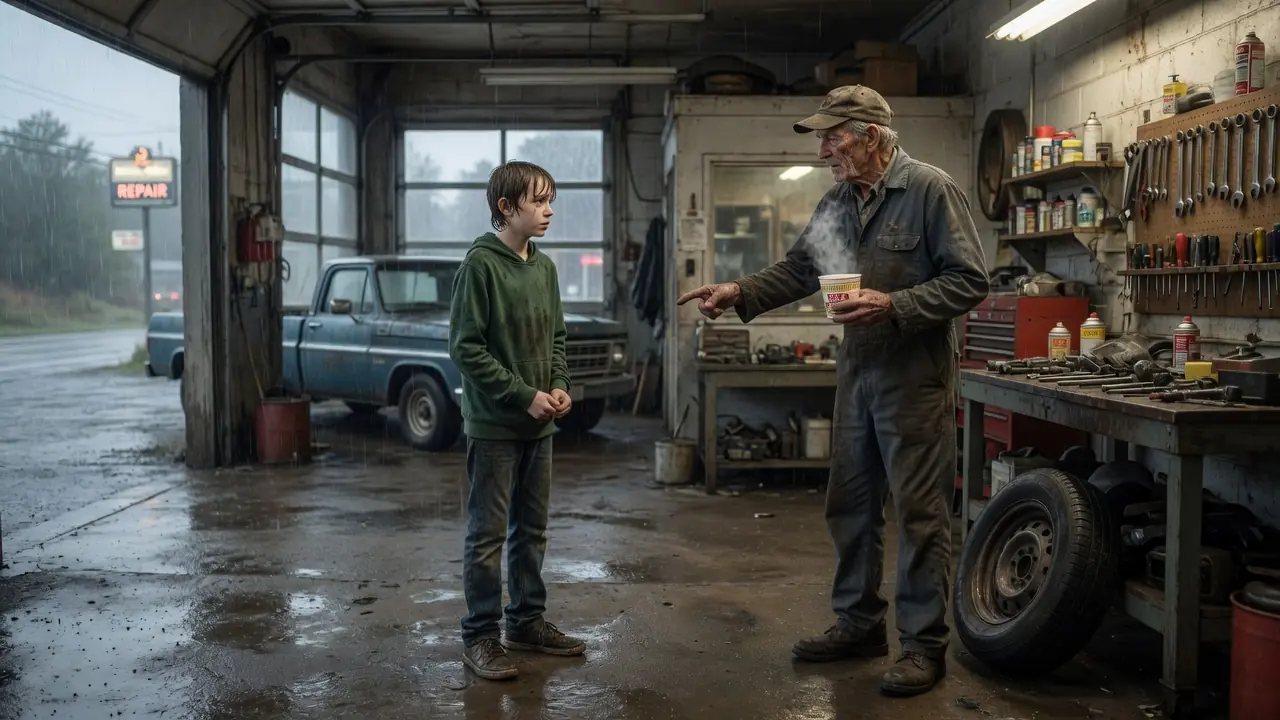
Walter sat at the desk.
Looked at the photo.
“She liked it when the garage was busy,” Walter said.
Ethan asked carefully, “Why did it stop being busy?”
Walter shrugged slightly.
“Town got smaller. Jobs left. People stopped fixing things and started replacing them.”
Ethan frowned. “That sounds wasteful.”
Walter gave a faint, dry sound that almost counted as laughter.
“It is,” he said. “But convenience usually wins.”
Ethan looked at the photo again.
“She would have liked you teaching me,” he said.
Walter didn’t answer immediately.
Then said, “She would have told me to be less grumpy.”
Ethan smiled.
Walter added, quieter, “She was usually right.”
That was the closest Walter had come to softness in weeks.
One morning, Walter did something unusual.
He didn’t assign a task.
He stepped back and said, “Fix the brake system. No instructions.”
Ethan froze. “No instructions?”
Walter nodded. “Pretend I’m not here.”
Ethan looked uneasy.
“That’s not how learning works,” he said.
Walter replied immediately.
“That’s exactly how learning sticks.”
Silence.
Ethan turned back to the car.
For a long time, nothing happened.
Then slowly—carefully—he began.
Not guessing.
Thinking.
Rechecking.
Undoing.
Redoing.
Walter watched from a distance.
Arms crossed.
Face unreadable.
At one point, Ethan stopped.
Looked unsure.
Looked like he might ask.
But didn’t.
He corrected himself instead.
Walter noticed that.
And nodded once.
Barely visible.
But real.
When Ethan finished, the sun was already low.
He stood back.
Wiped his hands.
Looked exhausted.
“Done,” he said.
Walter walked over.
Inspected everything.
Didn’t rush.
Didn’t praise.
Just checked.
Then nodded.
“One mistake,” Walter said.
Ethan stiffened. “Where?”
Walter pointed.
“Here. Minor alignment. Not dangerous. But sloppy.”
Ethan winced. “I can fix it.”
Walter held up a hand.
“Not today.”
Ethan looked confused. “But—”
Walter interrupted.
“You’ll fix it next time without me telling you.”
Silence.
Then Walter added:
“But it’s good work.”
Ethan froze.
“Good?” he repeated.
Walter grunted.
“Don’t make it emotional.”
But Ethan smiled anyway.
Because he understood.
That word, from Walter Hughes, meant more than praise.
It meant trust was forming.
That night, after Ethan left, Walter stayed longer than usual.
He sat in the garage alone.
Listening to the quiet engine ticking as it cooled.
He looked at Helen’s photo again.
Then at the tools.
Then at the space where Ethan stood earlier.
And for the first time in a long time, Walter didn’t think of the garage as something slowly fading.
He thought of it as something being passed on.
Not intentionally.
Not formally.
But inevitably.
Like a language being taught without realizing it.
Walter whispered into the empty space:
“You better not waste this.”
No one answered.
But the garage didn’t feel empty anymore.
It felt occupied.
By the time Ethan turned seventeen, Hughes Auto Repair no longer felt like a place he was “helping” in.
It felt like a place that expected him.
Not in words.
In silence.
Walter Hughes never officially changed anything. There were no announcements, no ceremony, no “promotion” from student to apprentice.
He simply stopped correcting every small movement Ethan made.
And in Walter’s world, that meant everything.
That morning, a customer arrived before Ethan did.
A delivery van, old and overworked, coughing smoke like it was trying to argue with existence itself. The driver stepped out looking stressed, pacing in circles near the front of the garage.
Walter was inside, already drinking his first coffee.
Ethan arrived five minutes late.
Walter noticed immediately.
He always did.
But this time, instead of a comment, Walter simply pointed toward the van.
“You’re handling it,” he said.
Ethan froze at the doorway. “Me?”
Walter didn’t look up. “Unless you see another apprentice hiding behind the oil drum.”
Ethan hesitated. “What if I get it wrong?”
Walter finally looked at him.
Then said something new.
“Then the customer waits while you fix it properly.”
That was it.
No safety net disguised as instruction.
Just responsibility.
Ethan swallowed, nodded, and walked toward the van.
Walter stayed inside.
But he didn’t sit down.
Ethan had done repairs before.
But always under Walter’s shadow.
This was different.
The driver explained the issue quickly: loss of power, strange vibration, hesitation when accelerating.
Ethan listened carefully.
Too carefully.
Then opened the hood.
The engine looked tired but not dead.
He remembered Walter’s voice:
Engines don’t lie. People guess wrong.
He began checking step by step.
Fuel line.
Air filter.
Spark plugs.
Then paused.
Something didn’t feel right.
He stepped back.
Looked again.
The pattern wasn’t matching what he expected.
Inside the garage, Walter watched through the open doorway.
He said nothing.
Ethan tightened his grip on the wrench.
Then made a decision.
Wrong.
The sound came first.
A sharp metallic misalignment.
Not catastrophic.
But wrong enough that Ethan immediately froze.
He stepped back.
Heart sinking.
The driver frowned. “Is everything okay?”
Ethan opened his mouth.
Nothing came out.
Inside the garage, Walter put down his coffee.
Slowly.
Then walked out.
He didn’t rush.
But his presence changed the air.
He looked at the engine.
Then at Ethan.
Then at the part that had just been adjusted.
Silence stretched.
Ethan whispered, “I think I messed it up.”
Walter crouched beside the engine.
Examined it.
Long.
Carefully.
Then said, “You did.”
Ethan closed his eyes briefly.
Walter continued.
“But not the way you think.”
Ethan looked up.
Walter pointed.
“You solved the wrong problem first. That’s different from destroying the engine.”
Ethan frowned. “It is?”
Walter stood up.
“Yes,” he said. “One is ignorance. The other is negligence.”
That distinction mattered more than Ethan realized.
Walter gestured toward the toolbox.
“Fix it,” he said.
Ethan blinked. “Now?”
“Yes.”
“But I—”
Walter interrupted.
“You’re not learning how to avoid mistakes,” he said. “You’re learning how to recover from them.”
That stopped Ethan.
He nodded slowly.
Then went back in.
It took two hours.
Not because it was difficult mechanically.
But because Ethan had to undo his confidence and rebuild the logic step by step.
Walter didn’t help.
Not directly.
He stayed nearby.
Watching.
Only speaking when absolutely necessary.
Once, Ethan hesitated again.
Walter said only, “Think backwards.”
Ethan repeated it under his breath.
“Think backwards…”
And something clicked.
Not fast.
Not magical.
But real.
Eventually, the engine started.
Smooth.
Stable.
Alive again.
The driver exhaled in relief. “I thought I was gonna lose this van.”
Ethan wiped his hands, still tense. “It should be okay now.”
The driver looked at him. “You fixed it?”
Ethan hesitated.
Then nodded.
“Yes.”
Inside the garage, Walter said nothing.
But he turned slightly away.
And that was how Ethan knew it was correct.
Later that evening, after the customer left, Ethan was cleaning tools in silence.
Walter stood nearby.
Watching.
Longer than usual.
Then said, almost casually:
“You didn’t panic.”
Ethan looked up. “I wanted to.”
Walter grunted. “Good. Means you’re human.”
Ethan smiled faintly.
Then asked, “Was it bad earlier?”
Walter paused.
Then said, “It was fixable.”
“That’s not what I asked.”
Walter looked at him.
A long pause.
Then:
“No,” he said. “It wasn’t bad.”
Ethan blinked.
Walter added, “It was learning.”
That was the closest Walter Hughes came to praise without forcing it into sarcasm.
Ethan understood that.
More than he expected.
Over the next weeks, Walter began stepping back further.
Ethan handled more jobs alone.
Simple repairs.
Oil changes.
Diagnostics.
Small customer complaints.
The garage slowly changed shape.
Not physically.
But emotionally.
Customers began asking for “the young mechanic working with Walter.”
Walter never corrected them.
One afternoon, a woman brought in a car with electrical issues.
Walter didn’t even look up.
He just said, “Ethan.”
And that was it.
No instructions.
No backup.
Just a name.
Ethan fixed it.
Not perfectly.
But correctly.
And that was enough.
One night, after closing, Ethan stayed late.
Walter was locking cabinets when Ethan spoke.
“Why did you really take me in?” he asked.
Walter didn’t look up immediately.
Then continued locking a drawer.
“You already asked that once,” he said.
“I know,” Ethan replied. “But I think I understand it differently now.”
Walter stopped.
Looked at him.
“Go on,” he said.
Ethan hesitated.
Then:
“At first, I thought it was just because I was there,” he said. “But now I think… you didn’t just teach me cars.”
Walter frowned slightly.
Ethan continued.
“You taught me how to stay steady when things go wrong.”
Silence.
Walter turned away slightly.
Then said, “Don’t overthink it.”
Ethan smiled faintly.
“I’m not.”
Walter picked up his keys.
“Good,” he said. “Overthinking leads to philosophy. Philosophy doesn’t fix engines.”
Ethan laughed.
Walter didn’t.
But he didn’t stop him either.
That night, after Ethan left, Walter stayed in the garage longer than usual.
He looked at the empty space where the car had been.
At the tools.
At the worn floor.
At the photograph of Helen in the office.
Then quietly said:
“He’s getting it.”
No response.
Just silence.
But for the first time in years, the silence didn’t feel like absence.
It felt like continuation.
By the time Ethan turned eighteen, Hughes Auto Repair had quietly become something different.
It still had the same rusted sign. Still smelled like oil and old metal. Still creaked when the wind hit the front door too hard.
But the center of gravity had shifted.
It no longer revolved solely around Walter Hughes.
It revolved around Walter… and Ethan.
And Walter did not say that out loud even once.
He didn’t need to.
Because customers already did.
“Is the young mechanic here today?”
“Can Ethan take a look at it?”
“Walter’s boy working?”
Walter always corrected none of it.
He simply pointed toward the garage and said, “Park it.”
That was his version of approval.
It happened on a Tuesday morning.
Walter had a doctor’s appointment in town.
He left the garage earlier than usual, handing Ethan a set of keys without ceremony.
“Lock up if I’m late,” Walter said.
Ethan frowned. “What about appointments?”
Walter paused at the door.
“Handle them.”
Ethan blinked. “All of them?”
Walter nodded once.
Then left.
No instructions.
No safety net.
Just an old garage and a teenager standing in the middle of it like it suddenly weighed more than it used to.
The first customer arrived at 9:12 a.m.
A man with a misfiring truck.
Then another at 9:40.
Then a woman with brake issues.
Ethan moved carefully.
Too carefully at first.
Then faster.
Then correctly.
He didn’t realize until noon that he hadn’t sat down once.
By the time Walter returned in the afternoon, Ethan had completed three jobs.
The garage smelled of warm metal and effort.
Walter walked in slowly.
Looked around.
Then at Ethan.
“You survived,” Walter said.
Ethan wiped his hands. “Barely.”
Walter nodded. “Good.”
That was it.
But something had changed permanently after that day.
It came two weeks later.
A delivery truck arrived late in the afternoon.
Not unusual.
What was unusual was the tone of the driver.
Angry.
Accusatory.
“This is the second time this engine’s failed after your repair,” he said. “I paid good money for this.”
Walter stepped out of the office.
Ethan was already standing near the vehicle.
He looked uncertain.
Walter didn’t speak yet.
He let Ethan check first.
Ethan opened the hood.
Listened.
Took notes.
Then frowned.
“That’s not the same issue,” Ethan said quietly.
The driver snapped. “Excuse me?”
Ethan hesitated.
Walter watched.
This was the moment.
The one where mechanics either became professionals or excuses.
Ethan stepped forward.
“The previous repair was correct,” he said. “But this failure is unrelated. It’s the fuel system now.”
The driver didn’t believe him.
“You’re just covering your mistake.”
Ethan’s hands tightened slightly.
Walter took a step closer—but stopped.
He didn’t interfere.
Ethan swallowed.
Then said, “If I made a mistake before, I would tell you. But I didn’t. And I can prove it.”
That sentence changed the air.
Not because it was confident.
But because it was calm.
Walter’s eyes narrowed slightly.
The driver hesitated.
“Prove it,” he said.
Ethan worked.
Slow.
Methodical.
Explaining as he went.
Showing.
Not arguing.
By the end, the issue was clear.
Separate fault.
Unrelated to previous repair.
The driver exhaled, embarrassed. “Alright… I was wrong.”
Ethan nodded once. “It happens.”
After he left, silence returned.
Walter walked over.
Looked at Ethan.
Then said:
“You didn’t flinch.”
Ethan blinked. “I wanted to.”
Walter nodded. “Good.”
That was becoming his favorite word.
Walter didn’t tell Ethan he was getting tired.
He just started moving slower.
Sitting more often.
Watching longer.
Ethan noticed before Walter admitted anything.
One evening, Walter dropped a wrench.
It hit the floor harder than it should have.
Ethan looked up immediately. “You alright?”
Walter grunted. “I’m not made of springs.”
Ethan walked over. “You should rest more.”
Walter scoffed. “You should stop diagnosing things you don’t understand.”
But he didn’t pick the wrench up quickly.
Ethan did it instead.
Walter watched him do it.
Then quietly said:
“Don’t get used to thinking I’ll slow this place down.”
Ethan hesitated.
“I’m not worried about the garage,” he said.
Walter raised an eyebrow.
Ethan added, softer:
“I’m worried about you.”
That made Walter stop for a second.
Just a second.
Then he turned away.
“Focus on the engine,” he said.
But he didn’t sound annoyed.
Just older.
It happened on a stormy evening.
A customer came in with a heavily damaged engine after overheating on the highway.
Urgent.
Complicated.
Time-sensitive.
Walter was inside the office reviewing paperwork.
Ethan handled it.
At first, everything went smoothly.
Diagnosis.
Initial repair.
Then the complication hit.
A hidden crack in a component Ethan hadn’t fully accounted for.
The engine failed during testing.
Not catastrophic damage.
But enough to stop everything.
The customer panicked.
“You made it worse!”
Ethan froze.
For the first time in a long time, doubt returned.
Walter came out.
Saw the situation.
Looked at the engine.
Then at Ethan.
Then said something unexpected.
“Fix it again.”
Ethan blinked. “I don’t know if—”
Walter interrupted.
“You do know. You just don’t trust it yet.”
That line landed harder than anger would have.
Ethan stepped forward again.
Re-evaluated everything.
Slower now.
Less confident.
More precise.
Walter stayed beside him this time.
Not helping.
Just present.
After an hour, the engine started again.
Properly.
The customer left.
Quiet.
Relieved.
Ashamed.
Ethan didn’t celebrate.
He just sat down on the tire near the bench.
Exhausted.
Walter stood nearby.
Then said:
“That’s what responsibility feels like.”
Ethan nodded slowly. “Heavy.”
Walter grunted. “Good. Means you didn’t run from it.”
That night, after closing, Walter sat longer than usual.
Ethan cleaned tools in silence.
Finally, Walter spoke.
“You’re not a kid in my garage anymore,” he said.
Ethan looked up slowly.
Walter continued.
“You’re running parts of it.”
Silence.
Ethan didn’t answer immediately.
Then asked quietly:
“What does that make me?”
Walter looked at him for a long moment.
Then said:
“Someone I don’t have to explain things to twice.”
That was the closest Walter Hughes ever came to calling someone family without using the word.
Ethan understood.
More than words.
Winter arrived early that year.
Not loudly.
Not dramatically.
Just quietly, like something slowly deciding to stay longer than expected.
Hughes Auto Repair felt it first.
The metal door became harder to open in the mornings. The floor stayed cold even after hours of work. The old heater in the corner coughed more than it warmed.
Walter Hughes noticed all of it.
But he noticed something else too.
His hands were not as steady as they used to be.
He didn’t say it.
He simply adjusted.
Slower movements.
Fewer long hours under cars.
More watching.
Less fixing.
Ethan noticed before Walter admitted anything.
One morning, Ethan saw Walter pause too long while tightening a bolt.
Just a second too long.
But enough.
Ethan stepped forward immediately. “I’ll do it.”
Walter didn’t argue.
That was new.
Too new.
The call came in on a Friday afternoon.
A fleet vehicle from a regional logistics company.
If Hughes Auto Repair could fix it quickly, it would mean a contract. Steady income. Survival for the garage.
If it failed…
It would end reputation in one stroke.
Walter knew it immediately.
So did Ethan.
The vehicle arrived late.
The issue was complex — electrical and mechanical failure combined, intermittent, unpredictable.
The kind of problem that destroyed confidence before it destroyed engines.
Walter looked at it.
Then at Ethan.
And said only:
“This one is yours.”
Ethan froze. “Mine?”
Walter nodded.
“No backup?”
Walter shook his head.
“If I stand too close, you’ll lean on me,” he said. “And this one can’t afford leaning.”
Ethan swallowed.
Then stepped forward.
Ethan worked like he had never worked before.
Not faster.
More carefully.
Every assumption checked twice.
Every system traced fully.
Every mistake anticipated before it happened.
Walter sat on an old stool nearby.
Watching.
Silent.
At one point, Ethan stopped.
Looked unsure.
Looked back at Walter.
Walter didn’t move.
Didn’t speak.
Just waited.
Ethan turned back.
Continued.
Later, another problem appeared.
Then another.
The garage felt smaller.
Tighter.
Heavier.
But Ethan didn’t stop.
He adapted.
Corrected.
Rebuilt.
When the engine finally started without hesitation, it was already dark outside.
Ethan stood there, hands covered in oil, breathing hard.
The customer tested it.
It worked.
Perfectly.
The silence that followed was not empty.
It was heavy with confirmation.
The customer left with a handshake and a promise of future contracts.
Ethan didn’t smile.
He just turned to Walter.
Waiting.
Walter stood up slowly.
Walked over.
Looked at the engine.
Then at Ethan.
Long silence.
Then:
“You don’t need me here anymore,” Walter said.
Ethan froze.
“What?”
Walter nodded slightly.
“You’ve outgrown this garage.”
Ethan shook his head immediately. “No. I still need—”
Walter interrupted.
“No,” he said calmly. “You don’t.”
That silence hit harder than any praise ever could.
Ethan’s voice dropped. “So that’s it?”
Walter looked at him for a long time.
Then said:
“That’s the job.”
Ethan didn’t move.
Walter continued, quieter:
“I taught you how to fix engines. Not how to stay in one place forever.”
Ethan’s hands tightened.
“I don’t want to leave,” he said.
Walter nodded once.
“I know.”
That was the first time Walter sounded like he was not arguing with him.
Just accepting something unavoidable.
The garage felt different now.
Not broken.
Finished in a strange way.
Like something had reached its natural end point.
Walter walked to his office.
Came back with a worn envelope.
Handed it to Ethan.
Ethan opened it.
Inside were documents.
Certification references.
A recommendation letter already signed.
And a small note.
Walter’s handwriting.
Simple.
“He learns faster than most men twice his age. Don’t waste him in a small place.”
Ethan’s breath caught.
“You wrote this?”
Walter shrugged.
“I don’t say things twice,” he said. “Paper is safer.”
Ethan looked down.
Then whispered, “Where am I supposed to go?”
Walter answered without hesitation:
“Anywhere the work is bigger than this garage.”
Silence.
Heavy.
Final.
Ethan packed nothing dramatic.
Just tools.
A few clothes.
And the wrench Walter had once said belonged to his father.
Walter stood by the garage door.
Watching.
Not stopping him.
Not pushing him.
Just present.
Ethan hesitated at the threshold.
Turned back.
“I’ll come back,” he said.
Walter nodded.
“No,” he said gently. “You’ll come forward.”
Ethan didn’t fully understand.
But he nodded anyway.
And left.
Walter Hughes almost didn’t recognize the sound first.
Engines had a language.
And this one spoke too cleanly.
Too professionally.
A modern truck pulled into the lot years later.
Not broken.
Not desperate.
Perfect condition.
The door opened.
Ethan stepped out.
Older.
Calmer.
Carrying the quiet confidence of someone who no longer guessed.
Behind him — another vehicle, and then another.
A small convoy.
Walter narrowed his eyes.
“You got lost?” he called out.
Ethan smiled.
“No,” he said. “I built something.”
He handed Walter a folder.
Inside:
A network of workshops.
Training centers.
Scholarship programs for young mechanics.
And the name across every document:
HUGHES TECH WORKSHOPS
Walter stared at it.
Long.
Very long.
“This is too much,” he said finally.
Ethan shook his head.
“This is not enough.”
Walter looked up sharply.
Ethan continued:
“You gave me a garage where I learned how to fix engines.”
He stepped closer.
“I built places where kids who are like I was… don’t have to beg for a chance.”
Silence.
Then Walter asked quietly:
“Why my name?”
Ethan smiled.
“Because you were the first place I stopped being invisible.”
Walter looked away for a moment.
Then back.
“Still bad branding,” he muttered.
Ethan laughed.
“Probably.”
Walter walked slowly into the old garage.
Touched the workbench.
The same one.
Same scratches.
Same oil stains.
Same life.
Ethan stood beside him.
“This place could still be a training center,” Ethan said.
Walter snorted. “You want me supervising kids now?”
“I want them to learn from someone who never taught nonsense.”
Walter looked at him.
Long pause.
Then:
“I’m old,” he said.
Ethan nodded.
“So were the best teachers when I met you.”
Walter exhaled.
Then said something he had never said before.
“Alright.”
Ethan blinked. “Alright?”
Walter nodded once.
“But I’m still not teaching group classes,” he added.
Ethan smiled.
“That’s fine.”
A pause.
Then Walter added:
“And no one touches my tools without asking.”
Ethan nodded.
“Of course.”
Another pause.
Then Walter muttered:
“…and fix that missing letter on the sign.”
Ethan laughed.
“I already did.”
Walter looked up at the garage sign.
For the first time in years, it read clearly:
HUGHES AUTO REPAIR
All letters intact.
Bright enough to be seen.
Still old.
Still honest.
Still standing.
Walter didn’t retire that day.
He simply stopped being alone in the garage.
And for the first time in a long time, the place didn’t feel like the end of something.
It felt like the beginning of something that would no longer need him…
but would always carry him.
Because some people don’t leave legacies behind.
They teach them how to walk.