At seventy-seven years old, Florence Hart still opened the secondhand bookstore on Pine Street every morning, even though most people in Albany, New York, said small bookstores were becoming things of the past.
Her shop was called Hart & Pages, a narrow little place squeezed between a dry cleaner and a bakery. The wooden floor creaked near the front window.
The poetry shelf leaned slightly to the left. The old heater clicked in winter like it was arguing with itself. But the store was warm, quiet, and smelled of paper, dust, cinnamon tea, and old wood.
Florence loved it.
Her husband, Henry, had built the shelves with his own hands. Their only son, David, had learned to read on the rug near the children’s section.
For years, the shop had been full of life: mothers reading picture books aloud, college students searching for cheap classics, old men arguing over history books, and children sitting cross-legged between the shelves.
Now Henry was gone.
David lived in Seattle with his wife and children.
And Florence spent most days alone with books that remembered more voices than the room did.
Still, every morning, she turned the sign to OPEN.
“Books wait better than people,” Henry used to say. “But even books like company.”
One cold November afternoon, rain tapped softly against the front window while Florence sorted a box of donated paperbacks near the counter. The bakery next door had just closed early, and the street outside looked gray and empty.
That was when the bell above her door rang.
A boy stepped inside.
He was about ten years old, thin, with dark brown hair, a pale face, and a navy school sweatshirt damp from rain. He held one hand pressed over his right eye, and his backpack hung low from one shoulder. His breathing was quick, like he had been running.
Florence looked up immediately.
“Hello, dear. Are you all right?”
The boy froze. “I’m fine.”
Florence had lived long enough to know that children said “I’m fine” most often when they were not.
She set down the books. “You’re holding your eye.”
“I’m okay.”
“Did something happen?”
He shook his head too quickly.
Florence stepped slowly around the counter, careful not to frighten him. “What’s your name?”
He hesitated. “Daniel.”
“Daniel what?”
“Daniel Price.”
“I’m Florence Hart.”
He glanced at the sign on the counter. “I know.”
“So you can read signs. Good. That means I don’t have to introduce the furniture.”
For one second, the corner of his mouth moved.
Then his face tightened again.
Florence noticed something in his other hand: a pair of broken glasses. One lens was cracked badly. One arm had snapped completely off.
“Oh,” she said softly.
Daniel immediately hid them behind his back.
“They’re not that bad.”
Florence raised one eyebrow. “I have owned this bookstore for forty-three years. I know a broken pair of glasses when I see one.”
Daniel looked down.
Rain slid down the glass behind him.
“May I look?” Florence asked.
He slowly handed them over.
The glasses were old, scratched, and held together in two places with clear tape. They had been repaired before, probably more than once. The crack across the left lens made it nearly impossible to see through.
“What happened?” Florence asked.
Daniel’s jaw tightened. “Nothing.”
“That must have been a very aggressive nothing.”
He looked away.
Florence waited.
Finally, he whispered, “Some boys at school grabbed my backpack. My glasses fell. They stepped on them.”
Florence felt anger rise in her chest, sharp and hot.
But she kept her voice calm.
“Did a teacher see?”
Daniel shook his head.
“Did you tell anyone?”
“No.”
“Why not?”
His fingers tightened around his backpack strap. “Because if I tell, it gets worse.”
Florence’s heart sank.
She knew that answer too.
“Do your parents know?”
“My mom’s at work.”
“And your father?”
“Gone.”
Florence nodded quietly. “Can your mother take you to get new glasses?”
Daniel looked toward the floor.
“She will,” he said quickly. “When she gets paid.”
“When is that?”
“Next Friday.”
Florence looked at the broken glasses again. “That’s more than a week.”
“I can manage.”
“Can you see without them?”
He lifted his chin. “Enough.”
Florence pointed gently toward a sign near the back wall. “Can you read that?”
Daniel squinted.
His face turned red.
“No,” he admitted.
Florence’s voice softened. “Why did you come here?”
He glanced toward the children’s section. “I have to study.”
“For what?”
“The scholarship exam. Saturday.”
Florence knew about it. The district had a competitive scholarship test for a strong private middle school across town. The exam could change a child’s path, especially a child whose family could not afford better options.
“It’s in two days,” Daniel said. “I need the practice book. The library copy is checked out, and my teacher said maybe a used bookstore would have one.”
Florence looked at the box of donated books, then at him.
He had come through rain, nearly blind, embarrassed, hurt, and still thinking about studying.
“What book?” she asked.
He pulled a folded paper from his pocket and handed it to her.
Florence checked the title, then moved toward the education shelf.
Daniel followed slowly, one hand brushing the shelf to guide himself.
That small movement broke her heart.
She found the book.
It was used, but clean.
“How much?” he asked.
Florence looked at the price penciled inside the front cover.
Six dollars.
Then she looked at his broken glasses.
“Two dollars,” she said.
Daniel searched his pocket and pulled out coins. “I have one eighty-seven.”
“Lucky day. There’s a thirteen-cent discount for rainy weather.”
He looked suspicious. “That’s not real.”
“It is in my store.”
He placed the coins on the counter carefully.
Florence slid the book into a paper bag.
Daniel reached for it, but she did not let go right away.
“Daniel,” she said gently, “you cannot take that exam if you cannot see the questions.”
His face hardened. “I’ll figure it out.”
“No.”
The word was soft, but firm.
He stared at her.
Florence placed the broken glasses beside the register. “There is an eye clinic on Madison Avenue. I know the owner. Her name is Dr. Elaine Morris. She bought mystery novels from me for twenty years and still owes me an opinion on Agatha Christie. We are going there.”
Daniel stepped back. “No.”
“Yes.”
“I don’t have money.”
“I didn’t ask for money.”
“I can’t let you buy me glasses.”
“You can let me help you see.”
His eyes filled, but he blinked quickly. “My mom will be mad.”
“Then we will call her first.”
Florence handed him the store phone.
Daniel knew the number by memory.
His mother answered on the fourth ring, breathless and worried.
“Daniel? Where are you?”
“I’m at Hart & Pages. My glasses broke.”
There was silence.
Then his mother’s voice cracked. “Oh, baby.”
Florence took the phone gently when Daniel looked overwhelmed.
“Mrs. Price? My name is Florence Hart. Your son is safe. His glasses are badly broken. I would like to take him to Dr. Morris’s clinic and cover the cost of a replacement pair.”
“No,” the woman said immediately, panic and shame tangled together. “Mrs. Hart, I can’t ask you to do that.”
“You didn’t ask.”
“I can pay you back next Friday.”
“We can discuss that after your son can see.”
The woman began to cry quietly. “He has his exam Saturday.”
“I know.”
“I was going to get them fixed. I swear I was. I just had to wait for payday.”
“I believe you,” Florence said.
The crying on the other end stopped for a moment.
“You do?”
“Yes.”
That seemed to undo the woman more than anything else.
Her name was Marisol Price. She worked at a nursing home kitchen and cleaned offices three nights a week. She could not leave work for another hour, but she gave permission for Florence to take Daniel to the clinic.
Before they left, Florence taped a handwritten sign to the shop door.
BACK IN ONE HOUR. BOOK EMERGENCY.
Daniel squinted at it. “Book emergency?”
“It sounds more respectable than glasses rescue.”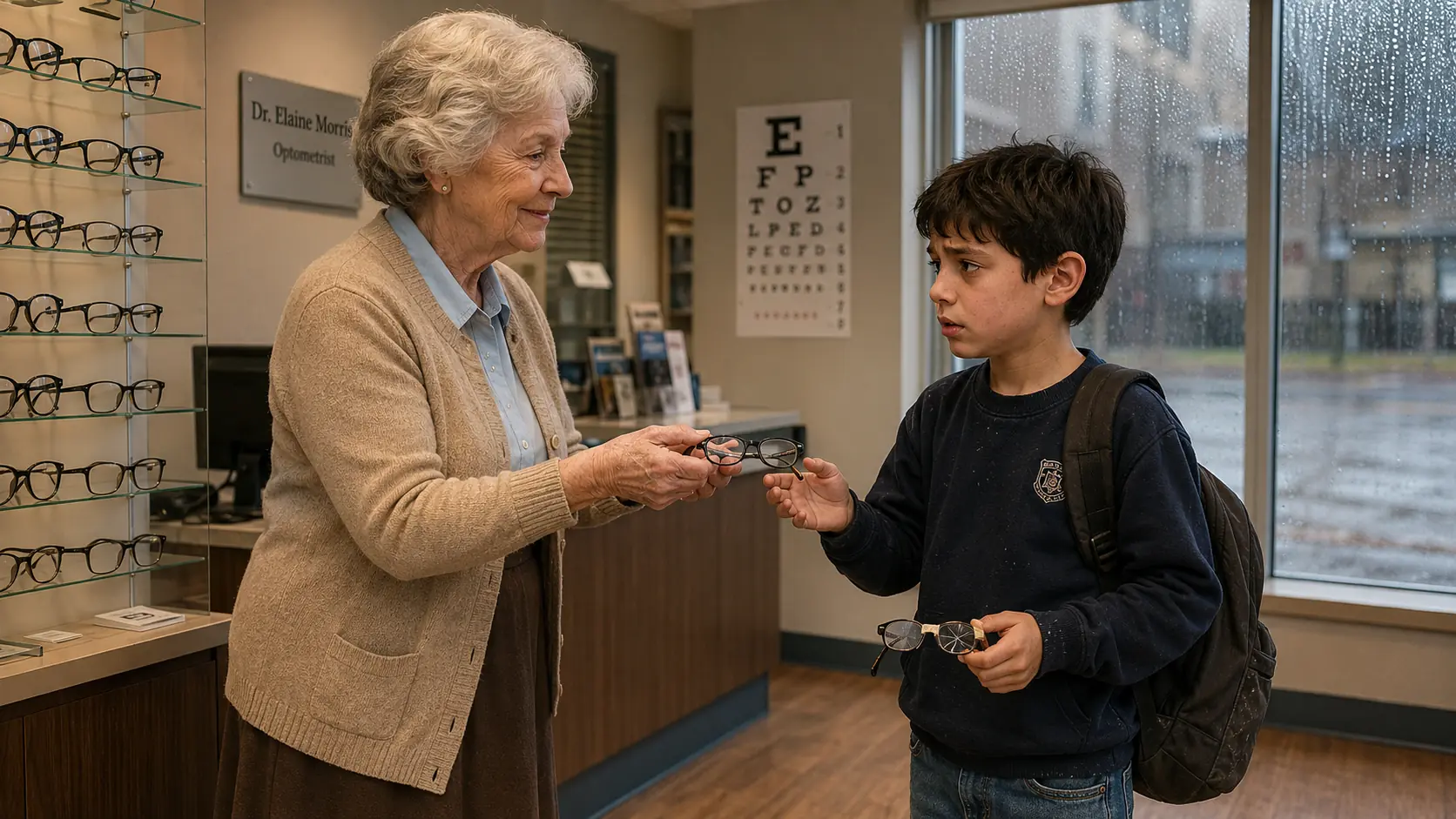
At the clinic, Dr. Morris examined Daniel immediately. His prescription was strong. Stronger than Florence expected. Without proper glasses, the boy’s world must have been a blur of shapes and guesses.
Dr. Morris lowered her voice when Daniel was choosing frames from the least expensive section.
“He needs glasses today,” she said. “Not next week.”
“I know,” Florence replied.
“We can make a basic pair before closing.”
“Do it.”
When Daniel heard the cost, he looked like he might run.
Florence stopped him with one sentence.
“Scholarship exams are difficult enough without fog.”
He stared at her, then lowered his head.
“I’ll pay you back,” he whispered.
Florence smiled gently. “Children keep trying to make business arrangements with me.”
“I mean it.”
“I know.”
Two hours later, Daniel put on his new glasses.
He blinked.
Then blinked again.
The world returned to him.
Florence watched his face change as the edges of things became sharp: the clock on the wall, the posters, the buttons on her coat, the rain on the window.
He looked down at the practice book in his hands and read the title clearly.
His mouth trembled.
“I forgot leaves had lines,” he whispered, looking at the plant near the door.
Florence turned away quickly and pretended to inspect a shelf of pamphlets.
Marisol arrived just before the clinic closed, still wearing her work uniform, her hair pulled back under a net, her face tired and wet with tears.
When she saw Daniel in his new glasses, she covered her mouth.
“Daniel.”
“I can see, Mom.”
Marisol hugged him tightly.
Then she turned to Florence.
“Mrs. Hart, I don’t know how to thank you.”
“Let him study in my shop tomorrow,” Florence said. “It is quieter than most places, except when the heater argues.”
Marisol laughed through tears.
The next day, Daniel came to the bookstore after school.
Then the next week.
Then almost every afternoon.
He passed the scholarship exam.
He got into the private middle school.
But even after that, he kept coming to Hart & Pages.
Florence gave him a chair behind the front counter. He did homework there while she sorted books. When customers came in, he looked up shyly at first, then more confidently. He became excellent at recommending books to children because he remembered what it felt like to need the right book at the right moment.
At eleven, he organized the children’s shelf by reading level.
At twelve, he created a “Books Under Two Dollars” basket for kids with coins.
At thirteen, he began tutoring younger children in the back corner on Saturdays.
Florence called him her assistant manager.
He said, “I don’t get paid.”
She said, “The title is mostly decorative.”
Marisol came often too, usually exhausted, always grateful. She brought food when she could: empanadas, rice pudding, soup. Florence accepted everything because she understood that dignity sometimes arrived in covered dishes.
Over the years, the bookstore became Daniel’s second home.
He grew tall. His voice deepened. His old shy caution turned into quiet confidence. He loved reading, but more than that, he loved access: the idea that the right room, the right book, or the right adult could change whether a child believed the future had room for them.
When he graduated high school at the top of his class, Florence sat beside Marisol in the front row.
Daniel received a full scholarship to study education policy and library science.
After the ceremony, he gave Florence a small wrapped box.
Inside were his old broken glasses.
The ones the boys had stepped on years before.
Florence looked up, startled.
“I kept them,” he said.
“Why?”
“To remember what it felt like when someone helped me see.”
Her eyes filled.
He hugged her carefully.
“I’ll pay you back one day,” he whispered.
Florence smiled through tears. “For glasses?”
“For everything.”
College took Daniel away, but not out of her life.
He called every Sunday. He sent books he thought she would like. He mailed her photos of libraries, classrooms, reading programs, and once a picture of a child holding a book with the message:
He reminded me of me. I helped him find the large-print edition.
Florence saved every letter.
But Hart & Pages was struggling.
The rent rose. Online sellers took customers. The roof leaked near the history shelf. The heater finally stopped arguing and simply surrendered. Florence’s hands stiffened with arthritis, making it harder to carry boxes. Her son urged her to retire and move closer to him in Seattle.
Florence knew he was right.
But closing the bookstore felt like closing the last door Henry had built with her.
She tried to hold on.
At eighty-five, she received the final notice.
The building would be sold.
The new owner planned to turn the row of shops into luxury offices.
Florence sat behind the counter with the notice in her lap, listening to the silence between the shelves.
For the first time in forty-three years, she did not turn the sign to OPEN the next morning.
Marisol noticed when she came by with soup.
Daniel arrived three days later.
He was twenty-eight now, wearing a dark coat and carrying a leather folder. He had become director of a nonprofit that built reading rooms and mobile libraries for low-income neighborhoods.
Florence opened the door and sighed.
“Your mother called you.”
“She loves you.”
“She worries too loudly.”
“She learned from you.”
He stepped inside and looked around the dim shop.
“You were going to close without telling me?”
“I didn’t want to pull you away from important work.”
“This is important work.”
“It is an old bookstore.”
“It is where my life changed.”
Florence looked down.
Daniel placed the folder on the counter and opened it.
Inside were plans.
The building had been purchased by a community literacy foundation Daniel worked with. Hart & Pages would not close. It would become a nonprofit children’s bookstore and reading center. The front would remain a bookstore with low-cost used books. The back would become a tutoring room. A new program would provide free eye exams, reading assessments, and books for children who struggled in school because no one had noticed what they could not see.
Florence could not speak.
Daniel turned to the final page.
It showed the new sign.
THE FLORENCE HART READING HOUSE
Helping Children See Their Future Clearly.
Florence covered her mouth.
“No.”
“Yes.”
“My name should not be above a door.”
“It should be above this one.”
“I only bought you glasses.”
Daniel’s voice softened. “You bought me sight, time, confidence, and a place to belong. You believed my mother. You protected my dignity. You made sure I didn’t walk into that exam blind.”
Her tears fell.
He reached into his pocket and pulled out the broken glasses, now preserved in a small frame.
“They will hang near the entrance,” he said. “Not as a sad thing. As a reminder.”
“A reminder of what?”
“That children do not fail because they lack ability. Sometimes they fail because no one notices what they need.”
The renovation took five months.
Florence complained about the noise, the new lights, the computer system, the bright rug in the children’s section, and the fact that everyone kept moving her favorite chair.
Daniel listened patiently and ignored most of it.
But he preserved what mattered.
Henry’s shelves stayed. The brass bell above the door stayed. The poetry shelf still leaned slightly left because Florence insisted “it had personality.” Her old counter was refinished, not replaced.
On reopening day, children lined up outside.
Some came for books.
Some came for tutoring.
Some came for free vision screenings in the new back room.
Marisol stood beside Florence, crying before the ceremony even began.
Daniel spoke to the crowd.
“When I was ten,” he said, “I walked into this shop with broken glasses and a scholarship exam two days away. Florence Hart did not treat me like a problem. She did not make my mother feel ashamed. She simply decided that a child who wanted to study deserved to see.”
Florence lowered her head.
“This place exists because of that decision,” Daniel continued. “Every child who comes here will be seen, heard, and helped before anyone decides what they are capable of.”
The room applauded.
Florence cried openly.
Years later, the Florence Hart Reading House became one of the most loved places in Albany. Children came after school to read, study, receive help, and choose books they could afford. Parents came nervous and left relieved. Volunteers helped with homework. Eye doctors visited once a month for free screenings.
Florence no longer carried boxes, but she sat near the front window three afternoons a week, helping children choose books.
One rainy afternoon, a boy came in holding a book inches from his face.
Florence noticed immediately.
She looked toward Daniel, who was visiting that day.
He noticed too.
The boy whispered, “I’m not good at reading.”
Florence smiled gently.
“Maybe,” she said, “we should first make sure the words are not hiding from you.”
Daniel’s eyes filled.
The boy looked confused, but he followed her to the back room.
Outside, rain slid down the window just as it had years ago.
Inside, the shelves were full, the lights were warm, and Henry’s old bell rang every time another child stepped through the door.
Florence had once thought she was only buying one boy a pair of glasses.
But kindness is rarely only what it seems in the moment.
A pair of glasses became a passed exam.
A passed exam became a future.
A future became a reading house.
And an old woman who feared her bookstore would disappear lived long enough to see it become a place where children were not only taught to read, but finally seen.