The boy stood outside the bakery window for eleven minutes before Evelyn Marsh finally opened the door.
She knew because she had been watching the clock.
Not openly, of course. Evelyn had owned Marsh Bakery for forty-three years, which meant she had perfected the art of noticing people without making them feel noticed. 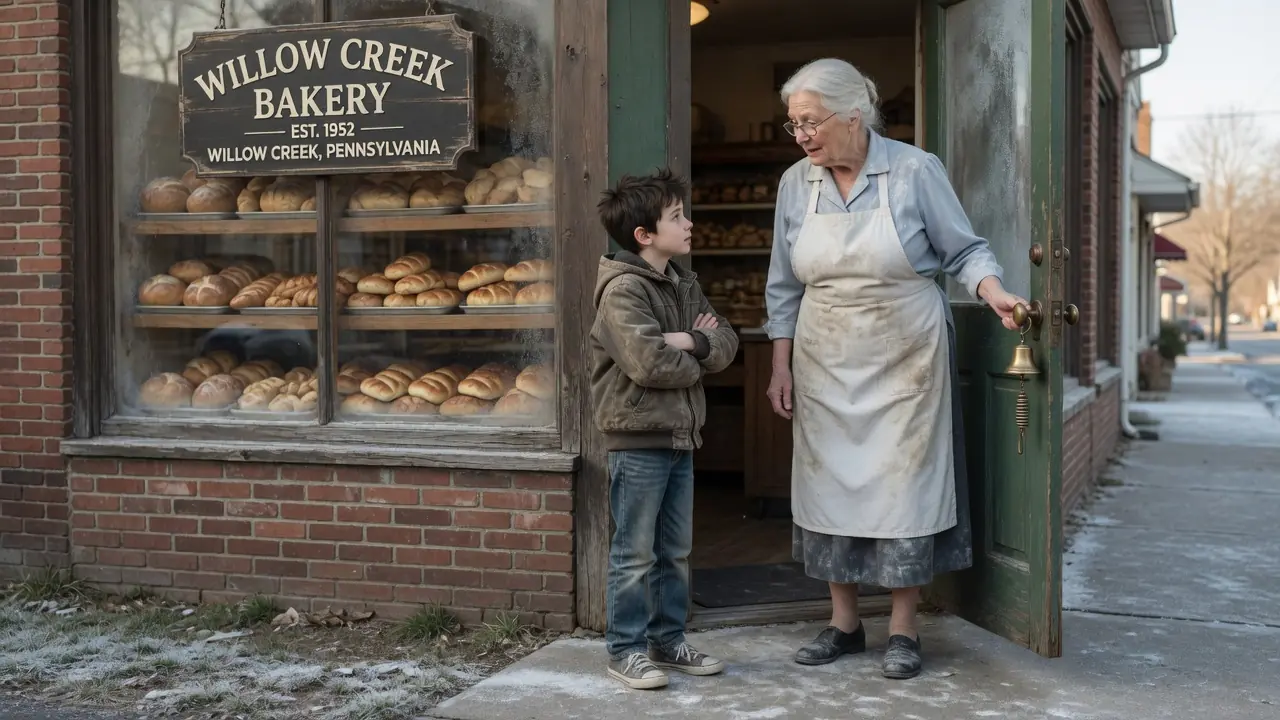
She could sweep crumbs from a counter while watching a customer count coins. She could tie a box of pastries while seeing a mother quietly check whether one child had eaten more than the other. She could refill coffee without interrupting the kind of silence people carried when life had been unkind.
That morning, she watched the boy through the front window while pretending to rearrange loaves of bread.
He was small for his age, maybe ten or eleven, though hunger and cold had a way of shrinking children. His faded brown jacket was zipped all the way to his chin. One sleeve was darker near the cuff, as if it had been wet and dried too many times. His shoes were scuffed so badly the toes looked tired. The laces did not match.
His hair was dark and uneven, cut short around the ears and too long in the back, the kind of haircut given at home by someone in a hurry with kitchen scissors.
He stood with his hands tucked under his arms. Not for attitude. Not because he wanted to look tough. Because the March morning in Willow Creek, Pennsylvania, still carried the stubborn cold of winter, and his fingers were red.
He never knocked.
He never reached for the door.
He only stared through the glass at the trays of bread cooling near the window.
Evelyn knew that look.
Not curiosity.
Not greed.
Hunger.
After forty-three years of baking bread for miners, teachers, truck drivers, church ladies, tired mothers, old men, teenagers, and people who came in pretending they only wanted coffee when what they really needed was warmth, Evelyn could recognize hunger faster than most people recognized a face.
Hunger had a posture.
It made children stand very still, as if sudden movement might use up energy they did not have. It made adults study the menu too long, pretending to decide when they were really calculating shame. It made proud people glance at food and then away again, as if not looking might make needing it less obvious.
Evelyn Marsh had been hungry before.
Not recently.
Not since the bakery had become steady enough to keep her pantry full and her bills paid on time. But she remembered hunger from childhood, from the years after her father died and her mother took in laundry until her knuckles cracked. She remembered stretching soup with water. She remembered pretending not to want the last biscuit because her younger brother was still growing. She remembered how hunger made kindness feel dangerous, because every gift came with the fear that someone would make you pay for it later.
The boy outside her window looked exactly like that fear.
Evelyn wiped her hands on her apron and walked to the door.
The little brass bell above it rang as she opened it.
The boy stepped back immediately.
“I’m sorry,” he said quickly. “I wasn’t bothering anybody.”
Evelyn looked at him over the top of her glasses.
“Standing outside my window like a frozen bird is bothering somebody.”
His face tightened with embarrassment.
“I’ll go.”
“I didn’t say go.”
He froze.
Evelyn held the door wider.
“Come in before the bread gets warmer than you are.”
The boy’s eyes flicked past her into the bakery.
Warmth rolled out onto the sidewalk, carrying the smell of yeast, butter, cinnamon, coffee, and sugar. The front room glowed softly in the morning light. Behind the counter, rows of loaves sat cooling on wooden racks. Apple turnovers rested under a glass dome. A tray of rolls steamed faintly near the register.
The boy looked at all of it, then down at his shoes.
“I don’t have money.”
“I didn’t ask if you had money.”
“I just don’t want you to think I’m trying to steal.”
“If I thought you were trying to steal, I would not be inviting you in through the front door.”
He swallowed.
“My name is Samuel.”
“Samuel what?”
“Samuel Price.”
“I’m Evelyn Marsh. This is Marsh Bakery. Now we are no longer strangers, which means you may come inside without looking like I am setting a trap.”
Samuel did not smile, but something in his shoulders loosened.
He stepped inside.
Warmth wrapped around him immediately.
For a second, he did nothing but stand there.
The bakery was small but alive in the way old places become alive when enough people have passed through them. The floorboards creaked near the counter. The walls were painted pale yellow, though time had softened the color until it looked like sunlight remembered from another year. Framed photographs hung behind the register: Evelyn and her late husband Henry on opening day, Evelyn with her two children when they were young, a row of local firefighters eating doughnuts after a storm, a little league team holding cinnamon rolls like trophies.
A wooden sign above the counter read:
Marsh Bakery
Bread, Pastries, Coffee
Since 1979
Samuel stared at it as if he had stepped into a place from a storybook.
Evelyn pretended not to notice.
“Sit there,” she said, pointing to the small table near the window.
“I can’t buy anything,” Samuel repeated.
“You already mentioned that.”
“I just don’t want you to think…”
“I think you’re cold and hungry,” Evelyn said. “That is plenty of thinking for one morning.”
Samuel sat slowly, as if the chair also required permission.
Evelyn went behind the counter and prepared a plate.
One warm roll with butter.
A bowl of potato soup from the back kitchen.
Half an apple turnover that had cracked on one side and could no longer be sold at full price, though it tasted exactly the same.
She added a cup of milk.
Then she carried everything to the table.
Samuel stared at the plate.
His voice dropped.
“I can’t pay.”
“That roll came out smaller than the others. The soup needs someone to appreciate it. The turnover is cosmetically injured.”
He looked up.
“Cosmetically?”
“It means ugly but delicious.”
For the first time, Samuel almost smiled.
Almost.
Then he picked up the roll.
At first, he took small bites, careful and polite. But hunger had no patience for manners. Soon he was eating faster, dipping the bread into the soup, spooning potatoes into his mouth, trying not to look desperate and failing because ten-year-old boys were not built to hide that kind of need.
Evelyn returned to the counter and busied herself with wrapping loaves.
She gave him privacy.
Some people needed food.
Some needed not to be watched while needing it.
Samuel drank the milk in three careful swallows. When he reached the apple turnover, he paused, as if dessert was something too generous to trust. He looked toward Evelyn.
She did not turn around.
Only then did he eat it.
When Evelyn came back, the plate was clean enough to return to the shelf.
Samuel sat with his hands folded on the table, guilt settling over his face now that hunger had loosened its grip.
“That was good,” he said quietly.
“It had better be. I made it.”
“Thank you.”
“You’re welcome.”
He looked toward the door.
“I should go.”
“Where?”
His expression changed.
Not much.
Just enough.
Evelyn had asked too quickly, and he had not prepared a lie.
“School,” he said.
“At nine-thirty on a Saturday?”
He looked down at the table.
Evelyn sat across from him.
“I am not trying to scare you, Samuel. But if a boy stands outside a bakery in the cold looking at bread like it is a miracle, there is usually a story attached.”
Samuel’s fingers tightened together.
For a moment, Evelyn thought he might run.
Then he said, “My mom is sick.”
Evelyn did not interrupt.
“She cleans rooms at the motel near the highway. She’s been coughing for two weeks. She still went to work because she said we needed the hours, but yesterday they sent her home because she almost passed out in one of the rooms.”
He swallowed hard.
“We had some food, but my little sister ate the last cereal this morning. Mom tried to get up to make something, but she couldn’t. I told her I was going to the library.”
“How old is your sister?”
“Six.”
“What is her name?”
“Lucy.”
“And your father?”
Samuel stared at the table.
“Gone.”
Evelyn nodded slowly.
Gone could mean many things.
A man who died.
A man who left.
A man who lived somewhere else and sent nothing back.
A man who had become a wound the family learned not to press.
All of those meanings were heavy.
“Does your mother know you are here?”
“No.”
“Would she be worried?”
“Yes.”
“Then we should not make a sick woman more worried than necessary.”
Samuel’s head snapped up.
“Please don’t call anyone.”
“I am going to call your mother,” Evelyn said gently. “Not because you are in trouble. Because a boy should not have to carry hunger home like a secret.”
His eyes filled, but he blinked hard.
“She’ll be embarrassed.”
“Probably.”
“She doesn’t like people knowing.”
“Most good mothers don’t. That does not mean they should have to be hungry in private.”
Samuel sat very still.
Evelyn brought the phone from behind the counter.
“Do you know the number?”
He recited it from memory.
Evelyn dialed.
A woman answered on the fourth ring, her voice weak and guarded.
“Hello?”
“Mrs. Price? My name is Evelyn Marsh. I own Marsh Bakery on Grant Street. Your son Samuel is here with me.”
The woman’s breath caught.
“Samuel? Is he hurt?”
“No, ma’am. He is warm, fed, and sitting right in front of me looking like he thinks I might report him to the mayor.”
Samuel looked down quickly.
His mother’s voice trembled.
“Oh God. Samuel, why would you…”
Evelyn interrupted gently.
“He came because he was trying to help. That is not a crime. But it is too much work for a ten-year-old before lunch.”
There was silence on the phone.
Then the woman began to cry softly.
“I’m sorry,” she whispered. “I’m so sorry. I just couldn’t get up this morning.”
“There is nothing to apologize for.”
“There is.”
“No,” Evelyn said firmly. “There is only a problem. Problems are different from sins.”
Samuel looked up at her.
Evelyn continued, “I am going to send Samuel home with soup, bread, and a few things for you and Lucy. If you need help getting to a clinic, I know Pastor Allen at the church, and he knows three women who organize rides better than the county organizes roads.”
Mrs. Price cried harder.
“I can’t pay you.”
“We will discuss payment when everyone in your house has eaten twice.”
“I don’t take charity.”
“Good,” Evelyn said. “Neither do I. I accept future good deeds.”
A weak laugh came through the phone, broken by a cough.
Evelyn looked at Samuel, then softened her voice.
“You have a brave boy here, Mrs. Price. But brave children still need adults around them.”
“I know,” his mother whispered.
“I will send him home soon.”
“Thank you.”
After Evelyn hung up, Samuel stared at her.
“You called me brave.”
“I did.”
“I’m not.”
“You were scared and came anyway. That is close enough.”
He wiped his nose on his sleeve, then looked embarrassed.
Evelyn pretended not to see.
She packed two loaves of bread, a container of soup, four rolls, a small jar of jam, a bag of apples, a carton of milk, and three cracked pastries into a cardboard box. Then she added a small envelope with twenty dollars inside, hidden under the napkins.
Samuel watched every item go in.
“That’s too much.”
“I am very bad at measuring.”
“My mom will bring it back.”
“I know.”
“She really will.”
“I believe you.”
“She doesn’t like owing people.”
“Then tell her this.” Evelyn folded the top of the box closed. “Tell her I once owed people too.”
Samuel looked curious.
Evelyn tied the box with string.
“When my husband died, this bakery almost closed. I had bills stacked higher than flour bags, two children at home, and a roof that leaked into the kitchen every time it rained. People helped me. Some bought bread they did not need. Some fixed things without charging full price. Some sat with me when I was too tired to stand.”
“What happened?”
“I kept baking. Eventually, I became old enough to pretend I always knew what I was doing.”
Samuel actually smiled then.
Small.
Real.
Evelyn carried the box to the door and handed it to him.
It was heavy, but he held it carefully.
“Samuel.”
He looked up.
“If you are hungry again, you come through the door. You do not stand outside the window. Windows are for looking. Doors are for entering.”
He nodded.
“Yes, ma’am.”
“And if anyone in your house is sick, you call. Pride makes a poor blanket.”
Samuel repeated it softly, as if he wanted to remember.
“Pride makes a poor blanket.”
He left with the box hugged to his chest.
Evelyn watched through the window until he turned the corner.
That evening, after closing, she found a folded piece of notebook paper slipped under the bakery door.
The handwriting was careful and uneven.
Dear Mrs. Marsh,
Thank you for feeding me and my family. My mom cried again but not in a bad way. Lucy said the apple thing was the best thing she ever ate. I am sorry I looked in your window for a long time. Next time I will use the door.
Samuel Price
Evelyn folded the note and placed it in the cash drawer beneath the pennies.
She thought that would be the end of it.
It was not.
Samuel came back the next Saturday.
This time, he opened the door.
He stood there with his hands in his pockets, cheeks red from the cold, trying to look casual and failing.
Evelyn looked up from kneading dough.
“Well,” she said. “The window inspector has become a customer.”
Samuel looked embarrassed.
“I wanted to bring this.”
He held out three dollars and seventeen cents.
Evelyn did not take it right away.
“What is that?”
“My mom said we should pay something.”
Evelyn wiped flour from her hands.
“Did your mother eat?”
“Yes.”
“Did Lucy eat?”
“Yes.”
“Did you eat?”
“Yes.”
“Then payment has begun.”
Samuel frowned.
“That doesn’t make sense.”
“Many correct things don’t.”
He held the coins out again.
Evelyn understood what she was seeing.
Not money.
Dignity.
So she took one quarter from his palm.
“Bread tax.”
Samuel blinked.
“That’s not real.”
“It is in my bakery.”
His mouth twitched.
That was how it started.
Not as rescue.
Not as charity.
As a quarter, a roll, and a door.
Samuel began coming by on Saturdays. Sometimes he had coins. Sometimes he did not. Sometimes he bought one roll and carried it home like treasure. Sometimes Evelyn pretended she had made too much soup and needed someone to “remove the evidence.”
His mother, Angela Price, came in once after she recovered enough to walk several blocks.
She was thin, pale, and ashamed before she even crossed the threshold.
Evelyn hated shame when it was worn by good people.
Angela held Lucy’s hand tightly. Lucy was six, bright-eyed, and cautious in the way children become cautious when adults whisper too much around them.
“I came to thank you,” Angela said.
“No thanks needed.”
“Yes,” Angela insisted. “It is needed.”
Evelyn looked at her for a long moment.
Then she nodded.
“Accepted.”
Angela seemed startled, as if she had expected a longer argument.
“I will pay you back.”
“I took a quarter from Samuel. We are practically settled.”
Angela’s eyes filled.
“You don’t understand. I have always worked. I have always handled things. Then I got sick, and the motel cut my hours, and I fell behind on rent, and then Samuel…”
Her voice broke.
“He should not have had to do that.”
“No,” Evelyn said gently. “He should not have had to do it. But he did it because he loves you. Let that part be good, even if the reason was hard.”
Angela covered her mouth.
Lucy looked at the pastry case.
Evelyn noticed.
“What do you think, Lucy?”
Lucy’s eyes widened.
“About what?”
“About whether apple turnovers should be trusted if they crack in the corner.”
Lucy looked serious.
“I think yes.”
“Good answer.”
Evelyn placed one in a small bag and handed it to her.
Angela began to protest.
Evelyn lifted one finger.
“Future good deeds.”
Angela closed her mouth.
That became the rule.
Future good deeds.
If Angela could not pay, she sent Samuel to sweep.
If Samuel could not sweep, Lucy drew pictures for the bakery wall.
If no one had anything to give, Evelyn told them to breathe and stop making gratitude so complicated.
Over time, Samuel became part of the bakery’s rhythm.
He came after school twice a week, then three times when Angela’s hours changed. He did homework at the table near the window. Evelyn made him show his math work before she gave him anything with cinnamon. He learned to count change, stack paper bags, label bread, wipe tables, and carry only the flour bags Evelyn allowed him to carry.
At first, he worked like a child trying to repay a debt too large for him.
He scrubbed clean tables.
Swept clean floors.
Apologized when he dropped a napkin.
Said thank you too often.
One afternoon, Evelyn found him wiping the same counter for the fourth time.
“Samuel.”
“Yes, ma’am?”
“Are you cleaning that counter or apologizing to it?”
His face flushed.
“I just want to help.”
“You are helping. You are not repaying your existence.”
He stared at her.
That sentence seemed to confuse him more deeply than anything she had ever said.
“You do not have to earn being cared for,” Evelyn said.
He looked away.
“I know.”
“No,” she replied. “You don’t. But you will.”
He did not answer.
She placed two rolls in a paper bag and pushed it toward him.
“Take these home. They are yesterday’s rolls pretending to be useful.”
Samuel took the bag.
For the first time, he did not argue.
Years settled into a pattern.
Samuel grew.
At ten, he was all sharp elbows and watchful silence.
At twelve, his voice began to change, and he became embarrassed by everything, including kindness.
At thirteen, he got into a fight at school because a boy made fun of Lucy’s secondhand coat. Evelyn gave him a cinnamon roll and a lecture about how fists were poor accountants because they always created more debt than they settled.
At fourteen, he began helping Evelyn with inventory.
At fifteen, he built her a simple spreadsheet to track daily sales, waste, and ingredient costs. Evelyn pretended to hate it until it saved her from overordering flour for three straight months.
At sixteen, he was taller than she was.
At seventeen, he filled out scholarship applications at the little table near the window, the same table where he had eaten soup on that first morning.
“This question is stupid,” he muttered.
Evelyn looked over her glasses.
“Most scholarship questions are written by people who forgot teenagers are human.”
“It asks who influenced me most.”
“Then answer.”
He tapped the pen against the paper.
“You.”
Evelyn stopped sorting receipts.
Samuel kept looking down.
“You fed me when I was hungry. You called my mom without making her feel bad. You told me to use doors. You let me work, but you didn’t let me think I had to pay you back for everything. You made me feel like needing help didn’t make me weak.”
Evelyn turned away quickly.
“Write smaller,” she said. “They do not give extra pages for making old women emotional.”
Samuel smiled.
He won the scholarship.
Not a full one, but enough to start.
Angela cried for three days when the letter came. Lucy made a sign that said My Brother Is A Genius and taped it to the refrigerator. Evelyn baked a chocolate cake and told Samuel not to look too pleased with himself because arrogance ruined appetite.
The morning Samuel left for college, Willow Creek was wet with early autumn rain.
Angela held him so tightly he had to remind her he needed ribs for school. Lucy cried openly, then denied crying. Evelyn came to the bus station with a tin of cinnamon rolls and a small envelope.
Samuel frowned.
“What is it?”
“Open it later.”
“Mrs. Marsh.”
“Later.”
He hugged her then.
For a second, he was not seventeen.
He was the small boy outside the window again, cold and hungry and trying not to need anything.
“You used the door,” Evelyn whispered. “Keep opening them.”
On the bus, Samuel opened the envelope.
Inside was the note he had written years ago after she fed his family.
Dear Mrs. Marsh,
Thank you for feeding me and my family...
Under it, in Evelyn’s careful handwriting, were the words:
You used the door. Keep opening them.
Samuel folded the note and placed it in his wallet.
He carried it for years.
College was harder than he expected.
Not because he lacked intelligence.
Because poverty followed people into new rooms even when their clothes changed.
Other students complained about cafeteria food. Samuel remembered empty cereal boxes.
Other students called home for spending money. Samuel called Angela to make sure she had taken her medicine.
Other students skipped class because they were tired. Samuel went even when he had worked until two in the morning stocking shelves at a grocery store.
He studied civil engineering first because he liked the idea of building things that held. Bridges. Roads. Drainage systems. Structures people could trust. Later, he shifted toward urban planning and community development because he realized what he truly cared about was not only buildings.
It was access.
Why some neighborhoods had libraries and others had liquor stores.
Why some streets had safe sidewalks and others had children walking beside traffic.
Why small businesses disappeared when rent doubled.
Why hunger could stand in front of a bakery window in a town full of people and still feel invisible.
While other students discussed theory, Samuel remembered cracked shoes, cold fingers, and the smell of potato soup.
He built his life around one idea:
People did not fail only because they lacked ambition.
Sometimes every door around them had been locked.
He wanted to build doors.
After graduation, Samuel worked for a nonprofit development group in Pittsburgh that helped preserve community spaces. He worked on affordable housing, small business grants, public markets, neighborhood kitchens, and community land trusts. He became known for his ability to see value where developers saw inconvenience.
Old laundromats.
Corner groceries.
Diners.
Bakeries.
Repair shops.
Barbershops.
Places that did not look important on spreadsheets until you understood how many lives were quietly held together inside them.
He came back to Willow Creek whenever he could.
But life stretched the distance.
A weekend became a holiday.
A holiday became a phone call.
Evelyn got older.
Her hair turned fully white. Her hands stiffened in the mornings. Her knees warned her about weather before the radio did. She still arrived at the bakery before sunrise because she said bread liked punctual people.
But the town around Marsh Bakery changed.
A new shopping center opened near the highway.
A chain coffee shop moved in with bright lights, fast service, and cups printed with names spelled incorrectly.
Younger customers drifted away.
Ingredient costs rose.
The building’s roof needed repairs.
The old oven, which had served Evelyn longer than some marriages, began to fail. It heated unevenly, smoked in winter, and once made a noise so alarming that Evelyn stood in front of it and said, “If you die before I do, I will be furious.”
The oven wheezed but continued.
Then the letter came.
The building owner, a man named Leonard Pike who had inherited half the block from his father and cared about none of it, informed Evelyn that her lease would not be renewed unless she agreed to a rent increase she could not possibly afford.
A developer wanted the block.
Upscale retail, Leonard said.
Improved foot traffic, he said.
New energy, he said.
Evelyn knew what those words meant.
They meant people with money had discovered charm and wanted to purchase it after removing everyone who had created it.
She read the letter twice.
Then she placed it in the cash drawer beneath the pennies, exactly where Samuel’s old note had once rested.
For the first time in forty-three years, Evelyn considered closing.
Not retiring.
Closing.
There was a difference.
Retiring sounded like tea on a porch and a chair in afternoon light.
Closing sounded like turning off the oven while it still had bread to bake.
She tried to fight quietly.
She met with Leonard.
He smiled too much and used words like transition.
She spoke with the bank.
The loan officer looked sympathetic in the way people look sympathetic when the answer is no.
She called her daughter in Harrisburg.
“Mom,” her daughter said gently, “maybe it’s time.”
“Maybe,” Evelyn said.
But she did not believe it.
The final notice arrived in January.
Thirty days.
After that, Marsh Bakery would close.
Evelyn stood behind the counter after reading it.
Snow fell outside the front window. A mother hurried past holding a little boy’s hand. The boy slowed briefly to look at the loaves in the window before his mother tugged him along.
For a strange second, Evelyn saw Samuel there again.
Small.
Hungry.
Still.
She touched the counter.
“I’m sorry,” she whispered.
She did not know if she was speaking to the bakery, her late husband, the town, or herself.
That Saturday, the bell above the door rang.
Evelyn looked up.
A man stood in the doorway.
Tall.
Broad-shouldered.
Well-dressed, but not in a way that begged to be noticed.
He wore a dark wool coat, polished shoes wet from snow, and carried a leather folder under one arm.
For a moment, Evelyn thought he was from the developer’s office.
Then he smiled.
And she saw the boy.
“Samuel?” she whispered.
His face changed at the sound of his name.
“Hello, Mrs. Marsh.”
Evelyn came around the counter slowly.
“You got tall.”
“That tends to happen after eleven.”
She touched his cheek with one flour-dusted hand, then pulled back, embarrassed.
“Look at you.”
“I came as soon as I heard.”
Her smile faded.
“Heard what?”
“About the bakery.”
Evelyn looked toward the cash drawer.
“I didn’t tell you.”
“I know.”
“Then who did?”
“Lucy.”
Evelyn sighed.
“That girl never could keep worry to herself.”
“She said you were about to lose the place.”
“I am considering options.”
Samuel glanced at the old oven, the cracked tile near the door, the faded paint, the tired window, the counter polished by decades of hands.
“This place raised half the town,” he said.
“This place sold bread.”
“It did more than that.”
Evelyn looked away.
“Do not make speeches before coffee.”
“I brought paperwork instead.”
“That is worse.”
He placed the leather folder on the counter.
“What is that?”
“Something you are going to argue with.”
“I dislike it already.”
“I expected that.”
He opened the folder.
Inside were papers, drawings, maps, financial plans, letters, and photographs. Evelyn stared at them without understanding at first.
Samuel spoke gently.
“I work with a nonprofit development group now. We help preserve small neighborhood businesses that function as community anchors.”
“That sounds like something people say in meetings.”
“It is.”
“I dislike meetings.”
“I know.”
He turned one page toward her.
“This building is being sold. My organization has negotiated to purchase the property as part of a community trust. The bakery would remain here under a protected long-term lease. Rent would be stabilized. Repairs would be funded through the trust and a small-business preservation grant.”
Evelyn stared at him.
“No.”
Samuel nodded slowly.
“I knew that would be first.”
“No,” she repeated. “I did not feed you soup so you could come back and buy buildings for me.”
“I know.”
“I won’t take charity.”
“It isn’t charity.”
“People always say that before charity arrives wearing better shoes.”
Samuel almost smiled.
“This is not charity. This is a preservation project. The bakery qualifies because of its history, community function, and neighborhood significance. We already have letters from residents, teachers, church leaders, former employees, and local families.”
Evelyn looked at the papers.
“You did all this?”
“Lucy helped. So did my mother.”
“Angela?”
“She wanted to come today, but she said if she saw you cry, she would cry, and then no one would read the documents.”
Evelyn pressed her lips together.
Samuel reached into his coat pocket and removed an old folded paper.
He placed it on the counter.
Evelyn recognized it before he opened it.
The note.
Samuel’s childhood handwriting stared back at her.
Dear Mrs. Marsh,
Thank you for feeding me and my family...
Her hand trembled.
“You kept it?”
“You gave it back to me when I left for college.”
“I remember.”
“I carried it for years.”
He turned the paper over.
Her own handwriting appeared beneath the crease.
You used the door. Keep opening them.
Samuel looked at her.
“I did.”
The bakery grew very quiet.
Outside, snow brushed against the window.
Inside, the old oven hummed like a tired animal trying to keep breathing.
Samuel continued, “You told me windows were for looking and doors were for entering. I built my whole life around that sentence. I help communities keep their doors open because you opened yours for me.”
Evelyn covered her mouth.
He stepped closer.
“You were kind to a hungry boy. You thought it was soup, bread, and a cracked turnover. But it became my first lesson in dignity.”
Her eyes filled.
“I only did what anyone should do.”
“But you did it,” Samuel said. “That matters.”
She looked down at the folder.
“What happens if I say yes?”
His smile trembled slightly.
“Then the bakery stays. The oven gets replaced. The roof gets repaired. The front room gets restored. The upstairs storage space becomes a teaching kitchen. You can train young people in baking, food safety, and small business basics if you want. Or you can simply keep baking and bossing everyone around.”
“I do not boss.”
Samuel raised an eyebrow.
She sighed.
“I guide firmly.”
He laughed, and the sound made the bakery feel younger.
The restoration took four months.
Evelyn complained through nearly all of it.
She complained that the new oven was too shiny.
Samuel said, “It works.”
“The old one worked.”
“The old one smoked when it felt emotional.”
She complained that the repaired front window made the bakery look too clean.
“Clean is fine,” she said. “Too clean is suspicious.”
She complained about the teaching kitchen upstairs.
“I am not becoming some inspirational old woman in an apron.”
Samuel looked at her.
“Mrs. Marsh, you have been that for decades.”
She pointed a floury finger at him.
“Do not use my own history against me.”
Angela Price came to help paint the upstairs room. She was older now, stronger, still carrying some tiredness in her face but no longer bowed by it. Lucy came too, no longer six but twenty-two, loud, bright, and studying early childhood education because she said children deserved adults who noticed when something was wrong.
When the new sign was installed, all of them stood outside together.
The original sign had been restored in deep green letters:
MARSH BAKERY
Bread, Pastries, Coffee
Since 1979
Below it, in smaller lettering Samuel had added without asking, were the words:
Use the Door
Evelyn stared at the sign for a long time.
“That is too much,” she said.
Samuel stood beside her.
“Yes.”
“Very sentimental.”
“Yes.”
“I should make you remove it.”
“Yes.”
She looked at him.
“I won’t.”
“I know.”
Opening day came on a cold Saturday morning, not unlike the morning Samuel had first stood outside the window.
The bakery filled before sunrise.
Old customers returned.
New families came.
Local reporters took photographs.
Teachers brought students.
Former employees hugged Evelyn and told stories she pretended not to remember.
People wrote memories on cards and pinned them to a board upstairs.
Mrs. Alvarez wrote about the bread Evelyn sent after her husband’s stroke.
Pastor Allen wrote about storm nights when Evelyn left rolls on the church steps for the shelter.
A firefighter wrote about doughnuts after a warehouse fire.
A mother wrote about the birthday cake Evelyn made for free when her husband lost his job.
Angela wrote one sentence:
She fed my son without taking my dignity.
At ten o’clock, Samuel stood near the front window and tapped a spoon gently against a mug.
Evelyn immediately turned.
“No speeches.”
“One,” Samuel said.
“Too many.”
“Necessary.”
The room quieted.
Samuel stood beside the little table near the window.
“When I was ten years old,” he began, “I stood outside this bakery for eleven minutes.”
Evelyn looked down.
“I know because Mrs. Marsh told me years later she had been watching the whole time. I was hungry. My mother was sick. My sister had eaten the last cereal. I had no money, and I did not know how to ask for help.”
The bakery went still.
“Mrs. Marsh opened the door. She fed me soup, bread, milk, and half an apple turnover she claimed was cosmetically injured.”
Laughter moved through the room.
Evelyn shook her head, but she was smiling through tears.
“She called my mother without shaming her. She sent food home. She hid twenty dollars under napkins, though she still thinks I do not know that.”
Evelyn’s eyes widened.
Samuel smiled.
“I knew.”
Angela laughed softly from the crowd, already crying.
Samuel continued, “But the most important thing she gave me was not food. It was permission to enter. She told me that if I was hungry again, I should use the door, not stand outside the window. That became more than advice. It became a way of seeing the world.”
He looked around the bakery.
“Places like this are doors. For the hungry, the lonely, the ashamed, the tired, the people one bad week away from breaking. When we lose places like this, we do not just lose bread. We lose proof that someone might notice us through the glass and let us in.”
Evelyn wiped her eyes with her apron.
Samuel turned toward her.
“Mrs. Marsh, I came back to say thank you. But thank you was not enough. So we brought paperwork, repairs, a new oven, a community trust, and a promise that this door stays open.”
Applause filled the bakery.
Evelyn covered her face, then waved one hand sharply.
“Stop clapping before the bread falls.”
Everyone laughed.
But they kept clapping anyway.
Years passed, and Marsh Bakery became stronger than it had been in decades.
Not bigger.
Better.
The teaching kitchen upstairs opened twice a week. Evelyn trained teenagers, single parents, retirees, and anyone patient enough to learn that dough could not be rushed just because people were impatient.
Samuel visited often.
Sometimes he brought community leaders.
Sometimes he brought students.
Sometimes he came alone to sit at the table near the window with coffee and the ugliest pastry in the case because Evelyn insisted ugly pastries built character.
The bakery kept a small wooden box near the register labeled:
Door Fund
Customers could pay extra to cover bread, soup, coffee, or pastries for someone who needed food without explanation.
Evelyn hated the name at first.
“Sounds like furniture money.”
Samuel said, “It is door money.”
She kept the box.
On winter mornings, children still stood near the window sometimes.
Adults too.
Proud people.
Tired people.
People counting coins, pretending to read the menu, deciding whether hunger was worth embarrassment.
Evelyn noticed them all.
And whenever she could, she opened the door.
One morning, many years after Samuel returned, a boy in a thin jacket stood outside the bakery window staring at the bread.
Evelyn was older now.
Slower.
Her hands ached in the cold.
Samuel happened to be inside, sitting near the counter, reviewing plans for another neighborhood project.
He saw the boy too.
Evelyn looked at Samuel.
Samuel looked back.
Neither spoke.
Evelyn walked to the door and opened it.
The bell rang.
The boy stepped back.
“I’m sorry,” he said quickly.
Evelyn smiled gently.
“Come in before the bread gets warmer than you are.”
Samuel looked down at his coffee.
His eyes filled.
The story had not ended.
It had learned how to repeat itself.
And that, Evelyn believed, was the best kind of thank you.
Not a plaque.
Not a speech.
Not even a restored bakery.
The real thank you was a door still opening.
A hungry child stepping inside.
A warm roll placed on a plate.
A person learning, for the first time or the hundredth, that needing help did not make them unworthy.
Years earlier, Evelyn Marsh had been kind to a hungry boy.
She thought she had given him one meal.
But kindness, when offered without shame, does not stay small.
It becomes memory.
Then direction.
Then work.
Then a door someone else keeps open.
And whenever Samuel Price walked into Marsh Bakery after that, Evelyn would pretend not to fuss over him. She would pour coffee, slide him the ugliest pastry in the tray, and say,
“Don’t stand there looking grateful. Sit down and eat.”
And Samuel always did.
Because no matter how many years passed, no matter how many buildings he helped save or how many doors he opened for others, some part of him would always be the hungry boy at the window.
And some part of Evelyn would always be the woman who saw him there and opened the door.