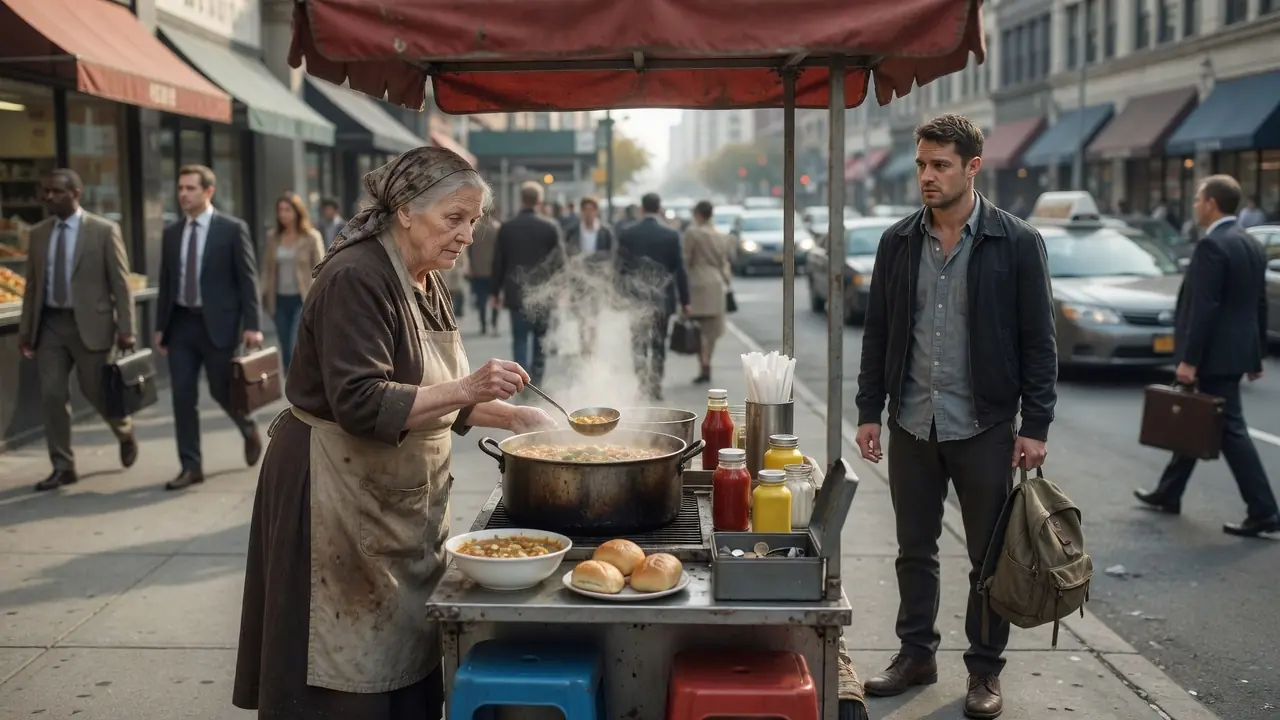
Smoke from the pot rose slowly into the evening air, mixing with the smell of hearty soup, grilled onions, and fresh rolls warming under a clean cloth.
Mrs. Eleanor’s cart was humble but spotless.
An old metal stand.
A faded red canopy.
A small sizzling grill.
A dented soup pot.
Jars of ketchup and mustard lined up like little soldiers along the counter.
All around her, the city moved with its usual indifference. Cars honked at the intersection. People hurried past with phones pressed to their ears. Somewhere down the block, a siren wailed and faded. Voices crossed paths without meeting. Shoes struck pavement. Doors opened and closed.
Nobody slowed down unless they were hungry.
Mrs. Eleanor had working hands.
Hands with tiny old burns near the wrists.
Hands with tired nails.
Hands that had washed, cooked, carried, scrubbed, served, and survived.
She adjusted her stained apron and handed a bowl of soup to a man who had been buying from her cart for nearly ten years.
“God bless you, Mrs. E,” he said, leaving a few dollars in the little cash box.
She barely smiled.
Not because she was unkind.
Because life had taught her to save even smiles for when she had enough strength to spend them.
“Hope it warms you up, son,” she replied.
When the customer left, Mrs. Eleanor looked into the cash box.
It was not full.
It never was.
And today, it seemed lighter than usual.
Road work had blocked half the sidewalk all week, diverting foot traffic away from her corner. Two streets over, a new food truck had appeared with bright paint, flashing lights, and gourmet sandwiches with names Mrs. Eleanor could barely pronounce.
People liked shiny things.
Her cart was not shiny.
It was old, clean, and stubborn.
Like her.
Even so, Mrs. Eleanor kept going.
She always kept going.
It was close to 6:00 when the sun began to dip behind the buildings, and the canopy’s shadow stretched long across the sidewalk.
That was when she saw him.
A man stood near the edge of the block, not close enough to order, not far enough to seem uninterested.
He looked about thirty-five, maybe a little younger, though exhaustion had carved years into his face. His jacket was thin and damp at the shoulders. His shirt collar had been ironed carefully but was beginning to fray. His shoes were office shoes, not street shoes, the leather cracked from walking too far in weather they were never meant to endure.
In one hand, he held a small backpack.
In the other, he held the hand of a little girl.
The child could not have been more than six or seven.
She had dark curls pulled into two uneven ponytails, a pink sweater with one missing button, and eyes far too alert for someone her age. She stood close to her father, leaning against his leg as if the whole city might push her over if she moved too far away.
The man watched the cart.
Not greedily.
Not boldly.
He watched it the way hungry people watch food when pride is still stronger than need.
Mrs. Eleanor had seen that look before.
It was not the look of a thief.
It was the look of someone calculating shame.
The little girl whispered something to him.
The man shook his head gently.
She looked down.
Mrs. Eleanor stirred the soup once, though it did not need stirring.
The man took one step forward.
Then stopped.
Then finally came closer, guiding the child with him.
He stopped two feet from the cart and cleared his throat.
“Ma’am,” he said softly. “Do you have anything left over that you can’t sell?”
Mrs. Eleanor held the ladle in midair.
She had heard that phrase before.
From teenagers.
From old men.
From women with babies.
From people who still wanted to pretend they were not asking for help.
There was something different in this man’s voice.
Not a scheme.
Not laziness.
Not expectation.
Shame.
The kind that sits behind the teeth and makes every word hurt.
Mrs. Eleanor looked at him fully now.
His face was clean but hollow. His cheeks had gone sharp. His hands were red from cold. He kept himself slightly turned, as if trying to shield the little girl from the humiliation of the question.
The child looked at the rolls under the cloth and swallowed.
Mrs. Eleanor’s heart tightened.
“You got a name?” she asked.
The man hesitated, as if even that cost something.
“Daniel Carter.”
Mrs. Eleanor looked at the little girl.
“And this child?”
Daniel’s hand tightened gently around hers.
“Lily.”
The girl gave the smallest nod.
Mrs. Eleanor set the ladle back into the pot.
“You two eat today?”
Daniel looked away.
Lily answered before he could.
“I had crackers at school.”
Daniel closed his eyes for one second.
Mrs. Eleanor understood that look too.
The look of a parent who would rather be slapped than hear his child confess hunger in public.
“And you?” Mrs. Eleanor asked him.
Daniel gave a faint, tired smile.
“I’m fine.”
Mrs. Eleanor snorted.
“Lies don’t fill stomachs.”
His smile faded.
For a moment, the city noise seemed to pull back from them.
Then Daniel spoke again, lower this time.
“I lost my job last month. Office closed. They said restructuring. I had savings for a little while. Then Lily got sick, and rent came due, and the motel wanted cash up front. We’re not asking for money. I just thought maybe if there was anything you were going to throw away…”
His voice broke slightly, and he stopped.
Lily leaned against him harder.
Mrs. Eleanor looked at the pot.
She looked at the rolls.
She looked at her cash box.
Then she looked at Daniel Carter and his daughter.
She made a decision.
It did not feel heroic to her.
It felt simple.
“Sit down,” she said, pointing to the two plastic stools beside the cart.
Daniel blinked.
“Ma’am, I didn’t mean—”
“I know what you meant. Sit down anyway.”
“We can share one bowl.”
“You can do what I serve you,” Mrs. Eleanor said, already reaching for two bowls.
Lily looked up at her father.
Daniel’s pride fought him.
Hunger fought harder.
He nodded once.
They sat.
Mrs. Eleanor filled two bowls with soup, not small portions, real ones. She added noodles from the bottom, carrots, potatoes, and pieces of chicken she had been saving for paying customers. She placed two warm rolls on napkins, then hesitated, lifted the cloth again, and added a third.
Daniel noticed.
His jaw tightened.
“You don’t have to do that.”
“Then it’s good I didn’t ask you.”
Lily looked at the bowl as if it were treasure.
“Thank you,” she whispered.
Mrs. Eleanor softened despite herself.
“You eat while it’s hot, baby.”
The child obeyed.
At first, Lily ate quickly, anxiously, spoon trembling between her fingers. Then, as warmth reached her stomach, she slowed down. Daniel waited until Lily had taken several bites before touching his own spoon.
Mrs. Eleanor noticed that too.
He was starving.
But he still waited for his child.
That told her more about him than any explanation could have.
The first spoonful made Daniel close his eyes.
Not dramatically.
Just for a breath.
As if his body had been waiting for permission to believe food was real.
Mrs. Eleanor looked away to give him privacy.
Some dignities were small, but they mattered.
Across the sidewalk, Mr. Roger leaned against a streetlight, watching.
Mr. Roger was one of those men who had never owned anything important but spoke as if the whole block belonged to him. He claimed to know inspectors, permit officers, police sergeants, councilmen, anyone whose name could make poor people nervous.
He had been bothering Mrs. Eleanor for years.
A “sidewalk management fee,” he called it.
A few dollars here.
A few more there.
A warning if she refused.
Most people knew what he was.
Few said it aloud.
Now he strolled over with a smile that had no warmth in it.
“Mrs. E,” he called. “Giving away food again?”
Daniel stopped eating.
Lily froze with her spoon halfway to her mouth.
Mrs. Eleanor did not look up.
“They’re eating.”
Mr. Roger laughed.
“That’s what I said. Giving away food.”
Mrs. Eleanor placed both hands on the edge of her cart.
“You buying something, Roger?”
“Maybe I’m buying advice for you. Bad for business, feeding every stray that wanders by.”
Daniel’s face flushed.
Lily looked down at her bowl.
Mrs. Eleanor straightened, even though her back hurt.
“He is not a stray,” she said. “He is a father.”
Mr. Roger looked Daniel up and down.
“A father with no wallet, looks like.”
Daniel lowered his gaze, shame burning across his face.
Mrs. Eleanor’s anger rose.
She had spent most of her life swallowing anger because poor women who showed too much of it got called difficult, bitter, crazy, dangerous.
But not today.
Not with Lily sitting there holding a spoon like she was afraid someone might snatch the bowl away.
“If seeing hunger bothers you,” Mrs. Eleanor said, “maybe you ought to ask what’s wrong with your eyes.”
A few people nearby slowed down.
Mr. Roger’s smile tightened.
“Careful, Mrs. E. You don’t want inspectors asking why you’re turning this corner into a shelter.”
“My cart is clean.”
“Clean isn’t always enough. Permits can get complicated.”
The threat hung there.
Daniel understood it.
His face changed, shifting from shame to worry.
He set his spoon down.
“We should go.”
Mrs. Eleanor pointed the ladle at him.
“You should eat.”
“I don’t want to bring trouble to you.”
“Trouble comes whether invited or not.”
Mr. Roger clicked his tongue.
“Soft heart’s going to ruin you, old woman.”
Mrs. Eleanor held his gaze.
“Maybe. But at least I’ll still have one.”
The people watching murmured.
Mr. Roger stepped back, embarrassed but not defeated.
“You’ll learn,” he said.
Then he walked away.
Daniel stared at the bowl.
“I’m sorry,” he said quietly.
Mrs. Eleanor turned back to him.
“For eating soup?”
“For making him talk to you that way.”
“He talks that way because his mama didn’t teach him shame.”
Lily almost smiled.
Mrs. Eleanor saw it and felt something loosen in her chest.
“What happened to your job?” she asked Daniel, not because she was nosy, but because practical problems needed practical answers.
Daniel took a breath.
“I worked in an office downtown. Data entry, inventory reports, vendor calls, whatever they needed. I was good at it. At least I thought I was. Then they merged departments. People with degrees stayed. People like me got thanked for our service and walked out with cardboard boxes.”
“You got family?”
“No.”
“Lily’s mother?”
His face went still.
“She left when Lily was two.”
Lily kept eating, but her eyes lowered.
Daniel’s voice softened.
“She was young. Tired. Said she couldn’t do the life. I stopped trying to explain it to people.”
Mrs. Eleanor nodded.
Some stories were too heavy for strangers, but she heard enough.
“And where do you sleep?”
Daniel hesitated.
“The bus station some nights. A church basement when there’s room. Last night, a motel.”
“Tonight?”
He did not answer.
That was answer enough.
Mrs. Eleanor looked at Lily’s small hands wrapped around the bowl.
The child was trying not to look scared.
That hurt most.
Children should not have to perform bravery to protect their parents.
Mrs. Eleanor turned off the grill flame under one pan and reached beneath the counter for a paper sack.
She packed two rolls.
Then another bowl of soup in a sealed container.
Then a slice of pie wrapped in wax paper, something she had bought for herself from the bakery earlier and had been saving for after closing.
Daniel saw it.
“No, ma’am. Please.”
“This is for later.”
“We can’t pay.”
“I know.”
“We can come back and help clean.”
“You can come back tomorrow, and we’ll talk about that.”
Daniel stared at her.
“Why are you doing this?”
Mrs. Eleanor tied the bag shut.
She thought of her son, Steven.
She thought of the day he left home with a duffel bag and dreams too large for their kitchen.
She thought of the phone calls that became shorter.
The trouble he hinted at but never explained.
The silence after he stopped calling.
She thought of searching bus stations, offices, shelters, police desks, churches, and hearing the same tired phrases from people who had already decided she was one more poor old woman with a sad story.
We can’t help without more information.
Come back tomorrow.
Are you sure he wants to be found?
Her son never came back.
Maybe that was why Daniel’s tired face and Lily’s hungry eyes cut so deep.
Maybe a wound recognizes another wound before the mind can name it.
“Because if my son had been standing somewhere hungry,” Mrs. Eleanor said quietly, “I would have wanted somebody to feed him.”
Daniel did not speak.
He looked at her as if the answer had gone somewhere deeper than hunger.
Lily finished the last of her soup and set the bowl down carefully.
“Thank you, Mrs. Eleanor.”
The way the child said her name, careful and respectful, nearly broke something in the old woman.
“You come back tomorrow,” Mrs. Eleanor said. “Both of you.”
Daniel stood slowly, holding the paper sack like it weighed more than food.
“We won’t bother you.”
“You already said that. I already ignored it.”
For the first time, Daniel smiled.
A real smile, though faint.
“Yes, ma’am.”
They disappeared into the evening crowd, Daniel holding Lily’s hand, the paper sack tucked under his arm.
Mrs. Eleanor watched until she could no longer see them.
The city moved on.
Cars passed.
People ordered.
The grill hissed.
But the corner felt different now.
As if a promise had been made without ceremony.
The next afternoon, Daniel and Lily returned.
They came early, before the dinner crowd, and Daniel immediately offered to help.
“I can carry water,” he said. “Clean the counter. Move boxes. Whatever you need.”
Mrs. Eleanor eyed him.
“You trying to pay me back?”
“I’m trying to keep my pride alive.”
She accepted that.
“Water bucket’s behind the cart.”
He went to work.
He worked the way tired men work when they have no room for laziness. Quietly. Thoroughly. Without needing to be told twice.
Lily wiped the plastic stools with a damp cloth and arranged napkins in a little stack. Every few minutes, she looked toward her father to make sure he was still there.
Mrs. Eleanor noticed that too.
Abandonment teaches children to count bodies in a room.
At dusk, she fed them again.
Then the next day.
Then the next.
A routine formed.
Daniel helped Mrs. Eleanor set up before the evening rush. Lily did small tasks with great seriousness. They ate supper from the cart. Afterward, Daniel cleaned, carried, organized, and walked Mrs. Eleanor’s trash to the alley.
People talked.
Of course they did.
“That old woman’s collecting beggars now.”
“He’s using her.”
“She better be careful with a man like that.”
“Single fathers always got a story.”
Mrs. Eleanor heard it all.
Daniel heard some of it.
Lily heard too much.
One evening, when a woman muttered that Daniel should “get a real job instead of hiding behind an old lady’s soup pot,” Daniel set down the crate he was carrying and turned away.
Mrs. Eleanor found him behind the cart, jaw tight, eyes lowered.
“You believe her?” she asked.
“No.”
“Then why let her carry your head for you?”
He looked at her.
“She doesn’t know what it feels like to apply for twenty-seven jobs and get three calls back. She doesn’t know what it feels like to tell your kid dinner is a surprise when the surprise is that there isn’t much.”
Mrs. Eleanor’s voice softened.
“No. She doesn’t.”
Daniel wiped one hand over his face.
“I had a life. Not much, but something. Apartment. Job. School routine. I had Lily’s drawings on the fridge. Then one month went wrong, and everything fell like it was waiting.”
Mrs. Eleanor nodded.
“That’s how poverty is. Folks think it’s a hole. It’s not. It’s a ledge. One wrong step.”
Daniel looked at her then, really looked.
“You know that ledge.”
“I’ve lived on it so long I could draw you a map.”
That night, after Lily fell asleep sitting on a stool, her head against Daniel’s jacket, Mrs. Eleanor made a decision.
“You two aren’t going to the bus station tonight.”
Daniel stiffened.
“Mrs. Eleanor—”
“No.”
“I can’t let you—”
“You can let me finish talking.”
He closed his mouth.
“My apartment’s small. One room and a bathroom. But the floor is clean, and I’ve got extra blankets.”
Daniel looked pained.
“I don’t want Lily sleeping on your floor.”
“She’s sleeping on worse now.”
That silenced him.
Mrs. Eleanor regretted the bluntness only a little.
Lily stirred and blinked up at her father.
“Daddy?”
Daniel crouched beside her.
“We’re going to stay somewhere warm tonight.”
Her eyes went immediately to Mrs. Eleanor.
“With her?”
Mrs. Eleanor softened.
“If you don’t snore.”
Lily whispered, “I don’t know if I do.”
“We’ll find out.”
That night, Mrs. Eleanor led them through three narrow blocks to her apartment above a closed tailor shop.
The stairs creaked.
The hallway smelled of cabbage, old carpet, and rain.
Her apartment was simple.
A narrow bed.
An old armchair.
A tiny kitchen.
A shelf with one candle, three framed photographs, and a cracked ceramic angel.
Daniel paused at the doorway.
“Mrs. Eleanor, this is too much.”
“It’s a floor,” she said. “Don’t make it royal.”
But he understood what she was giving.
A roof.
Trust.
Safety.
A place where Lily could sleep without one eye open.
Mrs. Eleanor pulled blankets from a trunk. Daniel made a bed for Lily first, folding towels beneath the blanket for padding. Only after Lily was settled did he sit down near the wall.
The child fell asleep within minutes.
Her face changed in sleep, worry loosening, mouth softening, hands unclenching.
Daniel watched her for a long time.
Mrs. Eleanor watched him.
“You love that child hard,” she said.
He nodded.
“She’s all I’ve got.”
“That’s a dangerous thing to make a child carry.”
Daniel looked down.
“I know.”
His voice was full of guilt.
Mrs. Eleanor sat in the armchair.
“I don’t mean you’re doing wrong. I mean love needs more than two hands sometimes. Even good fathers get tired.”
Daniel’s eyes shone.
He looked away.
“I’m so tired,” he whispered.
The words seemed to surprise him as much as her.
Mrs. Eleanor said nothing.
She let the truth sit in the room without trying to fix it too quickly.
After a while, Daniel spoke again.
“I used to think if I just worked hard enough, I could keep us safe. But the world doesn’t care how hard you work if one paper says no, one manager says cutbacks, one landlord says pay by Friday.”
Mrs. Eleanor leaned back.
“The world cares more when you’ve got someone standing beside you.”
Daniel looked at her.
“Is that what you’re doing?”
“For now.”
“For now is enough.”
Days became weeks.
Daniel continued helping at the cart. Mrs. Eleanor continued feeding him and Lily. He searched for work every morning from the public library computers, printed resumes when he could, went to interviews in his one good shirt, and returned each afternoon with new disappointment folded into his silence.
But slowly, things changed.
A regular customer who owned a small repair shop offered Daniel two days of work organizing inventory.
A church volunteer found Lily a spot in an after-school program.
Sophia from the diner down the block began saving leftover bread for Mrs. Eleanor’s cart.
The world did not become kind all at once.
But a few people did.
And sometimes a few is enough to keep someone alive until more arrives.
Mr. Roger hated it.
He hated that Daniel worked beside the cart like he belonged there.
He hated that Lily smiled when customers greeted her.
He hated that Mrs. Eleanor’s business improved because people liked seeing the old woman and the single father running the corner with quiet dignity.
So he began pushing harder.
One evening, he arrived with two men in municipal vests.
“Mrs. E,” he said, smiling. “Inspection.”
Mrs. Eleanor’s stomach tightened.
The men checked everything.
The soup pot.
The grill.
The water containers.
The napkins.
The sidewalk space.
Everything was clean.
It always was.
Still, one of the men made a note.
“Obstruction concern.”
Daniel frowned.
“The cart is inside the marked area.”
The man looked at him.
“And you are?”
“I help her.”
“Are you employed?”
“No.”
“Then why are you handling food service equipment?”
Daniel opened his mouth, then closed it.
Mr. Roger smiled.
“That’s the concern. Unregistered labor. Possible health violation.”
Mrs. Eleanor felt cold anger rise.
“He carries water and moves crates.”
“Still,” the inspector said.
Daniel stepped back immediately.
“I’ll stop.”
Lily looked frightened.
Mrs. Eleanor saw that and lost patience.
“No,” she said.
Everyone looked at her.
Mrs. Eleanor placed both hands on the cart.
“This man is helping me carry things because my back hurts and because he has more decency than half the people on this block. If that’s a violation, write it down. But don’t stand here pretending this is about health when you eat from my cart every Thursday.”
One of the men flushed.
Mr. Roger’s smile vanished.
“You’re getting bold.”
“No,” Mrs. Eleanor said. “I’m getting old. There’s a difference. Old means I don’t have much time left to be scared of fools.”
A few customers laughed.
Mr. Roger leaned closer, his voice low.
“You’ll regret embarrassing me.”
Daniel moved between them.
Not aggressively.
Just enough.
“You don’t talk to her like that.”
Mr. Roger looked him up and down.
“You think sleeping on her floor makes you family?”
Daniel’s jaw tightened.
Lily flinched.
Mrs. Eleanor stepped beside Daniel.
“Family is whoever shows up when the roof is leaking.”
The street went quiet.
Mr. Roger backed away, but his eyes promised trouble.
Trouble came three days later.
Mrs. Eleanor arrived at her corner and found a red notice taped to the cart.
Temporary suspension pending permit review.
Her hands shook as she read it.
Daniel took the paper and scanned it quickly.
“This isn’t right,” he said. “They didn’t list a violation.”
Mrs. Eleanor sat heavily on one of the stools.
The cart had been her livelihood for nineteen years.
Without it, she had nothing.
Daniel looked at the notice, then toward city hall.
“What does he usually ask for?” he said.
Mrs. Eleanor did not answer.
He looked at her.
“Mrs. Eleanor.”
She looked away.
“A fee.”
“What fee?”
“Roger says he keeps permits smooth.”
Daniel’s face changed.
“How long?”
“Years.”
“How much?”
“Enough.”
Daniel closed his eyes.
Lily reached for Mrs. Eleanor’s hand.
“Are we in trouble?”
Mrs. Eleanor squeezed the child’s fingers.
“Not you, baby.”
Daniel folded the notice carefully.
Then he said, “I know offices. I know paperwork. If there’s one thing I learned in my old job, it’s that people who hide behind forms usually leave tracks.”
He spent the next two days at the public library.
He searched municipal codes.
He requested permit records.
He wrote down names, dates, fees, and inconsistencies.
He asked Mrs. Eleanor for every receipt she had ever kept.
She had kept many.
Poor people keep proof because they know the world loves calling them liars.
By Friday, Daniel had a folder thick enough to matter.
Unauthorized payments.
Repeated threats.
Suspicious inspection timing.
No official record of several fees Mr. Roger claimed were required.
Daniel took the folder to a legal aid office.
The first receptionist tried to turn him away.
He refused to leave.
Not loudly.
Not rudely.
Just with the exhausted patience of a father who had learned that leaving too soon costs too much.
By Monday, a lawyer named Ms. Patel agreed to look at the case.
By Wednesday, she made three calls.
By Friday, Mrs. Eleanor’s suspension was lifted pending investigation.
Mr. Roger stopped smiling when he passed.
Daniel found part-time work through Ms. Patel’s husband, who owned a logistics company and needed someone who could organize chaos.
The job was temporary.
Then steady.
Then full-time.
For the first time in months, Daniel and Lily moved from Mrs. Eleanor’s floor into a small room above a church office.
It was not much, but it had a bed for Lily and a door that locked.
Daniel still came to the cart every evening.
He still carried water.
He still moved crates.
Now, when Mr. Roger passed, he crossed the street.
Months turned into years.
Daniel rebuilt his life slowly.
He worked in logistics, then operations, then process management. He had a gift for seeing where systems failed ordinary people. He could look at a delivery schedule, a warehouse floor plan, or a city food distribution form and find the broken part no one else noticed.
His employer sent him to night classes.
He earned certifications.
Then a degree.
Lily grew taller.
Mrs. Eleanor’s hair went whiter.
The cart remained.
Daniel never forgot where he had been fed.
Every Sunday, no matter how busy life became, he and Lily visited Mrs. Eleanor. Sometimes they brought groceries. Sometimes they fixed things in her apartment. Sometimes Lily sat at the little kitchen table doing homework while Mrs. Eleanor cooked.
When Daniel’s career carried him farther, he still called.
When he got his first management position, Mrs. Eleanor was the first person outside Lily he told.
When Lily graduated high school, Mrs. Eleanor sat in the front row, crying into a napkin and denying it loudly.
When Daniel launched his own logistics consulting company, he named the first internal project “The Cart.”
His employees thought it was a code name.
Only Lily knew.
Years later, on a warm Friday afternoon, Mrs. Eleanor stood behind her food cart, ladle in hand, the same corner loud around her.
She was smaller now.
More bent.
Her hands trembled some days, though she never admitted it.
The cart was older too, patched and repainted in places, still spotless, still stubborn.
Business had slowed.
The neighborhood had changed.
New buildings rose where old shops used to be. Young professionals hurried past her cart with expensive coffees and earbuds in their ears. Some looked at the cart like it was charming. Others looked through it entirely.
Mr. Roger was still around, though older and less feared. He had survived the investigation years earlier by blaming others and disappearing for a while. Now he hovered at the edges of things, still looking for weakness.
Mrs. Eleanor was serving a bowl of soup when she heard a sound that did not belong on her block.
A smooth, expensive engine.
Then another.
Then a third.
People turned.
Three black cars stopped near the curb, sleek and polished, the kind that made conversations die mid-sentence.
Mrs. Eleanor looked up slowly.
Her first reaction was not excitement.
It was fear.
In her life, shiny things usually brought officials, bills, or bad news.
The car doors opened.
A man stepped out of the first car.
Tall.
Well-dressed.
Calm.
In his early forties now, with silver beginning at his temples and a face marked by work, grief, and something steady.
Behind him stepped a young woman in a navy dress, confident and bright-eyed.
Lily.
Grown now.
Mrs. Eleanor’s breath caught.
The man walked toward the cart slowly.
Not like a rich man approaching a vendor.
Like a son approaching home.
“Mrs. Eleanor,” Daniel said.
She gripped the ladle.
For one dizzy second, she saw him as he had been years ago: soaked jacket, hollow cheeks, Lily’s little hand in his.
Then she saw him now.
Strong.
Whole.
Still looking at her with the same gratitude.
“Well,” she said, because if she said anything softer she might cry. “Look who learned how to wear a suit.”
Daniel laughed, but his eyes were wet.
“We came back.”
Lily stepped forward and took Mrs. Eleanor’s hands.
“You fed us when no one else did.”
Mrs. Eleanor’s mouth trembled.
“I fed you soup.”
Daniel shook his head.
“You gave us a place to stand.”
People were watching now.
Phones rose.
Whispers moved through the block.
Mrs. Eleanor felt exposed, embarrassed by the attention, by her old apron, by her shaking hands.
Daniel noticed immediately.
He turned toward the gathering crowd.
“Please,” he said firmly. “Give her room.”
It was not a request people ignored.
A hush settled.
Then Mr. Roger appeared, drawn by spectacle like a fly to sugar.
“Well, well,” he called. “Mrs. E finally found herself some rich friends.”
Daniel’s face changed.
Lily’s jaw tightened.
Mrs. Eleanor’s hand trembled around the ladle.
Roger stepped closer, smiling.
“I always knew helping folks would pay off someday. Maybe now you can settle some old neighborhood fees, Mrs. E.”
Daniel looked at him.
“What fees?”
Roger laughed.
“Private joke.”
“No,” Daniel said. “Say it plainly.”
The block quieted.
Roger’s smile thinned.
“Don’t come back here acting like you own the place.”
Daniel stepped closer, his voice calm.
“I don’t own the place. But I remember you threatening an old woman’s cart. I remember you calling me a stray. I remember you using inspectors to scare her.”
Roger scoffed.
“Ancient history.”
Lily spoke then.
“Not to us.”
Daniel opened a folder his assistant handed him from the car.
Mrs. Eleanor stared.
“You still keep folders?”
He gave her a quick smile.
“You taught me not to waste anything. That includes evidence.”
He turned back to Roger.
“Over the last six months, my legal team reviewed the complaints Mrs. Eleanor filed years ago, the permit records, and the payments she was pressured into making. We also found other vendors with the same story.”
Roger’s face drained.
Daniel continued.
“The district attorney’s office has reopened the case. State oversight is already on the way. You’re done collecting fear from this block.”
Roger looked around, searching for allies.
People who once feared him now stared with open satisfaction.
“You can’t prove—”
“We can,” Lily said.
Her voice was steady.
“And we will.”
Within the hour, officials arrived.
Real ones.
Not Roger’s friends.
Vendors came forward.
A flower seller.
A tamale vendor.
A man who repaired watches from a folding table.
One by one, they told the truth.
Fees.
Threats.
Fake warnings.
Inspections that appeared whenever someone refused to pay.
Mrs. Eleanor listened as the street finally said aloud what it had whispered for years.
Roger tried to leave.
He did not get far.
When the police placed him in the back of a car, Mrs. Eleanor did not cheer.
She only exhaled.
It sounded like twenty years leaving her lungs.
Daniel came to stand beside her.
“You should have told me how bad it still was.”
She looked at him.
“You had your life.”
“You were part of it.”
She turned away, blinking fast.
“I didn’t want to be a burden.”
Daniel smiled sadly.
“That sounds familiar.”
Lily laughed softly through tears.
That evening, Daniel closed the cart early.
Not forever.
Just for the night.
He took Mrs. Eleanor to dinner at Murphy’s Diner, which had somehow survived the years with its neon still flickering and its coffee still too strong.
Sophia, older now but still sharp-eyed, hugged Mrs. Eleanor first.
Then she hugged Daniel.
“I knew you’d do something with yourself,” she said.
Daniel smiled.
“She did something with me first.”
They sat in a booth by the window.
Mrs. Eleanor tried to order only tea.
Daniel ordered soup, rolls, roasted chicken, mashed potatoes, green beans, and pie.
“Are you feeding an army?” she asked.
“No,” he said. “Just making up for one night.”
She looked at him.
“You don’t owe me.”
“Yes,” Daniel said. “I do. But not in the way you think.”
He reached into his coat pocket and pulled out a small envelope.
Mrs. Eleanor immediately frowned.
“If that’s money, put it away.”
“It’s not money.”
She opened it cautiously.
Inside was a photograph.
A beautiful storefront with wide windows, a clean kitchen visible inside, and a sign above the door.
Eleanor’s Table
Community Kitchen and Food Cart Cooperative.
Mrs. Eleanor stared at it.
Daniel spoke gently.
“I bought the old tailor building. Your apartment building. We’re renovating it. Downstairs will be a legal commercial kitchen and training space for street vendors. Upstairs will be your apartment, repaired properly, with heat that works and stairs that won’t kill you. You can run the kitchen if you want. Or you can sit in a chair and boss everyone around. Honestly, that’s probably more efficient.”
Mrs. Eleanor’s lips parted.
“No.”
“Yes.”
“I can’t accept that.”
“You can.”
“Daniel.”
He leaned forward.
“You fed me when I could not feed my daughter. You protected my dignity when I had almost none left. You gave Lily warmth when the world had become cold. This isn’t charity. This is continuation.”
Lily placed her hand over Mrs. Eleanor’s.
“You always said soup tastes better when there’s enough for everybody. Now there will be enough.”
Mrs. Eleanor cried then.
Not loudly.
Not dramatically.
The tears simply came, sliding down her lined face while she pressed one hand to her mouth.
“I only gave you soup,” she whispered.
Daniel shook his head.
“No. You gave me proof that I was still worth helping.”
The kitchen opened six months later.
The whole block came.
Some out of love.
Some out of curiosity.
Some out of shame.
Mrs. Eleanor wore a clean white apron Lily had embroidered herself. Her hair was pinned neatly. Her hands still trembled, but when she lifted the ladle, the room fell quiet.
Daniel stood beside her.
Lily stood on the other side.
On the wall behind them hung a framed photograph.
Not of Daniel’s cars.
Not of a ribbon cutting.
Not of a fancy ceremony.
It was an old photo Lily had drawn years earlier as a child, rescued from Mrs. Eleanor’s box of keepsakes.
A food cart.
An old woman.
A man.
A little girl.
Three bowls of soup.
Under it, a plaque read:
No one who is hungry should have to earn kindness first.
Mrs. Eleanor read the words and shook her head.
“You all make everything sound fancy.”
Daniel smiled.
“It was your lesson.”
“No. My lesson was eat before the soup gets cold.”
“That too.”
Everyone laughed.
The first meal served at Eleanor’s Table was simple.
Soup.
Rolls.
Pie.
The same kind of meal that had once saved a father and daughter from disappearing into the city’s indifference.
Street vendors trained in the kitchen.
Single parents found evening meals there.
Children did homework at the long tables.
Older neighbors came not only to eat, but to be seen.
The place became warm in the way Mrs. Eleanor’s cart had always been warm, only now the warmth had walls, chairs, bathrooms, permits, protection, and room enough for everybody.
Years later, when Daniel Carter’s company became known nationwide for building food access systems and community logistics networks, reporters often asked him where the idea began.
They expected a story about business school, investors, or innovation.
Daniel always told the truth.
“It began with an old woman at a street cart who fed me when I was too ashamed to ask properly.”
Some interviewers smiled politely, thinking it was sentimental.
Daniel did not care.
Lily, now studying public policy, wrote her college essay about that first bowl of soup.
“My father was hungry,” she wrote. “I was a child, but I knew he was trying to hide it from me. Mrs. Eleanor did not just feed us. She protected him from the kind of shame that can break a parent. I learned that dignity is not an abstract idea. Sometimes dignity is a hot bowl, a clean stool, and someone saying, ‘Sit down. Eat.’”
Mrs. Eleanor kept a copy of the essay folded inside her Bible.
She still worked some mornings, though Daniel insisted she did not need to.
She said need had nothing to do with it.
“This is where my hands know what to do,” she told him.
On certain evenings, when the kitchen was full and the city outside glowed under streetlights, Daniel would sit on one of the old plastic stools they had preserved from the cart.
Lily would sit beside him.
Mrs. Eleanor would pretend not to fuss over them, then bring extra rolls anyway.
Sometimes Daniel would look around at the families eating, the vendors laughing, the children safe at the tables, and he would remember that first night.
The rain.
The hunger.
The shame.
The old woman who saw him not as a failure, not as a problem, not as a man who had fallen too low, but as a father trying to keep his child warm.
He would look at Mrs. Eleanor, older now but brighter somehow, moving through the room like the heart of it.
And he would think that some people do not rescue you by lifting you all at once.
Some rescue you by handing you a bowl.
By letting you sit.
By telling the world, quietly and firmly, that you are still a person.
One night, near closing, Mrs. Eleanor found Daniel standing by the front window.
Rain blurred the glass.
The neon sign from Murphy’s Diner flickered faintly down the block.
“You thinking too much again?” she asked.
“Probably.”
“Dangerous habit.”
He smiled.
She stood beside him.
For a while, they watched the rain in silence.
Then Daniel said, “I used to think that night was the worst moment of my life.”
Mrs. Eleanor looked at him.
“And now?”
“Now I think it was the night someone kept it from becoming worse.”
She nodded.
“That’s usually what kindness does. Doesn’t always fix the whole world. Just keeps the dark from swallowing one more person.”
Daniel’s throat tightened.
“You saved me.”
Mrs. Eleanor shook her head.
“No, son. You were already fighting. I just fed the fighter.”
He laughed softly, but his eyes shone.
She patted his arm.
“Now go home. Lily will fuss if you stay late.”
“She learned that from you.”
“Good. Means the child was raised right.”
Daniel kissed her cheek before leaving.
Mrs. Eleanor stood there after he went, listening to the kitchen settle around her.
The soup pot was empty.
The tables were clean.
The rain tapped softly against the windows.
For years, she had believed life had taken her son and left her only work and memory.
But life, strange and stubborn, had returned something to her in another form.
A single father.
A little girl.
A family not born from blood, but from hunger, dignity, and a bowl of soup given at the right moment.
Mrs. Eleanor turned off the last light and stood in the doorway of Eleanor’s Table.
The city was still noisy.
Still hurried.
Still full of people who looked past one another.
But on that corner, there was warmth.
There was food.
There was a place to sit.
And no one who came hungry was made to feel small.
Mrs. Eleanor locked the door, tucked the key into her apron pocket, and smiled.
Not a tired smile this time.
A full one.
Because sometimes a shared meal does not just fill the stomach.
Sometimes it brings a lost father back to his feet.
Sometimes it gives a child a future.
Sometimes it turns a lonely old woman’s cart into a table big enough for a whole community.
And sometimes, many years later, the person you fed when they had nothing comes back not to repay you, but to make sure your kindness never runs out.