The Blue Lantern Café stood at the edge of Route 17 like the last warm thought before the mountains swallowed the road.
It was a small place with faded blue shutters, a crooked porch, and a sign that had been repainted so many times the letters looked thicker than they should.
At night, when fog rolled low across the highway and the woods pressed close on both sides, the café’s porch light glowed like a promise.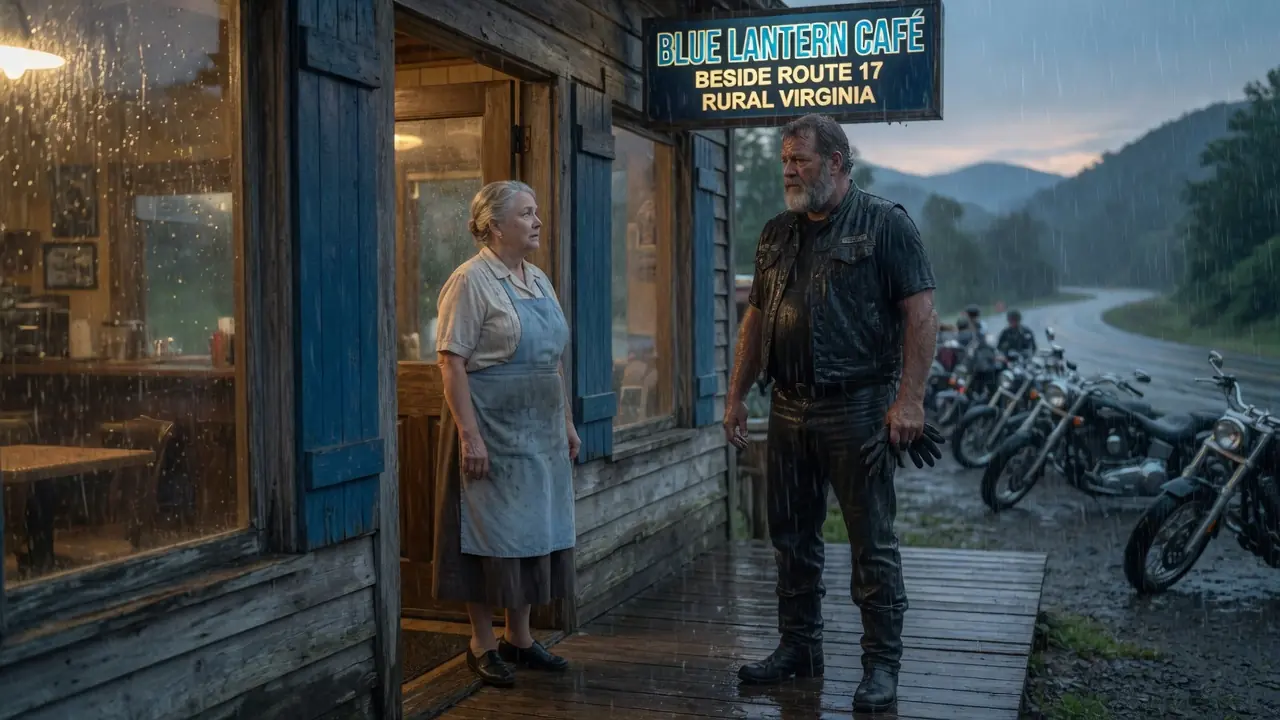
Inside, the booths were old.
The counter was worn smooth by elbows, coffee cups, folded newspapers, tired hands, and the quiet grief of people who had stopped somewhere because they needed more than food.
The floor creaked in three places that Marianne Caldwell could identify with her eyes closed. One loose board near booth four complained under heavy boots. Another near the register whispered softly under her own steps. The third, beside the pie case, had been squeaking since 1998, and Marianne refused to fix it because Paul had once said it sounded like the café saying hello.
Marianne was seventy-three years old, though she disliked saying it out loud because people heard that number and immediately began treating her like glass.
She was not glass.
Glass broke when dropped.
Marianne Caldwell had been dropped by life more times than she cared to count, and she was still standing behind her counter at 5:15 every morning, tying an apron around her waist and starting coffee before the sun came over the Virginia hills.
The café had been hers for thirty-eight years.
She and her husband, Paul, had bought it when it was nothing but a failing roadside lunchroom with bad plumbing, cracked windows, and a roof that hummed during hard rain. The first time Marianne walked in, the place smelled like old grease and wet wood. There were two broken stools, a dead fly in the sugar jar, and a coffee machine that made more noise than coffee.
Paul had looked around with his hands on his hips and said, “Well, Mari, it has personality.”
Marianne had stared at him.
“It has rot.”
“Rot can be fixed.”
“It has three customers a day.”
“Then we only need four to improve.”
She should have known then what kind of life she had married into. Paul Caldwell had a dangerous talent for seeing what things could become. Old houses, tired people, rusted porch railings, and one stubborn roadside café that any sensible person would have avoided.
They used nearly every dollar they had to buy it.
Paul fixed the roof himself, replaced the cracked front windows, built the shelves behind the counter, repaired the old booths, and painted the front door blue because Marianne said every tired traveler needed to see a cheerful color before deciding whether to stop.
Marianne built the menu from scratch.
Chicken stew.
Cornbread.
Apple pie.
Biscuits with honey.
Fried potatoes.
Ham and beans.
Coffee strong enough to wake up regret.
They never got rich. They never even got close. But they made a life there. They fed truck drivers, teachers, farmers, traveling salesmen, church ladies, runaways, widowers, college kids, old couples driving to visit grandchildren, and lonely men who said they only wanted coffee but stayed long enough for Marianne to know they needed a voice more than caffeine.
Paul had been gone twelve years now.
The café stayed.
Every morning, Marianne turned on the lights and looked at his photograph beside the register. In it, Paul was fifty, smiling with one hand on a ladder, paint on his cheek, his eyes full of mischief. The photograph had faded a little from the sun, but his grin remained stubbornly alive.
“You’d laugh at me today,” she told the photograph that morning, as rain began tapping against the windows. “The roof still complains, and so do I.”
The photograph did not answer, but Marianne could almost hear him anyway.
Keep the coffee hot, Mari. Somebody always needs it.
That was what Paul had believed.
It was what she had tried to believe too.
But lately, belief had become expensive.
The refrigerator motor groaned more often, low and tired, like an old dog struggling to rise. The porch steps needed repair. The blue shutters had begun to peel again. The roof leaked in the storage room if the rain came hard from the west. The bank note sat in a folder near the register, heavier than paper had any right to be.
Business had been slow for months.
A new chain restaurant had opened eight miles away with shiny lights, touchscreen ordering, bright parking spaces, and food that came out fast enough for modern families with modern cars and modern impatience. It had clean bathrooms, matching chairs, online coupons, and a glowing sign visible from half a mile away.
The Blue Lantern still had pie, coffee, and a bell above the door that rang like memory.
Memory did not always pay the bills.
At 6:00, Marianne unlocked the front door and flipped the sign to OPEN.
Her only waitress, Lily Harper, came in at 6:10, cheeks pink from the cold rain, hair tied in a messy bun, phone already in her hand. Lily was twenty-four, kind-hearted, quick with customers, and convinced that every struggling business could be saved by the internet.
“Morning, Miss Marianne.”
“Coffee’s fresh.”
Lily poured herself a cup and leaned against the counter.
“I made another post for the café,” she said.
Marianne was rolling biscuit dough on the floured board near the kitchen window.
“What kind of post?”
“A cute one. The pie in the window, the coffee steam, the old booths. Very nostalgic.”
Marianne cut out a biscuit with the rim of a glass because the proper cutter had vanished sometime during the Carter administration.
“People don’t come here to be nostalgic. They come here to eat.”
“People find places online now.”
“Hungry people find places by smell.”
Lily sighed.
“Miss Marianne, I love this place, but you have to let people know it exists.”
“The regulars know.”
“The regulars are getting fewer.”
The room went quiet except for the rain and the soft press of dough.
Lily regretted the words as soon as she said them. Marianne did not look hurt. That almost made it worse. She only looked tired.
“I know,” Marianne said.
Lily lowered her voice.
“I didn’t mean it like that.”
“I know what you meant.”
Marianne placed the biscuits on a tray.
She was not angry at Lily. The girl was right. That was the irritating part about the young. Sometimes they saw what older people were trying not to look at.
The café was fading.
Not quickly.
Not dramatically.
Just slowly, like wallpaper losing color in sunlight.
The morning crowd came and went. Old Mr. Duvall ordered oatmeal and complained that his grandson never called. Two road workers took coffee to go and left wet footprints across the floor. A woman in a red raincoat stopped for pie and asked whether the café had almond milk. Marianne told her no, but offered cream. The woman smiled politely and left without ordering coffee.
By noon, the rain had become stronger.
By two, the sky had turned dark green-gray over the mountains.
By four, the weather radio behind the counter began issuing warnings about flash flooding, fallen branches, and dangerous wind along the pass.
Lily checked her phone every few minutes.
“We should close early,” she said.
Marianne was wiping the counter.
“We close at eight.”
“Miss Marianne, the road could wash out.”
“The road has been threatening to wash out since I was forty-two.”
“That doesn’t mean it won’t.”
Marianne looked toward the windows. Rain struck the glass in silver lines. Across the road, the old gas station sign swung in the wind. Beyond that, the mountains rose dark and blurred, half-hidden by fog.
She believed in caution.
She kept flashlights in three drawers, blankets in the back room, canned goods on the shelf, and batteries organized by size. She did not believe in panic. Panic made people useless, and Marianne had spent her whole life trying to remain useful.
“We’ll keep an eye on it,” she said.
Lily gave her a look.
It was the look young people gave older people when they were trying to decide whether stubbornness was wisdom or denial.
Marianne ignored it.
At 5:37, the first engine sounded under the rain.
It was low and deep, nothing like thunder, nothing like a truck.
Marianne stopped near the coffee machine.
Lily looked up from wrapping silverware.
Another engine joined it.
Then another.
The sound grew, rolling through the storm until the windows trembled faintly in their frames.
Lily moved toward the front window.
“Oh no,” she whispered.
Headlights appeared through the rain.
Motorcycles.
A long line of them.
They came slowly off Route 17, tires cutting through water, riders hunched against the storm. One by one, they pulled into the café parking lot until nearly every space was filled. Chrome flashed beneath the porch light. Black jackets shone wet under the rain. Helmets came off. Men and women climbed from the bikes, shaking rain from their sleeves, helping one another stand steady in the wind.
There were at least forty of them.
Lily backed away from the window.
“Miss Marianne.”
Marianne stood still.
She had seen motorcycle groups before. Sometimes they came through in summer, loud but polite, ordering coffee and pie before riding toward the state line. But this group was soaked, exhausted, and stranded-looking. Their jackets bore a patch Marianne did not recognize.
Iron Saints Motorcycle Club.
One man separated from the group and came up the porch steps.
He was large, broad-shouldered, with a gray beard, rain running down the side of his face. His leather jacket looked heavy enough to pull a smaller man to the ground. His boots thudded on the porch, but before touching the door handle, he removed his gloves.
Even in that weather, manners still mattered to him.
The bell rang when he entered.
Warm air met cold rain.
The man stood just inside the doorway, dripping onto the mat.
“Ma’am,” he said, voice rough but respectful. “I’m sorry to come in like this.”
Lily had gone pale.
Marianne picked up a towel from beneath the counter and handed it to him.
“Then don’t stand there letting rain follow you in.”
The man blinked, then took the towel.
“Yes, ma’am.”
“What do you need?”
He glanced back through the window at the riders in the parking lot.
“Road’s getting bad up the mountain. We’ve got people cold, hungry, and one lady who needs to sit down before she drops from exhaustion. We can pay. We just need shelter until the worst of it passes.”
Marianne looked past him.
A woman with silver-streaked hair leaned against a younger rider. Another man was helping someone remove a soaked jacket. Several riders stood with arms crossed tight against the cold, trying to look tougher than the weather. Their faces were wet and drawn with fatigue.
Marianne knew that look.
She had seen it in truckers who had driven too many hours, fathers who had lost work, widows who pretended they came in for coffee when what they needed was a voice saying their name.
People often disguised need as pride.
Marianne opened the door wider.
“All of you come in.”
The man’s expression changed.
“You sure?”
“No,” Marianne said. “But I’m not leaving people in my parking lot during a mountain storm. Get them inside before I change my mind and start charging rent.”
For the first time, the corner of his mouth lifted.
“Yes, ma’am.”
Lily hurried behind Marianne as the big man stepped back onto the porch.
“We don’t have enough food,” Lily whispered.
“We have flour, eggs, beans, potatoes, and half a ham.”
“For forty people?”
Marianne tied her apron tighter.
“Then the ham is about to become very generous.”
The riders entered carefully.
That was the first thing Marianne noticed.
They did not storm in. They did not shout. They did not drag chairs across the floor like they owned the place. They wiped their boots, removed wet gloves, held the door for one another, and asked before moving tables together.
The big man stood near the entrance, directing them quietly.
“Jackets by the wall. Don’t block the door. Let the older folks sit first. Keep the floor clear.”
Older folks, Marianne thought, amused. Half of them looked old enough to complain about their knees with authority.
The woman with silver-streaked hair was guided into a booth near the heater. Lily brought her water without being asked. A young rider with tattoos down both arms began using napkins to wipe rain from the floor.
Marianne pointed at him.
“You want a mop?”
He froze like a schoolboy caught stealing cookies.
“Yes, ma’am.”
She handed him one.
The big man came to the counter.
“My name’s Caleb Turner,” he said. “Most call me Brick.”
“Of course they do,” Marianne said.
He gave a short laugh.
“And you are?”
“Marianne Caldwell. Most call me Marianne, because I don’t answer to nonsense.”
Brick nodded as if that was perfectly reasonable.
“Miss Marianne, we don’t want to put you out.”
“You already have. Sit down.”
He sat.
The café filled in a way it had not filled in years. Every booth, every counter stool, every spare chair from the back room was taken. Rainwater pooled near the door. Steam rose from wet jackets. The room smelled of coffee, leather, road dust, and storm.
Marianne began taking orders, though there was not much to order.
“You can have stew, biscuits, coffee, or water,” she announced. “Anybody asking for a custom menu can go argue with the rain.”
One rider raised a hand.
“Is pie available?”
Marianne looked at him.
“What’s your name?”
“Denny.”
“Denny, pie is always available for people who behave.”
Denny lowered his hand solemnly.
“I will behave.”
The room laughed, not loudly, but enough for the tension to loosen.
Lily moved quickly, still nervous but focused. She refilled coffee cups, passed out towels, and whispered to Marianne each time they ran low on something.
“We’re almost out of stew.”
“Add potatoes.”
“We’re almost out of potatoes.”
“Add beans.”
“We’re almost out of bowls.”
“Use mugs.”
In the kitchen, Marianne worked like a woman twenty years younger. Her hip hurt. Her back complained. Her hands moved anyway. She stretched the stew, baked more biscuits, sliced ham thin, buttered bread, and made a skillet of fried potatoes big enough to require both hands to lift.
Every plate that left the kitchen came back empty.
That pleased her.
A person could lie with words. People did it all the time. But hungry people eating quietly told a truth that did not need dressing up.
The woman near the heater introduced herself as Ruth Mallory. She was sixty-two, though road life and weather had written extra years around her eyes. She had ridden since she was nineteen. Her husband had belonged to the Iron Saints before he died, and the club had never stopped treating her as one of their own.
“You don’t need to fuss over me,” Ruth told Lily when the young waitress brought another towel.
Lily smiled nervously.
“I’m not fussing. I’m providing towel-based service.”
Ruth smiled.
“That sounds official.”
“I’m making it official tonight.”
Marianne heard that from the kitchen and almost smiled.
By 6:20, the café had become something more than a restaurant. It was a harbor. The storm struck the windows, and inside, strangers leaned over coffee cups, warming their hands, speaking softly, trying not to take more space than they needed.
Then the bell above the door rang again.
This time, the man who entered did not look wet, hungry, or grateful.
Arthur Bellamy, manager of the local bank and chairman of three committees nobody had asked for, stepped inside with his raincoat buttoned neatly and his face drawn tight with disapproval.
Marianne saw Lily stiffen.
Arthur’s eyes moved across the room, over the jackets, the patches, the riders, the crowded tables, the wet floor. His mouth flattened.
“Marianne,” he said.
She set down a pot of coffee.
“Arthur.”
“What is happening here?”
“I’m serving dinner.”
“To them?”
Several riders turned their heads.
Brick did not move, but his eyes lifted.
Marianne kept her voice even.
“Yes. To them.”
Arthur stepped closer to the counter, lowering his voice just enough to pretend he had manners.
“Do you understand what this looks like?”
“A busy evening?”
“It looks reckless.”
Marianne folded her arms.
“Rain is reckless. Hunger is ordinary.”
“These people have a reputation.”
“So do you, Arthur, but I still let you sit in booth three every Friday.”
A few riders looked down quickly, hiding smiles.
Arthur’s face reddened.
“This is not funny. You have a business loan under review next month. You have a public establishment. You cannot simply invite trouble into the middle of town.”
The room went quiet.
Lily looked at Marianne, frightened now for a different reason.
The loan.
Everyone in town knew the Blue Lantern was struggling, but Arthur knew the numbers. He knew the repairs needed. He knew the taxes owed. He knew exactly where to press if he wanted to hurt her.
Marianne felt it in her chest, that cold little hand of fear.
The café could not afford enemies.
It could not afford bad talk.
It could not afford Arthur Bellamy deciding that her judgment was poor, her risk too high, her little blue-doored diner no longer worth saving.
For a moment, she saw it all clearly.
The bank letter.
The locked doors.
The dark windows.
Paul’s photograph wrapped in newspaper and packed into a box.
Then Ruth coughed softly in the booth near the heater and wrapped both hands tighter around her coffee mug.
Marianne looked at the riders.
Wet.
Tired.
Waiting to see whether they would be defended or dismissed.
She had spent thirty-eight years saying no one left her place hungry if she could help it.
A principle was easy when it cost nothing.
It became real only when the bill came due.
Marianne looked back at Arthur.
“Every person in this room is a customer under my roof,” she said. “If you have business with the bank, conduct it at the bank. If you have business with my café, order coffee. If you came to insult people who needed shelter, the door works both ways.”
Arthur’s eyes sharpened.
“You are making a mistake.”
“I’ve made plenty. This isn’t one.”
“You may regret this.”
Marianne picked up the coffee pot again.
“Arthur, I am seventy-three years old. My regrets are already organized. There is no room for new ones.”
For several seconds, Arthur said nothing.
No one did.
Then Brick stood slowly.
He did not threaten. He did not step forward. He simply stood, one large man among forty seated riders, and looked at Arthur with calm attention.
Arthur seemed to realize then that the whole room was watching him.
Not angrily.
Worse.
Clearly.
He buttoned his coat with stiff fingers.
“You’ll hear from me.”
“I usually do,” Marianne said.
Arthur left.
The bell rang behind him.
Rain filled the silence for a moment.
Then Ruth spoke from the booth.
“Ma’am?”
Marianne turned.
Ruth lifted her mug slightly.
“Thank you for not making us smaller.”
That nearly undid her.
Marianne looked down at the coffee pot.
“Well,” she said, voice gruffer than usual, “you’re taking up every seat in my dining room. Smaller would be convenient, but I’ll manage.”
The riders laughed softly.
The room breathed again.
Dinner continued.
The storm worsened.
By seven-thirty, Route 17 was closed near the pass due to water and fallen branches. Phones buzzed with alerts. Rain hammered the roof so hard it sounded like applause from an angry crowd. The café lights flickered twice but stayed on.
Brick came to the counter.
“We can’t ride out in this,” he said.
“I know.”
“We can stay out on the porch if we need to.”
“You’ll do no such foolish thing.”
“Miss Marianne, forty people is a lot.”
“So is one old woman when she’s made up her mind.”
He studied her, then nodded slowly.
“I believe that.”
Marianne opened the storage room, pulled out emergency blankets, and told Lily to fetch the quilts from the small apartment above the café where Marianne sometimes rested between long shifts. Riders moved tables, stacked chairs, and made space without complaint. Some slept in booths. Others took the floor near the heaters. The older riders and Ruth were given the back room.
Nobody pushed.
Nobody demanded.
Nobody acted entitled to more than they were given.
Near ten, the café had transformed into a shelter.
Lily sat at the counter, hair loose now, hands wrapped around a mug of coffee.
“I was scared when they came in,” she admitted quietly.
Marianne stood beside her, looking over the sleeping shapes in the softened light.
“So was I.”
Lily looked surprised.
“You didn’t act scared.”
“Acting scared is rarely useful.”
“I thought they were dangerous.”
Marianne leaned against the counter.
“Some people are dangerous. Some people only look like the stories other folks tell about them. The trick is not pretending you know the difference before you’ve paid attention.”
Lily was quiet.
Across the room, Denny carefully tucked a blanket over a younger man who had fallen asleep sitting upright.
Lily watched him.
“I guess I didn’t pay attention.”
“You started tonight,” Marianne said. “That counts.”
After midnight, with most of the riders asleep and Lily resting in the office, Marianne found Brick sitting alone near the front window.
He had his phone in one hand but was not looking at it. Outside, the parking lot shone under rainwater. Motorcycles stood in rows like patient animals.
Marianne poured two cups of coffee and set one in front of him.
“You look like a man carrying a thought too heavy for one head,” she said.
Brick wrapped his hands around the mug.
“My mother owned a little bakery in Kentucky,” he said. “Not much bigger than this place.”
Marianne sat across from him.
“She fed everybody too. Kids after school, men out of work, women who said they were just passing by but stayed three hours because they didn’t want to go home yet.”
“She sounds like good people.”
“She was.”
His voice changed slightly.
“She’s gone now. Place is gone too. After she passed, nobody could keep it open.”
Marianne looked around the café.
“That happens.”
Brick nodded.
“When you opened the door tonight, it reminded me of her. Not in a soft way. She wasn’t soft. She could scare the devil out of a man with one wooden spoon.”
Marianne smiled despite herself.
“I respect that.”
“She used to say, ‘A table is a test. If you have room and food, you find out who you are by who you let sit down.’”
Marianne looked at him for a long moment.
“That is a fine sentence.”
“She had many. Usually louder.”
Brick looked toward the sleeping riders.
“Miss Marianne, a lot of people see us and decide what we are before we speak. Sometimes we earned some of it. Sometimes we didn’t. But tonight, you didn’t ask us to prove we were worth helping.”
“No one should have to pass a character exam while standing in the rain.”
He smiled faintly.
Then he looked at his phone.
“I posted something about you.”
Marianne narrowed her eyes.
“Posted where?”
“Online.”
“What did you say?”
“The truth.”
“That is a dangerous amount of information.”
He almost laughed.
“I told people what happened. That you took us in. Fed us. Let us stay. Stood up for us when that man tried to shame you.”
Marianne frowned.
“Take it down.”
“I can’t.”
“Why not?”
“Because it already moved faster than I expected.”
“How fast?”
Brick hesitated.
Marianne’s eyes narrowed further.
“Caleb Turner, if you made me famous without permission, I will put you to work cleaning the grease trap.”
“It’s not fame,” he said carefully. “It’s gratitude.”
“Gratitude should be quiet and leave a tip.”
“Sometimes gratitude rides back.”
Marianne did not understand what that meant.
She would soon.
Morning arrived pale and clean after the storm, the mountains washed in silver light. By six, Marianne was making breakfast for forty riders on almost no sleep. Lily worked beside her with her sleeves rolled up and her phone forgotten for once on the shelf by the register.
Two riders helped wash dishes.
Denny learned how to butter biscuits properly under Marianne’s strict supervision.
“No, not like you’re patching drywall,” she told him. “Like you respect butter.”
Denny nodded solemnly.
“I have disrespected butter in the past. I see that now.”
By eight, the roads reopened.
The riders prepared to leave.
Brick came to the register and placed cash on the counter. Marianne counted it, removed half, and pushed the rest back.
“No.”
“Miss Marianne.”
“I charged fair.”
“You gave more than fair.”
“That was my choice.”
He held her gaze.
“You always this stubborn?”
“Yes.”
“Good.”
He took back the extra money, but his expression told her the matter was not finished.
One by one, the riders thanked her. Some shook her hand. Ruth hugged her, gently and without asking too much. Denny promised to return for pie. Marianne told him only if he behaved in advance.
Then they rode away, engines rumbling down Route 17 until the mountains swallowed the sound.
The café felt suddenly enormous.
Too quiet.
Lily stood near the window.
“You think they’ll really come back?”
Marianne wiped the counter.
“People say all sorts of things when they are full and grateful.”
But she kept looking at the road.
At 10:12, the first car pulled in.
Then a truck.
Then two motorcycles.
Then more.
By noon, the parking lot was full.
Not with the riders from the storm, but with strangers. Families. Locals. Travelers. People holding phones, pointing at the sign, smiling toward the blue door. Lily burst from the back room with her phone in hand.
“Miss Marianne, the post has been shared eighty thousand times.”
Marianne stared at her.
“That seems excessive.”
“It’s everywhere.”
“What exactly is everywhere?”
“You.”
Marianne turned slowly toward Paul’s photograph.
“You hear this? Your wife has become a situation.”
The bell above the door rang again and again.
People came because they had read about the woman who fed stranded bikers. They ordered stew, biscuits, coffee, and pie. Some only wanted to shake her hand. Some left envelopes. Some paid for meals for future strangers.
One woman cried while telling Marianne that her brother rode with a club and had been judged his whole life.
A truck driver said he had driven forty miles out of his way because a place like this deserved to stay open.
A young couple bought two slices of pie and left a fifty-dollar bill beneath the plate.
A retired teacher from Roanoke said she remembered stopping at the café with her husband twenty years earlier and had thought it was gone.
“I’m not gone,” Marianne said.
The woman smiled.
“I see that.”
By two, Lily was laughing and crying at the same time.
By four, Silas Reed, a retired cook who lived two streets over, showed up without being called and put on an apron.
“I heard you were drowning in customers,” he said.
“I am not drowning,” Marianne replied.
He looked at the dining room.
“You are waist-deep.”
“Then wash your hands.”
He did.
The day became a blur of coffee, dishes, orders, phone calls, and faces.
But the biggest surprise came the next morning.
At exactly nine o’clock, engines sounded again.
Marianne froze near the register.
Lily ran to the window.
“Oh my goodness.”
Motorcycles rolled into the parking lot.
Not forty.
More.
They came from both directions, slowly, respectfully, filling the lot, the shoulder, and the empty field next door with the permission of Mr. Duvall, who stood proudly by the fence as if directing a parade.
Brick led them.
Behind him were riders from different towns and different backgrounds, all wearing rain gear or work clothes. Some had toolboxes strapped to their bikes. Some carried lumber. Others unloaded boxes of food, paper goods, cleaning supplies, and bags of coffee.
Marianne stepped onto the porch.
The crowd quieted.
Brick walked up the steps and removed his sunglasses.
“Morning, Miss Marianne.”
She looked at the motorcycles, the people, the supplies.
“No.”
Brick paused.
“No?”
“Whatever this is, no.”
He smiled.
“You don’t know what this is.”
“I know it looks expensive.”
“It’s not charity.”
“I dislike that sentence already.”
He turned and gestured toward the café.
“You fed us when the storm caught us. You defended us when a man tried to reduce us to our worst reputation. You gave us a roof without asking what people would say. So today, we’re here to pay a debt.”
“I told you there is no debt.”
“Then call it respect.”
Marianne opened her mouth.
Nothing came out.
Brick continued.
“We heard about the porch steps. The roof leak. The refrigerator motor. The bank note.”
Her eyes sharpened.
“Who told you that?”
Brick glanced toward Lily in the doorway.
Lily immediately looked guilty.
“I may have mentioned some things online,” she whispered.
Marianne closed her eyes.
“I am surrounded by criminals.”
Brick laughed.
“No criminals. Volunteers.”
The riders began working before Marianne could properly refuse.
Not wildly.
Not carelessly.
They asked where things belonged. They protected the old sign. They moved Paul’s photograph to a safe place before any hammering began. A woman named Tess checked the electrical outlets. A man named Raymond inspected the porch steps. Two riders cleaned the gutters. Another group unloaded groceries and filled the pantry.
Someone repaired the roof over the storage room.
Someone replaced the failing refrigerator motor.
Someone repainted the blue shutters.
Someone fixed the loose floorboard near booth six.
Marianne hovered, objected, corrected, complained, and made coffee. She tried to supervise. Then she tried to argue. Then she tried to make everyone stop for lunch at the same time, which was the only command anyone fully obeyed.
By noon, the café smelled of sawdust, paint, coffee, biscuits, and something Marianne had nearly forgotten.
Hope.
Arthur Bellamy arrived shortly after lunch.
He stopped at the edge of the parking lot, staring at the motorcycles, the workers, the customers, the local news van, and Marianne standing on her porch with a coffee pot in one hand like a queen holding court.
Brick saw him.
Marianne saw him too.
Arthur approached stiffly.
“Marianne.”
“Arthur.”
He looked around.
“This has gotten out of hand.”
She looked at the freshly repaired porch railing.
“I disagree.”
“I came to discuss your loan review.”
“Did you?”
He cleared his throat.
“There has been considerable public attention.”
“That happens when people pay attention.”
Arthur’s face tightened, but his voice softened into the tone of a man trying to find a new position after choosing the wrong one.
“The bank values long-standing community businesses.”
Marianne stared at him.
“Yesterday, the bank valued appearances.”
A few nearby riders went quiet.
Arthur swallowed.
“I may have spoken too quickly.”
“You spoke clearly.”
He had no answer to that.
Marianne set down the coffee pot.
“Arthur, I don’t need you to like who sits at my tables. I need you to understand that while I own this café, everybody who enters hungry becomes my business. That has been true for thirty-eight years. It will remain true whether the bank approves of my guest list or not.”
Arthur looked at the riders, then at the people filming from the edge of the lot, then back at Marianne.
“I will make sure your review is handled fairly.”
“Good,” she said. “Fair is all I ever wanted.”
He nodded once and left.
Brick came to stand beside her.
“You okay?”
Marianne watched Arthur’s car pull away.
“I am trying very hard not to enjoy that.”
“You can enjoy it a little.”
“I will enjoy it privately, like a lady.”
Brick grinned.
By evening, the Blue Lantern Café looked almost new.
Not modern.
Not polished.
Better than that.
Cared for.
The shutters were fresh blue. The porch was safe. The roof no longer leaked. The refrigerator hummed quietly instead of groaning. Inside, every booth had been cleaned, every light fixed, every shelf stocked.
As the sun lowered behind the mountains, the riders gathered in the parking lot.
Brick stood on the porch beside Marianne.
“We have one more thing,” he said.
“I knew it. There is always one more thing with you people.”
He handed her an envelope.
She looked suspicious.
“If this is money, I will throw it at you.”
“It is not money.”
She opened it.
Inside was a photograph taken the night of the storm. The Blue Lantern glowed in the rain, motorcycles lined in the lot, warm light spilling from the windows.
Behind the photograph was a folded paper.
A fund had been set up in the café’s name.
Not charity.
A community meal fund.
Customers, riders, truckers, old regulars, and strangers online had donated enough to cover meals for anyone who came through hungry and short on cash. There was also enough pledged work and support to keep the café repaired for the next year.
Marianne read the words twice.
Her vision blurred.
Brick spoke quietly.
“Your table got bigger.”
Marianne pressed her lips together.
For once, she did not have a sharp answer ready.
Lily stood nearby wiping her eyes. Silas looked suspiciously interested in the sky. Denny, who had returned as promised, whispered, “Is this a behaving moment?”
Marianne laughed through the tears she was trying to hide.
“Yes, Denny. This is a behaving moment.”
The crowd applauded then.
Not loudly at first.
Softly, respectfully, until the sound grew and filled the little parking lot at the edge of Route 17. Marianne stood on the porch, one hand over the envelope, looking at faces she would once have called strangers.
Then she looked through the front window at Paul’s photograph behind the register.
For twelve years, she had believed she was keeping the café alive for the past.
For Paul.
For memory.
For the life they had built.
But now, standing under the blue porch light as people cheered for kindness, Marianne understood something she had been too tired to see.
The café was not alive because it remembered yesterday.
It was alive because it still had room for tomorrow.
Months passed.
The story spread, then softened, then became part of local legend. Travelers still came because of it. Bikers returned on Sundays. Families stopped for pie. People paid into the meal fund when they could, and people ate from it when they needed to.
Arthur Bellamy never apologized in dramatic words, but he began eating lunch at the counter again. Marianne served him coffee without resentment, which she considered a personal achievement.
Lily took over the café’s online page properly. She posted photos of biscuits, regulars, repairs, and a weekly feature called The Open Table, telling small stories of kindness without turning people into charity projects.
Silas stayed on three mornings a week.
Denny became devoted to apple pie and behaved almost consistently.
Ruth sent scarves every winter.
Brick called once a month to ask whether the roof was holding, whether the refrigerator was behaving, and whether Marianne was resting.
She always lied about resting.
He always knew.
One cold evening nearly a year after the storm, Marianne sat alone at the counter after closing. The café was quiet, but no longer empty in the old way. The silence now felt like a room after laughter, not a room waiting to be forgotten.
She looked at Paul’s photograph.
“Well,” she said softly, “we’re still here.”
The photograph smiled back, unchanged.
The bell above the door chimed.
Marianne turned.
Brick stood there with Denny behind him, holding a pie box from another town.
“We were passing through,” Brick said.
“No, you weren’t.”
“No,” he admitted. “We weren’t.”
Denny lifted the box.
“We brought pie for professional comparison.”
Marianne narrowed her eyes.
“You brought outside pie into my café?”
Denny lowered the box slightly.
“I see now how that was reckless.”
Brick laughed.
Marianne shook her head, but she reached for plates.
“Sit down before I change my mind.”
They sat.
She poured coffee.
Outside, wind moved along Route 17, cold and restless, but inside the Blue Lantern, the lights were warm, the table was set, and nobody who entered hungry had to wonder if they belonged.
Years later, when people asked Marianne why she opened the door that night, she never made the answer complicated.
“They were cold,” she would say. “I had heat. They were hungry. I had food. Everything after that was just people remembering how to be human.”
That became the lesson of the Blue Lantern Café.
Kindness does not ask for a background check before offering a chair.
Decency does not become weak because others misunderstand it.
And sometimes, when you open your door for strangers in a storm, the whole world does not come in to take something from you.
Sometimes, it comes back to help you rebuild.