The pill bottle rattled in Evelyn Hart’s trembling hands.
She counted again.
Four tablets of lisinopril for her heart.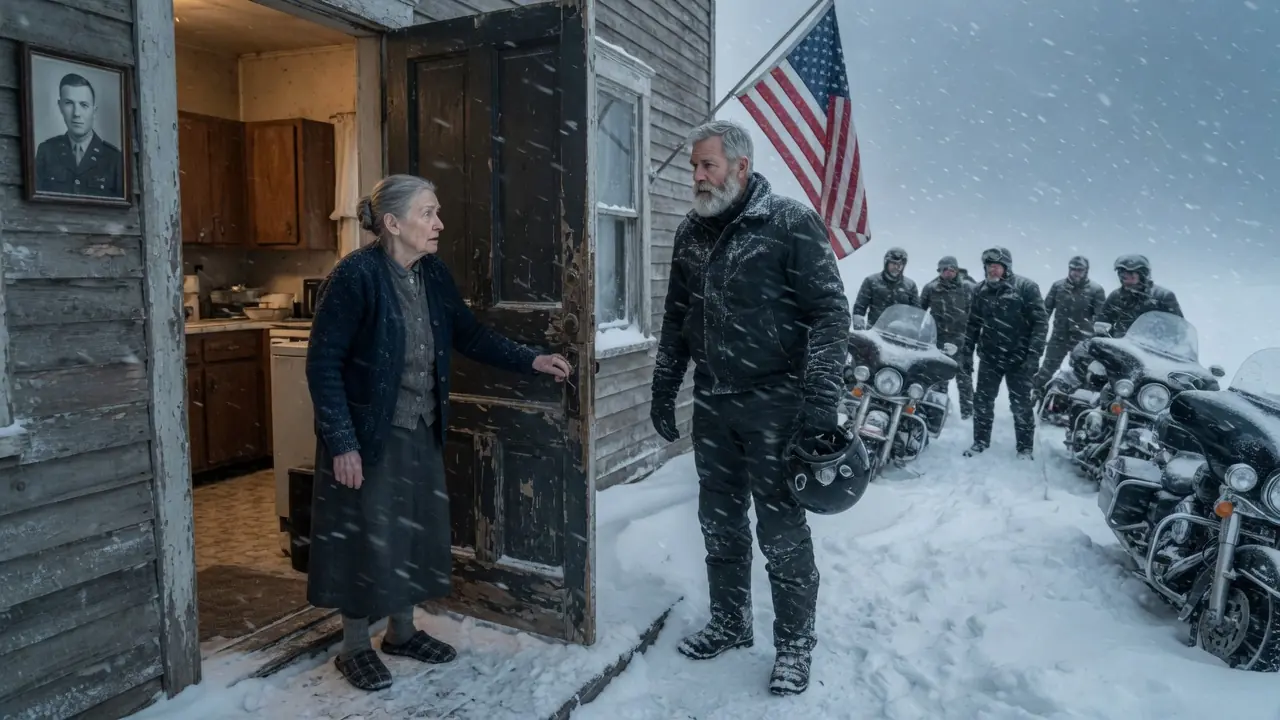
Four tablets of metformin for her diabetes.
The calendar on her kitchen wall showed March 14th. Social Security would not arrive until the first of next month.
Sixteen days.
Eight pills.
The mathematics of survival demanded cruel choices.
She chose the heart medication.
She unscrewed the cap with arthritic fingers that barely cooperated in the cold, swallowed one pill dry because even water tasted like defeat at 5:30 in the morning, then returned the bottle to the cabinet beside the photograph of Thomas in his Army uniform.
Forty-six years since Vietnam had claimed part of him.
Three years since cancer had taken the rest.
“Still being stubborn, baby,” she whispered to the photo. “Just like you taught me.”
The kitchen window rattled in its frame.
Outside, darkness pressed against the glass.
The Weather Channel had been screaming warnings for three days.
Unprecedented March blizzard.
Temperatures dropping to fifteen below zero.
Winds hitting sixty miles per hour.
Life-threatening conditions.
Do not travel.
In the basement, the furnace wheezed and rattled like an old man drowning. Evelyn had named it Old Faithful years ago, back when irony still felt like a luxury she could afford.
Now it was neither old in the cherished sense nor faithful in any sense at all. It was just loud and dying and expensive to replace.
Eight thousand five hundred dollars for a new furnace.
That number lived in her mind like a prison sentence.
Seventy months of careful saving if she never bought another thing, never ate, never took medicine, never turned on a light.
The CB radio on the kitchen counter crackled to life.
Thomas’s old trucking radio. One of the few connections she still maintained to a world that had moved on without her.
Static hissed and popped.
Then voices emerged through the white noise.
“Eagle One to convoy. Road conditions deteriorating fast.”
“Copy, Eagle. How long until whiteout?”
“Six hours, maybe less.”
The voices carried that particular quality she recognized from Thomas’s old war stories.
Military precision.
Call signs.
Men who measured the world in grid coordinates and threat assessments.
She wondered who they were, where they were going, whether they would make it safely.
She returned to her instant coffee. Powdered milk because real cream cost too much. One forty-watt bulb because the electric bill demanded sacrifice.
Her Bible lay open on the table to Hebrews 13:2.
She had read it so many times the page had worn thin.
Do not forget to show hospitality to strangers, for by so doing some people have shown hospitality to angels without knowing it.
She had no idea that in thirteen hours she would face the ultimate test of that verse.
No idea that nine strangers would appear at her door.
No idea that her next decision would ripple across three states and save two thousand lives.
For now, there was only the cold kitchen, the rationed pills, the dying furnace, and the impossible mathematics of making it through another day.
Seventy-two miles northeast, Colonel James Morrison stood at attention beside a hospital bed, watching his mentor’s chest barely rise and fall.
The machines beeped their steady countdown.
Morphine dripped through clear tubing into Bull Martinez’s arm.
Stage four pancreatic cancer had reduced the toughest sergeant Morrison had ever known to one hundred and ten pounds of yellowed skin stretched over fragile bones.
Bull’s eyes opened, still sharp despite the drugs.
Still assessing.
Still the sergeant who had trained a scared lieutenant thirty years ago and turned him into a commander.
“Eagle.”
The voice came out like gravel grinding against steel.
Morrison leaned close.
“Right here, Sergeant.”
“Need you to do something.”
Each word cost Bull visible effort. The machines beeped faster. A nurse glanced through the window but did not enter.
This was a moment that belonged to soldiers.
She understood that.
“Anything,” Morrison said.
Bull’s hand shot out with surprising strength. He gripped Morrison’s wrist with fingers that still remembered how to break a man’s arm in three places.
“Tom Hart. Vietnam, ’68. Mechanic. First Cavalry.”
Morrison knew this story.
Bull had told it a hundred times over thirty years.
Always the same details.
Always the same reverence in his voice.
“Tet Offensive,” Bull continued. His breathing grew labored. The machines complained. “My vehicle took fire. Engine died. I was hit. Couldn’t move. Chaos everywhere.”
He coughed, fighting for air.
“Hart ran into that kill zone. Fixed my engine under fire. Drove me out. Saved my life.”
“I know, Sergeant.”
“Find his family.”
Bull’s grip tightened until Morrison’s bones ground together.
“Make sure they’re okay. That’s an order.”
“Roger that, Sergeant. Consider it done.”
Bull’s face relaxed. The lines of pain softened into something that might have been peace.
“Best officer I ever trained. Your daddy would be proud.”
The monitor flatlined at 11:47.
Morrison stood at attention for five minutes, rendered a final salute, then walked out of the room and made three phone calls.
The first was to the funeral home.
The second was to Bull’s son, Doc Martinez.
The third was to a VA database contact he was not technically supposed to have, but had maintained through thirty years of knowing the right people.
By two in the afternoon, he had an address.
Evelyn Hart.
1847 Gratiot Avenue, Detroit.
Widow of Sergeant Thomas Hart, Vietnam veteran, First Cavalry Division.
Mechanic.
By four, he had assembled eight men in the parking lot of Morrison Construction. His company built with veteran labor, staffed entirely by men who understood that some debts transcended money.
“Gentlemen, listen up.”
Morrison’s voice carried the command authority that thirty years of service had hammered into his bones.
Eight men stood at attention without being told.
Muscle memory.
“Mission objective. Locate Evelyn Hart, widow of Sergeant Thomas Hart, Vietnam veteran who saved Bull Martinez during the Tet Offensive in 1968. Assess her situation. Render assistance if needed.”
Tank Williams raised a hand. Six foot four, two hundred and forty pounds of Marine Corps muscle wrapped in motorcycle leather.
“Rules of engagement, sir?”
“Standard MCVET protocol. We observe. We assess. We offer help. No pressure. If she declines, we respect it and find another approach.”
Morrison scanned the faces.
These men had followed him through Fallujah, through Kandahar, through every hell the world could manufacture. They would follow him through a Detroit blizzard without question.
“Weather forecast shows storm hitting at 1900 hours. We ride in two hours. Pack cold-weather gear. Be ready for anything.”
The men dispersed to their motorcycles.
Harley-Davidson Road Kings.
Winterized.
Heated grips.
Handlebar mitts.
Engine block heaters.
These were not showroom bikes. These were working machines, tools, extensions of the men who rode them.
Diesel Thompson, former Navy SEAL turned master mechanic, checked his fuel lines with the methodical precision of a man whose life had once depended on such attention.
Doc Martinez, Bull’s son, loaded medical supplies into his saddlebags.
The irony was not lost on Morrison.
The son of the man Tom Hart had saved, riding to help Hart’s widow.
Karma operating on a forty-six-year delay.
By six, nine motorcycles rolled out of the parking lot in tight formation.
Morrison led.
Four bikes flanked left and right.
Three brought up the rear.
Standard tactical deployment.
Old habits did not die.
They just found new missions.
The temperature was twenty-eight degrees. Roads were clear. Traffic was light. Civilians waved as the formation passed. American flags flew from several of the bikes.
People respected veterans in this part of Michigan.
Respected the uniform even when it came wrapped in leather and chrome.
By 6:30, the first snowflakes began to fall.
By 7:00, visibility had dropped to fifty yards.
By 7:30, the temperature had plummeted to five degrees, and Morrison knew they were in trouble.
“Eagle One to all units. Reduce speed to twenty-five. Double following distance. Roads are icing.”
His voice carried through the helmet communication system. Military grade. Encrypted. Range of one mile in clear conditions, maybe three hundred yards in the whiteout forming around them.
“Copy, Eagle.”
The responses came back in sequence.
Professional.
Calm.
But Morrison heard the tension underneath.
These men had survived firefights and roadside blasts. They had survived ambushes and every hell the world could build.
But Mother Nature did not care about their training.
Did not care about their courage.
The storm would kill them just as dead as any enemy combatant.
At 7:45, Diesel’s engine began to misfire.
“Eagle, my fuel lines are freezing. Engine’s cutting out.”
“Copy. Maintain formation. We’re close.”
Bear Kowalski’s voice crackled through next.
“Same here, Colonel. Carbs icing up.”
Morrison checked his GPS.
Two point three miles from the Hart address.
Behind them, nothing but eight miles of empty road and abandoned buildings. Ahead, one lit window in the darkness.
One chance.
“All units, sound off. Engine status.”
Six of eight bikes reported problems.
Critical problems.
The kind that meant walking soon.
Walking in fifteen-below-zero temperatures with sixty-mile-per-hour winds.
Walking meant frostbite within ten minutes.
Death within the hour.
“Target is the Hart residence two miles ahead. It’s our only option. We push through.”
The bikes began dying one by one.
Bear’s seized first.
Then Razor’s electrical system failed.
They were eight-tenths of a mile out when Morrison made the call.
“Dismount. Push the bikes. Stay together. Nobody gets left behind.”
Nine men in frozen leather pushed dead motorcycles through knee-deep snow.
The wind screamed.
The temperature dropped.
Minus twelve.
Minus fifteen.
Morrison counted heads every sixty seconds.
All present.
All moving.
But barely.
His beard had turned into a solid mass of ice. His fingers were numb inside heated gloves that had stopped heating twenty minutes earlier. Each breath burned his lungs.
But he kept moving.
Kept counting.
Kept pushing.
Because Bull Martinez had asked him to find Tom Hart’s family.
And Colonel James Morrison did not fail his missions.
At 8:10, a house materialized through the whiteout.
Victorian style.
Two stories.
Paint peeling.
Shingles missing.
But one window glowed with warm light, and an American flag hung from the porch, barely visible through the snow.
Morrison checked the address against his GPS.
1847 Gratiot.
Target acquired.
He counted heads one final time.
Nine.
All present.
All hypothermic.
All running out of time.
His combat experience told him they had five minutes before the first man lost consciousness.
Ten minutes before the first death.
“Gentlemen, listen up.”
His voice cut through the wind.
“We’re about to knock on a stranger’s door and ask for shelter. This woman doesn’t know us. She’s probably terrified of us. We do this with respect and discipline.”
He looked at Tank.
“You stay back initially. Six foot four in black leather in a white neighborhood at night. We lead with Doc and me. Less threatening. Everyone else form up behind, but give space. If she refuses, we respect it and find another way. Clear?”
The men murmured acknowledgment.
Tank showed no offense.
Just nodded.
Smart tactical thinking.
Everyone understood.
Morrison approached the door with Doc beside him. Behind them, seven giants in frozen leather stood in disciplined formation.
Morrison removed his helmet.
Show respect.
Show humanity.
Show her we are not monsters.
Through the frosted glass, he could see a silhouette.
Small.
Elderly.
Not moving.
Frozen with fear.
His gut twisted.
He was about to terrify this woman. About to validate every nightmare she had ever had about strangers and violence and men who meant harm.
But his men were dying.
And sometimes the mission demanded uncomfortable choices.
He knocked.
Three firm strikes, loud enough to be heard over the wind, but not aggressive.
Not demanding.
No response.
He could see her shadow through the glass, standing there. Her hand was probably on the phone or a weapon.
Smart woman.
Do not open the door for strangers.
He knocked again, raised his voice to carry through the door and the storm.
“Ma’am, I’m sorry to disturb you. My name is Colonel James Morrison, United States Army, retired. Our motorcycles died in the storm. Roads are impassable. We just need shelter until morning. We have sleeping bags. We won’t be any trouble. I understand if you can’t help, but please, we’re dying out here.”
Silence.
Thirty seconds that felt like thirty years.
Morrison’s teeth chattered. Doc shifted his weight beside him. Behind them, men swayed in the wind, running out of time.
“Colonel, she’s not opening it,” Doc said.
No judgment in his voice.
Just fact.
“We need to go.”
“Give her another minute.”
“We don’t have another minute.”
Morrison raised his fist to knock again.
Then stopped.
The deadbolt clicked.
The sound carried through the wind like a gunshot.
The door opened.
Evelyn Hart stood in the doorway.
Seventy-two years old.
Maybe one hundred pounds soaking wet.
Three sweaters.
Gray hair pulled back.
A face showing every year of struggle.
But her eyes were clear, bright, assessing them with the same calculating intelligence Morrison had seen in a thousand soldiers.
“Kitchen’s the warmest room,” she said.
Her voice shook but held firm.
“Get inside before you freeze to death.”
Morrison did not move immediately.
Could not.
This tiny woman had just opened her door to nine armed strangers in the middle of the night during a blizzard.
She had just chosen kindness over safety.
Faith over fear.
She had just demonstrated more courage than most soldiers he had commanded.
“Thank you, ma’am.”
He found his voice.
“We won’t forget this kindness.”
Nine frozen warriors filed through the door into blessed warmth. Not moving fast, not pushing, moving with discipline and respect because Evelyn Hart had given them a gift beyond measure and they damn well knew it.
Morrison was the last through the door.
He met her eyes as he passed.
He saw fear there.
Saw determination.
Saw something that reminded him of every soldier who had ever done their duty despite being terrified.
“Ma’am, I meant what I said. We won’t be any trouble.”
“You better not be.”
She closed the door, shot the deadbolt, and turned to face nine giants in her kitchen.
“I’m Evelyn Hart. This is my home. You’re welcome here tonight, but if any of you cause problems, I’ve got my husband’s service pistol in the bedroom, and I know how to use it.”
Morrison believed her.
“Understood, ma’am.”
“Now get those wet clothes off before you drip all over my floors. I’ll make coffee.”
The men moved with silent efficiency.
No loud voices.
No disorder.
Years of military discipline took over.
They formed two columns without being told. They stomped snow off their boots outside first, even though they were already inside, then removed helmets and unzipped jackets.
Morrison watched Evelyn watching them.
Saw her fear slowly transform into confusion.
These were not the monsters she had expected.
These were men who followed protocols. Men who understood respect and discipline.
“Sound off. Any injuries?”
Morrison’s command voice filled the kitchen.
“Frostbite on fingers, sir. Minimal.”
Tank’s voice was a low rumble.
“All good here, sir.”
Doc.
“Extremities numb but functional, sir.”
Diesel.
Each man reported in sequence.
Military protocol.
Automatic.
Ingrained so deep that freezing to death did not change the habits.
Evelyn stood at her stove filling a pot with water for coffee. Her hands shook.
Morrison noticed the arthritis.
Noticed how thin she was.
Noticed the buckets placed strategically around the kitchen to catch drips from roof leaks.
Noticed the single forty-watt bulb, the instant coffee, the poverty wrapped around this woman like a shroud.
And she had still opened her door.
“Ma’am, may I ask a question?”
Morrison kept his voice gentle.
She did not turn from the stove.
“Ask.”
“Why did you let us in? You didn’t know us. We could have been anyone.”
She was quiet for a long moment.
The water began to heat. The ancient stove clicked and hissed.
Finally, she turned.
“My husband, Thomas, was Army. Vietnam. He told me once that the worst thing a soldier can face isn’t the enemy. It’s coming home and finding out nobody cares anymore.”
She met Morrison’s eyes.
“You called yourself Colonel. Your men call you sir. You move like soldiers. Maybe you are. Maybe you’re not. But if you are, and I turned you away, and you died out there…”
She shook her head.
“I couldn’t look at Thomas’s photo tomorrow, knowing I let soldiers freeze when I could have helped.”
Morrison felt something crack in his chest, some armor he had been wearing for thirty years.
“Your husband. What was his name?”
“Thomas Hart. Sergeant. First Cavalry Division. Sixty-seven to sixty-nine.”
Morrison’s breath stopped.
Doc turned from where he was arranging sleeping bags.
The other men went still because impossible coincidences did not exist.
The universe did not work that way.
Which meant this was something else.
This was fate.
This was karma operating on a scale that defied understanding.
“Ma’am,” Morrison said, his voice rough. “What unit in First Cav?”
“I don’t remember the numbers. He was a mechanic. Fixed helicopters mostly. Some trucks.”
“Did he ever mention a sergeant named Bull Martinez?”
Evelyn’s eyes widened.
“Bull. Yes. Thomas talked about him. Said he was the toughest sergeant in the unit. How do you know that name?”
Morrison sat down slowly in one of her kitchen chairs. It creaked under his weight. Behind him, his men stood frozen, waiting.
“Ma’am, I need to tell you something, and I need you to sit down first.”
She sat, hands folded in her lap, back straight despite the arthritis.
Dignity intact despite the poverty.
“Tell me.”
“Bull Martinez was my mentor. He trained me when I was a lieutenant. Everything I became as an officer, every skill I learned, every man I saved, I owe to him.”
Morrison’s voice cracked.
“He died this morning. Pancreatic cancer. His last words to me were, ‘Find Tom Hart’s family. Make sure they’re okay. That’s an order.’”
Evelyn’s hands flew to her mouth.
“I spent all afternoon tracking you down through VA records. I was coming here anyway. The storm just forced us to arrive at your door instead of knocking politely tomorrow morning.”
Morrison leaned forward.
“Ma’am, do you know why Bull’s last thought was about your husband?”
She shook her head.
Could not speak.
“January 31st, 1968. Tet Offensive. Bull’s vehicle took enemy fire. Engine died. He was wounded. Pinned down. Enemy forces were closing in.”
Morrison’s voice dropped.
“Your husband ran into that kill zone. Fixed Bull’s engine under fire, with bullets hitting all around him. Got Bull mobile. Drove him to medical evacuation. Saved his life.”
Tears streamed down Evelyn’s face.
“Thomas never said. He never told me he saved anyone.”
“Good men rarely do.”
Morrison felt his own eyes burning.
“But Bull remembered. For forty-six years, he remembered. He told me that story maybe twenty times. Always the same words. Tom Hart, bravest mechanic I ever saw. And his last request was that I find you. Make sure Tom Hart’s family was okay.”
Doc Martinez stepped forward.
“Ma’am, I’m Bull’s son. My father raised me on that story. Your husband is the reason I exist. The reason I became a medic. The reason I saved forty-seven lives in Afghanistan. Because my father lived long enough to teach me what service means.”
Evelyn could not speak.
She just sat there crying silently while nine warriors stood in her kitchen and understood that they were standing on holy ground.
This was a moment forty-six years in the making.
Tom Hart’s courage in 1968 had rippled forward through time to bring them here.
To bring them to this door.
This woman.
This impossible, beautiful moment of connection.
Morrison stood, came to attention, and rendered a full military salute.
Sharp.
Precise.
Textbook perfect.
Behind him, eight men snapped to attention.
Eight hands rose in synchronized salute and held for five seconds.
Regulation.
Evelyn stared at them, confused, overwhelmed, not fully understanding the significance but feeling its weight.
“Ma’am,” Morrison said, lowering his salute, “you saved nine lives tonight. But your husband saved the man who saved mine. We’re here because of him. Because of what he did forty-six years ago. That debt transfers. You’re under MCVET protection now. Motorcycle Club Veterans. Eight hundred and forty-seven combat veterans across three states. Your family forever.”
He held her gaze.
“That’s not charity. That’s paying a debt that’s forty-six years overdue.”
He sat back down.
“But tonight, we’re just grateful guests who won’t be any trouble. We have our own food, our own sleeping bags. We’ll sleep on your floor and be gone at first light. And ma’am, we’ll leave your home cleaner than we found it. That’s a promise.”
Evelyn wiped her eyes, stood on shaky legs.
“I have instant coffee. No real cream, just powdered milk. I’m sorry it’s not better.”
Tank Williams accepted a cup with both hands like it was fine crystal.
“Ma’am, this is the best coffee I’ve had in six months. Thank you.”
The other men echoed agreement.
Genuine.
Not patronizing.
Because they understood what she had given them. They understood the sacrifice of opening her door. They understood that kindness had more value than cream and coffee.
Morrison noticed Diesel and Wrench disappearing toward the basement. Doc quietly examining prescription bottles on the counter. Tank assessing the house with trained eyes, checking smoke detectors.
These men were already working.
Already identifying problems.
Already planning solutions.
Because that was what soldiers did.
They assessed.
They adapted.
They accomplished the mission.
And the mission now was making sure Evelyn Hart never wanted for anything again.
At three in the morning, Morrison stood watch at the kitchen window.
Old habits.
In combat, someone always stood guard.
Kept everyone safe.
Kept the perimeter secure.
Evelyn emerged from her bedroom, saw him silhouetted against the streetlight, and stopped.
“You’re still up.”
“Yes, ma’am. All quiet.”
She moved to the counter, retrieved a pill bottle. He heard her counting quietly, saw her take one pill, then return the bottle.
She caught him watching.
“Can’t sleep?” she asked.
“Don’t sleep much anymore. Haven’t for years.”
“The war?”
“Yes, ma’am.”
“Thomas was the same. Some nights he would just stand at the window looking out. I never knew what he was seeing.”
Morrison turned from the window.
“He was seeing all the people he couldn’t save. All the moments he wished he could change. All the brothers who didn’t make it home.”
“How do you live with that?”
“You find new people to save. New missions. New ways to make the past matter.”
He gestured around her kitchen.
“Like making sure the widow of the man who saved your mentor is okay.”
Evelyn was quiet.
Then she said, “What did you notice when you came in? I saw your men looking around, assessing. What did you see?”
Morrison considered lying.
Decided against it.
“Roof leaks. Seven locations. Electrical system overloaded. Fire hazard. Furnace sounds terminal. Medicine bottles showing a rationing pattern. Grocery budget insufficient.”
He met her eyes.
“Poverty that no veteran’s widow should ever experience.”
“I manage.”
“You shouldn’t have to just manage. Your husband earned better for you. The VA should have provided better.”
“The VA said I wasn’t eligible for anything.”
Morrison’s jaw tightened.
“Ma’am, with respect, someone gave you wrong information. You’re eligible for widow benefits. Dependency and Indemnity Compensation. About twenty-eight hundred a month plus full medical coverage. You have been since Thomas passed.”
Evelyn stared at him.
“Twenty-eight hundred a month?”
“Yes, ma’am. And retroactive. If Thomas died three years ago, you’re owed roughly sixty-eight thousand in back payments.”
She sat down hard.
“That can’t be right.”
“It is. Tank Williams, the big Marine, is our VA benefits specialist. He’ll verify tomorrow. But ma’am, you should have been getting those benefits all along. Someone at the VA failed you. The system failed you. And that’s not acceptable.”
“I don’t understand. Why didn’t they tell me?”
“Because the system is broken. Because bureaucracy fails people. Because sometimes good people fall through cracks.”
Morrison moved to the table and sat across from her.
“But you’re not falling anymore. You’ve got eight hundred and forty-seven veterans who just learned your name. Who just learned that Tom Hart’s widow has been living in poverty while the system she’s entitled to support from ignored her. That doesn’t stand. Not on our watch.”
“I can’t accept charity.”
“It’s not charity. It’s what you’re owed. What Thomas earned for you. What you deserve.”
Morrison’s voice softened.
“Ma’am, let me tell you about MCVET. After I retired, I watched seven of my brothers die by suicide. Seven men who survived combat, survived ambushes and every hell we could find. Then they came home and couldn’t survive peace because nobody cared anymore, because the system failed them.”
He looked around her kitchen.
“So I founded MCVET. Eight hundred and forty-seven combat veterans who help each other survive peace. Who make sure nobody falls through cracks. Who take care of our own.”
He met her eyes.
“You’re our own now. Thomas Hart made you our own forty-six years ago. And we take care of our own.”
Evelyn wiped tears away.
“What happens now?”
“Now you let us help. You let Tank file for your benefits. You let my construction company fix your house. You let Doc make sure you’re getting proper medical care. You let us give you what you should have had all along.”
“I have children. They can help.”
“I’m sure they can, and I’m sure they want to. But why should they have to when there are eight hundred and forty-seven veterans who owe your husband their lives?”
Morrison stood.
“Get some sleep, ma’am. Tomorrow’s going to be a long day. Good long, but long.”
She stood, hesitated, then hugged him.
This tiny woman wrapping thin arms around a colonel who had commanded the 75th Ranger Regiment.
Morrison froze, then carefully returned the embrace, gentle, aware of her arthritis, aware of how fragile she felt, aware that he was holding something precious.
“Thank you,” she whispered. “For honoring Thomas. For remembering him.”
“Ma’am, we’ll never forget him. I promise you that.”
She released him and went back to her bedroom.
Morrison returned to the window.
To his watch.
To his duty.
Behind him, men slept in organized rows on the floor. Each in his assigned space. Each ready to wake and fight if needed. Each knowing they were exactly where they needed to be, doing exactly what they had been trained to do.
Taking care of their own.
At 6:30, Evelyn woke to sounds of activity.
She emerged from her bedroom to find nine men efficiently packing gear. Sleeping bags rolled tight, equipment staged by the door, and her kitchen cleaner than it had been in months.
“You didn’t have to clean.”
Preacher Johnson smiled.
“Yes, ma’am, we did. You gave us shelter. Least we can do is leave your home better than we found it.”
She noticed other things.
The loose cabinet handles she had been meaning to fix.
Fixed.
The smoke detector that needed batteries.
Fresh batteries installed.
Firewood by the back door that definitely had not been there last night.
These men had worked while she slept, quietly, efficiently, improving her home without asking permission or expecting thanks.
Morrison approached.
“Ma’am, my mechanic says your furnace won’t last two weeks. The repair we did last night was emergency only. You need a full replacement.”
“I know. I just can’t afford it right now.”
He pulled an envelope from his jacket.
Thick.
Heavy.
“This is for the furnace, for utilities, for whatever you need.”
Evelyn pushed it back firmly.
“I didn’t help you for money, Colonel.”
He blinked, clearly not used to refusal.
“Ma’am, most people would have kept that door locked. You saved our lives.”
“And you would have saved mine if our positions were reversed. That’s what decent people do.”
She met his eyes.
“I’m not most people. You’re good men. I can see that now. That’s payment enough.”
Morrison studied her face, then slowly put the envelope away.
He pulled out a keychain instead. A metal eagle logo, letters underneath reading MCVET.
“This is my call sign marker. If anyone bothers you, anyone at all, you show them this.”
He handed her a folded piece of paper.
“My personal number. Day or night. Anything you need, you call.”
“Colonel, I don’t expect anything.”
“Ma’am, in our world, debts get paid. Always. Your husband saved Bull. You saved us. That debt is mine now.”
He stood straighter.
“And I keep my promises.”
Then he did something that made Evelyn’s breath catch.
He snapped to attention and rendered a full military salute.
Sharp.
Perfect.
Held.
Eight men behind him instantly followed. Eight hands rising in synchronized precision. Eight faces showing respect and reverence and something close to love.
“Ma’am, you saved nine lives last night,” Morrison said. “In our world, that means everything. And because you’re Thomas Hart’s widow, it means even more. This salute is for him, for you, for what both of you represent.”
Evelyn felt tears streaming.
“I just did what anyone would do.”
“No, ma’am.”
Morrison lowered his salute.
“You did what heroes do.”
The men filed out, each thanking her personally, each handshake gentle, each face showing genuine gratitude.
Their motorcycles started with synchronized roars, somehow fixed during the night, somehow ready despite being dead and frozen twelve hours earlier.
Morrison paused at the door.
“Miss Evelyn, I meant what I said. You need anything, you call.”
“Just be safe out there, Colonel.”
“Yes, ma’am.”
He smiled.
“And ma’am, your husband would be proud of you. What you did last night took real courage.”
“He’d say I was foolish.”
“Maybe. But he’d be proud anyway.”
Then they were gone.
Nine motorcycles disappearing into morning light.
Formation perfect.
Discipline absolute.
Evelyn stood on her porch holding a keychain and a phone number and the knowledge that something fundamental had changed in her life.
She looked at Thomas’s photo when she went back inside.
“Baby, I think I just met your family. The family you never told me about.”
She made real breakfast for the first time in months.
Eggs.
Toast with actual butter.
Food the men had quietly restocked in her refrigerator while she slept.
She felt something she had not felt in three years.
Connected to something larger than her own survival.
Part of a family she had not known existed.
Valued in a way that transcended money or charity.
She filed Morrison’s number in her Bible, next to Thomas’s Purple Heart certificate, next to the verse about showing hospitality to strangers.
Because sometimes strangers turned out to be angels.
And sometimes angels wore leather, rode motorcycles, and carried forty-six-year-old debts they refused to forget.
Outside, the storm had passed.
The sun broke through the clouds, and Evelyn Hart stood in her warm kitchen, surrounded by evidence of kindness from men she had known for twelve hours, and understood that her life had just been divided into before and after.
Before she opened the door.
And after.
Everything that came next would flow from that single choice, that moment of faith over fear, that decision to be who Thomas had raised her to be.
A woman who opened doors even when she was terrified.
Even when logic screamed to keep them locked.
Because that was what heroes did.
And Evelyn Hart, seventy-two years old, one hundred pounds, three sweaters, and a dying furnace, was about to discover she had been a hero all along.
She just had not known it yet.
Three days after the blizzard, Evelyn stepped onto her porch to collect the mail and found her garbage bins positioned neatly beside the house.
In three years of living alone, the sanitation workers had never once returned them from the curb.
She stood there holding bills she could not pay, staring at bins she had not moved, and felt the first whisper of something watching over her.
The feeling intensified on day four when she noticed the corner was empty.
For two years, young men had gathered there every afternoon. Transactions happened. Money changed hands.
Evelyn had called the police seventeen times.
Seventeen times they had arrived too late or not at all.
Now the corner sat vacant, abandoned, like someone had convinced those boys to conduct business elsewhere.
On day five, the streetlight that had been broken for eight months suddenly worked.
Evelyn called the city utilities department.
“We don’t have any repair orders for that address, ma’am, but it’s working now.”
“Then someone else fixed it.”
“We haven’t been out there in over a year.”
She hung up slowly, looked at the light pole, noticed the way it illuminated her front walkway perfectly, noticed how safe that made her feel walking home after dark.
Day six brought groceries.
She found them on her porch when she returned from the library.
Real cream.
Fresh bread.
Actual butter.
Eggs.
Vegetables.
Quality food in quantities she could not afford.
A handwritten note said simply:
From grateful friends.
No signature.
No expectation of thanks.
Evelyn brought them inside crying.
Not from sadness.
From the overwhelming sensation of being cared for.
Of mattering to someone.
Of not being invisible anymore.
On day seven, she found an American flag planted in her front garden. Small, positioned to catch the morning sun. The exact angle Thomas used to position their flag before Vietnam changed him.
Before cancer took him.
Before she learned what loneliness truly meant.
That evening, the CB radio crackled to life.
“Eagle’s nest secure. Perimeter clear. Mama Bear stable. No threats detected. Confirming target residence has heat, lights, and mail delivery. Normal.”
Evelyn sat at her kitchen table listening to voices coordinate her protection.
Mama Bear.
They were calling her Mama Bear.
And Eagle’s Nest meant her house.
These men were not just checking on her.
They were maintaining active surveillance.
Professional.
Military-grade.
Constant.
She pulled out Morrison’s phone number, stared at it for ten minutes, put it away, pulled it out again, and finally dialed before fear could stop her.
He answered on the first ring.
“Morrison.”
“Colonel, this is Evelyn Hart.”
His voice immediately warmed.
“Miss Evelyn. Everything okay?”
“I need to know what’s happening. The groceries, the streetlight, the boys on the corner are gone. And I heard voices on the radio talking about me.”
Silence.
Then, “You picked up the transmissions.”
“Yes.”
“We should have encrypted better. I apologize.”
“Colonel, are you watching my house?”
More silence.
Then, “Yes, ma’am. Twenty-four seven. Rotating shifts. Shadow mostly. He’s our surveillance specialist. Former Army intelligence.”
“Why?”
“Because you’re family, and we protect our own.”
Evelyn’s hand shook.
“For how long?”
“However long it takes, ma’am. Days, weeks, forever. However long you need.”
“I don’t need protection. I’m fine.”
“With respect, ma’am, you’re not fine. Tank ran your information through VA databases. You’re entitled to widow benefits you never claimed. Two thousand eight hundred forty-seven dollars per month, plus sixty-eight thousand in retroactive payments, full medical coverage, prescription coverage, dental, vision, transportation to appointments, everything.”
Evelyn sat down hard.
“That can’t be right.”
“It is right. The VA failed to notify you properly when Thomas passed. You should have been receiving these benefits for three years. We’re filing the claims tomorrow. Tank knows people. We’ll expedite.”
Morrison’s voice softened.
“Ma’am, you’ve been rationing heart medication to make it last. Doc saw your pill bottles that night. You’re killing yourself slowly to save money you shouldn’t have to save.”
“How dare you go through my private things?”
“Doc’s a medic. He sees threats automatically. Medicine bottles in plain sight. Four pills when there should be twenty-three. That’s not snooping. That’s assessment.”
Morrison paused.
“Ma’am, if you keep rationing, you’ll have a stroke or a diabetic coma within ninety days. That’s medical fact, not opinion.”
Evelyn wiped her eyes.
“I manage.”
“You survive. There’s a difference. And Tom Hart’s widow shouldn’t have to just survive. She should thrive. That’s what we’re here to ensure.”
“By watching my house like I’m under surveillance?”
“By making sure nothing happens to you. By making sure the system that failed you doesn’t fail you again. By being the family Thomas earned for you forty-six years ago.”
Morrison’s command voice returned.
“Ma’am, I need you to understand something. MCVET isn’t a charity. It’s a brotherhood. Eight hundred and forty-seven combat veterans who take care of each other. Who make sure nobody falls through cracks. Who ensure that service means something. You’re part of that now, not because we pity you, but because you’re owed it.”
“I didn’t ask for this.”
“The best people never do. That’s why they deserve it most.”
Evelyn sat in silence, processing, trying to reconcile pride with need, independence with acceptance, the woman she had been with the woman these men saw.
“Miss Evelyn, may I ask you something?”
“Ask.”
“When you opened that door during the blizzard, were you scared?”
“Terrified.”
“But you opened it anyway.”
“Yes.”
“Why?”
She thought about that.
“Because there were human beings dying outside my door. Because saying no meant watching them freeze. Because Thomas would have opened it. Because it was the right thing to do, even though it terrified me.”
“That’s courage, ma’am. Real courage. Not the absence of fear. Acting despite it.”
Morrison’s voice grew intense.
“You showed us courage that night. Now I’m asking you to show it again. Accept help. Let us give you what you’re owed. Let us honor Thomas by taking care of the woman he loved. That takes courage too.”
“I have children. They can help.”
“I’m sure they want to. But why should they have to when eight hundred and forty-seven veterans want to? When we owe this debt? When helping you helps us?”
He paused.
“Ma’am, my men are drowning in civilian life. They need purpose. Need mission. Need to serve. You give us that. You let us be who we trained to be, who we want to be. Protectors. Providers. Brothers. Please don’t take that from us by refusing help you deserve.”
Evelyn closed her eyes.
“What happens now?”
“Now you say yes. You let Tank file your VA claims. You let my construction company assess your house. You let Doc coordinate your medical care. You let us do what we’re good at, what we need to do, what Thomas earned for you.”
“And if I say no?”
“Then we respect that. But we keep watching. Keep making sure you’re safe. Keep being family. Even if you won’t accept help, because that’s what family does.”
Morrison’s voice dropped.
“But I hope you don’t say no. I hope you trust us. Trust that we’re here for the right reasons. Trust that Thomas’s sacrifice earned you this. Trust that accepting help doesn’t make you weak. It makes you wise.”
Evelyn thought about Thomas.
About Bull Martinez.
About nine frozen men in her kitchen showing more discipline and respect than she had seen in years.
About being alone versus being lonely.
About pride versus wisdom.
“Okay.”
“Ma’am?”
“Okay. I’ll accept help. But I have conditions.”
“Name them.”
“I’m not a charity case. I’m a partner. You help me, I help you. I cook those Sunday dinners you mentioned. I provide space for your meetings. I earn my place in this family.”
“Agreed.”
Morrison laughed.
Actually laughed.
“Agreed, ma’am. Welcome to MCVET. Official title is Den Mother. Five hundred dollars a month salary. But mostly it means you’re the heart of what we do. The mom who keeps us human. The reminder of why we serve.”
“Five hundred dollars for what?”
“For being you. For opening doors. For showing courage. For reminding us what we’re fighting for.”
Evelyn felt something crack inside. Some wall she had maintained for three years. Some belief that she had to endure alone. That asking for help meant failure. That survival was supposed to hurt this much.
“Colonel Morrison, when do we start?”
“Already started, ma’am. Tank’s filing paperwork tomorrow. Doc’s sister Elena is coming Friday to help coordinate medical care. My crew will assess your house next week. And Sunday dinner is at your place. Thirty people will bring all the food and help cook. You just provide the space and the company.”
“Thirty people?”
“For now. Word’s spreading. By next month it might be fifty. We’ll figure it out.”
They talked for another twenty minutes.
Details.
Logistics.
Practical matters.
But underneath ran a current of something deeper.
Connection.
Family.
Purpose.
The sensation of mattering to people who understood service and sacrifice and the weight of promises kept.
When Evelyn hung up, she sat at her kitchen table staring at Thomas’s photo.
“Baby, I think I’m going to be okay. I think your family’s going to take care of me, just like you would have wanted.”
The CB radio crackled.
“Eagle to Shadow. Mama Bear just accepted help. Mission parameters changed. We’re going full support.”
“Copy, Eagle. About damn time. This woman deserves everything.”
“Agreed. Coordinate with Tank on medical, Diesel on housing assessment, Doc on family contact. Let’s show her what MCVET can do.”
“Roger that. Shadow out.”
Evelyn smiled through tears.
They were coordinating her care like a military operation because that was what they were.
Soldiers who had found a new mission.
Who had transformed their training into service.
Who had turned brotherhood into something that included her.
On day nine, Detective Raymond Cooper knocked on her door.
“Mrs. Hart, I’m Detective Cooper. Gang unit. Can we talk?”
Evelyn’s stomach tightened.
“About what?”
“Motorcycle club activity in your neighborhood. MCVET. You know them?”
She chose her words carefully.
“I know some veterans who helped me during the blizzard.”
Cooper showed photos.
Morrison.
Tank.
Diesel.
“These men came to your house that night. We have footage from a neighbor’s security camera.”
“They needed shelter. I provided it. That’s all.”
“Ma’am, MCVET has eight hundred and forty-seven members across three states. That’s larger than most gangs. Heavy military training. Organized structure. And now they’re establishing presence in this neighborhood. That concerns us.”
Evelyn felt anger rising.
“They’re not a gang. They’re veterans.”
“Veterans can be gang members, Mrs. Hart. Not all soldiers come home heroes. Some come home dangerous.”
Cooper leaned forward.
“I’m not saying they’ve hurt anyone yet. But organized groups of armed men operating in residential areas? That’s my jurisdiction. That’s my concern.”
“Your concern should be the people who operated on that corner for two years. The ones you never managed to catch. The ones who threatened children. They disappeared the same week these veterans started watching over me. Maybe you should be thanking MCVET instead of investigating them.”
Cooper’s eyes hardened.
“Mrs. Hart, if MCVET intimidated people off their territory, that’s vigilantism. That’s illegal. Even if the result seems positive.”
“Or maybe those boys heard veterans were around and decided to conduct business elsewhere. That’s not intimidation. That’s smart decision-making on their part.”
They stared at each other.
Cooper calculating.
Evelyn defiant.
Finally, he stood.
“Ma’am, I’m going to say this clearly. If you need protection, call the police. Don’t rely on a motorcycle gang. They have their own interests, their own agendas, and when that agenda conflicts with your safety, you’ll be the one who suffers.”
“Detective Cooper, those men saved my life. Then they made sure I got benefits I was legally entitled to but never received. They fixed my streetlight when the city couldn’t be bothered. They watch over me because I’m family to them. Not because they want something. Because they honor a debt from forty-six years ago.”
She stepped closer.
“So with all due respect, your concern is noted and dismissed. I trust them more than I trust the system that failed me for three years.”
Cooper left without another word.
Evelyn watched him go, then called Morrison.
“The police came.”
“Detective Cooper?”
“He’s investigating MCVET.”
“Expected. We’re operating in gang territory. Making their jobs harder by solving problems they couldn’t. Cooper’s a good cop, but territorial. He’ll come around.”
“He called you a gang.”
“Technically, any organized group is a gang, but we prefer brotherhood. Less negative connotation.”
Morrison’s voice held amusement.
“Don’t worry, ma’am. We’re not doing anything illegal. Just helping a veteran’s widow get what she deserves. If that bothers Cooper, he can take it up with the VA for failing you.”
“He seemed genuinely concerned.”
“He is. Cooper lost his nephew to gang violence three years ago. He sees organized groups and sees threats. Can’t blame him. But he’ll learn we’re different. Give it time.”
On day twelve, city inspector Ronald Simmons arrived unannounced.
“Mrs. Hart, I’m here about code violations. We received complaints.”
“Complaints from who?”
“Anonymous, but we’re required to investigate.”
He pulled out a tablet.
“May I inspect the premises?”
Evelyn had no choice.
She let him in.
Watched him document every flaw.
Every crack.
Every outdated system.
Her anxiety grew with each notation.
After forty minutes, Simmons faced her with bureaucratic satisfaction.
“Mrs. Hart, I’m finding multiple code violations. Electrical system outdated. Roof damage. Potential mold in the basement. These need immediate remediation.”
“I know the house needs work. I’m working on it.”
“You have thirty days to fix these issues or the house will be condemned.”
The words hit like physical blows.
Condemned.
Uninhabitable.
“Yes, ma’am. I’ll file my report today. You’ll receive official notice within a week. Thirty days to complete repairs or vacate.”
He handed her a checklist.
“Estimated cost is twelve to fifteen thousand minimum.”
He left.
Evelyn stood holding the paper.
Twelve thousand dollars might as well have been twelve million.
She had twenty-three dollars in checking.
The VA benefits had not come through yet.
Her children could not raise that kind of money quickly.
She was going to lose her house.
The house where she had raised five children.
Where Thomas had carried her over the threshold.
Where forty-six years of memories lived in every wall.
Gone because the city suddenly cared about codes it had ignored for a decade.
She called Morrison.
Could barely speak through tears.
“They’re going to condemn my house.”
“Who?”
“City inspector. Code violations. I have thirty days to fix them or they force me out.”
“How much?”
“Twelve thousand minimum.”
Silence.
Then, “Miss Evelyn, listen carefully. Do not panic. Do not call your children. Do not do anything. I’m handling this.”
“You can’t just handle twelve thousand dollars of repairs in thirty days.”
“Watch me. What we can do in thirty days would surprise you.”
Morrison’s voice went hard.
“This is retaliation. Someone doesn’t like us helping you. Probably the same people who called the detective. They’re using the system to hurt you.”
“It doesn’t matter why. The violations are real.”
“Violations that were ignored for years. Suddenly critical the same week MCVET gets involved. That’s not coincidence. That’s an attack.”
Morrison’s command voice returned.
“But they picked the wrong target and the wrong fight. I’ll have a crew there tomorrow morning. We’ll document everything. Then we’ll fix it. All of it. In seventy-two hours.”
“That’s impossible.”
“Ma’am, I’ve built forward operating bases in Afghanistan in less time under active fire. Your house repairs in three days under peaceful conditions? That’s a vacation.”
He paused.
“Trust me, please.”
Evelyn wiped her eyes.
“Okay.”
“Okay. Now get some rest. Tomorrow’s going to be loud. Fifteen guys with power tools loud. But by Sunday, your house passes inspection with perfect scores.”
“Why are you doing this?”
“Because you’re family. Because Thomas earned it. Because letting them force you out means they win. And ma’am, we don’t lose. Not missions. Not family. Not ever.”
The next morning at seven, fifteen veterans arrived with trucks full of equipment.
Morrison led them like a military operation.
Assignments barked.
Tasks delegated.
Men moving with purpose.
“Diesel and Wrench, hit the basement.”
“Foundation cracks. Mold behind the water heater. Give us four hours.”
“Tank and Bear, electrical.”
“Complete panel replacement. Upgrading to two-hundred-amp service. Six hours including inspection.”
“Razor and Preacher, roof.”
“Twenty percent of shingles compromised. Full replacement. Two-day job, but we’ll do it in eighteen hours.”
Morrison found Evelyn standing in her kitchen, overwhelmed.
“Ma’am, this is going to be chaos for three days. Catherine has a guest room ready at our house. Why don’t you stay there while we work?”
“This is my home.”
“I know, but we need room to operate. Some of this work involves cutting power, shutting water. You’ll be more comfortable at our place.”
Evelyn looked around at men already ripping out damaged drywall, at the organized destruction required before construction.
“Will my house survive this?”
Morrison smiled.
“It’ll be better than new. I promise. Trust us.”
She grabbed an overnight bag and let Morrison drive her to a farmhouse in Dearborn Heights, twenty minutes away.
Catherine Morrison met them at the door.
Fifty-two years old.
Former VA nurse.
Warm eyes.
Immediate hug.
“Evelyn. Finally. I’ve been wanting to meet you since James told me the story. Come in. Your room’s ready. Bathroom’s private. Make yourself at home.”
Morrison left to coordinate the crew.
Catherine led Evelyn to a first-floor guest suite.
Accessible bathroom.
Medical supplies visible but not intrusive.
A framed photo of Thomas on the nightstand.
“How did you get his photo?”
“James pulled it from VA records. Thought you might like having it here.”
Evelyn sat on the bed and started crying.
Catherine sat beside her, said nothing.
Just presence.
Just compassion.
After several minutes, Evelyn spoke.
“I don’t understand why you’re doing this. I’m nobody.”
“You’re Thomas Hart’s widow. That makes you somebody very important.”
“I opened a door during a storm. That’s all.”
“You showed courage when nine armed strangers appeared on your porch. You demonstrated trust when everything said to lock them out. You embodied the values these men fought to protect. Kindness. Service. Sacrifice.”
Catherine took her hand.
“And you gave my husband his purpose back.”
Evelyn looked up.
“What?”
“James came home from war broken. PTSD, survivor’s guilt, depression. He founded MCVET to save others, but he was drowning. Then Bull died. Then the blizzard. Then you.”
Catherine smiled through tears.
“You gave him a mission he could complete. A debt he could pay. A way to honor his mentor. You saved him, Evelyn. By letting him save you.”
“I don’t feel saved. I feel like I’m falling apart.”
“You’re not falling apart. You’re letting people catch you. There’s a difference.”
Catherine stood.
“Now come on. I’m making breakfast. Real breakfast. Eggs, bacon, toast with real butter. Then we’re going to talk about getting you enrolled in that GED program James mentioned. After that, we start peer counseling training. You’ve got skills these men need. Time to develop them.”
Over the next three days, Evelyn experienced life in the Morrison household.
Morning coffee with James on the porch at six. Planning community activities. Discussing veteran needs. Being treated like his partner in mission command.
Online classes at eight with Catherine tutoring.
Math.
English.
History.
Subjects Evelyn had abandoned at seventeen when she married Thomas and started having babies. Catherine made learning feel possible, feel important, feel like growth instead of remediation.
Physical therapy at ten with Tank Williams. Gentle exercises for arthritis. Strength training for stability. The big Marine working with infinite patience.
“Miss Evelyn, you’re doing great. Another week and you’ll feel twenty years younger.”
Lunch with Catherine.
Stories about James, about MCVET, about the men who had found purpose in service after service ended.
“They need you as much as you need them,” Catherine said. “Maybe more.”
Counseling training at two with Elena Rodriguez, Doc’s sister, retired VA administrator, teaching basic techniques.
“Your life experience is your credential,” Elena told her. “You’ve survived poverty, loss, loneliness. That’s more valuable than any degree.”
Family dinners at six. Rotating veteran guests. Different faces, same brotherhood.
Men who had served in Iraq, Afghanistan, places they could not name. Men who had come home carrying invisible wounds. Men who looked at Evelyn like she was everyone’s grandmother.
By day three, Evelyn felt different.
Stronger.
Fed properly.
Medicated correctly.
Sleeping eight hours.
Gaining weight.
Laughing at jokes.
Feeling human.
Morrison drove her home on Sunday morning.
“Ready to see what we did?”
“Nervous.”
“Don’t be.”
They pulled up to her house, and Evelyn’s breath caught.
The exterior gleamed.
Fresh paint, white with navy blue trim.
New roof, not a missing shingle visible.
New gutters.
Windows that actually closed properly.
Inside was transformation.
Hardwood floors refinished to glowing perfection.
Walls repaired and painted.
Kitchen updated but keeping vintage charm.
New appliances.
Everything clean.
Everything working.
Everything beautiful.
But the basement made her cry.
They had created a memorial corner.
Thomas’s old footlocker restored.
His uniform displayed professionally.
Purple Heart in a shadow box.
Photos arranged chronologically.
A plaque reading:
Sergeant Thomas Hart
United States Army
Vietnam, 1967 to 1969
Hero, Husband, Father, Brother-in-Arms
Morrison stood beside her.
“We found his footlocker during demolition. Wrench restored it. Shadow designed the display. We wanted to honor him properly.”
“It’s perfect. He would have hated the attention, but loved the respect.”
“That’s soldiers for you. Hate praise. Love being remembered.”
They toured the rest.
New furnace humming efficiently.
Electrical panel upgraded.
Plumbing replaced.
Accessibility features installed.
Grab bars.
Ramps.
Safety systems.
Everything an elderly woman living alone might need.
The backyard had been transformed, too.
Catherine’s garden design.
Roses blooming.
Perennials planted.
American flag garden with plants in red, white, and blue arranged around a flagpole. The flag flying at proper height, properly lit, properly honored.
Morrison handed her an envelope.
“Final inspection report. Perfect score. Zero violations. Signed off this morning.”
“How much did this cost?”
“Don’t worry about that.”
“Morrison. How much?”
He sighed.
“One hundred nineteen thousand. Went over budget.”
Evelyn’s legs buckled.
Morrison caught her, helped her sit.
“I can’t accept this. That’s too much.”
“It’s what you deserved. What Thomas earned for you. What forty-six years of interest on a life debt looks like.”
Morrison knelt beside her.
“Ma’am, every veteran who worked on this house volunteered. Nobody got paid. They gave their time because they wanted to. Because helping you helps them. Because being part of something good heals something broken inside.”
“One hundred nineteen thousand dollars.”
“Volunteer labor, donated materials, calling in favors with suppliers, leveraging every connection we have.”
Morrison smiled.
“Ma’am, when eight hundred and forty-seven combat veterans decide to accomplish a mission, budget becomes irrelevant. We get it done. Period.”
Evelyn looked around her transformed home.
At the evidence of love expressed through labor.
At the care taken with every detail.
At Thomas’s memorial honored with military precision.
At the message written in every repair.
You matter.
You are valued.
You are family.
She pulled Morrison into a hug.
This colonel who had commanded elite forces. This Medal of Honor recipient who had seen every horror war offered. This man who had turned his training into love expressed through service.
“Thank you doesn’t seem like enough.”
“It’s more than enough, ma’am. Way more.”
That afternoon, thirty veterans gathered for Sunday dinner. Evelyn’s first as official Den Mother.
They brought food. Mountains of it. Helped cook. Set up tables in the backyard. Organized everything with military efficiency while treating her like the commanding officer.
At five, Morrison called everyone to attention.
They stood facing Thomas’s memorial.
All in formation.
All silent.
“Before we eat, we honor. Thomas Hart saved Bull Martinez in 1968. Bull trained me. I trained some of you. That debt flows through generations. Today, we acknowledge it. Today, we thank him. Today, we promise his widow will never want for anything. Not while we draw a breath.”
Thirty veterans saluted in perfect synchronization.
Held for five seconds.
Dropped as one.
“To Thomas Hart. To Bull Martinez. To Evelyn Hart. To family forever.”
Everyone responded as one.
“Hooah.”
They ate.
They laughed.
They told stories.
Veterans from four states mixing with neighbors who had watched the transformation. With Detective Cooper, who had stopped by reluctantly but stayed willingly. With Linda Chen from the grocery store, who had complained about Evelyn but now brought donated food.
Evelyn moved through the gathering feeling something she had not felt in years.
Purpose.
Connection.
Family.
The sensation of being at the center of something important.
Of mattering to people who mattered.
As the sun set, Morrison found her standing by Thomas’s memorial.
“You okay, ma’am?”
“More than okay. But I need to know something.”
“Ask.”
“What happens if something happens to you? Who takes care of this?”
Morrison smiled.
“Eight hundred and forty-six others. Active-duty military coordinating with retirees, coordinating with law enforcement, coordinating with civilians. We’ve built a network, ma’am. Self-sustaining. Resilient. You’re not dependent on me. You’re embraced by a system designed to never fail.”
“You built all this in two weeks.”
“We built this over years. You just became the reason it exists. The proof that it works. The heart that keeps it beating.”
Evelyn looked at the gathering. At men who had survived war, finding peace in service, at brotherhood extending to include her. At Thomas’s legacy living on through people he never met.
“He’d be proud,” she whispered. “Of all of you. Of what you’ve become. Of how you honor him.”
“We hope so, ma’am. We surely hope so.”
As darkness fell, lights came on in her perfect house, in her beautiful yard, around Thomas’s memorial, illuminating the gathering, warming the night, proving that sometimes when you open a door to strangers in a storm, you open a thousand more doors behind it.
And sometimes those doors lead home.
Six months after the blizzard, Evelyn Hart stood in front of her bathroom mirror and barely recognized the woman staring back.
One hundred forty pounds instead of ninety-eight.
Healthy color in her cheeks instead of the gray pallor of malnutrition.
Eyes bright instead of dulled by pain and rationed medication.
Hair professionally cut instead of hacked short with kitchen scissors to save money.
She looked alive.
Actually alive.
Not just surviving.
The transformation had been gradual. So gradual she had not noticed it happening until Catherine made her stand on the scale that morning and laughed with pure joy at the number.
“Forty-two pounds, Evelyn. You’ve gained forty-two pounds of healthy weight in six months.”
The VA benefits had started flowing in month two.
Two thousand eight hundred forty-seven dollars deposited on the first of every month.
The retroactive payment of sixty-eight thousand had arrived in one stunning lump sum that made Evelyn call the bank three times to verify it was not a mistake.
Tank had helped her set up accounts.
Savings.
Emergency fund.
Monthly budget that included actual groceries instead of mathematical rations, medicine purchased without choosing between prescriptions, utilities paid on time, house repairs handled immediately instead of deferred indefinitely.
But the money was not what had saved her.
The family was.
Every Sunday, her home filled with fifty to sixty people. Veterans from four states. Families. Neighbors. Anyone who needed community.
Evelyn cooked with help from rotating volunteers. Real food. Quality ingredients. Meals that nourished bodies and souls.
Every Thursday, veterans came for individual counseling.
Evelyn had completed her peer counseling certificate with a 3.9 grade average. Wayne State University had been so impressed they offered her a full scholarship to complete a bachelor’s degree in social work.
At seventy-three years old, she was a junior, maintaining a 3.7.
The counseling happened in her basement, in the space where Thomas’s memorial stood as silent witness.
Men would sit across from her and talk about nightmares, about survivor’s guilt, about the impossible transition from warrior to civilian, about feeling purposeless, invisible, forgotten.
Evelyn would listen.
She would share her own story of invisibility and poverty and rationed pills. She would remind them that surviving took as much courage as fighting. That coming home was its own kind of war. That asking for help was strength, not weakness.
She had saved three lives that she knew of.
Men who had planned to end everything, who had written notes, who had made final arrangements, who had come to her basement for one last conversation before giving up.
And she had talked them back from the edge.
Not with psychology or technique.
Just with presence.
With understanding.
With the absolute certainty that they mattered.
Jeremy Chen had been the first.
Detective Cooper’s nephew.
Twenty-six years old.
Army infantry.
Three tours in Afghanistan.
Severe PTSD.
Could not hold a job.
Could not sleep.
Could not stop seeing the faces of people he had killed, people he had failed to save.
He came to Evelyn on a Thursday in April. Sat in her basement fidgeting, looking everywhere except at her.
Finally, he spoke.
“Miss Evelyn, I don’t know why I’m here.”
“That’s okay. Sometimes we don’t know until we start talking.”
“I’m not good at talking.”
“Then we’ll sit quiet until you are.”
They sat in silence for twenty minutes.
Evelyn did not push.
Did not prompt.
Just waited.
Just gave him space to gather courage.
“I killed a kid,” Jeremy finally whispered. “Thirteen years old. He had a rifle. He was shooting at us. I shot back. Dropped him. Legal. Justified. But he was thirteen. Same age as my little brother.”
“Tell me about that day.”
“Why? It doesn’t change anything. Kid’s still dead. I still killed him.”
“But you’re still alive. And that kid wouldn’t want his death to kill you, too.”
Jeremy looked up.
“How do you know what he’d want?”
“Because I know what Thomas wanted. My husband. He killed people in Vietnam. Had to. But he came home and spent forty years trying to build more than he destroyed. Trying to create life instead of taking it. That’s what warriors do when they survive. They build.”
“I can’t build anything. I can barely get out of bed.”
“Then we start smaller. What’s one thing you’re proud of from your service?”
Jeremy thought.
“I saved my squad leader. He stepped on a blast trigger. I applied a tourniquet, kept him alive until medevac arrived.”
“Tell me about that.”
And Jeremy talked for an hour about the save instead of the kill.
About the lives preserved instead of lives taken.
About the moment he became a medic instead of just a soldier.
About finding purpose in protection.
By the end, he was crying but also planning. Talking about EMT certification, about becoming a paramedic, about using his combat medical training for healing instead of just remembering the wounds.
Three months later, Jeremy was enrolled in paramedic school, working part-time for an ambulance company, living instead of just existing, building instead of just surviving.
Detective Cooper came to Evelyn’s house personally to thank her. He apologized for investigating MCVET and asked if his entire department could receive veteran sensitivity training from her.
She agreed.
Now she taught monthly classes to Detroit police, helping them understand PTSD, understand why veterans sometimes struggled with authority, understand how to de-escalate instead of confront.
The second life she saved was Maria Torres.
Thirty-eight years old.
Army sergeant.
A survivor of assault during her service.
Could not trust anyone.
Could not sleep without nightmares.
Could not imagine a future that did not involve constant fear.
Maria sat in Evelyn’s basement shaking.
“I don’t know why I’m here. I don’t trust therapists. Don’t trust men. Don’t trust the system that failed me.”
“Do you trust me?”
“I don’t know you.”
“That’s fair. So let me tell you who I am. I’m a woman who lived in poverty for three years because the system failed me. Who rationed heart medication to make it last. Who was invisible to everyone until nine strangers knocked on my door.”
Evelyn leaned forward.
“I understand what it means to be failed by people who promise to protect you. I understand what it means to feel alone in a room full of people. I understand betrayal. So you don’t have to trust me. But maybe you can trust that I understand.”
Maria started crying.
“I can’t make it stop. The memories. The fear. The feeling that I’m broken.”
“You’re not broken. You’re wounded. There’s a difference. Broken can’t be fixed. Wounded heals.”
They met every Thursday for twelve weeks.
Evelyn never asked for details Maria was not ready to share. Never pushed for trauma Maria was not ready to touch. Just provided space, provided safety, provided the absolute certainty that Maria mattered, that her survival was victory, that living despite the pain was courage.
By week twelve, Maria was leading a women veterans’ support group.
Fifteen survivors meeting weekly in Evelyn’s basement, supporting each other, healing together, proving that trauma did not have to be a life sentence. That community could reconstruct what violence had shattered.
The third save was different.
A young veteran named David Brooks.
Twenty-four years old.
Marine corporal.
Physically uninjured, but spiritually destroyed.
He had lost his entire squad in an ambush. Survived by pure chance, by being in the wrong place that turned out to be the right place, by living when everyone he loved died.
David came to Evelyn already holding the bottle of pills that would end it.
He sat across from her with dead eyes and said, “I just wanted someone to know why. So it doesn’t look like I was weak. I’m not weak. I just can’t carry this anymore.”
Evelyn looked at the pills.
Then looked at him.
“Can I tell you about my husband?”
“I don’t care about your husband.”
“Thomas came home from Vietnam in 1969. Twenty-two years old. He had watched friends die. He had killed people. He had survived when others didn’t. And for forty years, he carried that weight. Some days it crushed him. Some days he could barely breathe under the burden.”
Her voice softened.
“But he carried it. You know why?”
“Why?”
“Because his brothers who died didn’t get to. Because surviving meant living for them. Living enough for all of them.”
Evelyn’s voice cracked.
“David, those Marines in your squad, would they want their deaths to kill you too? Would they want you to join them? Or would they want you to live? To carry their memory? To be the one who makes it mean something?”
David stared at her, tears streaming.
“I don’t know how.”
“You start by putting those pills down. Then you start by coming here every week. Then you start by letting people help carry the weight. It doesn’t get lighter, but with enough people helping, it gets bearable.”
David put the pills on the table.
Evelyn took them, disposed of them safely while he watched, then called Morrison.
Within thirty minutes, David was enrolled in MCVET.
Within a week, he had a job at Morrison Construction.
Within a month, he was mentoring other veterans struggling with survivor’s guilt.
Six months later, David stood at a memorial ceremony Morrison organized and spoke about his squad. About their lives instead of their deaths. About keeping their memory alive through service, through building, through living deliberately and purposefully in their honor.
Evelyn watched from the audience crying because David was alive, because those Marines were remembered, because death did not have to win.
Because sometimes survival was the ultimate victory.
But it was not just the counseling that gave her purpose.
It was everything.
The Sunday dinners that fed bodies and souls.
The Tuesday morning coffee group for elderly veterans.
The Wednesday night support groups for military families.
The Thursday individual sessions.
The Friday planning meetings with Morrison and MCVET leadership.
The Saturday community service projects.
Her home had become the beating heart of MCVET operations in Detroit.
The place where broken things came to be repaired.
Where lost people came to be found.
Where the invisible became seen.
On a Tuesday morning in September, Evelyn sat on her porch with Morrison drinking coffee. Their ritual every Tuesday at six, planning the week, discussing veteran needs, being partners in a mission that grew larger every month.
“We need to talk about expansion,” Morrison said.
“What kind of expansion?”
“National. Twelve cities want to replicate what we built here. They want their own MCVET chapters, their own Den Mothers, their own community support centers.”
He pulled out a folder.
“Cleveland. Indianapolis. Chicago. Pittsburgh. Louisville. Milwaukee. Columbus. All requesting guidance on how to start.”
Evelyn felt overwhelmed.
“I can’t train twelve women.”
“You can. We’ll bring them here. One-week intensive training. You teach them what you do, how you do it, why it works. Then they go back and build their own programs.”
Morrison smiled.
“You’re not just helping Detroit anymore, ma’am. You’re creating a movement.”
“I just opened a door during a storm.”
“And now you’re teaching others to open doors. That’s leadership. That’s legacy. That’s how one act of kindness multiplies into thousands.”
Over the next three months, Evelyn trained eighteen women. All military widows or Gold Star mothers. All living in poverty or isolation or struggle. All carrying the weight of loss and sacrifice. All needing purpose as much as the veterans needed help.
She taught them practical skills.
How to cook for fifty people.
How to run support groups.
How to listen without fixing.
How to create safe spaces.
How to manage volunteers.
How to coordinate with VA systems.
How to navigate bureaucracy.
But mostly, she taught them philosophy.
The core belief that drove everything.
“You’re not charity. You’re family. The men and women who come through your doors aren’t clients. They’re brothers and sisters. Your job isn’t to fix them. It’s to remind them they’re not broken. Just wounded. And wounds heal in community.”
The women would nod, take notes, ask questions, share their own stories of loss and survival, recognize themselves in each other, form bonds that transcended geography and became their own support network.
By December, MCVET had chapters in eighteen cities.
Eighteen Den Mothers.
Eighteen community centers.
Eighteen safe harbors for veterans drowning in civilian life.
And the numbers were staggering.
Two thousand eight hundred forty-seven veterans helped with housing, employment, or counseling.
Eighty-nine confirmed suicide interventions. Veterans who had been hours or minutes from ending it. Who found purpose instead of death. Who chose to live because someone convinced them their life mattered.
Morrison showed Evelyn the statistics during their Tuesday coffee.
“You’ve created a forty-three percent reduction in veteran suicide rates in MCVET communities. Forty-three percent. The VA’s national programs achieve maybe ten. You’re saving lives at four times the rate of professional systems.”
“It’s not me. It’s all of us.”
“It started with you. With one door opened during one storm. Everything else flows from that moment.”
Evelyn thought about that.
About chaos theory.
About how small actions created massive consequences.
About how kindness multiplied exponentially when given freely.
“Morrison, can I ask you something?”
“Always.”
“Are you happy doing this? Running MCVET instead of the Army?”
He was quiet for a long time, staring at his coffee.
Finally, he spoke.
“The Army gave me purpose, structure, mission. But it also broke something inside me. I saw too much death. Caused too much death. Came home carrying ghosts.”
He looked at her.
“MCVET gave me a different purpose. Not destroying, creating. Not taking life, saving it. And you, ma’am, gave me proof that it works. That one person’s courage can cascade into thousands of lives changed. So yes, I’m happy. Happier than I’ve been in twenty years.”
Evelyn took his hand.
“Thank you for honoring Thomas. For keeping Bull’s promise. For making me feel like I matter.”
“You do matter. More than you know.”
The media attention had been unexpected.
Local news covered Evelyn’s story in April.
The Detroit Free Press ran a feature in May.
A radio program did a twelve-minute segment in June.
By August, PBS had approached about a documentary.
The documentary crew followed Evelyn for three months, filming Sunday dinners, Thursday counseling sessions, training sessions with new Den Mothers, interviews with veterans whose lives she had changed, interviews with Morrison, with Catherine, with her children Sarah and Marcus, who had flown in multiple times.
The hardest interview was Sarah’s.
Sitting in Evelyn’s living room, cameras rolling, producer asking questions.
“Sarah, how do you feel about your mother’s transformation?”
Sarah cried immediately.
“I feel guilty. For three years, my mom lived in poverty and I didn’t know. Didn’t visit enough to see. Didn’t ask the right questions. I sent money sometimes, but never enough. Never imagined it was this bad.”
She looked at Evelyn.
“I’m sorry, Mom. I should have been there.”
Evelyn took her daughter’s hand.
“Baby, you were building your own life, raising your own children. That’s what I wanted. What Thomas wanted. We didn’t raise you to sacrifice everything for us.”
“But you were alone. Suffering. Almost died.”
“And then I found family, found purpose, found a way to turn suffering into service.”
Evelyn smiled.
“If I hadn’t struggled, I couldn’t help others who struggle. If I hadn’t been invisible, I couldn’t see the invisible. My poverty became my credential. My pain became my authority. I wouldn’t trade it.”
The interview destroyed everyone in the room.
Crew members crying.
Producers wiping their eyes.
Sarah clinging to her mother.
Because the grace in that statement, the ability to transmute suffering into meaning, was the story.
That was what made Evelyn extraordinary.
The documentary premiered in January.
Mama Bear: How One Woman United 1,200 Warriors.
It won three Emmy Awards. Veterans Affairs adopted it for national training. Military academies showed it in leadership classes. Elementary schools used it to teach kindness and service.
Evelyn became famous.
Requests for speaking engagements flooded in.
Morning shows wanted interviews.
Publishers wanted books.
But she declined most and accepted only what served the mission.
What helped veterans.
What spread the message.
The message was simple.
When someone knocks on your door in their storm, you open it.
Fear is real, but courage is choosing faith anyway.
Kindness multiplies.
Service heals.
Family is not blood.
It is choice.
On March 14th, one year exactly after the blizzard, Evelyn stood on her porch at 8:15 in the evening.
The exact moment Morrison had knocked.
The exact moment her life had divided into before and after.
The weather was clear.
No storm.
Just cold and stars and the memory of a decision that changed everything.
Behind her, eighty-seven people gathered. Sunday dinner extended into memorial service.
Morrison had organized it as a surprise.
Evelyn had thought they were just eating.
Then at eight, Morrison had asked everyone outside.
Now they stood in formation.
Veterans in dress uniform.
Families.
Neighbors.
Detective Cooper and his nephew Jeremy.
Linda Chen from the grocery store, who had become a weekly volunteer.
Maria Torres and her women’s group.
David Brooks and the Marines he mentored.
Morrison stood beside a covered object in the front yard.
At exactly 8:15, he spoke.
“One year ago tonight, nine frozen warriors knocked on that door. We were dying. Hypothermic. Out of options. And Evelyn Hart made a choice. Fear or faith. Safety or service. Closing the door or opening it.”
He pulled the cover off, revealing a bronze statue.
Life-size.
Evelyn opening the door.
Morrison standing before her.
Behind him, eight figures.
The moment captured in metal.
Beautiful.
Powerful.
Permanent.
The plaque read:
The Door That Changed Everything
Evelyn Hart
March 14th, 2024
She opened her door in a storm.
We opened our hearts forever.
Evelyn could not speak.
She just stared at herself, immortalized in bronze, at Morrison’s face showing desperation and hope, at the moment that divided her life.
“This statue cost forty-seven thousand dollars,” Morrison continued. “Funded by donations from MCVET members nationwide. Average contribution fifty-five dollars per person. Eighteen hundred veterans wanted to be part of this. Wanted to say thank you. Wanted to make sure this moment never gets forgotten.”
He turned to her.
“Ma’am, you saved nine lives that night. But those nine lives saved twenty-eight hundred more. Your courage cascaded. Your kindness multiplied. Your faith created family.”
He came to attention.
“On behalf of every veteran whose life you’ve touched, on behalf of Thomas Hart whose sacrifice made this possible, on behalf of Bull Martinez whose promise brought us together, thank you.”
Ninety-two veterans snapped to attention, saluted in perfect synchronization, held for five seconds, and dropped as one.
Evelyn stood crying, surrounded by families she had created, by lives she had saved, by love expressed through service, by proof that opening one door had opened thousands more.
Morrison approached with a final surprise.
A folded American flag.
“Ma’am, this is the flag from Bull Martinez’s funeral. His will specified it goes to you. He wrote, ‘Tell Tom Hart’s widow I kept my promise. Tell her thank you for raising a hero.’”
Evelyn accepted the flag.
Heavy.
Formal.
Sacred.
Bull’s final message delivered one year late, but perfectly timed.
“Did Bull know?” she whispered. “Before he died. Did he know you’d find me?”
Morrison smiled.
“He knew I’d try. Knew I’d keep my promises. Same as he kept his.”
He gestured to the gathering.
“This is his legacy. Thomas’s legacy. Your legacy. All woven together into something none of you could have built alone, but together became unstoppable.”
The gathering moved inside for dinner, but first one more moment.
Morrison had arranged video calls. Screens set up in the living room connecting to MCVET chapters nationwide.
Cleveland appeared.
Then Indianapolis.
Chicago.
Pittsburgh.
Milwaukee.
Columbus.
Louisville.
Eighteen cities.
Eighteen Den Mothers.
Hundreds of veterans gathered in their own community centers, all connected, all watching, all part of the same family.
The Cleveland Den Mother spoke first.
“Miss Evelyn, I’m Janet Morrison. No relation to the colonel. Gold Star mother. Lost my son in Afghanistan three years ago. I was drowning in grief. Then I attended your training. Learned to transform pain into purpose. Now I run a center helping sixty veterans weekly. My son’s death didn’t become meaningless. It became my mission. Thank you for showing me how.”
Indianapolis came next.
“Miss Evelyn, Robert Chen here. Vietnam widow. My husband died in ’73. I spent forty years alone. You taught me that family isn’t blood. It’s choice. I’ve got forty-five veterans who call me Mom now. I’m not alone anymore. None of us are.”
Chicago.
Pittsburgh.
Each city sharing stories.
Each Den Mother explaining how Evelyn’s example had changed her trajectory.
How one woman’s courage had created permission for others to be courageous.
How opening doors had become contagious.
By the time all eighteen cities had spoken, Evelyn was overwhelmed.
“I don’t know what to say.”
“Say you’ll keep doing it,” Morrison urged. “Say you’ll accept the position of National Matriarch. Official title. One thousand a month salary. Coordinating all MCVET chapters, training new Den Mothers, providing guidance, being the heart of everything we do.”
Evelyn looked at Thomas’s photo, at Bull’s flag, at the bronze statue outside showing the moment everything changed, at the gathering of people who had become family, at the video screens connecting her to eighteen cities she had never visited but already loved.
“Thomas, baby,” she whispered, “what do you think?”
She could almost hear him.
Could almost feel his presence.
Could almost see him nodding, approving, proud.
“Yes,” she said. “I accept.”
The gathering erupted.
Cheering.
Applause.
Eighty-seven people in her home, plus hundreds on screen, celebrating. Celebrating her. Celebrating what they had built together. Celebrating proof that kindness wins, that service matters, that family transcends blood.
Morrison raised his hand for silence.
“Before we eat, we honor as always.”
He pointed to Thomas’s memorial.
Every veteran stood, came to attention, saluted.
“To Thomas Hart, who saved Bull Martinez in 1968. To Bull Martinez, who trained warriors for forty years. To Evelyn Hart, who opened her door and changed everything. To family forever.”
The response thundered.
“Hooah.”
They ate.
They laughed.
They told stories.
Veterans from four states mixing with neighbors, mixing with the documentary crew still filming, mixing with Sarah and Marcus and the grandchildren.
Community in its purest form.
People gathered not by obligation, but by choice, by mutual need, by recognition that together they were stronger than apart.
At midnight, after guests departed, Evelyn sat alone in her living room, exhausted, overwhelmed, happy beyond measure.
She looked at the bronze statue through her front window, at herself frozen in the moment of opening the door.
A knock startled her.
She opened the door without hesitation.
No fear.
No longer her first response.
Faith had become automatic.
A young Hispanic family stood on her porch. A man in his late twenties. A woman holding a baby. Their car was visible in the driveway with the hood up. Steam rising.
“Ma’am, I’m so sorry to bother you,” the man said. “Our car broke down. Phone’s dead. We just moved here and don’t know anyone. Can we please use your phone?”
Evelyn smiled.
Felt the universe completing a circle.
“You’re coming inside. All of you. Right now.”
“Ma’am, we just need to call AAA. We don’t want to trouble you.”
“Too late. You’re already in trouble. The good kind. Come on. I’ll make coffee while we figure this out.”
They came inside nervous, grateful, confused by this tiny old woman’s absolute certainty.
Evelyn made coffee, called Morrison, explained the situation.
Twenty minutes later, Morrison arrived with Diesel. They fixed the car in the driveway and refused payment. Then Morrison sat at Evelyn’s table with the family.
“Tell me about yourselves.”
The man, Diego Vasquez, explained.
Army sergeant.
Three tours in Iraq.
Honorable discharge six months ago.
Severe PTSD.
Struggling with civilian life.
Wife Maria was in nursing school, six months from graduation.
Baby Sophia, born premature, needed specialist care.
They had moved to Detroit for a VA job opportunity Diego had lined up starting Monday.
Morrison Construction.
Diego did not know Morrison owned it. Did not know the job had been created specifically for him after Morrison saw his application.
“You start Monday,” Morrison confirmed. “But you’ll need housing, transportation, child care for Maria’s clinical rotations, medical care for Sophia.”
Diego looked panicked.
“We’re working on it. We’ve got some savings. We’ll figure it out.”
Morrison pulled out his phone and made three calls.
By the time he hung up, Diego’s family had keys to a furnished apartment two blocks away. MCVET transitional housing, rent-free for six months. Maria’s nursing tuition paid through the MCVET scholarship fund. Sophia’s specialist appointment scheduled at the VA hospital with Dr. Martinez, Doc’s son, a pediatrician and one of the best in the state.
Diego stared.
“How is this possible? We just met you thirty minutes ago.”
Evelyn leaned forward.
“How much do you want to bet that one year from now, you’re helping the next family who shows up broken and scared? That’s how this works. We help you. You help the next person. Kindness multiplies.”
Maria started crying.
“We were so scared. New city, no family, no support, baby’s sick, and you just… you’re just helping like it’s normal.”
“It is normal,” Morrison said. “For us. For MCVET. For the family Evelyn created.”
He looked at Diego.
“Welcome home, Sergeant. You served. You sacrificed. You survived. Now we make sure that service meant something. That sacrifice gets honored. That survival leads to thriving.”
They left an hour later.
Keys to an apartment.
Groceries in the trunk from Evelyn’s pantry.
Baby supplies Catherine had rushed over with.
Phone numbers.
Promises.
Family.
After they drove away, Morrison stood with Evelyn on the porch.
“You knew,” he said. “When you saw them. You knew this was the universe giving you a gift.”
“I knew it was my turn to be Morrison. To be the one who shows up and fixes things. To be the answer instead of the question.”
“How did it feel?”
Evelyn smiled.
“Like coming full circle. Like Thomas watching and approving. Like proof that opening one door opens thousands more.”
“You think Diego will be okay?”
“I think in one year he’ll be standing where you’re standing, helping the next veteran, paying it forward, keeping the cycle going.”
Morrison was quiet.
“Then you know what you’ve built, right? You understand the scope?”
“Tell me.”
“Eighteen cities. Eighteen hundred MCVET members. Twenty-eight hundred veterans helped. Eighty-nine suicides prevented. Five hundred families served. Forty-three percent reduction in veteran suicide in our communities, and it’s growing. Every month, new chapters, new Den Mothers, new lives saved.”
He turned to her.
“Ma’am, you’ve created a national movement. A proven model for veteran care that works better than government programs and costs less. It saves more lives. The VA is studying what you do, trying to figure out how to replicate it.”
“It’s not complicated. You just give a damn. You just show up. You just open doors.”
“That’s what makes it revolutionary. Simplicity. Authenticity. Love expressed through service.”
Morrison smiled.
“You know what the Pentagon calls you in their reports?”
“What?”
“The Blizzard Protocol. The strategic deployment of compassion to achieve measurable veteran welfare outcomes. They’ve turned your kindness into doctrine.”
Evelyn laughed.
“The military turns everything into doctrine. Even love.”
“Because your love works. Because your compassion saves lives. Because your model proves that the best medicine for broken warriors isn’t only therapy or medication. It’s family. It’s purpose. It’s being needed.”
They stood in comfortable silence.
Two people connected by chance and storm and a forty-six-year-old debt.
Two people who had found purpose in service. Who had discovered that healing others healed themselves. Who had proven that kindness was not weakness.
It was the strongest force in the universe.
“Morrison, can I ask you something?”
“Always.”
“Are you still having nightmares?”
He considered lying.
Decided against it.
“Not as often. Maybe once a week instead of nightly. The ghosts are still there. Always will be. But they’re quieter now. Easier to live with. Because of MCVET. Because of you. Because you showed me that the opposite of taking life is creating it. That destruction can be balanced by construction. That my training for war could be repurposed for peace.”
He met her eyes.
“You saved me, ma’am. Just like you saved those nine men during the blizzard. Just like you’ve saved two thousand more. You save people. That’s your gift.”
“I just opened doors.”
“Yeah, but you open them when everyone else keeps them locked. That’s the difference between ordinary and extraordinary. Between survival and salvation. Between existing and living.”
Inside, Evelyn’s phone buzzed.
Text from Sarah.
Mom, the documentary is trending. Number one on PBS. People are calling you a hero. I’m so proud.
Evelyn showed Morrison.
He grinned.
“You’re famous now. Better get used to it.”
“I don’t want to be famous. I just want to help.”
“Too late. You’re the face of a movement. The proof that one person can change everything. The evidence that courage matters.”
He squeezed her shoulder.
“But fame is just a tool. Use it to help more people. To spread the message. To teach others. To open doors.”
Three months later, in a ceremony at the White House, the President of the United States awarded Evelyn Hart the Presidential Citizens Medal, presented for exemplary deeds of service to the nation.
Morrison attended in dress uniform, Catherine beside him, Sarah and Marcus with their families. All eight original veterans who had knocked during the blizzard. Diego and Maria Vasquez with baby Sophia. Jeremy Chen. Maria Torres. David Brooks. The eighteen Den Mothers from around the country.
Two hundred veterans stood in formation outside.
The president spoke.
“Evelyn Hart represents the finest tradition of American service. When strangers needed help, she opened her door. When offered payment, she refused. When given opportunity, she multiplied it. Twenty-eight hundred veterans have homes today because of her courage. Eighty-nine veterans are alive because she gave them hope. Eighteen cities have been transformed because she showed us that kindness is contagious. Mrs. Hart, on behalf of a grateful nation, thank you.”
He placed the medal around her neck.
The audience stood, applauded, honored this tiny woman who had saved thousands by opening one door during one storm.
Evelyn approached the podium with unprepared remarks, speaking from the heart.
“Mr. President, with respect, you’re thanking the wrong person. Thank Thomas Hart, who saved Bull Martinez in 1968. Thank Bull, who spent fifty years trying to keep that promise. Thank Colonel Morrison, who honored his mentor by helping a stranger. Thank veterans who turned one act of kindness into a national movement.”
She paused and looked at the audience, at faces representing every state, every branch of service, every war America had fought since Vietnam.
“I’m not a hero. Heroes are the men and women who serve this country, come home wounded, and keep fighting. Heroes are the families who support them. Heroes are the people who see someone in need and help, even when it’s hard, even when it’s scary, even when it costs them everything.”
Her voice cracked.
“I just opened a door. But I learned something. When you open one door, sometimes a thousand more open behind it. And behind every door is someone who needs family. Someone who needs purpose. Someone who needs to know they matter.”
She looked directly at the camera, at the nation watching, at the millions of people who had seen the documentary, who had heard her story, who had wondered if they could make a difference.
“So I ask you, when someone knocks on your door in their storm, and they will knock, what will you choose? Fear or faith? Safety or service? Closing the door or opening it?”
The room was silent.
Waiting.
“I chose faith, and it gave me everything. A family of twelve hundred. A purpose that matters. Proof that one person can change the world. You can too. You just have to open the door.”
She stepped back.
The audience erupted.
Standing ovation.
Four minutes.
Cameras flashing.
History being made.
But Evelyn was not thinking about history.
She was thinking about Thomas.
About whether he could see this.
Whether he knew his sacrifice forty-six years ago had led to this moment.
Whether he was proud.
She touched the medal, whispered too quietly for microphones.
“We did good, baby. We did real good.”
That evening, back in Detroit, Evelyn stood on her porch at 8:15.
Ritual now.
Every night.
The moment of remembering.
The moment of gratitude.
The moment of recognizing how far she had traveled from poverty and pills and choosing which medication to skip.
Morrison joined her.
Their Tuesday coffee had become a nightly ritual. Planning tomorrow, reviewing today, being partners in a mission that had grown beyond anything they had imagined.
“How does it feel?” he asked. “Presidential medal, national recognition, proof that you’ve changed the world.”
Evelyn looked at the bronze statue in her yard. At herself, frozen in the moment of opening the door. At Morrison’s face showing desperation and hope. At the moment that divided her life into before and after.
“It feels like responsibility. Like I can’t stop now. Like there are thousands more doors to open. Thousands more people to help. Thousands more families to create.”
“You don’t have to do it alone.”
“I know. That’s what makes it possible. That’s what makes it sustainable. That’s what transforms individual kindness into systematic change.”
She turned to him.
“Morrison, we’ve built something that will outlive us. Something that will keep saving lives long after we’re gone. That’s legacy. That’s immortality. That’s how love wins.”
He nodded.
“Thomas would be proud. So would Bull.”
They stood in comfortable silence.
Two people connected by impossible chance.
By blizzard and debt and promise kept.
By recognition that the universe sometimes orchestrates moments too perfect to be random, too meaningful to be coincidence.
Inside, Evelyn’s phone rang.
She answered.
“Miss Evelyn, this is Captain James Rodriguez, Army. I’m deployed in Iraq. My wife just gave birth to our daughter back in Kentucky. Premature. Medical complications. She’s alone, scared, has no family nearby. I can’t get home. I heard about MCVET, about what you do. Can you help her?”
Evelyn smiled.
“What’s her address?”
She wrote it down, hung up, and called the Louisville Den Mother.
“Margaret, I’m sending you a mission. Young mother, premature baby, husband deployed. She needs everything. Can you handle it?”
“Absolutely. Give me her information. We’ll have people there within the hour.”
Evelyn provided details, hung up, and looked at Morrison.
“It never stops. The need, the requests, the people falling through cracks.”
“No,” he said. “But now they have us. Now they have doors that open instead of close. Now they have family.”
Morrison smiled.
“That’s what you built. A safety net woven from kindness. A system designed to catch people before they hit bottom. A family that says yes instead of no.”
“We built it. All of us together.”
“You opened the first door. That’s leadership. That’s courage. That’s how movements start.”
Evelyn thought about that.
About leadership defined not by authority, but by example.
Not by commanding, but by demonstrating.
Not by telling people what to do, but by showing them what was possible.
“Morrison, promise me something.”
“Anything.”
“When I’m gone, whenever that is, promise you’ll keep this going. Promise MCVET survives me. Promise the doors stay open.”
“I promise. But ma’am, you’re seventy-three and healthier than most fifty-year-olds. You’ve got decades left.”
“Maybe. But I need to know the work continues. That it’s not dependent on me. That the system is bigger than any individual.”
“It already is. Eighteen hundred veterans. Eighteen Den Mothers. Eighteen cities. Infrastructure that functions independently. You could retire tomorrow and it would keep running. Keep growing. Keep saving lives.”
Morrison took her hand.
“But please don’t retire. We need you. I need you. You’re the heart that keeps us human.”
Evelyn squeezed his hand.
“I’m not going anywhere. I just needed to hear that what we built lasts. That it matters. That Thomas’s sacrifice continues to ripple forward.”
“It will ripple forever. That’s the nature of love. It never ends. Never depletes. Never stops multiplying.”
They returned inside to warmth, to home, to the gathering of people who had become family. To Sunday dinner extended into Monday morning because nobody wanted to leave.
Because this house had become sanctuary.
Because Evelyn Hart had opened a door and proven that sometimes angels knock during blizzards, and sometimes heroes are seventy-three-year-old women with steady hands and brave hearts.
Sometimes changing the world is as simple as choosing faith over fear.
At two in the morning, after the last guest departed, Evelyn stood alone in her living room, exhausted, fulfilled, grateful beyond words.
She looked at Thomas’s photo on the memorial.
“Baby, I hope you can see this. I hope you know what your courage in ’68 created. I hope you understand that saving Bull saved me, saved Morrison, saved thousands.”
She touched his photo.
“Your one act of running into enemy fire to fix an engine. Your one moment of choosing service over safety. It rippled forward forty-six years and created all of this.”
She smiled through tears.
“I miss you every day. But I’m not alone anymore. I’m surrounded by family. By purpose. By proof that love wins. That service matters. That sacrifice is never wasted.”
Outside, snow began to fall.
Not a blizzard.
Just gentle flakes drifting down like blessings, like reminders, like Thomas and Bull watching from somewhere beyond the stars and approving of what their sacrifice had created.
Evelyn went to bed in her warm house, in her safe home, in the sanctuary she had built from one act of courage during one storm.
And she slept peacefully, surrounded by family, protected by warriors, loved beyond measure, because she had opened a door and proved that sometimes that is all it takes.
One door opened.
One moment of faith.