At seventy-eight, Ruth Callahan still opened the small public library in Willow Creek, Missouri, every morning at eight, even though most people said the town no longer needed it. Children had phones now. Adults ordered books online. The old reading tables sat empty for hours, and the computer room had only three working monitors.
But Ruth opened the doors anyway.
The library had been her whole life. Her late husband, George, had built the children’s reading corner. Her daughter, Melissa, had learned to write her name at the front desk. For Ruth, every shelf held a memory, and every book was proof that a person could still find a way forward, no matter how lost they felt.
One rainy Tuesday afternoon, just before closing, Ruth heard someone crying in the back aisle.
She followed the sound past the history section and found a boy sitting on the floor between two shelves, holding a crumpled envelope in both hands. He was around ten years old, with sandy brown hair, pale cheeks, and a jacket too thin for the storm outside. His backpack sat beside him, patched at the corners with duct tape.
Ruth knelt slowly, one hand on the shelf to steady herself.
“Are you all right, sweetheart?”
The boy wiped his face quickly. “I’m not crying.”
Ruth nodded gently. “Of course not. The books must be leaking.”
He looked at her, confused, then almost smiled.
“What’s your name?” she asked.
“Eli.”
“I’m Ruth Callahan.”
“I know. Your name is on the desk.”
“So it is.”
Eli looked down at the envelope again.
Ruth noticed the words written across the front in a shaky hand: For Eli, When He Is Brave Enough.
“Is that yours?” she asked.
He nodded.
“Do you need help reading it?”
His face turned red. “I can read.”
“I believe you.”
“I just…” His voice cracked. “Some of the words are hard.”
Ruth sat beside him on the floor, despite her aching knees. “Hard words are easier when two people face them together.”
Eli hesitated, then handed her the letter.
“My mom wrote it,” he whispered. “Before she died.”
Ruth’s heart tightened.
She unfolded the paper carefully.
The letter was short, written by a woman whose hand had clearly been weak.
My sweet Eli, if you are reading this, it means I could not stay as long as I wanted. I need you to know something. None of this was your fault. You were the best part of my life. When days feel too heavy, find someone kind and let them help you carry one corner. Be brave, but do not be alone. Love, Mom.
Ruth read it slowly, pausing when Eli began to sob.
He tried to hide his face in his sleeve, but the grief came too hard. Ruth did not touch him at first. She simply sat beside him, close enough to be there, far enough not to frighten him.
After a while, he whispered, “My dad says I need to stop being sad.”
Ruth folded the letter carefully. “Your father is wrong about that.”
Eli looked up.
“Sadness is not something children can switch off like a lamp,” Ruth said. “Especially when they lose their mother.”
He stared at her as if no adult had ever said that before.
“My dad works nights,” Eli said. “He gets mad when I talk about her. He says it makes everything harder.”
“Maybe it does,” Ruth said softly. “But silence can make things harder too.”
Outside, thunder rolled over the town. Ruth looked toward the front windows, streaked with rain.
“Have you eaten dinner?” she asked.
Eli shook his head.
“Then come with me.”
“I don’t have money.”
“This is a library,” Ruth said. “The food is terribly overpriced because it doesn’t exist.”
He almost smiled again.
Ruth led him to the small staff room behind the desk. She had packed tomato soup in a thermos, crackers, and half a ham sandwich. It was supposed to be her dinner, but she poured the soup into a mug and placed the sandwich in front of Eli.
He stared at it.
“You should eat too,” he said.
“I had a large lunch.”
That was not true.
Eli knew it, but hunger won.
He ate carefully at first, then faster. Ruth pretended to organize returned books so he would not feel watched.
When he finished, she made him a cup of cocoa from an old tin in the cabinet.
“Can I come back tomorrow?” he asked quietly.
Ruth smiled. “Libraries are built for coming back.”
And he did.
At first, Eli came twice a week. Then every afternoon. He sat at the same table near the window, doing homework, reading slowly, and sometimes taking out his mother’s letter just to hold it. Ruth helped him with words he found difficult, then with essays, then with spelling lists, then with the quiet grief that followed him like a shadow.
She learned that his father, Brian, was not cruel, only broken and exhausted. He worked at a warehouse overnight and slept badly during the day. Losing his wife had hollowed him out. He loved Eli, but he did not know how to speak about pain without drowning in his own.
One evening, Brian came into the library looking embarrassed and defensive.
“Mrs. Callahan?”
“That’s me.”
“I’m Eli’s dad.”
Ruth nodded. “He’s a good boy.”
Brian swallowed hard. “I know.”
They stood in silence for a moment.
Then Brian said, “He talks about you all the time.”
“I hope that’s not a problem.”
“No.” He looked toward Eli, who was reading in the children’s corner. “I think I’ve been the problem.”
Ruth did not answer too quickly.
Brian’s voice dropped. “I don’t know how to help him miss her. I miss her too much myself.”
Ruth’s eyes softened. “Then maybe start by missing her together.”
That was how the library became a place for both of them.
On Thursdays, Brian came before his shift, and Ruth set out three mugs of cocoa. Sometimes Eli read aloud. Sometimes Brian told stories about Eli’s mother, Grace: how she danced while cooking, how she loved sunflowers, how she once cried during a dog food commercial because the puppy looked lonely.
Eli laughed for the first time in weeks.
Ruth watched father and son slowly find each other again.
Years passed.
Eli grew taller. His reading improved. Then it became excellent. He joined the debate club, then the school newspaper. By high school, he was writing essays so moving that Ruth kept copies in a folder labeled Eli’s Words, though she never told him.
Whenever he achieved something, he came to the library first.
When he won a writing contest, Ruth cried.
When he got accepted to college on scholarship, Brian cried.
When Eli left for journalism school in Chicago, he hugged Ruth so tightly she could barely breathe.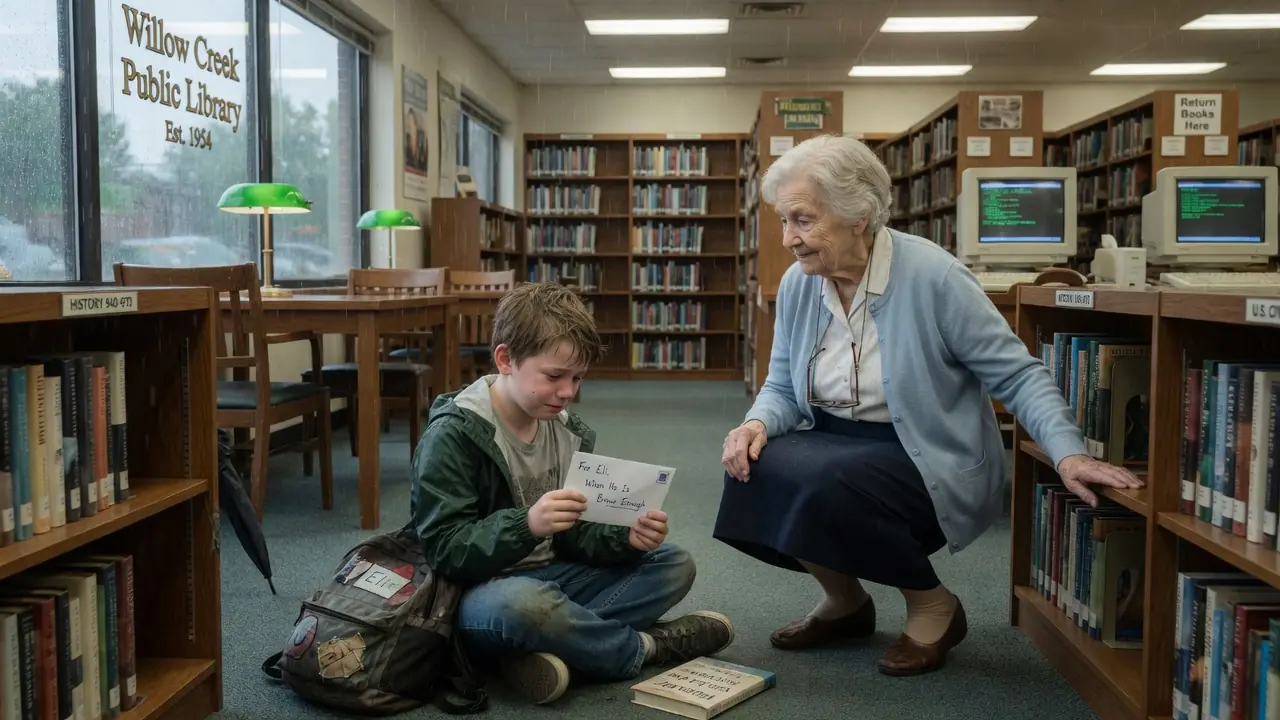
“You saved me,” he whispered.
“No,” Ruth said. “Your mother told you to find someone kind. I was just lucky enough to be sitting near the books.”
He shook his head. “You helped me read her last words.”
“And you lived them.”
Eli called every Sunday. He sent articles he wrote, postcards from internships, and once, a photo of himself standing outside a newspaper office with the caption: I got the job.
Ruth printed it and taped it behind the library desk.
But as Eli’s life grew wider, Ruth’s world grew smaller.
The library budget was cut. Then cut again. The town council said the building was too old, too expensive, and too empty. They planned to sell it to a developer who wanted to turn it into office space.
Ruth attended the council meeting in her best blue coat.
“This library still matters,” she said.
A councilman sighed. “Mrs. Callahan, we respect your years of service, but attendance is down. The town has to make practical choices.”
Practical.
Ruth hated that word when people used it to bury beautiful things.
She went home that night, placed her keys on the kitchen table, and sat in silence. George’s photo smiled from the mantel. The house felt colder than usual.
She did not tell Eli.
But Brian did.
Three days later, Eli arrived in Willow Creek.
He was twenty-seven now, tall and serious, with kind eyes and a reporter’s notebook in his coat pocket. He walked into the library just as Ruth was shelving books in the children’s corner.
“You should have called me,” he said.
Ruth turned, startled. “Eli?”
He crossed the room and hugged her.
“What are you doing here?”
“Saving the place that saved me.”
Ruth shook her head. “This is not your burden.”
He looked at her gently. “You taught me not to let people carry heavy things alone.”
Within a week, Eli began writing.
Not one article. A series.
He interviewed children who had learned to read in that library, seniors who came for computer help, job seekers who used the internet there, mothers who brought toddlers to story hour, and adults who had found warmth there when they had nowhere else to go.
He wrote about Ruth.
Not as an old librarian fighting change, but as a woman who had spent her life making sure no one in Willow Creek felt too poor, too lonely, or too broken to walk through a door.
The first article was titled:
The Library That Helped A Boy Read His Mother’s Last Letter
It spread through the town faster than Ruth expected.
People came back.
At first, out of nostalgia. Then with purpose.
Former students donated books. Parents organized story hours. A retired contractor inspected the roof for free. Teachers volunteered tutoring time. A local business owner offered funding for new computers. The town council suddenly faced a room full of residents asking why a building that still served the heart of the town was being treated like dead weight.
At the next council meeting, Eli stood at the podium.
He placed his mother’s old letter on the wood in front of him.
“When I was ten,” he said, “I came to this library because I could not read the last letter my mother left me without falling apart. Ruth Callahan sat on the floor beside me and helped me face every word. Then she fed me her dinner and gave me a place to grieve. This building is not just shelves and walls. It is where people learn they are not alone.”
Ruth sat in the front row, crying silently.
The vote changed.
The town did not sell the library.
Instead, with donations and grants Eli helped secure, the building was restored and renamed:
The Callahan Community Library
Beneath the new sign were the words:
Be Brave, But Do Not Be Alone.
The phrase came from Grace’s letter.
Ruth could barely look at it without tears.
On reopening day, children filled the reading corner. New lights brightened the shelves. The old tables had been repaired. A small food pantry stood near the entrance for families who needed help. A quiet room was created for grief support groups, with soft chairs, tissues, and a shelf of books about loss and healing.
Eli handed Ruth a small brass key.
“What is this?” she asked.
“The first key to the restored library.”
“I already had a key.”
“This one is different.”
On the back, engraved carefully, were the words:
For Helping Me Read My Way Home.
Ruth pressed it to her chest.
Years later, Eli became a respected journalist, known for stories about forgotten people and overlooked places. Whenever someone asked why he wrote the way he did, he told them about a librarian who sat on the floor with a grieving boy and taught him that words could hurt, heal, and hold a person together.
Ruth lived long enough to see the library become full again.
She no longer opened it every morning. Younger staff did that now. But every Thursday afternoon, she sat in the children’s corner and listened to kids read aloud. Some struggled over words. Some raced through pages. Some only came for cocoa and a safe chair.
Ruth welcomed them all.
One rainy Tuesday, many years after she first found Eli crying between the shelves, a little girl came into the library holding a wrinkled paper.
“My teacher said I have to read this,” the girl whispered. “But the words are hard.”
Ruth smiled and patted the chair beside her.
“Hard words are easier when two people face them together.”
Across the room, Eli stood near the entrance, visiting from Chicago. He heard the sentence and stopped.
For a moment, he was ten again, holding his mother’s letter, afraid the words would break him.
Then he saw Ruth lean close to the little girl, patient and kind, and understood something fully.
Ruth had not only helped him read one letter.
She had taught him how to carry its message into the world.
And in return, he had given her library back its future.
But more than that, he had given her proof that a single act of kindness, offered quietly on a rainy afternoon, could become a light bright enough for generations of children to read by.