At seventy-seven years old, Miriam Collins hated airports.
They were too loud, too bright, and too full of people rushing as if the world would end if they walked slowly.
The announcements echoed overhead until every gate sounded the same.
Rolling suitcases clicked against the floor. Children cried. Coffee shops smelled burnt. And everywhere, people stared at glowing screens instead of one another.
Still, that snowy December afternoon, Miriam sat at Gate B14 of Minneapolis–Saint Paul International Airport with a small blue suitcase by her feet and a paper cup of tea cooling in her hands.
She was flying to Denver to spend Christmas with her daughter, Anne.
At least, she was supposed to be.
A winter storm had moved across Minnesota faster than expected. Flights were delayed, then delayed again, then canceled one by one. People groaned at the screens. Families formed long lines at the airline counter. Businessmen muttered into phones. A young mother bounced a crying baby against her shoulder.
Miriam sighed and adjusted the knitted scarf around her neck.
Her late husband, Henry, had loved airports. He used to say they were proof that people still believed in arrivals. Miriam used to roll her eyes and tell him he made everything sound like a church sermon.
Henry had been gone for nine years.
Since then, travel felt less like adventure and more like being reminded that she was old, slow, and alone.
She checked her phone. Anne had sent another message.
Mom, are you okay?
Miriam typed carefully.
I’m fine. Flight canceled. Waiting in line soon. Don’t worry.
Then she looked up.
That was when she saw the boy.
He stood near the windows, away from the crowd, holding a small black backpack against his chest. He looked about ten years old, with dark blond hair, pale cheeks, and a red sweatshirt under a thin winter jacket. His eyes moved from the departure screen to the airline counter, then to the families around him.
He was trying very hard not to cry.
Miriam watched him for a moment.
No adult stood near him.
No parent touched his shoulder.
No older sibling called his name.
He simply stood there, frozen in the middle of a storm of strangers.
Miriam slowly rose from her seat and walked toward him.
“Excuse me, sweetheart,” she said gently. “Are you waiting for someone?”
The boy flinched and turned.
“I’m fine.”
Miriam nodded. “That is what many people say at airports when they are absolutely not fine.”
He stared at her.
She smiled softly. “My name is Miriam Collins.”
He hesitated.
“I’m not supposed to talk to strangers,” he said.
“That is a very good rule.”
“Then why are you talking to me?”
“Because sometimes a safe stranger helps you find the person who is not a stranger.”
The boy looked toward the counter again.
“What’s your name?” Miriam asked.
After a pause, he said, “Lucas.”
“Lucas what?”
“Lucas Reed.”
“Lucas Reed,” Miriam said. “Are you traveling alone?”
He nodded, then quickly added, “I’ve done it before.”
“I believe you.”
“My mom put me on the plane in Chicago. My dad was supposed to meet me in Denver.”
Miriam’s heart tightened. “And your flight was canceled?”
He nodded again.
“Have you spoken to your parents?”
“My phone died.”
He held up a small phone with a black screen.
Miriam looked around. Hundreds of people moved through the terminal, but no one seemed to notice the child stranded beside the window.
“Did an airline employee help you?”
Lucas swallowed. “The lady said to wait here. Then she went to help another family.”
“How long ago?”
He shrugged.
Miriam knew that shrug. Children used it when time felt too long to measure.
“All right,” she said. “Let’s solve one thing at a time. First, we charge your phone or call your parents from mine.”
Lucas’s eyes filled with relief so quickly he looked embarrassed by it.
“I know my mom’s number,” he said.
Miriam handed him her phone.
His fingers shook as he dialed.
The call connected after two rings.
“Mom?” Lucas said.
Even from where Miriam stood, she heard the panic in the woman’s voice.
Lucas’s face crumpled. “My flight got canceled. My phone died. I’m at the gate. I’m okay.”
Miriam gently held out her hand, and Lucas gave her the phone.
“Mrs. Reed?” Miriam said. “My name is Miriam Collins. I’m at Gate B14 with Lucas. He is safe.”
The woman on the phone began crying. “Oh, thank God. I’ve been calling the airline for forty minutes. They said someone would check on him, but no one called back. His father is already in Denver waiting.”
“He’s safe with me for the moment,” Miriam said. “We will go to the airline counter together.”
“Please don’t leave him.”
Miriam looked at Lucas, who was wiping his face with his sleeve.
“I won’t.”
After she hung up, Lucas whispered, “Is Mom mad?”
“No,” Miriam said. “She is scared because she loves you.”
He nodded, but his chin trembled.
The line at the airline counter was long and tense. Miriam stood beside Lucas for nearly an hour. People complained around them, but she kept one hand lightly on the handle of her suitcase and the other close enough that Lucas could reach for her if he needed to.
He did not reach.
But he stayed very close.
When they finally reached the counter, the exhausted airline employee looked at Miriam first.
“My grandson’s flight to Denver was canceled,” Miriam said.
Lucas looked up at her quickly.
She gave him a tiny nod.
Sometimes language made things simpler.
The employee typed into the computer, frowning. “He’s listed as an unaccompanied minor. We were trying to locate staff to escort him to the service desk.”
“He has been standing alone at the gate,” Miriam said, her voice calm but firm. “That should not happen.”
The employee’s face flushed. “I’m sorry. It’s been chaotic.”
“Chaos is not an adult. It cannot be responsible for a child.”
The employee had no answer.
There were no flights to Denver until the next afternoon. The airline could place Lucas in a supervised waiting area, but because of the storm, staffing was limited and the room was crowded with other stranded minors.
Lucas’s face went pale.
Miriam saw it.
She thought of Anne in Denver, waiting. She thought of her own aching knees, her canceled flight, the hotel voucher in her hand, and the fact that she had spent years wondering whether she still mattered to anyone beyond holiday phone calls and birthday cards.
Then she looked at Lucas.
“I will stay with him,” she said.
The employee blinked. “Ma’am?”
“I am also going to Denver. Put us on the same flight tomorrow. If his parents approve, I will remain with him until boarding.”
Lucas stared at her.
The airline made calls. His mother agreed tearfully. His father agreed from Denver, sounding shaken and grateful. Forms were noted. Staff were informed. Miriam received a hotel voucher near the airport and insisted Lucas receive one too, but the airline said he could not stay in a hotel room without an authorized adult.
Miriam asked, “Then authorize me.”
More calls.
More waiting.
More paperwork.
Finally, arrangements were made. Lucas would remain in Miriam’s care overnight with airline approval and parental consent, with check-ins documented by staff.
Miriam had not expected to become responsible for a child at seventy-seven.
But life rarely asked permission before placing someone in your path.
At the airport hotel, Miriam ordered tomato soup, grilled cheese, and hot chocolate from the restaurant. Lucas sat across from her, still gripping his backpack.
“I can pay you back,” he said.
Miriam smiled. “With what?”
He looked down. “I have twelve dollars.”
“Keep it.”
“I don’t like owing people.”
“Neither do I,” Miriam said. “But sometimes help is not a debt. Sometimes it is just help.”
He stirred his soup. “My dad says people always want something.”
Miriam looked at him carefully. “Do you believe that?”
Lucas shrugged. “My parents got divorced last year. They fight about everything. Flights, money, holidays, who forgot what. Everyone wants something.”
Miriam’s face softened.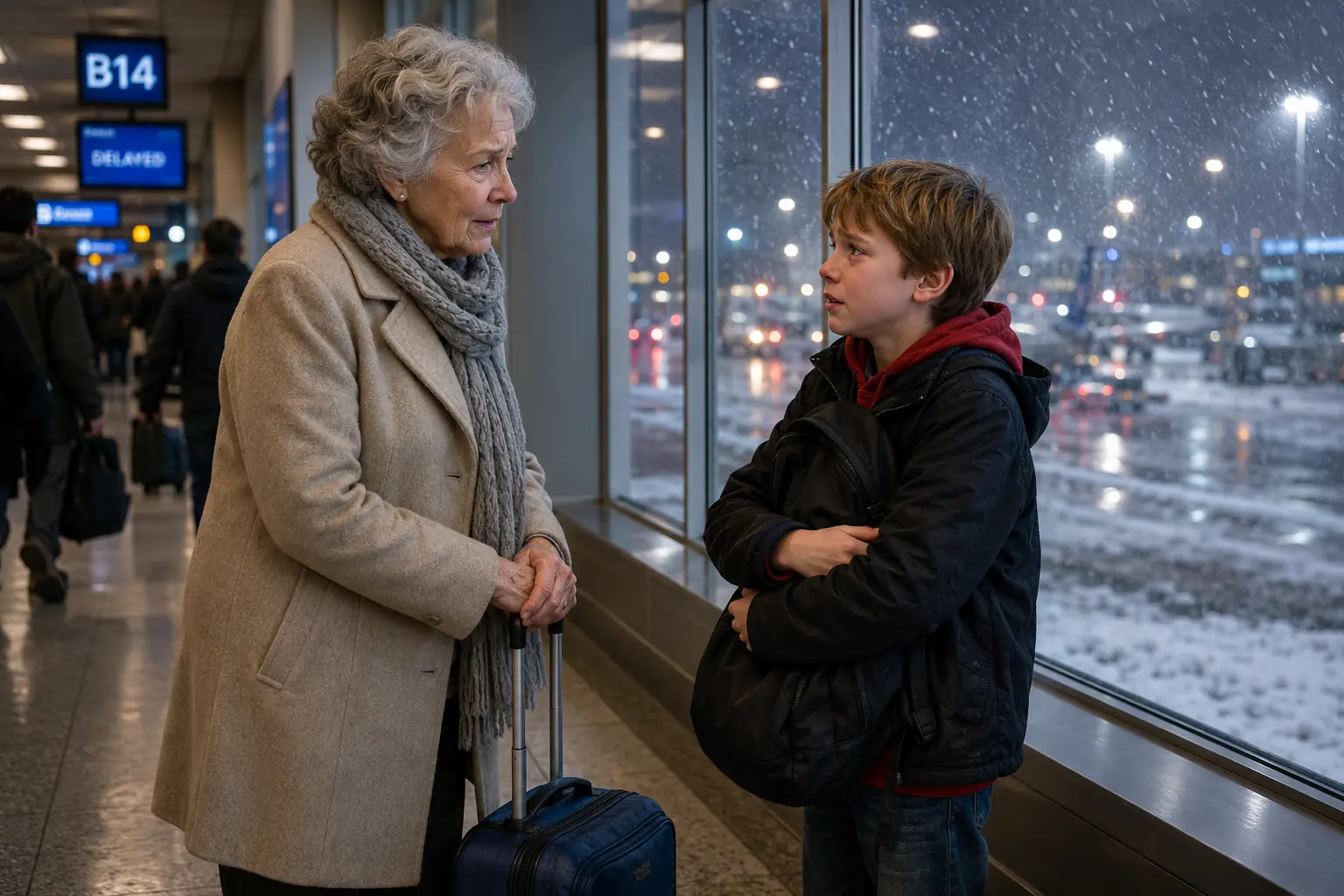
“Divorce can make children feel like luggage,” she said. “Moved from one place to another while adults argue about the handling.”
Lucas looked up, surprised. “Yeah.”
“My parents divorced when I was young,” Miriam said. “A long time ago, when people whispered about such things. I remember carrying a little suitcase between houses and wondering why adults called it visiting when it felt like being delivered.”
Lucas stared at her.
“What helped?” he asked.
Miriam thought of her grandmother, who had met her at the train station every summer with sandwiches wrapped in wax paper and never once made her feel like a burden.
“My grandmother,” she said. “She always acted like my arrival was the best part of her day.”
Lucas looked into his soup.
“My grandma died when I was six.”
“I’m sorry.”
“She made pancakes with blueberries.”
“Then she had excellent judgment.”
He smiled a little.
That night, Miriam slept lightly in one hotel bed while Lucas slept in the other, his backpack on the pillow beside him. Before turning off the lamp, he looked across the room.
“Mrs. Collins?”
“Yes?”
“Are you still going to be here when I wake up?”
The question pierced her.
“Yes,” she said softly. “I promise.”
He was quiet for a moment.
“Adults promise a lot.”
“I know.”
“Do you keep promises?”
“I try very hard.”
In the morning, she was still there.
They ate breakfast in the hotel lobby. Lucas called his mother and father. Miriam spoke to both parents, gently but firmly reminding them that Lucas was frightened and needed calm voices more than explanations of blame.
At noon, they returned to the airport. Their flight was delayed twice, but not canceled. Miriam bought Lucas a book about airplanes from a gift shop and pretended she had accidentally purchased two snacks instead of one.
He saw through the lie.
He ate the pretzels anyway.
On the plane, Lucas sat by the window and Miriam sat beside him. As the aircraft rose above the storm clouds, sunlight flooded the cabin.
Lucas pressed his face to the glass.
“It’s bright up here,” he whispered.
“It often is,” Miriam said. “Storms look different from above.”
He thought about that for a long time.
When they landed in Denver, his father was waiting at the gate, pale with worry. He rushed forward and hugged Lucas tightly.
Then his mother appeared a few minutes later, having taken the first flight she could from Chicago after the storm cleared. For one awkward moment, both parents stood on either side of Lucas, unsure how to share the same space.
Miriam looked at them.
“This boy had a hard night,” she said quietly. “Do not make him carry yours too.”
Both parents went still.
Lucas looked up at her.
His mother began to cry. His father lowered his head.
“You’re right,” his father said.
His mother wiped her eyes. “We’re sorry.”
Lucas did not say anything, but he leaned against both of them when they hugged him together.
Before leaving, he turned back to Miriam.
“Will I ever see you again?”
Miriam smiled, though her throat tightened. “That depends. Do you write letters?”
He nodded.
“Then yes.”
He hugged her around the waist.
It was quick, fierce, and full of things he did not know how to say.
Letters began the next week.
At first, they were short.
Dear Mrs. Collins, I got home okay. Dad didn’t yell at Mom at the airport. Thank you for the airplane book. Lucas.
Miriam wrote back on cream stationery.
Dear Lucas, I am very glad you got home. Remember, storms look different from above. Mrs. Collins.
Soon, the letters became longer.
Lucas wrote about school, about moving between houses, about missing his grandmother, about feeling tired of being “the schedule.” Miriam wrote about Henry, her garden, her daughter in Denver, and how courage did not always feel brave while it was happening.
After a year, Lucas began calling her Grandma Miriam.
The first time he wrote it, he added in parentheses:
Only if that is okay.
Miriam held the letter to her chest and cried.
She wrote back:
It is more than okay.
Years passed.
Lucas grew from a nervous boy into a thoughtful teenager. His parents slowly learned to speak to each other without turning every conversation into a storm. They were never friends exactly, but they became better at being parents. Miriam received school photos, graduation announcements, birthday cards, and once a very serious essay Lucas wrote about aviation safety and unaccompanied minors.
He became fascinated with airports—not because of the fear he had felt, but because of what should have happened differently.
“No child should get lost in a system built to move people,” he told Miriam when he was sixteen.
“That sounds like the beginning of important work,” she said.
“It sounds like a complaint.”
“Many important works begin as complaints.”
Lucas laughed.
He studied engineering, then transportation design, then aviation operations. He became determined to improve passenger care systems for children, elderly travelers, and people who needed assistance during disruptions. He said airports should not depend on luck and kind strangers to keep vulnerable people safe.
Miriam bragged about him to everyone.
“My Lucas is going to fix airports,” she would say at church.
People smiled politely, unsure what that meant.
Lucas meant it.
But while his life moved forward, Miriam’s began to slow.
Her knees worsened. Her eyesight dimmed. Travel became harder. Anne still lived in Denver and still wanted her to move closer, but Miriam refused because her little house in Minneapolis held Henry’s books, Henry’s chair, the maple tree they had planted together, and every letter Lucas had ever sent tied in bundles with blue ribbon.
Then, when Miriam was eighty-six, she fell on her front steps after an ice storm.
She broke her wrist and bruised her hip.
Lucas found out from Anne.
He arrived two days later.
Miriam was sitting in her living room with a blanket over her knees when he walked in. He was twenty-five now, tall, composed, with kind eyes and a travel bag slung over one shoulder.
She blinked at him.
“Lucas Reed,” she said. “You are supposed to be in Seattle.”
“I was.”
“You flew here because of a wrist?”
“I flew here because Grandma Miriam fell and tried to make it sound like a weather inconvenience.”
She looked toward Anne, who stood behind him.
“My daughter talks too much.”
Anne smiled. “Only when necessary.”
Lucas sat beside Miriam and took her good hand.
“You should have called me.”
“You have work.”
“You are work.”
“That is not flattering.”
He laughed softly, then grew serious.
The house needed repairs. The porch steps were unsafe. The heating system was unreliable. Miriam could no longer shovel snow or drive easily. Anne wanted her to move, but Miriam did not want to lose the life she had built.
Lucas listened to everyone.
Then he made a plan.
He arranged for the porch to be rebuilt with safer steps and railings. He organized grocery deliveries, medical transport, and a local snow removal service. Anne helped with finances. Neighbors from church volunteered check-ins. Miriam complained about being “managed like cargo,” and Lucas replied that cargo did not receive homemade soup.
But he had one more surprise.
Six months later, he invited Miriam to the airport.
“Absolutely not,” she said.
“You don’t even know why.”
“I know it involves an airport.”
“It does.”
“I hate airports.”
“I know.”
“Then why are you taking me?”
“Because this one owes you something.”
She narrowed her eyes. “Airports do not owe people.”
“This one does.”
At Minneapolis–Saint Paul, Lucas escorted her through the terminal slowly. But this time, the noise felt different. Staff greeted Lucas warmly. A manager shook Miriam’s hand. They led her to a bright room near the family assistance desk.
Above the doorway was a new sign:
THE MIRIAM COLLINS CARE ROOM
For Children, Elders, And Travelers Who Should Never Wait Alone.
Miriam stopped walking.
“What is this?” she whispered.
Lucas stood beside her.
“A new assistance center for stranded minors, elderly travelers, and anyone separated from support during delays or cancellations. Staffed. Documented. Comfortable. Visible. No child standing forgotten at a gate. No older traveler sleeping in a chair with nowhere to go.”
Miriam’s eyes filled.
“No.”
“Yes.”
“My name should not be on a room.”
“It should be on this one.”
Inside were soft chairs, charging stations, snacks, blankets, children’s books, a quiet phone area, and a wall display explaining the new traveler support program Lucas had helped design.
On the wall hung a framed copy of the first letter he ever sent her.
Dear Mrs. Collins, I got home okay...
Miriam covered her mouth.
Lucas’s voice trembled. “I built this because of you. You noticed me when everyone else was busy. You helped me call my mother. You stood in line. You stayed overnight. You kept your promise. You showed me what the system failed to do.”
She turned to him, crying.
“I was just an old woman with a canceled flight.”
“You were my safe arrival.”
During the small dedication ceremony, Lucas spoke.
“When I was ten, I was stranded in this airport during a snowstorm. My phone was dead, my flight was canceled, and I was alone at the gate. Miriam Collins did not walk past me. She became my advocate, my protector, and eventually my grandmother in every way that mattered.”
Miriam bowed her head.
“This room exists so care does not depend on chance,” Lucas continued. “It exists because one woman taught me that vulnerable travelers do not need pity. They need someone to stay.”
Years later, Miriam visited the care room often, even though she still claimed to hate airports.
She sat in one of the soft chairs while Lucas, now a leader in passenger support design, showed her how the program had expanded to other airports. Children colored at tables while waiting for parents. Elderly travelers rested with tea and assistance. Staff checked on people before panic could swallow them.
One snowy afternoon, a little boy sat near the window, clutching a backpack, tears in his eyes.
Miriam leaned over gently.
“Are you waiting for someone?”
He nodded.
“Would you like to borrow my phone?”
The boy looked at her.
“I’m not supposed to talk to strangers.”
Miriam smiled softly.
“That is a very good rule.”
Across the room, Lucas heard her and smiled through tears.
Long ago, she had helped one frightened child through one night in an airport.
She had thought it was a small thing.
A phone call.
A grilled cheese sandwich.
A promise kept until morning.
But that small thing became letters.
Letters became family.
Family became a mission.
And the boy she once stayed beside grew into a man who made sure thousands of travelers would never again have to stand alone in the middle of a storm, waiting for someone to notice.