At seventy-six, Grace Holloway still walked to the post office every Friday morning.
It was not because she had many letters to send. Most weeks, she only mailed a bill, picked up a church bulletin, or bought stamps she did not really need. But the walk gave shape to her days.
It took her past the little bakery on Main Street, past the library where children still pressed paper leaves onto the windows in autumn, and past the old fountain where her husband, Robert, had once proposed with trembling hands and a ring too small for her finger.
Robert had been gone eleven years.
Their son lived in Oregon now. Their daughter lived in Atlanta. Both called, both loved her, both worried, but neither could fill the silence of the white house on Elm Street where Grace still lived alone.
So she walked.
That Friday in late September, the morning had begun bright, but by noon the sky over Lancaster, Pennsylvania, had turned heavy and gray. A cold wind pushed dry leaves along the sidewalk. Store owners pulled signs closer to their doors. Mothers hurried children across crosswalks. Somewhere in the distance, thunder rolled low over the town.
Grace had just stepped out of the post office when she saw the boy.
He was standing beside the old fountain, turning in small circles.
He looked about seven years old, with sandy blond hair, pale cheeks, and a blue jacket zipped crookedly to his chin. His backpack was shaped like a dinosaur, one green strap twisted over his shoulder. He held a folded paper in one hand and kept looking from the street signs to the crowd, his face growing more frightened each second.
Grace stopped.
People passed around him.
No one seemed to notice that the child was trying very hard not to cry.
Grace walked toward him slowly.
“Hello, sweetheart,” she said gently. “Are you all right?”
The boy looked up fast. “I’m not lost.”
Grace nodded. “That’s good.”
“I know where I am.”
“Even better.”
His chin trembled.
Grace softened her voice. “Do you know where your grown-up is?”
The boy looked at the street behind him, then down at the paper in his hand.
“My mom was at the clinic.”
“Which clinic?”
He pointed vaguely toward the far end of Main Street. “The one with the red door.”
Grace knew it. A small urgent care office near the pharmacy.
“And how did you get here?”
The boy swallowed. “I followed the wrong lady.”
Grace’s heart tightened.
He spoke quickly, as if confessing before being scolded. “She had a yellow coat like Mom’s, and I thought it was her, but then she crossed the street, and it wasn’t her, and then I couldn’t see the clinic anymore.”
Grace crouched carefully, one hand on the edge of the fountain to steady her knees.
“What is your name?”
“Ben.”
“Ben what?”
“Ben Carter.”
“I’m Grace Holloway.”
“I’m not supposed to talk to strangers.”
“That is a very good rule.”
“Then why are you talking to me?”
Grace almost smiled. “Because sometimes a stranger can help you find the person who is not a stranger.”
Ben studied her face. “Are you a grandma?”
“I am, though my grandchildren live far away.”
“My grandma died.”
“I’m sorry.”
He nodded seriously, as if accepting something adults often said.
The first raindrop hit the fountain beside them.
Ben looked up.
Thunder rolled again, closer this time.
Grace stood slowly. “We need to get out of the rain and call your mother.”
Ben immediately stepped back. “No. Mom said stay where she can find me.”
“And that was a good instruction. But rain is coming hard, and we will not go far. See that bakery?” She pointed across the street. “We’ll stand right inside the door where we can still see the fountain. Then I’ll ask the owner to call the clinic.”
Ben looked uncertain.
Grace did not reach for him. She did not touch his arm. She only stepped aside and waited.
Rain began to fall faster.
Ben finally nodded.
They crossed carefully and entered Miller’s Bakery just as the storm opened.
Warm air wrapped around them, carrying the smell of bread, sugar, and cinnamon. Ben stood on the mat, dripping rain onto the floor, eyes fixed through the window on the fountain.
Grace turned to the young woman behind the counter. “Lydia, this little boy got separated from his mother near the clinic. May I use your phone?”
Lydia’s expression changed immediately. “Of course.”
Grace called the red-door clinic. A receptionist answered. Yes, a woman named Emily Carter had come in with severe dizziness and chest pain. Yes, she had a young son with her. No, they had not realized he was missing because Emily had been moved quickly for testing and thought he was in the waiting room with a nurse.
Within seconds, the clinic was in panic.
Grace kept her voice calm.
“He is safe at Miller’s Bakery. He can see the fountain. I will stay with him until someone comes.”
When Grace hung up, Ben was staring at her.
“Is Mom mad?”
“No, sweetheart. She is worried.”
“Is she sick?”
Grace hesitated. “She needed doctors to check her. But she knows where you are now.”
Ben’s face tightened. “She gets tired a lot.”
Grace’s heart ached. “Does she?”
He nodded. “She works nights. Sometimes she forgets to eat. I tell her to eat, but she says moms don’t need much.”
Grace looked at his little serious face and felt a wave of sadness.
Children noticed everything.
Lydia brought over a small cup of warm milk and a roll.
Ben looked at it, then at Grace.
“I don’t have money.”
Grace smiled gently. “I didn’t ask for money.”
He frowned. “People keep saying that.”
“Maybe today you needed to hear it more than once.”
He took the roll carefully.
When Emily Carter arrived ten minutes later, she came with a nurse holding an umbrella over her head. She was thirty-two, thin and pale, wearing a yellow coat soaked at the sleeves. Her face was filled with terror. The moment she saw Ben, she dropped to her knees.
“Ben.”
He ran into her arms.
“I followed the wrong lady,” he cried. “I’m sorry.”
“No, baby. No.” Emily held him tightly, shaking. “I’m sorry. I should have kept you closer.”
Grace looked away, giving them privacy.
The nurse explained softly that Emily had nearly fainted at the clinic and needed further testing. She should not be walking around in the storm. She should be at the hospital for evaluation, but Emily had refused because she could not leave Ben alone.
Grace listened.
Then she said, “I’ll go with you.”
Emily looked up. “What?”
“To the hospital. I’ll sit with Ben while you’re seen.”
“No, Mrs. Holloway, you’ve already done enough.”
“I have done the beginning. Not enough.”
Emily’s eyes filled. “I don’t even know you.”
Grace looked down at Ben, who was still clinging to his mother.
“That can change.”
At the hospital, Grace sat with Ben in the waiting area while Emily was examined. She bought him soup from the cafeteria and helped him draw dinosaurs on the back of old receipts from her purse. He told her his mother worked at a nursing home laundry department and sometimes cleaned offices on weekends. His father was “not around.” His grandmother had helped them before she died the previous winter.
“Mom says we’re okay,” Ben said. “But she cries when she thinks I’m asleep.”
Grace folded the receipt carefully. “Sometimes grown-ups cry because they are tired, not because they don’t love you.”
“I know she loves me.”
“I know too.”
Emily was diagnosed with severe anemia and exhaustion made worse by stress and poor nutrition. She needed treatment, rest, and follow-up care. The doctor spoke gently but firmly. If she kept living the way she had been living, she would collapse again.
Emily cried quietly when she heard that.
“I can’t just rest,” she whispered. “Rent won’t wait because I’m tired.”
Grace sat beside her bed and took her hand.
“Then we will make a plan.”
Emily shook her head. “There is no we.”
Grace smiled softly. “There is now.”
That was how Grace Holloway became part of their lives.
At first, she helped with simple things. She drove Emily to appointments. She watched Ben after school while Emily worked shorter shifts. She brought soup, groceries, and iron-rich meals that Emily insisted were too much.
Grace never called it charity.
She called it “extra.”
“I made extra stew.”
“I bought extra apples.”
“I have extra time.”
Ben believed this for about two weeks.
Then he said, “You always have extra.”
Grace laughed. “I am a suspicious woman.”
Emily recovered slowly. Color returned to her cheeks. Ben stopped watching her with constant fear. He began spending afternoons at Grace’s house, doing homework at the kitchen table where Grace’s own children had once sat.
He loved the old house immediately.
He loved the creaky stairs, the attic full of dusty boxes, the back garden where Robert had once grown tomatoes, and the little workshop where Grace kept jars of buttons, thread, glue, old tools, and things she refused to throw away.
One afternoon, Ben found a broken wooden birdhouse in the shed.
“Can we fix it?” he asked.
Grace looked at the crooked roof and cracked base. “We can try.”
Together, they sanded it, glued it, painted it blue, and hung it from the maple tree in the backyard. No bird moved in for weeks, but Ben checked every day.
When a sparrow finally appeared, he ran into the kitchen shouting, “Someone came home!”
Grace laughed until tears filled her eyes.
Years passed in small, beautiful pieces.
Emily found steadier work as a receptionist at a physical therapy clinic. She moved into a better apartment closer to Grace. Ben grew from a frightened little boy into a thoughtful teenager with a talent for building things. He repaired loose cabinet handles, fixed Grace’s garden gate, built shelves in her pantry, and once constructed an elaborate birdhouse village that Grace called “excessive architecture.”
At fourteen, he told Grace he wanted to become an architect.
“Not for rich people,” he said. “For families who need safe homes.”
Grace looked at him across the garden table. “That sounds like a calling.”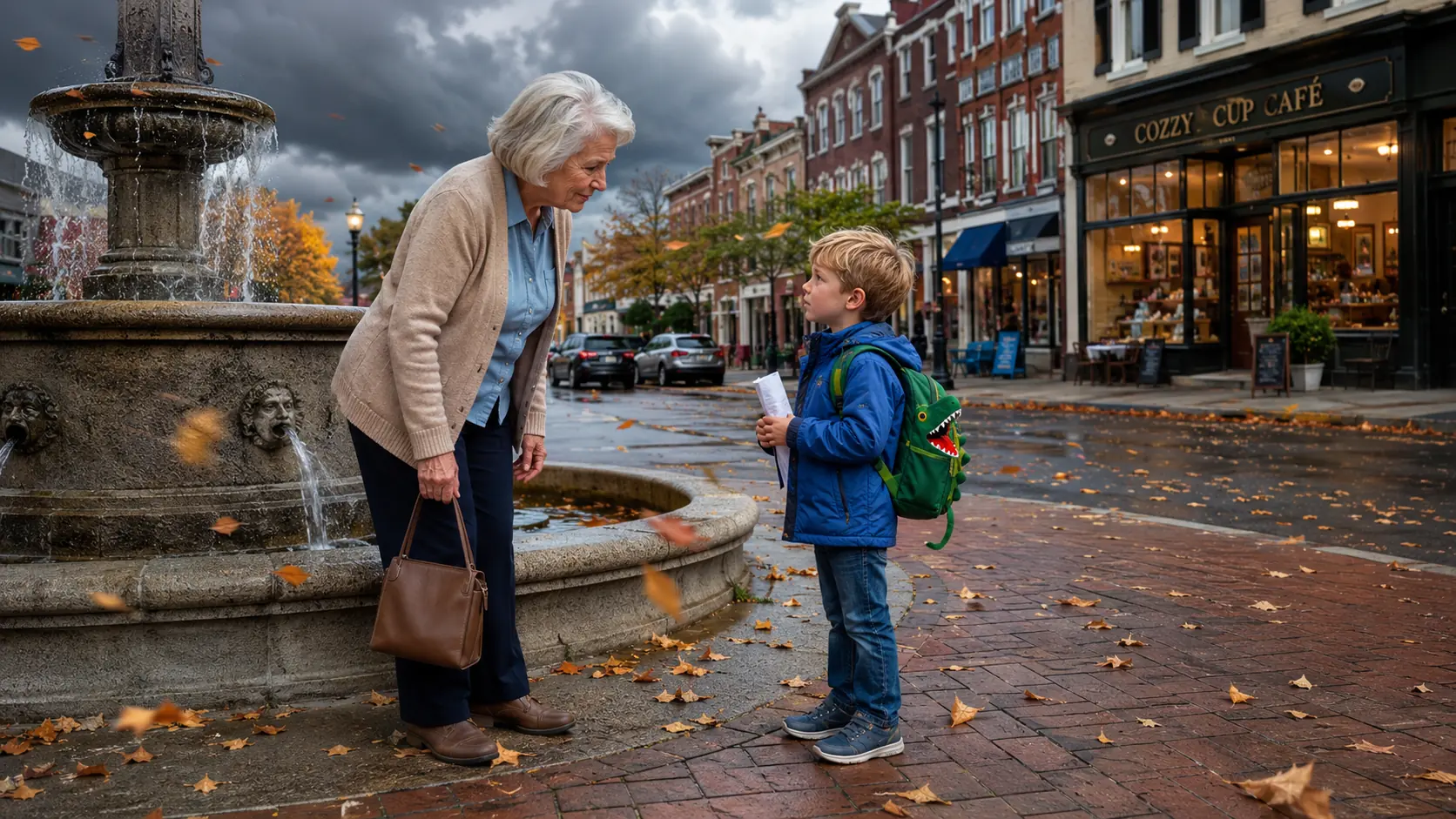
“It sounds expensive.”
“Most callings are.”
He smiled.
Grace helped him however she could. She bought used books about design. She drove him to a summer program two towns over. She sat through his school presentations and clapped louder than anyone, even when Ben turned red and whispered, “Grace, please.”
He never called her Mrs. Holloway after the first year.
Sometimes he called her Grace.
Sometimes, when he was tired or emotional, he called her Grandma Grace.
She never corrected him.
When Ben graduated high school, Grace sat beside Emily in the front row. He received a scholarship to study architecture at Penn State. After the ceremony, he handed Grace a small wooden birdhouse he had built himself.
On the bottom, he had carved:
FOR THE FIRST HOME WE FIXED TOGETHER.
Grace held it against her chest.
“I’ll pay you back one day,” Ben said.
Grace smiled. “For what? Warm milk and a roll?”
“For staying.”
She touched his cheek gently. “Then build something good.”
He did.
College led to internships. Internships led to community housing projects. Ben became known for designing small, affordable homes that felt dignified instead of temporary. He focused on seniors, single parents, and families recovering from crisis. He said every house should have light, storage, safety, and at least one corner that made a person feel they belonged.
Grace told everyone she met, “My Ben builds homes.”
Nobody corrected her.
But Grace was growing older.
Her house on Elm Street, once full of memory, began needing repairs faster than she could manage. The roof leaked near the attic. The porch railing loosened. The heating system groaned through winter. Her pension stretched thin between medicine, taxes, and repairs.
Her children urged her to sell.
“Mom, it’s too much house,” her daughter said gently over the phone.
Grace looked out at the maple tree where the blue birdhouse still hung, faded but standing.
“It’s not too much,” she said.
But some nights, alone in the kitchen, she wondered if she was wrong.
Then one spring storm, a heavy branch fell and damaged the back porch. The repair estimate was more than she could afford.
Grace cried that night, quietly, angrily, with the kitchen lights off.
She did not tell Ben.
Emily did.
Three days later, Ben appeared at her front door.
He was twenty-eight now, tall, calm, with kind eyes and rolled blueprints under his arm. Rain glistened on his coat, just like the day Grace first met him near the fountain.
She opened the door and sighed. “Emily talks too much.”
Ben smiled. “She talks exactly enough.”
“I’m fine.”
“No, you’re not.”
“I dislike architects who argue.”
“You helped raise one.”
He stepped inside and unrolled the blueprints on her kitchen table.
Grace frowned. “What is this?”
“Your house.”
“I can see that.”
“Your house after we repair it.”
She looked closer.
The drawings showed the roof restored, the porch rebuilt, the stairs made safer, a downstairs bathroom added, the kitchen opened slightly, and the back garden redesigned with raised beds, benches, and a small studio workshop.
Grace stared. “Ben…”
“There’s more.”
He turned another page.
The garage, unused for years, would become a small community workshop where children and seniors could build things together: birdhouses, shelves, garden boxes, repair projects. The program would partner with the library and local family services. Children who needed mentorship could come. Seniors who needed help with small repairs could request it. Grace would not manage it alone, but she would be its heart.
At the top of the page was a sign.
GRACE HOLLOWAY HOME WORKSHOP
Helping People Build Their Way Back.
Grace covered her mouth.
“No.”
“Yes.”
“I don’t need my name on anything.”
“I know,” Ben said. “That’s why it belongs there.”
“I can’t pay for this.”
“You already did.”
She shook her head, tears forming. “I helped a lost boy find his mother.”
Ben’s voice softened. “You helped a lost boy find a life.”
The renovation began that summer.
Grace complained about everything.
The porch railing was too smooth.
The workers arrived too early.
The bathroom tile was too modern.
The raised garden beds made her feel like “an elderly exhibit.”
Ben listened, smiled, and ignored complaints that were not useful.
But he preserved every piece of memory that mattered. Robert’s fountain photo stayed in the hallway. The kitchen table remained. The maple tree was carefully protected. The old blue birdhouse was repaired and rehung.
When the workshop opened, children came first.
A shy girl with a broken dollhouse. Two brothers who wanted to build a bird feeder. A boy whose mother was in recovery and who needed somewhere safe after school. Seniors came too, bringing broken stools, loose cabinet doors, and lonely afternoons.
Grace sat at the long worktable, showing children how to sand wood gently and measure twice.
“Tools listen better when you don’t rush them,” she told them.
Ben, standing in the doorway, smiled.
On opening day, he gave a short speech despite Grace’s protests.
“When I was seven,” he said, “I got separated from my mother during a storm. Grace Holloway noticed me when everyone else walked past. She did not stop at helping me find my mother. She stayed. Through sickness, fear, homework, birdhouses, graduations, and every hard turn after. She taught me that home is not just a building. It is someone who refuses to leave you lost.”
Grace wiped her eyes.
Ben lifted the little wooden birdhouse he had made for her graduation gift.
“This was the first home we built together. This workshop is the next.”
Years later, Grace’s house no longer felt too large.
It felt full.
Children’s laughter drifted from the garage workshop. Raised beds bloomed in the garden. Emily came every Sunday with dinner. Ben visited often, sometimes in a suit from a meeting, sometimes in jeans ready to fix something. Grace’s own children visited more too, relieved that their mother was safe and surrounded.
One autumn afternoon, a little boy came into the workshop holding a broken wooden toy truck.
“My dad said it’s trash,” the boy whispered.
Grace looked at the toy, then at Ben, who stood nearby.
She smiled.
“Well,” she said, “some people don’t know what can be fixed.”
The boy looked up. “Can you help me?”
Grace patted the chair beside her.
“We can try.”
Outside, leaves moved in the wind. The maple tree stood strong, with the blue birdhouse hanging from one branch. A sparrow landed on its roof, tilted its head, then flew away.
Grace watched it go.
Long ago, she had helped a frightened boy find his mother in a storm.
She had thought it was one small act.
But kindness had become visits.
Visits became family.
Family became a calling.
And the lost boy she once led out of the rain grew into a man who made sure Grace never had to leave the house where her love still lived.
In the end, Ben did not simply save Grace’s home.
He filled it with new reasons to stay.