Dorothy Lane was seventy-seven years old and still opened the bakery before sunrise, even when her hands ached so badly that gripping a rolling pin felt like holding winter itself.
Lane’s Bakery sat on a quiet corner in Brookfield, Wisconsin, between a small barber shop and an empty storefront that used to sell children’s shoes.
The sign above the door was old, cream-colored, and edged in faded blue paint.
Lane’s Bakery
Bread, Pies, Coffee, Rolls — Since 1975
Dorothy’s husband, Martin, had painted that sign the year they opened. He had stood on a ladder in the late afternoon, brush in hand, tongue pressed to the corner of his mouth in concentration, while Dorothy stood below with a tray of cinnamon rolls and told him the word Coffee was leaning.
“It gives the sign personality,” Martin had said.
“It gives the sign poor posture,” Dorothy replied.
He had laughed so hard he nearly dropped the brush.
Martin had been gone for nine years.
But every morning, Dorothy still spoke to him.
She would unlock the back door, turn on the kitchen lights, tie on her apron, touch the old wooden worktable, and whisper, “Morning, Marty.”
Then she made dough.
Bread first.
Always bread first.
After that came cinnamon rolls, apple turnovers, lemon bars, and the pies that old customers still insisted were the best in Waukesha County. The bakery smelled of flour, butter, yeast, coffee, sugar, and years of ordinary comfort.
Once, Lane’s Bakery had been busy all day.
Factory workers stopped before dawn. Teachers came after drop-off. Children pressed their noses against the glass case after school. Families ordered birthday cakes and holiday pies. On snowy mornings, customers shook off their boots by the door and said, “Dorothy, thank God you’re open,” as if bread were a form of rescue.
But Brookfield had changed.
The factory closed. Younger families bought pastries from chain coffee shops. Grocery stores sold cheaper bread. Delivery apps made people forget sidewalks. Rent went up. Butter went up. Flour went up. Everything went up except the number of customers.
Dorothy’s son, Andrew, called from Minneapolis every Sunday.
“Mom, you could sell the bakery,” he said gently. “You’ve worked long enough.”
Dorothy always answered, “People still need bread.”
“There are other bakeries.”
“There are other sons too, but I kept you.”
Andrew would groan.
She would smile.
The truth was, she was tired.
Her wrists hurt. Her knees hurt. The oven needed repair. The back roof leaked near the flour shelves. The front window frame had started to rot. The landlord wanted to renovate the block and raise rent. Dorothy had savings, but not enough for everything.
Still, she stayed.
Because the bakery was not just a business.
It was Martin’s dream.
It was the table where they had built a life with flour on their sleeves.
It was where customers came when they needed a pie for Thanksgiving, rolls for a funeral lunch, bread for a neighbor, or coffee because the house was too quiet.
Dorothy believed food could not solve grief.
But it could sit beside it.
That mattered.
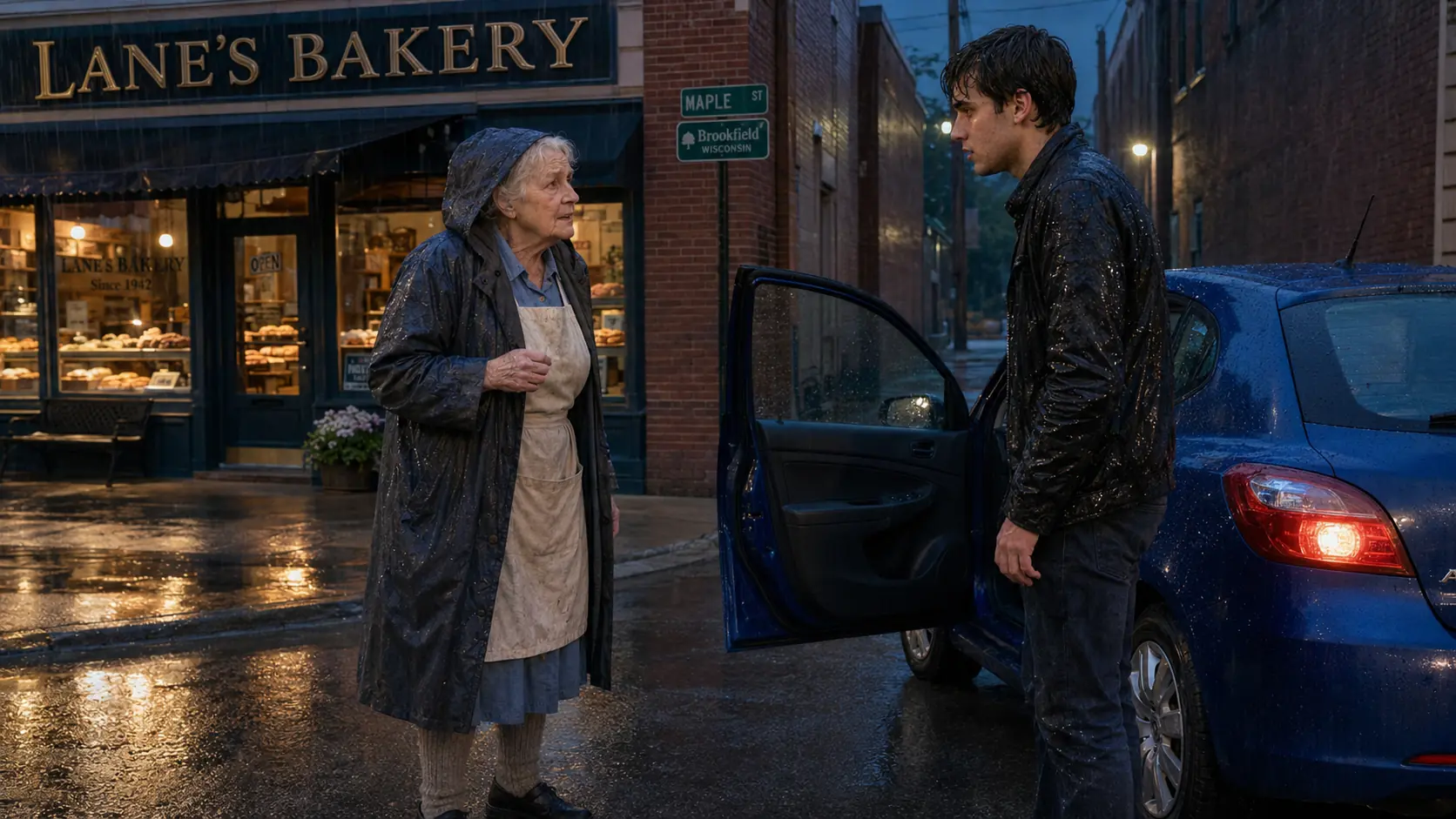
One cold April evening, rain swept through Brookfield just before closing.
It came hard and fast, blowing across the street in silver sheets, rattling the bakery windows, and sending people running under awnings. Dorothy had already sold the last loaf of sourdough and was wiping the glass case when she heard a car cough outside.
Then sputter.
Then die.
She looked through the front window.
Across the street, near the empty shoe store, a small blue car had rolled to a stop in the right lane. Its hazard lights blinked weakly through the rain. A young man stood beside it, soaked within seconds, one hand on the open hood and the other holding a phone against his ear.
He looked young.
Maybe twenty-three.
Tall, thin, with dark hair plastered to his forehead, a black jacket too light for the weather, and the kind of panic people tried to hide when they knew hiding was useless.
A truck honked behind him.
The young man waved apologetically and tried to push the car alone.
The car barely moved.
Dorothy frowned.
“Oh, for heaven’s sake.”
She grabbed her raincoat and stepped outside.
The bell above the bakery door jingled behind her as wind pushed rain into the shop.
“You’ll hurt yourself doing it that way!” she called.
The young man turned, startled.
“I’m sorry, ma’am. I’m trying to move it.”
“You’re trying badly.”
Despite the situation, he gave a shocked little laugh.
“I know.”
Dorothy crossed the street carefully, lifting her skirt slightly to avoid the deepest puddles. Cars slowed around them. Rain ran down the young man’s face.
“What’s your name?” she asked.
“Ryan.”
“Ryan what?”
“Ryan Brooks.”
“I’m Dorothy Lane.”
He glanced toward her bakery sign.
“You own the bakery?”
“I own the mess inside it.”
Another car honked.
Dorothy pointed to the steering wheel.
“You get in. Put it in neutral. I’ll push from the back.”
Ryan stared.
“No. No, ma’am. You can’t push my car.”
“I have pushed heavier things than your pride.”
“You’ll slip.”
“Then steer straight so I don’t die annoyed.”
“I can push.”
“You already failed. Get in.”
Ryan looked torn, but the honking car behind them made the decision.
He got behind the wheel.
Dorothy went to the rear bumper, planted both hands against the wet trunk, and pushed. Her shoes slipped once. Her knees protested. But Ryan pushed with one foot from the open driver’s door, and together they got the car rolling.
Slowly, painfully, they guided it across the street and into the small alley beside Lane’s Bakery.
Dorothy leaned against the trunk, breathing hard.
Ryan jumped out immediately.
“Are you okay?”
“I am old, not porcelain.”
“I’m so sorry.”
“You should be. That was a terrible parking job.”
He laughed again, but this time it broke into something close to panic.
“I don’t know what I’m going to do.”
Dorothy looked under the hood.
She did not know much about engines, but she knew enough to recognize steam, trouble, and the smell of something overheated.
“Where were you going?”
Ryan wiped rain from his eyes.
“Milwaukee. I have a job interview tomorrow morning.”
“Tomorrow?”
He nodded.
“But I was supposed to get there tonight. My cousin said I could sleep on his couch. My phone is almost dead, and the tow company said they’re backed up because of the storm.”
Dorothy looked at his car.
Then at the bakery.
Then at Ryan’s soaked jacket.
“What kind of job?”
“Apprentice electrician.” His voice tightened. “It’s not guaranteed, but if I get it, they train me. Paid work. Real work. I’ve been trying to get out of temporary jobs for two years.”
Dorothy’s expression changed.
A broken car was one thing.
A broken chance was another.
“You eaten?” she asked.
Ryan blinked.
“What?”
“Food. Did you eat?”
“This morning.”
“That is a memory, not a meal.”
“I’m fine.”
“No, you are wet and lying.”
He gave a weak smile.
Dorothy pointed toward the bakery.
“Come inside.”
“I can’t. I’m dripping.”
“It’s a bakery. Flour has survived worse.”
“I don’t want to trouble you.”
“Too late. You made me push a car in the rain. We’re practically relatives now.”
Ryan stared at her.
Then his shoulders lowered.
He followed her inside.
The bakery was warm and smelled of cinnamon, coffee, and bread. Dorothy gave him a towel, then disappeared into the back room and returned with a dry sweatshirt that had belonged to her son years ago.
“Bathroom is there. Change before you soak into the floor.”
“Dorothy, I can’t—”
“You can. I have already decided.”
When Ryan returned, wearing the oversized sweatshirt and holding his wet jacket awkwardly, Dorothy had placed a plate on the small table near the window.
Two rolls.
A bowl of chicken soup she had made for herself.
A slice of apple pie.
Ryan stared.
“I can pay you when I get cash.”
“Did I hand you a bill?”
“No.”
“Then eat before the soup gets offended.”
He sat down slowly.
At first, he ate carefully, as if one wrong bite might make the kindness disappear. Then hunger took over. Dorothy poured coffee and set it beside him.
For several minutes, the rain against the window did all the talking.
Finally, Ryan said, “This is the best soup I’ve ever had.”
“It is average soup. You are extremely hungry.”
“It’s still good.”
Dorothy sat across from him with her own coffee.
“Tell me about the interview.”
Ryan looked down at the spoon in his hand.
“It’s at a union training center. My high school counselor told me about it years ago, but I never had the confidence to apply. My mom got sick, and I helped with bills. Then she passed, and things just…” He stopped.
Dorothy did not interrupt.
“Things got messy,” he finished.
“Things often do.”
“I’ve been working warehouse shifts, delivery jobs, anything. A friend helped me fill out the application. They called last week. If I miss tomorrow, I don’t know if I’ll get another chance.”
Dorothy looked out at the rain.
“When is the interview?”
“Nine.”
“And your cousin?”
“Milwaukee. About forty minutes from here if my car worked.”
“It does not.”
“No.”
Dorothy stood and picked up the landline behind the counter.
Ryan looked up.
“What are you doing?”
“Calling Gus.”
“Who’s Gus?”
“A mechanic who owes me for three years of birthday cakes for his wife.”
She dialed from memory.
“Gus? It’s Dorothy. There’s a young man’s car dead in my alley, and he has an interview tomorrow. Yes, now. No, I don’t care if it’s raining. Bring the tow truck. And don’t tell me you’re too busy unless you want your wife to know who really forgot her anniversary cake in 2018.”
Ryan stared.
Dorothy hung up.
“He’ll come.”
“You just threatened him with cake history.”
“People should fear accurate women.”
Ryan laughed properly this time.
Gus arrived forty minutes later, soaked, grumbling, and carrying tools. He inspected the car under the alley light while Dorothy held an umbrella over absolutely the wrong part of the engine.
“Dorothy,” Gus said, “you’re blocking the light.”
“I’m keeping the rain off.”
“Off my elbow.”
“Your elbow should be grateful.”
Gus diagnosed the problem: a cracked radiator hose and a weak battery. The car could be fixed, but not tonight without parts.
Ryan’s face fell.
“I’m going to miss it.”
“No, you’re not,” Dorothy said.
He looked at her.
She pointed upstairs.
“There’s an apartment above the bakery. It was my son’s room years ago. You can sleep there tonight.”
Ryan stepped back.
“No. Dorothy, no. I can’t stay in your home.”
“You can.”
“You don’t know me.”
“I know you tried to push a car alone in the rain because you didn’t want to bother anyone. That tells me enough for one night.”
“I could sleep in the bakery chair.”
“You will sleep in a bed.”
“I can’t take that from you.”
“The bed is not currently being used by royalty.”
Gus looked between them and smiled.
“Don’t argue with her, kid. I tried once in 1996. Still recovering.”
Dorothy ignored him.
“I’ll drive you to Milwaukee in the morning.”
Ryan’s mouth opened.
Nothing came out.
Then he shook his head.
“You’ve already done too much.”
“You young people say that as if it changes anything.”
“It’s forty minutes.”
“Then we’ll leave early.”
“I don’t know how to thank you.”
“Start by getting the job.”
That night, Ryan slept in the small upstairs room above the bakery.
It had a narrow bed, a quilt, a dresser, and one window overlooking the wet street. On the wall was an old photograph of Dorothy, Martin, and a teenage boy standing behind the bakery counter, all three dusted with flour.
Ryan lay awake for a long time.
He had slept in worse places.
Couches.
Cars.
A storage room behind a warehouse.
One winter, he had slept in a bus station for two nights after his apartment situation fell apart.
But a warm room above a bakery felt unreal.
Downstairs, Dorothy washed dishes, packed leftover rolls, and placed Ryan’s wet clothes near the heater. Before going to bed, she put two sandwiches, an apple, and a small bag of cinnamon rolls into a paper sack.
Then she looked at Martin’s photograph near the register.
“Well,” she whispered, “I suppose we’re in trouble again.”
The next morning, Dorothy was downstairs by five.
The bakery ovens warmed the whole building. She made coffee, scrambled eggs, and toast. Ryan came down at five-thirty, clean, nervous, and wearing his own clothes, now dry.
“You didn’t have to make breakfast,” he said.
“Yes, I did. Interviews can smell hunger.”
He smiled.
They left at six-thirty in Dorothy’s old station wagon. Gus promised to fix Ryan’s car and leave the keys at the bakery.
The rain had stopped, but the sky was still gray. Ryan sat in the passenger seat with the paper sack of food in his lap, quiet and tense.
Dorothy glanced at him.
“You’re thinking too loudly.”
“Sorry.”
“That was not an apology request.”
He exhaled.
“What if I mess it up?”
“You might.”
Ryan looked at her.
“That’s not comforting.”
“It is honest. But you won’t mess it up by being nervous. You’ll mess it up if you pretend you don’t care.”
He looked down.
“I care too much.”
“Good. Caring is fuel. Just don’t pour it on the floor and light it.”
He laughed despite himself.
At the training center, Dorothy parked by the entrance.
Ryan sat still for a moment.
“I’ll pay you back someday,” he said.
Dorothy shook her head.
“No.”
“I mean it.”
“So do I.”
“I can’t just take this.”
“You are not taking. You are receiving. There is a difference.”
His eyes glistened.
“Why did you help me?”
Dorothy looked through the windshield at the building.
“Because Martin and I opened a bakery with one oven, one table, and no sense. Someone gave us credit for flour when the bank refused us. Someone gave us a secondhand mixer. Someone fixed our delivery van for free the first winter.” She turned to him. “No one starts alone, Ryan. People only forget who helped them.”
He nodded slowly.
“I won’t forget.”
“Good. Now go in before I start giving advice I didn’t prepare.”
He smiled, opened the door, then turned back.
“Dorothy?”
“What?”
“Thank you.”
“Get the job.”
He went inside.
Three weeks later, a letter arrived at Lane’s Bakery.
Inside was a note written in careful handwriting.
Dorothy,
I got accepted into the apprenticeship. I start next month. Gus fixed my car, and I paid him half. He said I can pay the rest after my first check, but I think that was because of you.
I still don’t know how to thank you. You gave me food, a room, a ride, and the feeling that maybe I wasn’t as alone as I thought.
I’ll come back with my first paycheck and buy every cinnamon roll in the case.
Ryan
Dorothy read the letter twice.
Then she placed it beside Martin’s photograph.
Ryan did come back.
Not with his first paycheck, but with his second, because the first had gone to rent and car repairs. He bought six cinnamon rolls, two loaves of bread, and a pie he insisted on paying full price for.
Dorothy said he was being ridiculous.
He said she should get used to it.
Over the years, Ryan returned whenever he could.
At first, just to visit.
Then to replace a broken light in the bakery kitchen.
Then to fix a faulty outlet near the coffee machine.
Then to install a safer breaker when Dorothy admitted, reluctantly, that the oven had been “acting dramatic.”
Ryan became an electrician.
A good one.
Not flashy. Not careless. He listened. He explained. He did not shame people for not understanding wires, panels, breakers, or costs. He built a reputation in Milwaukee and later opened a small electrical company called Brooks Reliable Electric.
On the wall of his office, he kept a framed note:
No One Starts Alone.
Dorothy never knew that for years.
She only knew that whenever something electrical broke, Ryan appeared with tools, coffee, and the kind of concern that annoyed her because it made her feel loved.
“I’m not helpless,” she told him once.
“I know.”
“Then stop checking my outlets.”
“Your outlets are suspicious.”
“So are young men with tool belts.”
He laughed.
As Ryan built his life, Lane’s Bakery grew weaker.
Dorothy’s ovens were old. The wiring was older. The landlord finally sold the building to a company that wanted to turn the corner into modern retail space. The new lease proposal doubled the rent and required Dorothy to pay for electrical upgrades, roof repairs, and front window replacement.
She read the letter behind the counter after closing.
The bakery was quiet.
The glass case was empty.
Martin’s photograph smiled from the shelf.
Dorothy folded the letter and placed it beneath his old recipe book.
For two weeks, she told no one.
Not Andrew.
Not Ryan.
She kept opening the bakery. Kept making bread. Kept telling herself she was only “thinking.” But Ryan noticed the second he walked in one Friday morning.
The cinnamon rolls were not in the case.
Dorothy always made cinnamon rolls on Fridays.
“What’s wrong?” he asked.
“Nothing.”
“That is the least convincing word in the English language.”
“I burned the first batch.”
“You haven’t burned cinnamon rolls since I’ve known you.”
“There is always a first time.”
Ryan looked behind the counter and saw the lease letter beneath the recipe book.
Dorothy moved too late.
“Ryan.”
He read it.
His face changed.
“They’re pushing you out.”
“They are raising rent.”
“To push you out.”
Dorothy sighed.
“Yes.”
“When were you going to tell me?”
“When I had made a decision.”
“You were going to close quietly.”
“I was going to avoid a fuss.”
“That is the same thing wearing a hat.”
She almost smiled.
Then her face softened into something tired.
“I’m old, Ryan. The bakery is old. The oven is tired. The wiring needs work. The roof leaks. Maybe it’s time.”
“Is that what you want?”
Dorothy looked around.
At the worktable.
The old oven.
The faded sign.
Martin’s photograph.
The place where she had fed half the town in one way or another.
“No,” she whispered.
Ryan nodded.
“Then we start there.”
“I don’t want charity.”
“I know.”
“I mean it.”
“I know.”
“I helped you one night. That does not make you responsible for my bakery.”
Ryan leaned forward.
“One night can be responsible for a lot.”
Dorothy looked away.
He returned three days later with a folder, his business partner, Andrew on speakerphone, and a plan Dorothy immediately distrusted.
Brooks Reliable Electric had grown enough that Ryan wanted to open a training branch for young apprentices. Not an office. A hands-on learning space where students could learn real electrical repair in old buildings, under supervision, while helping small businesses bring their spaces safely up to code.
Lane’s Bakery could become the first restoration project and the permanent home of a small morning training program. Ryan’s company would lease the unused upstairs space as an apprentice classroom and fund the electrical upgrades as part of a long-term lease. A local small-business preservation grant could help with roof repairs and window restoration. The bakery would stay open. Dorothy would remain owner. Ryan’s apprentices would buy breakfast there, learn there, and maintain the building safely.
Dorothy stared at the folder.
“You put my bakery in a folder.”
“Yes.”
“I dislike that.”
“I expected that.”
She turned the pages.
New wiring.
Panel upgrade.
Oven repair.
Roof patch.
Window restoration.
Upstairs classroom.
Bakery seating repaired.
A small sign near the staircase:
Brooks Apprentice Room
No One Starts Alone
Dorothy’s fingers stopped.
“That line,” she said.
Ryan’s voice softened.
“You said it the morning of my interview.”
“I say many things.”
“That one stayed.”
She looked at him.
“What do you get?”
“A place to train people the way I was helped. A place that smells better than any office. And the chance to keep the cinnamon rolls where they belong.”
Dorothy looked down at Martin’s recipe book.
“He would call this sentimental.”
“Yes.”
“And then ask if the wiring was safe.”
“That too.”
The work began in summer.
Dorothy complained every day.
She complained about contractors.
She complained about electricians.
She complained about dust.
“This is a bakery. Dust is not a flavor.”
Ryan replied, “Neither is electrical fire.”
She complained about the new breaker panel.
“The old one had survived forty years.”
“The old one was terrifying.”
“It had experience.”
“It had burn marks.”
She complained about the restored window.
“It looks too clean.”
“You can see through it now.”
“That is exactly what I mean.”
But beneath all the complaints, the bakery came alive again.
Andrew came from Minneapolis to help. He cried quietly when he saw the old sign being repainted. Former customers donated to the preservation fund. Gus repaired the alley door for free. The barber next door brought coffee. Ryan’s apprentices cleaned, carried, learned, and ate more pastries than Dorothy believed humanly reasonable.
The grand reopening happened on a Friday morning.
This time, the cinnamon rolls were in the case.
The sign outside had been repainted but not changed. The old worktable was sanded and sealed. The ovens were repaired. The lights were safer and brighter. The upstairs room had desks, tool boards, electrical diagrams, and a framed copy of Ryan’s first letter to Dorothy.
She was annoyed by that.
Deeply.
Publicly.
Privately, she stood in front of it for a long time.
At noon, Ryan tapped a spoon against a coffee mug.
Dorothy immediately said, “No speeches.”
“One.”
“Too many.”
Customers laughed.
Ryan stood beside the bakery counter.
“Years ago,” he began, “my car died in the rain outside this bakery. I was trying to get to an interview that changed my life. Dorothy Lane helped me push the car, brought me inside, fed me, gave me a room above the bakery, called a mechanic, and drove me to Milwaukee the next morning.”
Dorothy looked down, pretending to adjust a tray.
“She told me no one starts alone. I built my career from that sentence. Today, this bakery becomes a place where other young people can start too.”
The room grew quiet.
“This bakery fed me before I believed I deserved help. Now it will help train apprentices, keep an old building alive, and continue doing what it has always done best: giving people something warm when life feels cold.”
The applause filled the bakery.
Dorothy wiped her eyes with a towel and blamed flour.
No one believed her.
Years passed, and Lane’s Bakery became busier than it had been in a decade.
Not because it became trendy.
Because it became alive.
Apprentices came in early for classes and breakfast. Customers returned to see the restoration. Young electricians learned upstairs, then practiced under supervision in small businesses around town. Dorothy sold bread, rolls, pies, and coffee to people who once again had a reason to come through the door.
Ryan visited every Friday.
Sometimes for electrical checks.
Mostly for cinnamon rolls.
On Dorothy’s eighty-fourth birthday, Ryan and Andrew organized a small dinner in the bakery after closing.
Dorothy said she did not want a party.
They called it “inventory with cake.”
She attended.
At the end, Ryan handed her a small box.
“I dislike boxes,” she said.
“I know.”
Inside was a key attached to a small metal tag shaped like the bakery sign.
Engraved on it were the words:
No One Starts Alone
Dorothy held it silently.
Ryan said, “It opens the upstairs classroom. But I thought it belonged to you.”
She looked around the bakery.
At Andrew.
At Ryan.
At the apprentices.
At Martin’s photograph.
At the old sign glowing in the window.
“I only gave you one room for one night,” she said.
Ryan shook his head.
“You gave me the first place I didn’t feel like a burden.”
Dorothy’s eyes filled.
“Well,” she whispered, “that room was clearly underused.”
Everyone laughed softly.
Later that night, after everyone left, Dorothy stood behind the counter with Ryan. Rain tapped against the restored front window.
“You saved my bakery,” she said.
Ryan shook his head.
“You saved my beginning.”
“I pushed a car badly.”
“You pushed it enough.”
She smiled.
The bakery was quiet, but not empty anymore. It held the smell of bread, the glow of new lights, the memory of Martin, and the sound of young people upstairs learning how to build safe things with steady hands.
Years earlier, Dorothy Lane had helped a young man whose car broke down in the rain. She pushed beside him, brought him inside, fed him soup, gave him a room, called a mechanic, and drove him toward a future he was afraid to miss.
She thought she was only offering one night of help.
But one night can become the first safe step in a life.
Ryan built his career from that chance. And when Dorothy’s bakery was the thing breaking down, he returned with tools, training, repairs, apprentices, and gratitude strong enough to keep the ovens warm.
What Dorothy received was not only a saved bakery.
She received Martin’s dream still breathing.
She received a chosen son in Ryan, young people learning above the shop, customers returning for bread, and proof that kindness, like yeast, rises quietly when given time.
And every rainy evening after that, when a car slowed near the corner with hazard lights blinking, Dorothy would reach for her raincoat, look toward Martin’s photograph, and say,
“All right. Let’s see who needs a push.”