Agnes Whitfield was seventy-seven years old and still opened her little café every morning at six, even though downtown Millhaven, Pennsylvania, had changed so much that some days she felt like the last familiar thing left on the street.
Whitfield Café sat on the corner of Laurel Street and Main, beneath a striped green awning that had faded from sun, rain, and too many winters. The front window held two small tables, a chalkboard menu, and a row of pies cooling on a narrow shelf. Inside, the floorboards creaked, the counter had scratches from forty years of coffee cups, and the bell above the door had a tired little jingle Agnes could recognize in her sleep.
Her husband, Paul, had built the counter himself.
He had been gone nine years.
Still, every morning, Agnes touched the corner of that counter before turning on the lights.
“Morning, Paul,” she would whisper.
Then she brewed coffee, warmed the ovens, rolled biscuit dough, sliced lemons for tea, and wrote the day’s soup on the chalkboard in careful white letters.
The café had once been full every morning. Factory workers came before shifts. Teachers came after school drop-off. Mothers came with strollers. Retired men argued over newspapers. Students bought cheap muffins and stayed too long.
But the factory closed. The teachers went to chain coffee shops near the highway. The students ordered delivery. The old men passed away one by one. Rent rose. Flour rose. Butter rose. Everything rose except the number of customers.
Agnes’s daughter, Beth, called every Sunday from Pittsburgh and said the same thing in different ways.
“Mom, you don’t have to keep the café.”
“I know.”
“You could sell.”
“I could.”
“You could come live closer to me.”
“I could.”
“But you won’t.”
“No.”
“Why?”
Agnes always looked around the café before answering.
“Because people still get hungry.”
Beth would sigh.
Agnes knew her daughter worried. She knew the café was too much work for a woman her age. Her wrists ached after kneading dough. Her feet swelled by afternoon. The old refrigerator complained at night. The roof leaked above the storage room.
But the café gave Agnes a reason to keep moving.
And sometimes, a place that served soup and coffee could do more good than anyone noticed.
One gray Saturday morning in May, rain fell steadily over Millhaven.
Not a storm. Not yet.
Just a cold, miserable rain that made umbrellas flip inside out and turned the sidewalks slick. Agnes had opened at six, served three customers by eight, and was wiping the front window when she saw a young woman across the street.
The girl looked about twenty-two. She had dark blonde hair tied in a messy bun, a flour-dusted black jacket, jeans soaked at the cuffs, and both arms wrapped around a large white cake box.
She was trying to hurry without dropping it.
That was a dangerous kind of walk.
Agnes watched her step off the curb just as a delivery bicycle swerved to avoid a puddle. The girl jumped back, her foot slipped, and the cake box lurched violently in her arms.
She did not fall.
But the box hit the edge of a metal trash bin.
Agnes saw the side collapse.
The young woman froze.
For a moment, she just stood there in the rain, holding the damaged box.
Then she lowered it carefully onto a bench beneath the bus shelter and opened the lid.
Even from across the street, Agnes saw her face change.
Agnes grabbed her raincoat and went outside.
By the time she reached the bus shelter, the young woman was crying silently, one hand pressed to her mouth.
Inside the box was a two-tier cake.
Or what had been one.
The top tier had slid sideways. Frosting smeared against the box. Sugar flowers were crushed along one edge. A crack ran through the side of the lower tier. It was not destroyed beyond recognition, but it was ruined enough to break a baker’s heart.
Agnes looked at the cake.
Then at the girl.
“What’s your name, honey?”
The young woman looked up, embarrassed.
“I’m sorry. I’m okay.”
“I didn’t ask if you were okay. I asked your name.”
“Lucy,” she whispered. “Lucy Harper.”
“I’m Agnes Whitfield. That cake going somewhere important?”
Lucy wiped rain from her cheek with the back of her hand.
“A wedding shower. At the community hall. It starts in an hour.” Her voice shook. “It’s my first paid event cake.”
Agnes understood immediately.
Not just a cake.
A beginning.
Lucy stared at the broken frosting.
“I spent all night on it. I borrowed my aunt’s kitchen because mine is too small. My car wouldn’t start this morning, so I tried to carry it. I thought I could make it four blocks.”
Agnes looked toward the rain.
“Four blocks is a long way when the world dislikes you.”
Lucy gave a broken laugh.
“I can’t deliver it like this.”
“No,” Agnes said honestly. “You can’t.”
Lucy closed her eyes.
That honesty hurt, but Agnes had never believed in lying to people in emergencies.
Then Agnes pointed across the street.
“My café has a kitchen.”
Lucy opened her eyes.
“What?”
“My café has a kitchen, frosting bags, a refrigerator, clean towels, and enough experience with collapsed desserts to not panic.”
“I can’t ask you—”
“You didn’t. I offered.”
“But I don’t have money.”
“Did I mention money?”
“No, but—”
“Then stop answering questions I didn’t ask.”
Lucy looked at her, stunned.
Agnes lifted one side of the cake box.
“Take the other side. Carefully. We’re rescuing what still wants to be a cake.”
Together, they carried the damaged cake through the rain and into Whitfield Café.
Agnes cleared the front display table with one sweep of her arm, moving pies, napkins, and sugar jars out of the way. She laid down parchment paper and opened the cake box beneath the brightest light.
Lucy stood beside her, shivering.
“I’m sorry. I’m getting everything wet.”
“It’s a café, not a museum. Take off that jacket.”
Agnes handed her a towel, then examined the cake.
The sponge was stable. Good. The frosting was buttercream, not whipped cream. Better. The sugar flowers were crushed on one side but not all. The top tier had shifted but had not fully split. The crack in the lower tier could be disguised.
Agnes nodded.
“This is not dead.”
Lucy stared.
“It isn’t?”
“No. It is badly insulted.”
A tiny laugh escaped Lucy.
Agnes moved quickly.
She pulled extra butter from the refrigerator, powdered sugar from the pantry, vanilla, cream, spatulas, piping bags, and a rotating cake stand Paul had bought her in 1986. Lucy watched as if Agnes were opening a toolbox in an operating room.
“You bake?” Lucy asked.
Agnes looked at her over her glasses.
“Child, you are standing in a café.”
“I mean cakes like this.”
“I made wedding cakes for thirty years before people decided cupcakes in jars were civilization.”
Lucy almost smiled.
Agnes softened.
“You made this yourself?”
Lucy nodded.
“It’s lemon elderflower with raspberry filling. The bride loves lemon. Her sister ordered it. She said if people liked it, she’d recommend me.”
“Then we make sure people like it.”
For the next forty minutes, the café became an emergency bakery.
Agnes leveled the shifted tier while Lucy made fresh buttercream. Agnes showed her how to patch the cracked side with a thin crumb coat, chill it fast, then cover it with textured frosting instead of trying to make it perfectly smooth.
“Do not pretend the damage never happened,” Agnes said. “Use it.”
Lucy looked at her.
“What do you mean?”
“If one side is ruined, that side becomes the decorated side.”
Agnes crushed some of the broken sugar flowers, mixed them with fresh lemon zest, and created a cascading pattern along the damaged edge. Lucy piped small rosettes and leaves to hide the crack. Agnes added thin slices of candied lemon from a jar she kept for tea cakes.
Slowly, the cake changed.
It no longer looked like the original design.
It looked better.
Not flawless.
Alive.
Interesting.
Like a cake that had survived rain and still arrived beautiful.
Lucy stepped back, eyes wide.
“Oh my God.”
“Do not bring the Lord into frosting unless necessary.”
Lucy laughed through tears.
“It’s beautiful.”
“It will pass.”
“It’s more than that.”
Agnes checked the clock.
“You have eighteen minutes.”
Lucy’s smile vanished.
“I still have to get it there.”
Agnes grabbed her keys.
“My delivery van is behind the café.”
“You have a van?”
“I have a vehicle that once qualified as a van.”
The old white van had Whitfield Café painted on the side in faded green letters. It coughed before starting, complained while backing out, and smelled faintly of flour, cardboard, and old coffee.
Agnes drove. Lucy held the cake box on her lap like it was a sleeping child.
They reached the community hall with seven minutes to spare.
Inside, women were setting tables with yellow napkins and mason jars of flowers. The bride’s sister hurried over, worry already on her face.
“Lucy, what happened? You’re soaked.”
“There was a small accident,” Lucy said, voice trembling. “But the cake is here.”
Agnes helped her lift the cake onto the dessert table.
The bride’s sister stared.
Then the bride, a young woman in a cream dress, walked over and gasped.
“Oh, Lucy.”
Lucy froze.
Agnes held her breath.
The bride touched one of the candied lemon slices.
“It’s perfect,” she whispered. “It looks like spring rain.”
Lucy’s eyes filled again.
The bride hugged her.
Agnes turned away, pretending to adjust the cake stand because private relief deserved privacy.
Before leaving, Lucy ran after her.
“Agnes!”
The old woman stopped near the hall entrance.
Lucy stood there in her flour-dusted jacket, hair damp, face shining with gratitude.
“I don’t know how to thank you.”
“You can start by not carrying tiered cakes four blocks in the rain.”
“I mean it.”
“So do I.”
Lucy laughed softly.
“I’ll pay you back.”
Agnes shook her head.
“Pay me back by baking another cake.”
Lucy swallowed.
“What if I mess up again?”
Agnes looked at her carefully.
“Then learn the most important rule of baking and life.”
“What’s that?”
“Most things are not ruined the first time they break.”
Lucy stared at her.
Then she nodded.
“I won’t forget.”
She did not.
The following week, Lucy came to Whitfield Café carrying a small lemon cake in a white box.
Agnes looked up from rolling biscuit dough.
“If that is payment, turn around.”
“It’s not payment.”
“What is it?”
“Practice.”
Agnes opened the box.
The cake was simple, with lemon glaze and tiny piped flowers around the edge.
She cut one slice, tasted it, and said nothing for several seconds.
Lucy looked terrified.
“Well?”
“Good flavor.”
Lucy exhaled.
“Too much glaze.”
Lucy groaned.
“I knew it.”
“Good. Knowing is better than pretending.”
That became their rhythm.
Lucy came every Wednesday afternoon with something baked. Agnes tasted it honestly.
Too sweet.
Crust too thick.
Good crumb.
Weak filling.
Beautiful idea, poor structure.
Excellent.
That last word was rare.
Lucy treasured it.
Over time, Agnes became more than a rescuer. She became a teacher, though she refused the title.
“I am not teaching,” she said. “I am preventing pastry crimes.”
Lucy learned fast.
She improved her buttercream. Strengthened her cake layers. Balanced flavors. Priced her work properly. Stopped apologizing before presenting anything. Agnes let her use the café kitchen after hours for small orders, charging her almost nothing.
Lucy protested.
Agnes ignored her.
“You clean well and bring life into this kitchen,” Agnes said. “That is rent enough.”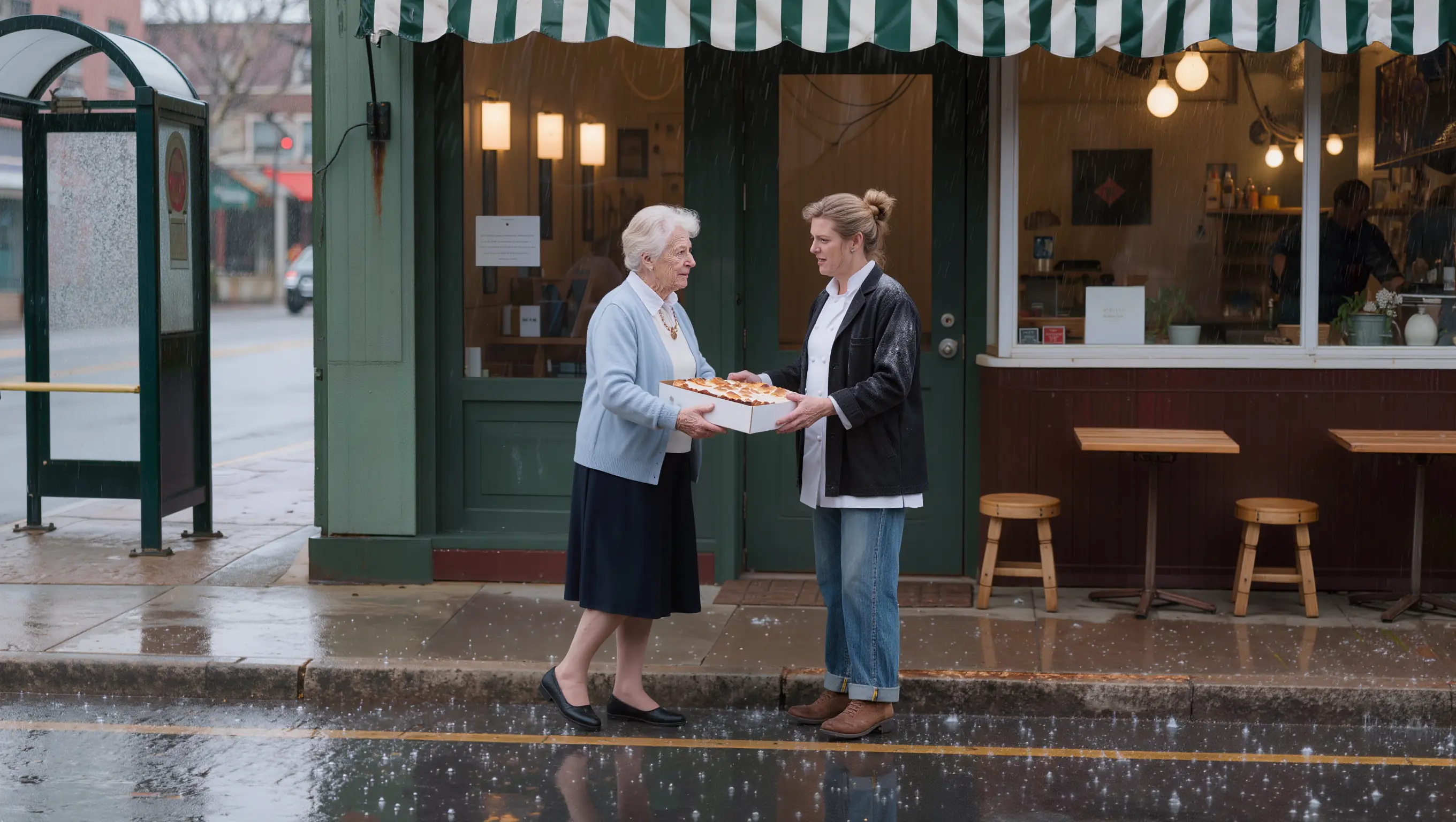
Lucy’s small baking business grew.
First birthday cakes. Then shower cakes. Then wedding cakes. Then dessert tables. She named it Harper & Honey Cakes, because her grandmother had called her “honey girl” when she was little.
Agnes said the name was too sweet.
Lucy said that was the point.
Years passed.
Lucy became known throughout the county for cakes that looked natural, graceful, and handmade in the best way. She used real fruit, careful flavors, and designs that told stories. Whenever someone asked where she learned to fix mistakes, Lucy smiled and said, “From the woman who taught me damage can become decoration.”
Agnes pretended she never said that.
But the café struggled.
More customers bought coffee at the new chain near the highway. Younger people wanted bright spaces with fast Wi-Fi and plant walls. Whitfield Café was small, old, and slow. The ovens needed repair. The roof leaked. The landlord wanted to raise rent. Agnes’s wrists hurt so badly some mornings she could barely roll dough.
Beth begged again.
“Mom, please. You don’t have to prove anything.”
Agnes looked at the empty café after closing one night.
“I’m not proving,” she whispered after the call ended. “I’m remembering.”
Then the letter came.
The building owner planned to renovate the block. Whitfield Café’s lease would not be renewed unless Agnes agreed to a rent increase she could not afford and several upgrades she could not pay for.
She folded the letter and tucked it under Paul’s old recipe book.
For two weeks, she told no one.
Not Beth.
Not Lucy.
But Lucy noticed.
She came in one Wednesday carrying a chocolate hazelnut cake and found Agnes sitting at the counter, not baking, not cleaning, just staring at the chalkboard menu.
“Agnes?”
“I’m thinking.”
“That looks heavier than thinking.”
Agnes sighed.
“You became too observant.”
“I learned from you.”
Lucy set down the cake.
“What happened?”
“Nothing you need to carry.”
“That means exactly the opposite.”
Agnes looked toward Paul’s recipe book.
Lucy followed her gaze.
The letter was there.
She read it silently.
Her face changed.
“They’re forcing you out?”
“They are raising rent.”
“To force you out.”
“Same cake, different knife.”
Lucy sat down hard on the stool.
“No.”
“That word has never paid a bill.”
“Do you want to close?”
Agnes looked around the café.
The counter Paul built.
The window tables.
The chalkboard.
The old cake stand.
The kitchen where Lucy had learned to stop fearing broken frosting.
“No,” she whispered.
Lucy nodded.
“Then we fix the decorated side.”
Agnes looked at her.
For a moment, neither spoke.
Then Agnes gave a faint, sad smile.
“You remember.”
“I remember everything.”
Lucy did not offer charity.
She offered a plan.
Harper & Honey Cakes had grown enough that Lucy needed a permanent storefront and production kitchen. She had been looking at spaces outside town, but none felt right. Whitfield Café had history, ovens, a downtown location, and a loyal group of customers who needed a reason to return.
Lucy proposed a partnership.
Whitfield Café would become Whitfield & Honey Café, a bakery-café combining Agnes’s classic breakfasts, soups, and pies with Lucy’s cakes, pastries, and custom orders. The café would keep its old counter, its name, its recipes, and its morning regulars. Lucy would invest in repairs, bring in her customer base, manage online orders, and hire staff. Agnes would stay as founder, recipe keeper, and mentor, working fewer hours but still shaping the menu.
Agnes stared at the proposal.
“You want to attach your successful business to my leaky café?”
“Yes.”
“That is poor survival instinct.”
“No,” Lucy said. “It’s roots.”
“I do not want your money.”
“I know. That’s why I’m buying into the business, not donating to it.”
“You learned how to argue.”
“You taught me.”
“I taught cake.”
“You taught structure.”
Agnes looked down at the sketch Lucy had made.
The green awning restored.
The old counter polished.
A new cake display case near the window.
The chalkboard menu expanded.
Paul’s recipes framed on one wall.
A teaching kitchen in the back for community baking classes.
On the front window, in gold lettering:
Whitfield & Honey Café
Most Things Are Not Ruined The First Time They Break
Agnes’s eyes stung.
“No,” she said softly.
Lucy smiled.
“I knew you’d say that.”
“It is too long.”
“It is true.”
“That makes it worse.”
The renovation took four months.
Agnes complained every day.
She complained about new ovens.
“The old ovens had personality.”
“They burned the left side of everything,” Lucy said.
“That was their personality.”
She complained about the cake display case.
“Too shiny.”
“It has lights.”
“Cakes should not perform.”
“They absolutely should.”
She complained about the new ordering system.
“I dislike tablets.”
“The tablet dislikes you too.”
“Good. Mutual respect.”
But beneath the complaints, Agnes came alive.
Beth visited during the renovation and cried when she saw her mother laughing with Lucy over paint samples.
“I thought she was going to lose this place,” Beth whispered.
Lucy looked toward Agnes, who was scolding a contractor for placing shelves too high.
“She almost did. Then she taught me how to use the damage.”
Opening day came in early September.
The green awning had been replaced, but the old sign was preserved inside, hanging above the counter. The floorboards still creaked. The bell still jingled. Paul’s photograph remained near the register. The air smelled of coffee, biscuits, lemon cake, and cinnamon.
Customers lined up before six.
Old regulars came first, suspicious of change.
Then Lucy’s cake customers arrived.
Then families.
Then students.
Then people who had seen the renovation online and wanted to know the story behind the long sentence on the window.
At noon, Lucy tapped a spoon against a glass.
Agnes pointed at her.
“No speeches.”
“One.”
“Too many.”
Lucy smiled and faced the crowded café.
“Years ago, I dropped my first paid event cake in the rain.”
People turned toward Agnes, who immediately looked annoyed.
“I was standing outside, soaked, convinced my chance was over. Agnes came across the street, carried the cake into this café, and taught me that the damaged side could become the decorated side.”
Agnes looked down.
“She helped me deliver that cake. Then she taught me how to bake better, price fairly, stop apologizing, and keep going.”
Lucy’s voice trembled.
“This café saved my beginning. Today, we get to save its next chapter.”
The room applauded.
Agnes blinked hard.
Lucy handed her a small brass key tied with green ribbon.
“What is this?” Agnes asked.
“The new front door key.”
“I already have one.”
“This one is for the partnership.”
Agnes looked at the engraving.
Whitfield & Honey
Still Open
Her hand closed around it.
“Too sentimental,” she whispered.
“I know,” Lucy said.
Years passed, and Whitfield & Honey Café became more successful than Agnes had dared imagine.
Morning regulars still came for biscuits and coffee. Families came for weekend brunch. Brides came for cake tastings. Children came for baking classes. Teenagers worked part-time and learned from Agnes that measuring mattered because “hope is not a substitute for flour.”
Lucy managed the business, but Agnes remained the heart.
She worked shorter shifts. She sat more often. She taught from a stool when her knees hurt. She told stories about Paul. She corrected frosting. She approved soup. She rejected three trendy menu items because, in her words, “Not everything needs lavender.”
On Agnes’s eighty-third birthday, Lucy organized a private dinner in the café after closing.
Agnes said she did not want a party.
Lucy called it “a menu meeting with cake.”
Agnes accepted.
Beth came. Old regulars came. Staff came. Lucy’s family came. The tables were filled with flowers, candles, and dishes made from Agnes and Paul’s old recipes.
At the end of dinner, Lucy brought out a cake.
Lemon elderflower with raspberry filling.
The same flavor as the first cake that had broken in the rain.
But this one was perfect in a way that did not look stiff. Along one side, sugar flowers cascaded over a textured frosting pattern, just like the emergency repair years ago.
Agnes stared.
“You remembered the design.”
Lucy nodded.
“It’s the cake that started everything.”
“It was a disaster.”
“It was a doorway.”
Agnes looked at the cake for a long time.
Then she said, “The glaze is correct.”
Lucy laughed through tears.
“That’s your birthday speech?”
“It is a strong compliment.”
Later that night, after everyone left, Agnes and Lucy sat by the front window with two slices of cake.
The café was quiet.
Rain tapped gently against the glass.
Agnes looked at the restored counter, the glowing cake case, the chalkboard menu, Paul’s photograph, the young staff cleaning the kitchen, and Lucy sitting across from her, no longer the frightened girl with a ruined cake, but a woman who had built something beautiful.
“You saved my café,” Agnes said.
Lucy shook her head.
“You saved my first cake.”
“That cake was barely saved.”
“So was I.”
Agnes looked at her sharply.
Lucy smiled softly.
“I was ready to quit that day. Not just the order. Baking. All of it. You made me believe mistakes could become part of the design.”
Agnes looked toward the window.
Outside, the gold lettering reflected softly in the rain.
Most Things Are Not Ruined The First Time They Break.
Years earlier, Agnes Whitfield had helped a young baker carry a damaged cake out of the rain, patch it with buttercream, candied lemon, and practical courage, then deliver it on time.
She thought she was only saving one event.
But that cake became a beginning.
Lucy grew from that moment, built a business, and returned when Agnes’s café was the thing cracked, sliding, and nearly lost.
What Agnes received was not just repairs, investment, or customers.
She received a second life for the place Paul had built.
She received a chosen granddaughter in Lucy, young hands in the kitchen, laughter at the counter, and proof that the work of feeding people still mattered.
And every time someone rushed into Whitfield & Honey Café with a ruined dessert, a broken plan, or panic in their eyes, Agnes would tie on her apron, look over her glasses, and say,
“Bring it here. We’ll see which side wants decorating.”