Beatrice Langley was seventy-six years old and still opened her little bookstore every morning, even when the street outside looked as if it had forgotten how to welcome customers.
Langley Books sat on a quiet corner in Marietta, Georgia, between a closed tailor shop and a small café that changed owners too often to keep the same curtains. The bookstore had narrow windows, a green front door, and a brass bell above the entrance that had been there since Beatrice and her husband, Thomas, first opened the shop forty-two years earlier.
Inside, the air smelled of paper, dust, lemon polish, and old wood. Bookshelves stretched from floor to ceiling. A round table near the front held staff picks, though Beatrice was the only staff left.
A faded armchair sat by the window, its cushion worn soft from years of readers trying one chapter and staying for five. Behind the counter was a framed photograph of Thomas standing beside Beatrice on opening day, both of them young, proud, and completely unaware of how hard it would be to keep a small bookstore alive.
Thomas had been gone for eight years.
Since then, the shop had grown quieter.
People ordered books online now. Rent went up. Foot traffic went down. The younger families who moved into town liked coffee shops, boutiques, gyms, and stores with bright signs and fast service. Beatrice’s bookstore was slow by nature. It invited wandering. It encouraged lingering. It smelled like memory instead of new paint.
She loved it fiercely.
Every morning, she unlocked the green door at nine, turned on the lamps, straightened the books on the front table, watered the little fern beside the register, and wrote one quote in chalk on the board outside.
That Tuesday in April, the quote read:
A kind hand may turn a page someone thought was finished.
Beatrice had chosen it herself.
No one had come in to read it yet.
By noon, rain began falling hard over Marietta. It ran along the curb, soaked the chalkboard, and blurred the windows of the café across the street. Beatrice stood by the front window with a cup of tea in one hand, watching people hurry past under umbrellas.
That was when she saw the young woman.
She was standing on the sidewalk near the corner, surrounded by flowers.
Buckets of them.
Roses, lilies, daisies, tulips, sunflowers, greenery, loose stems, ribbon, paper wrap. A small folding cart had tipped over beside her, and one wheel had snapped loose. Rain poured down on everything. The young woman, maybe twenty-four or twenty-five, was desperately trying to lift a fallen bucket while holding a plastic sheet over another.
The sheet blew out of her hands.
Flowers spilled across the wet sidewalk.
A man passing by stepped around them without stopping.
The young woman dropped to her knees and began gathering the stems, her hair plastered to her face, her blouse soaked, her hands shaking.
Beatrice set her tea down.
“Oh, for heaven’s sake.”
She grabbed her raincoat and opened the bookstore door.
The bell jingled wildly as wind pushed inside.
“Dear!” Beatrice called. “Bring them in here!”
The young woman looked up, startled.
“I’m sorry?”
“The flowers!” Beatrice pointed to the bookstore. “Bring them inside before the rain turns them into soup.”
The young woman blinked as if she could not quite process the kindness.
“I can’t. I don’t want to make a mess.”
“You are already making a tragedy. A mess is easier to clean.”
Beatrice hurried down the step, moving faster than her knees preferred. She picked up a bucket of tulips with both hands and nearly lost her balance.
The young woman jumped up.
“Please, don’t—”
“Then help me before I embarrass us both.”
That worked.
Together, they carried the buckets into the bookstore. Beatrice held the door while the young woman rushed back and forth through the rain, retrieving flowers, ribbon, paper, and the broken cart. Water dripped across the wooden floor. Petals clung to the entry mat. The brass bell rang again and again.
By the time everything was inside, both women were soaked.
The young woman stood near the door, breathing hard, looking at the puddles forming on the floor.
“I’m so sorry,” she said. “I’ll clean it. I promise. I’ll pay for any damage.”
Beatrice removed her wet hood and gave her a firm look.
“You can start by telling me your name.”
The young woman swallowed.
“Clara.”
“Clara what?”
“Clara Bennett.”
“I’m Beatrice Langley.”
Clara looked around the store.
“I know. I mean, I’ve seen the sign. I pass here sometimes.”
“Then you should have known this was a safe place for wet flowers.”
A shaky laugh escaped Clara, but her eyes filled almost immediately afterward.
Beatrice noticed.
She noticed the trembling hands. The soaked blouse. The broken cart wheel. The flowers wrapped with care, not factory bundles. The little handwritten tags tied to several arrangements. The way Clara looked at the buckets as if each one represented money she could not afford to lose.
“What happened?” Beatrice asked.
Clara wiped rain from her cheek.
“I was delivering flowers for an event at the community center. My car wouldn’t start this morning, so I loaded everything onto my cart and tried to walk. I was only three blocks away when the wheel broke. Then the rain came harder.”
“What kind of event?”
“A retirement luncheon. Two hundred dollars’ worth of arrangements.”
Beatrice raised her eyebrows.
“That sounds important.”
“It is.” Clara’s voice cracked. “It’s my first real client.”
Beatrice went still.
“First?”
Clara nodded.
“I’ve been trying to start a small floral business. I work at the grocery store floral counter, but I do custom arrangements on the side. This event was supposed to help me get more orders. If I don’t deliver them, I lose the money, the client, and probably the only chance I had this month to pay for the vendor license.”
She pressed both hands over her mouth, fighting tears.
“I know it sounds stupid.”
“No,” Beatrice said. “It sounds like Tuesday.”
Clara looked at her through tears.
Beatrice moved toward the back.
“I have towels. And plastic tablecloths from a poetry night no one attended. We will dry what can be dried, save what can be saved, and find a way to deliver the rest.”
Clara stared.
“We?”
“Yes, dear. You are in a bookstore. We are very familiar with rescuing fragile things from water.”
Within minutes, the front of Langley Books became a flower rescue station.
Beatrice spread plastic tablecloths over the front display table and moved the books to higher shelves. Clara sorted the flowers by damage. Some stems were broken beyond use, but most were salvageable. Beatrice brought towels, scissors, old glass jars, twine, and a small fan from the office.
“You have vases?” Clara asked, surprised.
“Book clubs attract flowers and emotional women. I have learned to prepare.”
They worked quickly.
Beatrice cut damaged leaves. Clara rebuilt arrangements with practiced hands. The rain continued beating the windows, but inside the shop, color began returning to order: yellow tulips, white daisies, pink roses, soft greenery, purple ribbon.
Clara’s fingers moved with instinct now, faster and steadier.
Beatrice watched her twist stems, balance colors, hide damaged spots, and turn almost-ruined flowers into something graceful.
“You’re good,” Beatrice said.
Clara did not look up.
“I hope so.”
“That was not hope. That was observation.”
Clara’s mouth trembled into a smile.
By one o’clock, most arrangements had been saved.
But delivery remained a problem.
Beatrice looked out the window. Rain still fell. The community center was too far to carry everything by hand, and Clara’s broken cart lay useless near the door.
Beatrice picked up the phone behind the counter.
“Who are you calling?” Clara asked.
“A man who owes me.”
Five minutes later, Beatrice was speaking firmly into the receiver.
“Stanley, I need your van. No, not tomorrow. Now. Yes, flowers. No, not for me. A young woman is trying not to have her future drowned in front of my shop. That should be enough explanation. Bring the van.”
Clara stared.
“You can’t just ask someone for a van.”
“I did not ask. I reminded.”
Stanley arrived fifteen minutes later from the café across the street, grumbling but smiling. He was the owner’s older brother and used the café van for supply runs.
Together, they loaded the arrangements.
Clara kept apologizing.
Beatrice finally pointed a finger at her.
“Enough. Apologize one more time and I’ll make you alphabetize the poetry section.”
Clara blinked.
“Is that bad?”
“Terrible. Nobody agrees where longing belongs.”
That made Clara laugh so hard she nearly dropped a bouquet.
Beatrice rode with her to the community center.
When they arrived, the client was waiting at the door, worried and impatient. Clara stepped out of the van, soaked but determined, carrying the first arrangement.
“I’m so sorry for the delay,” she said. “There was an accident with my cart in the storm, but the flowers are here.”
The woman looked at the arrangements.
Her expression changed.
“Oh,” she said softly. “They’re beautiful.”
Clara froze.
“They’re okay?”
“They’re more than okay.”
The luncheon guests were already inside. With Beatrice and Stanley helping, Clara placed the arrangements on the tables. The flowers transformed the plain room. White tablecloths, paper plates, and fluorescent lights suddenly looked softer, warmer, more cared for.
The retiring librarian, a woman named Mrs. Powell, cried when she saw the flowers.
“They look like spring,” she said.
Clara looked as if someone had handed her back her breath.
The client paid her in full.
Then she asked for business cards.
Clara’s face fell.
“I don’t have any yet.”
Beatrice pulled a pen from her purse and several blank index cards from her book bag.
“She will in three minutes.”
At a side table, while luncheon guests admired the arrangements, Beatrice wrote neatly:
Clara Bennett Floral Design
Custom Arrangements, Events, Bouquets
Phone:
She looked at Clara.
“Number?”
Clara whispered it.
Beatrice wrote ten cards by hand and placed them near the guest book.
“There,” she said. “A business begins where it begins.”
Clara stared at the cards.
Then at Beatrice.
“I don’t know how to thank you.”
“Start by keeping one card for yourself. You should see your name looking official.”
Clara took one and held it carefully.
Her eyes filled again, but this time the tears were different.
That evening, after the event ended, Clara returned to the bookstore with Beatrice. Stanley carried the broken cart inside and declared it beyond help. Beatrice made tea while Clara cleaned the floor, wiped the entryway, and rearranged the front table exactly as it had been.
Before leaving, Clara placed a small bouquet beside the register.
“For you.”
Beatrice looked at it.
“You need every flower for paying customers.”
“That one is for the woman who saved them.”
Beatrice’s expression softened.
“I only opened the door.”
Clara shook her head.
“You opened more than that.”
Beatrice looked away, uncomfortable with too much gratitude.
“Well,” she said, “come back when you have real business cards. The handwritten ones lack dignity.”
Clara smiled.
“I will.”
She did.
Two weeks later, Clara returned with printed business cards and a bouquet of yellow tulips for the front window.
“Absolutely not,” Beatrice said.
Clara paused.
“You don’t like tulips?”
“I love tulips. That is why I distrust gifts of them.”
“They’re not a gift. They’re display enhancement.”
“That sounds like business nonsense.”
“It is.”
Beatrice let her place them in the window.
People noticed.
A woman came in to ask about the tulips and left with a book and Clara’s card. Another customer ordered a bouquet for her mother. A teacher bought three paperbacks and asked if Clara could make small arrangements for a school dinner.
Soon, Clara began using the front corner of Langley Books as a tiny weekend flower stand.
At first, it was only Saturdays. A few bouquets in jars, a small sign, and Clara standing near the window with nervous hope. Beatrice let her use the space for free.
Clara protested.
Beatrice ignored her.
“You bring people through my door,” Beatrice said. “That is rent enough.”
And it was true.
People came for flowers and discovered books.
People came for books and bought flowers.
The store began to feel alive in a new way.
Color filled the window. The scent of roses mixed with old paper. Beatrice and Clara developed a rhythm. Clara arranged flowers at the front table while Beatrice recommended novels to customers. Sometimes they argued over color.
“That pink is too loud,” Beatrice said.
“Flowers are allowed to be loud.”
“Not beside Jane Austen.”
“Jane Austen can handle pink.”
“She handled worse.”
They both laughed.
Over the years, Clara’s business grew.
She went from grocery store employee to full-time florist. She rented a small studio. Then opened a storefront. She supplied weddings, birthdays, memorial luncheons, school events, restaurants, and offices. Her arrangements became known for looking natural, thoughtful, and deeply personal.
But she never stopped bringing flowers to Beatrice.
Every Monday morning, a fresh arrangement appeared in the bookstore window.
Sometimes tulips.
Sometimes wildflowers.
Sometimes roses and lavender.
Sometimes simple greenery with tiny white blossoms.
Beatrice always complained.
Clara always ignored her.
As Clara rose, Beatrice’s bookstore struggled.
The flower arrangements helped, but not enough. Rent increased. Online sales cut deeper. The café across the street became a chain coffee shop with bright lighting and fast turnover. The closed tailor shop next door was purchased by a developer who wanted to combine several storefronts into one modern retail space.
Then Beatrice received the letter.
Her lease would not be renewed unless she agreed to a rent increase she could not pay.
She read the letter standing behind the counter beneath the photograph of Thomas.
For a moment, the whole shop seemed to blur.
The green door.
The shelves.
The armchair by the window.
The bell above the entrance.
Forty-two years of books, readers, stories, and quiet afternoons.
Reduced to a number on paper.
Beatrice folded the letter and placed it inside the drawer where she kept spare bookmarks.
For three weeks, she told no one.
Not her children.
Not her few remaining regulars.
Not Clara.
She kept opening the shop. Kept writing quotes on the chalkboard. Kept watering the fern. Kept pretending not to see the way the future was walking toward her with a locked door.
But Clara noticed.
Of course she noticed.
One Monday, she arrived with a vase of white lilies and found Beatrice taking old photographs down from the corkboard.
“What are you doing?” Clara asked.
“Dusting.”
“You hate dusting.”
“Everyone hates dusting. That does not stop dust.”
Clara looked at the small stack of empty boxes behind the counter.
“Beatrice.”
The old woman did not turn.
“Clara.”
“What happened?”
“Nothing that needs flowers.”
Clara walked behind the counter, opened the bookmark drawer, and saw the folded letter.
Beatrice’s shoulders stiffened.
“That is private.”
Clara picked it up carefully.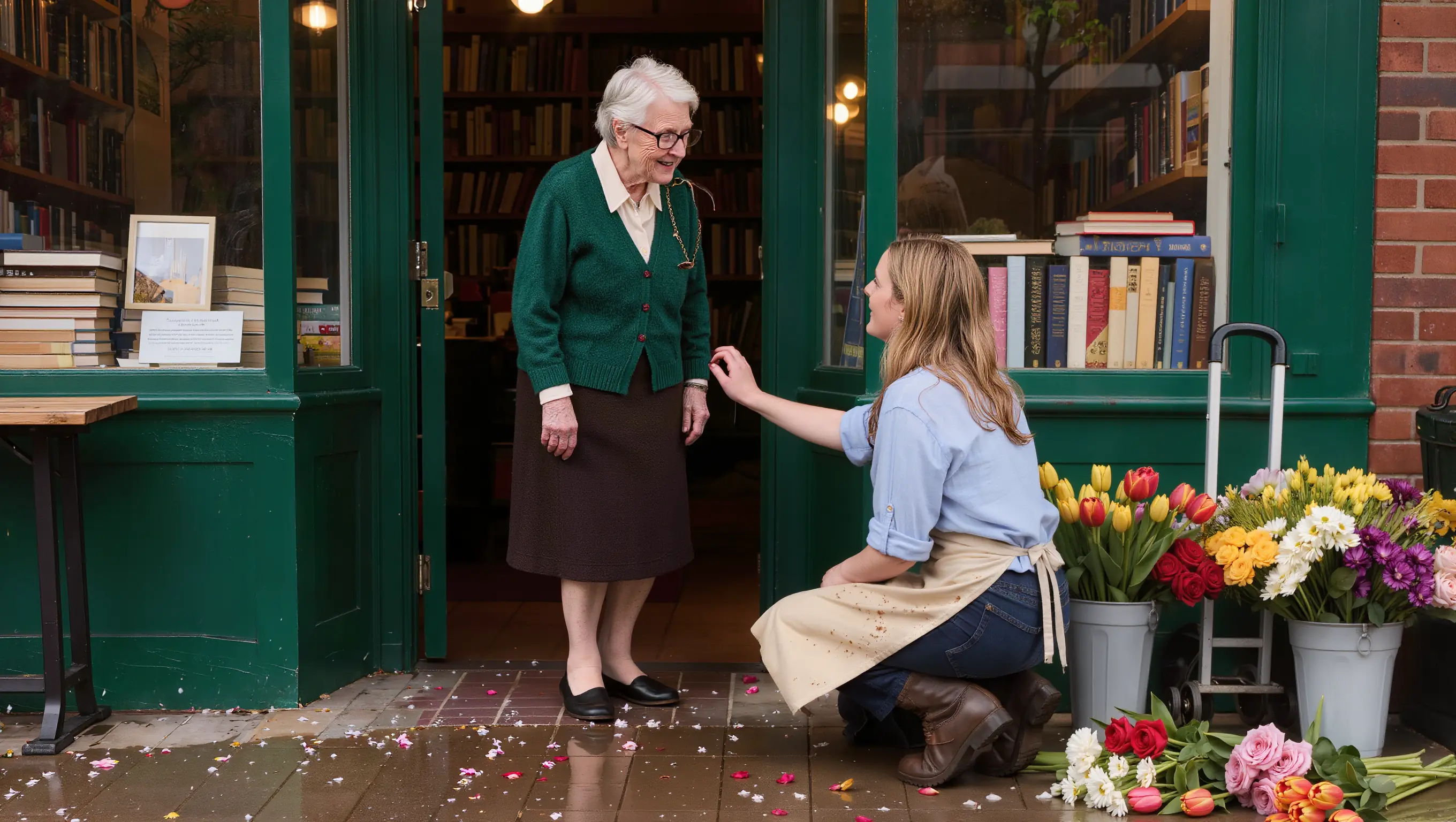
“It looks serious.”
“It is both.”
She read it.
Her face went pale.
“They’re pushing you out?”
“They are raising rent.”
“To push you out.”
“That is one interpretation.”
“It’s the correct one.”
Beatrice sat slowly on the stool behind the register.
“I knew this would happen eventually.”
“No.”
“Yes. Small shops close. Streets change. People move on. I am old enough not to be surprised.”
Clara looked around the bookstore.
“But you’re not ready.”
Beatrice’s eyes flicked toward Thomas’s photograph.
“No,” she admitted softly. “I am not.”
Clara folded the letter with trembling fingers.
“Then we make a plan.”
Beatrice gave a tired smile.
“Dear, flowers cannot fix leases.”
“No. But people can.”
“I do not want charity.”
“Neither did I when my flowers were drowning on the sidewalk.”
“That was different.”
Clara leaned forward.
“No, it wasn’t. You didn’t rescue me because I was helpless. You helped because my work mattered and I needed one door opened.”
Beatrice looked down.
Clara’s voice softened.
“This shop matters. Let me open one for you.”
Clara did not waste time.
She made calls that very afternoon.
She called former customers, authors who had done readings at Langley Books, teachers, librarians, local parents, book clubs, small business groups, and everyone who had ever admired the flowers in Beatrice’s window. She called Stanley, who still owned a van and still owed Beatrice more favors than he admitted. She called her wedding clients, restaurant clients, and the community center where her first real event had happened.
Then she came back with a proposal.
Not only to save the bookstore.
To transform it.
The vacant tailor shop next door, though purchased by the developer, had not yet been renovated. Clara had connections with a local historic preservation group. If the two spaces could be protected together as a community arts and reading space, there might be grant support and donor interest. Langley Books could remain a bookstore, but also host floral workshops, reading hours, author nights, book-and-bouquet events, school programs, and small gatherings.
Clara’s floral business would sponsor part of the space and open a permanent flower counter inside the bookstore.
Books and flowers.
Stories and stems.
Beatrice stared at the sketch Clara had brought.
“You want to put a flower counter in my store?”
“You already let me do it once.”
“That was a table.”
“This would be nicer.”
“Nicer means expensive.”
“Funded.”
“I dislike that word when it comes from young people.”
Clara smiled.
“You liked it when I said paid in full after my first event.”
“That was different.”
“You keep saying that.”
“Because you keep being difficult.”
The campaign began quietly, then grew.
Clara named it Save The Green Door.
Beatrice hated the name.
Clara kept it anyway.
People began sharing memories of Langley Books.
A woman wrote that she had bought her first poetry book there at sixteen.
A father wrote that Beatrice helped his shy son find books that made him love reading.
A retired teacher wrote that Thomas and Beatrice had donated boxes of books after the school library flooded.
A young novelist wrote that she had drafted her first chapter in the armchair by the window.
And Clara wrote her own story.
She wrote about the rainstorm, the broken cart, the flowers spilling across the sidewalk, and the old woman who opened her bookstore door without asking whether a young florist could pay for the mess.
The story spread through town.
Then beyond it.
Customers returned.
Some bought books.
Some donated.
Some ordered flowers.
Some simply came to stand in the shop and say, “I remember this place.”
Beatrice found that part the hardest.
She could manage bills.
She could manage dust.
She could manage stubborn customers.
But being loved publicly was almost unbearable.
“You have made me into a sentimental landmark,” she told Clara.
“You were already a landmark.”
“I was a bookseller.”
“Same thing, if you do it long enough.”
The developer, seeing the public attention and grant possibilities, agreed to negotiate. The historic preservation group stepped in. A local foundation offered matching funds if the space would include community programming. Clara committed a portion of her floral business revenue to the new model. Beatrice’s children contributed, relieved and astonished that their mother had finally accepted help from someone.
After months of paperwork, calls, meetings, donations, and stubborn persistence, the green door stayed.
So did Beatrice.
The tailor shop wall was opened carefully, creating a passage between the two spaces. Langley Books expanded into a reading room and event space. Clara installed a small floral counter near the front window, where fresh bouquets sat beside new releases and old classics. The armchair remained exactly where it had always been.
Above the new archway between the spaces, a sign read:
The Green Door Room
Books, Flowers, And Second Chances
Beatrice objected.
“Too sentimental.”
Clara said, “Perfect.”
The reopening day came in early spring.
The same season when Clara’s flowers had once spilled across the sidewalk.
This time, the weather was clear.
The green door had been repainted. The cracked window repaired. The brass bell polished. The chalkboard outside read:
Some doors are saved because they once opened for someone else.
Beatrice had not written that.
Clara had.
Beatrice threatened to erase it.
Then did not.
People lined the sidewalk before opening.
Teachers, librarians, book clubs, parents, children, florists, authors, old customers, new customers, neighbors, and people who had heard the story online. Stanley arrived with coffee. The community center director brought a framed photograph from Clara’s first event. Beatrice’s children stood beside her, misty-eyed and proud.
Clara stood at the flower counter, hands shaking slightly.
Beatrice noticed.
She took Clara’s hand.
“Still nervous?”
Clara laughed softly.
“Always.”
“Good. Means it matters.”
At ten o’clock, Beatrice unlocked the green door.
The bell rang.
People entered.
The store filled with voices, footsteps, flowers, turning pages, laughter, and the old smell of books made brighter by roses and lavender.
At noon, Clara insisted on speaking.
Beatrice objected.
No one listened.
Clara stood near the front window where her first tulips had once sat.
“Years ago,” she began, “I stood outside this shop in a rainstorm with a broken cart and flowers scattered across the sidewalk. I thought I was watching my first real chance fall apart.”
Beatrice looked down.
“Beatrice Langley opened the door. She saved the flowers. She called a van. She helped me deliver them. She wrote my first business cards by hand on index cards.”
People laughed softly.
Clara’s voice thickened.
“She did not ask if I deserved help. She did not ask if I could repay it. She simply saw that something fragile mattered to me and decided it was worth saving.”
Beatrice’s eyes filled.
Clara turned toward her.
“This place did the same thing for generations of readers. It held quiet dreams before they were ready to speak. It gave people somewhere to wander, think, grieve, hope, and begin. So when the green door was at risk of closing, we did what Beatrice taught us.”
She smiled through tears.
“We opened it wider.”
The applause filled the shop.
Beatrice stood very still.
Then Clara stepped forward and placed something in her hand.
A key.
The old key to the green door, polished and tied with a ribbon made from floral silk.
Beatrice looked at it.
“What is this?”
Clara smiled.
“The same door. Just saved.”
Beatrice closed her fingers around the key.
For once, she had no correction.
Years passed, and The Green Door Room became one of the most beloved places in Marietta.
Children came for story hour beneath hanging plants.
Couples came to order wedding flowers and left with books about marriage, patience, and gardens.
Book clubs met among vases of seasonal blooms.
Teenagers came after school to read in the armchair.
Local artists sold handmade cards near the flower counter.
Clara taught floral workshops.
Beatrice taught reading circles, though she refused to call them classes.
The bookstore did not become rich.
It became alive.
That mattered more.
Beatrice grew older.
Her hands shook slightly when wrapping books. Her steps slowed. She sat more often. Clara hired part-time help and arranged things so Beatrice could work shorter days without feeling pushed aside.
Every Monday, Clara still brought flowers for the window.
Every Monday, Beatrice still complained.
“This arrangement is too tall.”
“It draws the eye.”
“It blocks Dickens.”
“Dickens has had enough attention.”
“Blasphemy.”
On Beatrice’s eighty-second birthday, Clara organized a small celebration in the reading room.
Beatrice said she did not want a party.
Clara called it “a literary gathering with cake.”
Beatrice accepted only because cake had been mentioned.
The room filled with people carrying flowers and books. On the wall hung photographs: Thomas and Beatrice on opening day, Clara’s first handwritten business card, the rain-soaked sidewalk after the rescue, the reopening, children at story hour, flowers in the window.
Clara gave Beatrice a framed copy of the first business card.
The one written by hand on an index card.
Beatrice stared at it for a long time.
“You kept this?”
“Of course.”
“It was poorly spaced.”
“It was perfect.”
“It lacked professionalism.”
“It gave me a beginning.”
Beatrice’s mouth trembled.
Clara hugged her carefully.
“You saved my flowers,” Clara whispered.
Beatrice looked around at the shop, the green door, the books, the flowers, the readers, the life still moving through the space Thomas had helped build.
“And you saved my shelves,” she said.
Outside, spring light fell across the sidewalk where rain had once nearly ruined everything.
A young woman walked past the window, stopped, and looked at a bouquet beside a stack of novels. After a moment, she opened the green door and stepped inside.
The bell rang.
Beatrice turned toward the sound with a smile.
Years earlier, she had helped a young florist on the sidewalk because the rain was ruining her flowers and her first chance.
She thought she was only offering shelter, towels, a phone call, and a little practical sense.
But kindness, like flowers, has roots hidden beneath the surface.
Clara grew from that day. Her business bloomed. And when Beatrice’s own life’s work was threatened, Clara returned with the same urgency, the same loyalty, and the same belief that fragile things deserved saving.
What Beatrice received was not just a renewed lease, a repaired shop, or flowers in the window.
She received proof that one opened door can become a future.
She received a partner, a chosen granddaughter, a room full of readers, and a bookstore that would continue long after she could no longer climb the step to unlock it herself.
And every rainy afternoon, when Beatrice saw someone struggling outside the green door, she would set down her tea, straighten her cardigan, and say,
“Well, we know what to do with storms.”