At seventy-eight years old, Clara Whitmore still unlocked her greenhouse every morning before the sun touched the rooftops.
The greenhouse sat behind her small yellow house in Portland, Maine, at the end of a narrow street where the ocean wind came cold even in spring.
It was not large, only a glass structure with a crooked door, wooden shelves, clay pots, seed trays, and a small iron stove she used when the nights grew too sharp.
To other people, it looked like an old woman’s hobby.
To Clara, it was the last living room of her heart.
Her husband, Peter, had built it for her thirty-five years earlier after she retired from teaching second grade. He had joked that she needed somewhere to raise “quiet children with leaves.”
Clara had laughed, then filled the place with tomatoes, basil, geraniums, lavender, and seedlings she gave away to neighbors whether they asked or not.
Peter had been gone for seven years.
Their son lived in Chicago. Their daughter lived in California. They called, visited when they could, and worried about Clara staying alone.
But Clara refused to leave the house, the greenhouse, or the garden path Peter had laid with his own hands.
“Plants do not like being abandoned,” she always said.
What she meant was, neither did she.
One cold April afternoon, rain began falling hard over Portland.
It was not the gentle kind of rain that fed flowers. It was sharp, sideways, and cold, rattling against windows and turning the yard into mud. Clara had gone out to check the young tomato plants because the forecast warned of a sudden drop in temperature. She wore a thick brown cardigan under her raincoat, rubber boots, and gardening gloves with soil already pressed into the seams.
She opened the greenhouse door and stepped inside.
Then she stopped.
Something moved behind the potting bench.
Clara held still, listening.
There was a small breath.
Then a cough.
Not an animal.
A child.
Clara slowly set down her watering can.
“Hello?” she said gently.
Silence.
“I know someone is there.”
A boy stepped out from behind the bench.
He was about eleven years old, with wet black hair stuck to his forehead, pale brown skin, and frightened dark eyes. His navy hoodie was soaked. His jeans were muddy at the knees. He held a backpack tightly against his chest, and his shoes were so wet they made small puddles on the greenhouse floor.
“I’m sorry,” he said quickly. “I wasn’t stealing.”
Clara looked at his shivering hands.
“I didn’t say you were.”
“I just came in because of the rain.”
“So I see.”
“I’ll leave.”
He took one step toward the door.
Clara moved slightly, not blocking him, but not letting the moment pass.
“In this weather?”
“I’m fine.”
Clara raised one eyebrow. “Children who are fine do not usually hide behind potting benches.”
The boy looked down.
“What’s your name?” she asked.
He hesitated.
“Evan.”
“Evan what?”
“Evan Brooks.”
“I’m Clara Whitmore.”
He glanced toward the house beyond the wet glass. “I know. Your mailbox says Whitmore.”
“So it does.”
The rain hammered the greenhouse roof. Water streamed down the glass walls, blurring the yard outside. Evan shivered again, harder this time.
Clara took off her gardening gloves.
“You are freezing,” she said.
“I’m okay.”
“You are not.”
“I don’t have money,” he said suddenly.
Clara blinked. “For what?”
“For being here. For anything.”
Her face softened. “Evan, I do not charge children rent for hiding from rain.”
He looked at her as if he was unsure whether that was a joke.
Clara pointed to the small wooden stool near the stove. “Sit there.”
“I should go.”
“Where?”
He did not answer.
That answer worried her more than any words could have.
“Where are your parents?” she asked.
“My mom is at work.”
“And your father?”
“Gone.”
Clara nodded slowly. “Does your mother know you’re here?”
Evan’s face tightened.
“No.”
“Where does she think you are?”
He stared at the floor.
“At home,” he whispered.
Clara looked through the rain toward the street. “And why aren’t you at home?”
Evan swallowed. “Because home is locked.”
“Did you lose your key?”
“No.” His voice became defensive. “The lock got changed.”
Clara went very still.
“Who changed it?”
“The landlord.”
“Was your mother there?”
“No. She was at work.”
Clara closed her eyes for one moment.
When she opened them, Evan was watching her carefully, ready for blame.
Instead, she said, “Come inside the house. We will call your mother.”
He shook his head immediately. “No.”
“Yes.”
“I can’t go inside a stranger’s house.”
“That is a wise rule.”
“Then why are you asking?”
“Because another wise rule is that children should not sit in wet clothes in a greenhouse while the temperature drops.”
He hugged the backpack tighter. “My mom will get in trouble.”
Clara understood then.
He was not only cold.
He was protecting her.
“Evan,” she said softly, “I am not trying to get your mother in trouble. I am trying to keep you safe until she can come.”
“She works at the nursing home,” he said quickly. “She can’t leave. She already missed days when I was sick. If she misses again, they’ll fire her.”
“I believe you.”
His eyes lifted.
“You do?”
“Yes.”
That seemed to unsettle him more than suspicion would have.
Clara picked up a thick folded blanket from the shelf where she kept old cloths for covering plants during frost.
“Wrap this around your shoulders.”
“It’s for plants.”
“Tonight, you are the plant most in danger.”
He stared at her.
Then, despite himself, he almost smiled.
Clara led him through the rain to her back door. Evan left his muddy shoes on the mat without being asked. Inside, the kitchen was warm, bright, and smelled of vegetable soup. A small round table stood beside the window. A kettle sat on the stove. Peter’s old coat still hung on a peg by the door because Clara had never found the courage to move it.
Evan stood awkwardly in the doorway.
“I’m dripping.”
“Water dries.”
“I’m dirty.”
“So is the garden. I still like it.”
He looked down, embarrassed.
Clara handed him a towel and one of Peter’s old sweaters. It was much too large, but warm. Evan changed in the bathroom and returned with the sleeves hanging past his hands.
Clara did not comment.
She set a bowl of soup and two slices of buttered bread on the table.
Evan stared at the food.
“I’m not hungry.”
His stomach growled loudly.
Clara looked toward the ceiling politely, as if the sound had come from somewhere else.
“The house disagrees,” she said.
He sat carefully.
At first, he ate slowly, trying to seem as though he did not need it. Then hunger took over. He finished the bowl, the bread, and the second bowl Clara offered without asking.
When he finished, he whispered, “Thank you.”
“You’re welcome.”
“I’ll pay you back.”
“You are eleven.”
“Almost twelve.”
“Practically a banker, then.”
This time he did smile, though only for a second.
Clara gave him the kitchen phone. Evan dialed from memory.
No answer.
He tried again.
Still no answer.
“She can’t answer during shift,” he said. “She checks on break.”
“What is her name?”
“Rebecca Brooks.”
“Where does she work?”
“Harbor Pines Nursing Home.”
Clara called the nursing home. After several transfers, she reached a supervisor and explained that Rebecca’s son was safe at her house. She gave her full name, address, and phone number. The supervisor promised to tell Rebecca during her next break.
When Clara hung up, Evan looked at the door.
“You can wait here,” she said.
“How long?”
“As long as it takes.”
“What if my mom can’t come until midnight?”
“Then we will wait until midnight.”
“What if she can’t fix the apartment?”
Clara did not answer too quickly.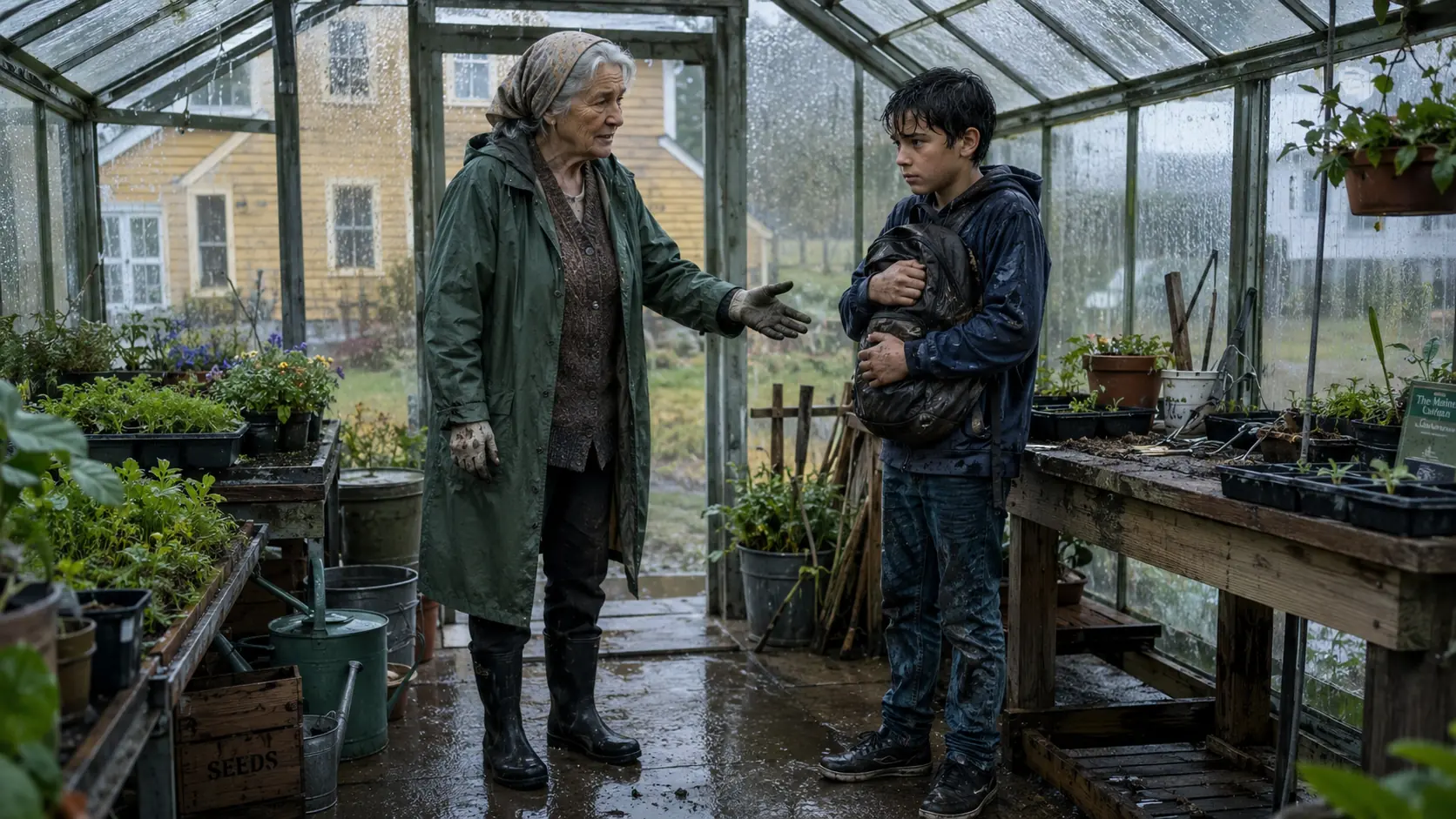
“Then we will figure out the next right thing.”
Evan looked down at his backpack.
Inside, Clara later learned, were his school notebooks, his mother’s spare work shoes, a family photo, a folder of papers, and a small plastic container of coins. He had grabbed what he thought mattered before the landlord told him to leave the hallway.
A child with a whole life packed into one wet backpack.
At 9:20, the phone rang.
Clara answered.
A woman’s voice came through, terrified and breathless.
“Mrs. Whitmore? This is Rebecca Brooks. Is Evan there? Is he okay?”
“He is safe. Wet and cold when he arrived, but safe now. He has eaten.”
A sob broke through the phone.
“Oh God. I thought he was at the apartment. My neighbor called and said the landlord changed the locks. I couldn’t get anyone to answer. I couldn’t leave my shift. I didn’t know where he went.”
“He came to my greenhouse.”
“My God.” Rebecca cried harder. “I’m so sorry. He shouldn’t have bothered you.”
“He did not bother me.”
“I can come after my shift. I get off at eleven thirty. I’ll come straight there.”
“Drive carefully.”
“I don’t have a car. I’ll take the bus.”
“In this rain?”
“It’s all right.”
Clara looked toward Evan, who was pretending not to listen while wiping the table with a napkin.
“No,” Clara said. “I will come get you.”
“Mrs. Whitmore, no. You’ve already done too much.”
“I have not done nearly enough. What time?”
By midnight, Rebecca Brooks sat at Clara’s kitchen table with both hands around a mug of tea.
She was thirty-three, with tired hazel eyes, dark hair pulled into a messy bun, and the exhausted posture of someone who had been fighting too many small fires for too long. Her nursing home uniform smelled faintly of laundry soap and disinfectant. When she saw Evan wearing Peter’s old sweater, she cried again and held him as if someone had handed her back the world.
“I’m sorry,” she kept whispering. “I’m so sorry.”
Evan pressed his face into her shoulder.
“I kept the papers.”
“I don’t care about the papers.”
“You said they were important.”
“You are important.”
Clara turned away and busied herself with the kettle.
The landlord had changed the locks after Rebecca fell behind on rent. He claimed he had given proper notice. Rebecca insisted the case was still being handled through a legal aid office, but her work schedule made everything difficult. She had no close family nearby. Her car had broken down months earlier. The nursing home job paid just enough to keep them surviving until one accident became a crisis.
“We are not homeless,” Rebecca said quickly, shame burning in her face. “It’s temporary. I have a job. I have money coming. I just need a few days.”
Clara sat across from her.
“I believe you.”
Rebecca looked at her.
“You do?”
“Yes.”
Sometimes belief is not a solution, but it is the first solid ground.
Clara offered the spare room for the night.
Rebecca refused.
Then refused again.
Then Evan began coughing from the cold he had caught in the rain, and pride lost to motherhood.
They stayed.
One night became four.
Four became two weeks.
Clara helped Rebecca call legal aid. She drove her to the housing office. She helped copy papers, organize documents, and contact a church emergency fund. She watched Evan after school while Rebecca worked. She made soup, folded laundry, and pretended not to notice when Rebecca cried quietly in the bathroom after long phone calls.
The house changed.
Evan’s schoolbooks appeared on the kitchen table. Rebecca’s work shoes sat by the back door. The spare room smelled faintly of soap and rain. Peter’s old sweater became Evan’s favorite thing to wear in the evenings, though he always folded it carefully before bed.
And the greenhouse changed most of all.
Evan followed Clara there every afternoon.
At first, he only stood in the doorway.
Then he began asking questions.
“Why do those seedlings lean that way?”
“Toward the light.”
“Do they know where it is?”
“In their own way.”
“What happens if they don’t get enough?”
“They grow weak.”
“What do you do?”
“Move them closer.”
He nodded, serious.
One afternoon, Clara gave him a packet of basil seeds.
“Plant these.”
“I don’t know how.”
“Good. Then you will learn.”
He pressed the seeds into soil with careful fingers.
“They’re so small.”
“Most beginnings are.”
Evan looked at her, then back at the pot.
The legal battle with the landlord did not restore their apartment, but it helped Rebecca recover some belongings and avoid certain fees. With emergency assistance, she found a small apartment near the nursing home. It was plain, but clean, with working locks and a kitchen window that faced the morning sun.
When she and Evan moved out, Clara packed food, blankets, and three small pots of basil.
“For the window,” she said.
Evan held one pot carefully.
“Will it live?”
“If you water it and give it light.”
“What if I forget?”
“Then remember again.”
He smiled.
They did not disappear.
Every Saturday, Evan came to help Clara in the greenhouse. Rebecca came too when she could, bringing tea, muffins, or folded laundry she insisted Clara must allow her to do.
Evan learned everything.
He learned to start seeds, transplant tomatoes, prune basil, mix compost, test soil, and protect young plants from frost. He liked the order of it. He liked that plants needed care but did not lie. If something was wrong, they showed it.
At thirteen, he built a shelf for seedlings.
At fifteen, he started a small vegetable garden behind his apartment building.
At seventeen, he organized a school project that created container gardens for families living in temporary housing.
Clara watched him with quiet pride.
“You’re good at helping things root,” she told him.
Evan smiled. “You taught me.”
When Evan graduated high school, Clara sat beside Rebecca in the front row. He received a scholarship to study environmental science and community agriculture. After the ceremony, he gave Clara a small wooden sign he had made by hand.
It read:
CLARA’S GREENHOUSE — WHERE SMALL BEGINNINGS ARE WELCOME.
She cried so hard Rebecca had to hold her hand.
Before he left for college, Evan stood with Clara in the greenhouse one last time.
“I’ll pay you back one day,” he said.
“For soup and basil?”
“For letting us stay.”
“You owe me nothing.”
“I know,” he said. “That’s why I want to.”
Years passed.
Evan studied, worked, and built a career around community gardens, food access, and green spaces for families in housing crisis. He believed every temporary home should have something living in it: a plant on the windowsill, a garden bed outside, a place where children could see that roots could grow again after being moved.
He called Clara every Sunday.
He sent pictures of gardens he helped build.
She sent advice he did not always ask for.
“Those tomatoes are too crowded.”
“That soil looks tired.”
“Do not trust anyone who plants mint without boundaries.”
He saved every note.
But Clara grew older.
At eighty-six, the greenhouse roof began leaking. The wooden shelves rotted in places. The little iron stove failed. Her knees hurt too badly for heavy pots. Her children begged her to move closer to them.
Then a winter storm cracked two glass panels and damaged the door.
The repair estimate frightened her.
For the first time in decades, Clara considered closing the greenhouse.
She did not tell Evan.
Rebecca did.
One week later, Evan arrived at Clara’s house with rolled plans, work boots, and a truck full of supplies.
Clara opened the door and sighed.
“Your mother has become a terrible keeper of secrets.”
“She loves you.”
“That is not an excuse.”
“It is the best one.”
He stepped inside and spread the plans across her kitchen table.
Clara saw the greenhouse.
But restored.
New glass panels. Stronger framing. Safer paths. Raised planting beds. A heated seed room. A classroom corner with benches for children.
Then she saw the second page.
The land beside her house would become a small community garden for children and families who had experienced eviction, displacement, or temporary housing. The program would partner with local shelters, schools, and housing advocates. Children could plant seeds, take vegetables home, learn gardening, and keep small potted plants for new apartments.
At the top of the plan was a sign:
THE CLARA WHITMORE ROOTS GARDEN
Small Beginnings Are Welcome Here.
Clara stared.
“No.”
“Yes.”
“I don’t need my name on a garden.”
“You already have one. We’re just making it official.”
“I only let you hide in my greenhouse.”
Evan’s voice softened. “You let me stop hiding.”
Clara looked away, eyes full.
The renovation took the rest of spring.
Clara complained about nearly everything.
The new glass was too clear.
The paths were too smooth.
The children’s benches were too bright.
The volunteers moved pots without asking permission.
Evan listened carefully, then ignored every complaint that came from fear instead of wisdom.
But he preserved what mattered.
Peter’s old potting bench stayed.
The original crooked door handle was mounted inside the new doorway.
The first basil pot Evan had planted years ago, long since cracked and empty, was placed on a shelf with a small label:
The First Seed.
On opening day, families filled the garden.
Children planted lettuce, tomatoes, sunflowers, and basil. Parents stood nearby, some nervous, some smiling, some quietly crying because their children were touching soil instead of holding fear. Rebecca served lemonade from a folding table. Evan stood beside Clara near the greenhouse door.
When he spoke, his voice shook.
“When I was eleven, I hid in this greenhouse because my mother and I had been locked out of our apartment and I had nowhere to go. Clara Whitmore found me, brought me inside, fed me, believed my mother, and gave us a place to stay until we could stand again.”
Clara lowered her head.
“She taught me that being uprooted does not mean life is over. It means you need care, light, patience, and someone willing to make room.”
The crowd applauded.
Clara cried openly.
Years later, the Roots Garden became a place of quiet healing in Portland. Children from shelters came to plant seeds. Families in temporary housing picked vegetables. Teenagers learned composting, cooking, and patience. Every child who moved into a new apartment received a small potted basil plant with instructions written in Clara’s careful handwriting.
Clara no longer lifted heavy pots.
She sat near the greenhouse door, wrapped in a cardigan, telling children not to overwater seedlings and reminding volunteers that tomatoes had opinions.
One rainy afternoon, a boy about eleven stood at the greenhouse entrance, soaked and uncertain, holding a backpack against his chest.
Clara noticed him immediately.
“Are you cold, sweetheart?” she asked.
He looked down. “I don’t have money.”
Clara smiled gently.
“I didn’t ask for money.”
Across the greenhouse, Evan heard her and turned.
For a moment, he saw himself.
Then he saw Clara opening the door wider.
“Come in,” she said. “Small beginnings are welcome here.”
And the boy stepped inside.
Long ago, Clara had thought she was only helping one frightened child get out of the rain.
But kindness had taken root.
A bowl of soup became a seed.
A seed became a calling.
A calling became a garden.
And an old woman who feared her greenhouse would die with her lived long enough to watch it become a place where uprooted children learned they could grow again.