Clara Whitmore was about to lock the door of her little bookshop when she heard the sneeze.
It was not loud. It was small, sharp, and quickly swallowed, the kind of sound a child makes when trying not to be noticed. Clara paused with the key halfway turned in the lock and listened.
Outside, rain slid down the windows of Whitmore Books in long silver lines. It was a cold April evening in Portland, Maine, and the street had emptied early because the wind off the harbor made every drop feel like ice. The bakery across the road was already dark. The flower shop had pulled in its sidewalk display. Even the coffee shop on the corner had stacked its chairs and shut off its sign.
Clara was seventy-five years old, with white hair tucked into a loose bun, gentle green eyes, and a back that ached when she stood too long. She wore a soft gray cardigan over a blue dress and comfortable brown shoes. Her hands were thin but steady, marked by age and paper cuts from a lifetime of turning pages.
She had owned the bookshop for thirty-nine years.
To most people, it was just a narrow store with crowded shelves, a bell above the door, and a reading chair near the front window. But to Clara, it was her whole life. Her late husband, Peter, had built the shelves himself. Her daughter, Ruth, had taken her first steps between the poetry section and the old globe. Her grandson used to fall asleep beneath the front counter when he was little.
Now Peter was gone. Ruth lived in Seattle. Her grandson was grown and busy. The shop had become quieter every year.
Still, Clara opened every morning.
Books, she believed, should never feel abandoned.
She heard the sneeze again.
This time, it came from the small recessed doorway beside the shop, where the old newspaper box used to stand.
Clara unlocked the door again, pushed it open, and stepped beneath the awning.
“Hello?” she called.
At first, no one answered.
Then something moved near the brick wall.
A boy sat curled behind a stack of flattened cardboard, knees pulled to his chest, a wet backpack pressed against him. He looked around ten years old. His dark blond hair stuck to his forehead, and his jacket was soaked through. His sneakers were muddy, and one sock had slipped down around his ankle. His face was pale except for his red nose and frightened eyes.
Clara’s heart tightened.
“Oh, sweetheart,” she whispered. “You must be freezing.”
The boy scrambled to his feet. “I wasn’t doing anything.”
“I didn’t say you were.”
“I’ll go.”
“No,” Clara said quickly. Then she softened her voice. “No, don’t run. Come inside and warm up.”
The boy shook his head. “I can’t.”
“Why not?”
He looked toward the street, then back at her. “I don’t have money.”
Clara almost smiled, though sadness pressed against her ribs. “This is a bookshop, not a hotel.”
“I know.”
“And I didn’t ask for money.”
The boy hugged his backpack tighter. “I’m not stealing.”
“I didn’t say that either.”
He stared at her, unsure what to do with an adult who was not accusing him of something.
Clara stepped aside and held the door open. Warm yellow light spilled onto the wet sidewalk.
“Come in for ten minutes,” she said. “Just long enough to dry your hair and stop shaking.”
“I’m not shaking.”
His teeth clicked as he said it.
Clara raised one eyebrow.
The boy looked embarrassed.
Finally, he stepped inside.
The bell above the door gave a soft jingle, and warmth wrapped around them. The shop smelled of old pages, cinnamon tea, and lemon polish. Rain tapped gently against the glass. The boy stood on the welcome mat as if afraid to move farther.
Clara locked the door behind them, but left the sign turned to OPEN so he would not feel trapped.
“What’s your name?” she asked.
He hesitated.
“Ethan,” he said.
“I’m Clara Whitmore.”
“I know.”
She blinked. “You know?”
He nodded toward the sign behind the counter. “It says Whitmore Books.”
“So it does.”
For the first time, the corner of his mouth moved slightly, almost a smile.
Clara pointed to the reading chair near the window. “Sit there. I’ll get you a towel.”
“I’ll get the chair wet.”
“Chairs survive worse.”
He did not sit until she turned away.
In the back room, Clara found an old towel, a blanket, and the electric kettle. She made hot chocolate from a tin she kept for children who came in after school. When she returned, Ethan was perched on the edge of the chair, still clutching his backpack.
She handed him the towel.
“Here. Dry your hair.”
He took it carefully. “Thank you.”
She gave him the mug next.
His eyes widened. “What’s that?”
“Hot chocolate.”
“I didn’t ask for that.”
“I know. That is what makes it a surprise.”
He looked at the mug as if it might disappear.
Clara sat on the stool behind the counter, giving him space. “Careful. It’s hot.”
Ethan took a small sip. His eyes closed for half a second.
That tiny expression told Clara more than any explanation could.
“When did you last eat?” she asked gently.
The boy opened his eyes. Guarded again. “I’m fine.”
“That was not an answer.”
“I ate.”
“When?”
He looked down into the mug.
Clara did not push. Instead, she went to the back and returned with a cheese sandwich wrapped in wax paper, an apple, and the last oatmeal cookie from the jar.
“I made too much lunch,” she said.
Ethan looked at the plate. “That’s not lunch. It’s dinner now.”
“Then I made too much dinner.”
He stared at her, then at the food.
“I can pay you back,” he said.
“With what?”
He swallowed. “I can sweep. Or carry boxes. Or clean windows.”
“You’re ten.”
“Eleven.”
“My mistake. Practically retired, then.”
He blinked, then gave a small laugh before catching himself.
Clara placed the plate on the little table beside him. “Eat first. Negotiate later.”
He ate slowly at first, trying to appear polite. But hunger soon overcame pride. He finished the sandwich in several careful bites, then the apple, then the cookie, saving one crumb on his thumb and licking it quietly when he thought she wasn’t looking.
Clara looked at the rain instead.
When he finished, she asked, “Do you have someone I should call?”
His whole body changed.
The warmth left his face. His hands tightened around the mug.
“No.”
“No parents?”
“I have a mom.”
“Does she know where you are?”
He nodded too quickly. “Yes.”
Clara recognized the lie.
“Where is she?”
“At work.”
“What kind of work?”
He shrugged. “Different kinds.”
Clara folded her hands. “And where do you live?”
“Not far.”
“Ethan.”
He looked at her sharply.
She spoke gently. “I’m not trying to trap you. I’m trying to understand whether you are safe.”
The word safe seemed to hurt him.
He looked toward the door.
“I should go.”
“It’s still raining.”
“I’m okay.”
“You are wet, cold, hungry, and sitting in a bookshop after closing because you were hiding in a doorway.”
His eyes flashed. “I wasn’t hiding.”
Clara let the silence answer.
After a long moment, he whispered, “We got kicked out.”
Clara’s chest tightened. “From your home?”
“The apartment.” He stared at the floor. “Mom was short on rent. She said it was temporary. She said she had a plan.”
“Where is she now?”
“At the shelter on Congress Street.”
“And you?”
He pulled the backpack closer. “They said there wasn’t space for both of us tonight. Mom told me to stay with her friend, but her friend wasn’t home. I was going to go back.”
“To the shelter?”
He nodded, but Clara saw uncertainty in his eyes.
“Why didn’t you?”
His voice grew smaller. “I didn’t want Mom to know I had nowhere.”
That sentence settled in the shop heavier than the rain.
Clara looked at the boy, soaked and trying to be brave, and thought of her own grandson when he was eleven, complaining that his socks were itchy, asking for another bedtime story, certain that someone would always know what to do.
No child should have to protect an adult from worry by sleeping outside.
Clara stood.
Ethan tensed.
“I’m calling the shelter,” she said. “Not the police. Not anyone to punish you. Just the shelter.”
“No.”
“Ethan.”
“They’ll get mad at Mom.”
“No one is getting mad at your mother for being poor.”
He looked at her with a bitterness too old for his face. “People do.”
Clara could not argue with that.
So she said, “Then I won’t be one of them.”
She called the shelter. After several transfers and a long hold, she spoke with a caseworker named Denise who confirmed that Ethan’s mother, Laura Hayes, was there and terrified. She had been trying to reach her son for two hours. Her phone had died. She had no bus fare left. She was afraid he had tried to walk to the friend’s apartment and gotten lost.
Clara looked at Ethan while Denise spoke. He sat stiffly, eyes fixed on the floor, ashamed and relieved at the same time.
When Clara hung up, she said, “Your mother is worried sick.”
His face crumpled for one second before he forced it still. “Is she mad?”
“No. She is scared.”
“I didn’t mean to scare her.”
“I know.”
The shelter could not send anyone immediately. The storm had worsened, and Denise was trying to arrange transportation. Clara looked at the rain, then at the boy, then at the old staircase at the back of the shop that led to the tiny apartment above.
She had not planned to invite anyone upstairs.
She had not planned to open the part of her life that had become so private.
But life often asked for kindness without giving a person time to tidy first.
“You and your mother can stay here tonight,” Clara said.
Ethan stared at her. “Here?”
“The apartment above the shop. It’s small, but it has a couch and a warm quilt.”
“We can’t.”
“You can.”
“My mom won’t.”
“Then I will argue with her.”
He looked worried. “She’s good at arguing.”
“So am I.”
Ethan’s mouth twitched.
Forty minutes later, Laura Hayes arrived in a volunteer’s car.
She burst through the door the moment Clara unlocked it. She was thirty-four, with tired brown eyes, a soaked coat, and fear written across every part of her face. When she saw Ethan, she dropped to her knees.
“Ethan.”
He ran into her arms.
“I’m sorry,” he whispered.
Laura held him so tightly Clara had to look away.
“I thought I lost you,” Laura cried. “Don’t ever do that again. Don’t ever try to protect me like that.”
“I didn’t want you to worry.”
“I’m your mother. Worrying is my job.”
Clara stood behind the counter, blinking back tears.
When Laura finally stood, she turned to Clara.
“I don’t know how to thank you.”
“Start by taking off that wet coat.”
Laura shook her head. “Mrs. Whitmore, I can’t stay here. Denise told me what you offered, but we can’t impose.”
“You can impose tonight.”
“No, really, I—”
Clara lifted one hand. “Laura, I am old, stubborn, and already made hot chocolate. You may save your strength.”
Ethan whispered, “I told you she argues.”
Laura gave a shaky laugh that turned into a sob.
That night, Clara gave Laura the couch upstairs and Ethan the old daybed in the corner near the window. She found extra blankets in the closet and towels in a cabinet. Laura apologized for everything: the wet floor, the borrowed clothes, the noise, the trouble, even the fact that Ethan ate another sandwich.
Clara finally said, “If you apologize one more time for needing shelter from a storm, I’m going to start reading poetry aloud.”
Laura stared.
Ethan said, “Is that bad?”
“Very,” Clara said.
Laura laughed for real then.
It was small, but it warmed the room.
In the morning, Clara made scrambled eggs, toast, and tea. Ethan ate like a boy trying very hard not to seem too hungry. Laura drank her tea with both hands wrapped around the mug.
She told Clara pieces of the story.
She had worked at a hotel laundry until her hours were cut. Then she took shifts cleaning offices, but the schedule changed without warning. One missed paycheck became late rent. Late rent became fees. Fees became eviction. She had applied for housing assistance, but waiting lists stretched for months. She had tried to keep Ethan in school, fed, clean, and hopeful while every door closed one at a time.
“I kept thinking I could fix it before he noticed,” Laura said.
Clara looked toward Ethan, who was reading a book about lighthouses in the front room.
“Children notice everything,” Clara said.
Laura’s eyes filled. “I know.”
After breakfast, Clara walked downstairs and opened the shop. Laura insisted on helping. Ethan organized the children’s books by color, which Clara pretended to object to before admitting it looked cheerful.
By noon, the rain had stopped.
The shelter found temporary space for Laura and Ethan that evening. Before they left, Clara packed a paper bag with food, two books for Ethan, and a clean sweater that had belonged to Peter.
Laura tried to refuse the sweater.
Clara said, “Peter would be offended.”
That settled it.
Ethan stood near the door, holding the books against his chest.
“Can I bring them back?” he asked.
“Of course.”
“What if they get damaged?”
“Then they will have lived an adventurous life.”
He looked at her seriously. “I’ll take care of them.”
“I believe you.”
He paused, then said, “Thank you for not calling me a problem.”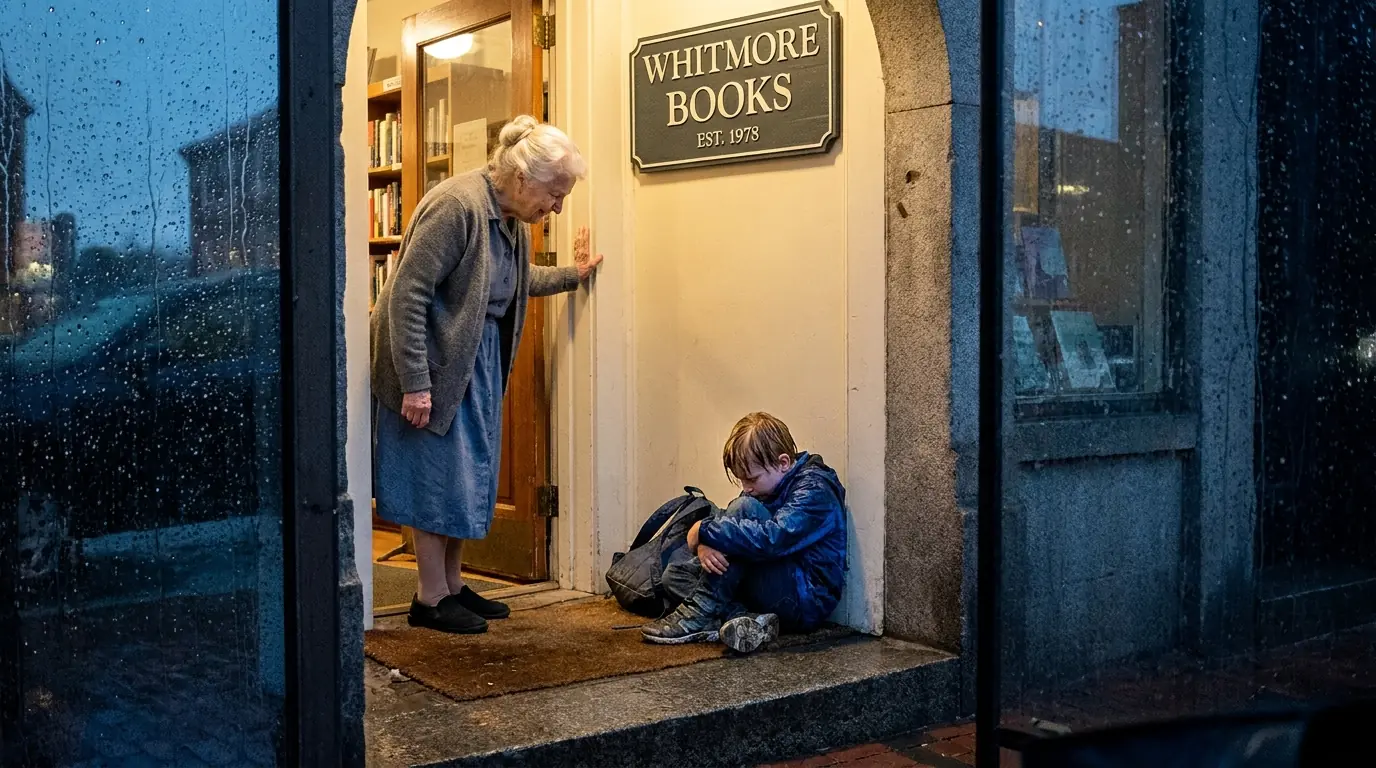
Clara swallowed.
“Oh, Ethan,” she said softly. “You were never the problem.”
For several weeks, Clara did not see them.
Then one Tuesday after school, the bell above the shop door rang, and Ethan came in with the two books.
“I finished them,” he said.
Clara looked up from her ledger. “Both?”
He nodded. “Do you have more about lighthouses?”
“I have a whole shelf.”
His face brightened.
From then on, Ethan came every Tuesday and Thursday afternoon. Sometimes Laura came too, usually before work, tired but grateful. They were still in temporary housing, still waiting for something stable, but the bookshop became a place between hard things.
Ethan read at the small table near the front window. Clara helped him with homework. Laura used the back room to fill out job applications. Clara kept snacks in the drawer and always claimed she had bought too many.
Slowly, Ethan changed.
He stopped flinching when the bell rang.
He began asking questions.
He told Clara he liked buildings, boats, maps, and stories where people survived being lost.
“That is a very specific category,” Clara said.
He shrugged. “It’s the best kind.”
One afternoon, Ethan found a damaged copy of The Secret Garden in a donation box.
“The cover is torn,” he said.
“Yes.”
“Can books be fixed?”
Clara smiled. “Most can.”
She showed him how to repair a loose page with special tape and how to press a bent cover beneath a stack of heavy books. Ethan watched with intense focus.
“It still has marks,” he said after the repair.
“Many things do.”
“But it can still be read.”
“Exactly.”
He ran one finger over the mended page.
Clara had the feeling he was not only talking about books.
Months passed.
Laura found steady work as a receptionist at a dental office. With help from a housing program, she and Ethan moved into a small apartment fifteen minutes away. It was not perfect, but it was theirs. Ethan got his own desk. Laura cried when she put groceries into their own refrigerator.
Still, every Tuesday, Ethan came to the bookshop.
By the time he was thirteen, he knew the store almost as well as Clara did. He shelved returns, carried boxes, dusted the top shelves she could no longer reach, and read anything she put in front of him.
At fourteen, he asked if he could work for her.
“I can pay you minimum wage,” Clara warned.
“That’s more than zero.”
“You drive a hard bargain.”
He became her official part-time helper.
Customers adored him. He recommended adventure books to reluctant readers and mysteries to old men who claimed they hated fiction. He remembered which child liked dragons, which grandmother wanted large print, and which college student bought poetry but hid it inside textbooks.
Clara watched him with quiet pride.
The boy from the doorway had become a young man who moved through the shop as if he belonged there.
But businesses, like people, grow old.
Online shopping hurt the store. Rent increased. The roof leaked near the history section. The heating system failed twice in one winter. Clara’s hands stiffened with arthritis, making it harder to lift boxes and wrap packages. Her doctor told her she needed rest.
“Rest,” Clara muttered. “Everyone prescribes rest as if it can pay bills.”
By the time Ethan was seventeen, Clara was months behind on payments to suppliers. She hid the overdue notices in a drawer beneath old bookmarks.
Ethan found them anyway.
He came to the counter holding a folded letter.
“What is this?”
Clara looked up and sighed. “That is private.”
“It says final notice.”
“That is privately unpleasant.”
“Are you closing?”
“No.”
“Are you lying?”
“Yes.”
He stared at her.
Clara removed her glasses and rubbed her eyes. “I don’t want you worrying about this.”
“You worried about us.”
“That was different.”
“How?”
She had no answer.
Ethan looked around the shop. The shelves, the reading chair, the children’s corner, the window where he had first sat wrapped in a blanket.
“This place saved me,” he said.
Clara’s voice softened. “No, dear. You saved yourself.”
“Not alone.”
He folded the notice carefully and placed it back on the counter. “Then don’t try to lose it alone.”
A week later, Ethan created a social media page for Whitmore Books. Clara objected to every part of this.
“I do not need to be on the internet.”
“The shop does.”
“The shop is shy.”
“The shop will survive.”
He posted photos of the shelves, staff recommendations, old books with handwritten notes tucked inside, and Clara’s weekly reading picks. He wrote a short story about the bookshop being a place where lost readers found their way home. He did not mention himself, but Clara knew.
The page grew slowly at first.
Then quickly.
People came in because of Ethan’s posts. Parents brought children for Saturday story hour. College students came for used classics. A local journalist wrote an article about the seventy-five-year-old bookshop owner and the teenager helping her keep the doors open.
Clara pretended to be annoyed by the attention.
But when the first profitable Saturday in months ended, she went into the back room and cried quietly.
Ethan found her.
“Are you okay?”
She wiped her eyes. “Dust.”
“There is no dust back here. You made me clean it.”
“Then emotional dust.”
He laughed and hugged her carefully.
But the rescue did not last forever.
After Ethan left for college in Boston to study library science and community education, the shop grew quiet again. He called often and visited during breaks, but Clara refused to tell him how hard things had become.
Then, when she was eighty-two, she fell from a step stool while reaching for a box of donated books.
She broke her wrist and bruised her hip.
Laura came immediately. Ethan took the train from Boston that night. He found Clara sitting in the hospital bed, furious at everyone and everything.
“I was getting a poetry collection,” she said.
“You fell off a stool.”
“A short stool.”
“Grandma Clara.”
She froze.
He had called her that before, casually, affectionately, but in the hospital room it felt different. Full of years. Full of history.
“I’m fine,” she said more softly.
“No, you’re not.”
He sat beside her bed.
Her face weakened. “I can’t run the shop like this.”
“I know.”
The words hurt because he did not deny it.
Clara looked toward the window. “Maybe it’s time.”
“For what?”
“To close.”
Ethan’s voice became firm. “No.”
“Dear, you’re young. You don’t understand. Some things end.”
“Yes,” he said. “But not like this.”
“What does that mean?”
“It means you once gave us a warm room when we had nowhere. Now I’m going to give your shop a future.”
Clara tried to argue.
Ethan did not let her.
Over the next three months, he worked with Laura, former customers, local teachers, and the library network. He applied for grants. He contacted preservation groups. He organized volunteers. He created a plan to turn Whitmore Books into a nonprofit community bookshop and literacy center, with Clara as founder and permanent story advisor.
Clara called that title ridiculous.
Everyone else loved it.
The community raised money for repairs. A contractor fixed the roof at a discount. Former customers donated. Teachers wrote letters about what the shop meant to local children. Parents volunteered for story hours. College students built a new website. The children’s corner was expanded. A small upstairs room became a free tutoring space.
And Ethan did the one thing Clara never expected.
He made a new sign.
The morning the shop reopened, Clara stood across the street with Laura and Ethan. She wore a lavender coat, her wrist healed but still stiff, her eyes full of nervous tears.
The old sign had been carefully restored, but beneath it hung a new one in dark green letters.
WHITMORE BOOKS
A Place For Lost Stories To Find Home
Clara covered her mouth.
Ethan held out a key.
“What is this?” she whispered.
“The new front door key.”
“I already have a key.”
“This one is different.”
She looked down.
Attached to it was a small silver charm shaped like an open book.
On one side, it said:
FOR THE NIGHT YOU LET ME IN.
On the other side:
FOR EVERY CHILD WHO COMES NEXT.
Clara began to cry.
Ethan’s own eyes shone. “You didn’t just let me sleep in a bookshop. You gave me a place where I wasn’t a problem. You gave my mom a place to breathe. You gave me books when I didn’t know how to imagine past survival. Everything I became started here.”
Clara shook her head. “I only gave you hot chocolate.”
“And a sandwich,” he said.
She laughed through tears.
“And a blanket,” Laura added.
“And three lighthouse books,” Ethan said.
Clara looked at the sign again.
People had begun gathering near the door. Children with backpacks. Parents holding coffee. Elderly customers who had known Clara for decades. Teachers, neighbors, former students, and readers who had driven across town because Ethan had told them the shop was opening again.
The bell above the door rang when Clara stepped inside.
Everyone applauded.
She tried to scold them, but her voice failed.
The shop looked familiar and new at once. The old reading chair remained by the window. Peter’s shelves still held the walls. But there were fresh rugs, brighter lamps, a children’s mural of a lighthouse, and a table filled with free books for families who needed them.
Near the counter, a framed photograph showed Clara and Ethan years earlier, standing beside a stack of books. Ethan was fourteen, awkward and smiling. Clara had one hand on his shoulder.
Below it was a small plaque.
In honor of Clara Whitmore, who believed every lost child deserved a warm room and a good story.
Clara touched the frame gently.
“Too much,” she whispered.
Ethan stood beside her. “Not enough.”
Years passed after that, but Whitmore Books did not close.
It grew.
The tutoring room helped children who struggled with reading. The free book table became a community program. Teenagers volunteered after school. Parents found support. Lonely seniors found conversation. Every Thursday evening, Clara sat in the front chair and read aloud to anyone who wanted to listen.
Her voice grew thinner with age, but children still leaned forward when she spoke.
Ethan returned to Portland after graduation and became the director of the literacy center. Laura managed the volunteer schedule. Clara, despite insisting she was retired, still corrected displays, recommended books, and told children never to fold page corners unless they wanted to break her heart.
One rainy April evening, many years after she first opened the door to a shivering boy, Clara sat by the front window with a blanket over her knees. She watched the rain slide down the glass, just as it had that night.
The bell rang.
A little girl stepped inside with wet hair and a backpack clutched to her chest. Her mother stood behind her, exhausted and apologetic.
“I’m sorry,” the woman said. “The library was closed, and she needs somewhere to finish homework before the shelter opens for evening check-in. We saw the sign.”
Ethan looked toward Clara.
Clara smiled.
“Then you came to the right place,” she said.
The little girl looked nervous. “Do I need money?”
Clara felt the past move gently through the room.
“No, dear,” she said. “You need a chair.”
Ethan brought hot chocolate.
Laura brought a towel.
The girl sat near the front window, slowly relaxing as warmth reached her fingers.
Clara watched quietly.
Later, after the child and her mother had gone safely to the shelter with a bag of books and sandwiches, Ethan sat beside Clara.
“You’re thinking about something,” he said.
“I’m thinking life is strange.”
“That’s usually true.”
She looked at him, now grown, kind-eyed, steady, still carrying a part of the boy she first met in the doorway.
“I thought I was saving you that night,” she said.
“You did.”
“No,” Clara said softly. “I think I was saving the part of myself that had forgotten doors can still open.”
Ethan took her hand.
The rain continued outside, but inside the shop there was warmth, light, and the quiet turning of pages.
Clara looked at the shelves, the children’s corner, the new sign, and the young man who had once been too proud to accept a sandwich. She had given him one night of shelter.
In return, he had given her bookshop a future.
More than that, he had given her final years a purpose larger than memory.
And every time the bell above the door rang, Clara Whitmore looked up with hope, because she knew another lost story might be walking in, waiting for someone to say:
Come inside. You are safe here.