Every morning at 7:10, Beatrice Walker opened the side door of Roosevelt Elementary and turned on the kitchen lights.
She was seventy-four years old, short and sturdy, with silver hair tucked beneath a hairnet, warm brown eyes, and hands that had spent most of her life stirring soup, kneading dough, washing dishes, and feeding people who did not always know how badly they needed to be fed.
For thirty-two years, Beatrice had worked in the school cafeteria in Dayton, Ohio. She was supposed to retire at sixty-five. Then sixty-seven. Then seventy. But every time someone asked when she planned to stop, she gave the same answer.
“When children stop coming to school hungry.”
No one ever knew what to say after that.
Roosevelt Elementary was an old brick school with cracked sidewalks, faded classroom doors, and a playground fence that leaned slightly near the basketball court. The children came from every kind of home: some warm and steady, some crowded and loud, some struggling so hard that breakfast depended on luck and lunch depended on paperwork.
Beatrice knew the signs.
A child who drank too much water before lunch.
A child who saved half a sandwich in a napkin.
A child who pretended not to like food because asking for seconds felt embarrassing.
A child whose stomach growled during the pledge.
That winter, she noticed a boy named Marcus Hill.
He was ten years old, thin, quiet, with serious dark eyes and a blue hoodie that had been washed so many times the fabric had faded at the elbows. He always stood at the end of the lunch line, never pushing, never complaining. When children laughed or shouted around him, Marcus watched more than he joined in.
At first, Beatrice thought he was simply shy.
Then one Tuesday, she saw him place his tray on the counter and freeze.
The cashier, Mrs. Lyle, looked at the computer screen and frowned.
“Marcus, your lunch account is still negative.”
Marcus lowered his head.
Beatrice, standing near the serving trays, heard every word.
Mrs. Lyle’s voice was not cruel, only tired. “You need to bring a note home. Your mother has to fill out the form again.”
Marcus whispered, “She did.”
“It hasn’t gone through.”
“I gave it to the office.”
“I’m sorry, honey. I can give you the alternate meal today.”
The alternate meal was a cold cheese sandwich and a small carton of milk.
Marcus looked at the hot tray in front of him: chicken, rice, green beans, and a roll. His face did not change much, but Beatrice saw the disappointment pass through him like a shadow.
He nodded. “Okay.”
The boy tried to step aside.
Beatrice reached for a full tray and placed it in front of him.
Mrs. Lyle looked up. “Bea…”
Beatrice did not look away from Marcus. “Take this, baby.”
Marcus blinked. “I can’t.”
“Yes, you can.”
“My account…”
“Your account can discuss business with me after lunch.”
Mrs. Lyle sighed softly, but she did not stop her.
Marcus stared at the tray. “I don’t have money.”
Beatrice leaned closer and lowered her voice so the other children would not hear.
“Food is not a prize, Marcus. It’s lunch.”
His eyes lifted to hers.
For a moment, he looked like a child who had been waiting a long time for someone to say something that simple.
He took the tray.
“Thank you,” he whispered.
“Go eat while it’s hot.”
That should have been the end of it.
But the next day, it happened again.
And the day after that.
The office insisted the paperwork was missing. Marcus insisted his mother had sent it. The system showed debt. The rules said alternate meal. The adults said they were sorry.
Beatrice said nothing in front of him.
She simply gave him the hot lunch.
On Friday, Marcus stayed after the lunch period ended. He stood near the kitchen door while Beatrice wiped down the counter.
“Mrs. Walker?”
She turned. “Yes, baby?”
He held out a folded dollar bill and several coins.
Beatrice looked at his small hand.
“What is that?”
“For the food.”
Her heart tightened. “Where did you get this?”
“I saved it.”
“From what?”
He shrugged. “My mom gave me bus money, but I walked.”
Beatrice put down the towel.
“Marcus Hill, you walked home in this cold to save bus money for lunch?”
His face flushed. “I don’t want you to get in trouble.”
Beatrice stared at him for a long second.
Then she gently closed his fingers around the money and pushed his hand back toward his chest.
“You listen to me. You do not skip the bus. You do not walk in freezing weather. And you do not pay me back with money meant to get you home safely.”
“But you paid for me.”
“I fed you.”
“That costs money.”
“So does a child getting sick from walking miles in the cold.”
He looked down.
Beatrice softened. “Where is your coat?”
He tugged at the sleeves of his hoodie. “This is fine.”
“That was not an answer.”
“My coat is too small.”
“Does your mother know?”
“She knows.” He said it quickly, defensively. “She works nights. She’s trying.”
Beatrice heard the fear beneath the words. He was protecting his mother.
“I believe you,” she said.
Marcus looked surprised.
Beatrice took a breath. “Do you have food at home?”
He stared at the floor.
That answer was enough.
That afternoon, Beatrice packed a brown paper bag before she left the cafeteria. Inside, she placed two turkey sandwiches, apples, carrot sticks, crackers, and a small container of leftover chicken rice. Then she added one of the school’s extra milk cartons and a cookie from her own lunch.
She found Marcus near the side door.
“Here,” she said.
He looked at the bag. “What is it?”
“Homework.”
His eyebrows pulled together. “Food isn’t homework.”
“Tonight it is. Your assignment is to eat it.”
He shook his head. “I can’t take that.”
“You can.”
“My mom will be embarrassed.”
“Then tell her Mrs. Walker packed too much and hates waste.”
Marcus held the bag carefully. “Why are you doing this?”
Beatrice looked at him, and for a moment she saw another boy.
Her younger brother, Isaiah, many years ago, standing in their mother’s kitchen in Alabama with hunger in his eyes because there were six children and never enough biscuits. Beatrice had been twelve then. She learned to stretch beans, save bread ends, and give her portion away without letting anyone notice.
Isaiah died young, long before he could grow into the man he should have become. But Beatrice never forgot the sound of his stomach growling in church, or the way he smiled when she slipped him half her cornbread.
She looked back at Marcus.
“Because I know what hungry looks like,” she said.
Marcus swallowed.
“Go home,” she added gently. “And take the bus.”
He nodded.
The following Monday, Marcus’s mother came to school.
Her name was Denise Hill. She was thirty-one, thin from overwork, with tired eyes and a janitor’s uniform beneath her coat. Her hands were rough, her voice careful, and shame sat on her shoulders before she even spoke.
She found Beatrice in the cafeteria after breakfast.
“Mrs. Walker?”
“That’s me.”
“I’m Marcus’s mother.”
Beatrice smiled. “You’ve got a fine boy.”
Denise’s eyes filled instantly.
“I filled out the lunch form,” she said. “Twice. I gave it to the office. I don’t know what happened. I’m not trying to avoid paying. I just…”
Her voice broke.
Beatrice stepped closer. “I know.”
Denise wiped her cheek quickly. “Marcus brought food home Friday. He said you packed too much.”
“I did.”
Denise gave her a look that said she knew the lie and loved her for it.
“I’m working nights at the hospital and cleaning offices in the morning. His father is gone. Rent went up. The car broke down. I keep thinking if I can just get through one more week, it’ll get better.”
Beatrice nodded slowly. “One more week can become a heavy thing.”
Denise covered her mouth, fighting tears.
Beatrice put a hand on her arm. “We’re going to fix the form first. Then we’re going to find Marcus a coat.”
“I can’t accept—”
“You can accept your son being warm.”
Denise lowered her head.
That day, Beatrice marched to the school office with Denise and did not leave until the lunch paperwork was found, corrected, and approved. Then she called her church friend, Mrs. Alberta Jones, who ran the clothing closet. By the next morning, Marcus had a thick winter coat, gloves, and a hat.
He came into the cafeteria wearing the coat zipped all the way up.
Beatrice pretended not to notice his shy smile.
“Looking sharp, Mr. Hill.”
He touched the sleeve. “It’s warm.”
“That is usually the job of a coat.”
He grinned.
From then on, Beatrice kept an eye on him.
Not loudly. Not in a way that made him feel poor.
She simply noticed.
When Marcus stayed late for tutoring, she saved him a snack. When he joined the school robotics club, she packed extra fruit because “inventors need vitamins.” When Denise worked a double shift, Beatrice let Marcus sit in the cafeteria until she finished cleaning, then walked him to the after-school bus.
Marcus began helping her.
At first, he wiped tables. Then he stacked trays. Then he carried boxes too heavy for her aching wrists. Beatrice taught him how to peel potatoes safely, how to season soup without measuring, how to tell when bread was done by smell.
“You cook like a scientist,” Marcus told her once.
Beatrice laughed. “Cooking came before science, baby.”
“No, I mean you test things. Adjust things. Solve problems.”
“Then I suppose every kitchen is a laboratory.”
Marcus liked that.
At school, he was quiet but brilliant. He loved math. He loved machines. He could fix a jammed pencil sharpener, repair a loose chair leg, and explain how the cafeteria dishwasher worked after watching it for five minutes.
One afternoon, Beatrice found him studying the old warming cabinet.
“What are you doing?”
“Listening.”
“To the cabinet?”
“It makes a clicking sound every thirty seconds. I think the thermostat is bad.”
Beatrice stared at him.
“You got all that from listening?”
He nodded.
She smiled. “Marcus Hill, you are going to build something important one day.”
He looked embarrassed. “I just like figuring out why things stop working.”
“That’s one of the most useful gifts in the world.”
Years passed.
Marcus grew taller. His voice deepened. His hoodie was replaced by school polos, then work shirts, then a jacket from a summer engineering camp he won through a scholarship. But he never stopped coming by the cafeteria.
In middle school, he helped Beatrice unload donated food for the backpack program.
In high school, he organized a student project to repair broken desks instead of throwing them away.
At sixteen, he built a low-cost insulated food carrier for the cafeteria so hot meals could be delivered safely to children in after-school programs. He named the prototype “The Walker Box.”
Beatrice scolded him for the name.
“I do not need my name on a box.”
“Yes, you do,” Marcus said.
“No, I do not.”
“You put my name on lunch bags for years.”
“That was different.”
“How?”
Beatrice had no answer.
Marcus graduated at the top of his class. Denise cried so hard at the ceremony that Beatrice had to hand her napkins from her purse. When Marcus crossed the stage, he looked into the crowd until he found Beatrice.
She stood, clapping with both hands raised.
“Go on, baby,” she whispered. “Go on.”
He received a full scholarship to study mechanical engineering at Purdue. Before he left, he visited the school cafeteria one last time.
Beatrice was alone, wiping the same counter where she had once placed his first hot tray.
“You leaving tomorrow?” she asked.
He nodded.
“You scared?”
“Yes.”
“Good.”
He looked surprised. “Good?”
“Fear means the door is big.”
Marcus smiled sadly. “You always say things like that.”
“And you always pretend not to like them.”
He looked around the kitchen. “I don’t know how to thank you.”
“Graduate. Eat properly. Call your mother.”
“I mean really thank you.”
Beatrice leaned on the counter. Her knees hurt more these days. Her hands had begun to stiffen in the mornings. But her eyes remained warm.
“Marcus, when I gave you lunch, I wasn’t buying a future reward. I was feeding a hungry child.”
“You gave me more than lunch.”
“I know,” she said softly. “But I didn’t give it so you’d owe me. I gave it because someone should have.”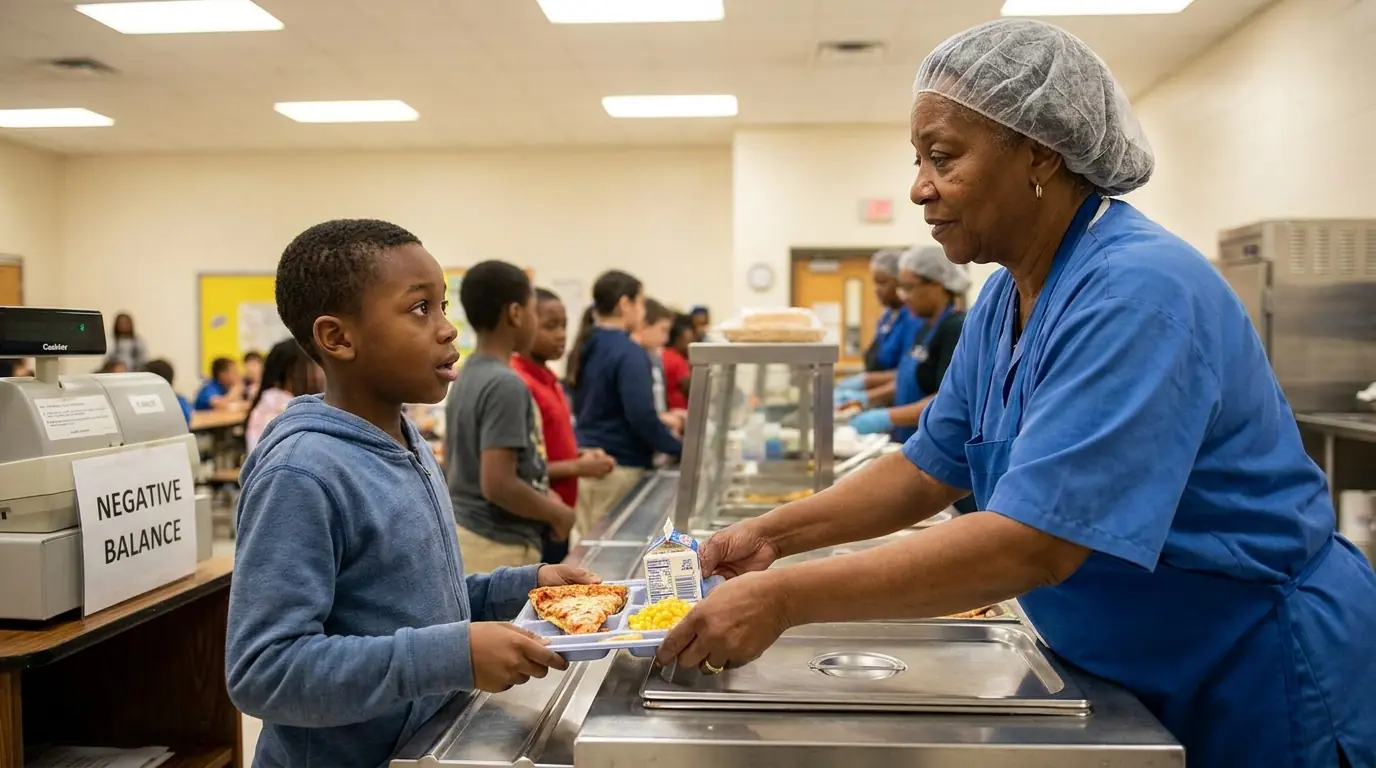
He stepped forward and hugged her.
For a moment, he was ten again.
Then he was gone.
College was hard, but Marcus worked harder. He called Beatrice every Sunday evening after calling his mother. He told her about classes, exams, projects, and cafeteria food he claimed was “scientifically disappointing.”
Beatrice mailed him cookies, handwritten recipes, and sometimes twenty-dollar bills hidden inside church bulletins.
He always called to protest.
She always hung up.
After graduation, Marcus worked for a company designing energy-efficient kitchen equipment for schools, shelters, and community centers. His specialty became low-cost systems that kept food hot safely without expensive infrastructure. He said too many children lost meals because schools lacked the equipment to distribute them well.
Beatrice bragged about him constantly.
“My Marcus designs machines that feed children,” she told everyone.
No one corrected the “my.”
But while Marcus’s life expanded, Beatrice’s became harder.
At eighty-two, her wrists ached too badly to lift heavy pots. The school district finally made her retire after a minor fall near the storage room.
She hated retirement.
Her apartment was small and quiet. Her pension was modest. Medical bills took more than expected. The old cafeteria had been her purpose, her social life, and her way of loving the world. Without it, the days stretched too long.
She still volunteered at church, but her body no longer moved as easily. She began skipping meals because cooking for one felt pointless. Then because groceries cost too much. Then because she did not want anyone to know.
One afternoon, Denise visited and found only tea, bread, and a jar of peanut butter in Beatrice’s kitchen.
“Miss Bea,” she said softly.
Beatrice turned from the sink. “Don’t start.”
“You need food.”
“I have food.”
“You have ingredients for sadness.”
Beatrice tried to laugh, but Denise’s eyes filled.
“Does Marcus know?”
“No. And you won’t tell him.”
Denise folded her arms. “That boy is grown now. You don’t get to protect him from loving you.”
Beatrice looked away.
But Denise told him anyway.
The next weekend, Marcus arrived in Dayton.
He was twenty-nine now, tall, broad-shouldered, with kind eyes and the calm focus of a man who had turned his childhood pain into purpose. He found Beatrice at her apartment table, pretending to work on a crossword puzzle.
“You came all this way for nothing,” she said.
He placed a grocery bag on the counter. Then another. Then another.
“No,” he said. “I came because you forgot your own rule.”
“What rule?”
“Children don’t stop needing food just because they grow up. And people don’t stop needing care just because they get old.”
Beatrice’s mouth trembled.
“I fed you because you were a boy,” she said.
“And I’m feeding you because you’re family.”
He cooked dinner that night using her own recipe: chicken and rice with green beans, rolls, and peach cobbler. Denise came. So did Mrs. Alberta from church. Beatrice complained that everyone had conspired against her.
They agreed.
After dinner, Marcus opened a folder.
Beatrice narrowed her eyes. “Folders are trouble.”
“This one is good trouble.”
Inside were plans, drawings, funding documents, and a photograph of Roosevelt Elementary’s old cafeteria.
Marcus explained that the school district was building a new community education center on the site of an unused wing. He had partnered with a nonprofit, his company, and local donors to create a full food access program for children and seniors: hot after-school meals, weekend grocery packs, summer lunches, and a teaching kitchen where students could learn cooking, budgeting, and nutrition without shame.
Beatrice stared at the papers.
“What does that have to do with me?”
Marcus slid the final drawing across the table.
It was a sign.
THE BEATRICE WALKER FAMILY KITCHEN
Food Is Not A Prize. It Is Lunch.
Beatrice covered her mouth.
“No.”
“Yes.”
“Marcus…”
“You said that to me the first day you gave me a hot tray.”
“I remember.”
“So do I.”
Her eyes filled.
He continued, “I spent years designing equipment, writing grants, and building systems because you taught me that hunger is not a character flaw. It is a problem adults should solve. This kitchen will feed children before school, after school, during summer, and on weekends. It will also serve seniors in the neighborhood who are quietly skipping meals.”
Beatrice looked down.
Marcus’s voice softened. “People like you.”
She shook her head. “I don’t need my name on anything.”
“I know,” he said. “That’s why it belongs there.”
The Beatrice Walker Family Kitchen opened the following spring.
The old school cafeteria had been transformed. Bright windows, long tables, new equipment, storage shelves, and a warm teaching kitchen filled the space. There was a pantry with fresh produce, a weekend meal-packing station, and a quiet corner where children could eat breakfast without feeling watched.
On opening day, Beatrice wore a purple dress and comfortable shoes. Marcus insisted on escorting her through the front doors.
Children stood in two lines, holding paper lunch bags decorated with hand-drawn hearts.
Beatrice stopped.
“What is all this?”
Marcus smiled. “A welcome.”
Mrs. Lyle, the old cashier, now retired, came forward wiping tears. “Bea, you really did it.”
“I did nothing,” Beatrice whispered.
Marcus leaned closer. “You fed one boy. Then another. Then another. This is what that became.”
During the ceremony, Marcus spoke.
“When I was ten,” he said, “I stood in this cafeteria with a negative lunch account and an empty stomach. I was given a cold alternate meal because paperwork had gone missing. Then Beatrice Walker placed a hot tray in front of me and said, ‘Food is not a prize. It is lunch.’”
Beatrice lowered her head, crying.
“That sentence changed my life,” Marcus continued. “She protected my dignity before I even understood what dignity was. She helped my mother when the system made her feel invisible. She fed me, taught me, believed in me, and never once made kindness feel like debt.”
He turned to her.
“This kitchen exists because no child should have to earn the right to eat, and no elder should be too proud or too forgotten to be fed.”
The room applauded.
Beatrice could not speak.
After the ribbon was cut, Marcus placed a key in her hand.
“What is this?” she asked.
“The first key to the kitchen.”
“I’m retired.”
“You are the founder.”
“I am not.”
“You are,” he said gently. “You founded it the day you fed me.”
Years passed, and the kitchen flourished.
Every morning, children came for breakfast. Every Friday, volunteers packed weekend bags with fruit, soup, pasta, vegetables, and handwritten notes. In summer, families came for lunches. On Wednesdays, seniors gathered for hot meals and conversation.
Beatrice came three times a week at first.
Then twice.
Then once, when her knees worsened.
But every time she entered, children shouted, “Miss Bea!”
She pretended to be annoyed.
She was not.
One winter afternoon, a small boy stood near the serving line, staring at his tray with tears in his eyes.
Beatrice, now eighty-seven and walking with a cane, noticed him immediately.
She moved slowly toward him.
“What’s wrong, baby?”
He whispered, “I forgot my lunch card.”
The young volunteer began to explain that cards were no longer needed, but Beatrice gently raised one hand.
She looked at the boy and said, “Food is not a prize.”
The boy blinked.
“It’s lunch,” she finished.
Across the room, Marcus stood beside the kitchen door, watching.
His eyes filled.
Later, he sat with Beatrice at one of the long tables while children ate around them.
“You know,” she said, “I used to think I was just serving food.”
Marcus smiled. “You were serving futures.”
“That sounds fancy.”
“It’s true.”
She looked around the room: the children eating without shame, the seniors laughing over soup, the volunteers packing bags, the warm lights glowing over the kitchen that carried her name.
“I had thirty-two years in that cafeteria,” she said softly. “I thought retirement meant I was finished.”
Marcus took her hand.
“You were never finished,” he said. “You were becoming a beginning.”
Beatrice smiled through tears.
Long ago, an old cafeteria worker had placed a hot tray in front of a hungry boy when the rules said he should receive less. She had packed lunch bags, found him a coat, helped his mother, and protected his dignity with the fierce tenderness of someone who knew hunger too well.
She thought she was feeding one child.
But one child grew into a man who built a kitchen.
And that kitchen fed hundreds.
So in the end, Marcus did pay her back.
Not with the dollar bill and coins he had once tried to give her.
Not with a gift that could fit in her hands.
He paid her back by making sure her kindness kept feeding people long after her own hands grew too tired to lift a tray.