Marjorie Ellis was seventy-seven years old and still opened Ellis Corner Store every morning at seven, even though the neighborhood around it had changed so much that some days she felt like a photograph left in the wrong frame.
The store sat on a corner in Dayton, Ohio, across from a small park with cracked basketball courts and two old sycamore trees. Its brick walls had faded. The green awning above the front door had one corner that sagged when it rained. The sign in the window still read:
Ellis Corner Store
Snacks, Groceries, Coffee, Ice Cream
The word Ice Cream had been painted by her husband, Walter, thirty-eight years earlier, back when they kept a little freezer by the register filled with popsicles, fudge bars, orange creamsicles, and strawberry ice cream cups that children bought with sticky quarters after school.
Walter had been gone for nine years.
But Marjorie still kept that freezer.
Even when the motor hummed too loudly. Even when the repairman told her it would be cheaper to replace it. Even when the big convenience store on the main road sold more flavors, brighter packaging, and colder drinks.
She kept it because Walter had loved watching children choose ice cream.
He used to say, “A child deciding between chocolate and strawberry is doing important work.”
Marjorie would roll her eyes and say, “The important work is making sure they pay first.”
But she had loved it too.
The store had once been busy from morning until night. Parents stopped for milk. Workers bought coffee. Kids bought candy after school. Elderly neighbors bought bread and stayed to talk. Walter knew everyone’s favorite ice cream. Marjorie knew who needed credit until Friday and who would be offended if she offered it too directly.
But time had thinned the business.
People drove to supermarkets now. Young families used delivery apps. The new convenience store had gas pumps, hot food, bright lighting, and a coffee machine that made six kinds of drinks Marjorie considered unnecessary.
Her daughter, Pamela, called from Cincinnati twice a week.
“Mom, you don’t have to keep the store,” she said. “You could sell the building and move closer to me.”
Marjorie always answered, “People still need bread.”
“There are other places to buy bread.”
“Yes,” Marjorie said. “But not from me.”
Pamela would sigh, and Marjorie would change the subject.
The truth was, the store was becoming too much.
The refrigerator case leaked. The roof needed repair. The floor near the back room had softened from old water damage. The ice cream freezer still worked, but barely. Marjorie’s knees hurt after standing too long, and her hands shook when she counted coins at the end of the day.
Still, every morning, she unlocked the door, turned on the lights, brewed coffee, wiped the counter, and checked the freezer.
“Morning, Walter,” she would whisper.
Then she would begin.
One brutally hot July afternoon, the temperature in Dayton climbed past ninety-eight degrees.
Heat shimmered above the sidewalk. The park across the street sat nearly empty, except for two boys under a tree and one man asleep on a bench with a newspaper over his face. Cars moved slowly. The air felt thick enough to chew.
Marjorie had just finished restocking bottled water when she heard a sharp shout outside.
“No, no, no, come on!”
She looked through the front window.
Across the street, near the park entrance, a young man stood beside a small pushcart painted blue and white. A striped umbrella tilted above it. On the side of the cart were hand-painted words:
Leo’s Homemade Ice Cream
Mango, Vanilla Bean, Chocolate, Strawberry
The young man was maybe twenty-four, tall and thin, with curly black hair, brown skin, and a white T-shirt already soaked through with sweat. He had both hands pressed against the side of the cart, staring at the little generator attached to the back.
The generator coughed once.
Then went silent.
The young man tried to restart it.
Nothing.
He opened the cart lid, and a cloud of cold air escaped too quickly into the heat.
Marjorie saw his face change.
Panic.
She knew that look.
It was the look of someone watching work turn into loss by the minute.
She grabbed her cane and stepped outside.
The heat hit her like a wall.
By the time she reached the curb, the young man had both hands in his hair.
“You all right?” Marjorie called.
He turned quickly.
“Yes, ma’am. I mean, no. I’m sorry. I’m not blocking your store, am I?”
“You’re across the street. If you blocked me from there, I’d be impressed.”
He gave a nervous laugh, then looked back at the cart.
“My freezer died. Or the generator did. I don’t know. I’m supposed to serve at the children’s reading event in the park at three. They paid me for sixty cups. If the ice cream melts, I lose the money, and the kids don’t get anything.”
Marjorie looked toward the park pavilion.
A few folding tables were already set up. A banner hung between two posts:
Summer Reading Celebration
Children would be arriving soon.
She looked back at the cart.
“What’s your name?”
“Leo.”
“Leo what?”
“Leo Martinez.”
“Marjorie Ellis.”
He glanced at the store sign.
“You own the corner store?”
“For my sins and blessings.”
Despite the heat, he almost smiled.
Marjorie stepped closer to the cart.
“How much ice cream is in there?”
“Four tubs. Maybe five gallons total. I made it last night at the community kitchen. It took forever. Mango is already softening.” He swallowed. “This is my first paid event.”
That changed everything.
First paid event.
Marjorie understood first chances. They were fragile things, often ruined by problems that looked small to everyone else.
A broken generator.
A hot day.
A melting tub of mango ice cream.
She pointed across the street.
“My store has a freezer.”
Leo blinked.
“What?”
“My store has a freezer. Old, loud, stubborn, but cold. Bring the tubs inside.”
“I can’t use your freezer.”
“You can if I open it.”
“But I don’t want to trouble you.”
“Young man, your ice cream is melting in July. Trouble is already wearing a hat and waving at us. Move.”
That snapped him into action.
Together, they lifted the tubs from the cart. Marjorie could not carry much, but she carried one small container with both hands while Leo handled the bigger tubs. They hurried across the street into Ellis Corner Store.
The little bell above the door jingled wildly.
Marjorie cleared space in the old ice cream freezer by removing popsicles, frozen fruit bars, and a box of ice cream sandwiches that had been sitting too long anyway.
Leo slid the tubs inside.
The freezer groaned under the sudden load.
Marjorie slapped the side of it.
“Don’t you dare embarrass me today.”
Leo stared.
“Does that help?”
“It has for thirty years.”
The freezer hummed louder.
Then steadier.
Leo exhaled.
“Oh my God.”
“Don’t thank heaven yet. Thank Walter’s freezer.”
“Walter?”
“My husband.”
Leo’s face softened.
“Is he here?”
“In a manner of speaking.”
Marjorie pointed toward the cart outside.
“Now what about your generator?”
Leo wiped sweat from his forehead.
“I don’t know. I borrowed it. It started fine this morning.”
“Who knows generators nearby?”
“I called the man from the community kitchen, but he’s across town.”
Marjorie went behind the counter and picked up the old landline.
“Then we call Harold.”
“Who’s Harold?”
“A man who claims he can fix anything that makes noise.”
She dialed from memory.
“Harold? It’s Marjorie. There’s a young man outside my store with a dead generator and ice cream trying to become soup. Yes, now. No, not after lunch. Bring tools. And don’t wear those sandals.”
She hung up.
Leo stared again.
“You just call people and tell them what to do?”
“At my age, that is one of the few remaining privileges.”
He laughed, but worry returned quickly.
“The event starts in twenty-five minutes.”
“Then we serve from here.”
“What?”
Marjorie looked toward the park.
“Kids can cross the street with adults. Or we carry cups over in batches with coolers. Do you have cups?”
“Yes.”
“Spoons?”
“Yes.”
“Labels?”
“Yes.”
“Common sense?”
He paused.
“Some.”
“Good. We’ll provide the rest.”
Leo stood very still for a second.
Then he whispered, “Why are you helping me?”
Marjorie opened a drawer and pulled out Walter’s old ice cream scoop.
The handle was red, chipped near the end, worn smooth from years of use.
“Because my husband would haunt me if I let ice cream melt across from a children’s reading event.”
Leo looked at the scoop.
Something in his face changed.
“Then I guess we better not disappoint him.”
For the next twenty minutes, Ellis Corner Store became an emergency ice cream station.
Marjorie cleared the counter. Leo brought cups, spoons, napkins, and handwritten flavor cards from the cart. Marjorie pulled two coolers from the back room, wiped them out, and filled them with ice packs she kept for deliveries. Leo checked the ice cream every few minutes until the tubs firmed up again.
At 2:58, the first group of children crossed from the park with the event coordinator, a woman in a yellow dress who looked deeply relieved.
“Leo, are you okay?” she asked.
“Generator died,” Leo said. “But Mrs. Ellis saved the ice cream.”
Marjorie corrected him immediately.
“The freezer saved the ice cream. I supervised.”
A little girl looked into the freezer.
“Is there mango?”
Leo smiled.
“Yes. Mango first?”
She nodded seriously.
Marjorie handed him Walter’s scoop.
Leo hesitated.
“I don’t want to use something special.”
“It’s a scoop. It was made to work.”
He took it carefully.
The first scoop curled perfectly into the cup.
Golden, cold, saved.
The little girl accepted it with both hands.
“This is good,” she announced after one bite.
Leo looked like he might cry.
More children came. Then parents. Then volunteers. The line stretched from the counter to the door. Some children wanted chocolate, others strawberry, others vanilla bean. Mango ran out first. Marjorie kept the line moving with the authority of a woman who had sold snacks to impatient children for decades.
“One flavor at a time.”
“Do not put your hand inside the spoon box.”
“Read a book before you ask for seconds.”
“If you drop that cup, gravity wins and you do not get to blame Leo.”
The children adored her immediately.
Harold arrived at 3:20 with tools and, thankfully, proper shoes. He examined the generator outside while Leo kept serving. By the time the event ended, Harold had found a clogged fuel line and a loose connection.
“Not dead,” Harold declared.
“Just dramatic,” Marjorie said.
Leo nodded toward the store freezer.
“I know something about dramatic equipment now.”
By four o’clock, all sixty cups were served, plus several extra Marjorie had insisted he sell to regular customers who wandered in.
The event coordinator paid Leo the full amount and booked him for two more summer programs.
Leo stood behind the counter after everyone left, holding the envelope of payment.
“I thought I’d lost it,” he said.
“You nearly did.”
He laughed weakly.
“Thank you for not pretending I didn’t.”
“Pretending wastes time.”
He looked at the red-handled scoop on the counter.
“I don’t know how to repay you.”
“You can start by returning my husband’s scoop.”
He quickly handed it over.
“I mean for everything.”
Marjorie wiped the scoop clean with a towel.
“Make more ice cream.”
“That’s it?”
“And buy a generator you trust.”
“I will.”
“And never open a freezer in July just to stare sadly at it.”
He smiled.
“I won’t.”
Before he left, Marjorie packed the leftover popsicles she had removed from her freezer into a bag and handed them to him.
“What’s this?”
“Inventory I needed to rotate.”
“I can’t take your inventory.”
“You can if it is becoming questionable.”
Leo looked at her with wet eyes.
“You really saved me today.”
“No,” Marjorie said. “We kept things cold long enough for you to do your job. That is different.”
“It feels the same.”
“It often does.”
The next morning, Leo came back with a container of mango ice cream.
“For you,” he said.
Marjorie looked at it suspiciously.
“I do not accept payment in dairy.”
“It’s not payment. It’s gratitude.”
“That sounds like payment wearing nicer shoes.”
He smiled.
“Please.”
She took it.
That evening, after closing, she sat behind the counter and tasted one spoonful.
Then another.
Then she looked toward Walter’s photograph on the shelf.
“Well,” she said softly, “the boy knows mango.”
Leo became part of the store after that.
At first, he came to buy ice, napkins, and bottled water before events. Then he came for advice. Then he came simply because Marjorie kept coffee on and told better stories than anyone he knew.
He had learned to make ice cream from his grandmother, who sold paletas from a cooler when he was a child. He wanted to build something small but real. Not a huge company. Not a trendy dessert brand that forgot the neighborhood. He wanted a cart, then maybe a small shop, where kids could afford a cup and adults could taste something that reminded them of home.
Marjorie listened.
“You need more than flavors,” she told him.
“What do you mean?”
“You need a system. Heat is your enemy. So is poor planning. So is undercharging because you feel guilty.”
Leo wrote that down.
“Don’t write everything I say.”
“Too late.”
She taught him what Walter had known: children took forever to choose, parents appreciated simple prices, napkins vanished faster than inventory, and the best businesses treated small customers with big respect.
Leo taught her about flavors.
Mango with lime.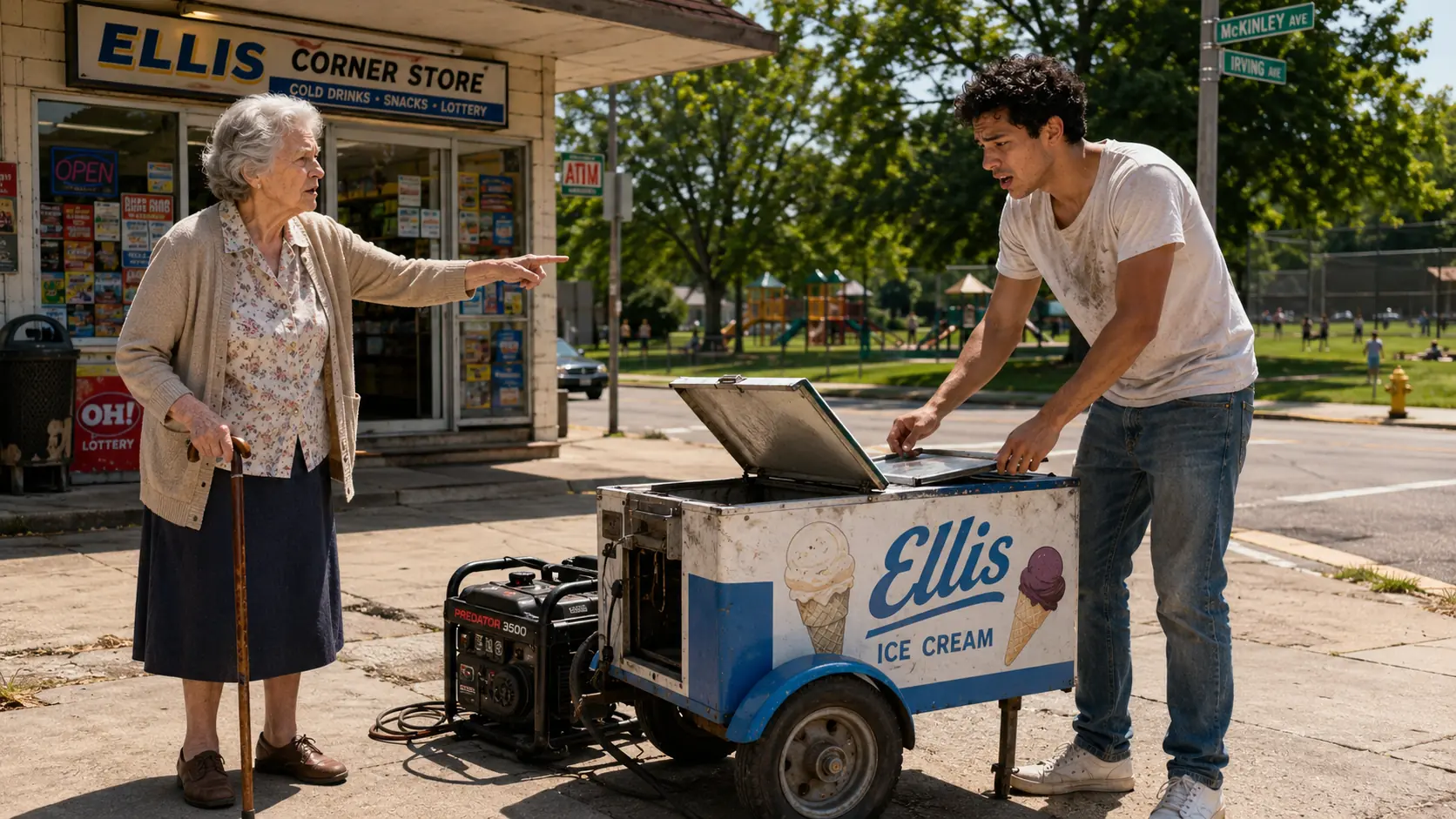
Chocolate cinnamon.
Strawberry basil.
Sweet corn.
Coconut pineapple.
Marjorie distrusted strawberry basil until she tasted it.
Then she said, “That is confusingly good.”
Leo treated it as a triumph.
Over the years, Leo’s business grew.
The cart became two carts. Then a small rented kitchen. Then a storefront called Leo’s Scoops near the library. He hired local teenagers and trained them to be patient with children, careful with food, and generous without giving away the business.
He never forgot the old freezer in Ellis Corner Store.
Every summer reading event, he brought ice cream.
Every July, on the anniversary of the day his generator died, he brought Marjorie a tub of mango.
She always said it was too much.
She always kept it.
As Leo’s life expanded, Marjorie’s store kept shrinking.
The new convenience store took more business. The refrigerator case finally failed and had to be replaced on credit. The roof leak spread toward the back shelves. The landlord who owned the block died, and his nephews inherited the property. They wanted to sell to a developer planning to turn the corner into a small apartment building with retail space below.
Marjorie received the first letter in April.
Then another in May.
By June, the message was clear.
Her lease would not be renewed unless she agreed to a rent increase she could not afford and costly repairs she could not complete.
She folded the letter and placed it beneath Walter’s ice cream scoop in the drawer behind the counter.
For two weeks, she told no one.
Not Pamela.
Not Leo.
She kept opening the store. Kept stocking bread. Kept making coffee. Kept selling popsicles to children with coins. But Leo noticed the change immediately.
He came in one afternoon with a cooler bag and found Marjorie standing beside the old ice cream freezer, her hand resting on the lid.
“You okay?” he asked.
“I am looking at inventory.”
“The freezer is empty.”
“Exactly. Easier to count.”
He set the bag down.
“What happened?”
“Nothing.”
“That word never means nothing.”
She looked at him sharply.
“You became annoying.”
“You trained me.”
He moved behind the counter, not because he owned the place, but because after years, he belonged there. He saw the drawer slightly open. Inside lay Walter’s red-handled scoop and the folded letter.
Marjorie did not stop him.
He read it.
His face changed.
“No.”
“That word does not affect rent.”
“They’re pushing you out.”
“They are raising rent.”
“To push you out.”
“Yes.”
The simple answer made him quiet.
He looked around the store.
At the shelves.
The coffee machine.
The freezer.
The window where children pressed their faces to choose ice cream.
The counter where Marjorie had handed him Walter’s scoop.
“You weren’t going to tell me?”
“I was going to tell you when I had solved it.”
“You can’t solve this alone.”
“I have solved many things alone.”
“And you helped me because I couldn’t.”
“That was different.”
Leo shook his head.
“No. It was the same. Something good was melting, and you opened the freezer.”
Marjorie looked away.
“I am old, Leo.”
“Yes.”
“The store is old.”
“Yes.”
“Maybe corner stores close.”
“Some do.”
“Then—”
“Do you want this one to close?”
She looked toward Walter’s photograph.
For a moment, the store was quiet except for the hum of the old freezer.
“No,” she whispered.
Leo nodded.
“Then I have a plan.”
Marjorie groaned.
“I dislike plans from young men with coolers.”
“This one has ice cream.”
“That improves nothing.”
But she listened.
Leo’s ice cream shop had grown enough that he needed a second location for production, storage, and community sales. He did not want a polished shop in a rich district. He wanted a neighborhood location where families could still afford treats.
His proposal was simple but strong.
Ellis Corner Store would become Ellis & Leo’s Corner Market, keeping groceries, coffee, bread, basic household items, and Marjorie’s old counter, while adding a small ice cream counter operated by Leo’s Scoops. Leo would lease part of the store, invest in repairs, replace the freezer, help modernize inventory, and bring in foot traffic through affordable neighborhood ice cream nights, reading rewards, and community events.
The store would not become only an ice cream shop.
It would remain a corner store.
But colder, brighter, and busier.
Marjorie stared at the folder he placed on the counter.
“You made charts.”
“Yes.”
“I distrust charts.”
“These charts like you.”
“I doubt that.”
She turned the pages.
Roof repair estimate.
Shared lease proposal.
Freezer replacement.
New cooler.
Store layout.
Coffee station update.
Affordable ice cream menu.
Neighborhood reading program.
A drawing of the front window with the old sign restored:
Ellis Corner Store
Groceries, Coffee, Ice Cream Since 1986
Below it, in smaller letters:
Home Of Leo’s Scoops
Marjorie’s finger rested on Walter’s word.
Ice Cream.
“You kept the old wording,” she said.
Leo’s voice softened.
“It was already right.”
She looked up.
“What do you get?”
“A place to serve the neighborhood that saved my first event.”
“The neighborhood did not save you.”
“You did.”
“I had a freezer.”
“And a scoop. And Harold. And the kind of bossiness that saves businesses.”
She tried not to smile.
“I do not want charity.”
“I’m not offering charity. I’m offering rent, repairs, customers, and mango.”
“Mango is not legally binding.”
“It should be.”
The work began in August.
Marjorie complained through all of it.
She complained about contractors.
She complained about the new freezer.
“The old one had character.”
“The old one was sweating on the outside,” Leo said.
“So do people. We don’t replace them.”
She complained about repainting the sign.
“Too bright.”
“It was unreadable.”
“It was subtle.”
“It was peeling.”
She complained about the new ice cream counter.
“It takes up too much space.”
“It replaces the shelf with expired crackers.”
“Those crackers were not expired by much.”
Leo looked at her.
She looked away.
“Fine. They were tired crackers.”
Pamela came from Cincinnati and cried when she saw the renovation.
“I thought Mom was going to lose the store,” she told Leo.
Leo looked toward Marjorie, who was scolding a painter for dripping on the floor.
“She almost did. Then she got stubborn with help.”
The reopening happened on a Saturday in September.
The weather was warm but gentle, the kind of day that made people forgive summer for being cruel. The green awning had been repaired. The shelves were cleaner but still familiar. The coffee station worked properly. The new freezer hummed quietly. The ice cream counter gleamed beside the register, with handwritten flavor cards:
Mango Lime.
Chocolate Cinnamon.
Vanilla Bean.
Strawberry.
Coconut Pineapple.
Walter’s Classic Fudge Cup.
Marjorie stared at the last one.
“You named a flavor after Walter?”
Leo nodded.
“Chocolate fudge with a little coffee.”
“He would have liked that.”
“I hoped so.”
“He would have said it needed peanuts.”
Leo smiled.
“Next batch.”
By noon, the store was packed.
Old customers came to see. Children came for ice cream. Parents bought bread and milk while waiting. The reading program from the park brought families over with coupons for small scoops. Elderly neighbors came for coffee and stayed because the store felt alive again.
At three o’clock, Leo tapped Walter’s scoop gently against a metal cup.
Marjorie immediately said, “No speeches.”
“One.”
“Too many.”
“Necessary.”
People gathered near the counter.
Leo stood beside the ice cream freezer.
“Years ago,” he began, “my generator died across the street in ninety-eight-degree heat. I had sixty cups of homemade ice cream for a children’s reading event, and I thought I was watching my first paid job melt.”
Marjorie looked down at the counter.
“Mrs. Ellis crossed the street, opened her freezer, called Harold, handed me Walter’s scoop, and helped me serve every child.”
His voice softened.
“She told me trouble had already arrived, so we might as well move. That day became the start of everything I built.”
Marjorie’s eyes stung.
Leo looked around the store.
“This corner store has been doing that for decades. Keeping milk cold. Coffee hot. Bread on shelves. Ice cream ready for children deciding important things. Today, we keep it open because places like this do not just sell things. They hold neighborhoods together.”
The applause filled the little store.
Marjorie pretended to rearrange napkins.
No one believed her.
Leo handed her a small box.
“I dislike boxes,” she said.
“Open it anyway.”
Inside was Walter’s red-handled scoop, polished, repaired, and engraved on the handle with tiny letters:
Still Serving
Marjorie stared at it.
“You engraved his scoop?”
“Yes.”
“That is sentimental.”
“Yes.”
“He would have laughed.”
“I know.”
She closed her hand around it.
Years passed, and Ellis & Leo’s Corner Market became one of the warmest places in the neighborhood.
Not fancy.
Not trendy.
Better than that.
Useful.
Children came after school for small scoops and homework reward coupons. Parents came for groceries and stayed for coffee. Elderly neighbors came for bread and conversation. Leo trained teenagers behind the ice cream counter, teaching them patience, food safety, and how to treat a child with one dollar like a customer worth respecting.
Marjorie worked shorter days, but she still opened most mornings. She still checked the freezer. She still talked to Walter’s photograph. She still told children not to press their noses against the glass because “the ice cream is not impressed.”
On Marjorie’s eighty-third birthday, Leo and Pamela organized a party in the store after closing.
Marjorie said she did not want a party.
They called it “inventory with cake and ice cream.”
She attended.
There were balloons, coffee, sandwiches, mango ice cream, Walter’s Classic Fudge Cup, and a cake shaped like the corner store sign. Marjorie said the cake had too much frosting. Then she asked for another slice.
At the end of the evening, a little girl from the reading program came up to her with a handmade card.
It showed Marjorie behind the counter holding a giant ice cream scoop like a queen’s staff.
Inside, it said:
Thank you for keeping the ice cream store open.
Marjorie read it twice.
Then she looked at Leo.
“This is your fault.”
He smiled.
“Probably.”
Later that night, after everyone left, Marjorie and Leo sat behind the counter with two small cups of mango ice cream.
The store was quiet.
The freezer hummed softly.
The green awning outside moved slightly in the night breeze.
“You saved my store,” Marjorie said.
Leo shook his head.
“You saved my first event.”
“I kept ice cream cold.”
“You kept me from giving up.”
She looked at him.
He smiled gently.
“Same thing, sometimes.”
Marjorie looked toward Walter’s photograph.
“I think he would like this.”
“The store?”
“The flavor.”
Leo laughed.
“We’ll add peanuts.”
“Good.”
Years earlier, Marjorie Ellis had helped a young man save his ice cream cart in brutal heat because his generator failed, his first event was melting, and children across the street were waiting.
She thought she had only opened a freezer, made a phone call, and handed him Walter’s old scoop.
But practical kindness can stay cold long enough to become a future.
Leo built his business from that day. And when Marjorie’s corner store was the thing in danger of melting away, he returned with a plan, repairs, customers, ice cream, and gratitude strong enough to keep the door open.
What Marjorie received was not only a saved lease or a repaired store.
She received Walter’s word on the sign restored.
Ice Cream.
She received children laughing at the counter, neighbors returning for bread, young workers learning responsibility, and a chosen grandson who understood that small businesses are not small to the people who need them.
And every hot afternoon, when a child stood in front of the freezer trying to choose between mango, chocolate, and strawberry, Marjorie would lean on the counter and say,
“Take your time. Important work should not be rushed.”