The snow began falling over rural Vermont before sunrise, quiet at first, almost gentle, as if winter had laid a soft hand over the roofs, roads, barns, and dark pine trees.
At dawn, it looked beautiful.
By noon, it looked dangerous.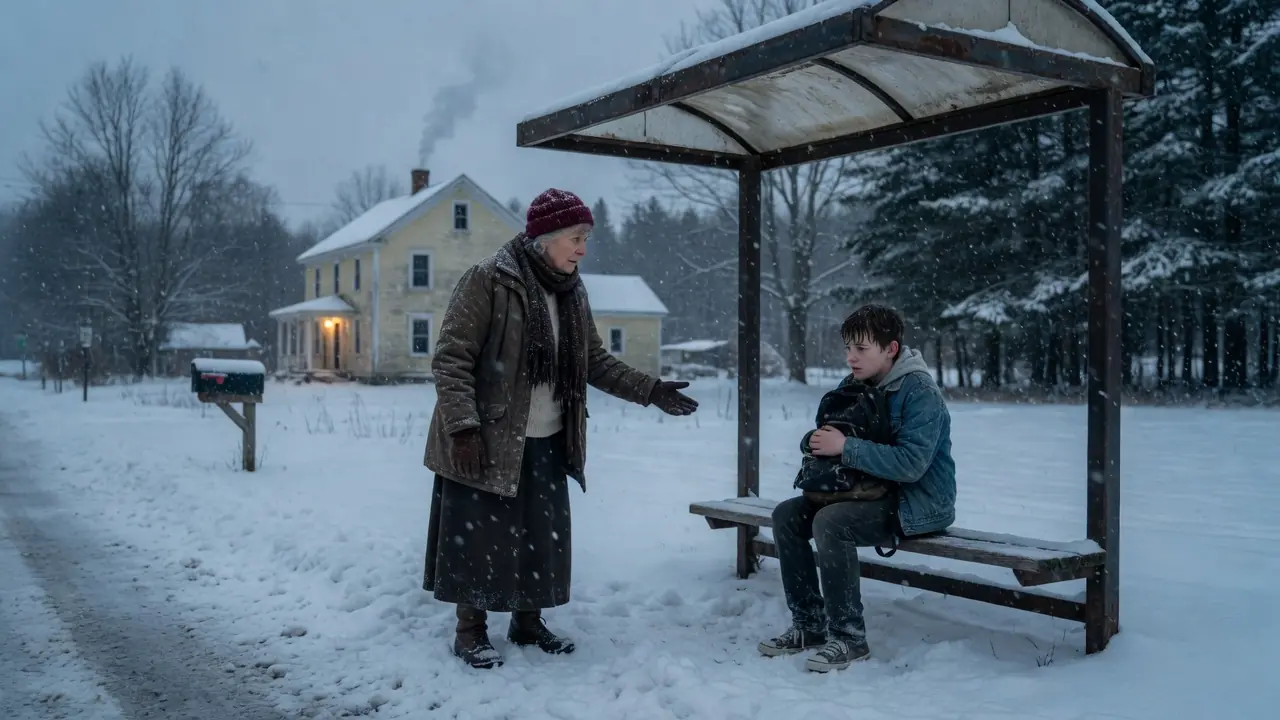
Wind pushed hard across the empty fields. Snow swept sideways over the narrow country road, covering tire tracks almost as soon as they appeared. The stone walls along the pasture had turned into soft white lines. The mailbox posts had become little frozen ghosts. Even the old maple trees, tall and stubborn as village elders, bent under the weight of ice.
The radio called it the worst storm of the season, but in the old yellow farmhouse at the end of Maple Hollow Lane, seventy-two-year-old Clara Whitaker had already stopped listening.
She stood at her kitchen counter, slicing potatoes for stew, while the windows rattled in their wooden frames.
The house was too large for one person.
Clara knew that better than anyone.
Once, the kitchen had been loud before storms. Her husband, Thomas, would carry firewood in from the shed and stomp snow from his boots while pretending he was not cold. Her daughter, Marlene, would sit at the table doing homework, complaining about algebra and stealing carrot slices from the cutting board. Later, her grandson, Eli, had spent summers there, running barefoot through the garden, leaving muddy fingerprints on the back door and asking for pancakes at impossible hours.
But Thomas had been gone for eleven years.
Marlene had moved across the country and called less often than both women pretended was normal.
And Eli, now grown, had built a life in another state, sending polite messages and birthday cards that arrived on time but never stayed for coffee.
So Clara had learned the sound of an empty house.
She knew the groan of the old pipes.
The sigh of the attic boards.
The sharp snap of the front porch when the wind leaned against it.
She knew how silence settled after dinner, heavy and patient, waiting for her to admit that no one was coming.
But Clara was not the kind of woman who surrendered easily.
She still woke before dawn.
She still baked bread on Wednesdays.
She still kept the bird feeder full, even though the squirrels robbed it like little criminals with tails.
She still put two logs on the fire before sunset, because Thomas had always said a fire should be prepared before the cold gets brave.
That afternoon, she was making stew because she always made stew when the weather turned mean. It was a habit from the years when she had fed neighbors, children, church friends, stranded drivers, and anyone foolish enough to get caught in winter without a plan.
Now there was nobody to feed but herself.
Still, she used the large pot.
Some habits were too stubborn to shrink.
She peeled the carrots slowly, using the same small knife Thomas had sharpened every fall. She cut onions even though they made her eyes water. She added bay leaves because Thomas had insisted stew without bay leaves was only soup with ambition. She salted carefully, tasted twice, and told herself she was not cooking too much.
The truth was that she always cooked too much.
A person who had spent fifty years feeding others did not easily learn how to make one bowl.
The phone rang while she was stirring the pot.
Clara wiped her hands on a towel and picked it up.
“Marlene,” she said, not needing the caller ID.
“Mom, are you watching the weather?”
“I’m watching potatoes soften.”
“Mom.”
“I heard the radio. Yes, it’s snowing.”
“It’s more than snowing. They’re closing roads. Eli texted me that your area is under a storm warning.”
Clara looked through the kitchen window. The field had disappeared behind a wall of white.
“Well, Eli is welcome to text the clouds and ask them to behave.”
Marlene sighed.
This had become the rhythm of their conversations: Marlene worrying from far away, Clara pretending she needed no worry at all.
“Do you have enough firewood inside?”
“Yes.”
“Food?”
“I’m standing over enough stew to feed the county.”
“Medicine?”
“Yes.”
“Power backup?”
“I have flashlights.”
“Mom, flashlights are not a power backup.”
“They are if the only thing you need power for is seeing.”
Marlene was quiet for a moment.
Then her voice softened.
“I just don’t like you being alone out there.”
Clara looked toward Thomas’s photograph on the wall near the pantry. He was standing beside the old tractor, smiling with one hand on his hip, his cap pushed back from his forehead.
“I know,” Clara said.
“We talked about this. Maybe after winter, you could think again about moving closer to us. There are nice senior communities here. You wouldn’t have to handle storms by yourself.”
There it was again.
The gentle suggestion wrapped around a hard truth.
Marlene wanted her to leave the farmhouse.
Not because Marlene was cruel.
Because she was afraid.
But the house was not only a building. It was Thomas’s laugh in the hallway. It was Marlene’s height marks still penciled beside the pantry door. It was Eli’s old toy truck buried somewhere under the porch, unless a raccoon had finally claimed it. It was every version of Clara that had existed before she became old enough for people to discuss her future in careful voices.
“I’m not ready to leave,” Clara said.
“Mom, being ready isn’t always the point.”
“It is when it’s my life.”
Marlene sighed again.
“I’m not trying to fight.”
“Neither am I.”
But they both knew they were.
After they hung up, Clara stood in the quiet kitchen with one hand still on the phone.
The storm pushed against the windows.
The house creaked around her.
For the first time that day, the silence felt less familiar and more like a question.
A little after four, Clara wrapped a scarf around her neck, pulled on her old brown coat, and went out to the porch to check the storm latch. The snow had already climbed over the first step. Her mailbox stood at the road like a lonely soldier, nearly hidden in white.
Across the field, she could barely see the shape of the old bus shelter near the county road.
Clara was about to turn back inside when she saw movement.
At first, she thought it was a branch caught in the wind.
Then it moved again.
Small.
Human.
Clara narrowed her eyes against the snow.
Someone was sitting inside the bus shelter.
She stood still, one hand on the porch railing.
The figure was hunched over, knees pulled close, arms wrapped around a backpack. The snow blew so thickly that he disappeared for a moment, then appeared again, like a memory trying not to be erased.
A child.
No.
A boy.
Clara’s chest tightened.
She looked back toward her warm kitchen, the stew, the fire, the old clock ticking on the wall.
Then she stepped off the porch.
“Lord, give me knees for this,” she muttered.
She was not as fast as she used to be. Her boots sank into the snow with every step. The wind slapped cold across her cheeks, and her breath came out in short white clouds. Still, she crossed the yard, passed the frozen garden beds, and made her way toward the road.
The boy did not look up until she was close.
He was perhaps thirteen or fourteen, thin under a gray hoodie that was much too light for the weather. His jeans were damp at the cuffs. His sneakers were not made for snow. Both hands clutched a worn backpack to his chest as if it held the last thing in the world that belonged to him.
His face was pale from cold, but his eyes were sharp.
Guarded.
Proud.
Too old for his age.
Clara stopped a few feet away, careful not to crowd him.
“You waiting for somebody?” she asked.
The boy stared at her.
His lips moved once before sound came out.
“Bus.”
“There won’t be another bus today.”
He looked away down the road.
“There might be.”
“No,” Clara said gently. “There won’t.”
The boy’s jaw tightened.
He did not argue, but he did not move either.
Clara studied him. She had raised a daughter, taught Sunday school for thirty years, and fed enough children to know when a young person was hungry, scared, and determined not to show either one.
“What’s your name?” she asked.
He hesitated.
“Jonah.”
“Jonah what?”
“Just Jonah.”
Clara accepted that.
“I’m Clara Whitaker. My house is right there.” She pointed through the snow. “There’s a fire going and stew on the stove. You can come warm up.”
“I’m fine.”
Clara looked at his shaking hands.
“No, you’re stubborn. Those are different things.”
His eyes flicked back to her, surprised.
For a second, something like annoyance gave his face color.
“I don’t need help.”
“I didn’t ask if you needed it,” Clara said. “I said it’s there.”
The boy gripped the backpack tighter.
“I can’t pay you.”
“I didn’t open a restaurant.”
“I don’t want trouble.”
“Neither do I. That makes two of us.”
The wind rose again, sending snow across the road in a hard white sheet. Jonah turned his face away, but his shoulders trembled.
Clara softened her voice.
“Come inside for twenty minutes. If you still want to sit out here after that, I’ll bring you a blanket and call you foolish from my porch.”
Jonah stared at her.
The smallest confused frown crossed his face, as if he had expected pity, anger, suspicion, anything but this old woman scolding him like he had tracked mud through her hallway.
His pride fought the cold.
The cold won.
He stood slowly, unsteady for only a moment.
Clara pretended not to notice.
“Mind your step,” she said, turning toward the farmhouse. “Snow hides every hole in this yard, and I’m too old to carry a boy taller than my tomato stakes.”
“I’m not that tall,” Jonah muttered.
“Then don’t prove it by falling.”
He followed her.
Inside the farmhouse, warmth met them at the door.
Jonah stopped just past the threshold, as though crossing into a house without permission still felt dangerous even after he had been invited. Snow melted on his sleeves. His hair, dark and flattened by the hood, dripped onto his forehead.
Clara shut the door and pointed to a mat.
“Shoes there. Coat on the chair. Backpack wherever you can keep an eye on it, since I can see you don’t trust me yet.”
Jonah blinked at her.
Then, silently, he set the backpack beside his chair but kept one hand near the strap.
Clara moved around the kitchen without fuss. She hung her coat, stirred the stew, and poured hot water into a mug. She added honey and lemon, then set it on the table in front of him.
“Drink slow.”
He looked down at the mug.
“What is it?”
“Not poison, if that’s your concern.”
His eyes rose sharply.
Clara gave him a dry look.
“Tea, Jonah. It’s tea.”
He wrapped both hands around the mug, letting the heat soak into his fingers. He did not drink at first. He just held it, watching her with the wary focus of someone who had learned that kindness often came with a hidden price.
Clara did not ask questions.
She went back to the stove.
The kitchen filled with the smell of beef stew, onions, potatoes, carrots, bay leaves, and black pepper. The fire cracked in the sitting room. The windows fogged at the edges. Snow whispered against the glass.
Jonah’s shoulders slowly lowered.
Only a little.
But Clara noticed.
She placed a bowl of stew on the table, then a thick slice of bread beside it.
“Eat,” she said.
“I’m not hungry.”
His stomach answered before Clara could.
A small, sharp sound broke the silence.
Jonah’s face tightened with embarrassment.
Clara turned away to fill her own bowl, giving him the mercy of not being watched.
“Then keep the stew company,” she said.
He ate.
At first, he took small bites, cautious and controlled. Then hunger overtook pride. He finished half the bowl quickly, slowed down, glanced at Clara as if expecting judgment, and found none.
She sat across from him and ate her own stew.
For a while, the only sounds were spoons against bowls and the storm outside.
Jonah looked around the kitchen.
There were old photographs on the wall. A young woman in a graduation gown. A smiling man holding a fishing pole. A little boy missing two front teeth, standing beside a pumpkin nearly as wide as his body. A wedding photo faded at the corners.
“You live here alone?” Jonah asked.
Clara nodded.
“Mostly.”
“Mostly?”
“The mice believe they have rights.”
Jonah looked at her.
Then, despite himself, he almost smiled.
Clara saw it and said nothing.
When he finished the stew, she offered more.
He shook his head too quickly.
“I’m okay.”
“Okay is not the question. More?”
He hesitated.
Then nodded.
She filled his bowl again.
After dinner, Clara gave him dry socks from a basket near the stove. They were wool, thick, and clearly too large. Jonah took them with suspicion.
“They were my husband’s,” Clara said. “He had feet like canoe paddles. You’ll survive.”
Jonah changed behind the mudroom door, then returned with the socks bunching around his ankles.
Clara pointed toward the sitting room.
“Fire’s warmer in there.”
Jonah carried his backpack with him.
He sat on the edge of the old sofa, never sinking fully into it, never leaning back. His eyes kept moving toward the doors and windows. Clara settled into her armchair with a quilt over her knees.
The house fell into a quiet that was different from the one before.
Not empty now.
Careful.
Jonah stared at the fire.
Clara picked up her knitting, though she only made three stitches in ten minutes.
Finally, Jonah spoke.
“I should go when it slows down.”
“It won’t slow down tonight.”
“I can walk.”
“No, you can’t.”
“You don’t know that.”
Clara looked at him over her glasses.
“You were shaking in a bus shelter with sneakers full of snow. I know enough.”
His face hardened.
“I said I’m fine.”
Clara set the knitting down.
“Listen to me, Jonah. You can be brave and still not be fine. Those things are allowed to stand in the same room.”
He looked away.
The firelight moved across his face.
“I don’t need anyone feeling sorry for me,” he said.
“Good. I don’t have the energy for pity.”
That made him look back.
Clara’s expression was steady.
“But I do have a sofa, stew, and more blankets than sense. Tonight, you can use them. Tomorrow, we decide what comes next.”
“We?”
The word came out sharp.
Clara nodded.
“We. Unless you plan to argue with the weather and win.”
Jonah said nothing.
But he stayed.
That night, Clara made up the sofa with two quilts and a pillow that had once belonged to Eli. Jonah kept his backpack under his arm even as he lay down. Clara pretended not to notice that either.
Before going upstairs, she paused in the doorway.
“Bathroom is down the hall. Kitchen is yours if you need water. Don’t open the front door unless the house is on fire, and if the house is on fire, wake me first because I still have opinions.”
Jonah looked at her from under the quilt.
“You talk a lot.”
“I live alone. My audience is usually a kettle.”
He almost smiled again.
Clara turned off the lamp.
“Goodnight, Jonah.”
There was a long silence.
Then, very quietly, he said, “Goodnight.”
Clara climbed the stairs slowly.
In her room, she sat on the edge of the bed for a long time.
She should have been afraid. A strange boy was sleeping downstairs. She knew that. But fear was not what moved through her chest.
It was memory.
Years ago, her grandson Eli had run into this house after falling from a tree, pretending not to cry. He had been ten, all elbows and pride, furious at the idea of being comforted. Clara had given him a biscuit, sat beside him, and talked about everything except the fall until he leaned against her shoulder.
Boys, she had learned, sometimes accepted love better when it came disguised as food, chores, or practical instructions.
Downstairs, Jonah did not sleep for a long time.
Clara heard the old floor creak. She heard him rise once, maybe checking the window, maybe checking if she had locked him in. She heard the refrigerator open, then close. She heard nothing else.
The storm continued all night.
By morning, the world had vanished.
Snow covered the porch steps, the fence, the garden, the road, and the bus shelter where Clara had found him. The farmhouse seemed to float inside a white silence.
Clara came downstairs before seven and found Jonah already awake in the kitchen.
He had folded the quilts perfectly.
He had washed his bowl from the night before.
He was standing at the sink, looking out at the storm.
“You’re up early,” Clara said.
Jonah turned quickly.
“Sorry.”
“For being awake?”
“For using the sink.”
Clara studied him.
“You apologize like someone trained you to take up less space.”
His face closed.
“I just said sorry.”
“I heard.”
She moved past him and started coffee.
Jonah shifted awkwardly.
“I can shovel.”
“No, you can eat.”
“I can shovel after.”
“We’ll discuss your career in snow removal after pancakes.”
He stared at her.
“You’re making pancakes?”
“I was thinking of eating wallpaper paste, but pancakes seemed kinder.”
The corner of his mouth twitched.
Over breakfast, Jonah ate four pancakes and tried to pretend the fourth was a favor to her. Clara let him have that pride.
Afterward, he insisted on clearing the table. Then he asked where the shovel was. Clara told him the snow was too deep and the wind too sharp, but Jonah was already putting on his damp sneakers.
Clara blocked the mudroom door.
“No.”
“I can help.”
“You can help by not turning yourself into a frozen fence post.”
His eyes flashed.
“I’m not useless.”
The words came out louder than either of them expected.
Clara went still.
There it was.
Not anger.
Fear wearing anger’s coat.
“I didn’t say you were useless,” she said quietly.
Jonah’s jaw tightened.
“People always act like I’m a problem. Like I’m something they have to deal with. I can work. I can carry stuff. I can fix things. I’m not some little kid.”
Clara’s face softened, but her voice did not.
“Then hear me like a young man and not a little kid. Helping is not the same as proving you deserve to exist.”
Jonah stared at her.
The words landed in the kitchen like a heavy object placed carefully on a table.
His eyes dropped first.
Clara stepped aside, opened the coat closet, and pulled out Thomas’s old winter boots.
“These are too big. Everything in this house is too big. Wear them anyway. We’ll shovel the porch together for fifteen minutes. Then you come back in before your toes start writing complaints.”
Jonah looked at the boots.
“You said no.”
“I changed my mind.”
“Why?”
“Because you need to help. And I need to not be bossy every second of the day.”
He looked at her with doubt.
“You’re still bossy.”
“Yes, but now I’m self-aware.”
He did smile then.
Small.
Brief.
But real.
They shoveled the porch together.
Jonah worked hard, too hard, pushing his thin body as if each scoop had to prove something. Clara let him work for a few minutes before handing him a smaller shovel and saying, “Smart work lasts longer than angry work.”
He rolled his eyes but took the shovel.
After fifteen minutes, his cheeks had color and his breathing was rough.
Clara pointed inside.
He opened his mouth to argue.
She lifted one eyebrow.
He went inside.
By the second day, the storm still held the road closed.
By the third, Jonah had stopped watching the door every minute.
He helped Clara bring in firewood from the covered rack beside the house. He repaired a loose handle on a kitchen drawer without being asked. He showed her how to reset the router when the internet returned. She showed him how to knead bread dough and told him he was attacking it like it owed him money.
“You said knead,” Jonah said.
“I said knead, not wrestle.”
They settled into a rhythm neither of them named.
Clara cooked.
Jonah cleaned.
Clara talked to the radio.
Jonah pretended not to listen.
At night, they sat by the fire. Clara knitted. Jonah examined the contents of his backpack with the secretive care of someone opening a small private world.
On the fourth evening, Clara saw what he kept inside.
A folded hoodie.
A paperback book.
A flashlight.
A small screwdriver set.
A photograph of a woman with kind eyes.
And a letter, worn soft at the creases.
Jonah caught her looking and zipped the bag quickly.
Clara looked back at her knitting.
“My daughter used to hide report cards under the couch,” she said. “As hiding places go, a backpack is respectable.”
Jonah did not answer.
A long silence passed.
Then he said, “That was my grandmother.”
Clara kept her eyes on the yarn.
“In the picture?”
He nodded.
“She raised me.”
Clara’s hands slowed.
“Is she still living?”
Jonah shook his head.
The fire cracked softly.
“She passed in October,” he said. His voice was flat, but Clara heard the effort beneath it. “After that, I stayed with my mom’s cousin for a while. She had her own kids. Her boyfriend didn’t want me there. Said I ate too much and looked at people like I was judging them.”
“Were you?”
Jonah glanced up.
Clara’s mouth curved slightly.
He looked down again.
“Maybe.”
“Continue.”
He took a slow breath.
“They said I could stay until after Christmas. Then yesterday, he told me it was enough. Said I should go find my aunt in Burlington. My grandmother wrote her address in a letter a long time ago. I thought I could take the bus.”
Clara’s needles stopped.
“In this storm?”
“It wasn’t this bad when I started.”
“You were going to Burlington alone?”
“I had money.”
“How much?”
He hesitated.
“Eighteen dollars.”
Clara closed her eyes for one second.
When she opened them, Jonah was staring at her with defiance already raised.
“I would’ve figured it out,” he said.
“I believe you would have tried.”
“That’s not the same thing.”
“No,” Clara said. “It isn’t.”
His expression tightened.
“I don’t want to go into some system. I don’t want strangers deciding where I sleep. I don’t want people looking through my bag and talking like I’m not in the room.”
Clara listened.
“I just need to get to my aunt,” Jonah said. “If she still lives there. If she remembers my grandma. If she says yes.”
There were too many ifs in the room.
Clara felt each one.
She folded her knitting in her lap.
“Tomorrow, when the lines are steady, we’ll call her.”
Jonah’s face changed.
“We?”
“Yes.”
“You don’t have to.”
“I know.”
“Then why?”
Clara looked toward the old photographs on the wall.
“Because once, many years ago, my grandson got lost at a county fair. He was only six. A woman selling lemonade kept him with her until we found him. She didn’t know us. She didn’t ask whether he deserved help. She just kept him safe.”
Her eyes returned to Jonah.
“I never forgot that woman. Mercy is something we pass along, or it dies with us.”
Jonah swallowed.
“What if my aunt doesn’t want me?”
The question was barely above a whisper.
There was the boy beneath the pride.
Clara answered carefully.
“Then we make another plan.”
His eyes filled, but he blinked hard and turned toward the fire.
“I hate plans.”
“No, you hate plans that depend on people leaving.”
He said nothing.
That night, Jonah left his backpack beside the sofa instead of under his arm.
Clara noticed.
In the morning, they called the number from the letter.
It rang six times.
No answer.
Jonah’s face became unreadable.
Clara hung up and tried again an hour later.
Still no answer.
By afternoon, the roads had begun to clear, but the county still warned against travel. Clara called an old friend from church who knew people in Burlington. Then she called the library there. Then a community center.
Jonah sat at the table pretending to read while listening to every word.
By evening, they had an answer.
The aunt had moved three years earlier.
No forwarding number.
Jonah stared at the table.
Clara could feel his disappointment from across the room.
He did not cry.
That worried her more.
“Well,” he said, standing abruptly. “Thanks for the food. I’ll go tomorrow.”
“Go where?”
He shrugged too hard.
“Somewhere.”
“No.”
His head snapped up.
“You can’t say no.”
“I just did.”
“I’m not your responsibility.”
“No,” Clara said. “You are not a package left on my porch. You are a person sitting at my table. That means what happens next matters.”
His voice rose.
“You don’t even know me.”
“I know you fix drawers when you’re nervous. I know you eat fast unless reminded there’s more. I know you fold blankets like someone afraid to be accused of making a mess. I know you loved your grandmother. I know you are tired of being passed from one maybe to another maybe.”
Jonah’s face trembled with anger.
Or sorrow.
Or both.
Clara stood, steady despite her aching knees.
“And I know this. No child should have to walk into a storm because every adult nearby decided he was someone else’s concern.”
The kitchen fell silent.
Jonah looked away first.
“I’m not a child,” he muttered.
“No,” Clara said softly. “You’re a boy who has had to act grown. That is not the same thing.”
His shoulders shook once.
He turned toward the window.
“I don’t know what to do,” he said.
Clara walked closer, but left space between them.
“Then for tonight, do nothing. Eat dinner. Sleep. Let tomorrow be tomorrow.”
He wiped his face quickly with his sleeve, angry at the evidence of feeling.
“Don’t be nice to me because you feel bad.”
“I am not that nice,” Clara said.
A weak laugh escaped him, broken and unwilling.
She smiled faintly.
“Sit down, Jonah. The stew is better the second day.”
The next morning, a woman named Denise Avery arrived from family services in a county truck with snow packed around the tires and worry written plainly across her face.
Jonah sat stiffly at the kitchen table when she came in.
Clara made tea.
Denise did not rush. That helped. She removed her gloves, accepted the mug, and sat across from Jonah as if she had all the time in the world.
“Jonah,” she said gently, “I know you’ve probably answered too many questions from too many adults.”
He said nothing.
“I’m going to ask some anyway. But I promise I will tell you why I’m asking.”
His eyes flicked toward Clara.
Clara remained by the stove, close enough to be present, far enough not to take over.
Denise asked about his grandmother.
His mother.
The cousin.
The boyfriend.
The bus shelter.
The eighteen dollars.
The aunt in Burlington.
Jonah answered in clipped sentences at first. Then, slowly, details came loose. His grandmother’s name was Ruth Alvarez. She had raised him from age four after his mother disappeared into addiction and then died when he was nine. Ruth had worked at a laundromat, saved coupons in a red tin, and believed every household needed a radio, a can opener, and one good blanket.
“She said if you have those three things, you can survive most bad days,” Jonah said.
Clara turned toward the sink so he would not see her face.
Denise listened.
She wrote carefully.
When Jonah finished, Denise looked at Clara.
“This is not simple.”
“Most things worth doing are not simple,” Clara replied.
Denise almost smiled.
“Mrs. Whitaker, are you willing to let Jonah remain here temporarily while we locate relatives and review the situation?”
Jonah’s head snapped toward Clara.
There it was again.
That flash of wanting and not trusting.
Clara met his gaze.
“Yes,” she said.
Denise nodded.
“There will be paperwork. Background checks. Home visits. School enrollment. Follow-up interviews. It may become complicated.”
Clara looked at Jonah.
He looked like a boy trying not to hope too loudly.
“Complicated has never frightened me much,” she said.
Jonah looked down at the table.
But his hand, resting beside the mug, stopped trembling.
The following weeks did not move like a miracle.
They moved like real life.
Slowly.
Messily.
With phone calls, forms, signatures, school records, medical appointments, and conversations that sometimes ended with Jonah shutting down completely. Clara learned that Jonah hated being asked where he wanted to be because choice had so often turned out to be an illusion. She learned he disliked closed doors but hated being watched. She learned he ate more when nobody commented on it.
She learned he had nightmares.
The first time it happened, she found him standing in the kitchen at 2:00 a.m., barefoot, breathing hard, holding his backpack.
He looked ashamed when she appeared in the doorway.
“I was just getting water,” he said.
Clara looked at the empty glass in his hand.
“Of course.”
He glared weakly.
“I don’t need some big talk.”
“That is fortunate,” she said. “I dislike large speeches before sunrise.”
She moved to the stove and warmed milk with honey because Thomas had always said it helped sleep, though Clara suspected Thomas had only said so because he liked warm milk.
Jonah sat at the table.
Neither of them discussed the nightmare.
When she placed the mug before him, he stared at it.
“My grandmother did this,” he said quietly.
“Smart woman.”
“She used cinnamon.”
Clara opened the spice cabinet.
“Then cinnamon it is.”
After that, cinnamon stayed near the stove.
The farmhouse changed in small, almost invisible ways.
A pair of boots appeared near the back door.
A backpack stayed on a kitchen chair.
A second toothbrush stood in the bathroom cup.
There were math worksheets on the table, library books on the sofa, and once, to Clara’s great confusion, half of a radio taken apart beside the breadbox.
“What happened to my kitchen?” she asked.
Jonah looked up from the tiny screws.
“Your radio was making a buzzing sound.”
“It was also making music.”
“It’ll make better music.”
“It is currently making pieces.”
He grinned.
Clara tried to stay stern, but failed.
At school, Jonah struggled at first. He was behind in some classes, ahead in others, and suspicious of anyone who asked personal questions. But he was bright. He understood machines quickly, read history with surprising interest, and wrote essays that made his English teacher call Clara one evening with a voice full of wonder.
“He notices everything,” the teacher said.
“Yes,” Clara replied. “That has been clear from the beginning.”
He still had hard days.
Some mornings he woke quiet and sharp-edged, as though the old fear had followed him into sleep and waited for him there. Some evenings he pushed Clara away with sarcasm and cold answers. Once, after a letter arrived from a distant relative saying they were “unable to take on more responsibility,” Jonah disappeared to the shed for two hours.
Clara found him sitting on an overturned bucket, staring at Thomas’s old tools.
“I’m not worth the trouble,” he said, not looking at her.
Clara’s heart hurt, but she did not rush him with comfort.
She sat on another bucket.
For a while, they listened to snow melting from the roof.
Then she said, “When Thomas planted apple trees, half of them leaned crooked. One almost snapped in the first wind. He staked it, watered it, fussed over it for years. That tree gives the sweetest apples now.”
Jonah scowled.
“I’m not a tree.”
“No. You talk back more.”
He sighed.
Clara continued.
“Worth is not measured by how easy someone is to care for. Easy things are not always valuable. Valuable things are often worth patience.”
He stared at the floor.
“You always have some old lady lesson ready?”
“I have lived seventy-two years. It would be embarrassing if I had learned nothing.”
He did not answer.
But when she stood, he followed her back inside.
Spring came.
The snow melted into streams along the roadside. The bus shelter reappeared, ordinary and small, almost innocent under the blue sky. Clara could not pass it without seeing Jonah there, curled around his backpack, too proud to ask for help and too cold to keep refusing it.
By April, the temporary arrangement became more stable.
By June, Jonah had his own room upstairs.
It had once been Eli’s summer room, with faded baseball wallpaper and a window overlooking the garden. Jonah did not ask to change it. He simply placed his grandmother’s photograph on the dresser, lined up his books, and arranged the screwdriver set near the lamp.
One evening, Clara found him standing in the doorway, staring at the room.
“You don’t like it?” she asked.
He shook his head.
“I do.”
“Then why do you look like someone gave you homework in another language?”
He rubbed the back of his neck.
“I’ve never had a room that felt like I could keep it.”
Clara’s throat tightened.
She stepped beside him.
“Well,” she said, “this room has survived peeling wallpaper, a leaky window, one squirrel in 1998, and Eli’s drum phase. I think it can survive belonging to you.”
Jonah looked at her.
His eyes shone.
Then he turned away quickly.
“Eli had drums?”
“Briefly, before I chose peace.”
Jonah laughed.
The sound filled the hallway.
Clara stood still after he walked into the room, listening to him open drawers, move books, claim space.
For the first time in years, the house did not feel too large.
It felt as if it had been waiting.
Summer deepened.
Jonah helped Clara in the garden, though he complained about weeding as if weeds were a personal insult. He repaired the bird feeder so well that even the squirrels looked offended. He learned to bake bread, though his first loaf came out so dense Clara said it could be used to hold down a roof in a hurricane.
He rolled his eyes.
Then made another loaf.
The first time Marlene visited, she arrived from Oregon with a suitcase, a rental car, and the unsettled look of a daughter who had rehearsed concern for several thousand miles.
She was not unkind.
But she was startled.
She looked at Jonah, then at the repaired kitchen drawer, the extra boots, the school calendar on the fridge, the second place setting at the table.
“Mom,” she said carefully, “you didn’t tell me it had become so permanent.”
Clara poured coffee.
“You didn’t ask it in a way that invited the answer.”
Marlene closed her eyes.
“I’m trying.”
“I know.”
Jonah stood near the sink, stiff as a fence post.
Marlene looked at him and softened.
“I’m Marlene,” she said. “Clara’s daughter.”
“Jonah.”
“I know. Mom told me about you.”
Jonah’s eyes moved to Clara.
“What did she say?”
“That you fix things.”
He seemed unsure what to do with that.
Marlene stayed three days.
The first day, she worried. The second day, she watched. The third day, she found Jonah helping Clara hang laundry in the yard while Clara scolded him for using too many clothespins.
That evening, Marlene stood beside her mother on the porch.
“He loves you,” she said.
Clara did not look at her.
“He has been careful not to say it.”
“So have you.”
Clara watched Jonah kneel near the garden fence, fixing a loose wire.
“I am old enough to know some words should not be forced before they are ready.”
Marlene nodded.
Then, quietly, she said, “I’m sorry I made you feel like I wanted to take you away from your life.”
Clara looked at her daughter then.
“I know you were scared.”
“I still am.”
“So am I.”
The confession surprised them both.
Clara looked toward the fields.
“But fear is not always a trustworthy advisor.”
Marlene laughed softly.
“You and your sentences.”
“They come with age.”
Before Marlene left, she gave Jonah a new winter coat. He stared at it like it was a trap.
“It’s just a coat,” she said.
“I have one.”
“You have a hoodie with ambition.”
Jonah looked at Clara.
“She talks like you.”
“Unfortunately,” Clara said.
He accepted the coat.
That winter, he wore it every day.
Years passed in the ordinary, miraculous way years do when people are safe enough to grow.
Jonah became taller than Clara by sixteen. By seventeen, he was fixing neighbors’ lawn mowers for money and saving nearly every dollar. By eighteen, he graduated with honors, wearing a suit Clara found at a thrift store and altered by hand at the kitchen table.
When his name was called, he walked across the stage with shoulders straight.
Clara stood in the crowd, clapping with both hands raised, not caring who saw her cry.
After graduation, Jonah studied mechanical engineering at a state college, close enough to come home on weekends, far enough to learn the size of his own life. He called Clara every Wednesday night because she insisted Sunday calls were “too predictable.”
He never forgot the farmhouse.
He never forgot the bus shelter.
And he never forgot the woman who did not ask for his whole story before giving him warmth.
Clara grew older.
She moved slower.
Her hands ached in the mornings. The stairs became less friendly. The garden became harder to manage, though she lied about that until Jonah caught her sitting on the porch one afternoon, breathing through pain and pretending to admire the clouds.
“You’re terrible at lying,” he said.
“I taught you sarcasm. Not disrespect.”
“You also taught me to notice things.”
“That was careless of me.”
By then, Jonah was twenty-four, broad-shouldered, steady-eyed, and still stubborn enough to argue with weather. He had finished school, started work designing heating systems for energy-efficient homes, and spent weekends helping repair houses for older people who wanted to stay where their memories lived.
That work had started with Clara.
Everything good in him, he believed, had started with someone opening a door.
One December morning, nearly ten years after the storm, Clara woke to the sound of trucks outside.
Not one truck.
Several.
She wrapped her robe around herself and hurried downstairs as quickly as her knees allowed.
When she opened the front door, she found Jonah standing on the porch with a toolbox in one hand and a grin he was trying to hide.
Behind him were friends, coworkers, neighbors, and former classmates. Some carried lumber. Some carried insulation. Someone held a new railing. Another stood beside a van marked with the name of Jonah’s company.
Clara stared.
“What is this?”
Jonah stepped forward.
“You once told me mercy has to be passed along.”
“I did not mean by turning my yard into a construction site.”
“Yes, you did. You just didn’t know it.”
She looked past him at the people unloading supplies.
“Jonah.”
He softened.
“The stairs are too steep. The heat leaks from the back wall. The porch railing is loose again. The bathroom needs safer flooring. You were going to hide all of that until something forced the issue.”
Clara lifted her chin.
“I was managing.”
He smiled gently.
“No. You were stubborn. Those are different things.”
The words struck her.
They were hers.
Returned after all these years.
Clara looked away, but Jonah saw her face tremble.
He lowered his voice.
“This isn’t charity.”
“I didn’t say it was.”
“You were about to.”
She gave a weak laugh.
He took her hand.
“You gave me a home when I had nowhere to put my fear. Let me make sure you can stay in yours.”
Clara closed her fingers around his.
For once, she had no lesson ready.
The repairs took three days.
Her house filled again with voices, footsteps, sawdust, coffee, sandwiches, and laughter. Jonah moved through it all like someone who knew exactly where every creaking board lived. He protected the old photographs. He labeled boxes. He argued with a contractor about preserving the kitchen shelves because “Mrs. Whitaker knows where everything is by muscle memory and judgment.”
Clara sat in her chair by the fire, watching him.
Not the frozen boy from the bus shelter anymore.
Not the guarded child clutching a backpack.
A man now.
A good one.
But still Jonah.
Still rolling his eyes when she corrected his grammar.
Still pretending he did not like extra biscuits.
Still fixing things when feelings became too large.
On the final evening, when the work was done, Jonah carried in one last object wrapped in brown paper.
He placed it above the kitchen table.
A framed photograph.
Clara stepped closer.
It was a picture taken that spring after Jonah moved into the upstairs room. He stood beside Clara in the garden, awkward and unsmiling, while she held a basket of apples and looked at him with pride she had not yet learned to hide.
Beneath the photograph, engraved on a small brass plate, were the words:
The door that opened became a home.
Clara covered her mouth.
Jonah stood beside her, quiet.
“I wanted you to have it,” he said. “In case you ever forget what you did.”
She shook her head.
“I only brought you inside.”
“No,” Jonah said. “You saw a boy in the cold and decided his future mattered before you knew his past.”
Clara’s eyes filled.
He continued.
“That taught me what love is supposed to do. Not ask who deserves warmth. Just offer it.”
Outside, snow had begun falling again.
Gentle this time.
Soft against the windows.
Clara looked toward the road, where the old bus shelter stood beneath a white roof. Years ago, that small broken shelter had held a boy with eighteen dollars, a backpack, and almost no hope. Now the house across from it glowed with light.
She looked at Jonah.
“You saved me too, you know.”
He frowned slightly.
“I was the one sitting in the storm.”
“And I was the one living like winter had moved inside and planned to stay.”
Jonah’s face softened.
Clara touched the frame.
“This house was quiet before you. Too quiet. I thought I was being strong by needing no one.”
Jonah smiled faintly.
“Turns out that’s not strength.”
“No,” Clara said. “It’s just loneliness wearing a proud hat.”
He laughed.
Then, carefully, he put his arm around her shoulders.
She leaned into him.
For a long moment, neither spoke.
The fire burned low.
The stew simmered on the stove.
The house, once too large for one woman, held the sound of two people who had chosen each other and stayed.
Years later, when Jonah told the story, people often focused on the storm.
They imagined the snow, the bus shelter, the old woman crossing the field, the boy too proud to ask for help. They spoke of rescue as if it had happened in one dramatic moment, as if opening the door had solved everything.
But Jonah knew the truth.
The rescue was only the beginning.
The real saving happened afterward.
It happened when Clara made breakfast the next morning.
When she called again after no one answered.
When she sat through forms, meetings, fears, and silence.
When she gave him chores without making him feel like a burden.
When she let him help, not because she needed proof that he was useful, but because she understood that dignity matters as much as shelter.
And Clara knew her own truth too.
She had thought she was giving warmth to a boy in a storm.
But warmth does not stay in one direction.
It returns.
It fills the rooms we thought would remain empty.
It repairs the railings, steadies the stairs, brings laughter back to old kitchens, and teaches the heart that it is never too late to belong again.
On winter nights, Clara still made stew in the large pot.
Not because she expected a crowd.
Not because she feared being alone.
But because somewhere in the world, someone might be cold.
Someone might be walking with pride as their only coat.
Someone might need a door opened before they had the strength to explain why.
And Clara Whitaker had learned the lesson well.
Kindness does not ask for a full story before offering a seat by the fire.
Sometimes, mercy begins with a bowl of stew, a pair of oversized socks, and an old woman saying, “Come inside. We’ll decide tomorrow when tomorrow gets here.”
That was how a frozen boy found a home.
And that was how a lonely old woman found her family again.