At seventy-eight years old, Eleanor Brooks no longer liked walking after sunset, but that evening she had no choice.
The pharmacy had taken longer than expected. Her blood pressure prescription had been delayed, the young clerk had apologized three times, and by the time Eleanor stepped back onto Maple Avenue, the sky over Harrisburg, Pennsylvania, had already turned deep blue. The air was cold enough to make her fingers ache around the handle of her cane.
She walked slowly past the closed bakery, past the laundromat humming under yellow lights, and toward the little side street that led to her house.
That was when she heard the sound.
A small metallic creak.
Eleanor stopped.
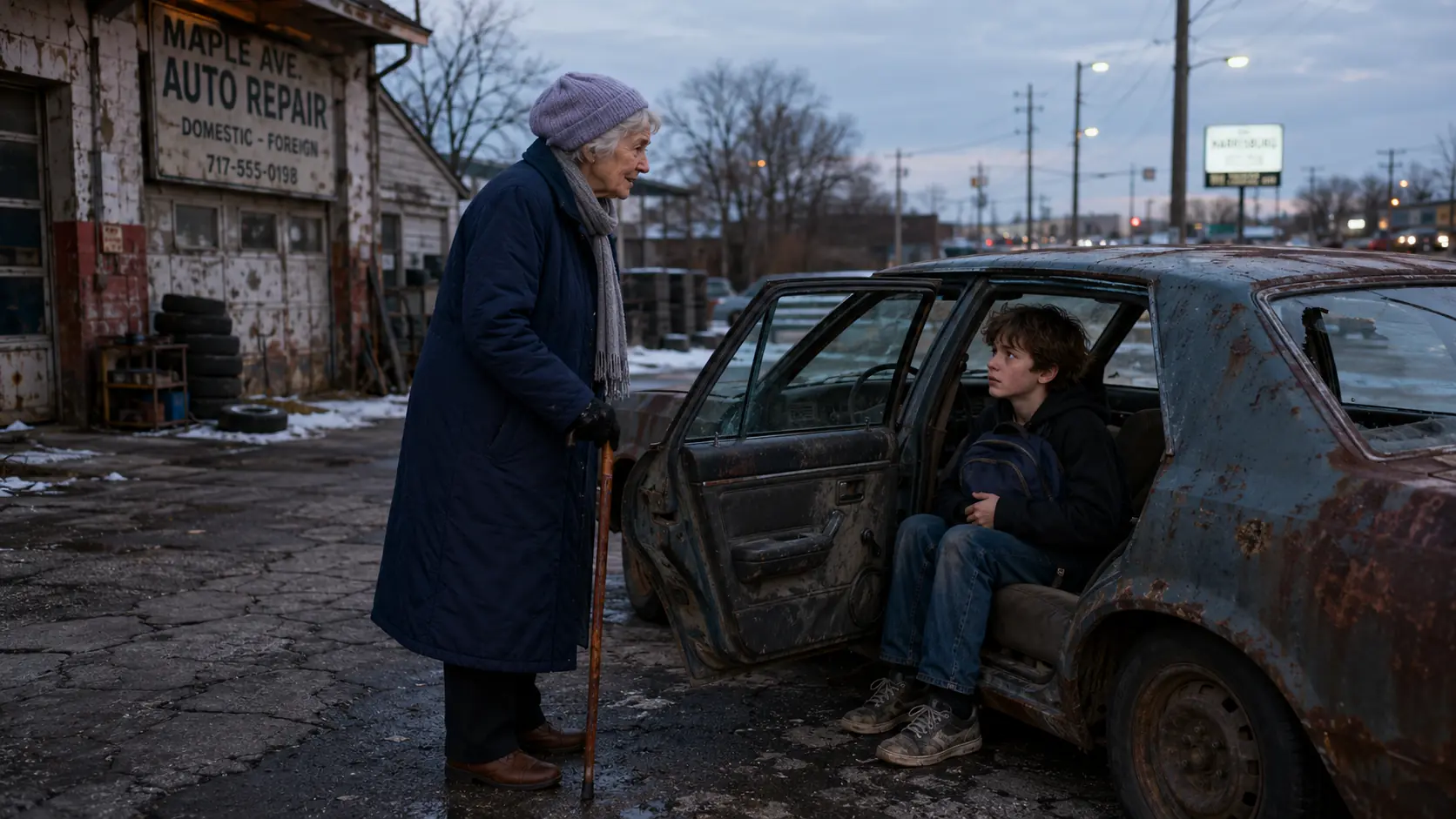
Across the narrow parking lot behind the old auto shop sat a rusted blue sedan that had not moved in years. Its tires were flat, its windows dusty, and its hood was spotted with old leaves. Most people ignored it.
But tonight, one of its doors was slightly open.
Eleanor narrowed her eyes.
Then she saw a small hand pull the door closed from inside.
Her heart tightened.
She crossed the parking lot carefully, her cane tapping against the cracked pavement.
“Hello?” she called.
No answer.
She came closer and peered through the fogged window.
A boy was curled across the back seat.
He looked about ten years old, with messy brown hair, pale cheeks, and a thin black hoodie pulled over his shoulders. A backpack sat beneath his head like a pillow. His sneakers were muddy, and he held a folded school jacket against his chest as if it were a blanket.
When he saw Eleanor, he sat up fast.
“I’m leaving,” he said through the glass.
Eleanor stepped back slightly so he would not feel trapped. “I didn’t ask you to leave.”
“I wasn’t stealing.”
“I didn’t say you were.”
The boy opened the car door just enough to look out. “Then what do you want?”
Eleanor studied him. His lips were pale. His hands were red from cold. The temperature would drop further before midnight.
“I want to know why a child is sleeping in an abandoned car,” she said.
“I’m not sleeping.”
“You were curled up like a cat.”
“I was resting.”
“In a car with no heat?”
He looked away.
“What’s your name?” Eleanor asked gently.
He hesitated. “Leo.”
“Leo what?”
“Leo Parker.”
“I’m Eleanor Brooks.”
He said nothing.
Wind moved through the parking lot, rattling a loose piece of metal on the old auto shop sign.
Eleanor pulled her coat tighter. “Leo, you can’t stay in there tonight.”
“I’m fine.”
“No, sweetheart. You are cold, alone, and trying to convince an old woman with bad knees that an abandoned car is a bedroom.”
His face flushed. “I have nowhere else.”
The words came out sharp, almost angry.
Then his eyes dropped, as if he regretted saying them.
Eleanor’s voice softened. “Where is your home?”
He hugged his backpack tighter. “Gone.”
“That is not an address.”
“They locked us out.”
“Us?”
“My mom and me.”
Eleanor looked around the parking lot. “Where is your mother now?”
“At work.”
“Does she know you’re here?”
Leo did not answer.
That answer was enough.
Eleanor took a slow breath. “When will she get off work?”
“Late.”
“How late?”
“Midnight. Maybe one.”
“And she thinks you’re where?”
He swallowed. “At our neighbor’s.”
“But you’re not.”
“The neighbor said I couldn’t stay tonight. Her boyfriend doesn’t like kids.”
Eleanor closed her eyes for a second.
When she opened them, Leo was watching her with the defensive look of a child waiting for judgment.
Instead, she said, “Come with me.”
He immediately shook his head. “No.”
“My house is two blocks away. It has heat, a telephone, soup, and a couch that has survived worse than muddy sneakers.”
“I don’t know you.”
“That is true.”
“I’m not stupid.”
“I did not think you were.”
“People act nice and then they’re not.”
Eleanor nodded slowly. “Some do.”
That seemed to surprise him. He had expected argument, not agreement.
“So why should I go with you?” he asked.
“Because I will walk in front of you, not behind you. You can keep distance. When we get to my porch, you can stand outside while I call your mother from the doorway. If she says no, I will call someone else safe. But you are not sleeping in that car.”
Leo looked at the sedan, then at the dark street, then at Eleanor.
His pride fought his fear.
The cold helped decide.
“Just to call my mom,” he said.
“Just to call your mom.”
They walked slowly to Eleanor’s house on Birch Street. Leo kept three steps behind her, clutching his backpack. Eleanor did not look back too often. She understood frightened children better than most people expected. For thirty-six years, she had worked as a school secretary. She had seen children arrive without coats, without lunch, without sleep, without anyone at home who had energy left to ask how they were.
She had learned that help had to be offered carefully.
Too much too fast could make a child run.
Her house was small and white, with green shutters, a porch swing, and a maple tree in the yard. The garden beds were bare for winter. Her late husband, Richard, had planted tulips there every spring. Since he died six years earlier, Eleanor had tried to keep them alive, but the garden had slowly grown thinner, as if it missed him too.
At the porch, Leo stopped.
Eleanor unlocked the door and turned on the hall light.
Warmth spilled out.
“You may stand right there,” she said. “I’ll bring the phone.”
She brought her cordless phone to the doorway and held it out.
Leo dialed from memory.
The phone rang four times.
Then a woman answered, breathless.
“Hello?”
“Mom?” Leo said.
The voice on the other end changed instantly. Eleanor could hear panic even from where she stood.
“Leo? Where are you? Mrs. Grant said you left. I’ve been calling everywhere.”
“I’m okay.”
“Where are you?”
“With Mrs. Brooks.”
Eleanor gently took the phone when Leo looked at her helplessly.
“Mrs. Parker? My name is Eleanor Brooks. I found Leo near the old auto shop. He is safe. He’s cold, but safe.”
A broken sob came through the phone.
“Oh God. I thought… I couldn’t leave work. If I leave early again, they’ll fire me. We got locked out this morning, and I thought he could stay with the neighbor until I got paid tomorrow. I didn’t know she sent him away.”
Eleanor looked at Leo, who was staring at the porch floor, ashamed of a situation he had not created.
“Where are you working?” Eleanor asked.
“St. Mary’s Hospital. Laundry department.”
“What time do you finish?”
“Midnight.”
“Then Leo will stay here until you can come.”
“No, ma’am, I can’t ask that.”
“You didn’t ask. I offered.”
“I don’t have money.”
“I didn’t ask for money either.”
The woman cried harder.
After Eleanor hung up, Leo looked ready to bolt.
“She said I can stay?”
“Yes.”
“Until midnight?”
“Yes.”
He looked into the warm hallway. “I don’t want to get dirt inside.”
Eleanor smiled softly. “Dirt and I have been enemies for decades. It always wins. Come in.”
He stepped inside.
Eleanor gave him a towel, a blanket, and a bowl of vegetable soup from the pot she had made that morning. She added toast with butter and a mug of hot chocolate. Leo sat at the kitchen table, stiff-backed, trying to eat politely, but hunger soon took over.
Eleanor pretended to search for something in a drawer so he could eat without feeling watched.
After the bowl was empty, she offered more.
He looked embarrassed. “Is there enough?”
“For soup? Always.”
He ate a second bowl.
Then he whispered, “Thank you.”
“You’re welcome.”
At midnight, his mother arrived.
Sarah Parker came to the door wearing a blue hospital uniform under a thin coat. She was thirty-two, with tired hazel eyes, dark hair falling loose from a bun, and the desperate look of someone who had spent the whole day one breath away from collapse.
The moment she saw Leo, she dropped to her knees and hugged him so tightly he squeaked.
“I’m sorry,” she cried. “I’m so sorry, baby.”
Leo clung to her. “I didn’t know where to go.”
“I know. I know. This is my fault.”
“No,” Eleanor said gently from the doorway.
Sarah looked up, face wet with tears.
“This is poverty’s fault,” Eleanor said. “And bad luck’s. And a landlord with poor timing. But no good mother working until midnight should have to choose between wages and her child’s safety.”
Sarah covered her mouth.
That night, Eleanor learned the rest.
Sarah and Leo had been evicted after falling behind on rent. Sarah’s hours had been cut, then changed, then increased only after the damage was done. A motel wanted more cash than she had. The shelter was full. Her paycheck would come the next day, but that did not solve the night in between.
Eleanor looked at the mother and son sitting at her kitchen table, both exhausted, both trying not to ask for too much.
“You’ll stay here tonight,” she said.
Sarah shook her head. “No. Mrs. Brooks, you’ve done enough.”
“I have two spare rooms.”
“We can’t impose.”
“You can sleep.”
“I can pay you Friday.”
“You can rest Friday too.”
Sarah tried to speak, but tears came instead.
One night became three.
Then a week.
Eleanor helped Sarah contact a housing advocate. She helped gather documents, made phone calls, and drove them to appointments in her old beige car. She gave Leo the small guest room that had once belonged to her grandson during summer visits. Leo kept his backpack packed beside the bed for the first four nights.
On the fifth night, Eleanor noticed he had placed his schoolbooks on the desk.
She said nothing.
But she smiled while washing dishes.
Leo began helping around the house. He took out trash, swept the porch, carried groceries, and once tried to fix the squeaky cabinet door with a butter knife.
“Tools, Leo,” Eleanor said. “We use tools, not breakfast weapons.”
He laughed.
It was the first real laugh she heard from him.
Sarah found temporary housing after two weeks, then a small apartment after two months. But she and Leo never truly left Eleanor. Every Sunday, they came for dinner. Sarah brought cornbread when she could. Leo helped in the yard, even though he knew nothing about plants at first.
“What are these?” he asked one early spring afternoon, pointing to green shoots near the porch.
“Tulips,” Eleanor said.
“They look like onions.”
“They are trying their best.”
Leo crouched beside them. “Do they come back every year?”
“If the bulbs survive.”
He touched the soil carefully. “So even if they disappear in winter, they’re not dead?”
Eleanor looked at him.
“No,” she said softly. “They’re waiting.”
Leo loved that.
Over the years, he became the keeper of Eleanor’s garden. At eleven, he learned to water without drowning roots. At thirteen, he planted marigolds around the mailbox. At fifteen, he built raised beds from scrap wood and grew tomatoes, basil, and peppers. By sixteen, he was reading books about landscape design and soil health.
Sarah watched her son in the garden one Sunday and whispered to Eleanor, “You gave him something to care about.”
Eleanor smiled. “He gave me the garden back.”
Leo worked hard in school. He became quiet, thoughtful, and patient. He did not like waste. He fixed things before replacing them. He noticed when people looked lost, the way Eleanor had noticed him.
When he graduated high school, he gave Eleanor a small clay pot with one tulip bulb inside.
“For winter,” he said. “So you remember it’s still alive under there.”
She cried.
He pretended not to see.
Leo earned a scholarship to study environmental design. He called Eleanor every Sunday. He sent photos of gardens, parks, community spaces, and once a picture of an abandoned parking lot he wanted to turn into “somewhere children don’t feel invisible.”
Eleanor printed that one and put it on the refrigerator.
Years passed.
Leo became a landscape architect, specializing in community gardens and safe outdoor spaces for low-income neighborhoods. Sarah became a supervisor at the hospital laundry department, then bought a small condo after years of saving. Every spring, Leo still came back to help Eleanor plant tulips.
But Eleanor grew older.
At eighty-six, her knees hurt too much for gardening. The porch steps became dangerous. The roof leaked over the back bedroom. The heating system failed twice in one winter. Her children urged her to sell and move into assisted living.
Eleanor understood their concern.
But leaving the house felt like leaving Richard, the porch swing, the tulips, the kitchen table where Leo had first eaten soup, and the rooms that had once sheltered a frightened boy and his mother.
She tried to hide the bills.
Leo found them anyway.
One Sunday afternoon, he arrived early and saw the repair estimates spread across the kitchen table.
“Grandma Eleanor,” he said quietly.
She closed her eyes. “You and that tone.”
“You should have told me.”
“I didn’t want to bother you.”
He sat across from her. “You found me in an abandoned car because I didn’t know who to bother.”
She looked down.
“You taught me safe people can be bothered,” he said.
Her eyes filled.
“I can’t keep up with the house,” she admitted.
Leo reached across the table and took her hand.
“Then we’ll help the house keep up with you.”
The work began that summer.
Leo organized contractors, volunteers, grants, and family help. Sarah cooked for the workers. Eleanor’s children contributed money and visited more often than they had in years. The roof was repaired. The porch was rebuilt with safer steps and a sturdy railing. The heating system was replaced. The garden beds were raised so Eleanor could tend them from a chair.
But Leo had one more plan.
He transformed the empty lot next to Eleanor’s house, long neglected and full of weeds, into a community garden.
There were vegetable beds for families, flower beds for seniors, benches under young trees, and a small shelter with a phone, first-aid kit, and resource board for people in crisis.
At the entrance stood a wooden sign:
ELEANOR’S GARDEN
A Safe Place To Grow.
Eleanor stared at it on opening day.
“No,” she whispered.
Leo stood beside her. “Yes.”
“I don’t need my name on a sign.”
“I know. That’s why it belongs there.”
She wiped her eyes. “I only brought you inside.”
Leo’s voice trembled. “You brought me out of the cold.”
The garden became a place of life.
Children came after school to plant vegetables. Seniors came to sit among flowers. Families picked tomatoes in summer. Volunteers distributed resource cards for housing help, food support, and emergency shelter. No child who came through the gate was treated like a problem.
Eleanor sat on her porch most afternoons, watching the garden bloom beside her house.
One evening, a boy around ten stood near the gate with a backpack on his shoulders, staring at the benches as if unsure whether he was allowed inside.
Eleanor noticed him immediately.
Leo, visiting that day, noticed too.
The boy looked at them and said, “I’m just waiting.”
Eleanor smiled gently. “Waiting is easier with soup.”
The boy stiffened. “I don’t have money.”
Leo looked at Eleanor.
Eleanor looked at Leo.
Then they both said, almost together, “We didn’t ask for money.”
The boy blinked.
And after a moment, he stepped inside.
Years later, people in the neighborhood would say Leo Parker built Eleanor’s Garden.
But Leo always corrected them.
“No,” he would say. “Eleanor planted it the night she refused to let a child sleep in an abandoned car.”
And Eleanor, who had once thought her house had become too quiet and too old, lived long enough to see children laughing beside her tulips, mothers resting on garden benches, and frightened people finding help before the cold could swallow them.
She had given Leo soup, warmth, and one safe night.
In return, he gave her back her home, her garden, and the joy of watching many lives begin again right outside her porch.