At seventy-eight years old, Martha Ellison still kept a pot of soup on the stove every Thursday evening.
It was an old habit from a life that no longer existed.
Years ago, Thursdays had been the busiest nights in her little house in Scranton, Pennsylvania.
Her husband, Walter, came home late from the rail yard.
Their two daughters rushed in from school hungry and loud. Neighbors sometimes stopped by with news, complaints, borrowed sugar, or children who needed watching for an hour.
Martha’s kitchen had always been ready.
Soup on the stove.
Bread wrapped in a towel.
Tea in the kettle.
A chair for whoever needed one.
But Walter had passed away twelve years earlier. Her daughters had grown up and moved away, one to Chicago and the other to South Carolina. They called often, visited when they could, and worried about Martha living alone in the old house on Oak Street.
“Mom, you don’t have to keep that big place,” her oldest daughter said every few months.
Martha always smiled and answered, “It’s not big. It’s just quiet.”
The truth was, the house felt too large only because no one ran through it anymore.
Still, every Thursday, Martha made soup.
She told herself it was practical. A pot could last several days. It saved money. It was easier than cooking new meals.
But deep down, she knew the truth.
Some part of her was still waiting for someone to come in cold and hungry.
One stormy Thursday in October, that someone did.
The rain began before sunset and turned heavy by six o’clock. It rushed down the gutters, slapped against the kitchen windows, and filled the street with shining black puddles. Wind pushed the bare branches of the maple tree against the side of the house like fingers tapping for attention.
Martha had just lowered the heat under the soup when she heard a knock.
It was not loud.
Not confident.
A small, quick knock.
Then silence.
Martha stood still for a moment, listening.
The knock came again.
She wiped her hands on a towel and walked slowly to the front door. Her knees hurt in wet weather, so she held the banister as she crossed the hall.
When she opened the door, she found a boy standing on her porch.
He was about eleven years old, with wet brown hair stuck to his forehead, pale cheeks, and a school backpack hanging heavily from one shoulder. His jacket was thin and soaked through. His jeans were dark with rain from the knees down. One hand clutched a folded paper, now soft and wrinkled from the weather.
The boy looked at her with frightened eyes.
“I’m sorry,” he said quickly. “I think I have the wrong house.”
Martha looked past him toward the street.
No car.
No adult.
No one calling his name.
“What house are you looking for, sweetheart?”
He looked down at the wet paper. “Mrs. Kline’s.”
Martha’s heart tightened.
Mrs. Kline had lived next door for thirty years, but she had moved to assisted living three months earlier after a fall.
Martha stepped onto the porch, holding the door open behind her so warm light spilled around them.
“Mrs. Kline doesn’t live there anymore.”
The boy’s face changed.
Not dramatically.
Not loudly.
But something inside him seemed to drop.
“Oh,” he whispered.
“What’s your name?”
He hesitated.
“Ryan.”
“Ryan what?”
“Ryan Cooper.”
“I’m Martha Ellison.”
He nodded toward the mailbox. “I know. It says Ellison.”
“So it does.” She studied him gently. “Why were you looking for Mrs. Kline?”
“My dad said if something happened and he couldn’t pick me up, I should go to Mrs. Kline’s house. He said she knew us from when we lived on this street.”
Martha remembered now.
The Coopers.
A young widowed father and a little boy who had lived in the small rental house at the corner for a short time years ago. The father had worked construction then, always leaving early and coming home tired. The boy had been much smaller, maybe six, usually carrying toy trucks in his hands.
“You’re Daniel Cooper’s son,” Martha said.
Ryan nodded.
“Where is your father?”
Ryan looked back toward the rain.
“He didn’t come.”
Martha kept her voice calm. “From where?”
“School. He always picks me up after my robotics club. But he didn’t come today. The office called his phone, but it went to voicemail. They let me wait until they had to close. I knew the bus route to Oak Street, so I came here.”
“You came here alone?”
His face tightened. “I knew the way.”
“In this storm?”
“I had to do something.”
Martha looked at him for a long moment. He was trembling now, though whether from cold or fear, she could not tell.
“Come inside,” she said.
He immediately shook his head. “I can’t.”
“Why not?”
“I don’t know you.”
“That is true.”
“My dad says not to go inside strangers’ houses.”
“Your dad is right.”
He looked confused. “Then why are you asking?”
“Because your dad also told you to come to Mrs. Kline if there was trouble. Mrs. Kline is not here anymore, but I am. And right now, you are cold, wet, and alone on my porch.”
Ryan looked toward the empty house next door again, as if hoping Mrs. Kline might suddenly appear.
Martha softened her voice.
“You can stand in the hallway while we call your father. The door can stay open until you feel safer.”
The wind blew rain across the porch and into his face.
That helped him decide.
He stepped inside.
Martha kept the front door open at first, just as promised. She handed him a towel from the hall closet and pointed to the little bench near the door.
“Sit there. Take off those wet shoes.”
“I don’t want to get your floor dirty.”
“Floors were invented to survive children and weather.”
He sat carefully.
Martha brought the phone from the kitchen.
“Do you know your father’s number?”
Ryan nodded and dialed with shaking fingers.
It went to voicemail.
He tried again.
Voicemail.
Again.
Voicemail.
His face grew paler with each call.
“He always answers,” Ryan whispered.
Martha felt worry move through her chest.
“Where does your father work now?”
“He drives for a delivery company. Medical supplies mostly. He said he had a long route today.”
“Do you know the company name?”
Ryan nodded and pulled a small card from the pocket of his backpack. The card was damp but readable.
Martha called.
The first person who answered did not know anything. The second person transferred her. The third person placed her on hold so long Ryan started breathing faster.
Finally, a dispatcher came on the line.
Martha explained who she was and that Daniel Cooper’s son was safe at her house.
There was a pause.
Then the dispatcher’s voice changed.
“Ma’am, Mr. Cooper was in an accident this afternoon.”
Ryan stood up so fast the towel fell from his shoulders.
“What?” he whispered.
Martha held up one hand gently, trying to keep him calm while she listened.
The dispatcher explained that Daniel’s delivery van had been struck by a pickup truck on a wet road outside town. He was alive. He had been taken to St. Vincent Hospital. His phone had been damaged in the crash. The company had been trying to reach his emergency contact, but the number listed was outdated.
Martha closed her eyes for one second.
Then she opened them and spoke clearly.
“His son is with me. I will bring him to the hospital.”
Ryan was staring at her.
“My dad?” he asked.
“He’s alive,” Martha said immediately. “He was in an accident, and he’s at St. Vincent. We’re going to him.”
Ryan’s lips trembled.
“Is he going to die?”
Martha crossed the hallway and crouched slowly in front of him, ignoring the pain in her knees.
“I do not know how badly he is hurt,” she said honestly. “But I know he is alive. And I know we are not going to stand here imagining the worst while he is waiting.”
Ryan nodded, but tears slid down his face.
Martha helped him put his wet shoes back on, wrapped a dry scarf around his neck, and grabbed her coat. She also filled a thermos with soup because old habits became instincts in a crisis.
The drive to the hospital took twenty-five minutes.
Ryan sat in the passenger seat, both hands gripping his backpack. Every few minutes, he asked a question Martha could not fully answer.
“Did they say if he was awake?”
“Did they say if he broke anything?”
“Did they say if he asked for me?”
Martha answered what she could and refused to lie about what she could not.
“He is at the hospital.”
“We are going to him.”
“One step at a time.”
At St. Vincent, the emergency room was bright, crowded, and tense. A nurse found Daniel Cooper’s name in the system and asked Martha who she was.
Before Martha could answer, Ryan said, “She helped me.”
The nurse looked at the soaked boy, then at the old woman beside him, and her expression softened.
Daniel was in a treatment room with a concussion, bruised ribs, a broken wrist, and a deep cut along his forehead. He was awake but groggy.
When Ryan saw him, he ran forward, then stopped at the side of the bed as if afraid to touch him.
“Dad?”
Daniel’s eyes opened slowly.
“Ryan?”
The boy broke.
He grabbed his father’s uninjured hand and sobbed.
“I went to Mrs. Kline’s, but she was gone. I didn’t know where to go. I’m sorry.”
Daniel tried to lift his head and winced.
“No, buddy. No. You did right. You did exactly right.”
Martha stood near the door, holding the thermos like a foolish offering in the middle of machines and medical curtains.
Daniel looked toward her.
“Mrs…?”
“Ellison. Martha Ellison. I live next door to where Mrs. Kline used to be.”
Daniel’s eyes filled with exhausted gratitude.
“Thank you,” he whispered. “Thank you for helping my son.”
“He knocked on the right door,” Martha said softly.
Daniel had no close family nearby. His wife had died when Ryan was four. His sister lived in Ohio, but she was caring for her own sick husband and could not come quickly. Daniel would need to stay overnight for observation, then rest for several days after discharge.
The nurse asked who could care for Ryan.
Daniel closed his eyes.
That question hurt him more than the broken wrist.
“I’ll figure something out,” he whispered.
Martha looked at Ryan, sitting beside the bed with red eyes and wet sleeves.
Then she heard herself say, “Ryan can stay with me tonight.”
Daniel looked at her sharply. “No. Mrs. Ellison, I can’t ask that.”
“You didn’t ask.”
“I don’t even know you.”
“That can be fixed faster than a broken wrist.”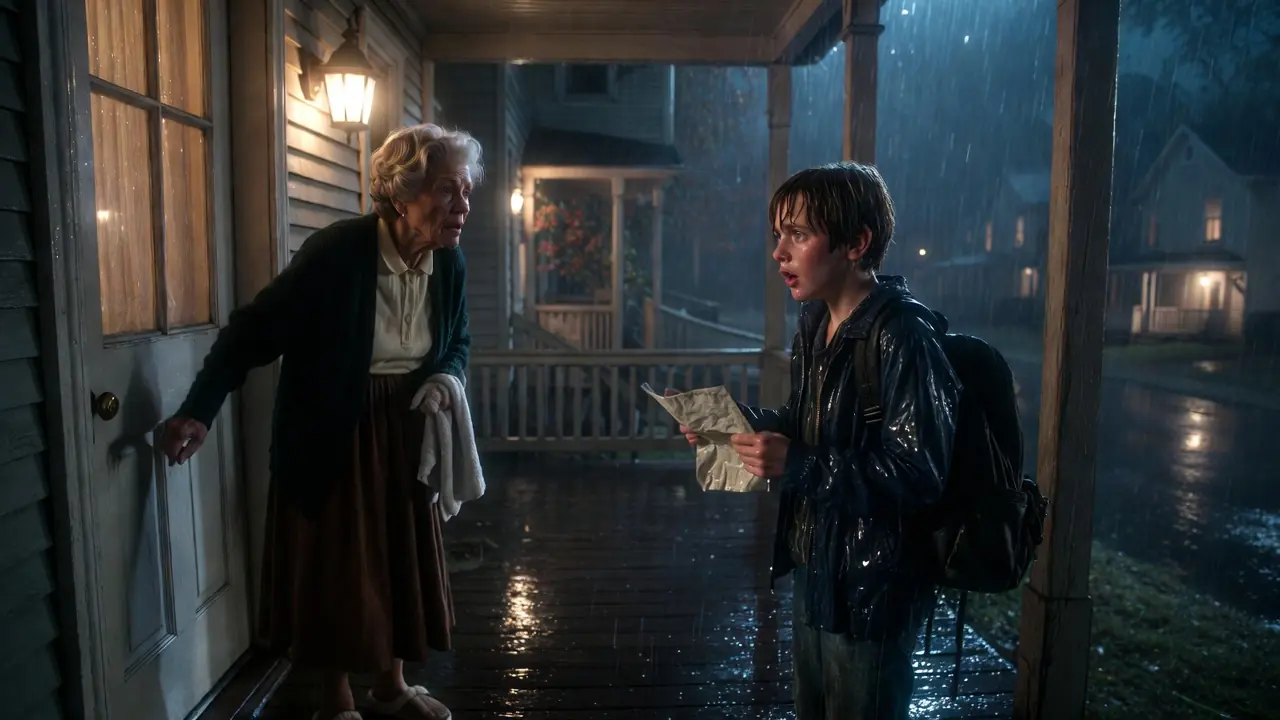
He tried to smile but failed.
“I can pay you when I’m back at work.”
“I didn’t mention money.”
Daniel’s face tightened with shame.
“We’re not in trouble like that. I mean, things are tight, but I work. I take care of him.”
Martha stepped closer to the bed.
“I believe you.”
Daniel stared at her.
“You do?”
“Yes.”
Those words seemed to loosen something in him.
His eyes closed, and tears slipped into his hairline.
Ryan stayed at Martha’s house that night.
He slept in the guest room, though he kept his backpack on the floor beside the bed. Martha left the hallway light on and told him where the bathroom was. Before bed, she gave him a bowl of soup he barely touched and promised they would return to the hospital first thing in the morning.
At 2 a.m., she found him sitting at the kitchen table.
“I couldn’t sleep,” he whispered.
“I suspected as much.”
“What if Dad can’t work?”
Martha sat across from him.
“Then he will heal first, and adults will figure out the rest.”
“I’m almost twelve. I can help.”
“You can help by being a boy who goes to school, sleeps, eats, and tells the truth when he’s scared.”
Ryan looked down.
“I hate being scared.”
“So do I.”
He looked surprised. “You get scared?”
“Of course.”
“But you’re old.”
“That gives me more things to be scared of, not fewer.”
For the first time all night, Ryan almost smiled.
Daniel was discharged the next afternoon, but he was in no condition to cook, clean, drive, or manage stairs. His small apartment was across town, up two flights, with no elevator. His broken wrist made everything harder.
Martha did not ask permission.
She made a plan.
Daniel and Ryan would stay in her house for a week.
Daniel refused.
Then refused again.
Then tried to stand too quickly and nearly fainted.
Martha pointed at the couch.
“Sit down before pride finishes what the accident started.”
Ryan laughed, then looked guilty for laughing.
Daniel gave in.
One week became three.
Daniel slept in the downstairs guest room. Ryan returned to school and came back to Martha’s house in the afternoons. Martha drove Daniel to follow-up appointments, helped him organize insurance papers, called his employer, and made sure he took medicine on schedule.
Daniel hated needing help.
Martha understood.
She never made him feel small for it.
“You are recovering,” she told him. “Recovery is not laziness.”
“I’m used to doing everything myself,” Daniel said one evening.
“That is not always a virtue.”
He looked at her.
She poured tea.
“My husband was the same way. Stubborn men think needing help is a character flaw. It is not. It is a human condition.”
Daniel smiled faintly. “You talk like a teacher.”
“I was one.”
“What grade?”
“Fourth.”
“That explains the authority.”
Ryan adapted faster than his father.
He did homework at Martha’s kitchen table. He helped wash dishes. He learned where she kept extra pencils, crackers, stamps, and batteries. He asked about the framed photographs in the hallway and listened as Martha told him about Walter, her daughters, and the life the house used to hold.
One afternoon, he found an old model train set in the closet.
“Was this your husband’s?”
“Yes. Walter loved trains.”
“Does it work?”
“I have no idea.”
Ryan’s eyes brightened. “Can we fix it?”
Martha looked at the dusty box.
Something inside her stirred.
“We can try.”
For the next two weeks, Ryan and Daniel worked on the train set at the dining room table while Daniel’s wrist healed. Martha watched as father and son cleaned tracks, checked wires, repaired a small engine, and laughed when the train finally moved in a shaky circle.
The house sounded alive again.
After Daniel recovered enough to return home, he and Ryan moved back to their apartment, but they did not disappear.
Every Thursday evening, they came for soup.
At first, Daniel said they did not want to impose.
Martha said she had been making Thursday soup for years and was tired of eating it alone.
So they came.
Ryan grew taller. Daniel regained his strength and returned to work, though he changed companies after the accident. He found a safer route position with better hours. He made sure his emergency contacts were updated. He gave Ryan a phone for emergencies, though Ryan still carried Martha’s number written on a card in his backpack.
The relationship became family before anyone named it.
Ryan helped Martha carry groceries.
Daniel fixed her porch railing.
Martha attended Ryan’s school events.
Ryan called her Grandma Martha by accident when he was thirteen.
Everyone pretended it was normal because, by then, it was.
Years passed.
Ryan became fascinated with transportation, safety systems, and emergency planning. The accident had planted a question in him that never went away.
What happens when one person fails to arrive, and a child has nowhere to go?
At sixteen, he designed a school project: a community emergency contact network for children whose working parents could be delayed by accidents, storms, medical issues, or job emergencies. It included verified safe homes, school contacts, emergency cards, and neighborhood check-in systems.
He called it The Porch Light Plan.
Martha cried when she saw the title.
Daniel stood in the back of the classroom during the presentation, his eyes shining.
When Ryan graduated high school, Martha sat between Daniel and her own visiting daughters. Ryan received a scholarship to study public safety administration and community planning.
After the ceremony, he handed Martha a framed drawing.
It showed her front porch in the rain, with the light glowing yellow and a boy standing beneath it.
At the bottom, he had written:
The Door That Opened When The Right One Was Gone.
Martha held it against her chest and cried.
Before he left for college, Ryan stood with her on the porch.
“I’ll pay you back one day,” he said.
“For soup?” she asked.
“For taking me in.”
“You owe me nothing, sweetheart.”
“I know,” he said. “That’s why it matters.”
College became work.
Work became purpose.
By the time Ryan was thirty, he had built a career designing emergency family support systems for school districts and small cities. His programs helped children safely reach verified adults when parents were injured, delayed, hospitalized, or unreachable. He focused especially on working parents with no nearby family.
He said no child should have to wander through a storm with an outdated address written on wet paper.
Martha told everyone, “My Ryan builds porch lights for whole towns.”
People did not always understand.
She did not care.
But Martha was growing older.
At eighty-eight, the old house began to fail faster than she could repair it. The roof leaked near the guest room. The porch steps sagged. The heating system needed replacement. Her daughters became more insistent.
“Mom, it’s too much house.”
Martha looked at the dining room table where Ryan and Daniel had repaired Walter’s train set.
“It still has use,” she said.
But the bills frightened her.
One winter storm damaged the porch roof badly. A contractor’s estimate sat on the kitchen table for three days before Martha folded it and placed it in a drawer.
Daniel found it during a Thursday soup dinner.
Ryan arrived the following weekend.
He stood on her porch with rolled plans under his arm, rain dripping from his coat, now a grown man with kind eyes and the same steady seriousness he had carried as a boy.
Martha opened the door and sighed.
“Your father talks too much.”
“He learned from you.”
“That is not an answer.”
“It is the truth.”
He came inside and spread the plans across the kitchen table.
Martha saw her house.
But restored.
The roof repaired. The porch rebuilt. The steps widened and made safe. A downstairs bathroom added. The guest room updated. The kitchen opened slightly. The old dining room transformed into a community check-in room without losing the table.
Then Ryan showed her the second plan.
Her house would become the first neighborhood location for a local family emergency network. Martha would remain living there for as long as she wished. The house would be supported by a nonprofit, with trained volunteers, verified contacts, and school partnerships. Children whose parents were suddenly delayed or hospitalized could safely wait there until approved family or guardians arrived.
Not a shelter.
Not an institution.
A porch light.
At the top of the drawing was a sign:
THE MARTHA ELLISON PORCH LIGHT HOUSE
A Safe Door When Plans Fall Apart.
Martha covered her mouth.
“No.”
“Yes.”
“I don’t need my name on a house.”
“It is already your house.”
“You know what I mean.”
Ryan sat across from her.
“When I was eleven, my father had an accident, and every plan we had fell apart. You opened your door. You believed him. You let us stay until we could breathe again. That one night became the work of my life.”
Her eyes filled.
“I was lonely,” she whispered.
“So was I,” Ryan said. “Maybe that’s why the door opened.”
The renovation took nearly a year.
Martha complained about almost everything.
The new porch railing was too smooth.
The roof color was slightly wrong.
The volunteers labeled pantry shelves “like nervous librarians.”
The downstairs bathroom made the house feel “too official.”
Ryan listened, smiled, and fixed the roof color.
He kept what mattered.
Walter’s train set was restored and placed in a glass case in the check-in room. Martha’s kitchen table stayed. The soup pot remained on the stove every Thursday. The porch light was replaced with one that looked exactly like the old one but shone brighter.
On opening day, neighbors, teachers, parents, and city officials gathered in the yard.
Daniel stood beside Martha, older now, his once-broken wrist strong around her hand.
Ryan spoke from the porch.
“When I was a boy,” he said, “I knocked on this door in a storm because the safe adult I had been told to find had moved away. My father was in the hospital after an accident. I was scared, wet, and alone. Martha Ellison opened the door, called for help, drove me to my father, fed us, sheltered us, and never made our crisis feel like failure.”
Martha lowered her head, tears falling.
“This house exists because emergencies do not wait for perfect families, perfect schedules, or perfect paperwork. Sometimes a child simply needs one safe door to open.”
The applause was gentle and long.
Years later, the Porch Light House became one of the most trusted places in Scranton. Children came there after storms, hospital calls, missed pickups, and sudden family emergencies. Parents signed up through schools and community centers. Volunteers were trained. Calls were logged. Safety was careful, but kindness remained simple.
Martha no longer did everything herself.
She sat at the kitchen table, poured tea, and asked children whether they wanted soup.
One rainy Thursday, a boy came in holding a wet paper with an address on it.
“My dad didn’t come,” he whispered.
Martha looked across the room at Ryan, who had come for dinner.
His eyes filled.
Martha smiled gently at the boy.
“Then we’ll find him together.”
The boy looked down. “I don’t have money.”
Martha reached for a bowl.
“I didn’t ask for money.”
Outside, rain tapped against the rebuilt porch.
Inside, the soup was warm, the light was on, and the door that had opened once stayed ready for everyone who needed it.
Long ago, Martha had believed she was only helping one frightened boy after his father’s accident.
But kindness had become a system.
A kitchen.
A family.
A porch light bright enough for a whole town.
And the quiet house on Oak Street was quiet no more.