People look at a cart like Ruth Whitaker’s and think it is nothing special.
Just bread.
A little milk.
A few cans of soup.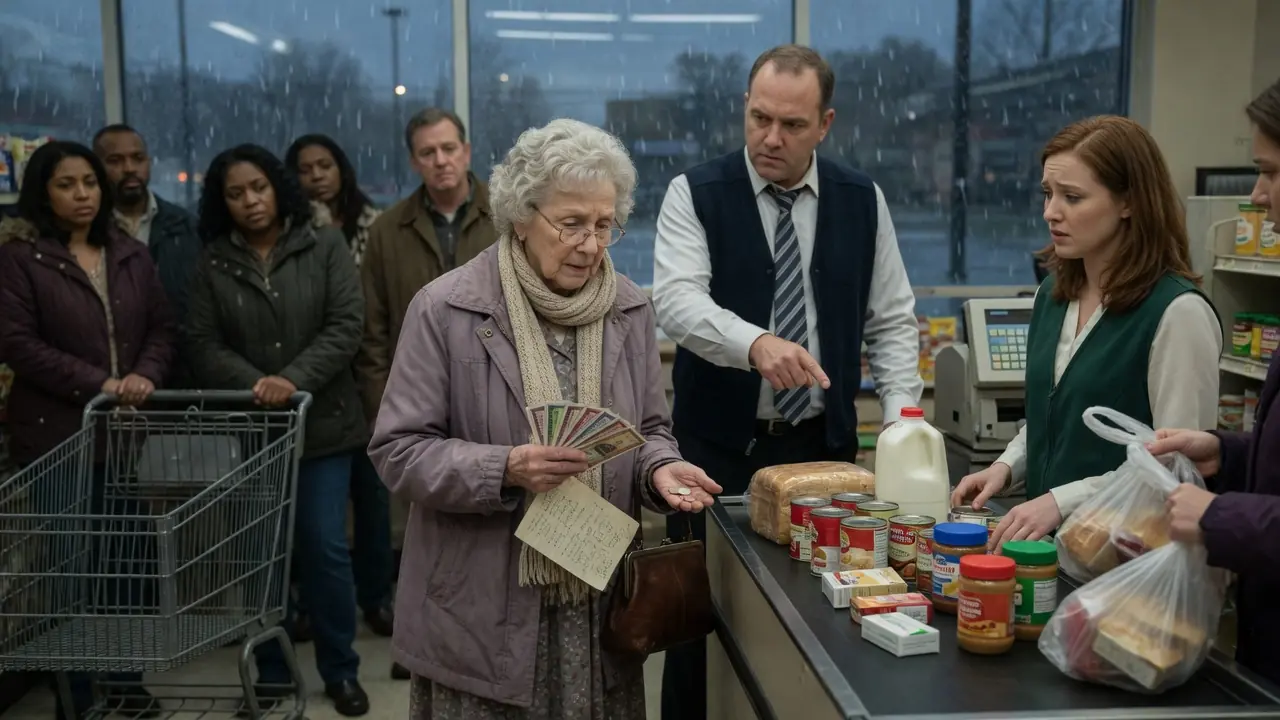
Some tea bags, a carton of eggs, a jar of peanut butter, two small bags of apples, and a stack of coupons folded so many times the paper had gone soft at the creases.
To most people, that kind of grocery cart is invisible.
It is the cart pushed by someone old enough to move slowly, carefully, apologetically. It is the cart people sigh behind in line when the coupons come out. It is the cart that makes impatient customers shift from one foot to the other, checking their phones, wondering why someone did not just tap a card and move along.
But sometimes the smallest carts carry more weight than anyone sees.
Sometimes a loaf of bread is not just bread.
Sometimes a can of soup is someone’s dinner.
Sometimes a carton of milk means an old man can take his pills without an empty stomach.
Sometimes a grocery list is not a list at all.
It is a promise.
That Thursday evening, rain hammered the windows of Mason’s Market with such force that everyone inside kept glancing toward the glass as if expecting the storm to break through. Thunder rolled low over the parking lot, rattling the automatic doors each time they opened. The store lights flickered twice, dimmed for one terrifying second, then steadied again.
Ruth stood at checkout lane four with both hands trembling over her coupons.
She was seventy-four years old, though most people guessed older on stormy days when the ache in her knees made her shoulders bend. She wore a faded blue raincoat with one missing button, sensible shoes darkened at the edges from puddles, and a gray scarf wrapped twice around her neck. Her white hair was pinned back in a neat bun, though loose strands had curled from the damp.
She had always tried to look tidy in public.
Even on difficult days.
Especially on difficult days.
There was dignity in brushed hair.
Dignity in a clean coat.
Dignity in saying thank you even when the world gave you less than enough.
The young cashier across from her could not have been more than nineteen. Her name tag read Alyssa. She had kind eyes, nervous hands, and the worried expression of someone trying to do the right thing while knowing the wrong person might be watching.
“Take your time, ma’am,” Alyssa said softly.
Ruth looked up from the coupons.
“You’re very sweet, dear.”
Alyssa glanced toward the glass office at the front of the store.
“But I should warn you,” she whispered, “my manager doesn’t like delays.”
“I understand.” Ruth tried to smile. “I’ve counted all three times. I’m just trying to make it work.”
“I know.”
Alyssa looked at the small pile of groceries still on the belt. Bread. Low-sodium soup. Milk. Canned vegetables. Tea. Crackers. Nothing fancy. Nothing wasteful. Nothing anyone should have had to justify.
“I can scan the coupons again,” Alyssa said. “Maybe one of them didn’t apply.”
Ruth shook her head gently.
“You already tried. It’s all right. I may just need to put something back.”
She said it calmly because she had practiced calmness for years.
The first time she could not afford everything in her cart, she had cried in the parking lot. That was years ago, not long after her husband Samuel died and his pension turned out to be smaller than the bills grief left behind. Since then, Ruth had learned to keep her face still while doing the arithmetic of need.
Milk or eggs.
Medicine or heat.
Bus fare or fresh fruit.
Pride or dinner.
People imagined poverty as loud, chaotic, obvious.
Ruth knew better.
Poverty was quiet math.
It was standing in a bright store with a coupon for seventy-five cents off soup and pretending your hands were not shaking.
Alyssa lowered her voice further.
“I’m just afraid if he sees this, he’ll come over.”
Before Ruth could answer, a sharp voice cut through the line.
“Ma’am, this is taking too long.”
Ruth turned.
The front-end manager stood beside the register, arms folded over his red store vest. His name tag read Brent. He was in his early thirties, with slicked-back hair, a tight mouth, and the kind of impatience that made him seem taller than he was. He looked at Ruth not like a customer, but like an obstacle.
“You’re holding up the line,” he said.
Ruth glanced behind her.
There were six people waiting. A mother with a toddler. A man in a rain-darkened coat. A college student holding frozen pizza. An older couple with a basket of prescriptions and crackers. A teenager with headphones. Everyone looked tired. Everyone wanted to go home before the storm got worse.
Ruth felt heat rise to her face.
“I only need another moment,” she said. “I’ve almost got it sorted.”
Brent’s eyes dropped to the coupons.
“You can’t stop the whole register for a stack of coupons.”
“I understand, sir. I’m doing the best I can.”
Alyssa touched the register screen.
“I can suspend the transaction and—”
“No,” Brent snapped without looking at her. “We are not suspending another coupon issue during rush.”
“It’s not rush,” Alyssa said softly.
Brent’s eyes cut to her.
She went silent.
Ruth reached toward the groceries as if rearranging them might somehow change the total. Her fingers brushed the bread, then the soup, then the milk. She tried to decide what could stay and what would have to be returned.
The milk was for Mrs. Ellis in apartment 1B.
The low-sodium soup was for Mr. Reed in 3A.
The bread was for Apartment 2C, where the Carlisle sisters lived together and pretended one loaf lasted longer than it did.
The tea was for Miss Lorraine, who said tea was not food but somehow made hunger more polite.
Ruth could go without the apples.
She could go without the crackers.
She could water down her own milk another few days.
But the others were waiting.
That was what made her hands tremble.
Not embarrassment alone.
Responsibility.
Brent picked up two cans from the belt.
“Please don’t put them back yet,” Ruth said quickly. “I just need one more minute.”
“Ma’am, this register isn’t here for you to sort out your problems.”
A quiet discomfort moved through the line.
Alyssa’s face tightened.
Ruth swallowed.
“I’m not trying to cause trouble. I really do need these groceries.”
“You should have come prepared before wasting everyone’s time.”
The words struck harder than Ruth expected.
Prepared.
She had prepared all week.
She had cut coupons from three newspapers rescued from the community room recycling bin. She had matched sale prices with pantry needs. She had written names beside items and calculated totals in pencil at her kitchen table while rain clouds gathered outside. She had counted the coins from the old blue jar Samuel once used for fishing money. She had checked the bus schedule twice.
She had come prepared.
Life had simply come short.
“I counted every cent before I came,” Ruth said, keeping her voice gentle. “I’m not asking for special treatment. I’m only trying to get these groceries home.”
Brent gestured toward the line.
“I’m trying to keep customers moving. Your explanation doesn’t change the problem.”
An impatient man somewhere behind her muttered, “Unbelievable.”
Ruth looked down.
She had spent most of her life trying not to be a burden.
She had been a school cafeteria worker for thirty-four years, long enough to know which children came through the line hungry on Mondays because the weekend had been thin. She had slipped extra fruit onto trays. She had saved unopened milk cartons. She had learned which children needed kindness disguised as accident.
“Oh, I must have given you two rolls by mistake.”
“Looks like there’s an extra apple on your tray.”
“Take it, sweetheart. Waste not.”
After retirement, she moved with Samuel into Willow Creek Senior Apartments, a brick building on the south side of Millbrook where the elevator was slow, the hallway carpets smelled faintly of lemon cleaner, and the residents looked out for one another because no one else did consistently enough.
Samuel died two winters later.
A heart attack.
Fast.
Unfairly fast.
One moment he was complaining about the neighbor’s television being too loud, and the next, Ruth was calling 911 with one hand pressed to his chest, begging a man who had loved her for fifty-one years not to leave before breakfast.
After he died, everyone assumed Ruth would be the one who needed taking care of.
For a while, she was.
Mrs. Ellis brought casseroles. Mr. Reed fixed her window latch. Miss Lorraine sat with her through the first Christmas. The Carlisle sisters made her tea so strong it could have pulled nails from wood.
Then, slowly, Ruth began taking care of them.
Not because anyone appointed her.
Because she noticed things.
She noticed who stopped coming downstairs.
Who looked thinner.
Who was watering down soup.
Who said, “I’m fine,” too quickly.
Every Thursday, she took the bus to Mason’s Market with a folded list in her purse. People in the building slipped her dollars when they could, coins when they could not, coupons when they found them, and notes in careful handwriting.
Milk, if on sale.
Tea, cheapest kind.
Soup without too much salt.
Soft bread, please.
Bananas, but only if bruised ones are cheaper.
Ruth never called it charity.
She called it errands.
Errands preserved dignity.
That night, Brent did not know any of that.
He only saw an old woman delaying his register.
“We’re done here,” he said.
Alyssa looked up.
“Sir—”
“Take the items away.”
Ruth reached for her purse again.
“Please, not yet.”
Brent’s expression hardened.
“Ma’am, this isn’t working. I need you to step aside.”
“There are other people waiting,” someone muttered again.
Ruth looked down at the cart.
“I was so close,” she whispered.
Alyssa heard her.
Her eyes filled, but she said nothing.
That silence hurt Ruth too, though she understood it. Young workers with rent and tuition and managers like Brent learned quickly how expensive courage could become.
Brent reached for the bread.
Something in Ruth broke then, not loudly, but visibly.
She closed her purse with both hands.
“All right,” she said.
Her voice was small.
“Never mind.”
She moved away from the counter, leaving the groceries behind as if walking away from them took more strength than carrying them.
Alyssa whispered, “I’m sorry.”
Ruth nodded because kindness deserved acknowledgment even when it failed to change the outcome.
Then a man’s voice came from the line.
“Well, this isn’t right.”
Everyone turned.
A middle-aged man in a rain-darkened coat stepped forward. He had been standing two customers back, watching quietly. He was about fifty-five, with silver beginning at his temples, a square face, and the tired but steady posture of someone used to long days. His coat was plain but well-made, wet across the shoulders from the storm. His hands were broad, his expression controlled.
His name was Thomas Carter, though Ruth did not know that yet.
Most people in Millbrook knew the Carter name. Carter Medical Transport operated half the wheelchair vans and non-emergency medical vehicles in three counties. Thomas had inherited two old vans from his father and built the business over thirty years into a respected local company.
But Ruth did not know that either.
At that moment, he was simply the stranger who stepped forward when everyone else looked away.
“She’s not causing trouble,” he said. “She’s trying to get through this. And if nobody else is going to help her, I will.”
Brent turned toward him sharply.
“Sir, this is store business. I need you to stay out of it.”
Thomas ignored him and looked at Alyssa.
“Ring up whatever’s left, and I’ll cover it.”
Ruth immediately shook her head.
“No, please. I couldn’t ask that of you.”
“You didn’t ask,” Thomas said gently.
Brent cut in before Alyssa could move.
“That isn’t necessary.”
Thomas looked at him.
“It became necessary when you humiliated her.”
Brent’s face reddened.
“I handled a delayed transaction.”
“No,” Thomas said. “You handled a human being badly and called it procedure.”
The line went silent.
Ruth wanted to disappear.
She had spent a lifetime avoiding scenes. Scenes made people remember you for all the wrong reasons. Scenes turned need into spectacle.
She picked up her purse.
“I should go.”
Thomas turned slightly.
“Ma’am, please let me help.”
Ruth lowered her eyes.
“I was so close,” she said. “And now I’m walking out with nothing.”
The words slipped out before she could stop them.
Then she walked away.
The automatic doors opened with a rush of cold wind and rain. Ruth stepped outside beneath the awning, clutching her thin coat around her shoulders.
Inside, Thomas watched her go.
Then he looked back at Brent.
“You should be ashamed of yourself.”
Brent straightened his badge as if it were armor.
“Have a good evening, sir.”
Thomas did not move.
“I doubt you will.”
Then he followed Ruth outside.
The storm had grown worse.
Water rushed along the curb in shining streams. Rain blew sideways across the parking lot. The sky was dark enough now that the grocery store sign glowed red and white against the wet pavement. Cars crept through the lot with wipers thrashing.
Ruth stood beneath the awning, one hand on a support post, staring toward the bus stop.
The bench there was empty.
The last bus had already gone.
Thomas stepped out beside her but kept a respectful distance.
“Ma’am, you shouldn’t be standing out here alone in this storm.”
Ruth tried to smile.
It wavered.
“I missed the last bus, but I’ll find some way home.”
“Let me drive you.”
She looked at him quickly.
Suspicion crossed her face, then embarrassment for feeling suspicious.
Thomas understood.
“I’m Thomas Carter,” he said, taking out his wallet and showing her his business card instead of moving closer. “Carter Medical Transport. My office is on Elm Street. Half the doctors in town have yelled at me at some point, so I’m easy to verify.”
That surprised a small laugh out of her.
“I know Carter vans,” she said. “They take Mrs. Ellis to dialysis sometimes.”
“Then you know my drivers are less frightening than my dispatcher.”
Ruth looked toward the rain.
“I don’t want to be trouble.”
“You’re not trouble.”
“I don’t have groceries now.”
“You still need to get home.”
She studied him for another moment.
His face held no pity.
That helped.
Pity made people feel smaller. Respect let them stand.
“All right,” she said softly. “Thank you, Mr. Carter.”
They walked toward his car. Thomas held the umbrella over her more than himself. Ruth noticed. People who had gone without often noticed how much space others allowed them under shelter.
As she opened the passenger door, a folded paper slipped from her purse and landed on the wet pavement.
Thomas bent quickly and picked it up before the rain could ruin it.
“Ma’am, you dropped this.”
“Oh, thank you,” Ruth said, reaching for it. “It’s only a list.”
He glanced down before handing it back.
Not intentionally.
Just enough.
Then he stopped.
The paper was filled with names.
Not grocery items.
Names.
Apartment numbers.
Short notes written in careful pencil.
Mrs. Ellis, 1B — milk, crackers, tea if possible.
Mr. Reed, 3A — low-sodium soup, bread, batteries.
Carlisle sisters, 2C — soft bread, canned peaches.
Miss Lorraine, 4D — tea, sugar packets, soup.
Mr. Alvarez, 5B — peanut butter, apples, no hard foods.
Community room — extra water, candles if cheap.
Thomas looked at the paper, then at Ruth.
“That’s a lot of names for one grocery trip.”
Ruth took the list gently and held it to her chest.
“They were counting on me tonight.”
“These names,” he asked carefully, “are they people in your building?”
“Yes.”
“Neighbors?”
“Friends,” she said.
The word was simple, but her voice made it sacred.
“Some of them can’t get out anymore,” she continued. “Especially on nights like this.”
Thomas looked back toward the grocery store, then at her empty hands.
“So those groceries weren’t just for you?”
Ruth shook her head.
“No. They were waiting on me tonight.”
The sentence landed in him harder than he expected.
Thomas had spent thirty years moving people from home to clinic, from hospital to rehabilitation center, from nursing facility to specialist appointment. He knew the fragile logistics of aging. He knew how one missed ride could become a missed treatment. How one empty fridge could become a fall. How one storm could turn inconvenience into danger for people who could not simply get in a car and go buy more.
He also knew what it meant when an elderly woman carried an entire building’s needs in her purse.
“Where do you live?” he asked.
“Willow Creek Senior Apartments.”
“South Mill?”
“Yes.”
“That area lost power earlier.”
Ruth looked up sharply.
“It did?”
“My dispatcher mentioned outages near Willow and Grant.”
Her hand tightened around the list.
“Oh no.”
Thomas opened the car door.
“Let’s get you there.”
The drive took twelve minutes, though the storm made it feel longer. Ruth sat with her purse in her lap, hands folded over it, watching rain smear the windshield. She did not speak much. Thomas did not force conversation.
At one point, she said, “I’ve never missed a Thursday.”
He glanced at her.
“Never?”
“Not in six years.”
“That’s a long time to carry groceries.”
Ruth smiled faintly.
“Everyone carries something.”
Thomas thought about that.
His wife, Angela, had died four years earlier after a stroke that took her speech first and her body slowly after. For eighteen months, Thomas arranged every appointment, every therapy session, every medication schedule. He ran a transport company and still found himself overwhelmed by the simple cruelty of stairs, doorways, insurance forms, and meals that had to be soft enough to swallow.
After Angela died, Thomas kept the company running because he did not know who he was without responsibility.
But grief had made him efficient rather than kind for a while.
He was ashamed to admit that now.
Maybe that was why Ruth moved him.
She was responsibility without bitterness.
Willow Creek Senior Apartments rose at the end of a narrow street lined with old sycamores. The building was five stories, brown brick, with balconies facing the parking lot and a faded green awning over the front entrance. Half the windows were dark. The storm had knocked out power through much of the neighborhood, and the building glowed only faintly from emergency lights.
Thomas parked near the entrance.
Inside, the lobby was dim and chilly. Battery lanterns sat on two side tables. A few residents had gathered near the common room, wrapped in coats and blankets. Someone had placed a flashlight upright in a flowerpot to make a small cone of light on the ceiling.
As soon as Ruth stepped inside, several voices called out.
“Ruth?”
“Did you make it back?”
“Is the bus still running?”
“Did you get the soup?”
Ruth stopped.
The shame returned to her face so quickly that Thomas felt it like a hand against his chest.
“I’m so sorry,” she said.
A woman wrapped in a purple blanket came forward. Her hair was in silver braids, and her hands held an empty mug.
“What happened?”
“I couldn’t bring the groceries tonight.”
The room went quiet.
Not angry.
Worried.
That made Ruth’s face tighten further.
“I tried,” she said quickly. “I had the coupons, and I counted, but the total was still too high, and the manager—”
Her voice faltered.
Miss Lorraine, the woman in the purple blanket, stepped closer.
“Oh, Ruth.”
“I was so close,” Ruth whispered.
Mr. Reed sat near the wall in a winter coat, one hand resting on a walker.
“She never misses,” he said to Thomas, though Thomas had not asked. “Never. Even when her knee acts up. Even when it snows. She comes back with something for everybody.”
Another resident, Mrs. Ellis, sat with a blanket over her lap and a medical bracelet on one wrist.
“I was waiting for the milk,” she said softly. “For my pills.”
Ruth turned toward her immediately.
“I know. I’m sorry. I’ll find some way—”
“No,” Thomas said.
Everyone looked at him.
He had spoken more firmly than intended.
He softened his voice.
“No, Ruth. You’ve done enough tonight.”
Ruth looked confused.
“Mr. Carter?”
He glanced around the dim lobby.
At the old hands wrapped around empty mugs.
At the coats worn indoors.
At the emergency lights.
At people waiting not only for groceries, but for the woman who made them feel remembered.
He turned back to Ruth.
“What do they still need for tonight?”
She held the list against her chest.
“A few were counting on bread, soup, milk, tea, something simple to get through the night. Some batteries if I could manage them. Water, maybe. The elevator is working on backup, but I don’t know for how long.”
Miss Lorraine spoke from beside Ruth.
“She’s the one who keeps us going when things get hard.”
Mr. Reed nodded.
“Checks every door. Knows who needs what. Remembers birthdays too.”
Ruth shook her head.
“Now, don’t make a fuss.”
Thomas looked at her.
“Ruth, this is already a fuss. The only question is whether we make it useful.”
She stared at him.
“What are you saying?”
“I’m saying stay here with them. Let me handle the next part.”
“The next part?”
He held out his hand.
“May I borrow the list?”
Ruth hesitated.
The list was not just paper.
It was trust.
Names.
Needs.
Small private vulnerabilities.
Thomas seemed to understand that.
“I’ll bring it back,” he said. “And I’ll bring what’s on it.”
Her eyes filled.
“You don’t have to do this.”
“I know.”
That was when she handed him the list.
Thomas tucked it carefully inside his coat and turned toward the door.
“Mr. Carter?”
He stopped.
Ruth’s voice trembled.
“Please don’t be unkind to the cashier. Alyssa tried.”
He looked back at her.
Even after being humiliated, Ruth was protecting the one person who had shown her softness.
Thomas nodded.
“I’ll remember.”
Then he walked out into the storm.
By the time he returned to Mason’s Market, his coat was soaked through. Rain dripped from the brim of his hat. His shoes squeaked against the polished floor as he walked straight toward the front registers.
Brent stood near lane four, speaking to another cashier. When he saw Thomas, irritation flashed across his face.
“Sir, the transaction was already ended.”
Thomas stopped in front of him.
“No. You ended it. So ring it up again.”
Brent folded his arms.
“That isn’t store procedure.”
Thomas’s voice stayed even.
“I just came from Willow Creek Senior Apartments. Those groceries weren’t for one woman. They were for seniors sitting in a blackout with almost nothing left.”
Brent blinked.
The information hit him, but pride stepped in front of it.
“Sir, I’m sorry if there’s some hardship situation, but we handled the transaction according to—”
“You humiliated a woman who was trying to keep her neighbors fed.”
People nearby slowed.
The mother with the toddler was still checking out at another lane. She turned her head. Alyssa, wiping the belt at lane four, went still.
Thomas continued.
“You saw an old woman with coupons and decided she was wasting your time. You didn’t ask why she needed the groceries. You didn’t offer to suspend the order. You didn’t call for assistance. You chose embarrassment as a management tool.”
Brent’s jaw tightened.
“I need you to lower your voice.”
“My voice is fine.”
“This is private store business.”
“No,” Thomas said. “It became community business when the groceries you refused were meant for people without power tonight.”
Alyssa stepped forward.
“They’re still in the back,” she said quietly.
Brent snapped, “Alyssa.”
She flinched but did not step back.
“Most of Ruth’s groceries are still in the back,” she said again. “They hadn’t been restocked yet.”
Thomas turned toward her.
“Thank you.”
Another employee came from behind the service desk. She was in her late twenties, with dark hair pulled into a ponytail and a name tag that read Megan.
“I saw what happened earlier,” Megan said. “And I want to help.”
Brent looked furious.
“You both need to stop.”
Megan ignored him and looked at Thomas.
“Our closing manager is in the stock office. Marisol Diaz. She can reopen the order.”
“Get her,” Thomas said.
Megan hurried away.
Brent reached for the phone at the register.
“I’m calling security.”
Thomas removed a business card from his coat and placed it on the counter.
“Call whoever you like. Then call your district manager and explain why Carter Medical Transport will be reconsidering its employee grocery partnership with Mason’s Market.”
Brent glanced down.
His expression shifted.
The Carter Medical Transport account was not enormous, but it was local, steady, and public-facing. Employees bought food there. Drivers stopped there. Their vans were known. More importantly, Thomas Carter’s name carried weight in town.
“You’re Thomas Carter,” Brent said.
“Yes.”
That was all.
A minute later, Marisol Diaz arrived from the back office.
She was in her forties, compact and serious, with reading glasses pushed on top of her head and a store radio clipped to her belt. She looked at Thomas, then Brent, then Alyssa’s pale face.
“What happened?”
Megan returned behind her.
Thomas handed Marisol Ruth’s list.
“An elderly woman named Ruth Whitaker tried to buy these groceries tonight with coupons. She was short. Your cashier tried to help. Your front-end manager humiliated her, ended the transaction, and sent her out into a storm.”
Brent began, “That is not an accurate—”
Marisol lifted one hand.
“Stop.”
He stopped.
Thomas continued.
“The groceries were for Willow Creek Senior Apartments. The building is partly without power. People are waiting there with no food ready, no hot drinks, limited light, and no way to come here themselves.”
Marisol read the list.
Her expression changed line by line.
Milk for Mrs. Ellis.
Low-sodium soup for Mr. Reed.
Bread for Apartment 2C.
Tea for Miss Lorraine.
Water.
Batteries.
Candles if cheap.
She lowered the paper.
“Where are Ruth’s groceries?”
Alyssa answered before Brent could.
“In the back bin by returns. Most of them are still together.”
Marisol turned to Megan.
“Get them.”
Megan nodded.
Marisol looked at Alyssa.
“Reopen the order.”
Alyssa’s relief was visible.
“Yes, ma’am.”
Brent took a step forward.
“Marisol, we can’t just—”
She turned to him.
“You are done for the evening.”
His face went red.
“What?”
“Clock out. Go home. Do not speak to any more customers tonight. We’ll discuss this with district tomorrow.”
“That is ridiculous.”
“No,” Marisol said coldly. “What’s ridiculous is that an elderly customer left this store in a storm without essential groceries because you cared more about clearing a line than solving a problem.”
Brent looked around.
People were watching now.
Not with curiosity.
With judgment.
He opened his mouth, then closed it.
For once, he seemed to understand that the room had turned against him.
He took off his vest and walked toward the back.
Marisol turned to Thomas.
“We’ll make this right.”
“Tonight,” Thomas said.
“Yes. Tonight.”
The store shifted from embarrassment to action.
Megan returned pushing a cart with Ruth’s original groceries. Alyssa rescanned each item. Marisol read from Ruth’s list and began adding what was missing. Bread. Milk. Soup. Tea. Crackers. Peanut butter. Apples. Canned peaches. Bottled water. Batteries.
A stock clerk named Jamal brought soup by the case.
Another employee, Kayla, pulled loaves of bread from the bakery rack.
The mother with the toddler stepped forward and placed two boxes of instant oatmeal on the counter.
“For them,” she said.
The college student added a package of granola bars.
The older couple bought an extra flashlight.
The teenager with headphones quietly placed a bag of oranges near the growing order and walked away before anyone could thank him.
Alyssa scanned with tears in her eyes.
“I should have done more,” she whispered when Thomas came near.
“You did what you could under pressure,” he said. “Tonight, do the next right thing.”
She nodded and kept scanning.
Megan took Ruth’s list and began sorting bags by apartment numbers. She wrote labels in thick black marker.
1B — Mrs. Ellis.
3A — Mr. Reed.
2C — Carlisle sisters.
4D — Miss Lorraine.
Community room.
Thomas stepped outside beneath the awning and made a call.
“Dennis,” he said when his dispatcher answered. “I need every available van or car that isn’t on a medical run sent to Mason’s Market now.”
A pause.
“No, this isn’t business. It’s people.”
Another pause.
“Clear trunk space. Bring drivers. Tell them to wear rain gear.”
By the time the first Carter Medical Transport van arrived, the carts were packed and labeled.
Then another van arrived.
Then a sedan driven by one of Thomas’s off-duty drivers.
Then a neighbor who had heard the call through Dennis and came with a pickup truck.
Rain soaked everyone as they loaded the vehicles.
No one complained.
Marisol approved every added item and refused Thomas’s offer to cover the full amount.
“You can pay Ruth’s original total if you want,” she said. “The rest is on the store.”
Thomas looked at her.
“That will matter to her.”
“It should.”
He nodded.
“Then thank you.”
Marisol looked toward the rain.
“No. Thank Ruth. Apparently, she’s been running a better community food network than half the funded programs in this county.”
Thomas smiled faintly.
“She would hate hearing it described that way.”
“Then we won’t tell her.”
When the vehicles pulled up to Willow Creek Senior Apartments, headlights swept across the lobby windows. Inside, Ruth was sitting in the common room with the others, hands folded, trying not to watch the door too hopefully.
Miss Lorraine saw the lights first.
“Someone’s here.”
Ruth stood slowly.
A moment later, the front doors opened.
Thomas walked in carrying two grocery bags.
Behind him came Megan, Alyssa, Jamal, two Carter drivers, and three volunteers, all carrying bags marked with apartment numbers. Rainwater dripped from coats and hats. Cold air swept briefly into the lobby before the doors closed again.
Ruth covered her mouth with both hands.
“You came back.”
Thomas smiled.
“We brought it all, Ruth.”
Megan lifted the list.
“For every door.”
Alyssa stepped forward, nervous.
“I’m sorry about earlier, Mrs. Whitaker.”
Ruth lowered her hands.
“Oh, dear. You tried.”
“I should have tried louder.”
Ruth’s eyes softened.
“Sometimes loud takes practice.”
The residents began to rise from their chairs.
Bags were sorted by apartment. Milk for Mrs. Ellis. Soup for Mr. Reed. Bread for the Carlisle sisters. Tea for Miss Lorraine. Peanut butter for Mr. Alvarez. Water and batteries for the community room.
More bags kept coming.
Then more.
Someone found folding tables.
Someone lit battery lanterns.
A Carter driver carried in a portable camp stove from his van. Miss Lorraine declared she knew how to make soup stretch “without making it taste like sadness.” The Carlisle sisters began opening bread. Mr. Reed took inventory of batteries with the seriousness of a military quartermaster.
The dim common room slowly transformed.
Not into abundance exactly.
Into relief.
That was sometimes better.
Ruth stood in the middle of it all, tears running silently down her face.
Mrs. Ellis reached for her hand.
“Ruth, you took care of us again.”
Ruth shook her head.
“Not alone this time.”
Thomas heard the sentence and understood why it mattered.
For years, Ruth had made herself the bridge between her neighbors and the things they needed. She had carried lists, bags, worry, bus schedules, coupons, and other people’s hunger. She had done it quietly because quiet service often goes unnoticed until the one carrying it stumbles.
Tonight, she had stumbled.
And the world had caught her.
Megan set bags on the table.
“No one eats alone tonight,” she said.
An older man near the window laughed softly.
“That sounds like Ruth’s rule.”
Ruth wiped her eyes.
“It is not a rule.”
Miss Lorraine snorted.
“Everything you say twice becomes a rule.”
Soup warmed on the small stove. Bread was passed from hand to hand. Tea was made with bottled water heated carefully. Someone opened canned peaches. Someone else found paper bowls from a storage closet. The storm still raged outside, but inside the common room, the air slowly filled with steam, food, and voices.
Ruth tried to stand and help sort the last bags.
Thomas gently stopped her.
“Ruth.”
She looked up.
“Tonight let us serve you.”
“I’m fine.”
“I know. Sit anyway.”
She gave him a look.
He gave her one back.
Finally, she sat.
For once, Ruth was not the one hurrying through rain, counting coins, clipping coupons, stretching dollars, and trying to make too little become enough for everyone else.
For once, the hands carrying food were not hers.
Someone placed a bowl of soup in front of her.
Then bread.
Then tea.
Alyssa sat beside her and helped write down which apartments still needed deliveries. Megan took bags upstairs with Jamal. Carter drivers checked on residents who could not come down. Thomas helped Mr. Reed replace batteries in two flashlights.
The storm knocked out the last of the non-emergency lights at 8:52.
The common room gasped into darkness.
Then lanterns glowed.
One by one.
Small circles of light.
Ruth looked around at the faces illuminated in the dimness.
Old faces.
Tired faces.
Hungry faces.
But not forgotten faces.
By ten o’clock, every person on Ruth’s list had food.
By ten-thirty, every apartment had been checked.
By eleven, Marisol arrived from Mason’s Market with two more employees and a handwritten apology tucked in an envelope. She brought extra bottled water, fruit, and a large box of pastries from the bakery that would have been marked down the next morning.
Ruth tried to stand when Marisol came in.
Marisol shook her head.
“Please don’t get up.”
Ruth looked embarrassed.
“I caused a lot of trouble tonight.”
“No,” Marisol said. “You revealed some trouble that was already there.”
She handed Ruth the envelope.
Ruth opened it slowly.
Inside was a letter from Mason’s Market.
Mrs. Whitaker,
What happened to you tonight should never have happened. You came into our store carrying the needs of your neighbors, and we failed to recognize the care and responsibility in front of us.
Your groceries tonight are fully covered by Mason’s Market. Beginning next Thursday, our store will prepare a weekly senior delivery order for Willow Creek Senior Apartments at a discounted community rate. We will also provide free delivery during severe weather.
With respect and apology,
Marisol Diaz
Closing Manager, Mason’s Market
Ruth read the letter twice.
Then she pressed it to her chest.
“That’s too much.”
Thomas sat across from her.
“No, Ruth. It’s overdue.”
The next morning, the storm passed.
Millbrook woke beneath a washed gray sky. Branches lay across sidewalks. Puddles shone in potholes. Power crews worked along South Mill Road, and the residents of Willow Creek Senior Apartments gathered in the common room drinking coffee that tasted slightly smoky from being reheated badly and gratefully.
By noon, the story had begun to spread.
Not because Ruth told it.
She would not have.
Alyssa told her mother.
Megan told her sister.
A Carter driver posted a careful version online, leaving out private names but describing how one elderly woman’s grocery cart had been meant for an entire senior building.
By evening, people were calling Mason’s Market asking how to donate to Ruth’s weekly grocery list.
Marisol called Thomas.
“What do we do with this?”
Thomas looked across his office at the raincoat still drying on the hook.
“We do it properly.”
Within two weeks, the Willow Creek Thursday Fund existed.
Not a charity with Ruth’s face printed on posters.
She refused that immediately.
A practical fund.
Neighbors could donate at Mason’s Market registers. Carter Medical Transport provided weekly delivery. Mason’s Market discounted essentials and assigned Megan to coordinate orders. The senior building created a rotating committee so Ruth no longer had to carry every name alone.
Ruth remained involved, of course.
No one could stop her.
But now she sat at a table in the community room on Wednesday afternoons while residents came with lists, coupons, and updates. Two younger volunteers helped organize everything. Alyssa came after her shift once a week. Megan built a spreadsheet Ruth called “fancy nonsense” before admitting it was useful.
Thomas visited every Thursday for the first month.
Then every other Thursday.
Then sometimes just because Miss Lorraine made tea strong enough to frighten him awake.
Brent was fired after district review.
Ruth asked Marisol whether he had family.
Marisol sighed.
“Ruth, he humiliated you.”
“I know,” Ruth said. “But people who humiliate others usually learned it somewhere. I hope he learns something better next.”
That was Ruth.
Firm enough to survive.
Soft enough not to rot.
A month after the storm, Mason’s Market held a community breakfast in the Willow Creek common room. Nothing fancy. Coffee, fruit, muffins, oatmeal, scrambled eggs kept warm in foil trays. Residents came downstairs in sweaters and slippers. Store employees came before their shifts. Carter drivers parked two vans outside.
Ruth stood near the window holding a paper cup of tea.
Thomas came to stand beside her.
“You doing all right?” he asked.
She smiled.
“I’ve been asked that too many times lately.”
“That means people care.”
“It also means people think I’m fragile.”
“Are you?”
She looked at him.
“Everyone is, Mr. Carter. Some of us just have better practice hiding the cracks.”
He nodded.
Outside, the sky was clear. Sunlight caught the wet branches left from the storm. Across the parking lot, two residents sat on a bench sharing a muffin, laughing about something small.
Thomas looked at Ruth.
“Why did you start doing it?”
“The groceries?”
“Yes.”
She turned the cup slowly between her hands.
“After Samuel died, I stopped eating properly. People noticed. They brought me food. Checked on me. Miss Lorraine made tea. Mr. Reed fixed my window. Mrs. Ellis sat with me through a whole night when I couldn’t stop crying.”
Her eyes remained on the window.
“One day, I realized grief had made me feel empty, but being cared for had kept me alive. So when Mrs. Ellis got sick, I brought her milk. Then Mr. Reed needed soup. Then Miss Lorraine needed tea. One thing became another.”
She looked back at him.
“Love usually does.”
Thomas felt something in his chest shift.
He thought of Angela.
The appointments.
The van rides.
The long months of care that had exhausted him and still somehow become the holiest work of his life.
“I think my wife would have liked you,” he said.
Ruth smiled gently.
“Was she hard to impress?”
“Very.”
“Then I’m honored.”
Over time, Thomas and Ruth became friends.
Not in a sentimental, forced way.
In a practical way.
He drove her to appointments when his schedule allowed. She sent him home with soup he insisted he did not need and ate in his office anyway. He helped fix a loose shelf in the Willow Creek pantry. She corrected his habit of drinking coffee too late in the day.
“You’re not twenty-five, Mr. Carter.”
“No one asked for that reminder.”
“You looked like you needed one.”
The Thursday Fund grew beyond Willow Creek.
Mason’s Market added a “Round Up For Seniors” option at checkout. People donated canned goods, but Ruth insisted on dignity rules.
“No dented cans unless we would serve them to our own family.”
“No expired food.”
“No treating people like storage bins for what we don’t want.”
Marisol printed those rules and taped them in the employee break room.
Alyssa transferred to customer service and later applied for a social work program at the community college. In her application essay, she wrote about Ruth without naming her, describing the night she learned that silence can become participation when someone is being shamed.
Megan became the official community outreach coordinator for the store.
Jamal, the stock clerk, started keeping extra low-sodium soup aside whenever it went on sale.
Small changes.
Real changes.
The kind that do not make national news but keep people fed.
The following winter, a snowstorm hit Millbrook hard.
The roads iced over by noon. Buses stopped running. Schools closed early. Mason’s Market announced limited hours, and for the first time in years, Ruth did not even try to go herself.
At three o’clock, Carter Medical Transport vans pulled up outside Willow Creek carrying pre-sorted grocery boxes.
Megan stepped out in a red hat.
Alyssa followed, now wearing a college sweatshirt beneath her coat.
Thomas carried the first box inside.
Ruth stood in the lobby with her list.
Miss Lorraine sat behind her like a supervisor.
“Late by seven minutes,” Miss Lorraine said.
Thomas shook snow from his shoulders.
“Roads are ice.”
“Ruth would have been on time.”
Ruth smiled.
“Ruth would have fallen on her backside and frozen to the sidewalk.”
Everyone laughed.
They delivered every box.
Every apartment.
Every person.
No one was missed.
That night, after the deliveries were done, the residents gathered in the common room. Soup simmered in slow cookers now donated by three churches and one very enthusiastic bowling league. Bread sat in baskets. Tea steamed in mugs. Battery lanterns lined the windowsills just in case the power failed again.
Ruth sat at the center table.
Not because she put herself there.
Because everyone else did.
Thomas raised a paper cup.
“To Ruth,” he said.
She immediately shook her head.
“No, no.”
“Yes,” Miss Lorraine said. “Hush.”
Thomas continued.
“To Ruth, who taught us that a grocery list can be a promise, a cart can carry a whole building, and help is not charity when it is given with respect.”
Ruth’s eyes filled.
“You all make too much fuss.”
Mr. Reed smiled.
“You started it.”
She looked around the room.
At Mrs. Ellis drinking milk with her pills.
At the Carlisle sisters sharing peaches.
At Alyssa laughing with Megan near the counter.
At Thomas, whose grief had found work again in kindness.
At the residents who once waited nervously for her to return and now carried the work together.
For the first time in years, Ruth allowed herself to feel tired without feeling guilty.
That was a gift too.
The ability to rest.
The knowledge that if her hands trembled, someone else would hold the list.
A year after the storm, Mason’s Market renovated checkout lane four.
The old register was replaced. The belt was repaired. A small brass plaque was mounted on the side of the lane, just below the counter where customers placed their groceries.
Most shoppers barely noticed it.
But those who looked closely could read the words:
Ruth’s Lane
Take Your Time.
Everyone Deserves To Be Seen.
Ruth cried when Marisol showed it to her.
Then she complained that people would stare.
Then she brought cookies for the employees.
Thomas stood beside her near the register, smiling.
“People will remember,” he said.
Ruth touched the plaque gently.
“I hope they remember the right thing.”
“What’s the right thing?”
She looked toward the carts near the door.
“That nobody knows what someone else is carrying.”
Thomas nodded.
That evening, Ruth went home to Willow Creek with her weekly groceries. Not alone this time. Alyssa carried two bags. Megan carried three. Thomas carried the heavy items. Mr. Reed waited in the lobby with his walker and a clipboard, which he claimed made him look official.
Miss Lorraine had tea ready.
Mrs. Ellis had saved cookies.
The Carlisle sisters had set out napkins.
Everything was ordinary.
That was the miracle.
People often expect kindness to arrive as a grand rescue. A check with many zeros. A public ceremony. A headline. A speech. But most kindness is smaller. A ride in the rain. A reopened grocery order. A cashier choosing to speak. A manager admitting a wrong. A community deciding that one elderly woman should not have to hold everyone’s hunger by herself.
That night, Ruth sat by the common room window after everyone had eaten.
Rain tapped softly against the glass.
Not a violent storm this time.
Just rain.
Thomas sat across from her with tea he claimed was too strong and drank anyway.
Ruth watched water slide down the window.
“You know,” she said, “that night at the store, I thought I had failed everyone.”
“You didn’t.”
“I walked out with nothing.”
“You walked out with the truth,” Thomas said. “The rest of us were just late catching up.”
She smiled faintly.
“That sounds like something a man says after he has had too much of Miss Lorraine’s tea.”
“It is possible I can hear colors.”
Ruth laughed.
A real laugh.
Soft, surprised, free.
Across the room, Miss Lorraine looked up from her knitting.
“Are you laughing at my tea?”
“Yes,” Thomas said.
“Good. It builds character.”
Ruth laughed again.
Outside, the rain continued.
Inside, the room was warm.
Years later, people in Millbrook still told the story of Ruth Whitaker and the storm at Mason’s Market.
Some told it as a story about a rude manager who learned a hard lesson.
Some told it as a story about Thomas Carter and the night he turned his transport company into a grocery rescue team.
Some told it as a story about a cashier who found her courage and a grocery store that changed because it had to.
But Ruth always corrected them.
“It was never about me,” she would say.
Of course, everyone knew that was only partly true.
It was about Ruth.
But it was also about Mrs. Ellis and her milk.
Mr. Reed and his soup.
Miss Lorraine and her tea.
The Carlisle sisters and their bread.
Alyssa and her quiet kindness.
Megan and her quick hands.
Marisol and her willingness to make things right.
Thomas and the folded list he picked up before the rain could ruin it.
It was about all the invisible needs people carry into public places, hoping no one will make them explain why they are trying so hard.
And it was about the simple fact that humiliation can empty a cart, but compassion can fill a whole room.
Ruth kept the original list in a small frame beside her kitchen window.
The pencil marks had faded.
The edges had curled slightly from the rain.
Beside it, she kept a photograph someone took months later in the Willow Creek common room. Ruth sat at the center table with a bowl of soup in front of her, laughing while Miss Lorraine pointed a spoon at Thomas Carter as if issuing a royal decree.
On the back of the photograph, Ruth had written one sentence.
No one eats alone tonight.
It became the rule of Willow Creek.
Then of Mason’s Market.
Then of the Thursday Fund.
And finally, in quiet ways, of the whole town.
People look at a grocery cart like Ruth’s and think it is nothing special.
Just bread.
A little milk.
A few cans.
A handful of coupons.
But sometimes the smallest things carry the most weight.
Sometimes a cart is a lifeline.
Sometimes a list is love written in pencil.
Sometimes an old woman counting coupons is not delaying a line.
She is holding a community together with trembling hands.
And sometimes, when those hands finally grow too tired, the right person sees the list, turns around in the rain, and makes sure hope still gets delivered.
That night, hope came home to Willow Creek in grocery bags.
And Ruth, who had spent years making sure no one else was forgotten, finally learned that she was not forgotten either.