For three days, the desert wind was the only thing speaking to Eli Dunbar.
It moved through Box Elder Canyon in long, dry breaths, pushing sand against the wrecked Harley-Davidson and dragging cold air down the red stone walls after sunset. During the day, the Nevada sun burned the rocks until touching them hurt. At night, the temperature dropped so sharply that Eli could see his breath while he pressed himself beside the injured biker to keep the man from freezing.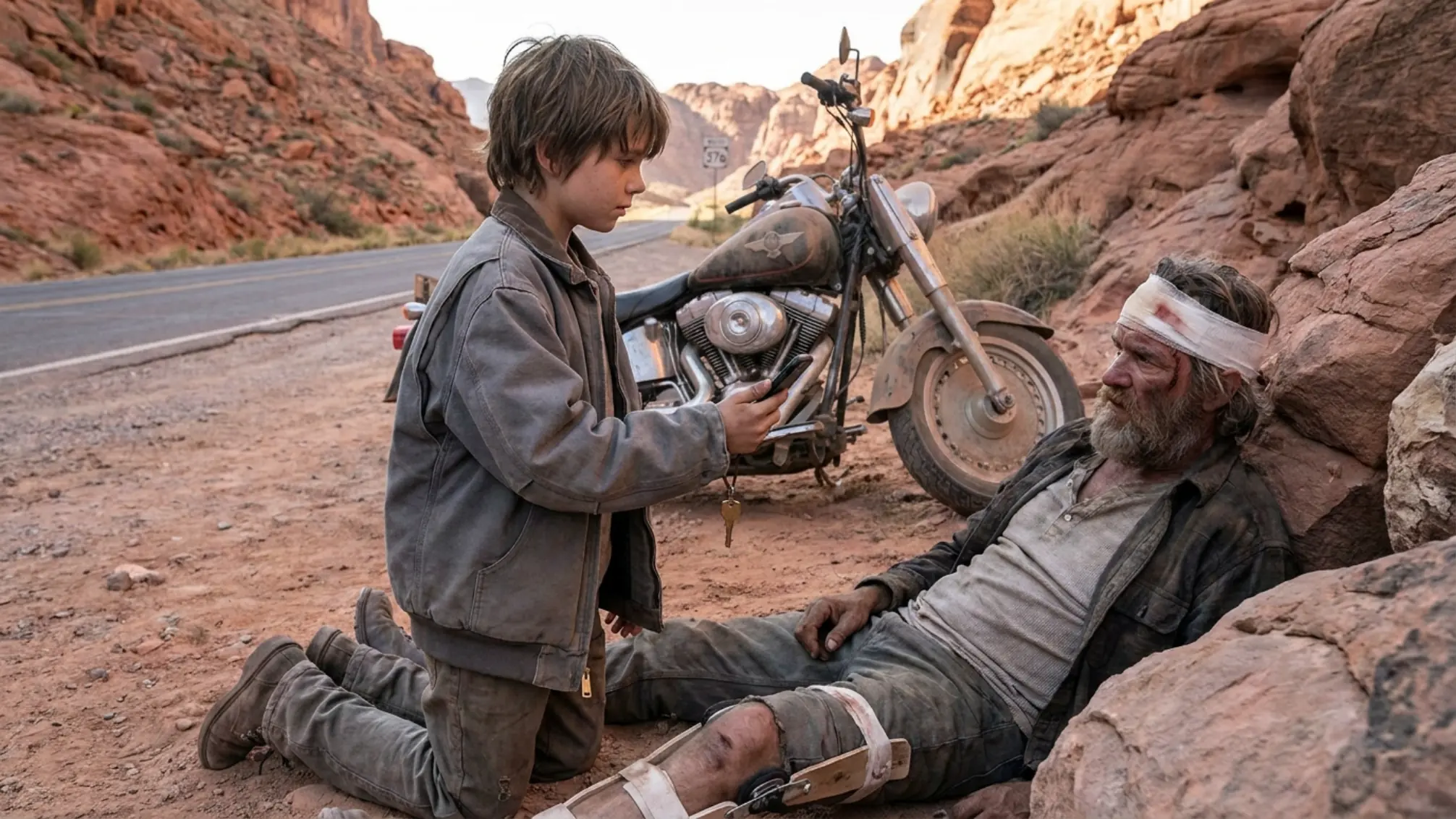
The boy was only eleven years old.
He weighed seventy-three pounds, wore cracked boots two sizes too large, and had not slept longer than twenty minutes at a time since the motorcycle came over the canyon ridge. Yet Cade Harlow was still breathing because Eli had refused to leave him.
Three days earlier, Eli had been walking along Route 376 after slipping away from the Sagebrush Youth Home. He was not running from the other children or from Mrs. Avery, the exhausted director who spent her own money to keep food in the kitchen. He had gone to check the small tool shed once used by Earl Trimble, the home’s elderly mechanic.
Earl had died five months earlier from a heart attack.
He had left Eli a brass key on a shoelace and told him the shed belonged to anyone willing to keep its tools clean.
That morning, Eli had wanted to sit at Earl’s workbench and remember the only adult who had ever trusted him with something valuable. Instead, he heard the roar of a motorcycle, the harder growl of an SUV, and then the violent scream of metal.
A black Cadillac Escalade struck the motorcycle from the side.
The biker fought to control it, swerving toward the ridge rather than hitting Eli, who stood frozen near the shoulder. The Harley broke through loose gravel and vanished over the edge.
The SUV stopped for only a second.
Eli saw the driver through the open window.
Douglas Callaway.
County commissioner. Chairman of the committee preparing to close Sagebrush Youth Home.
Callaway stared directly at Eli, then accelerated away.
Eli climbed down into the canyon.
He found Cade beneath the motorcycle, unconscious and bleeding from the head. His right leg bent at an angle no leg should make, and gasoline dripped from a damaged fuel line near the hot engine.
Eli did not scream.
Earl had taught him that panic was energy spent without producing anything useful.
The boy dragged the biker away from the motorcycle, sealed the leaking line with wet canyon clay, and built a windbreak at a twenty-two-degree angle against the rock face. He used two pieces of broken wood and Cade’s belt to splint the injured leg. Then he cleaned the head wound with filtered water and closed the worst section with fishing line from Earl’s emergency kit.
Water.
Shelter.
Signal.
Wait.
Eli wrote those four words in the dirt.
They became the rules keeping them alive.
Cade awakened briefly on the first night, muttered something about Sagebrush, and lost consciousness again. Eli gave him water in tiny amounts, monitored his breathing, and covered him with Cade’s leather vest after the temperature fell.
The boy made his first attempt to get help the following morning.
He climbed to the road and waved at a truck. The driver slowed, looked at his dirty clothes and Sagebrush identification badge, then drove away.
Eli returned to the canyon.
Cade was still alive.
His second attempt came at a gas station several miles down the road. The attendant listened until Eli mentioned Sagebrush. Then the man reached for the phone.
“I’ll call Commissioner Callaway,” he said. “He handles trouble involving those kids.”
Eli ran before the number connected.
On the second afternoon, a tourist couple allowed him to use their satellite phone. Eli called emergency services and reported an injured man below mile point 4.7.
Deputy Odell Trosper arrived thirty minutes later.
He searched the canyon for eight minutes, never walking close enough to see the hidden motorcycle or Eli’s windbreak. Then he returned to the road and told the boy nothing was there.
“You imagined it,” Trosper said. “Go back to the youth home.”
Eli followed the deputy from a distance.
He watched Trosper call Douglas Callaway.
The third morning brought an HOA cleanup crew collecting trash along the highway. A woman named Nadine listened carefully to Eli’s story and offered him water.
For one hopeful moment, he believed her.
Then she said, “Mr. Callaway is wonderful with children. Let me call him.”
Eli ran again.
Four adults had heard him.
Four adults had either abandoned him or tried to send him directly to the man who caused the crash.
That was when Eli stopped looking for help from the road.
Instead, he began hunting for evidence.
He found a curved fragment of red taillight six feet from the tire marks. A chrome trim clip remained attached, stamped with a number identifying it as a part from a 2022 Cadillac Escalade.
Near the shoulder, he found a silver cuff link engraved with the initials D.C.
He also pressed wet clay into the tire track left beside the motorcycle’s skid mark. After six hours in the sun, the impression hardened enough to preserve the tread pattern.
Earl had always told him the same thing.
“Evidence stays with you. Never leave it where the wrong person can find it first.”
Eli wrapped the objects in torn notebook paper and placed them inside the deepest pocket of his jacket.
On the third afternoon, Cade opened his eyes for eleven seconds.
Eli was holding the biker’s phone.
“I kept it charged,” the boy said.
A small solar panel from Earl’s kit lay on a flat rock nearby, connected to the device by a repaired wire.
Cade blinked against the sunlight. His weathered face was pale beneath the dust, and dried blood darkened the bandage around his head.
He looked at the phone, then at Eli.
“There’s a voicemail,” the boy explained. “I listened six times. I memorized it, but you need to hear his voice.”
Cade’s hand shook as he took the phone.
Eli pressed play.
Douglas Callaway’s smooth, reasonable voice filled the canyon.
“Harlow, or whoever finds this, it doesn’t matter. I know why you were on Route 376. The land records you pulled change nothing. The Sagebrush trust closes Friday morning at nine.”
Cade’s jaw tightened.
The message continued.
“The sheriff’s department already logged your ride as a single-vehicle accident. No witnesses. Deer strike, most likely. If you’re alive, walk away from Sagebrush and Ember Creek. The next time someone asks questions about that land, the answer will cost more than a set of handlebars.”
The recording ended.
Cade pressed play again.
This time, he listened with his eyes closed.
When the message stopped, he looked directly at Eli.
“You’ve been here three days?”
“Yes.”
“You didn’t leave?”
“No.”
“Why?”
Eli touched the brass key hanging from his neck.
“Earl said if a man wears the wings, you don’t let the fire go out.”
Cade stared at him.
The boy’s face was hollow with exhaustion. His gray jacket had mismatched stitching across both elbows. His fingers were cut, blistered, and dirty from climbing the canyon, but his eyes remained steady.
“Who was Earl?”
“The mechanic at Sagebrush. He was a Marine. He taught me field medicine, engines, water filters, and windbreaks.”
“Where is he now?”
“Dead.”
Cade swallowed.
“And your parents?”
“Dead too. Car accident four years ago. Same road.”
Eli said it without visible emotion, as though reading facts from a report.
Cade looked toward the improvised splint around his leg.
“You did that?”
“Yes.”
“The bandage?”
“Yes.”
“The fuel line?”
“It was leaking. I sealed it with clay so the bike wouldn’t catch fire.”
Cade’s eyes returned to the boy.
“What’s your full name?”
“Eli Dunbar.”
“Give me the phone, Eli Dunbar.”
The boy handed it back.
Cade dialed one number.
The call connected after two rings.
“Spike,” Cade said.
A gravelly voice answered. “Where the hell have you been?”
“Box Elder Canyon. Route 376 South, mile point 4.7. I’m injured.”
The voice on the other end changed instantly.
“How bad?”
“Broken leg. Head wound. Three days exposed.”
“Who did it?”
“County Commissioner Douglas Callaway. Same man closing the Sagebrush Youth Home. I have a recorded threat and physical evidence collected by an eleven-year-old boy who kept me alive.”
Silence followed.
Then Spike asked, “How many roads reach you?”
“One fire-access track on the east side.”
“We’re coming.”
Cade looked at Eli.
“How many?” the boy asked.
Cade’s mouth tightened into the first hint of a smile.
“All of them.”
Eli climbed fifteen feet to the eastern rim carrying a signal flare.
He waited forty-three minutes.
Then he heard the engines.
The vibration reached the canyon floor before the motorcycles became visible. It began as a low tremor in the stones and grew into one unified roar.
The first bike rounded the bend.
Then ten.
Then thirty.
Then more than two hundred motorcycles filled the fire-access road in disciplined formation, black leather and chrome moving across the desert like a storm.
Eli raised the flare.
Red smoke exploded into the sky.
The lead rider stopped ten feet from him. He was a broad man in his mid-fifties with a silver beard and a vest marked PRESIDENT.
Eli did not move aside.
“Show me the bell,” he said.
The rider called Spike studied him but did not question the demand. He leaned his motorcycle and revealed a small brass guardian bell hanging beneath the frame.
Eli examined it for three full seconds.
Then he reached into his pocket and produced a second bell.
“I found this beside Cade’s motorcycle,” he said. “I kept it for him.”
Spike accepted it carefully.
“You kept him alive for three days?”
“Yes.”
“Lead us in.”
Four bikers carried a stretcher into the canyon. Tank, a former combat medic, reached Cade first.
He examined the broken leg and swore quietly.
“This needs surgery.”
“I know.”
Tank studied the splint. “Who built this?”
Cade pointed toward Eli.
“The kid.”
Tank looked at the boy, then at the windbreak and repaired fuel line.
“He kept my temperature stable,” Cade said. “Filtered water. Rationed food. Closed my head wound. Made four attempts to get help and got redirected to Callaway every time.”
Tank walked to Eli and crouched until they were eye level.
“Earl taught you this?”
“Yes.”
“He taught you well.”
Spike approached while Rook, the club’s technology specialist, photographed the crash site. Eli removed the evidence from his jacket and placed each item carefully on a clean cloth.
“Taillight fragment,” he said. “Escalade part number.”
He indicated the second object.
“Cuff link. Initials D.C.”
Then the hardened clay impression.
“Premium SUV tread. Same pattern as Callaway’s vehicle.”
Spike looked from the evidence to the boy.
“You collected all of this?”
“Yes.”
“Did anyone touch it?”
“No.”
Rook photographed each item before placing it in separate evidence bags.
“Chain of custody starts now,” Spike said.
Cade pointed toward the wrecked Harley.
“Blue folder. Left saddlebag.”
Rook retrieved it and began reading.
The documents explained why Callaway had tried to kill Cade.
Sagebrush Youth Home occupied forty-seven acres held by a charitable land trust. Callaway had withdrawn county funding seven weeks earlier, reducing the number of children from twenty-two to eleven and forcing the home to cut meals from three per day to two.
Once the home closed for financial insolvency, Callaway would chair the committee selling the land.
A secret agreement already existed with Pinnacle Land Partners.
The developer wanted sixty-nine acres for a luxury canyon resort: Sagebrush’s forty-seven acres and an adjoining twenty-two-acre parcel that Callaway had acquired from his elderly great-aunt after becoming her guardian.
Callaway’s private company would receive a transaction fee of $431,200.
“He caused the funding crisis,” Eli said. “Then he gets paid when the home closes.”
Spike looked at him. “Exactly.”
Cade told them about the probate filing scheduled for nine the next morning.
Spike immediately divided the work.
Snake, a retired attorney whose bar license remained active, would prepare an emergency petition to stop the sale. Rook would provide the financial records. Dagger, a former land surveyor, would map both properties and prove the development could not proceed without Sagebrush.
Tank would take Cade to Hawthorne Regional Hospital.
The remaining bikers would protect the children at the youth home.
Spike then called Sheriff Grayson.
“This is not a courtesy call,” he said. “I’m reporting attempted murder, charity fraud, and an endangered child witness. We have physical evidence, a recorded confession, and financial motive. Meet us at the courthouse, or explain your absence in the federal complaint.”
After ending the call, Spike looked at Eli.
“You’re coming with us.”
“The other children need me.”
“They need you alive.”
“Callaway knows I was trying to get help.”
“That’s why you’re not returning alone.”
Spike crouched in front of him.
“You kept Cade alive. You preserved evidence. You did the work of every adult who failed you. Now you let us carry some of the weight.”
Eli’s hand closed around the key on his necklace.
For the first time in three days, his expression cracked.
“Okay,” he whispered.
At 7:14 that evening, seventy-three bikers sat silently inside Mineral County Probate Court.
Judge Patricia Evers examined the emergency petition while Douglas Callaway stood at the opposing table without an attorney. He wore pressed khakis, a county windbreaker, and the calm expression of a respected public official.
Snake presented the land trust, the developer agreement, and Callaway’s financial interest.
“The same man who created the home’s insolvency benefits from its closure,” he told the judge.
Callaway dismissed the documents as preliminary discussions.
Then Snake played the voicemail.
Callaway’s own voice threatened Cade and referred to the motorcycle crash as a completed problem.
The commissioner’s calm mask disappeared.
Judge Evers stared at him.
“Is that your voice?”
“The message is out of context.”
“Is it your voice?”
Callaway hesitated. “Yes.”
Snake presented photographs of the taillight fragment, cuff link, and tire impression.
“These were collected by an eleven-year-old witness who kept Mr. Harlow alive for seventy-two hours.”
The judge lifted her gavel.
“The emergency stay is granted. Tomorrow’s probate filing is halted. All transactions involving the Sagebrush Land Trust and Callaway Advisory LLC are frozen pending investigation.”
The gavel struck.
Callaway stood motionless while seventy-three bikers watched without celebration.
Sheriff Grayson arrested him the following morning.
Federal investigators uncovered payments to Deputy Trosper, who admitted he had intentionally ignored Eli’s emergency call. They also found money sent to Nadine Colburn for steering complaints back toward Callaway.
The financial investigation expanded beyond Sagebrush.
Callaway had exploited elderly property owners, manipulated guardianship arrangements, and used county resources to weaken charitable trusts before purchasing their land through private companies.
The voicemail, physical evidence, and hospital records connected him directly to the attack on Cade.
He would eventually receive twenty-two years in federal prison.
At Hawthorne Regional, doctors placed pins and plates in Cade’s leg and closed his head wound with twelve stitches. His temperature at admission was 95.2 degrees—early hypothermia.
Dr. Raymond Kern stood beside Eli’s chair after the operation.
“You shared your body heat with him for three nights?”
Eli nodded.
“The broken leg was serious, but it wasn’t what nearly killed him. The cold was. You are the reason he survived.”
Eli touched Earl’s key.
He did not know how to respond to praise.
Tank took him to the hospital cafeteria and ordered pancakes, bacon, eggs, and juice. Eli ate slowly, watching the tray as though someone might remove it.
When he finished, Tank asked, “More?”
Eli hesitated, then nodded.
Tank returned with a second plate.
No one counted the food.
No one told him he had taken too much.
Later, Spike joined Cade and Eli in the hospital room.
“Sagebrush is staying open,” he said. “The trust is frozen, and county funding must be restored.”
Eli relaxed slightly.
“But you’re not going back there.”
His body became rigid again.
“Where am I going?”
Cade looked at him from the hospital bed.
“I have a house with three bedrooms. One is empty.”
Eli said nothing.
“I’m not asking you to call me your father,” Cade continued. “I’m asking whether you want a room with no expiration date. A bed that belongs to you. Three meals a day. School. Someone who makes sure you don’t disappear into the system.”
Eli’s fingers tightened around the brass key.
“What about Earl’s shed?”
“We’ll move it,” Spike said. “Every wall, every tool, every drawer. We’ll rebuild it in Cade’s garage exactly the way Earl left it.”
Eli stared at them for six seconds.
Then he whispered, “Okay.”
Three weeks later, the bikers finished rebuilding the shed.
Every tool hung in its original place. Earl’s workbench stood beneath the same battered lamp. Even the old wooden sign above the door had been preserved.
Cade watched from the garage entrance as Eli stepped inside.
The boy placed the brass key in the lock.
For a moment, he simply stood there.
Then he walked to the workbench and picked up a carburetor.
His hands began moving with the same careful precision Earl had taught him.
Sixteen months later, Eli stood inside the Mineral County Courthouse again. This time, he was not a witness to fraud or attempted murder.
The Sagebrush trust had been rebuilt under independent supervision. Funding was restored, twenty-two children lived there again, and every child received three meals daily.
A scholarship for young people leaving residential care had been created in Earl Trimble’s name.
Eli became its first recipient.
He stood at the podium and read four sentences.
“Earl taught me tools are useful only when you know how to use them. He taught me evidence stays with you. He taught me quiet can buy time when you have nothing else to spend. I’m going to study mechanical engineering so I can teach someone else what he taught me.”
Cade waited in the front row.
The guardian bell Eli had found in the canyon hung once again beneath his repaired motorcycle.
Outside, more than two hundred bikes stood beneath the desert sun.
But Eli no longer needed their roar to know he was protected.
The boy who had spent three days refusing to let a stranger’s fire go out finally had a home where someone would do the same for him.