“Your parents would be ashamed of what you’ve done to their farm.”
Grant Dalton laughed as the first flatbed truck rolled through the wooden gate of Reed Family Farm. Its tires sank slightly into the wet dirt, and the smell of strawberries drifted across the fog-covered fields. Behind it came a second truck stacked with dented crates filled with bruised, misshapen, and overripe fruit that grocery stores had refused to accept.
Twenty-year-old Emma Reed stood beside the gate gripping her farm ledger against her chest. Her auburn hair was tied into a practical ponytail, mud covered her work boots, and exhaustion had darkened the skin beneath her green eyes. She looked younger than the responsibilities resting on her shoulders, but there was nothing childish in the way she faced the wealthy produce distributor.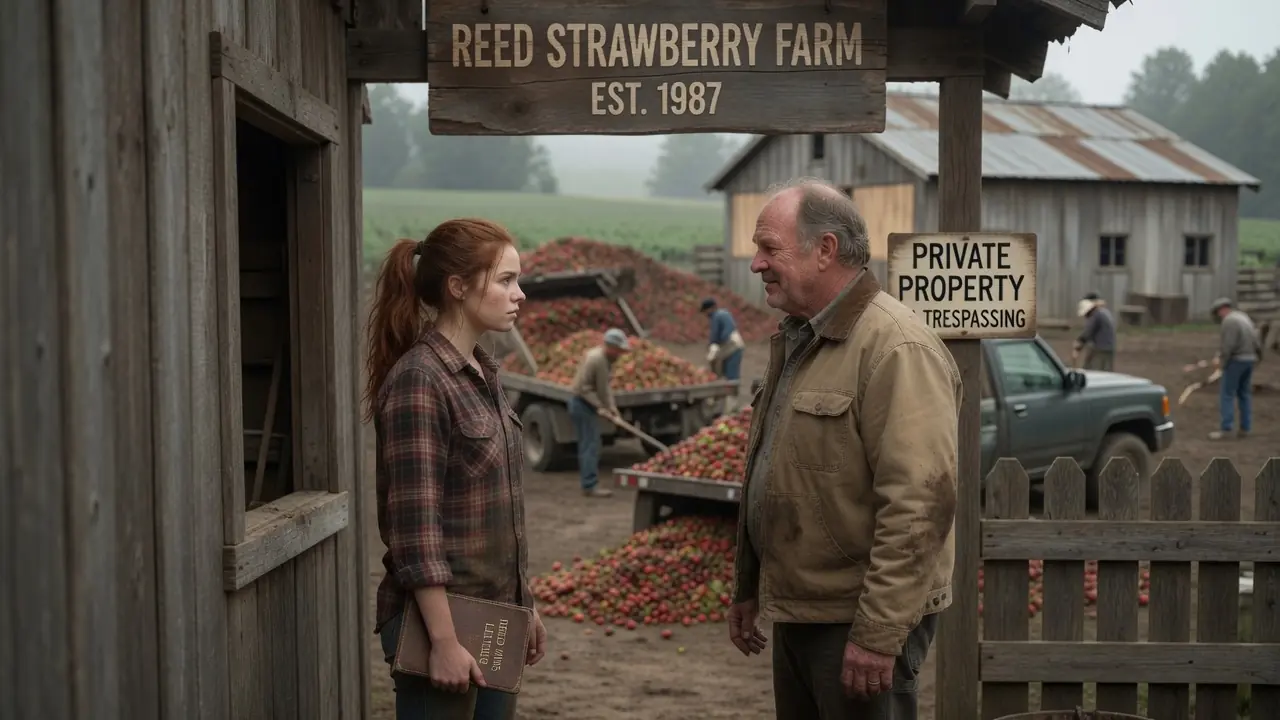
“They’re not rotten,” Emma said. “They’re rejected.”
Grant smirked. “That distinction won’t matter when they start fermenting under the sun.”
Several neighboring farmers watched from the roadside. Some had come because Grant told them Emma had lost her mind. Others were simply curious to see what kind of desperate person spent nearly every remaining dollar on fruit no supermarket wanted.
Emma’s late father had once stood among those same men.
David Reed had farmed strawberries, tomatoes, and lettuce on twenty-six acres outside Watsonville, California. His wife, Laura, handled the books, managed the roadside stand, and somehow made their weathered farmhouse feel warm even during terrible seasons. Together, they raised Emma and her younger siblings, fourteen-year-old Lucas and nine-year-old Sophie.
Then a truck crossed the center line on a rainy highway.
David and Laura never made it home.
Emma was nineteen when the sheriff knocked on the farmhouse door. By sunrise the next morning, she was no longer simply an older sister. She was a legal guardian, farm manager, debt holder, cook, driver, and the only person standing between two frightened children and the loss of everything their parents had built.
Most people expected her to sell.
Grant offered first.
He arrived three days after the funeral wearing a pressed jacket and an expression meant to resemble sympathy. His distribution company controlled many of the contracts linking local farms to grocery stores, hotels, and food manufacturers. He told Emma that farming was too difficult for someone her age and offered to purchase the land before the bank took it.
His price was less than half the property’s assessed value.
Emma refused.
Grant returned twice, lowering the offer each time while warning her that grief could make people unreasonable. When she continued refusing, several grocery orders mysteriously disappeared. Suppliers demanded earlier payments, and the lender holding the farm’s equipment loan began calling every week.
Emma understood what Grant was doing.
He was waiting for desperation to make his insulting offer look generous.
The two younger children gave her the reason not to surrender.
Lucas tried to become the man of the family overnight. He woke before school to repair fences, fed the chickens, and pretended not to notice overdue notices on the kitchen table. Sophie slept with their mother’s old cardigan and cried quietly whenever she thought Emma could not hear.
Selling the farm would not merely change their address.
It would erase the last place where they still felt like a family.
Emma took a job packing produce at night and worked the farm during the day. She reduced planting, sold one tractor, and turned the unused equipment shed into a crude processing room with secondhand sinks, stainless-steel tables, and an old industrial freezer purchased at auction.
The idea began inside the packing warehouse.
Every evening, Emma watched workers remove strawberries that were too small, oddly shaped, lightly bruised, or too ripe to survive long-distance shipping. Much of that fruit was still edible, but appearance standards made it commercially useless. Some went to animal feed, while tons were dumped because hauling it elsewhere cost more than destroying it.
Emma saw food.
More importantly, she saw ingredients.
Her mother had once made preserves from damaged berries after storms. Bruised fruit could not sit attractively in a plastic container, but it could become jam, puree, syrup, vinegar, fruit leather, or frozen concentrate. Emma began researching food-safety rules at night after her siblings went to bed.
She contacted county inspectors, community-college instructors, nonprofit food rescuers, and small manufacturers. Most ignored her. A few explained the costs involved in washing, sorting, testing, cooling, packaging, and transporting processed fruit.
The obstacles were enormous.
Still, they were smaller than losing the farm.
Emma spent six weeks designing a plan. Only fruit that remained safe and free from mold would enter the processing room. Damaged portions would be removed, while unusable waste would go into sealed composting bins. The clean berries would be washed, rapidly chilled, and converted into unsweetened puree.
She found her first possible customer through a school nutrition conference announcement.
BrightStart Foods supplied yogurt cups, breakfast bars, and smoothies to public schools across California. The company wanted affordable regional fruit but struggled with rising prices and unreliable supply. Emma mailed its purchasing director, Thomas Keller, a sample produced from one hundred pounds of rescued berries.
Thomas replied three days later.
The puree tasted excellent.
But Emma could not produce enough volume to qualify for a real contract.
That was why the rejected truckloads mattered.
Grant’s company had recently lost a major supermarket order when a heat wave caused berries to ripen too quickly. He faced enormous disposal costs, so Emma offered to accept the usable rejected fruit at a low price. Grant agreed because he assumed the inexperienced farmer would destroy herself handling it.
He did not know Thomas Keller was coming.
Grant pointed toward the unloading trucks. “By tomorrow, this place will stink, your siblings will lose their home, and I’ll buy the land for almost nothing.”
Emma opened the processing-shed doors.
“Keep laughing,” she said. “Your biggest customer arrives at noon, and he’s coming to sign with me.”
Grant’s smile vanished.
BrightStart Foods purchased millions of dollars in produce through Dalton Distribution. Losing even part of that business would damage Grant’s influence across the region. He looked inside the shed and saw stainless-steel tables, commercial washers, cooling tanks, sealed bins, and six workers wearing gloves and protective aprons.
The room was small, but it was not careless.
“You cannot process this much fruit,” he said.
“We start sorting the moment each crate comes off the truck.”
“You don’t have enough refrigeration.”
“The county cooperative loaned us two mobile cooling units.”
“You don’t have food-manufacturing certification.”
Emma removed a document from her ledger. “Temporary pilot approval, issued yesterday.”
Grant snatched the paper and read it.
For the first time, the neighboring farmers stopped smiling.
At eight that morning, the work began.
Every crate was inspected before entering the shed. Moldy fruit went directly into closed composting containers. Safe berries were washed, trimmed, weighed, and moved into cold storage. Emma tracked temperatures and processing times while Lucas labeled bins and Sophie sat inside the farmhouse preparing sandwiches for the workers.
Several women from the local church arrived to help.
Then came students from the nearby community college. Their food-science instructor had heard about Emma’s project and offered supervised volunteer assistance in exchange for allowing students to observe the pilot process.
By ten thirty, the first batch of puree entered the freezer.
Grant remained near his truck, making calls.
Emma knew he was not simply watching. He was looking for a weakness he could use to stop the operation. Twenty minutes later, a county vehicle appeared at the gate.
Inspector Paul Harris stepped out carrying a clipboard.
Grant smiled again.
“I reported unsafe food handling,” he said loudly. “Someone had to protect the public.”
Emma removed her gloves and approached the inspector. “You’re welcome to examine everything.”
Paul spent nearly an hour checking water temperature, sanitation logs, waste separation, worker practices, refrigeration, and fruit quality. Grant followed him through the shed, pointing out every stain and uneven crate as though he were presenting evidence at trial.
Paul ignored him.
At the end of the inspection, he signed the production log.
“The facility remains approved for the pilot,” he announced.
Grant’s face tightened. “You’re allowing a twenty-year-old girl to feed schoolchildren with garbage?”
Paul looked directly at him. “I’m allowing a licensed facility to process safe fruit that would otherwise be wasted. Her records are better than those from several larger operations I inspected this month.”
A few workers laughed.
Grant left in his truck shortly before noon, but not before warning Emma that Thomas Keller would never trust an operation built in a barn. Emma watched the distributor disappear down the dirt road and wondered whether he might be right.
The farm looked imperfect.
The farmhouse needed paint, one barn leaned slightly toward the orchard, and the processing shed still carried marks from decades of machinery. Emma had built everything through borrowed equipment, volunteer labor, and careful improvisation.
Thomas might see courage.
He might also see risk.
At twelve fifteen, a dark sedan entered through the gate.
Thomas Keller stepped out with a food technologist and BrightStart’s regional purchasing manager. He was a practical man in his early fifties who spoke little before inspecting the operation himself. Emma walked them through the entire process, explaining where the fruit came from, how workers separated unsafe berries, and why rapid cooling protected flavor.
The food technologist tested the first thawed sample.
She tasted it twice.
“No added sugar?” she asked.
“None.”
“The color is strong.”
“The rejected berries are often riper than supermarket fruit,” Emma explained. “They’re too soft for shelves, but better for puree.”
Thomas examined the production records. “Your cost estimate is thirty-eight percent below our current supplier.”
“Because I’m not paying for perfect appearance.”
“What happens when rejected volume falls?”
Emma showed him agreements she had negotiated with four nearby farms. Instead of paying disposal costs, they would deliver safe surplus and cosmetically rejected berries to Reed Farm. Emma would also plant several acres specifically for processing once the business generated enough income.
Thomas looked toward the fields.
“You’re building a supply chain from fruit everyone else considers worthless.”
“I’m building one from fruit everyone else misjudges.”
The purchasing manager smiled.
Thomas did not.
He remained silent while walking to the farmhouse, where Sophie had arranged sandwiches, lemonade, and a plate of strawberry cookies. Lucas stood beside the porch in work clothes, trying to look older than fourteen.
Thomas noticed him.
“Do you work here?”
Lucas glanced at Emma before answering. “Before school and after.”
“And what do you do?”
“Whatever keeps us here.”
The simple answer changed something in Thomas’s expression.
He looked toward Emma. “Your parents?”
“They died last year.”
“I’m sorry.”
“Thank you.”
Thomas had read the business proposal, but he had not known why the project mattered. Emma deliberately avoided using tragedy as a sales strategy. She wanted BrightStart to buy the puree because it was safe, affordable, and useful—not because the buyer pitied three orphaned children.
Thomas tasted one of Sophie’s cookies.
“My mother raised four children alone,” he said. “She used to make jam from damaged fruit because we couldn’t afford the prettier boxes.”
Sophie looked up at him. “Did it taste better?”
“Much better.”
The adults laughed.
Thomas returned to business. BrightStart needed one hundred thousand pounds of puree over six months. Emma’s pilot could not reach that level immediately. However, the company was willing to begin with twenty thousand pounds and expand if quality remained consistent.
The first contract would bring enough revenue to make the farm’s overdue equipment payment.
Emma held the pen but did not sign.
“What about Dalton Distribution?” she asked.
Thomas’s expression hardened. “Grant called me this morning.”
“What did he say?”
“That you were processing spoiled fruit without approval and that partnering with you would create liability.”
The workers nearby fell silent.
Thomas continued, “Then he offered to supply strawberry puree himself at a lower price if we rejected your proposal.”
Emma felt anger rise in her chest. Grant had mocked her idea until he realized it could threaten him. Now he wanted to copy it and use his size to crush her before the first contract began.
“Are you accepting his offer?” she asked.
“No.”
“Why?”
“He told me you were irresponsible. I arrived and found complete records, inspection approval, trained supervision, and a young farmer who understands our needs better than his sales department does.”
Thomas placed a second document on the porch table.
It was not merely a purchase agreement.
BrightStart offered Reed Farm a three-year development partnership, including advance funding for certified equipment, technical support, and guaranteed minimum orders. The company would also promote the project as part of its food-waste reduction program.
Emma stared at the figures.
The advance alone could stabilize the farm.
“This is real?” Lucas whispered.
Thomas nodded. “If your sister wants it.”
Emma signed.
Sophie threw both arms around her waist, while Lucas turned away to hide his tears. The workers applauded, and one elderly neighbor removed his hat with shaking hands.
For the first time since their parents’ funeral, Emma felt the farm move away from the edge of disappearance.
But Grant was not finished.
The following week, two growers who had promised rejected fruit canceled their agreements. Both admitted privately that Dalton Distribution threatened to stop purchasing their premium crops if they worked with Emma.
Then the mobile cooling company demanded its units back early.
Grant had offered to pay double.
Emma’s operation could not continue without reliable cooling. The first BrightStart delivery was due in twelve days, and failure would allow the company to cancel the contract.
Grant visited the farm that evening.
He parked near the processing shed and stepped out holding a purchase agreement for the land.
“You made a respectable attempt,” he said. “Now be sensible.”
Emma did not take the document.
“You pressured the growers.”
“I reminded them which relationships keep their businesses alive.”
“You bribed the cooling company.”
“I offered a competitive rate.”
“You tried to steal my customer.”
Grant smiled. “Competition feels unfair when you’re losing.”
Emma looked toward the farmhouse, where Lucas was helping Sophie with homework. “What do you want?”
“The land.”
“Why?”
“Because BrightStart proved the model works. This property is close to six major strawberry farms and has water rights, road access, and enough space for a real plant.”
“And what happens to us?”
“You take the money and move somewhere easier.”
“This is our home.”
“Sentiment does not belong in business.”
Emma remembered her father teaching Lucas to repair irrigation lines. She remembered her mother baking pies beside Sophie and laughing when flour landed in her hair. Grant saw acreage, infrastructure, and opportunity.
Emma saw her family.
“No,” she said.
His smile disappeared. “Then you’ll fail publicly instead of leaving quietly.”
After he drove away, Emma called every cooling provider within two hundred miles. None could deliver equipment fast enough. She considered telling BrightStart the truth, but she feared the company would see instability and withdraw.
Lucas found her sitting alone inside the empty shed.
“We’re not going to make the delivery, are we?” he asked.
“I don’t know.”
“Can we use the old freezer?”
“Not at that volume.”
“What would Dad do?”
Emma closed her eyes.
Their father was not a magician. He had endured droughts, pests, broken equipment, and bad prices by refusing to treat one failed plan as the end of every plan.
“He’d ask who else has what we need,” she said.
The answer arrived at midnight.
Reed Farm did not own commercial cooling equipment, but three neighboring farms did. Those growers had refused official agreements because they feared Grant’s retaliation. Emma visited them the next morning, not asking for fruit or contracts.
She asked for courage.
“You’ve all complained about Grant’s control for years,” she told them inside a machinery barn. “He sets prices, punishes anyone who questions him, and makes us compete for contracts he can cancel without warning.”
Farmer Miguel Alvarez folded his arms. “He can destroy us.”
“He can destroy us one at a time,” Emma replied. “But not if we build something together.”
She proposed a cooperative.
Each farm would contribute equipment, rejected fruit, or labor. Reed Farm would handle initial processing and the BrightStart contract. Profits would be divided according to documented contributions, and future customers would negotiate with the cooperative rather than individual growers.
The room remained quiet.
Then seventy-two-year-old Rose Bennett spoke.
“Your mother suggested something similar ten years ago.”
Emma stared at her. “She did?”
“Your father worried the others weren’t ready.”
Rose looked around the barn. “Maybe losing them is what finally made us ready.”
Six farmers joined.
By sunset, two refrigerated trailers stood beside Emma’s processing shed. Miguel supplied a portable washing line. Rose brought thirty workers and enough safe rejected strawberries to complete the BrightStart order.
Grant’s threats lost power the moment the farmers stopped facing them alone.
The first delivery left Reed Farm on schedule.
BrightStart’s laboratory approved the puree without a single quality complaint. School kitchens began using it in yogurt, breakfast smoothies, and reduced-sugar fruit bars. Children who had never heard of Emma Reed ate strawberries that grocery stores once considered worthless.
Within six months, the cooperative processed more than a million pounds of rescued fruit.
The operation expanded beyond strawberries. Bruised peaches became puree, small apples became sauce, and overripe tomatoes entered soup and salsa production. Food that once cost farmers money to discard became a second source of income.
Grant’s company began losing suppliers.
Several farmers discovered they earned more through cooperative processing than by accepting his lowest offers. BrightStart canceled much of its Dalton Distribution contract after auditors found that Grant knowingly supplied false information about Emma’s operation.
His largest customer had not merely signed with her.
It had left him because of the lies he told to stop her.
One year after the trucks arrived, Grant returned to Reed Farm.
The leaning barn had been repaired, the processing shed had doubled in size, and a new sign stood beside the gate:
REED VALLEY FOOD COOPERATIVE — NOTHING GOOD SHOULD GO TO WASTE
Emma met him outside.
He looked older and less certain.
“I came to offer a partnership,” he said.
“You already offered one.”
“I offered to purchase the farm.”
“That was not a partnership.”
Grant explained that his distribution network could help the cooperative reach national markets. He spoke respectfully now, praising Emma’s vision and describing food rescue as the industry’s future.
She listened without interrupting.
When he finished, Emma opened the gate.
For a moment, hope appeared in his face.
Then she pointed toward the road.
“We work with partners who respect farmers before they become profitable.”
Grant’s jaw tightened. “Business should not be personal.”
“You tried to take the home where my parents raised us. It became personal when you decided our grief made us easy to defeat.”
She closed the gate between them.
Grant left without another word.
The farm changed, but Emma protected what mattered.
Lucas eventually attended agricultural college and returned with plans for more efficient irrigation. Sophie designed labels covered with tiny strawberry drawings and proudly told classmates that ugly fruit paid for her school supplies.
Emma turned twenty-two inside the restored barn surrounded by farmers, workers, teachers, inspectors, and neighbors who once laughed at the rejected trucks.
Rose Bennett raised a glass of strawberry lemonade.
“To the girl who saw hope where the rest of us saw garbage.”
Emma looked around at the people who had helped save the farm.
“I didn’t do it alone.”
“No,” Rose replied. “But you were the first one brave enough to begin.”
Later that evening, Emma walked through the quiet fields with Lucas and Sophie. Fog rolled across the hills much as it had on the morning the trucks arrived. The farmhouse windows glowed in the distance.
Sophie slipped her hand into Emma’s.
“Do you think Mom and Dad know we kept it?”
Emma looked toward the sky.
“I think they knew we would.”
At the edge of the strawberry field stood the first crate delivered that morning, cleaned and mounted beneath a protective glass cover. A small plaque carried the words their mother often used when trimming damaged fruit for preserves:
Bruised is not the same as useless.
The sentence described more than strawberries.
It described a young woman who lost her parents and was told she was too inexperienced to survive. It described two children who believed their family had been permanently broken. It described farmers pushed aside by a distributor who thought fear could keep them divided.
Grant saw damaged fruit, desperate landowners, and an orphan he could overpower.
Emma saw ingredients, partners, and a reason to keep fighting.
The trucks he expected to bury her farm became the beginning of the business that saved it.
And every time another load of rejected strawberries rolled through the wooden gate, no one laughed anymore.