“Thirty tons of split trash—and you think a notebook makes you a businesswoman?”
Dale Harrington laughed as he crushed the signed waste sheet inside one thick hand. Behind him, forty-three towering bins of split peaches waited beneath the July sun at Harrington Brothers Packing House in Sauk County, Wisconsin. The fruit smelled intensely sweet, but heat and time were already turning that sweetness toward rot.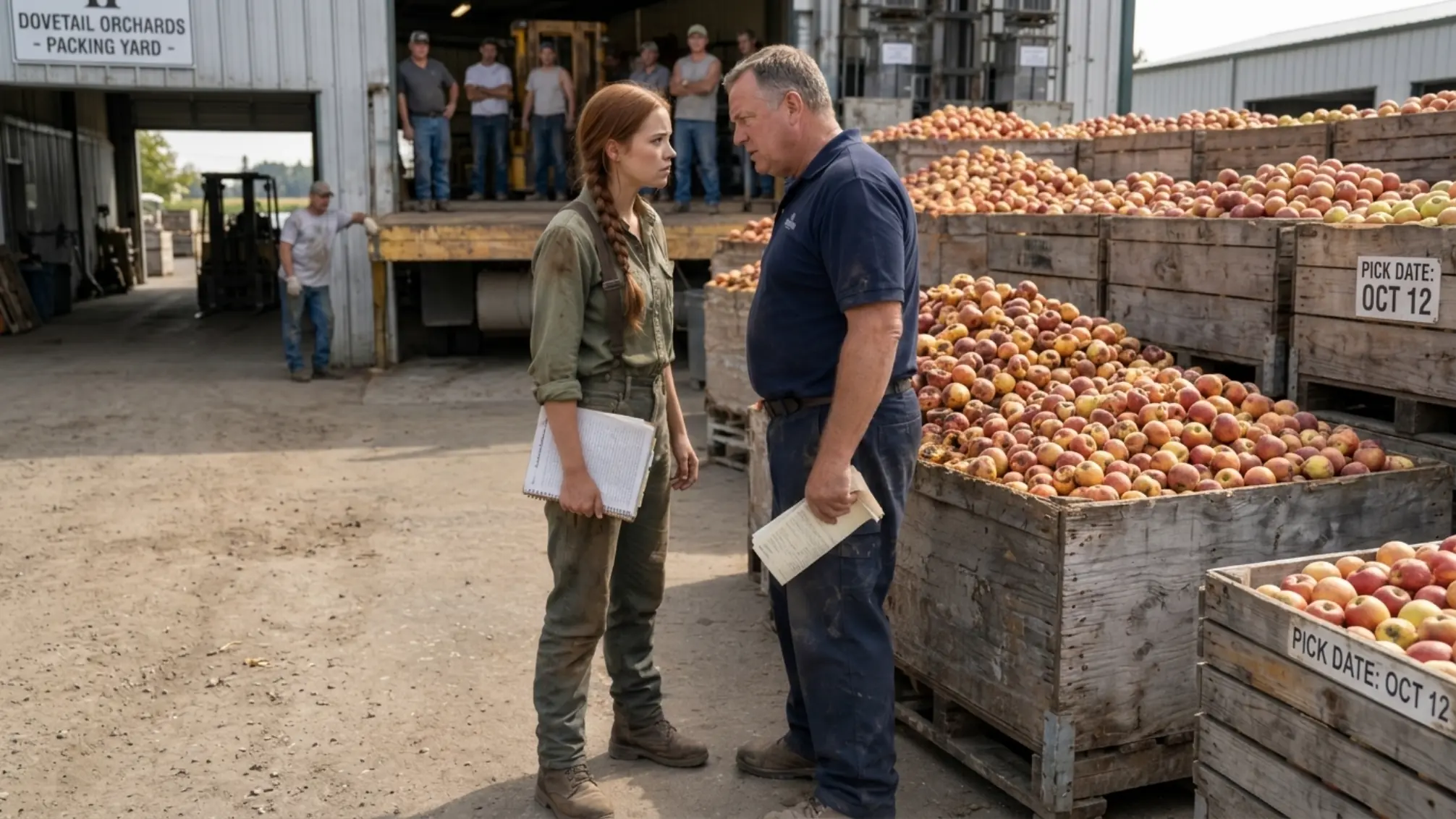
Nora Dijkstra stood directly before him with her spiral notebook pressed against her mud-stained overalls. Her auburn braid rested over one shoulder, and determination sharpened her green-gray eyes. At nineteen, she looked young enough for Dale to dismiss before she finished speaking.
“No,” Nora replied with a slight smile. “Turning your yearly loss into profit does.”
Several workers near the loading dock stopped stacking empty crates. Wes Crowley, an equipment dealer visiting the packing house, chuckled loudly from beside Dale’s pickup. Dale glanced toward him, pleased that someone else understood how ridiculous the situation appeared.
“Your little peach drink will be forgotten by Saturday,” Dale said.
Nora looked past him toward the bins his foreman had already marked for disposal.
“Then come Saturday,” she answered. “Watch your garbage sell out before noon.”
The smile disappeared from Dale’s face.
Nora turned and walked across the gravel yard without waiting for his response. Forty yards away stood the small wooden stand she had built from leftover lumber the previous summer. It had a canvas awning, four stools, a chalkboard menu, and a hand-painted sign reading Dijkstra Orchard Cider.
Dale watched her go and shook his head.
For twenty-two years, he had operated the packing house under one simple system. Grade A peaches went to large grocery chains in Madison and Milwaukee. Grade B fruit went to roadside markets and independent retailers, while anything split, bruised, or visually imperfect became a contractual loss.
The peaches were not necessarily rotten or unsafe. Most had cracked because heavy rain followed a period of dry July heat, causing the fruit to expand faster than its skin could stretch. Their flesh remained sweet and flavorful, but grocery stores refused produce that would deteriorate quickly on display.
Each July, Harrington Brothers wrote off between twenty and thirty-five tons.
Dale considered it unavoidable.
Nora had spent years wondering why everyone else accepted it.
Her family had farmed sixty acres of peaches and apples for three generations. Her grandfather had planted the first trees on sloped, sandy Wisconsin ground that neighboring farmers claimed would never support a profitable orchard. Her father, Raymond, inherited the farm in 1989 and developed a reputation for careful pruning, dependable deliveries, and consistent fruit.
Raymond valued his relationship with Harrington Brothers because it had kept the farm stable for decades. He accepted small damage payments for rejected peaches the same way he accepted drought, frost, and insects. Farming came with losses, and a wise farmer did not waste energy fighting conditions he could not control.
Nora believed this loss was different.
She had watched perfectly edible peaches disappear into dumpsters every summer since childhood. By seventeen, she had begun recording the number of rejected bins, estimating weight, calculating contract payments, and researching what other orchards did with cosmetically imperfect fruit.
During her first year at the University of Wisconsin, she studied agricultural economics and food systems. A professor named Dr. Annika Sorensen introduced her to case studies from Michigan, Vermont, New York, and Ontario. Those operations converted damaged-looking fruit into juice, preserves, vinegar, and hard cider.
The results changed how Nora viewed the packing-house yard.
A split peach could not survive eight days on a grocery shelf, but it did not need to. If pressed within forty-eight hours, its slightly concentrated sugar content could create richer juice and more flavorful fermented cider than fruit harvested early for shipping.
Dr. Sorensen’s research suggested processing could recover between three and six times the value offered through standard damage payments. Applying conservative figures to the Dijkstra orchard, Nora estimated that fruit currently generating roughly $11,000 could create between $47,000 and $62,000 annually. At the highest realistic level, the number approached $110,000.
She ran the calculations three times before presenting them to her father.
Raymond listened at the kitchen table while she explained equipment costs, licensing, processing windows, bottle prices, and estimated margins. He did not laugh, but his expression revealed how far her proposal existed outside the methods he trusted.
“We’ve worked with Harrington Brothers for thirty years,” he said.
“I’m not asking you to stop.”
“You’re proposing a winery inside an equipment shed.”
“A small licensed processing operation.”
“We grow fruit, Nora.”
“And then we throw part of it away.”
Raymond glanced toward the notebook.
“Processing requires equipment, insurance, permits, sanitation, storage, and customers.”
“I’ve included all of them.”
“You included estimates.”
“Then let me create real numbers.”
Her mother, Carolyn, remained quiet until Raymond left the kitchen. She found Nora inside the barn an hour later and rested one hand against the doorway.
“I think you’re right,” Carolyn said.
“That doesn’t mean Dad will let me do it.”
“He needs time.”
“He’s had thirty years.”
“To him, those thirty years prove the system works. To you, they prove the system wastes fruit.”
Nora closed her notebook. “Which one of us is right?”
“Build something strong enough that the answer becomes obvious.”
Raymond took six weeks.
Eventually, he granted Nora access to the old equipment shed and the split fruit from ten orchard acres. He emphasized that he was allowing an experiment, not approving a permanent business.
“If you lose money, it ends after one summer,” he said.
Nora extended her hand. “Fair.”
She converted the shed into a licensed processing space using equipment purchased secondhand. A sixty-gallon press came from a closed Door County operation. Two stainless fermentation tanks arrived from a home-brewing supplier in Madison.
She completed food-safety training, secured the required permits, and spent three days moving between county offices to correct paperwork. She built the roadside stand herself and painted the sign after midnight because the daylight hours belonged to the orchard.
Her first batch used four hundred pounds of split peaches.
She pressed the fruit Thursday evening, bottled fresh juice Friday morning, and opened the stand Saturday. Every bottle sold within three hours.
Nora did not celebrate publicly.
She recorded the result.
By the end of that first summer, she had processed approximately 4,200 pounds of fruit through eleven batches. Total revenue reached $14,300, while expenses—including equipment, permits, supplies, and the assigned value of the peaches—came to roughly $6,800.
The experiment produced $7,500 in net income.
Under the packing-house contract, the same fruit would have generated approximately $840.
Raymond studied the figures twice.
“That’s not bad,” he said.
“It’s the first year.”
“No advertising.”
“No established customers.”
“And you used old equipment.”
Nora nodded.
Raymond slowly closed the report. “I need to think about next season.”
That autumn, Nora approached Dale Harrington at the Sauk County Co-op. He stood beside Wes Crowley and another grower, drinking coffee and discussing contracts. Nora waited until the crowd thinned before opening her notebook.
She showed Dale the processing results and proposed a partnership. Instead of paying to haul away rejected fruit, Harrington Brothers could redirect safe split peaches toward licensed local processors.
Dale listened politely.
Then he gave her the same patient smile powerful men often gave young people whose ideas they had no intention of considering.
“I appreciate your entrepreneurial spirit,” he said. “But packing-house waste is more complicated than it looks from the outside.”
“I’ve included insurance and liability requirements.”
“A small operation can’t manage the exposure.”
“I already hold the permits.”
“Grocery chains establish the cosmetic standards. We can’t change them.”
“I’m not asking you to change the standards. I’m asking you to stop treating rejected fruit as worthless.”
Wes laughed into his coffee. “Peach wine sounds like a pleasant hobby.”
Nora looked at him. “Seven thousand five hundred dollars is an expensive hobby.”
“For one lucky summer.”
“That’s why I’m expanding the test.”
Dale set down his cup. “Young people always think one spreadsheet can replace experience.”
“No. It shows when experience stopped asking questions.”
The co-op became silent.
Dale’s expression hardened, but Nora closed her notebook before the conversation could become an argument. She thanked him for listening and walked away.
The laugh followed her toward the door.
She remembered it all winter.
Raymond granted Nora thirty acres for the 2019 season—the lower slope most vulnerable to split fruit. It was not the easiest ground, and it produced the highest percentage of cosmetic rejects.
“If your system works there, we discuss the entire orchard,” he said.
Nora upgraded the equipment shed immediately.
She purchased a used two-hundred-gallon press from a Michigan cidery, added two fermentation tanks, and created a cold-storage room with insulated panels and a secondhand refrigeration unit. A Wisconsin farm-winery license allowed her to increase production and sell through markets and licensed retailers.
She hired two local students for seasonal work.
Her redesigned bottles carried white labels with a hand-drawn peach. Fresh juice sold for eight dollars, while hard peach cider sold for fourteen. Those prices had not been guessed; Nora calculated them against costs, market demand, labor, and sustainable margins.
The first major fruit split occurred on July ninth.
Three days of rain followed two weeks of dry heat, cracking peaches across twelve orchard rows in one afternoon. Raymond’s foreman reported the damage as a major loss.
Nora heard opportunity.
Within an hour, she and her workers entered the orchard with every available bin. They harvested until darkness, continued beneath portable lights, and finished near dawn.
By six the next morning, 4,800 pounds of split peaches filled the processing shed.
Nora ran the press for two days.
She produced 312 bottles of fresh juice and filled sixty gallons of fermentation tanks. By Friday, the roadside stand had reopened.
The fresh juice sold out before noon Saturday.
Customers added their names to a waiting list for the upcoming cider release. Some had driven from Madison after tasting bottles purchased by friends. Others arrived after seeing photographs online.
That same week, Harrington Brothers discarded thirty-one tons of fruit.
The bins remained beneath the sun for four days before the waste hauler arrived.
Nora drove past them on her way to the Baraboo farmers market. She saw Dale standing beside his loading dock but did not slow down. He saw the Dijkstra Orchard Cider sign on her trailer and looked away.
By the end of July, Nora had processed eleven thousand pounds of fruit and generated $42,000 in gross revenue. Hard-cider margins approached sixty-three percent, while fresh juice ran close to fifty-eight percent.
A Madison wine-shop owner called after tasting a bottle brought in by a customer. He wanted to discuss wholesale orders.
Raymond drove past the orchard stand one Thursday afternoon and found eleven people waiting beneath the awning. He remained inside his pickup for several minutes, watching Nora answer questions, arrange bottles, and collect payments.
At dinner, he said almost nothing.
Carolyn recognized the expression on his face.
“You could tell her you’re impressed,” she said after Nora left the room.
“I’m watching the entire season.”
“She knows.”
“One strong month isn’t a business.”
“No, but it is more than the hobby everyone called it.”
Raymond stared at his coffee.
“I should have listened sooner.”
Carolyn smiled faintly. “You still can.”
Wes Crowley visited Harrington Brothers in early August and casually mentioned Nora’s line of customers.
“Looks like Raymond’s girl is doing well with that little setup.”
Dale kept reviewing an equipment quote. “That’s nice.”
“She has Madison buyers now.”
“Trends disappear.”
“Thirty tons of peaches don’t.”
Dale lifted his eyes.
Wes regretted the remark immediately and changed the subject.
Nora closed the stand on October fourth and spent the next week completing her accounting. She checked every invoice, payroll entry, licensing expense, equipment allocation, bottle purchase, and market fee.
The final numbers exceeded even her conservative forecast.
From the thirty-acre block, she processed 44,200 pounds of split and cull peaches—approximately eighty-seven percent of its cosmetic reject volume. Gross revenue reached $111,400.
Total expenses came to $41,200.
Net operating income was $70,200.
The packing-house damage payment for the same fruit would have been approximately $9,300.
Nora placed the spreadsheet before Raymond at the kitchen table.
He read it once.
Then again.
“Seventy thousand two hundred?”
“Yes.”
“From the lower thirty acres?”
“Yes.”
He looked toward the dark orchard beyond the window. “What would the whole sixty acres produce?”
Nora opened the notebook to a calculation prepared several weeks earlier.
Raymond read the projected figure and remained silent for nearly a minute.
Finally, he looked at his daughter.
“You were right.”
“I know.”
There was no cruelty or triumph in her answer. She had not spent two years trying to defeat her father. She had been trying to save something the farm already produced.
Raymond nodded.
“You decide next year’s rotation.”
In November, the Madison wine shop ordered forty-eight cases. A specialty grocery in Milwaukee expressed interest, and a farm-to-table restaurant in Spring Green requested samples for its beverage menu.
Nora expanded the cold-storage room.
Then she received an invitation to present at the Wisconsin Orchard Growers Association annual meeting in February 2020. At nineteen, she would be the youngest speaker by nearly twenty years and the only woman presenting on production economics.
Dale Harrington sat in the third row.
He had not known Nora would speak until he saw her name printed in the program. Leaving would have drawn attention, so he remained.
Nora stood at the podium before sixty-three orchard operators. She presented waste volume, damage rates, processing costs, licensing, margins, and market access. She did not insult packing houses or claim every farm needed a cidery.
She showed numbers.
Then she displayed the final comparison:
Packing-house payment: approximately $9,300.
Processing net income: $70,200.
The room went silent.
Dale looked down at his hands.
Afterward, growers surrounded Nora near the coffee station, asking about equipment, fermentation, processing windows, and permits. Raymond stood two feet behind her, watching his daughter answer every question without referring to her notes.
Twenty minutes later, Dale approached.
“Nora.”
“Mr. Harrington.”
“I have questions about your processing model.”
She tilted her head slightly. “I believe you said liability was more complicated than it looked from the outside.”
Dale stared into his untouched coffee. “That was fair.”
“It was your exact statement.”
“I was wrong.”
“The regulations existed when I showed them to you.”
“I know.”
“The numbers existed too.”
“I know that now.”
“You knew them then. You just didn’t believe they could come from me.”
Dale lifted his eyes.
Raymond remained silent behind her.
Nora continued calmly. “The lesson isn’t that cider is better than packing contracts. The lesson is that any business writing off its own product without asking what else it could become is leaving money on the ground.”
Dale nodded slowly.
“The ground doesn’t care how long you’ve been in business,” Nora added.
“No.”
“I’ll send you the processing framework.”
That was not forgiveness.
It was something more useful.
By 2021, Dijkstra Orchard Cider processed rejected fruit from the full sixty-acre orchard. The equipment shed had been expanded twice, the cold-storage room held 480 cases, and Nora employed four seasonal workers plus one year-round assistant.
Her cider reached eleven Wisconsin retailers.
Between 2017 and 2022, the orchard’s per-acre revenue increased by 231 percent. Raymond did not replace the trees or abandon the careful farming methods he had practiced for decades. The family simply stopped calling part of its harvest worthless.
Harrington Brothers quietly changed its waste policy.
Dale partnered with three local processing operations and redirected fruit previously sent to waste haulers. One of those operations was Dijkstra Orchard Cider.
Wes eventually visited the stand and purchased two bottles.
He did not mention laughing at Nora’s proposal.
She did not mention it either.
Years later, another grower asked Nora to help build an apple-processing program. Then another farmer called. Soon, the notebook mocked at the co-op became the framework several orchard families used to recover income from fruit previously written off.
Nora continued studying the orchard itself.
She learned that split events followed patterns connected to moisture changes on the lower slope. By adjusting irrigation and using cover crops that improved water retention, she spread the cracking across a more manageable period, allowing the cidery to process fruit without emergency overnight harvests.
She was not trying to eliminate the split peaches.
She had built a business around them.
She was teaching the orchard to deliver them when she could use them best.
One evening, Raymond sat beside her on the porch and looked across the rows planted by his father.
“Your grandfather would have liked what you’ve done.”
Nora watched the last light move over the trees.
“I think about that sometimes.”
“So do I.”
In the spring of 2024, Nora’s seventeen-year-old sister arrived at the kitchen table carrying her own notebook. She had studied a new crop proposal for unused ground and already gathered information on licensing, seed costs, and expected returns.
She asked Nora what she thought.
Nora remembered placing her first notebook beside Raymond’s coffee. She remembered his hesitation, Dale’s patient smile, Wes’s laughter, and thirty tons of peaches collapsing beneath the July sun.
“Show me the numbers,” she said. “Then we’ll figure out what you need.”
Her sister opened the notebook.
Raymond stood near the coffee pot, watching his two daughters discuss soil, markets, permits, and possibilities. This time, he did not ask for six weeks to think.
The original spiral notebook now rests inside a drawer in the cidery office. Beside it sits the first wholesale order from Madison and a photograph taken after the major split event of 2019. Nora and her two workers stand before rows of bins harvested through the night.
Thirty tons of split peaches had been discarded every July for twenty-two years.
Dale Harrington saw a waste log.
Nora saw raw material.
He mocked her notebook, dismissed her cider as a hobby, and predicted customers would forget it by Saturday.
Saturday arrived.
The juice sold out before noon.
And when Dale finally came asking how she had done it, Nora did not need to remind him who had laughed.
The $70,200 on her final report remembered for her.