The morning sun had barely climbed above the glass hangars of Sterling Executive Air when Sophia Sterling stepped out of a black sedan and onto the quiet private tarmac. At thirty-four, Sophia carried herself with calm authority, but there was nothing cold about her beauty. She was a striking Black woman with deep brown skin, long glossy black waves falling over her shoulders, sharp intelligent eyes framed by flawless makeup, and a poised, elegant face that made people look twice even before they understood who she was. Dressed in a tailored cream skirt suit, nude heels, and gold earrings, with a structured designer handbag in one hand and her phone in the other, she looked every bit like a woman born to command boardrooms, balance billion-dollar negotiations, and make difficult decisions without raising her voice.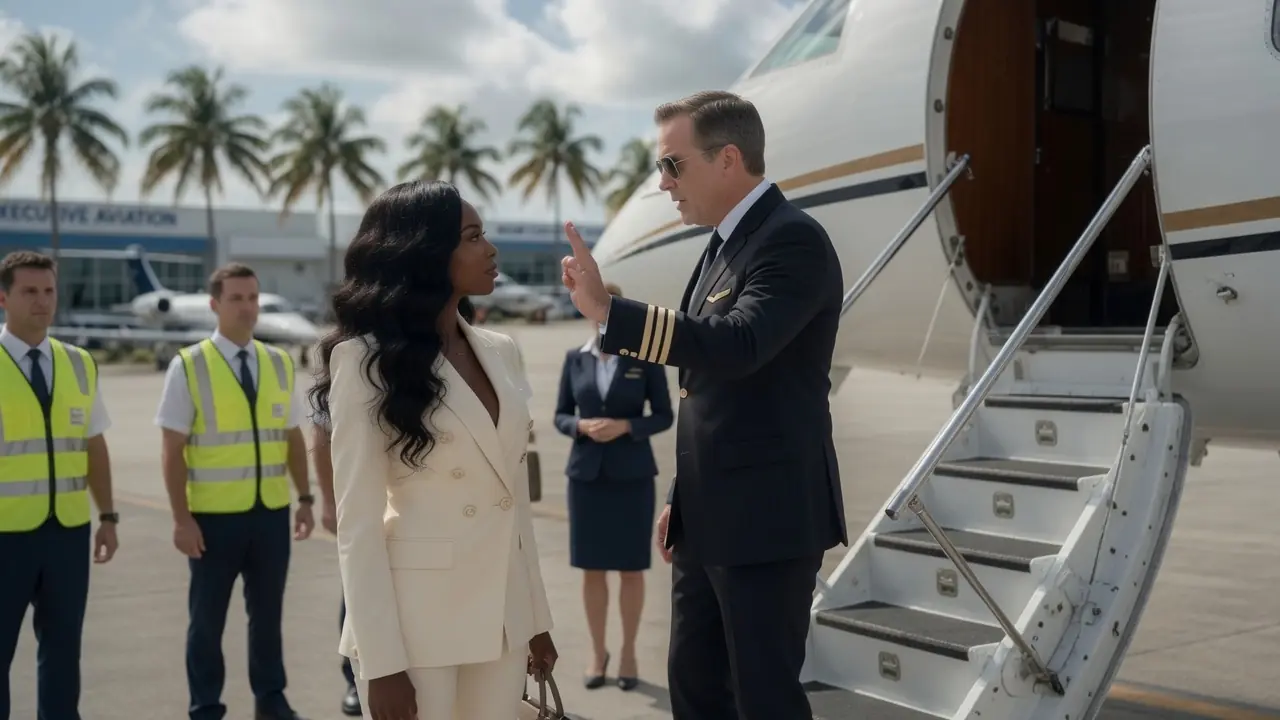
Yet Sophia had not been born into any of it. She had built Sterling Executive Air from the ashes of a cargo brokerage her late father left behind, turning a failing aviation business into one of the most respected private charter and corporate flight companies in the Southeast. She knew every inch of the business, from fuel contracts and safety audits to the tone a pilot used when greeting a passenger. That morning she was headed to Dallas for a final merger meeting that could expand the company nationwide. She had deliberately traveled without an assistant or entourage because she preferred seeing how employees behaved when they thought no one important was watching.
The aircraft waiting on the runway gleamed in the sun, its white body polished to a mirror shine. The jet was one of the newest in the fleet and, more importantly, it belonged personally to Sophia through a holding division of her company. A flight attendant stood just inside the open door, checking a manifest, while a tall, broad-shouldered pilot in a dark uniform descended the stairs with his sunglasses on and one hand lifted in a stopping gesture. He wore captain’s stripes and the expression of a man already annoyed before a word had been spoken.
He looked Sophia up and down, his mouth flattening with dismissive judgment.
“This flight is private, ma’am.”
The words landed with practiced insult, the kind dressed up as professionalism. Sophia stopped at the foot of the stairs and studied him for a moment. She had met enough arrogant men in tailored uniforms to recognize the type instantly: men who believed authority lived in their voice, men who mistook confidence for ownership, and men who assumed a Black woman traveling alone could not possibly belong beside a private jet unless she was lost.
She kept her tone calm. “I’m aware.”
Captain Mark Dawson shifted his weight and glanced toward the sedan that had already driven off. “Then you’re probably looking for the charter desk in the main terminal. This aircraft isn’t for commercial boarding.”
Sophia’s gaze did not move. “I’m not looking for the charter desk.”
He gave a short laugh, humorless and sharp. “Ma’am, I’m trying to save you some embarrassment. This plane is reserved for executive use.”
A baggage handler nearby slowed his cart. The flight attendant inside the doorway looked down uneasily. Sophia noticed both of them, but she kept her attention on the pilot.
“And what exactly do you think I’m here for?” she asked.
Mark’s jaw tightened, as if he resented being made to say it openly. “You’re clearly at the wrong aircraft.”
Sophia tilted her head. “Clearly?”
He removed his sunglasses just enough for her to see the irritation in his eyes. “Look, ma’am, private aviation doesn’t work the way commercial airports do. You can’t just walk up because you think you belong here.”
The insult was no longer subtle. Sophia had heard versions of it her entire career, in investor meetings, at country clubs, at aviation expos where men assumed she was someone’s assistant. Years ago, such moments had stung. Now they sharpened her.
“What is your name, Captain?” she asked.
He seemed pleased by the formality, as if he believed he had won the exchange. “Captain Mark Dawson.”
Sophia nodded once and lifted her phone. “Thank you.”
Mark folded his arms. “Security can escort you to the terminal if you’d like.”
Sophia unlocked her phone and dialed a number she knew by heart. The chief of operations answered before the second ring. Around them, the tarmac remained bright and still, with only the low hum of ground equipment and the distant cry of gulls slicing through the heat.
“Daniel,” Sophia said, her voice even, “who assigned Captain Mark Dawson to my jet this morning?”
There was a pause. Then Daniel’s tone shifted from casual to alarmed. “Captain Dawson, ma’am. Is there a problem?”
Sophia did not break eye contact with Mark. “Yes. A serious one. He’s currently standing on the stairs of my aircraft informing me this flight is private and suggesting I don’t belong on it.”
The color drained from Mark’s face.
Daniel inhaled sharply. “I’ll be there in sixty seconds.”
Sophia ended the call. She slipped the phone back into her hand and said nothing more. Mark stared at her as the meaning of the conversation settled like a weight in his stomach. For a second, he seemed unable to decide whether to apologize, deny, or pretend he had misunderstood. The flight attendant at the door straightened immediately, now visibly aware of exactly who stood below her.
“Ms. Sterling,” the young attendant said nervously, “I’m so sorry—”
Sophia lifted one hand gently to stop her. “Not your fault.”
Mark swallowed. “Ms. Sterling?”
“Yes,” Sophia said.
“I—there must be some confusion.”
Sophia’s expression remained unreadable. “The only confusion was yours.”
He stepped down one stair, suddenly stripped of the swagger he had worn a moment before. “I didn’t realize—”
“That’s exactly the problem,” Sophia said quietly. “You didn’t realize because you decided who belonged here before you asked a single respectful question.”
A white operations cart sped across the tarmac, brakes squealing as it stopped nearby. Daniel Reeves, the company’s chief of operations, jumped out alongside two HR staff members and a security supervisor. Daniel was a meticulous man in his forties who normally spoke with controlled calm, but that calm was gone now. He approached Sophia first.
“Ms. Sterling, I apologize.”
Sophia nodded. “You should.”
Daniel turned to Mark. “Captain Dawson, step away from the aircraft.”
Mark looked around as though hoping someone would intervene for him. “Daniel, this is being blown out of proportion. I was protecting the flight.”
“From the owner?” Daniel asked coldly.
Mark’s throat moved. “I didn’t know she was the owner.”
Sophia finally let a trace of emotion enter her face, though it was not anger so much as disappointment. “And if I weren’t? If I were a client’s wife? A board member? A new executive? Would speaking to me that way have been acceptable then?”
Mark opened his mouth, then closed it again.
The security supervisor stayed at a distance, but his presence made the shift in power unmistakable. Several ground crew members had paused near the hangar, pretending to work while watching the scene unfold. In private aviation, reputation meant everything. A pilot’s technical skill mattered, but so did discretion, courtesy, and judgment. Public humiliation was rare. Public humiliation earned by arrogance was unforgettable.
Daniel spoke crisply. “Captain Dawson, effective immediately, you are removed from flight duty pending termination review under the conduct and discrimination provisions of your contract.”
“Pending?” Sophia said without taking her eyes off Mark.
Daniel corrected himself immediately. “Terminated, then.”
Mark flushed deeper. “You can’t fire me over one misunderstanding.”
Sophia’s gaze sharpened. “This isn’t one misunderstanding. This is a professional failure. You were entrusted with one of the most visible aircraft in my company, and you treated a woman on the tarmac like she was too poor to stand near it. That tells me this isn’t the first time you’ve made that judgment. It’s just the first time it cost you your job.”
He tried once more. “I’ve flown thousands of hours for this company.”
“And you still never learned the first lesson of service,” Sophia replied. “The plane may be private, Captain. Your prejudice shouldn’t be.”
Silence followed that line. Even the breeze seemed to stop for a moment. Daniel signaled to HR, and one of them held out a folder with formal termination paperwork already being prepared digitally on a tablet. In any other circumstance, Sophia might have preferred a quieter handling. But something in Mark’s tone, something in the smug certainty with which he had tried to shame her, made public accountability feel necessary.
Mark looked from Daniel to Sophia with growing desperation. “Ms. Sterling, please. I made a bad assumption. Let me apologize properly.”
Sophia’s voice softened, but only in volume. “No, Captain. A proper apology starts before consequences.”
The flight attendant stepped aside as Daniel arranged a replacement crew. Another pilot, Captain Elena Ward, was called from standby. She arrived within minutes, composed and efficient, greeting Sophia with professional warmth and not a flicker of hesitation. That contrast, more than anything, exposed how needless Mark’s behavior had been.
As operations staff handled the crew swap, Sophia finally turned toward the stairs. Mark moved instinctively aside, no longer blocking her path. She paused just before ascending and looked back at him one final time.
“You thought you were protecting this flight from the wrong passenger,” she said. “What you really did was prove you were the wrong pilot.”
Then she boarded her jet.
Inside, the cabin was cool and elegant, with cream leather seats, polished walnut surfaces, and fresh white orchids placed near the rear conference table. Sophia set her bag down and took the window seat, though she did not relax. Her pulse had steadied, but her mind was already moving beyond personal insult toward something larger. Men like Mark did not behave that way in isolation. A culture allowed them to feel safe doing it.
Before takeoff, she asked Daniel to join her briefly on board. He entered with a tablet in hand and a carefully guilty expression.
“Tell me the truth,” Sophia said. “Have there been other complaints?”
Daniel hesitated, which answered the question before he spoke.
“Two,” he admitted. “Neither reached you directly. One concerned a female executive who said Captain Dawson was condescending during boarding. The other came from a Black entrepreneur who felt he was questioned more aggressively than his guests. HR documented them, but he had strong flight performance records and no safety incidents, so—”
“So the company chose convenience over character,” Sophia finished.
Daniel lowered his eyes. “Yes.”
Sophia sat back, disappointment turning colder. “Then this is bigger than a termination. I want a full review of client-facing conduct across flight crews and executive staff. Anonymous reporting, mandatory retraining, and real penalties. Not a memo. Not a workshop that everyone forgets by lunch. Fix it.”
“It’ll be done.”
“And Daniel?”
“Yes, ma’am?”
“The next time a complaint like that lands on anyone’s desk, I want it in mine by the end of the day.”
He nodded. “Understood.”
When the jet finally taxied toward the runway, Sophia looked through the oval window and saw Mark standing near the operations cart with an HR representative beside him. He looked smaller now, not because he had changed size, but because stripped arrogance always revealed the ordinary man underneath. Sophia did not feel triumph. What she felt was resolve.
During the flight to Dallas, she tried to focus on the merger documents spread across the conference table, but the morning’s encounter kept returning in small flashes. The raised hand at the stairs. The lazy certainty in his voice. The assumption that she should feel embarrassed simply for approaching what was hers. Each memory connected to a longer chain of moments she had spent her entire life surviving.
She remembered being seventeen and accompanying her father to a regional air show, where a vendor handed the brochures to him and said, “Your daughter can sit in the shade if this gets too technical.” She remembered a banker fifteen years later asking whether the real decision-maker in her startup was available. She remembered buyers who addressed white junior staff while ignoring her at the head of the table. None of those men had known how much they revealed about themselves in one sentence.
By the time the jet landed in Dallas, Sophia had made up her mind about something else as well. She was no longer interested in merely building a successful company. She wanted to build one where young women who looked like her did not have to armor themselves before stepping onto a runway.
The merger meeting took most of the afternoon. Sophia was flawless in it. She negotiated with precision, challenged inflated forecasts, spotted a hidden liability in the fuel partnership language, and left the opposing board stunned by how fully she commanded every detail. By five o’clock, the deal was nearly complete pending final signatures. Her legal counsel called it one of the strongest performances he had ever seen from her, though Sophia knew it had been fueled partly by the steel still burning from that morning.
When she returned to Atlanta late that night, she did not go home. Instead, she asked the driver to take her to the headquarters building. Most lights were off, but the executive floor remained accessible. She walked alone into the dark conference room overlooking the city and stood by the window, heels in one hand, the skyline glittering beneath her.
Success had brought her many things—wealth, influence, recognition, a fleet of aircraft bearing her name—but on nights like this, she still felt the lonely edges of it. There was no one waiting at home who would hear the story and understand the cost beneath the victory. Her parents were gone. Her long engagement had ended three years earlier when her fiancé decided he loved the idea of her more than the reality of her ambition. She had built an empire, yes, but sometimes she stepped off her own planes into silence.
That night, however, the silence felt less heavy. Something about refusing humiliation in the exact place it had been offered brought a strange kind of peace. She had not raised her voice. She had not begged for respect. She had simply named what was hers and made the consequence fit the offense.
The next morning, company-wide changes began. Daniel circulated notice of an internal culture review. HR opened confidential interviews. A client-relations director was appointed to audit executive travel experiences. Sophia personally approved a new program to recruit and mentor women and minority professionals in aviation leadership, from pilots to operations managers to senior executives.
Within two weeks, more stories surfaced about Mark Dawson—subtle insults, dismissive tones, selective courtesy that always seemed to favor the same kinds of passengers. None had seemed dramatic enough alone to provoke decisive action. Together, they painted a clear picture. Sophia read every report herself, and each one confirmed what she had already known on the tarmac: the problem had never been confusion. It had been entitlement.
The story also began to travel quietly through industry circles. Not through gossip columns or public scandal, but through the private networks where aviation professionals talked. People heard that Sophia Sterling, the Black CEO of Sterling Executive Air, had arrived alone at her own jet, been mistaken for someone who did not belong, and fired the pilot on the spot. By the time the story reached national business circles, it had become something almost mythic.
Sophia disliked myths. She preferred facts.
So when she was later invited to speak on a panel for women in aviation leadership, she told the story plainly. She did not name Mark, and she did not dramatize the humiliation. Instead, she said, “Power is not proved by how loudly you defend a gate. It’s proved by how wisely you decide who deserves to walk through it. If your first instinct is to protect privilege by insulting people, you are not guarding excellence. You are guarding your prejudice.”
The room had gone silent. Then it rose in applause.
Months later, on another bright morning at the same private airport, Sophia stepped once again onto the tarmac. This time there was no confrontation. Captain Elena Ward met her at the stairs with composed professionalism, greeted her by name, confirmed the flight plan, and asked whether she preferred coffee before boarding. Ground staff worked with relaxed efficiency. No one blocked her path. No one questioned whether she belonged.
Sophia paused at the foot of the stairs and glanced briefly across the runway where the earlier confrontation had happened. The memory remained clear, but it no longer stung. It had become part of the foundation instead—a reminder that every room, every runway, every aircraft she claimed had once been a place someone thought she would never reach.
She smiled faintly, then turned to board.
The jet door closed behind her, and the engines began to hum.
Somewhere in the company records, Captain Mark Dawson had become just another terminated employee, a cautionary example filed beneath misconduct. But on that tarmac, in front of the crew, the ground staff, and the very plane he thought he was protecting from the wrong woman, he had learned the truth too late.
The elegant Black woman he called poor was not a lost passenger.
She was the CEO.
And it was her jet.