The handcuffs clicked shut around my wrists at 11:47 p.m. in a Walmart parking lot in Virginia Beach.
I had a classified mission briefing at 0500. I had deployments to Iraq, Afghanistan, and three other countries I am still not allowed to name. And I was face down on asphalt with a knee on my back because I matched a description.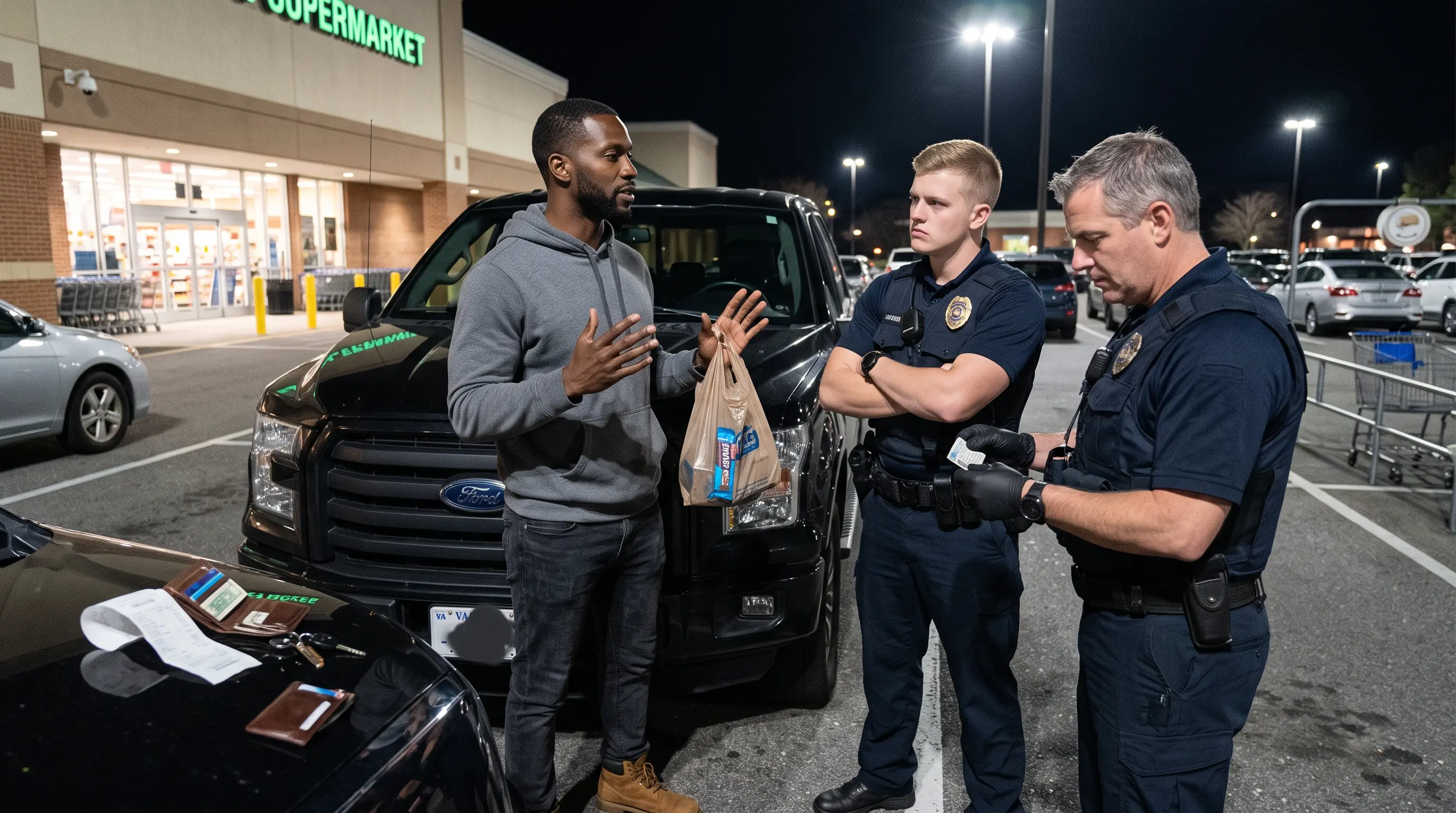
The description was: Black male, mid-thirties, athletic build.
That was the whole description.
By morning, the Pentagon would be involved. By noon, those two officers would wish they had never gotten out of their patrol car.
But I should start from the beginning.
My name is Marcus DeShawn Webb.
I was thirty-four years old, a chief petty officer in Naval Special Warfare Command, SEAL Team 8 out of Little Creek, Virginia.
Fourteen years of service. Four combat deployments. A Silver Star. Two Bronze Stars with Valor. And a collection of scars that tell stories I am still not authorized to share.
I was good at my job.
I was quiet about being good at my job.
That was the culture. You do not talk about what you do. You just do it. Then you come home, mow your lawn, get groceries, and live like a normal person because that is the only way to stay sane.
The night it happened, I was returning from a late training session at Dam Neck Annex. Not official training. Just me, the weight room, and about two hours of trying to get my mind right before the pre-deployment brief the following morning.
We were forty-eight hours out from wheels up on an operation I cannot describe, except to say that it mattered, and it was real.
I had the edge that always comes before a mission.
Not nerves, exactly.
More like a sharpening.
Every sound crisper. Every light brighter. Your body knows before your brain fully admits it.
The next two weeks are not ordinary.
I had stopped at the Walmart on Independence Boulevard to pick up protein bars and a replacement phone charger. My apartment was twelve minutes away.
I was in civilian clothes, dark jeans, a gray hoodie, Timberland boots. I had my military ID in my wallet, my concealed carry permit, and a legally holstered Glock 19 on my right hip, which I was fully licensed to carry in the state of Virginia.
I was not drunk.
I was not arguing with anyone.
I was carrying a plastic bag with eighteen dollars and forty-seven cents worth of groceries and walking toward my truck, a black F-150, third row from the entrance, when the cruiser spotlight hit me like a wall.
I heard it before I saw it. The low crunch of tires moving slow, deliberate, the way they do when they are not going anywhere, just watching you walk.
I did not speed up.
I did not slow down.
I kept my pace even and my hands visible, because that is what you do when you have grown up Black in America and you have also been trained in lethal-force assessment.
You make yourself legible.
You give them every reason not to escalate.
The cruiser stopped six feet to my left. Two doors opened.
“Stop right there,” the first officer said.
He was white, maybe twenty-six, with the kind of tight jaw that meant he was already primed for a fight he had already decided was coming.
I stopped. I turned slowly. I kept my hands up at chest height, palms out.
“Yes, sir. What’s the problem?”
My voice was level.
I had given orders under fire in Helmand Province. Keeping my voice level was not something I needed to think about.
He was older, heavyset, with a salt-and-pepper mustache and a hand resting on his holster like it lived there.
“You got ID?”
“I do,” I said slowly, deliberately. “It’s in my back left pocket. I also need to inform you that I am carrying a legally licensed concealed firearm on my right hip. I have my carry permit in the same wallet. I’d like to reach for both carefully. Is that okay?”
The younger officer’s hand moved to his weapon the moment I said the word firearm.
His partner took a step forward.
And there was something in that step. Something conclusive, like a door closing, that told me the next part of this conversation had already been scripted before I opened my mouth.
“Don’t reach for anything. Hands above your head.”
The older officer’s voice had gone flat.
Not angry.
Just flat.
The way a voice goes when a decision has already been made and the person making it is simply executing it.
Something tightened behind my sternum.
Not fear.
I want to be precise about this.
Not fear.
Recognition.
The cold, professional part of my brain that had been trained to assess threat levels and probable outcomes was telling me this had moved past the normal script faster than it should have.
I raised both hands above my head.
“Gentlemen, I am happy to cooperate fully. I am a chief petty officer in the United States Navy, SEAL Team 8, stationed at Little Creek,” I said, keeping every word measured and distinct, the same cadence I used to communicate in environments where clarity meant survival. “I have done nothing wrong. I was inside that store for approximately eleven minutes. There is security camera footage at every entrance and exit. I just need you to allow me to show you my ID.”
The younger officer moved behind me.
I felt his hand on my right wrist.
Then my left.
His grip was practiced, tight. And there was something performative about it, something that said this part had been decided before he got out of the car.
“We’re detaining you for investigation of the vehicle break-in,” he said.
Then I felt the cold metal close around both wrists.
I heard the double click.
And I was face down on asphalt in a Walmart parking lot in Virginia Beach, forty-eight hours before a classified military operation, with a knee pressed between my shoulder blades and my plastic bag of protein bars lying somewhere near my left boot.
I did not struggle.
I did not raise my voice.
I stared at the oil-stained concrete, breathed through my nose, and felt the roughness of the asphalt against my cheek.
I thought about fourteen years of service and the briefing at 0500, and the men who would be depending on me to be at that table.
And I thought, They don’t know who I am.
Then I thought, It probably wouldn’t matter if they did.
I was wrong about that second part.
But I did not know it yet.
They placed me in the rear of the cruiser.
Through the scratched Plexiglas divider, I watched the parking lot lights hover in the humid Virginia night, each one ringed with a faint halo of moisture.
My phone was still in my jacket pocket.
They had not searched me yet.
That would come at the station.
In the three minutes between being placed in the cruiser and the older officer getting back into the driver’s seat, I had twelve seconds during which my hands were at an angle and my jacket pocket was within reach.
Twelve seconds.
I used six of them.
The speed dial connected on the second ring. I heard the sound of a television, then the scrape of a chair, and two words came out of my mouth before the car shifted and I had to drop my hands.
“Parking lot.”
Then the phone went muffled against my thigh.
On the other end of that call, six miles away in a second-floor apartment on Lynnhaven Parkway, Chief Petty Officer Darnell Okafor set down a container of leftover Thai food, looked at the phone in his hand, and understood immediately.
We had been teammates for nine years. Four deployments.
He knew the code in my silences the way a musician knows the space between notes.
He set down his food, picked up a second phone, and started making calls.
The drive to the station took nine minutes.
I counted the seconds because it was something to do that was not thinking about the mission brief.
When we pulled into the lot behind the Third Precinct building, I had already gone through the full inventory of what was in my wallet, what was on my phone, what could be found, and what could not.
And what, specifically, my commanding officer, Captain James Whitfield of Naval Special Warfare Command, would say when he got the call that his senior chief had spent the night before pre-deployment in a Virginia Beach holding room.
The intake officer was a young woman, professional and efficient. She worked through the process without looking at me in any particular way, just doing her job, cataloging items, filling in fields.
I was grateful for that in the specific way you are grateful for small, neutral things when all the large things have turned hostile.
They took my phone, my wallet, my watch, and my Glock 19. Each item sealed in a labeled evidence bag.
I signed the intake form.
She showed me to a room.
The room smelled of industrial cleaner and cold coffee and the particular staleness of recycled institutional air.
A metal table. Two chairs. A fluorescent light overhead that hummed at a frequency precisely calibrated to sit just below conscious irritation, so you feel it without being able to name it.
A clock on the wall.
It read 12:02 a.m.
I sat down.
I folded my hands on the table in front of me.
And I waited.
In those first twenty-two minutes alone in that room, I did what I am trained to do when the situation is unclear and the variables are not yet known.
I assessed.
Option one, cooperate fully, make no noise, allow the surveillance footage to clear me as it inevitably would, and be out by two in the morning with the briefing still intact.
Option two, request a phone call immediately, contact Captain Whitfield, and have this resolved in thirty minutes with one phone call, at the cost of potentially exposing operational scheduling details I was bound by classified protocol not to disclose.
Option three, wait, because the same instinct that had kept me alive across four deployments and fourteen years was telling me something larger than this room was already in motion.
And whatever was coming through that door was not going to be a standard resolution.
I chose option three.
At 12:16 a.m., the door opened.
Not the intake officer.
Not either of the officers from the parking lot.
The man who walked in was wearing dark civilian clothes, a blue lanyard, and an expression that combined annoyance and calculated calm in a ratio that was distinctly federal.
I recognized the style of the lanyard before I could even read the ID badge because I had seen that specific combination before. That cut of jacket. That particular posture. That way of placing yourself in a room as if you are simultaneously the most important person in it and simultaneously not there at all.
I had seen it in secure briefing rooms and classified facilities across two continents and three theaters of operation.
He sat down across from me.
He placed a folder on the table.
He looked at me.
“Chief Webb,” he said, and his voice was the voice of someone trying very hard to communicate that he was not rattled, which told me he was rattled. “I need you to stay very calm for the next few minutes.”
“I’m calm,” I said.
My voice came out quieter than I expected.
Flat, low, and completely steady.
The way you sound when you are past the point where noise serves any purpose.
He nodded, opened the folder, and slid two sheets of paper across the metal table toward me.
The first was a printed incident report from that night. The call-in, the detainment, my name, the investigation for vehicle break-in.
The second document I recognized before I had read a single word of it because of its header, its classification markings, and the seal embossed at the top right corner.
It was a communication from the Department of Defense.
The body of it was blocked in thick black redaction bars, but I could see the date.
Today’s date.
And I could see that it had been generated at 11:54 p.m., seven minutes after my name had been run through the precinct system.
Seven minutes.
From my arrest to the Pentagon generating a document.
Seven minutes.
My hands were completely steady when I picked it up. Steady in the way hands are steady when the shaking has already moved somewhere interior, somewhere deeper than the muscles, somewhere that does not show.
I set it back down.
I looked at the man across from me and asked the question that had been forming in me since the moment the cuffs clicked shut.
The question that was not really about tonight at all.
The question that was about every night before this one and every moment like it.
“How long?” I said quietly.
“Has this been going on?”
He did not answer right away.
He straightened his pen on the table surface. He looked at the door. He pressed his lips together once, briefly.
And in that silence, that long, deliberate, stretching silence, I felt something shift inside me.
The crack that had started on the asphalt of that parking lot, the cold fracture that had been widening through every minute of the drive and the intake and the waiting, reached something structural now.
Something that would not close again.
He looked back at me.
He opened his mouth.
And before he could speak, there was a sound from the hallway outside the door.
Voices, more than two of them. The particular quality of several people trying simultaneously to speak quietly and urgently.
Then the door swung open again.
What came through that door in the next four minutes was going to rewrite every assumption I had made about the night, about the incident, and about how deep the truth actually ran.
But I did not know that yet.
All I knew was that my hands were flat on the table, my breathing was even, and the fluorescent light above me was still humming.
I had been in darker rooms than this.
I had been in rooms with no light at all.
I knew how to wait for the real beginning.
The door swung open, and three people came through it in a sequence that told me immediately this had been choreographed before any of them walked down that hallway.
First, a woman in a dark suit, mid-forties, short hair, a badge clipped to her hip that I identified as JAG, Judge Advocate General’s Corps, before she had fully crossed the threshold.
Second, a man I recognized, not personally, not by name, but by rank, because I had seen the insignia on his collar in enough command briefings to know that a two-star admiral does not arrive at a Virginia Beach police precinct at 12:20 a.m. for a routine vehicle break-in investigation.
Third, Captain James Whitfield, my commanding officer, in civilian clothes, with the particular expression he wore in the field when the situation had escalated past what the original plan accounted for, and he was now operating on judgment alone.
He looked at me across the room.
I looked at him.
Neither of us said anything for a full three seconds.
“Get those evidence bags back to Chief Webb,” Whitfield said, and his voice was the quietest I had ever heard it.
That was how I knew he was furious.
James Whitfield got very quiet when he was angry. The louder the room got, the quieter he became.
The man in the federal suit stood up.
The JAG officer set a briefcase on the table.
The admiral stood near the door with his arms at his sides and said nothing, but his presence in the room was doing all the work words would have done.
“Sir, the detainment procedure is still…”
The voice came from the doorway, and I recognized it as the older officer from the parking lot, who had apparently followed this procession down the hall.
“It’s complete,” the admiral said.
He did not raise his voice. He did not turn around.
He just said those two words into the room, and the sentence stopped.
The JAG officer opened her briefcase and took out a single sheet of paper, which she placed on the table in front of me.
I looked at it.
It was a release order.
It had been signed.
I checked the timestamp.
12:09 a.m.
That meant it had been generated while I was still sitting alone in that room. Which meant the phone call D-Train had made, and the calls that had followed from that call, had moved up a chain in less than twenty minutes and produced a signed document from someone with enough authority to release a military asset from civilian custody without a charge being formally filed.
I looked at Whitfield.
“Who made the call?” I asked quietly.
“D-Train made four calls,” he said. “The last one reached the right desk.”
I nodded.
I looked at the release order. I looked at the evidence bags being returned to the intake counter. I looked at the ceiling for a moment, not dramatically, just to give myself the one second I needed to make sure that what came out of my mouth next was the thing I actually meant to say.
Not the other thing.
The one that had been building since the asphalt.
“I want to know the name of the caller who reported a Black male breaking into vehicles,” I said. “And I want to know whether those officers were provided that caller’s contact information. I want that information formally, on paper, before I leave this building.”
The JAG officer looked at me.
She had the look of someone who was already three steps ahead of the conversation.
“That request has already been initiated,” she said. “We’ll have it within the hour.”
“I’ll wait,” I said.
Whitfield almost smiled.
Almost.
The next forty minutes in that precinct were the most interesting forty minutes I had spent in a room that did not require a security clearance.
The JAG officer’s name was Commander Patricia O’Shea, and I would come to understand over the following weeks that she was among the sharpest legal minds in the United States military.
She worked through documents at the metal table with the focused efficiency of someone on a deadline, which she was.
The federal suit, whose name I eventually learned was Agent Calvin Marsh, made phone calls in the hallway in a voice so low it was practically subsonic.
The admiral, Rear Admiral Thomas Greaves, spoke to the precinct captain, who had arrived in a jacket pulled over pajamas and the expression of a man whose career had just developed a visible crack, for twelve minutes in the captain’s office with the door closed.
I sat with my Glock back on my hip and my wallet back in my pocket, and I drank the coffee that the same efficient young intake officer brought me.
And I waited.
The coffee was bad.
It was the kind of coffee that had been on a burner for four hours and had taken on a flavor closer to the concept of regret than to any actual bean.
I drank it anyway.
At 1:03 a.m., Commander O’Shea slid a document across to me.
The caller’s name was Richard Hallett, age fifty-eight, home address two blocks from the Walmart. He had called 911 at 11:31 p.m., sixteen minutes before I arrived in the parking lot, to report a vehicle break-in.
The suspect he described was a Black male in dark clothing.
The officers had received that call, had driven through the lot, had not located the original suspect, and had then observed me, a Black male in dark clothing, and made a determination.
The actual suspect captured on Walmart’s security footage at 11:28 p.m. was a white male in a red jacket.
The footage had been reviewed by the precinct’s own security liaison by 11:55 p.m. and had been available to the arresting officers at 12:04 a.m., while I was already in the holding room.
They had known by 12:04 a.m.
They had not acted on it until the admiral walked through the door.
I read that last part twice.
The cold thing in my chest became very still and very focused.
I set the document down with the same care you use when handling something explosive.
“The footage was available at 12:04 a.m.,” I said.
“Yes,” O’Shea said.
“And I was released at 12:47 a.m.”
“Yes,” she said. “Forty-three minutes after exculpatory footage was in the possession of the department.”
I looked at Whitfield.
He looked at me.
The thing between us in that moment was not a conversation.
It was an understanding.
“Commander O’Shea,” I said. “What are my options?”
She put both hands flat on the table, and the slight forward tilt of her posture told me she had been waiting for exactly this question.
“You have significant options,” she said.
I did not sleep that night.
I drove home at 2:15 a.m. in my black F-150, and I sat in the parking garage of my building with the engine off for a while, hands on the steering wheel, listening to the tick of cooling metal.
The garage smelled of exhaust and concrete and the faint chemical sweetness of someone’s car air freshener.
I sat there and let myself feel, for the first time since the handcuffs had clicked shut, the full weight of what had happened.
Not the facts of it.
The facts I had been managing with precision since the parking lot.
The weight of it.
The specific exhaustion of being a person who must remain calm in order for a situation to stay survivable.
The math of it.
Fourteen years. Four deployments. A Silver Star.
And still, still face down on asphalt because someone had seen dark clothing and Black skin and made a call.
I went upstairs.
I did not sleep.
I made coffee, real coffee, from the good beans I kept in the cabinet above the stove. Then I sat at my kitchen table in the dark with the mug in both hands and watched the city outside my window, the lights across the river, the slow rotation of a distant beacon.
And I made a decision.
Not an angry decision.
Anger had been present, yes, but it had burned through the hot stage and become something quieter and more directional.
A decision made from the place in yourself that is past the point of reacting and has arrived at the place of acting.
I was not going to let this disappear into a department procedure, a formal apology, and an internal review that produced nothing.
I was not built that way.
And I did not intend to start.
By 3:30 a.m., I had written down every detail I remembered from the moment the spotlight hit me to the moment I walked out of the precinct.
Every timestamp. Every name. Every exact word.
I did it the way I write mission reports.
Precise. Sequential. Without editorializing.
Because the facts were damning enough on their own.
At 4:15 a.m., D-Train called.
“You good?” he said.
“I’m fine.”
“That’s not what I asked.”
I held the phone for a moment and looked at my kitchen window, at the dark outline of the city against the pre-dawn sky.
“I’m going to be fine,” I corrected.
“Yeah, you are,” he said. “O’Shea called me. She said you asked for options.”
“I did.”
“Good.”
There was a brief pause.
“You going to make the brief at 0500?”
“Wouldn’t miss it.”
“That’s my guy.”
He hung up.
I finished my coffee, got dressed, and drove to Little Creek in the last hour before sunrise, watching the sky go from black to purple to the particular pale gray that comes just before dawn.
That liminal color that is neither night nor day, but the threshold between them.
I had stood in that threshold before, on rooftops, in desert wadis, and on helicopter decks with rotors spinning, and I had learned that the threshold is not a problem to be solved.
It is just the moment before the next thing.
You breathe through it.
You stay level.
And then the light comes.
The briefing at 0500 went as briefings go.
Whitfield gave me one look when I walked in, a look that said, We will deal with this when you’re back.
Then the briefing was the briefing, and I was a SEAL again, and everything else was compartmentalized with the efficiency that fourteen years of training produces.
The operation itself is not the story.
I was gone for nineteen days.
I came back on a Tuesday morning in early November, and before I had cleared the debrief, Commander O’Shea had sent three documents to my secure email.
The first was the result of the formal complaint she had filed with the Virginia Beach Police Department on my behalf, supported by the Walmart security footage, the timeline showing the forty-three-minute delay, and statements from the precinct captain, both officers, and two independent witnesses.
One of those witnesses was the retired Army sergeant who had watched the arrest from the lot entrance and had sent the footage to four different addresses by midnight.
The internal affairs division had completed its investigation.
Both officers had been placed on administrative leave pending a disciplinary hearing.
The department had issued a formal written apology.
Not a verbal statement.
Not a press release.
A legal document signed by the chief, acknowledging that the detainment had been conducted without adequate justification and that the forty-three-minute delay in acting on exculpatory footage represented a failure of procedure.
The second document was from Richard Hallett’s insurance company.
Commander O’Shea, in a move I had not expected, had cross-referenced Hallett’s 911 call history.
It was not the first time he had called to report a suspicious Black male in his area.
It was the seventh time in four years.
Not one of those calls had resulted in a confirmed crime committed by the person reported.
She had forwarded that history with a formal letter to the city’s civil rights office.
I would not see the full outcome of that for another six months.
But I saw the beginning of it.
And the beginning was enough.
The third document was a letter.
Not from the department. Not from legal. Not from the government.
It was from the older officer.
The one with the mustache. The flat voice. The one who had treated me like the outcome had already been decided.
His name was Sergeant Dennis Kowalski, and he had been on the force for nineteen years.
The letter was three paragraphs.
It was not eloquent.
It was not complete.
But it was handwritten on actual paper.
And it said:
I reviewed the footage on the night in question, and I made a choice not to act on it immediately. I have been living with that choice every day since. I do not expect you to accept this. I am not sure I would. But I needed you to know that I know what I did.
I read it twice.
I folded it.
I put it in the inside pocket of my jacket next to the worn photo I carry from my first deployment. My whole unit, all of us grinning like idiots in front of a Humvee, young and certain and very alive.
I kept it there.
Not as forgiveness.
Not yet.
Maybe not ever.
But as evidence.
Evidence that something had moved somewhere, even if it was small, even if it was too late, even if the forty-three minutes could not be given back.
The Monday after I returned, D-Train took me to a bar in Ghent, a place we had been going to since we were both junior enlisted and had no business being in a neighborhood that nice.
We sat at the same corner table we always sat at and ordered the same drinks we always ordered, and for a long time neither of us said anything in particular.
The bar was warm, and it smelled of bourbon and old wood and the faint floral note of someone’s perfume from three tables away.
“How do you feel?” D-Train asked eventually.
I thought about it.
Not the diplomatic answer.
Not the tactical answer.
The real one.
“Like something changed,” I said. “Not fixed. Not over. But changed.”
He nodded slowly, turning his glass in a circle on the table.
“You know what I keep thinking about?” he said.
“What?”
“Seven minutes. Pentagon document in seven minutes.”
“Yeah.”
“You know what that means, right?”
He looked at me.
“It means they knew who you were the whole time. The system knew. It just didn’t speak up until someone with enough stars in the room made it speak.”
I held my glass.
The ice had melted, and the bourbon was warm, and the bar was warm, and outside it was November in Virginia, and the leaves were off the trees, and the sky was the pale color of something that had been through a lot and come out the other side.
“That’s the part I’m working on,” I said.
He raised his glass.
I raised mine.
The case did not end that night in the bar. It did not end with the department’s letter. It did not end when both officers quietly resigned six weeks before their disciplinary hearing, which is the kind of ending that is not quite an ending, but is something.
Commander O’Shea filed a civil rights complaint with the Department of Justice that was still active as of the following spring.
Hallett’s call history became part of a broader review of 911 call patterns in three Virginia Beach precincts.
I was asked once to give a statement to a congressional subcommittee looking at the treatment of active military personnel during civilian law enforcement encounters.
I gave it.
Plainly.
Precisely.
In the same cadence I use when clarity matters.
When I walked out of that hearing room in D.C., D-Train was waiting in the hall with two cups of coffee from the building cafeteria, which was not good coffee.
It was the kind of institutional coffee that bears the same relationship to actual coffee that the word sunlight bears to actual sun.
But I took it anyway.
We walked down the marble hallway and out through the main doors into the gray November afternoon.
I held the cup in both hands and felt the warmth of it and thought about the Walmart parking lot, and the asphalt, and the fluorescent room, and the seven minutes, and the forty-three minutes, and the nineteen days, and the letter, and the bar in Ghent, and everything that had moved, and everything that had not, and everything that still needed to.
The coffee was bad.
I drank it anyway.
Slowly.
On my own terms.
In the middle of a city that owed me more than it had yet paid.
Standing in the open air.
In no hurry.
Not face down on anything.
Some things you win all at once.
Some things you win an inch at a time in the cold over a very long time.
With your hands visible, your voice level, and your feet planted on ground that belongs to you as much as it belongs to anyone.
I knew which kind of fight this was.
I had been in longer ones.