Rain had only begun when the older patrol officer decided the brass tag mattered more than everything else.
The woman noticed the moment his attention changed.
Until then, the stop had been irritating but ordinary.
She stood beside a gray SUV outside a roadside diner near the commuter terminal, one hand resting lightly against the damp hood while buses moved through the station behind her.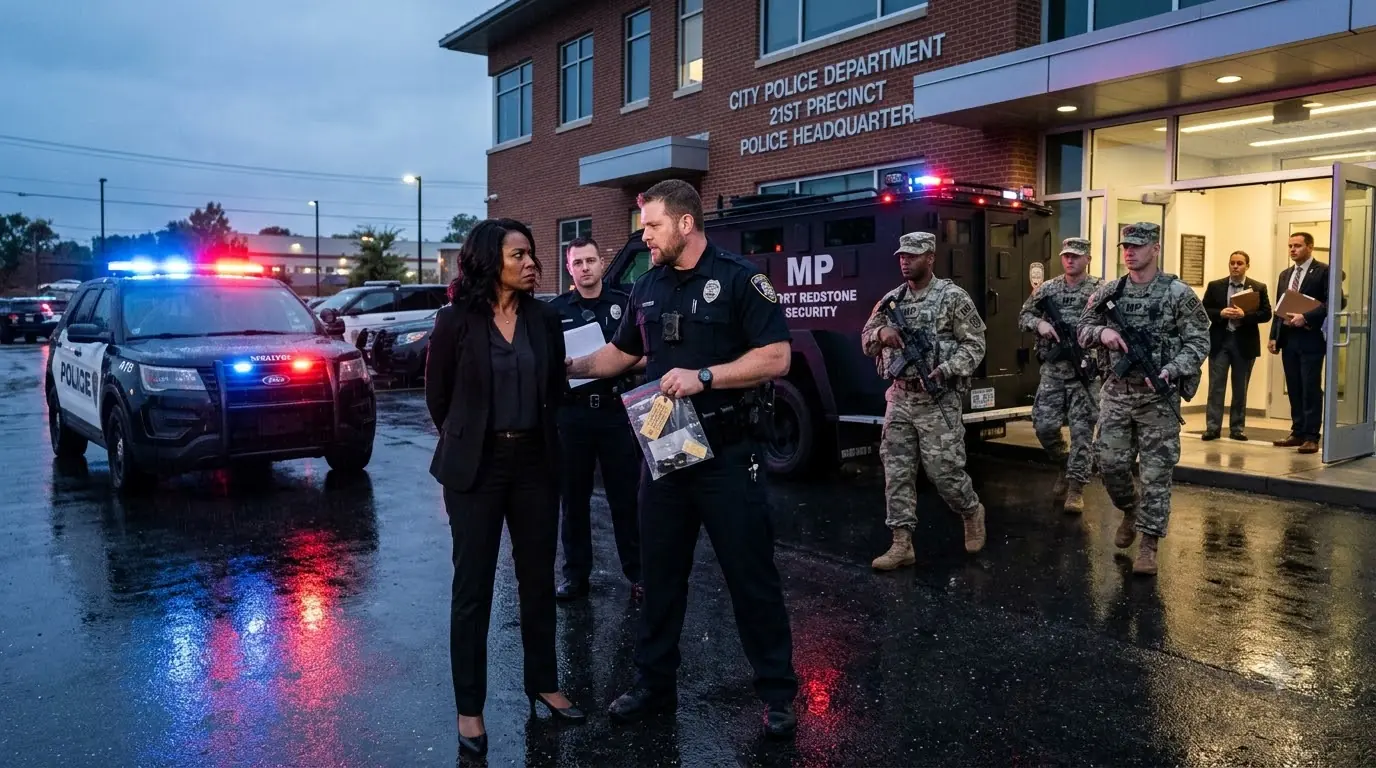
She was fifty-two years old.
Deep-brown skin.
Shoulder-length black hair softened by the rain.
A dark blazer over a charcoal blouse.
Tailored black trousers.
Low heels she had regretted wearing the moment the weather changed.
Her SUV was seven years old and showed every year of it.
A shallow scratch ran along the rear passenger door.
The dashboard rattled whenever she drove over rough pavement.
The cup holder had been repaired twice.
A paper coffee cup cooled near the windshield.
Nothing about the vehicle suggested importance.
Except for a small restricted parking decal fixed to the lower corner of the glass.
The older officer had seen it while walking past.
Then he had seen her.
Then the keys.
The keys were lying beside the coffee cup because she had set them down while searching her handbag for her phone.
A worn brass tag hung from the ring.
Scratched.
Dull.
Almost ugly.
Stamped across one side were faded block letters.
REDSTONE CONTROLLED ACCESS
A serial number appeared beneath.
The officer stopped.
“What’s that?”
The woman looked toward the keys.
“An access identifier.”
“To what?”
She glanced at the decal.
“Redstone.”
The officer’s eyes narrowed.
The Redstone Federal Complex stood twelve miles beyond Cedar Ridge.
Most residents knew it only as a large government research and administrative facility surrounded by fences, access roads, laboratories, offices, warehouses, and enough security that local people learned not to wander near the wrong gate.
Thousands worked there.
Engineers.
Researchers.
Administrative staff.
Contractors.
Safety personnel.
Security personnel.
Inspectors.
Nobody in town knew exactly what every building did.
That mystery had produced decades of exaggerated stories.
The woman did not participate in them.
She knew what Redstone was.
More importantly, she knew what it was not.
A brass tag did not unlock secret doors.
It did not override electronic systems.
It did not turn the person carrying it into someone above the law.
It was an old physical identifier retained for a narrow administrative purpose, tied to a serial record and an internal verification process.
To almost everyone else, it looked like a strange piece of metal.
The officer picked it up.
The woman immediately said:
“Please leave that attached to the keys.”
He turned toward her.
“Why?”
“Because it is assigned property.”
“To you?”
“Yes.”
The officer gave a short laugh.
Something in it bothered her.
Not amusement.
Disbelief.
“Assigned to you.”
“Yes.”
“What do you do at Redstone?”
The woman looked toward his uniform.
“Before we get into employment, am I being investigated for something?”
The officer’s expression hardened.
“I’m asking questions.”
“And I’m answering.”
“Then answer that one.”
She looked toward the keys in his hand.
“I work in federal security compliance.”
The phrase was accurate.
Incomplete.
Deliberately.
The woman had spent twenty-six years working in risk, public infrastructure, government oversight, and security governance.
She had begun as a junior analyst.
Then counsel.
Then regional compliance officer.
Then inspector.
Now she served as the senior director responsible for reviewing protective-security procedures across several federal facilities, including Redstone.
That evening she was scheduled to meet Cedar Ridge’s police chief and command staff at six o’clock.
The meeting had been arranged weeks earlier.
Its purpose was mundane enough that nobody outside the agencies would have cared.
Joint emergency coordination.
Credential verification.
Evidence preservation.
Jurisdictional boundaries.
Communication protocols between local police and federal facilities.
A long table.
Coffee.
Presentation folders.
No drama.
At least that had been the plan.
The officer looked toward the restricted parking decal again.
“Federal security compliance.”
“Yes.”
“Got identification for that?”
“In my wallet.”
The woman reached toward her handbag.
The officer’s hand rose.
“Slowly.”
She stopped.
Looked at him.
Then deliberately moved more slowly.
She removed her wallet.
Driver’s license first.
Then a professional identification card.
The officer took both.
His younger partner had just arrived from the patrol car.
He was perhaps ten years younger and carried himself differently.
Less certain.
More observant.
He looked at the license.
Then the registration the woman had already provided.
“Vehicle matches.”
The older officer said:
“Run it again.”
The younger officer looked toward him.
“I already did.”
“Again.”
The younger officer obeyed.
The woman waited beneath the rain.
Inside the diner, faces had begun appearing near the windows.
Cedar Ridge was the sort of town where people watched police stops even while pretending they were studying the weather.
The woman recognized one neighbor inside.
Another older man stood from his booth.
A teenager near the door lifted a phone.
The woman breathed slowly.
The younger officer returned.
“License valid.”