“All rise.”
Naomi entered wearing a black judicial robe over a burgundy blouse.
The same woman who had been kneeling in her garden two days earlier now walked toward the bench.
Walsh stood near the back with department representatives.
His expression changed completely.
Doyle looked down.
The irony was impossible to ignore.
The officers had treated her differently only after learning who she was.
Now they had to face the meaning of that.
Naomi did not immediately speak.
She reviewed the documents.
The reports.
The footage.
The complaint.
Then she looked up.
“Before anything else, I want to address something.”
Everyone listened.
“This courtroom is not important because I am a judge.”
She paused.
“It is important because the law applies before anyone knows who someone is.”
Walsh looked uncomfortable.
Naomi continued.
“The question is not whether I deserved different treatment after my position became known.”
“The question is whether I deserved fair treatment before it was known.”
Nobody moved.
The review continued with another judge assigned to any formal proceedings involving the officers to avoid conflict.
An independent investigation followed.
Walsh received disciplinary action after the department concluded the arrest lacked sufficient legal basis.
Doyle was not disciplined at the same level.
Investigators noted that he had questioned the decision and attempted to seek clarification, though they also noted he failed to intervene more strongly.
The department reviewed its policies.
The biggest finding was not about one arrest.
It was about assumptions.
Officers had been trained to identify threats.
But they had not always separated threats from unfamiliarity.
A person asking questions was not automatically hostile.
A person requesting explanation was not automatically suspicious.
A person who did not immediately obey was not automatically guilty.
Months later, Naomi returned to her garden.
The roses were blooming again.
Linda walked by.
“You still gardening after all that?”
Naomi smiled.
“Yes.”
“Why?”
Naomi looked at the flowers.
“Because the garden did nothing wrong.”
Linda laughed.
Then became serious.
“Do you think they learned?”
Naomi considered.
“I hope so.”
“That’s all?”
“That’s all anyone can do.”
She trimmed a rose carefully.
“People change when they choose to.”
The neighborhood eventually moved on.
The story became less about the arrest.
More about the lesson.
A person’s dignity should not appear only after someone discovers their importance.
A homeowner should not need to be a judge.
A customer should not need to be a CEO.
A driver should not need a badge.
A citizen should not need a title.
Respect should come first.
And that was the mistake those officers made.
They thought they were arresting an ordinary woman working in her garden.
They did not realize they were standing in front of a judge.
But the real lesson was that she should never have needed to be one.
The months after the incident were quieter than anyone expected.
There were no public arguments.
No dramatic statements.
No attempt by Naomi Carter to turn the arrest into a personal victory.
That surprised many people.
Several community members expected Judge Carter to demand punishment immediately.
They expected anger.
They expected a public confrontation.
Instead, Naomi returned to her normal routine.
She continued hearing cases.
She continued volunteering at neighborhood programs.
She continued spending Saturday afternoons in her garden.
That was the part many people did not understand.
The garden had never been about the arrest.
It had always been about balance.
But the department was not allowed to simply move on.
The investigation continued.
And the deeper investigators looked, the more they realized the incident on Willow Creek Lane was not just about one afternoon.
It was about how decisions were being made long before anyone pressed record.
Officer Brent Walsh had been with the department for twelve years.
His personnel file showed strong activity numbers.
Many arrests.
Many citations.
Many supervisors described him as “decisive.”
But buried between those positive reviews were smaller complaints.
A driver who said Walsh became aggressive when asked for clarification.
A teenager who reported being followed through a neighborhood because an officer “thought he looked suspicious.”
An elderly man who claimed Walsh demanded identification without explaining why.
Each complaint had been handled separately.
Each one had a different explanation.
Miscommunication.
Poor wording.
Citizen frustration.
Nothing serious enough to create concern.
Until investigators placed them side by side.
Then a pattern appeared.
Not a pattern of one specific action.
A pattern of one specific mindset.
Walsh often decided what he believed before gathering enough information.
That discovery became the focus of the review.
The department’s internal auditor, Rebecca Lane, studied dozens of body-camera recordings.
She was known as someone who paid attention to small details.
Not just what people said.
How they said it.
How quickly they interrupted.
How often they explained.
How often they assumed.
She watched the Willow Creek footage again.
At first, she focused on the arrest.
Then she focused on the first thirty seconds.
That was where the entire situation changed.
Officer Walsh approached Naomi.
He did not begin with:
“Good afternoon, are you the homeowner?”
He did not begin with:
“We received a concern and want to clarify something.”
He began with suspicion.
The assumption came before the question.
Rebecca wrote one sentence in her report:
“The escalation began before any facts were established.”
That sentence became the most discussed line in the investigation.
Because it applied beyond Naomi.
It applied to every future interaction.
The department held a meeting with officers.
Some expected a lecture.
Instead, Chief Raymond Ellis placed a simple question on the screen.
“What do you know?”
Not:
“What do you think?”
Not:
“What do you suspect?”
What do you know?
He showed several scenarios.
A person standing near a parked vehicle.
A customer refusing a bag search.
A homeowner questioning an officer.
A teenager asking why they were stopped.
Then he asked the same question.
“What do you know?”
At first, officers gave assumptions.
“He looks suspicious.”
“She is being defensive.”
“He is avoiding questions.”
The chief stopped them.
“Those are interpretations.”
He pointed to the screen.
“Not facts.”
The room became quieter.
The training continued for weeks.
But one person struggled more than most.
Officer Doyle.
The younger officer who had stood beside Walsh during the arrest.
Doyle was not fired.
He was not suspended.
But the investigation noted something important.
He recognized the problem.
And he still stayed silent.
That bothered him.
More than the criticism.
More than the paperwork.
Because Doyle had always believed he was the kind of officer who would speak up.
Until the moment arrived.
Then he discovered something uncomfortable.
Knowing the right thing and doing the right thing were not always the same.
One evening, Doyle requested a meeting with Naomi.
Not at the courthouse.
Not officially.
At a community center after a public safety event.
Naomi almost refused.
Then she agreed.
Doyle arrived early.
He looked nervous.
Not because of Naomi’s position.
Because of what he needed to say.
“I owe you an apology.”
Naomi listened.
“For arresting me?”
Doyle shook his head.
“For not stopping it.”
That answer surprised her.
She waited.
Doyle continued.
“I knew the questions weren’t being answered.”
“Yes.”
“I knew you weren’t threatening anyone.”
“Yes.”
“I knew something felt wrong.”
Naomi looked at him.
“And?”
Doyle lowered his eyes.
“And I let rank become more important than judgment.”
The honesty mattered.
Naomi did not excuse him.
But she respected the truth.
“Why?”
Doyle thought.
“Because Officer Walsh was experienced.”
“That is not a reason.”
“I know.”
He paused.
“It was an explanation.”
Naomi nodded.
That difference mattered.
An explanation did not remove responsibility.
But it helped understand how mistakes survived.
“What will you do differently?”
Doyle answered quickly.
“Ask earlier.”
“Ask what?”
“Whether we actually have a reason.”
Naomi looked at him.
“Good.”
Doyle seemed surprised.
“That’s it?”
“That is where it begins.”
Months later, Naomi received an invitation.
The department wanted her to speak during their leadership training.
At first, she declined.
Then she changed her mind.
Not because she wanted recognition.
Because she wanted the lesson preserved.
The training room was filled with officers.
Different ages.
Different backgrounds.
Naomi stood at the front.
No robe.
No courtroom.
No title introduction.
Just Naomi Carter.
She started with one sentence.
“I want to talk about the moment before you know someone’s name.”
The room became silent.
“That is the moment that reveals your character.”
She explained that titles could create artificial respect.
A badge.
A uniform.
A judge’s robe.
A company position.
But the real test was how people behaved before those things appeared.
She showed a picture of her garden.
The roses.
The walkway.
The front yard where everything happened.
“Most people remember what happened after they learned who I was.”
She paused.
“But I remember what happened before.”
She asked the officers a question.
“If I had been a retired teacher, would the situation have mattered less?”
Nobody answered.
“If I had been a single mother working two jobs?”
Silence.
“If I had been someone with no title at all?”
The room remained still.
Naomi nodded.
“That is the question.”
After the training, several officers approached her.
Some apologized.
Some shared stories.
One officer admitted:
“I used to think people asking questions were trying to challenge authority.”
Naomi asked:
“And now?”
He answered:
“Sometimes they are helping us slow down.”
That was the kind of change Naomi wanted.
Not fear.
Not embarrassment.
Understanding.
A year after the arrest, Naomi walked into her garden again.
Spring had returned.
The roses were taller.
The soil was healthier.
She knelt down and touched the leaves.
Her neighbor Linda walked by.
“You still haven’t changed anything.”
Naomi looked up.
“What do you mean?”
“The garden.”
Linda smiled.
“After everything, I thought you might put up a fence.”
Naomi laughed softly.
“No.”
“Why not?”
Naomi looked toward the street.
“Because the problem was never the garden.”
Linda nodded.
That was true.
The garden had only revealed something that already existed.
The way people saw.
The assumptions they carried.
The decisions they made before knowing the truth.
A police cruiser passed slowly at the end of the street.
Naomi watched it disappear.
She did not feel anger.
She felt something more complicated.
Responsibility.
Because change was not created by proving someone wrong once.
It was created by making sure the next person received better treatment.
A person without a title.
Without influence.
Without anyone watching.
That was the real measure.
Not how people behaved when they discovered a judge was standing in front of them.
But how they behaved when they believed nobody important was there.
And Naomi Carter knew the answer would always be found in those quiet moments.
The moments before the name was known.
Before the badge was seen.
Before the courtroom doors opened.
Before anyone realized who was standing in the garden.
The story of Judge Naomi Carter did not end when the investigation closed.
In many ways, that was when the harder work began.
Because changing one officer’s behavior was easier than changing the environment that allowed a mistake to happen.
The department had disciplined Officer Brent Walsh.
It had updated procedures.
It had created new training.
But Naomi understood something from years of sitting behind the bench.
A rule written on paper was only as strong as the people willing to follow it when nobody was watching.
That was where real change was measured.
Not during public meetings.
Not during press conferences.
Not when cameras were present.
In quiet moments.
The same moments where decisions were made before anyone knew the outcome.
Six months after the incident, Naomi received a letter from a woman named Denise Walker.
Denise was fifty-eight years old and lived in a small neighborhood on the other side of the county.
She had never met Naomi.
She had only seen the news reports.
The letter was not about the arrest.
It was about something that happened three years earlier.
Denise wrote that police officers had stopped her son while he was walking home from work.
They questioned him.
Asked why he was in the neighborhood.
Asked where he was going.
He answered every question.
Nothing happened.
No arrest.
No citation.
No report.
“My son came home and said he felt like he had to prove he belonged in the place where he lived.”
Naomi read the sentence several times.
Then she placed the letter on her desk.
Because that was the part people often missed.
A bad encounter did not need to end in an arrest to matter.
Sometimes the damage happened earlier.
In the hesitation.
In the fear.
In the feeling that a person had to prove they were allowed to exist somewhere.
Naomi brought the letter to the department’s community meeting.
She did not mention Denise’s name.
She did not want attention on one person.
She wanted attention on the pattern.
The room was filled with officers, supervisors, and community members.
Chief Raymond Ellis stood beside her.
“We changed policy,” he said.
Then he looked around.
“But policy alone is not enough.”
Naomi nodded.
She stepped forward.
“I want to ask everyone here a question.”
The room became quiet.
“What happens when nobody complains?”
Nobody answered.
Naomi continued.
“Does that mean everything went well?”
“No.”
“Does it mean nobody was harmed?”
“No.”
“Then what does silence mean?”
An older officer in the back raised his hand.
“It could mean people don’t trust the system.”
Naomi nodded.
“Exactly.”
That answer became the foundation of the next reform.
The department created a community feedback program.
Not a complaint system.
A listening system.
The difference mattered.
A complaint system waited until something went wrong.
A listening system tried to discover problems earlier.
Officers attended neighborhood meetings.
Residents could speak without filing formal complaints.
Supervisors reviewed concerns before they became investigations.
Some officers supported it immediately.
Others resisted.
Not because they opposed accountability.
Because they misunderstood it.
They believed every criticism meant someone was attacking them.
Naomi understood that feeling.
She had experienced it in court.
A person could hear disagreement as disrespect if they were too attached to being right.
That was true everywhere.
Including law enforcement.
Including judges.
Including herself.
One afternoon, Naomi received a surprising visitor.
Officer Walsh.
He was no longer wearing his patrol uniform.
His disciplinary process had ended months earlier.
He had received mandatory training and was transferred to an administrative role while completing additional review.
Naomi almost declined the meeting.
Then she accepted.
Walsh arrived looking different.
Not physically.
Emotionally.
The confidence was gone.
The certainty.
The belief that every decision he made was automatically correct.
He sat across from her.
“I know you don’t owe me this meeting.”
Naomi said nothing.
“I wanted to say something.”
“Go ahead.”
Walsh looked down.
“I was wrong.”
The words were simple.
But not easy.
Naomi waited.
“I thought the problem was that people didn’t respect authority.”
He paused.
“But I understand now that authority has to earn trust.”
Naomi looked at him.
“What changed?”
Walsh thought.
“Seeing the footage.”
“Your own footage?”
“Yes.”
“What did you see?”
He answered quietly.
“Someone asking me questions.”
Naomi waited.
“Not someone attacking me.”
The room remained silent.
Walsh continued.
“I kept telling myself you were difficult.”
“Were you?”
He looked up.
“No.”
The answer came quickly.
“You were asking me to explain myself.”
Naomi nodded.
“That is important.”
Walsh looked confused.
“Why?”
“Because the easiest mistake in power is believing questions are disrespect.”
Walsh looked down again.
“I think I forgot something.”
“What?”
“That the person in front of me was still a person.”
Naomi did not forgive him immediately.
Forgiveness was not the same as accountability.
But she recognized something important.
A person admitting a mistake was different from a person defending one.
“What will you do now?”
Walsh looked surprised.
“I don’t know.”
“Then start there.”
He looked at her.
“Start where?”
“By not needing to be right.”
That sentence stayed with him.
Years later, Walsh would say that was the hardest advice he ever received.
Because admitting a mistake was one moment.
Changing the habit that created it was another.
The department continued changing.
Slowly.
There were setbacks.
There were disagreements.
Some community members believed reforms were too slow.
Some officers believed they were too harsh.
Both sides had concerns.
Naomi watched carefully.
Because she knew real improvement was rarely comfortable.
Comfort often meant nothing was changing.
One year after the garden incident, the county held a public ceremony recognizing community partnerships.
Naomi did not want to attend.
She disliked ceremonies focused on individuals.
But Linda convinced her.
“You are going.”
“Why?”
“Because sometimes people need to see that change has a face.”
Naomi smiled.
“That sounds like something I would say.”
“Exactly.”
At the event, Chief Ellis announced a new annual training program.
It would be called:
The Carter Principle.
Naomi immediately looked uncomfortable.
She stood and approached the microphone.
“I appreciate the intention.”
The audience waited.
“But I want one thing clear.”
She looked toward the officers.
“This is not about me.”
She paused.
“It should never be about whether someone recognizes a name.”
The room became quiet.
“It should be about whether we recognize humanity.”
That became the sentence printed on the first page of the training manual.
Not Judge Carter.
Not the arrest.
Humanity.
Years later, new officers who never met Naomi would study the Willow Creek incident.
They would watch the footage.
They would analyze the decisions.
They would discuss what happened.
But the final question was always the same.
Not:
“Who was the woman?”
Not:
“Why did the officers change after discovering her title?”
The question was:
“What would you have done if she was nobody important?”
That question was harder.
Because it removed the easy answer.
There was no judge.
No robe.
No courtroom.
No reputation.
Just a person.
A garden.
A conversation.
A choice.
Naomi eventually retired from the bench after decades of service.
On her final day, she walked through the courthouse one last time.
People thanked her.
Clerks.
Attorneys.
Officers.
Residents.
She appreciated every word.
But the moment she remembered most happened afterward.
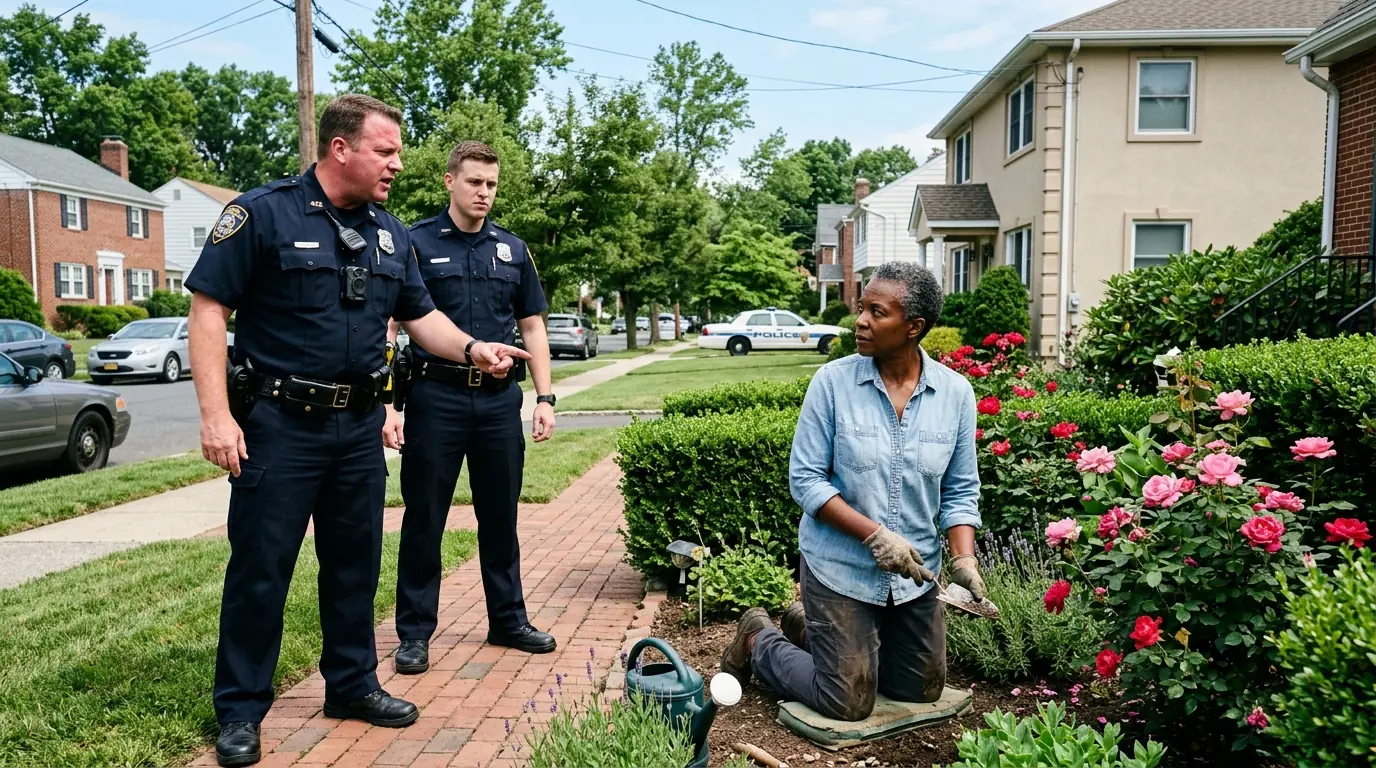
She went home.
Changed clothes.
Walked outside.
And returned to her garden.
The roses were older now.
The branches thicker.
The flowers stronger.
She knelt beside them.
The same place where everything had started.
Her neighbor Linda walked by and stopped.
“You know, most people would have changed that garden after what happened.”
Naomi smiled.
“Why?”
“Because of the memory.”
Naomi touched the soil.
“The memory isn’t the garden’s fault.”
Linda nodded.
“You really believe that?”
“Yes.”
Naomi looked toward the street.
“The problem was never where I was standing.”
She paused.
“It was what someone assumed before asking why.”
The sun lowered behind the houses.
The neighborhood became quiet.
A child rode a bicycle past the sidewalk.
A dog barked behind a fence.
A car turned into a driveway.
Normal life continued.
And that was exactly what Naomi wanted.
Not a monument.
Not a headline.
Not a reminder of conflict.
Just a place where someone could stand without needing to explain why they belonged.
Because the greatest lesson from that afternoon was never that police officers accidentally arrested a judge.
The lesson was that they arrested a person.
And every person deserves the same care, the same patience, and the same respect before anyone discovers their name.