The sound of the birthday cake hitting the pavement was what made people stop.
Not the police lights.
Not the open truck.
Not even the officer searching through someone’s belongings.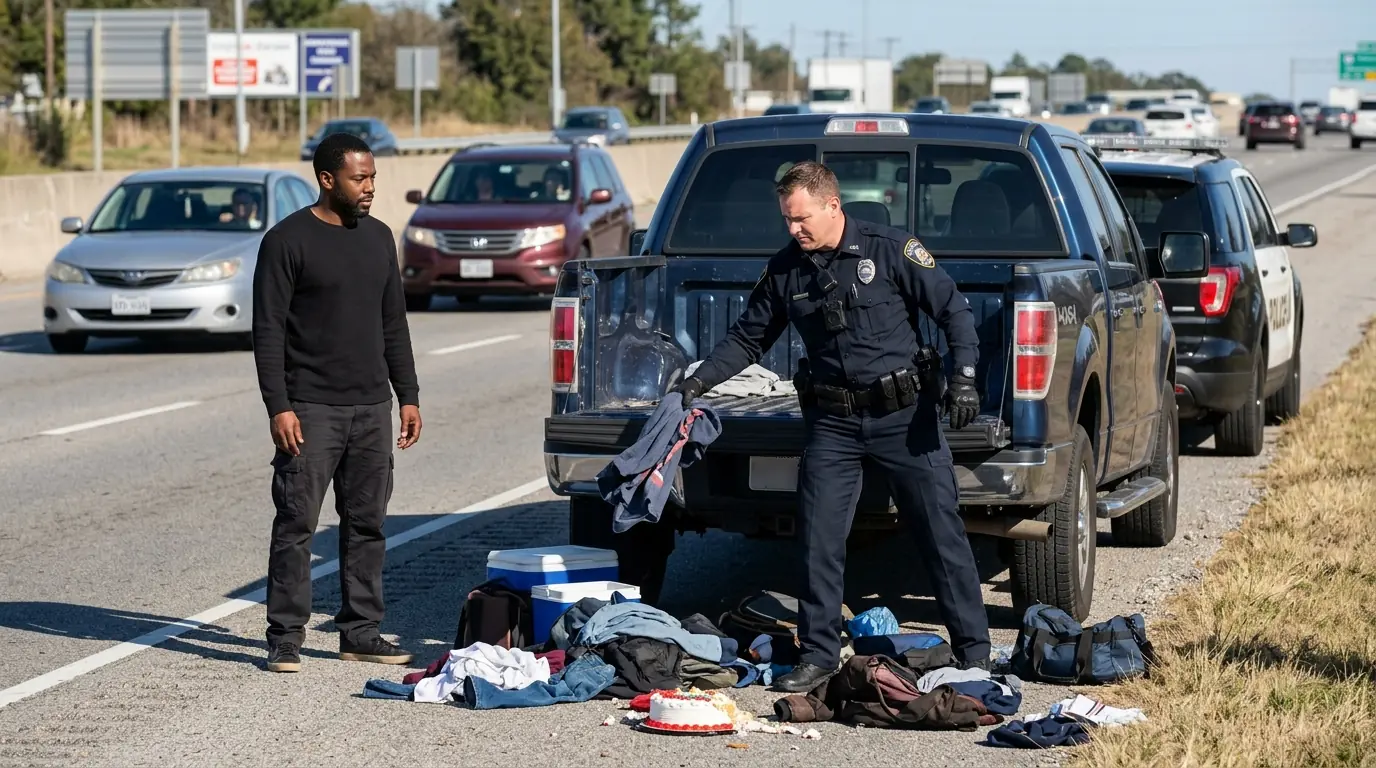
The cake.
A simple white cake decorated with blue frosting and small flowers landed upside down on the gravel shoulder of the highway.
The plastic container cracked.
The writing on top became unreadable.
A message meant for someone’s birthday disappeared into the dirt.
And for a few seconds, everyone watching understood something.
This was no longer just a vehicle search.
Something personal had been destroyed.
The man standing beside the truck did not move.
Terrence Hayes watched quietly as pieces of his mother’s birthday celebration sat scattered across the roadside.
A bag of clothes.
A jacket.
A small gift box.
A cooler.
Family photographs.
And the cake he had picked up less than an hour earlier from a bakery in town.
He did not shout.
He did not step forward.
He did not threaten anyone.
He simply watched.
That calmness confused people.
Most people expected anger.
They expected an argument.
They expected the situation to become louder.
But Terrence remained still.
Because he understood something that many people did not.
Sometimes the most important thing you can do in a difficult moment is remember that every second is being recorded.
And every decision matters.
Terrence Hayes was forty-two years old.
He was a Black American man with deep-brown skin, short black hair, a neatly trimmed beard, and the quiet confidence of someone who had spent years working in high-pressure environments.
He wore a simple black long-sleeve shirt, dark pants, and practical shoes.
Nothing about his appearance suggested power.
Nothing about his appearance announced his career.
And that was exactly how he preferred it.
Terrence believed people revealed the most about themselves when they thought nobody important was watching.
For most of his life, he avoided leading with his job title.
Not because he was ashamed of it.
Because he believed a person should be treated fairly before anyone knew their position.
That belief came from experience.
Terrence worked as a federal investigator.
His career involved sensitive cases, interviews, and reviewing situations where facts mattered more than assumptions.
He had spent years learning one lesson.
The first version of a story is often wrong.
The first impression.
The first accusation.
The first assumption.
All of them needed to be tested.
That morning, however, he was not working.
He was simply driving across Texas.
His mother’s birthday was the next day.
Terrence had promised her he would bring her favorite cake.
Not an expensive gift.
Not something complicated.
Just the cake she always requested.
Vanilla cake.
Blue frosting.
Small flowers around the edge.
She had laughed when he asked why she always chose the same one.
“Because some things don’t need improvement,” she told him.
Terrence remembered that.
He remembered many things his mother said.
That was why the cake mattered.
It was not just dessert.
It was a small promise.
A reminder that after years of difficult work, he still had ordinary moments to protect.
He stopped at a roadside market outside a small Texas town.
He bought coffee.
Checked his phone.
Loaded his bags.
Then continued toward home.
He never expected the next fifteen minutes would become one of the most watched moments of his life.
Officer Daniel Brooks was parked several hundred feet away.
Brooks was forty-five years old.
A white American police officer with short brown hair, a serious expression, and a dark navy patrol uniform.
He had worked highway patrol for nearly sixteen years.
His reputation inside the department was complicated.
Some officers respected his confidence.
They believed he was decisive.
They believed he acted quickly.
Others quietly described him differently.
Too quick to decide.
Too certain.
Too convinced that his first instinct was correct.
Brooks believed good policing required confidence.
And confidence was valuable.
But sometimes confidence became something else.
A refusal to reconsider.
That afternoon, dispatch reported a possible issue involving a pickup truck.
The information was limited.
A caller had reported a suspicious vehicle near a roadside area.
No confirmed crime.
No confirmed stolen property.
No clear description of the driver.
Just concern.
Brooks saw Terrence’s truck parked on the shoulder.
A dark-blue pickup.
He slowed down.
Then he stopped.
Terrence noticed the patrol vehicle in his mirror.
He pulled over completely.
He turned off the engine.
He waited.
That was his first decision.
Do not make the situation worse.
Brooks approached.
“Afternoon.”
Terrence lowered the window.
“Afternoon, officer.”
“License and registration.”
Terrence handed them over.
Brooks looked at the documents.
Then at Terrence.
Then at the truck.
“Where are you headed?”
“Home.”
“Where’s home?”
Terrence answered.
Brooks looked back at the truck bed.
“What’s back there?”
“Personal belongings.”
“What kind?”
“Clothes. Some family items.”
Brooks walked around the vehicle.
Terrence watched.
“Officer.”
Brooks looked at him.
“Yes?”
“Is there a reason you’re inspecting the truck?”
Brooks gave a small smile.
“We received a report.”
“What kind of report?”
“Suspicious vehicle.”
Terrence nodded.
“What made it suspicious?”
Brooks did not answer immediately.
Instead, he walked toward the truck bed.
Terrence noticed.
“Officer, I’m asking a question.”
Brooks turned.
“You’re asking a lot of questions.”
Terrence looked at him.
“That is because I’m trying to understand.”
Brooks stepped closer.
“You don’t need to understand everything.”
Terrence remained calm.
“Actually, I do.”
That answer irritated Brooks.
Because Terrence was not afraid.
He was not defensive.
He was simply refusing to accept vague explanations.
Brooks opened the truck bed.
Terrence immediately spoke.
“I do not consent to a search.”
The words were clear.
The bystander standing near a gas station entrance heard them.
A woman in a parked car heard them.
The body camera heard them.
Brooks looked at him.
“Why not?”
“Because I do not consent.”
“If you have nothing to hide, why refuse?”
Terrence looked at him.
“That question does not replace a legal reason.”
Brooks’s expression changed.
“You know the law?”
“I know enough to ask questions.”
The officer stared.
“Turn around.”
Terrence did not move.
“For what?”
“You are interfering.”
“With what?”