“Judge or not, you’re still going in cuffs today.”
Officer Dylan Mercer said it with the absolute confidence of a man who had already decided what he was looking at before he ever stepped onto the lawn. His right hand remained locked around Marcus Holloway’s upper arm while crushed flower clippings scattered beneath their shoes. Marcus stood in a thin charcoal T-shirt, loose floral-print shorts, black gardening gloves, and soft house shoes, one hand still holding the pruning shears he had been using seconds earlier. Behind them, red and blue lights from the patrol SUV flashed against the white columns of Marcus’s Charlotte home.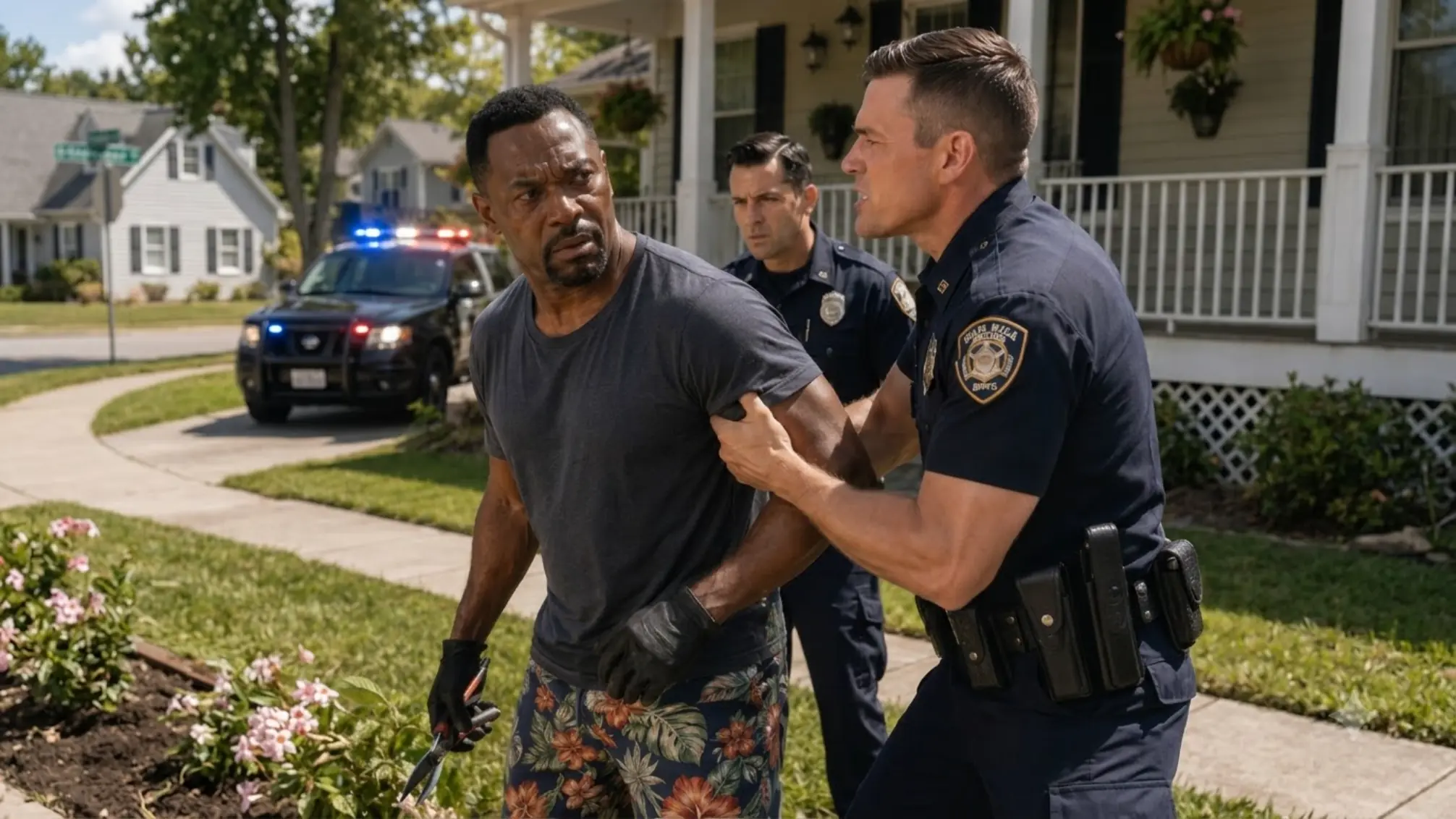
Marcus slowly turned his head toward Mercer. “You walked onto my property while I was trimming flowers, and somehow you decided I was a criminal.” His voice was low and controlled, but there was nothing submissive about it. Officer Aaron Blake, standing several feet behind Mercer, looked from the gardening shears to the flower bed and then toward the front porch. Even he seemed to understand that something about the scene did not fit the urgency with which Mercer was treating it.
The call had come in at 2:17 that afternoon. A resident several houses away had reported “suspicious plants” growing in a front garden and claimed a man was “handling them strangely.” No photograph had been provided. No description of an actual illegal substance had been given. The dispatch note listed only an address one digit away from Marcus’s house.
Mercer had arrived first. He did not check the address carefully. He saw Marcus kneeling among orchids, hydrangeas, and newly planted herbs, then walked directly across the lawn as if ownership of the property had already been decided for him. Marcus had barely risen before Mercer began questioning him.
“You live here?” Mercer had asked.
Marcus stared at him. “Yes.”
“You got ID?”
“Inside.”
Mercer looked toward the house. “Convenient.”
That single word told Marcus almost everything.
He had spent twenty-two years in law, first as a federal prosecutor, then as an appellate attorney, and finally as a United States district judge. He had watched witnesses lie with confidence, attorneys hide bad arguments behind louder voices, and defendants panic because someone with a badge spoke as if accusation alone were proof. Marcus had learned long ago that power often revealed itself most clearly when the person holding it thought nobody important was watching.
Today, Mercer believed nobody important was watching.
Marcus placed the pruning shears carefully on the stone border of the flower bed. “Officer, you are on private property responding to a vague complaint that does not even match this address. Before we go any further, I suggest you verify the call.”
Mercer laughed.
“You suggest?”
“I do.”
“You think because you talk like that, I’m supposed to back off?”
Marcus held his gaze. “No. I think because you’re a police officer, you’re supposed to confirm basic facts before escalating.”
That answer irritated Mercer far more than fear would have.
Officer Blake stepped closer. “Dylan, maybe we should check dispatch.”
Mercer ignored him.
Instead, he looked at Marcus’s gardening gloves, loose shorts, casual shirt, and dirt on his knee. Marcus had been halfway through trimming a row of azaleas before the officers arrived. He looked exactly like what he was: a homeowner doing yard work on a Saturday afternoon.
Yet Mercer asked, “Whose house is this really?”
Marcus blinked once.
Then he said, “Mine.”
Mercer’s expression did not change.
“You got proof?”
Marcus looked toward the porch.
Through the open front window, his laptop sat on a small table. He had been on a secure video conference before stepping outside to check his flowers. The meeting involved federal judges reviewing a procedural matter scheduled for the following week. Marcus had told them he would be gone for five minutes.
That had been eleven minutes ago.
Inside the house, the call was still running.
One of the people waiting on that screen was Chief Judge Eleanor Whitmore.
Marcus looked back at Mercer. “My identification is inside. If you allow me to walk ten feet to the door, I’ll show it to you.”
Mercer stepped closer.
“No sudden moves.”
Marcus almost smiled at the absurdity.
“I am standing in flower clippings wearing hibiscus shorts.”
Blake looked away for a second, fighting an inappropriate reaction.
Mercer did not.
“Hands where I can see them.”
Marcus slowly removed one gardening glove.
Then the other.
“Better?”
Mercer’s jaw tightened.
“Turn around.”
Marcus remained still.
“On what legal basis?”
That was the first moment Mercer hesitated.
Not because he reconsidered.
Because he had not expected the question.
“We received a complaint.”
“A complaint about what?”
“Illegal plants.”
Marcus glanced toward the flower bed.
“Those are orchids, basil, rosemary, lavender, and hydrangeas.”
Mercer pointed toward a row of taller green plants near the porch.
“What about those?”
“Tomatoes.”
Blake cleared his throat.
Mercer ignored him again.
“You expect me to just take your word for it?”
Marcus’s patience thinned. “Officer, if you cannot distinguish a tomato plant from narcotics, that is not probable cause.”
Mercer stepped forward and grabbed Marcus’s arm.
The move changed everything.
Marcus stiffened instantly.
Not in fear.
In disbelief.
Blake raised his hands. “Dylan.”
Mercer pulled Marcus away from the flower bed. “Stop resisting.”
“I am not resisting.”
“You’re pulling away.”
“You grabbed me without lawful basis.”
“Judge or not, you’re still going in cuffs today.”
The words left Mercer’s mouth before Marcus had identified himself officially.
That mattered.
Marcus knew it immediately.
“So you heard me say I’m a federal judge.”
“Anybody can say anything.”
Marcus’s voice turned colder. “Then verify it.”
Mercer reached for his cuffs.
That was when a voice shouted from inside the house.
“Marcus?”
Everyone froze.
A woman’s voice carried from the open front window.
“Marcus, are you there?”
Blake looked toward the porch.
Marcus closed his eyes for half a second.
Then another voice came through the laptop speakers.
“Judge Holloway, we can still hear everything.”
Mercer’s grip loosened slightly.
Marcus turned his head toward him.
“The Chief Judge is still on my video call.”
Blake’s face changed first.
Mercer’s did not.
“What?”
Marcus spoke slowly. “Chief Judge Eleanor Whitmore of the United States District Court is sitting on an active conference call inside my house.”
For the first time, Mercer looked uncertain.
Blake stepped away from him.
“Dylan, we need to stop.”
Mercer looked toward the window.
Then toward Marcus.
Then toward the patrol SUV.
His pride had carried him too far to retreat easily.
“You could’ve set that up.”
Marcus stared at him.
“Before you arrived?”
Mercer said nothing.
Marcus continued. “You were dispatched eleven minutes ago.”
Blake reached for his radio.
“Dispatch, confirm residence address for current call.”
Static.
Then the dispatcher responded.
“Reported address is 1427 Carver Lane.”
Blake looked at the number attached beside Marcus’s porch.
1429.
He closed his eyes.
“We’re at the wrong house.”
Mercer looked at the number.
Then back at Marcus.
The situation should have ended there.
Mercer should have released his arm.
He should have apologized.
He should have stepped off the lawn.
Instead, he looked at the officers’ body cameras, at Marcus, and at the neighbors beginning to gather near driveways.
Then he made the decision that would define the rest of his career.
“Still need to identify him.”
Marcus stared at him.
“You know you’re at the wrong property.”
“I need to make sure there’s no outstanding issue.”
“For trimming flowers?”
“You’re being argumentative.”
Marcus laughed once.
Not because anything was funny.
Because the sentence was so revealing.
Officer Blake stepped between them.
“Dylan, let him go.”
Mercer turned. “Back off.”
“No.”
That stopped everyone.
Blake had worked with Mercer for almost four years. He had watched him talk aggressively to drivers, escalate minor disputes, and turn casual questions into confrontations because he disliked being challenged. Most of the time Blake convinced himself it was personality.
This was different.
Mercer was holding a homeowner on the wrong property after dispatch had corrected the address.
And the man had just identified himself as a federal judge.
Blake looked directly at his partner.
“You don’t have grounds.”
Mercer released Marcus’s arm.
Finally.
Marcus stepped backward.
He did not rub the spot where Mercer had gripped him. He simply walked toward the porch.
Mercer called after him.
“Don’t go inside.”
Marcus stopped on the first step.
“Officer, you have just been informed that you’re at the wrong address.”
“I said stop.”
Marcus turned.
“You are no longer directing my movement on my property.”
He entered the house.
Mercer looked toward Blake as if expecting support.
Blake gave none.
Inside, Marcus crossed the living room and reached the laptop.
Four faces filled the screen.
Chief Judge Eleanor Whitmore sat in the upper-left corner, silver-haired, composed, and visibly furious.
Judge Samuel Reed sat beside her virtually.
Two court administrators occupied the lower boxes.
Eleanor spoke first.
“Marcus, are you alright?”
“I’m fine.”
“We heard everything.”
Marcus nodded.
“I assumed so.”
She leaned closer to the camera.
“Do not terminate this call.”
Marcus looked toward the front window.
Mercer remained on the lawn.
Blake was speaking quietly into his radio.
A third patrol vehicle had just turned onto the street.
Marcus returned to the porch carrying his federal judicial credentials.
He held the leather wallet open.
Mercer glanced at it.
Gold seal.
Photograph.
Full name.
Appointment.
Everything unmistakable.
Mercer’s face drained.
Marcus extended it toward Blake instead.
Blake verified it.
Then handed it back.
“I’m sorry, Your Honor.”
Marcus nodded once.
Mercer said nothing.
Within minutes, Sergeant Linda Ortega arrived.
She was fifty-one, experienced, and clearly unimpressed by what she saw.
Blake explained the address mistake.
Then the attempted detention.
Then Marcus’s identification.
Ortega looked at Mercer.
“Body camera running?”
“Yes.”
“All of it?”
“Yes.”
“Good.”
Mercer swallowed.
Marcus caught that reaction.
He had seen it before in courtrooms.
People feared evidence most when they knew exactly what it would show.
Ortega turned to Marcus.
“Judge Holloway, I apologize for the intrusion. I’d like to take your statement.”
Marcus looked toward Mercer.
“I’ll give one.”
Mercer shifted.
Marcus continued.
“But I want the body-camera footage preserved immediately.”
Ortega nodded.
“It will be.”
“And the dispatch recording.”
“Yes.”
“And the original caller information.”
Ortega hesitated.
“We can preserve it pending review.”
“That will be sufficient.”
Mercer finally spoke.
“This is getting blown out of proportion.”
Marcus looked at him.
“You grabbed me on my own property after dispatch confirmed you had the wrong address.”
“You were confrontational.”
“I asked you to verify facts.”
“You kept questioning me.”
Marcus’s expression changed.
Not anger.
Recognition.
“That’s your explanation?”
Mercer looked away.
The Chief Judge’s voice suddenly carried from the laptop inside.
“Marcus?”
He turned.
Eleanor was still connected.
“So are we,” she said. “For the record, we heard Officer Mercer’s explanation.”
The street went silent.
Mercer looked toward the house.
Marcus almost felt sorry for him.
Almost.
The department placed Mercer on administrative leave that evening pending internal review.
That could have been the end.
A bad stop.
A wrong address.
An officer whose pride escalated a mistake.
But three days later, Marcus received a phone call.
The caller was a woman named Rachel Stevens.
She lived six blocks away.
“I saw the video.”
Marcus said nothing.
Several neighbors had posted portions of the encounter online.
Rachel continued.
“Officer Mercer stopped my son last year.”
Marcus sat straighter.
“What happened?”
“He said Aaron looked suspicious walking home.”
“How old?”
“Twenty-two.”
“What was the suspicion?”
Rachel laughed without humor.
“Existing.”
She told Marcus Mercer had questioned her son for nearly twenty minutes before letting him leave.
No arrest.
No ticket.
No report they could find.
Rachel had complained to the department.
Nothing happened.
Two days later, another person contacted Marcus.
Then another.
The stories were not identical.
That mattered.
Marcus did not want a narrative built from assumptions.
He wanted evidence.
One resident had video.
Another had an unanswered complaint email.
A third had body-camera request correspondence showing footage was “unavailable.”
Marcus did not investigate the department himself.
That would have been improper given his judicial position.
Instead, he referred every contact to independent counsel and notified the appropriate state oversight authority.
Then something else happened.
Officer Blake requested a confidential interview.
He had reviewed old incidents involving Mercer.
Not officially.
Privately.
What he discovered worried him.
Mercer had received fourteen complaints in five years.
Most involved unnecessary escalation.
Five alleged discriminatory treatment.
Three alleged improper detention.
Only one had resulted in formal discipline.
A written warning.
For documentation.
Blake struggled with what to do.
His career was built inside the department.
His friends worked there.
His supervisor had mentored him.
But he could no longer pretend Mercer’s behavior toward Marcus had been unique.
Blake eventually gave investigators everything he knew.
The state opened a broader administrative review.
Body-camera archives were preserved.
Dispatch logs were compared.
Complaint files were reopened.
What emerged was not a secret conspiracy.
It was something more ordinary.
And in some ways, more troubling.
Mercer had been allowed to develop bad habits because his arrest numbers were strong and supervisors considered complaints against him the cost of “proactive policing.”
Repeated warnings had been treated as personality issues.
Reports were technically reviewed but rarely challenged.
Citizens without attorneys often gave up.
Mercer learned that confidence protected him.
Until the afternoon he stepped onto Marcus Holloway’s lawn.
The internal interview took place six weeks later.
Mercer sat across from investigators with union counsel present.
They played the body-camera footage.
Marcus kneeling beside flowers.
Mercer approaching.
Marcus explaining the plants.
Dispatch confirming the wrong address.
Blake telling him to stop.
Then Mercer saying:
“Judge or not, you’re still going in cuffs today.”
The investigator paused the video.
“What crime did you believe Judge Holloway had committed at that moment?”
Mercer looked toward his attorney.
No answer came.
The investigator repeated the question.
Mercer finally said, “Obstruction.”
“How?”
“He refused commands.”
“What lawful investigation were those commands supporting after you knew you were at the wrong house?”
Silence.
That silence followed Mercer through the rest of the review.
The department eventually terminated him for policy violations including improper detention, failure to de-escalate, and dishonesty during review.
Several supervisors received disciplinary action for inadequate complaint handling.
The department adopted new requirements for wrong-address incidents, supervisory review of repeated complaints, and automatic examination of officers with repeated escalation allegations.
Marcus refused interviews for weeks.
When he finally spoke publicly, reporters expected anger.
Instead, he stood outside the courthouse in a charcoal suit and gave a measured statement.
“This story is not important because I am a federal judge.”
Cameras clicked.
“It is important because Officer Mercer changed his behavior only after he learned that fact.”
Marcus paused.
“The law does not become more binding because the person standing in front of you has a title.”
The quote spread everywhere.
But Marcus cared far more about what happened quietly afterward.
Rachel Stevens’s son received a formal review of his stop.
Three old complaints were reopened.
Two citizens obtained settlements.
Officer Blake remained in the department and later became an instructor in constitutional policing and de-escalation.
Sergeant Ortega was promoted.
And Marcus returned to his garden.
The orchids survived.
Several hydrangeas did not.
Mercer had stepped directly through them during the confrontation.
Marcus replanted them himself.
One Saturday morning, Chief Judge Whitmore visited for coffee.
She stood on the porch examining the repaired flower bed.
“So these are the dangerous plants?”
Marcus pointed.
“That’s basil.”
Eleanor nodded solemnly.
“Terrifying.”
“And that’s rosemary.”
“Clearly organized.”
Marcus laughed.
She smiled.
Then her expression softened.
“You alright?”
Marcus looked toward the lawn.
For weeks, he had answered that question automatically.
Fine.
He was fine.
But being legally vindicated was not the same as forgetting the feeling of a stranger placing a hand on him while assuming authority would make every question disappear.
“I keep thinking about one thing.”
“What?”
“If I hadn’t been a judge.”
Eleanor understood immediately.
Marcus continued.
“If the laptop hadn’t been running. If you hadn’t heard it. If I were just some guy wearing flower shorts in his yard.”
Eleanor looked toward the garden.
“That’s why the case mattered.”
Marcus nodded.
He picked up the pruning shears.
The flower bed had grown uneven during the investigation.
He trimmed one branch.
Then another.
A police cruiser passed slowly at the end of the street.
Marcus watched it for a moment.
The officer driving lifted one hand in greeting.
Marcus returned the gesture.
Then he went back to work.
Months later, his neighborhood association planted a small public garden near the community entrance.
Rachel Stevens suggested they name it the Holloway Garden.
Marcus refused immediately.
“Absolutely not.”
They compromised.
The sign eventually read:
THE CARVER LANE COMMUNITY GARDEN
Everyone Belongs Here
Marcus liked that much better.
On the first Saturday after it opened, families gathered to plant herbs, flowers, and vegetables.
Officer Blake arrived off duty carrying two flats of tomato plants.
Marcus raised an eyebrow.
“Careful with those.”
Blake laughed.
“I checked. Completely legal.”
They planted them together.
The original incident remained online for years.
Millions watched the moment Mercer grabbed Marcus.
Millions watched the body-camera footage.
Millions repeated the line about the Chief Judge still listening.
But the moment Marcus remembered most came before any of that.
It was when Mercer looked at him in a thin T-shirt, floral shorts, gardening gloves, and soft house shoes and decided those details told him everything worth knowing.
They did not.
Marcus had spent a career watching people make that mistake.
Judges about defendants.
Attorneys about witnesses.
Police about citizens.
Neighbors about strangers.
Power about vulnerability.
That afternoon simply made the lesson personal.
A year later, Marcus gave a speech to newly appointed federal judges.
He did not mention Mercer by name.
He did not need to.
Instead, he told them:
“Authority does not prove that our assumptions are correct. It makes the consequences of our wrong assumptions more dangerous.”
The room became quiet.
Marcus smiled faintly.
“And whenever you think someone should obey simply because of your title, remember that titles disappear the moment fairness does.”
Afterward, he drove home.
He changed out of his suit.
Put on a thin charcoal T-shirt.
Pulled on another pair of ridiculous floral shorts his sister had bought specifically because she found the original story hilarious.
Then he walked into the front yard.
The hydrangeas needed trimming.
Marcus knelt beside them.
No cameras.
No courtroom.
No badge.
Just a homeowner tending his flowers.
Exactly as he had been from the beginning.