“Where do you think you are going?”
Officer Daniel Mercer’s voice cut across the sunny Maplewood street just as Evelyn Carter reached for the little white gate leading back toward her porch. She stopped with one gardening glove still hanging from her fingers, confused by the sudden hardness in his tone. At seventy-four, Evelyn had lived in the small pale-blue house on Willow Creek Drive for thirty-two years, and nobody had ever demanded that she explain why she was walking through her own front yard.
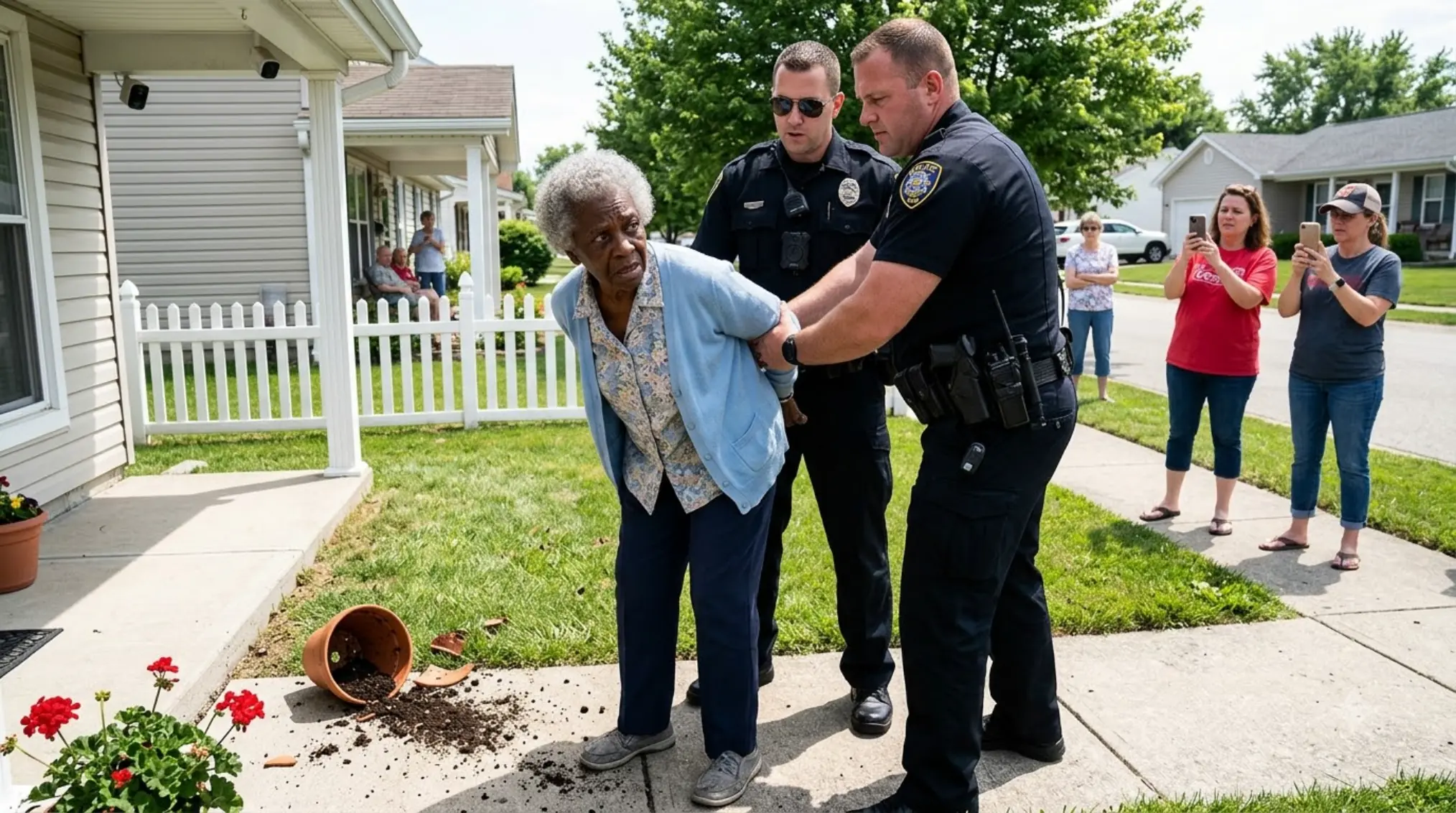
“I’m going inside my house,” she answered.
Officer Mercer stepped between her and the gate. “Not until we settle this property complaint.”
Evelyn looked past him toward the flower bed she had been tending only minutes earlier. Pink coneflowers, daisies, and small red geraniums grew along the white picket fence her late husband, Thomas, had built with his own hands in 1994. A terracotta flowerpot lay broken on the sidewalk where it had been knocked over during the argument, dark soil scattered around Evelyn’s gray walking shoes.
“This isn’t a property complaint,” Evelyn said. “This is my yard.”
Officer Mercer’s partner, Officer Caleb Ross, stood several feet away wearing dark sunglasses. Behind them, their patrol SUV sat at the curb with its lights flashing silently beneath the shade of a maple tree. Three neighbors had already come outside, then five, then eight, and several were holding up phones.
Mercer reached for Evelyn’s wrist.
“Turn around.”
Her eyes widened.
“For what?”
“You’ve been instructed not to cross the disputed boundary.”
Evelyn stared at him.
“The disputed boundary is six feet inside my own garden.”
“Ma’am, turn around.”
Evelyn pulled her hand back.
“Officer, I have a deed inside that house showing exactly where this property ends.”
Mercer’s expression tightened. “You can explain it after we sort this out.”
“Sort what out?”
“You’ve been warned.”
“By who?”
Mercer did not answer immediately.
Evelyn already knew.
The Maplewood Hills Neighborhood Association.
And more specifically, its president, Linda Harwood.
Three months earlier, Linda had appeared at Evelyn’s door carrying a clipboard and a smile that never reached her eyes. She claimed the association had discovered an “irregularity” involving Evelyn’s eastern boundary, specifically the narrow strip containing her flower bed, side walkway, and the small white gate beside the porch.
Evelyn had listened politely.
Then Linda had handed her a printed map.
The problem was obvious.
The line on Linda’s map cut directly through Evelyn’s property.
According to it, six feet of Evelyn’s yard suddenly belonged to the association’s common landscaping corridor.
That would have been surprising enough.
What made it absurd was that the corridor did not exist.
Evelyn’s original deed, county survey, tax map, mortgage records, and the stone survey marker buried near the sidewalk all placed the boundary exactly where the white fence had stood for nearly three decades.
Linda did not care.
“The association updated its property plans during the neighborhood improvement review,” she explained.
Evelyn had looked at her.
“An association plan cannot rewrite my deed.”
Linda’s smile disappeared.
“We’ll see.”
That had been the beginning.
At first, the conflict seemed almost silly.
Letters arrived.
Then violation notices.
Then warnings that Evelyn was “obstructing common property” with flowers, fencing, and a garden bench.
Each letter carried increasingly official language.
Unauthorized use.
Encroachment.
Noncompliance.
Potential enforcement.
Evelyn kept every one.
She had spent twenty-seven years working as a records administrator for the county hospital before retiring. Paper did not frighten her. If anything, inaccurate paper made her unusually patient.
She created a folder.
Green for association letters.
Blue for her deed and tax records.
Yellow for photographs.
Red for anything involving threats or enforcement.
Her daughter, Denise, laughed when she saw the color-coded system.
“Mom, you’re preparing like this is a federal trial.”
Evelyn had smiled.
“No. I’m preparing because people become very confident when they think an old woman won’t keep receipts.”
Then Linda escalated.
A landscaping contractor arrived one Tuesday and attempted to remove three fence sections.
Evelyn stopped him before he touched them.
The contractor showed her a work order signed by the association.
Evelyn photographed it.
Then she photographed the truck.
Then the workers.
Then the section of fence.
The contractor became uncomfortable.
“Ma’am, I’m just doing the job they gave me.”
“I know.”
Evelyn pointed toward the county survey pin.
“And I’m telling you that job puts you on private property.”
The workers left.
Two days later, Linda came back.
This time she was not smiling.
“You embarrassed our contractor.”
“No.”
Evelyn stood behind her screen door.
“I prevented him from tearing out my fence.”
“You’re becoming difficult.”
Evelyn’s expression changed.
“Linda, I’m seventy-four. I’ve buried my husband, survived breast cancer, raised three children, balanced hospital records through two computer system failures, and lived through thirty-two Ohio winters in this house.”
She leaned slightly closer.
“You will need a better threat than difficult.”
Linda’s face reddened.
“You don’t own everything you think you own.”
Evelyn replied quietly.
“That’s what deeds are for.”
After that encounter, Evelyn installed two new cameras.
One above the porch.
One near the side gate.
Her grandson, Marcus, helped connect them to a small recorder inside the house.
“Grandma, these upload automatically.”
Evelyn frowned.
“To the cloud?”
“Yes.”
“I don’t trust clouds.”
Marcus laughed.
“This cloud doesn’t rain.”
She did not laugh.
But she let him finish.
The cameras recorded continuously and stored both video and sound whenever movement occurred.
For nearly two months, nothing serious happened.
Then came Saturday morning.
Evelyn woke before seven, made oatmeal, watered the indoor plants, and went outside shortly after nine to work around the fence. The weather was beautiful. Bright blue sky, mild breeze, children riding bicycles two blocks away.
She had just finished repotting a geranium when a white SUV stopped.
Linda Harwood stepped out.
She was fifty-eight, blond, sharply dressed even on weekends, and wearing the same expression Evelyn had learned to associate with association business.
Two board members followed her.
Evelyn remained kneeling.
“Morning.”
Linda did not return the greeting.
“You were formally told not to access this strip.”
Evelyn looked down at the ground beneath her knees.
“This strip?”
“You know exactly what I mean.”
Evelyn stood slowly.
“I’m planting flowers.”
“On association property.”
“No.”
Linda produced another paper.
“Final compliance notice.”
Evelyn did not take it.
“You can put it in the mailbox.”
Linda’s mouth tightened.
“You continue to treat this like a joke.”
“I haven’t laughed once.”
The two board members exchanged glances.
Linda stepped toward the gate.
“You removed our temporary boundary markers.”
Evelyn looked toward three orange stakes that had appeared two days earlier inside her yard.
“I placed them beside my garage.”
“That is destruction of association property.”
“No. They’re perfectly fine.”
“You had no authority to move them.”
“You had no authority to put them there.”
Linda took out her phone.
Evelyn watched her dial.
“Who are you calling?”
“The police.”
Evelyn almost smiled.
“For gardening?”
“For trespassing and interference with association property.”
One board member, a retired accountant named Thomas Bell, looked uneasy.
“Linda, maybe we should wait for the survey meeting.”
Linda ignored him.
“We’ve waited long enough.”
Within fifteen minutes, the patrol SUV arrived.
Officer Mercer stepped out first.
Linda walked toward him before he had even closed the door.
She spoke quickly.
Evelyn could not hear every word from the garden, but certain phrases carried clearly.
Repeat violation.
Private association property.
Previous warnings.
Hostile refusal.
Mercer nodded several times.
He never walked toward the survey marker.
He never asked to see Evelyn’s deed.
He never asked whether the association had a court order.
Instead, he approached Evelyn.
“Ma’am, you need to step away from the disputed area.”
Evelyn looked around.
“I’m standing beside my porch.”
“I understand there’s an active property dispute.”
“There is an association president inventing one.”
Linda shouted from behind him.
“She’s been warned repeatedly!”
Evelyn sighed.
Mercer pointed toward the sidewalk.
“For now, move off this section.”
“Officer, if I move where you’re pointing, I’ll still be on my property.”
“Then just cooperate.”
“I am cooperating.”
“No, you’re arguing.”
“I’m answering.”
That was when neighbors began appearing.