Police Lieutenant Adrian Cole saw the prisoner tear the ventilation grate from the wall at exactly 2:35 a.m.
The live security feed filled the largest monitor inside the surveillance room of Red Mesa Maximum Security Prison in Arizona. On-screen, a muscular inmate in an orange jumpsuit stood on the steel bunk inside Cell 214, stretching both tattooed arms toward a dark rectangular opening behind the loosened grate. Concrete dust fell over his shoulders as he pulled the metal cover farther away from the wall.
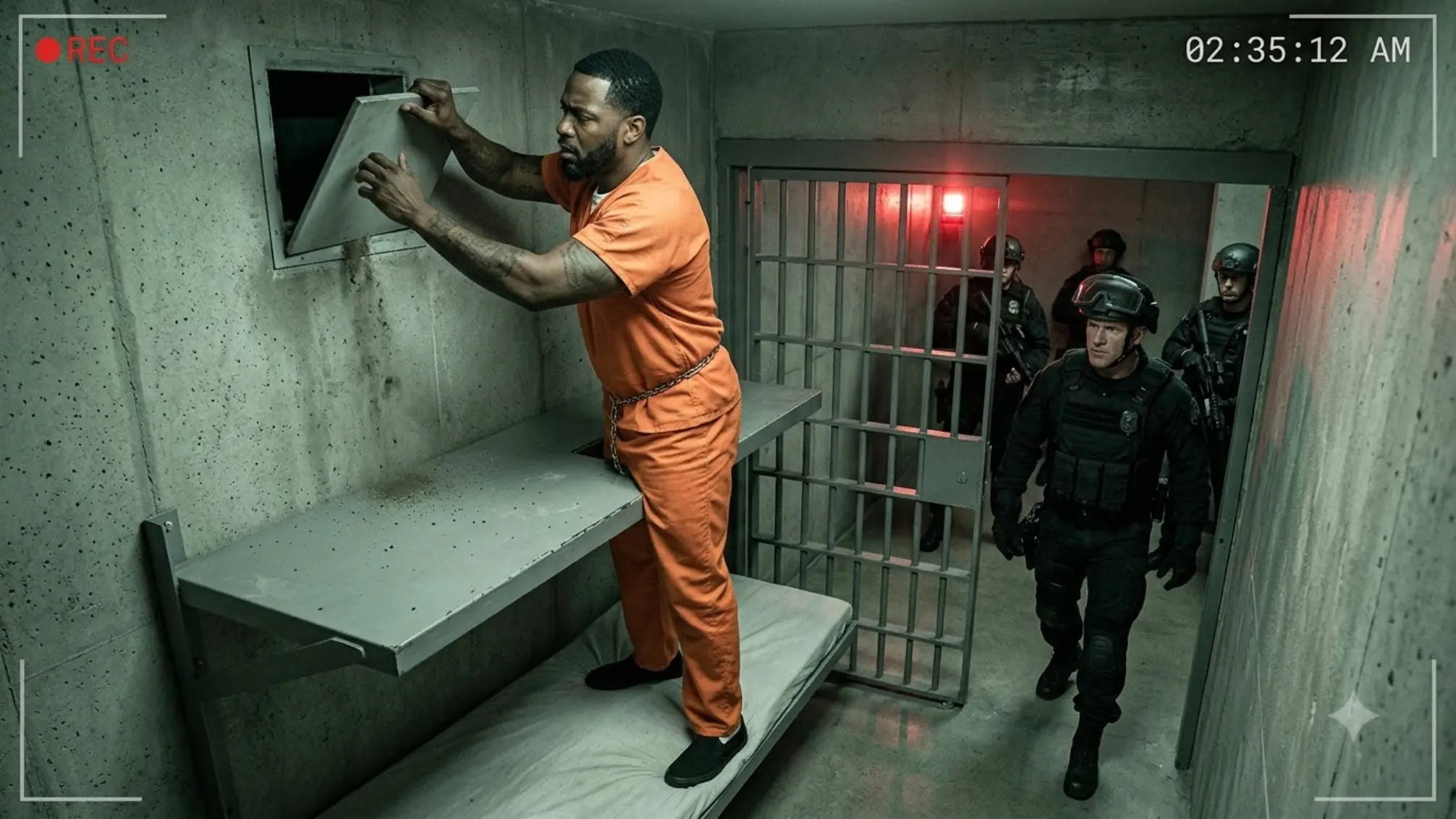
Adrian leaned toward the monitor.
The prisoner’s name was Elijah Voss, a thirty-eight-year-old Black American man serving twenty-five years for armed robbery and criminal conspiracy. His record contained fights and disobedience charges, but no previous escape attempts. Yet he was now staring into a hidden passage that did not appear on any architectural map of the prison.
Adrian pressed the emergency-lockdown button.
Red lights flashed throughout the east cellblock. Steel doors slammed shut one after another, and alarms shook the concrete corridors. Adrian grabbed his protective vest from the back of his chair and spoke into his shoulder radio.
“Control to Special Response Unit. Possible escape in Cell 214. Seal all maintenance exits and move now.”
The inmate looked directly at the camera.
Then a voice seemed to come from inside the wall.
Adrian could not hear it because the cell microphone had been disabled, but Elijah’s head turned sharply toward the passage. He reached one arm into the darkness as though someone were waiting to pull him through.
The security alarm should have driven him away from the opening.
Instead, Elijah climbed higher.
Adrian ran from the surveillance room.
Four tactical officers met him at the east-wing security gate. They wore black protective armor, helmets, gloves, and heavy boots. Sergeant Lucas Grant carried the shield while Officers Meyers and Bennett covered the corridor behind him.
Adrian led them forward.
“Prisoner may have support inside the wall,” he warned. “Watch the passage, not just the inmate.”
The reinforced door to Cell 214 unlocked with a violent mechanical crash. Grant struck it with the shield, forcing it open, and Adrian stormed inside first.
“Get down!” he shouted. “The escape ends right now!”
Elijah jumped from the bunk.
“You’re arresting the wrong man.”
He turned toward the passage again, but Adrian seized the back of his jumpsuit and drove him against the wall. Elijah resisted long enough for Grant and Bennett to secure his arms, then suddenly stopped fighting.
Adrian forced his hands behind his back.
“Who opened that passage?”
Elijah twisted his head toward him.
“Check the tunnel.”
“What am I looking for?”
The inmate’s eyes dropped to Adrian’s silver badge.
“Your badge number is carved inside.”
For one second, no one moved.
Adrian’s identification number was 4172. It had been assigned to him eleven years earlier when he joined the Arizona State Police. Only official records, his personnel file, and the badge itself connected that number to his name.
Elijah smiled without humor.
“You still think I’m the one escaping?”
Adrian ordered the officers to remove him.
As they escorted the prisoner into the corridor, Adrian climbed onto the bunk and aimed his flashlight through the opening. The beam revealed a narrow concrete passage large enough for a man to crawl through sideways.
Fresh scratches marked the inner wall.
Among them were several groups of numbers.
Adrian moved the light closer.
The first sequence read:
4172.
His badge number.
Beneath it, someone had carved another message.
COLE OPENS THE DOOR.
Adrian stepped down from the bunk.
Sergeant Grant looked into the passage.
“What does it say?”
Adrian turned off the flashlight.
“Seal the cell. Nobody enters that tunnel until Internal Affairs and prison command arrive.”
Grant studied his face.
“What did you see?”
“My number.”
“What number?”
“My badge number.”
The sergeant’s expression changed.
Before Adrian could say more, the prison radio crackled.
Deputy Warden Charles Pike ordered Adrian to report immediately to the command office. His tone carried no question and no concern about the secret passage. He sounded angry that Adrian had interrupted something.
Adrian pressed the radio button.
“Cell 214 remains an active security scene. I’m staying until it’s preserved.”
“That is a direct order, Lieutenant.”
“Then put it in writing.”
Silence followed.
Pike answered several seconds later.
“Report to me now.”
Adrian looked toward the camera above the cell door. The indicator light had gone dark.
Someone had remotely disabled the live feed.
He spoke quietly to Grant.
“Do not let anyone enter this cell.”
“You expecting trouble?”
“I’m expecting someone to decide evidence is more dangerous than an escaping prisoner.”
Adrian walked to the command office alone.
Deputy Warden Pike stood behind a wide metal desk when he entered. Pike was a fifty-three-year-old white American man with a thick neck, gray hair, and narrow eyes that rarely revealed whether he was calculating or merely angry. Two senior correctional officers stood near the wall, both wearing full duty belts despite being assigned to administrative shifts.
Director Helen Shaw sat across from Pike.
She was sixty, with short silver hair and a controlled expression. Unlike Pike, she appeared interested in facts rather than authority.
“What exactly happened?” Shaw asked.
Adrian remained standing.
“At 2:35, I observed Elijah Voss removing a ventilation cover. Behind it was an undocumented passage. We stopped him before he entered.”
Pike folded his arms.
“So he attempted escape.”
“That has not been established.”
“We watched him open a tunnel.”
“We watched him open a cover. The wall was cut from the other side.”
Pike’s jaw tightened.
“You determined that in the few minutes you were inside?”
“The broken concrete faces inward toward the cell. Someone worked from inside the passage.”
Director Shaw leaned forward.
“What else did you find?”
Adrian looked at Pike.
“My badge number was carved into the tunnel wall.”
Pike’s expression remained still, but one of the officers beside him moved his hand closer to his belt.
Shaw noticed.
“Why would Lieutenant Cole’s number be there?”
Pike answered before Adrian could.
“Voss may have seen the badge during previous interactions.”
“I’ve never interviewed him,” Adrian said. “Tonight was the first time I entered his cell.”
“Prisoners collect information.”
“The message also said I open the door.”
Pike walked around the desk.
“This is exactly why you should step away from the investigation. You are now part of the evidence.”
Adrian met his stare.
“That may be why someone put it there.”
Pike stopped.
“What are you implying?”
“That the passage could be part of a setup.”
“You saw a prisoner attempting escape.”
“I saw a prisoner responding to someone inside a hidden corridor. The alarm was manually activated from an unused security station.”
Director Shaw turned toward the computer technician standing near the door.
“Is that true?”
The technician swallowed.
“The log shows activation from East Station Four.”
“That station is closed,” Shaw said.
“Yes, ma’am.”
“Who has access?”
The technician hesitated.
Pike’s voice sharpened.
“Answer the director.”
“Maintenance command, senior administration, and the deputy warden’s office.”
The room became silent.
Pike looked at Adrian.
“You’re accusing me now?”
“I’m stating who had access.”
Shaw stood.
“Lock East Station Four and preserve every digital log. Commander Barrett’s tactical unit will inspect the tunnel.”
Pike moved toward her.
“Director, an outside tactical inspection is unnecessary. Prison maintenance can handle it.”
“No.”
“It may contain structural hazards.”
“That is another reason your maintenance staff will not enter first.”
Pike’s face hardened.
Shaw continued.
“And Lieutenant Cole remains part of the investigation until I decide otherwise.”
Adrian left the office with the uneasy feeling that Pike had expected a different outcome. He returned to Cell 214 and discovered Sergeant Grant arguing with two maintenance workers who claimed they had been ordered to enter.
“By whom?” Adrian asked.
One worker pointed toward his radio.
“Deputy Warden.”
“The director overruled him. Step away.”
The second worker reached toward the cell door.
Adrian placed one hand against his chest.
“I said step away.”
The man stared at him, then slowly withdrew.
Commander Nathan Barrett arrived twenty minutes later with an independent tactical inspection team. They inserted a fiber-optic camera through the opening before allowing anyone inside.
The passage extended twenty feet behind the cells and descended into an old service corridor. Electrical cables ran along the floor. Food wrappers, batteries, gloves, and water bottles showed recent activity.
“This is no forgotten construction gap,” Barrett said. “Someone has been working in there.”
Adrian pointed toward the carved numbers.
“Photograph everything before touching it.”
The inspection team entered one at a time.
The corridor split beneath the medical wing. One direction led toward the prison laundry, while another ended at a reinforced steel door. Behind it, they found a small room containing a chair, plastic restraints, a portable camera tripod, and dried blood on the floor.
No exit tools were present.
No maps for escaping the prison.
The passage had not been designed to help inmates leave.
It had been designed to move them somewhere cameras could not see.
Adrian returned to the isolation room where Elijah sat cuffed to a steel table.
The inmate looked exhausted but unsurprised.
“You found the room,” he said.
“You knew it was there?”
“I knew someone wanted me inside.”
“Who spoke through the wall?”
Elijah looked toward the mirrored window.
“Turn off the recorder.”
“No.”
“Then I don’t know anything.”
Adrian sat across from him.
“My badge number was carved in that tunnel. Someone is trying to make this look like I helped you.”
Elijah studied him.
“That means they’re planning to bury both of us.”
“Who are they?”
The prisoner leaned back.
“Six months ago, I was taken to the medical wing after a fight. A guard came in after midnight and asked me about Victor Hale.”
Hale had been Elijah’s co-defendant. He testified against Elijah during the robbery trial and later disappeared during a transfer between prisons. Officials claimed he escaped at a highway rest stop.
“What did the guard want?” Adrian asked.
“The missing money.”
The warehouse robbery involved four million dollars in illegal cash. Authorities recovered less than one million. Elijah always claimed Hale had hidden the rest.
“Did Hale tell you where it was?”
“No. But he told me something else.”
“What?”
“He said officers helped plan the robbery.”
Adrian remained still.
“Which officers?”
“He never gave names. He said someone provided the warehouse security schedule, alarm code, and police response time.”
“And the guard believed you knew more.”
Elijah nodded.
“He said Hale had talked before disappearing.”
“Did you recognize the guard’s voice tonight?”
“Yes.”
“Who was it?”
Elijah looked straight at him.
“Officer Nolan Price.”
Price had worked inside Red Mesa for nine years. He supervised medical transfers and controlled access to the east-wing maintenance keys.
Adrian stood.
“Stay here.”
Elijah laughed bitterly.
“Where am I going?”
Adrian ordered officers to locate Price.
The response came back quickly.
Price was not at his assigned post.
Security footage showed him entering the prison at 1:48 a.m., though he was not scheduled until six. He appeared on a hallway camera near East Station Four seven minutes before the alarm.
Then his image disappeared.
Adrian and Barrett searched the medical wing. They found Price attempting to open a service door behind the supply room. When he saw them, he reached toward his sidearm.
Adrian drew first.
“Hands away from the weapon!”
Price froze.
Barrett moved behind him and removed the gun.
Inside Price’s jacket were two burner phones, a maintenance key, and a folded map of the hidden corridor.
One phone contained messages from Deputy Warden Pike.
The final message had been sent one minute before the alarm.
Voss is opening the vent. Activate response when his arm enters. Make sure Cole leads the team.
Adrian read the words twice.
Another message followed.
If Voss resists, Cole shoots. If he survives, the number in the tunnel connects them.
The entire event had been staged.
Pike wanted Adrian to kill Elijah during an apparent escape. The carved badge number would then suggest Adrian helped build the passage and murdered the prisoner to hide their relationship.
If Adrian refused to shoot, Pike could still accuse him of conspiracy.
Price lowered his head.
Adrian stepped closer.
“Where is Pike?”
“I want an attorney.”
“Where is he?”
Price said nothing.
An alarm sounded near the administrative wing.
Director Shaw’s voice came over the radio.
“Deputy Warden Pike is missing. His vehicle remains outside. Lock the prison.”
Adrian understood immediately.
Pike was using the hidden corridors.
Barrett’s team divided into three units. One sealed the laundry exit, another covered the old boiler rooms, and Adrian led the third through the passage behind Cell 214.
He crawled past his badge number.
Farther inside, they found additional numbers carved into the concrete. Some belonged to correctional officers. Others matched prison employees who had resigned suddenly over the previous five years.
One number belonged to Samuel Ortiz, an inmate officially transferred to Nevada eight months earlier.
Nevada had no record of receiving him.
Inside the hidden restraint room, investigators matched the blood to Ortiz.
The passage was part of a larger operation. Pike and compromised officers removed selected inmates from their cells, questioned them about hidden money and criminal contacts, then altered transfer records if they became dangerous.
Some prisoners were returned.
Others disappeared.
Victor Hale had learned too much.
Elijah was the last person believed to know what Hale had revealed.
Adrian’s radio crackled.
Movement had been detected near the western supply dock.
He and Barrett exited the tunnel through the laundry corridor and ran across the lower level. At the loading dock, Pike stood behind a maintenance worker with a knife pressed against the man’s throat.
He had removed his uniform jacket and carried a bag filled with cash, forged identification, and prison records.
Adrian aimed his weapon.
“Release him.”
Pike pulled the worker closer.
“You were supposed to shoot Voss.”
“You chose the wrong officer.”
“I chose the officer everyone trusted.”
“You carved my badge number into a kidnapping tunnel.”
Pike smiled.
“And once you killed him, everyone would believe you were protecting your partner.”
“You underestimated the camera.”
“No. I controlled the camera.”
“Not the command log.”
Pike’s smile disappeared.
Adrian continued.
“Price gave us your messages.”
Pike tightened his grip on the knife.
“He won’t survive long enough to testify.”
“That sounds like another confession.”
The maintenance worker suddenly drove his elbow backward. Pike lost his grip for half a second.
Adrian moved.
He struck Pike’s wrist with both hands, forcing the knife away, while Barrett pulled the hostage to safety. Pike slammed Adrian against a steel loading rack, but Adrian drove one shoulder into his chest and forced him to the concrete.
Pike fought wildly.
Adrian pinned his arm.
“The passage ends here.”
Barrett secured the handcuffs.
Pike laughed even while lying face down.
“You still don’t know why your number was chosen.”
Adrian pulled him upright.
“You wanted a trusted officer to take the fall.”
“No.”
Pike looked toward Adrian’s body camera.
“Hale carved your number first.”
Adrian stopped.
Pike’s smile returned.
“He knew you were investigating missing transport records before anyone else did. He thought you might be the only officer who would follow the evidence.”
Months earlier, Adrian had submitted questions about inconsistent prisoner transfers. Pike secretly accessed the report. Hale somehow learned Adrian’s number and carved it beside a hidden metal strip inside the vent.
Pike added the words COLE OPENS THE DOOR later, changing a message intended to identify an ally into evidence of conspiracy.
Investigators searched the vent again.
Beneath the inner edge, taped behind a rusted support, they found a thin strip of metal containing nineteen badge and employee numbers. Pike’s appeared first.
Price’s appeared seventh.
Adrian’s appeared last, separated from the others by one word:
TRUST.
Victor Hale had left a map of the corrupt network.
He had also left the number of the officer he believed might expose it.
Federal agents searched property connected to Pike and found recorded interrogations, forged transfer orders, and evidence linking several prison contractors to inmate disappearances. Samuel Ortiz had been killed after refusing to reveal information about a drug network.
Hale was still alive.
Agents found him six weeks later inside an abandoned private detention facility in New Mexico. He was weak and injured but able to testify. His evidence connected Pike’s group to the original warehouse robbery, including the compromised investigator who provided security information.
Elijah’s conviction did not disappear entirely. He had knowingly participated in the robbery, but the murder-related portion of his sentence relied on manipulated testimony and hidden agreements.
A judge ordered a new hearing.
Elijah eventually received a reduced sentence based on the crimes he could actually be proven to have committed. He was not declared innocent, but the system could no longer punish him using evidence created by the same corrupt officials trying to kill him.
Pike, Price, and twelve others were convicted of conspiracy, kidnapping, evidence tampering, obstruction, and offenses connected to multiple deaths.
Director Shaw ordered every sealed corridor mapped and opened. Security stations received independent logging systems that no single administrator could erase.
Cell 214 was permanently closed.
The camera recording from 2:35 a.m. became central evidence during Pike’s trial. Jurors watched Elijah remove the vent, heard testimony about the voice inside the wall, and saw Adrian storm into the cell.
Pike’s attorney claimed Adrian used unnecessary force.
The prosecutor played the message ordering Price to ensure Elijah did not survive.
Adrian had not ruined the plan by using too much force.
He ruined it by refusing to fire.
Two years later, Adrian visited a vocational workshop connected to the prison reentry program. Elijah had completed his sentence and now repaired heavy machinery while helping other former inmates find apprenticeships.
They stood beside a disassembled diesel engine.
Elijah wiped grease from his hands.
“You still have badge 4172?”
Adrian touched the silver badge on his belt.
“Yes.”
“I hated seeing it carved in that wall.”
“So did I.”
“You thought I put it there.”
“For about thirty seconds.”
Elijah nodded.
“That’s longer than I’d like.”
Adrian looked toward the workshop’s security camera.
“You reached into a secret tunnel during a lockdown.”
“I didn’t say I made good choices.”
They both laughed once.
Then Elijah became serious.
“If you had shot me, Pike would’ve won.”
Adrian shook his head.
“He expected fear to make the decision for me.”
“What stopped you?”
“You looked toward the tunnel instead of the cell door.”
Elijah waited.
“An escaping man watches the exit. You were watching whoever had called you inside.”
Adrian had noticed it before he understood it.
That small difference saved both of them.
The secret passage was built to remove prisoners without witnesses. The live camera was supposed to transform a planned murder into a justified shooting. Adrian’s badge number was supposed to destroy his credibility before he could ask the right questions.
Instead, the camera captured the exact moment the conspiracy failed.
Adrian did not open the hidden door for the criminals behind the wall.
He opened it for the truth.