“No address, long hair, combat blade—you’re exactly the trash I keep out of my town.”
Sheriff Warren Hale held the survival knife beneath the fluorescent lights of the booking room as though he had uncovered proof of a violent crime. Three deputies watched from behind the counter, amused by the exhausted traveler standing in handcuffs before them. Rainwater dripped from the man’s olive military jacket and collected beneath his worn boots.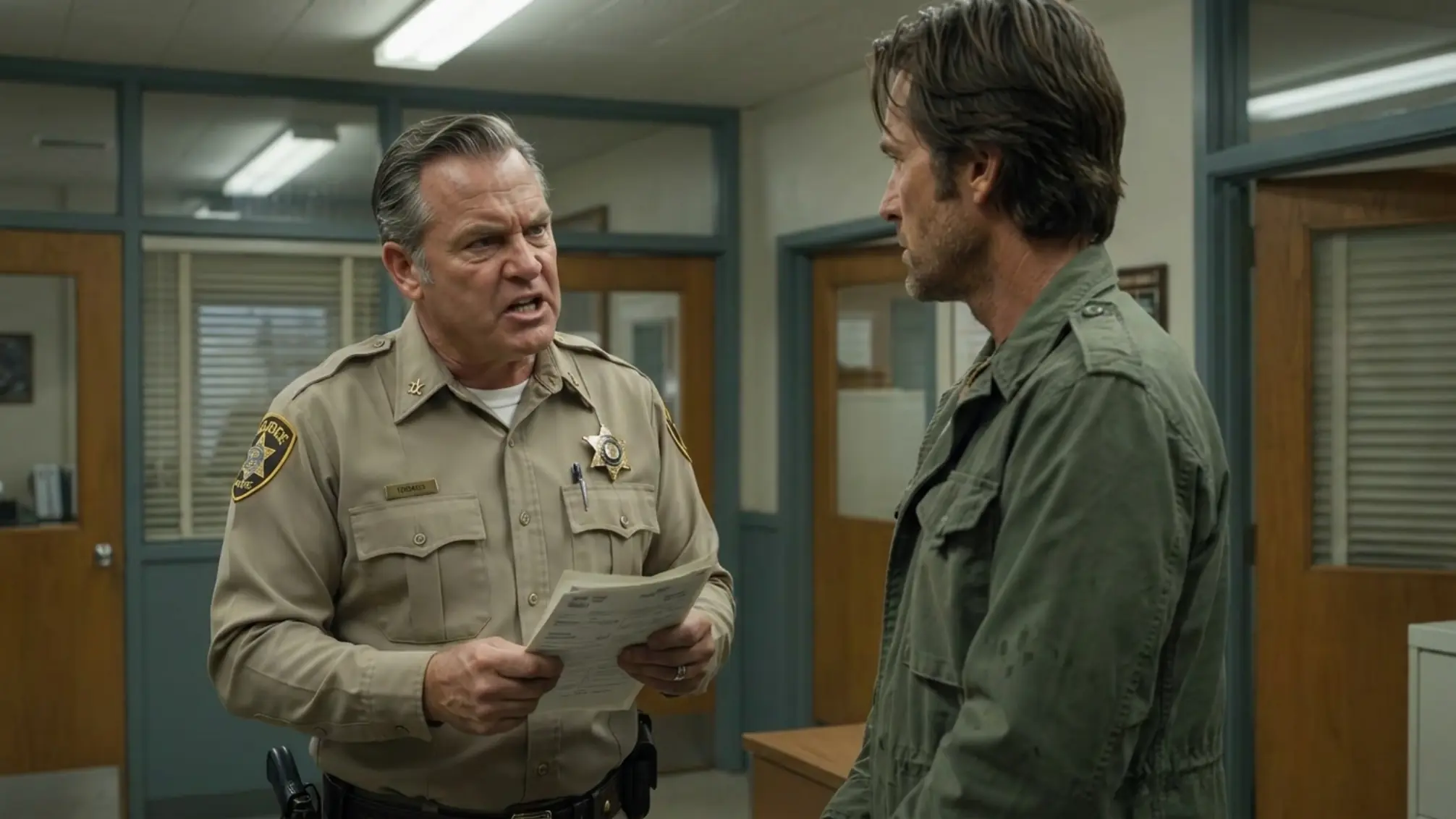
The prisoner lifted his blue-gray eyes.
“I came for food,” he said. “Not your permission.”
Hale stepped forward until they were nearly face-to-face.
“Keep talking, and my deputies will teach you respect.”
The quiet man raised his restrained hands just enough for the metal dog tags around his neck to catch the light.
“Read the name,” he answered. “Then call the colonel who trained me.”
The laughter in the room faded.
The name stamped into the metal was Nathan Cole.
None of the officers recognized it.
That was their first mistake.
Nathan was forty-two years old, a white American single father, and a former member of an elite United States Army Special Forces unit. He had served in places the government rarely discussed and survived missions whose details remained sealed. His military record included the Silver Star, two Bronze Stars, a Purple Heart, and the Medal of Honor.
He did not look like the photographs displayed inside military museums.
His shoulder-length dark-brown hair was wet and uneven. Light stubble covered his weathered face, and his military jacket had been repaired twice along one sleeve. A canvas bag sat on the booking-room floor beside him, containing two shirts, a photograph, and a child’s drawing folded carefully inside a plastic cover.
Nathan had not come to the small Washington town of Bell Creek looking for conflict.
He had come to visit the mother of a soldier who had once saved his life.
Staff Sergeant Michael Torres had been Nathan’s closest friend during their final deployment. When an explosion separated their unit, Michael carried Nathan nearly half a mile through hostile ground despite suffering injuries of his own. Both men returned home, but neither truly escaped what followed them.
Michael died seven months earlier.
Nathan learned about it from a letter that reached him late because he had moved twice while searching for stable work. Michael’s mother wrote that her son’s health had collapsed after years of complications connected to military exposure overseas.
Nathan carried the letter across three states.
He left his thirteen-year-old daughter, Grace, with his older sister in Oregon for four days. Before he departed, Grace made him promise to call every evening.
“You always disappear inside yourself when you visit people from the Army,” she said.
“I’ll call.”
“Even if you’re tired?”
“Especially then.”
She handed him the folded drawing.
It showed Nathan and Grace standing beside a small blue house with a yellow sun above them. Underneath, she had written:
Come home, Dad.
Nathan placed it inside his bag.
The visit with Michael’s mother lasted less than an hour.
She showed Nathan photographs of her son before the sickness took his strength. She described the final months, the hospital visits, and Michael’s refusal to complain because he believed other veterans had suffered more.
Nathan listened without interrupting.
Before leaving, he gave her the old photograph he had carried since deployment. It showed Michael and Nathan sitting on an armored vehicle, both young enough to believe survival meant the war would eventually end.
Michael’s mother held the photograph against her chest.
“He talked about you,” she said. “Said you were the reason he made it home.”
Nathan lowered his eyes.
“He was the reason I did.”
He left the house carrying one less photograph and much more weight.
By late afternoon, he was walking along the highway toward Bell Creek. He planned to eat at a diner, find a motel, and catch a bus south the following morning.
Sheriff Warren Hale noticed him before he reached the first traffic light.
Hale had controlled Bell Creek for twelve years. He knew the business owners, school-board members, and families who had lived there for generations. Outsiders made him suspicious, especially outsiders who looked unwilling to explain themselves.
He slowed his patrol vehicle beside Nathan.
“Where are you headed?”
“Town.”
“For what?”
“Food.”
Hale studied the long hair, patched jacket, canvas bag, and quiet expression.
“There’s another diner twenty miles south.”
Nathan looked toward the buildings ahead.
“There’s one right there.”
“That one serves locals.”
Nathan said nothing.
Hale pulled ahead and stopped across the shoulder.
“Get in.”
Nathan hesitated before entering the passenger seat. He had learned that resisting men with badges often gave them the excuse they were already searching for.
The sheriff drove through Bell Creek without stopping.
Nathan watched the diner pass.
“You missed it.”
“I didn’t.”
Hale continued to the southern edge of town and pulled onto the shoulder.
“You can continue from here.”
Nathan looked at him.
“I haven’t broken any law.”
“I’m preventing that.”
“By removing me from a public town?”
“By using judgment.”
Nathan stepped out.
Hale expected him to continue south.
Instead, Nathan closed the door, waited until the patrol car moved forward, and turned back toward Bell Creek.
He had crossed mountains under enemy fire. He had crawled through mud with broken ribs and carried wounded soldiers while helicopters searched for a safe landing zone.
He would not be denied a meal because one sheriff disliked his appearance.
Hale saw him in the mirror.
The patrol car stopped again.
The sheriff climbed out and blocked Nathan’s path.
“I told you to leave.”
“You gave an unlawful order.”
Hale grabbed his arm.
Nathan removed the hand with one controlled movement.
He did not strike the sheriff or raise his voice. He simply broke the grip and stepped away.
Hale drew his weapon.
“Hands behind your head.”
Nathan looked at the gun, then at the man holding it.
He complied.
The arrest report later listed vagrancy, resisting an officer, and carrying a concealed weapon. Nathan’s knife was secured openly in a sheath on his belt, but Hale wrote the charge anyway.
At the station, deputies treated the arrest as entertainment.
Deputy Clark Danner pulled Nathan’s canvas bag onto the counter and emptied it. Clothing, medicine, a notebook, and Grace’s drawing fell onto the scratched surface.
Danner unfolded the picture.
“What’s this supposed to be?”
Nathan’s voice changed.
“Put it down.”
“A kid draw it?”
“Put it down.”
Danner smiled.
“Your kid?”
Nathan took one step forward.
Two officers immediately grabbed him.
Hale entered at that moment.
“Problem?”
“Prisoner’s getting emotional,” Danner said.
Nathan looked at the drawing in the deputy’s hand.
“That belongs to my daughter.”
Hale took it, studied the simple house, and dropped it back onto the counter.
“Then you should have behaved better.”
Nathan’s jaw tightened.
He had spent years learning how to control reactions that arrived before thought. Loud noises could return him to a burning convoy. Locked rooms could make his lungs forget how to work. A hand grabbing his neck could transform a harmless moment into a prison cell overseas.
He knew the signs.
The narrowed vision.
The rising heartbeat.
The instinct to identify exits, weapons, and the weakest person in the room.
Nathan forced himself to breathe.
He had promised Grace he would come home.
The deputies removed his jacket and searched him. Beneath the wet shirt, old scars crossed his shoulders and ribs.
A young deputy named Owen Reed stopped smiling.
“What happened to him?”
Danner shrugged.
“Probably lost a bar fight.”
Nathan looked at him.
Danner pulled the dog tags from Nathan’s chest.
“Nathan Cole,” he read. “Army.”
Hale leaned against the desk.
“Plenty of losers joined the Army.”
Nathan’s eyes met his.
“Plenty of good men died wearing those tags.”
The sheriff’s expression hardened.
“Clean him up.”
The order made Nathan still.
Danner dragged him toward the holding area, where a hose used for washing floors hung beside a utility sink. Another deputy retrieved clippers and joked that the traveler would look respectable after losing his hair.
Nathan stopped walking.
“No.”
Danner shoved him.
“You’re not being asked.”
Nathan turned slowly.
“Don’t touch my head.”
The warning was not loud.
It was worse than loud.
Owen noticed Nathan’s breathing change.
“Sheriff, maybe we should check his military file.”
Hale dismissed him with a glance.
“He’s a drifter with a knife.”
“Those scars aren’t from a bar fight.”
Danner pushed Nathan again.
The room disappeared.
For one terrible instant, Nathan was no longer in Washington. He was restrained inside a concrete room overseas while men held him beneath freezing water and questioned him about soldiers who were already dead.
His body reacted before his mind returned.
He twisted free, redirected Danner into the wall, and knocked the clippers from another deputy’s hand. When the third man reached for his baton, Nathan trapped the arm and placed him on the floor without striking his head.
Every movement was exact.
Controlled.
The officers expected rage.
What they saw was training.
Nathan could have seriously injured them.
He did not.
Hale drew his pistol.
Nathan froze with both hands visible.
The room returned around him.
Owen stared at the three deputies on the floor.
Nathan’s voice was strained.
“I told you not to touch my head.”
Hale ordered him into a reinforced holding cell.
This time, six officers were present.
Nathan allowed them to secure him because he understood that another fight would lead to gunfire. As the steel door closed, he sat against the wall and pressed both hands over his face.
He had failed Grace’s request.
He had disappeared inside himself again.
Outside the cell, Owen entered Nathan’s name into a federal military database.
Access was restricted.
He tried a second system available to law enforcement and found a public citation from the Department of Defense.
The photograph showed a younger Nathan wearing a dress uniform while the President of the United States placed the Medal of Honor around his neck.
Owen stopped breathing for a moment.
He read the citation.
Nathan had held a defensive position after his unit was surrounded, protected wounded soldiers, and crossed exposed ground repeatedly to guide a rescue aircraft. He was injured twice and refused evacuation until every surviving member of his team had been removed.
Owen printed the page.
He carried it to Hale’s office.
“You need to see this.”
Hale glanced at the photograph.
“So he was a soldier.”
“He received the Medal of Honor.”
The sheriff looked again.
“That doesn’t excuse assaulting deputies.”
“They assaulted him first.”
Hale stood.
“Choose your words carefully.”
Owen placed the report on the desk.
“We arrested him for walking toward a diner.”
“We arrested him for refusing a lawful order.”
“You ordered him out of town because you didn’t like his face.”
Hale stepped closer.
“Are you challenging me?”
“I’m telling you this is getting worse.”
Before the sheriff could answer, the station telephone rang.
The dispatcher said a United States Army colonel was demanding immediate contact regarding Nathan Cole.
Hale took the call.
“This is Sheriff Warren Hale.”
A deep male voice answered.
“This is Colonel Samuel Grayson. Is Master Sergeant Cole in your custody?”
“He is being held after attacking officers.”
“Why was he arrested?”
“Vagrancy and resisting.”
Silence followed.
Then Grayson asked, “Did you verify his identity before placing hands on him?”
Hale disliked the question.
“We do not need military permission to enforce local law.”
“No,” the colonel replied. “But you may soon need federal attorneys to explain why decorated Special Forces personnel are being abused in your jail.”
Hale looked toward Owen.
“How soon can you get here?”
“I’m already outside.”
The front doors opened.
Colonel Samuel Grayson entered wearing a dark Army uniform decorated with ribbons. He was sixty-one, tall, silver-haired, and carried the authority of a man who never needed to announce it.
Two military legal officers followed him.
The station became silent.
Grayson saw Nathan’s jacket on the booking counter, the dog tags beside it, and the child’s drawing still unfolded near the edge.
His face hardened.
“Where is he?”
Hale stepped forward.
“Before you see him, you should understand that your soldier became violent.”
Grayson looked directly at him.
“My soldier?”
“He attacked three deputies.”
“Are they alive?”
Hale frowned.
“Yes.”
“Then Nathan Cole was controlling himself.”
The sheriff stared at him.
Grayson moved closer.
“I trained him for six years. I commanded him overseas. If he intended to seriously hurt those men, you would not be having this conversation.”
Owen opened the cell.
Nathan sat against the wall with his head lowered.
When he heard the colonel’s voice, he looked up.
Grayson entered alone.
For several seconds, neither man spoke.
Then Grayson noticed the marks on Nathan’s wrists.
“What did they do?”
Nathan’s answer came quietly.
“I lost control.”
“That isn’t what I asked.”
Nathan looked toward the hallway.
“They tried to cut my hair.”
Grayson understood.
He had been present when Nathan was recovered from the prison camp years earlier. He knew about the restraints, water, blades, and months of treatment that followed.
“You hurt anyone badly?”
“No.”
“Good.”
“I scared them.”
“They should be scared of what they nearly caused.”
Nathan looked down.
“Grace is waiting for my call.”
Grayson removed a phone from his pocket.
“Then call your daughter.”
Nathan’s hands shook slightly as he entered the number.
Grace answered on the first ring.
“Dad?”
“I’m here.”
“You’re late.”
“I know.”
“Are you okay?”
Nathan looked at the cell.
“I had a difficult evening.”
“Are you coming home?”
He closed his eyes.
“Yes.”
“You promised.”
“I remember.”
After the call, Nathan returned the phone.
Grayson stood.
“Let’s get you out.”
Hale blocked the booking-room exit.
“He is still facing charges.”
The military attorneys placed two folders on the desk.
One contained Nathan’s service record.
The other contained statements from witnesses who had seen Hale force Nathan into the patrol vehicle despite no criminal conduct. A diner employee had also provided security footage showing the sheriff intentionally driving him past the business after Nathan requested food.
Owen added his own statement.
Hale looked at the young deputy with disbelief.
“You’re siding with him?”
“I’m siding with what happened.”
The sheriff’s face reddened.
“I decide what happened in this station.”
Grayson answered before anyone else could.
“That sentence is why you should never wear authority again.”
Hale reached for Nathan’s knife.
“This man entered my town armed.”
Nathan spoke from the cell doorway.
“It was a survival tool.”
“You expect me to believe that?”
Grayson took the knife and twisted the handle. A small compass, fishing line, needle, and emergency kit were stored inside.
“He carried this through three deployments,” Grayson said. “It helped keep four American soldiers alive for eleven days after their aircraft went down.”
Hale’s confidence weakened.
The military attorney informed him that the county prosecutor had reviewed the arrest and declined all charges against Nathan. State investigators were also being notified about the use of force inside the station.
Hale turned toward Owen.
“You called them?”
“I sent the footage.”
The booking area contained two security cameras.
Hale had forgotten them.
The video showed Nathan following instructions until deputies touched his belongings, mocked his daughter, shoved him repeatedly, and prepared to forcefully cut his hair.
It also showed Nathan disabling three officers without continuing the attack after they fell.
The evidence did not support Hale’s story.
It destroyed it.
Nathan collected his belongings slowly.
He folded Grace’s drawing along the original creases and returned it to the plastic cover. Then he placed the dog tags around his neck and sheathed the knife at his belt.
Danner stood near the wall with one arm supported in a sling.
He avoided Nathan’s eyes.
Nathan looked at him anyway.
“You laughed because you thought I was powerless.”
Danner said nothing.
“You should be grateful I remembered I wasn’t.”
The deputy lowered his head.
Hale still refused to apologize.
“You came into my town looking like trouble.”
Nathan picked up his canvas bag.
“No. I came looking for dinner.”
The sentence carried through the station.
Reporters were waiting outside by morning.
Someone had leaked the Medal of Honor citation and station footage. News cameras surrounded the courthouse while residents demanded an investigation into previous arrests connected to Hale.
Nathan wanted no part of the spectacle.
He agreed to give one statement.
He stood beside Colonel Grayson and Owen Reed on the courthouse steps, still wearing the patched jacket.
“I served my country because I believed authority should protect people who cannot protect themselves,” he said. “A badge, uniform, or medal does not make a person honorable. Their choices do.”
He paused before continuing.
“I do not want special treatment because of my military record. I should not have needed medals to be treated like a human being.”
The final sentence appeared in newspapers across the country.
Sheriff Hale was suspended that afternoon.
The state investigation uncovered fourteen complaints alleging unlawful stops, harassment of travelers, and retaliatory arrests. Several had been dismissed internally without independent review.
Hale eventually lost his position.
Deputy Danner was fired for excessive force and falsifying his written report. Two other officers were suspended and required to complete additional training before returning.
Owen Reed was appointed acting supervisor during the investigation.
He visited Nathan before Nathan left Bell Creek.
They met at the diner Nathan had originally tried to enter.
Owen placed a cup of coffee on the table.
“I should have spoken sooner.”
“You spoke.”
“After they hurt you.”
Nathan looked through the window at the street.
“Courage rarely arrives as early as we wish.”
Owen sat across from him.
“How did you stop yourself?”
“From what?”
“Hurting them worse.”
Nathan studied his hands.
“I saw my daughter’s drawing.”
“That was enough?”
“No.”
He looked at Owen.
“But it reminded me who had to live with what I did next.”
Colonel Grayson drove Nathan south.
During the journey, they spoke about Michael Torres, the men their unit had lost, and the years Nathan spent pretending civilian life had repaired him.
“You need help,” Grayson said.
“I’ve had help.”
“You stopped going.”
Nathan looked through the window.
“I was busy raising Grace.”
“Being a father doesn’t mean disappearing as a man.”
The words followed Nathan all the way home.
Grace ran from the porch when the car stopped.
Nathan barely had time to put down his bag before she wrapped both arms around him. She examined the bruise near his jaw and demanded to know who hurt him.
“Some men made bad choices.”
“Did you fight them?”
“I stopped them.”
“That isn’t an answer.”
Nathan smiled faintly.
“You’re getting too good at questions.”
She held up the drawing he had returned.
“You kept it.”
“Always.”
Nathan began treatment again the following week.
He joined a veterans’ support group and accepted a position training emergency-response teams in wilderness survival. The work allowed him to use skills once connected only to war for rescues, disaster response, and missing-person searches.
He also became more honest with Grace.
When nightmares woke him, he stopped pretending he had merely heard a noise. When crowds overwhelmed him, he explained why they needed to leave instead of becoming silent and distant.
Healing was not quick.
But it was movement.
Months later, Bell Creek invited Nathan to attend the opening of a community veterans’ center built inside the renovated police annex. He initially refused.
Grace changed his mind.
“You told me people should face the things they’re scared of.”
“I was talking about you giving a school presentation.”
“Still counts.”
Nathan returned with her.
Owen, now permanently appointed sheriff, met them outside. He had removed the old department motto from the lobby wall and replaced it with a simpler statement:
Authority Begins With Restraint.
Inside the former holding room, Nathan stopped near the place where deputies had tried to cut his hair.
Grace took his hand.
“You okay?”
He breathed slowly.
“Yes.”
This time, the room remained a room.
No prison walls replaced it.
No voices from the past drowned out the present.
At the ceremony, Owen returned Nathan’s knife. State investigators had held it as evidence until every case was complete.
Nathan examined the worn handle.
“You could put it in a museum,” Owen said.
“It belongs in my bag.”
Grace looked at it.
“Is that the knife everyone was scared of?”
Nathan nodded.
“Did it save people?”
“Yes.”
“Then they were scared because they didn’t know the story.”
Nathan looked across the room at the officers, veterans, families, and townspeople gathered together.
“That happens too often.”
He placed the knife in its sheath.
Nathan had entered Bell Creek as an exhausted single father searching for food after saying goodbye to a fallen friend. Sheriff Hale saw long hair, old clothes, and silence, then decided those things added up to danger.
The deputies mocked his scars because they did not understand where they came from.
They laughed at his dog tags because they believed a man without visible status deserved no respect.
Only after a colonel arrived, military records opened, and the Medal of Honor appeared did they reconsider who stood before them.
But the medal was never the point.
Nathan would have deserved dignity without it.
He would have deserved food, due process, and safety if he had never worn a uniform, never saved a soldier, and never received recognition from his country.
The truth exposed inside that small police station was simple.
The officers had not failed because they misunderstood an elite veteran.
They failed because they believed an ordinary stranger could be humiliated without consequence.
Nathan Cole returned home to his daughter carrying the same patched jacket, worn bag, and survival knife he had arrived with.
Nothing about his appearance had changed.
Only the world’s understanding of him had.
And when Grace asked what he had learned from Bell Creek, Nathan gave her the answer he wished every person with authority understood:
“Never wait for someone’s medals before deciding they matter.”