The traffic stop unfolded on a quiet residential road outside Los Angeles, where trimmed hedges, tall cypress trees, and expensive homes lined both sides of the street. Evening sunlight reflected from the curved windshield of the black McLaren Jordan had pulled against the curb. A marked patrol cruiser sat behind it with its emergency lights flashing, while several drivers slowed to watch.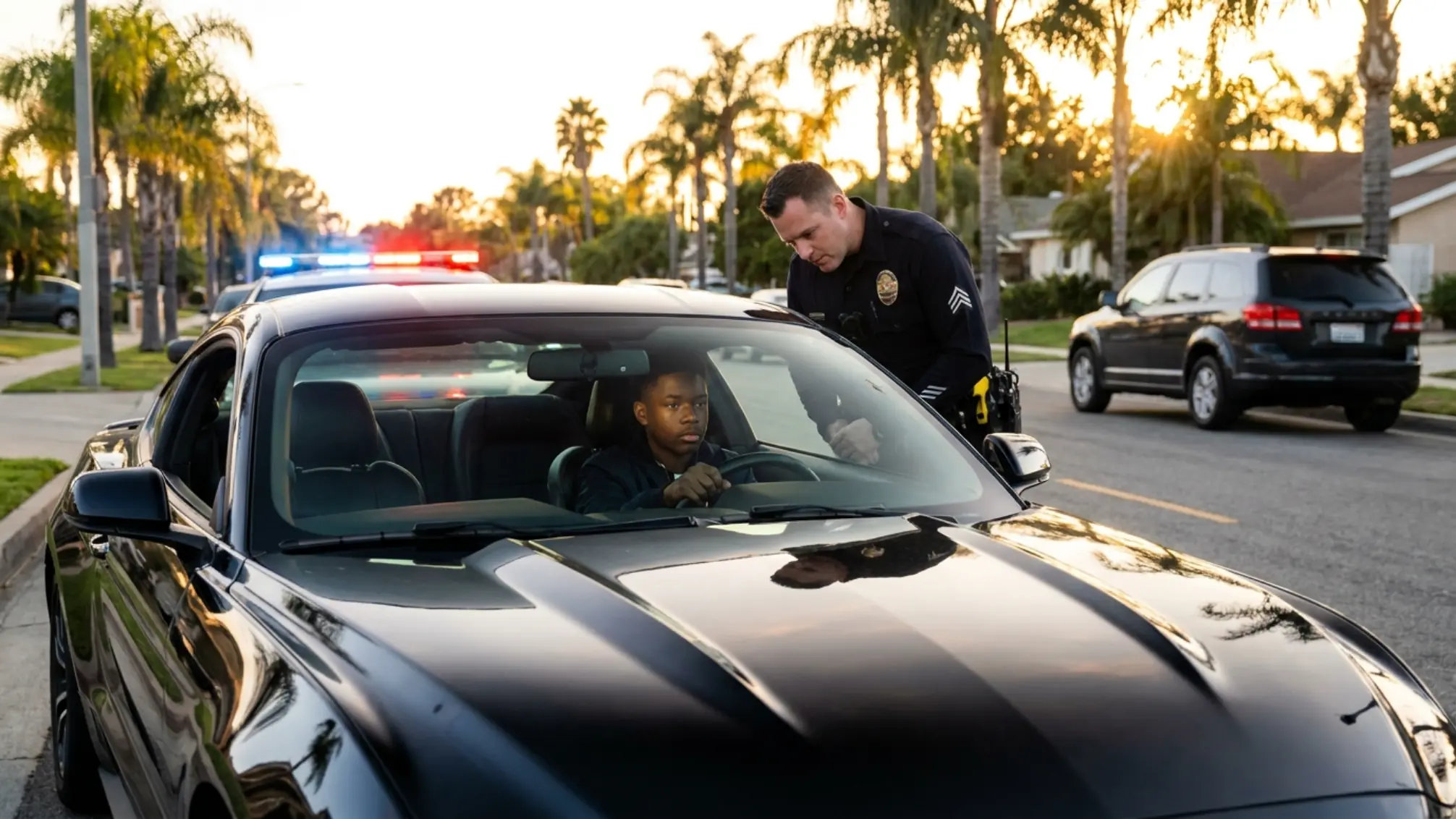
Jordan was a slim, athletic Black teenager with medium-brown skin, short neatly trimmed hair, and dark eyes that remained calm despite the anger tightening his jaw. He wore a plain black T-shirt beneath a dark jacket, blue jeans, and clean white sneakers. Nothing about him suggested danger, but Officer Mercer had approached the car with one hand hovering near his duty belt as though he had stopped an armed fugitive.
Mercer was thirty-nine, broad-shouldered, fair-skinned, and convinced that confidence could substitute for evidence. He had seen the McLaren pass him at the legal speed limit and followed it for six blocks before activating his lights. No dispatch alert described the car, and no stolen-vehicle report matched its license plate.
The officer had made his decision before checking either one.
A young Black driver in a supercar looked wrong to him.
That was enough.
Jordan had borrowed the McLaren with permission from his father, Adrian Ellis, to attend a scholarship dinner at a nearby hotel. The car was registered to the Ellis Family Trust, insured for authorized household drivers, and equipped with an electronic key carrying Jordan’s fingerprint profile. Adrian had asked his son to collect him afterward because his official vehicle had been delayed at a security meeting.
Jordan was supposed to meet him at seven.
It was now six forty-two.
Mercer tapped the roof with two fingers. “License and registration.”
“They’re in the glove compartment,” Jordan replied. “I’m going to reach for them with my right hand.”
“I didn’t ask for a speech.”
“I’m telling you before I move.”
The officer stared at him for a moment, irritated by the teenager’s caution. Jordan had learned the habit from his father, who insisted that clarity mattered whenever authority and fear occupied the same space.
Jordan slowly opened the compartment and removed a leather document case. He handed Mercer his driver’s license, the registration, and the insurance card.
Mercer examined the license first.
“Jordan Ellis. Seventeen.”
“Yes, sir.”
“This your address?”
“Yes.”
Mercer looked toward the registration. The owner was listed as the Ellis Family Trust at the same address shown on Jordan’s license. The insurance card included Jordan’s full name under authorized drivers.
The facts should have ended the suspicion.
Instead, Mercer looked back into the car. “Who is Adrian Ellis?”
“My father.”
“What does he do?”
Jordan paused. “That isn’t relevant to the stop.”
Mercer smiled without warmth. “You don’t decide what’s relevant.”
“The plate is valid, the insurance is valid, and I was not speeding.”
“You were driving suspiciously.”
“How?”
“You accelerated when I pulled behind you.”
“The light turned green.”
“You kept checking your mirror.”
“There was a police cruiser following me.”
Mercer bent lower, placing one hand on the window frame. “Kids who own cars like this usually know how to cooperate.”
Jordan looked directly at him. “You already have everything you asked for.”
The officer stepped back. “Get out.”
“For what reason?”
“I need to verify the vehicle identification number.”
“It’s visible through the windshield.”
“Out of the car.”
Jordan did not move. “Am I being detained for a traffic violation or investigated for vehicle theft?”
Mercer’s expression hardened. “You’re being detained because I said so.”
A woman walking a dog stopped on the opposite sidewalk. Farther down the street, a delivery driver held his phone near his chest and began recording. The patrol cruiser’s camera pointed toward the rear of the McLaren, but Mercer’s body camera displayed no active light.
Jordan noticed.
“Is your body camera recording?”
Mercer reached toward the door handle. “Step out before I remove you.”
Jordan pressed the door-lock button. “Please call a supervisor.”
The officer jerked the handle once and then struck the window with the flat of his palm.
“Unlock the door!”
Jordan’s breathing quickened, but he kept his hands visible. “I have complied with every document request. The car is registered, insured, and not reported stolen.”
“You don’t look like the registered owner.”
“The owner is a family trust.”
“Exactly.”
“That does not mean what you think it means.”
Mercer looked through the windshield at the leather interior, dashboard, and expensive watch lying in the center console. His suspicion had become personal. Each sign of wealth seemed to offend him because it belonged to someone he had already decided should not possess it.
“Where did you get the key?” he demanded.
“My father gave it to me.”
“Call him.”
Jordan glanced toward his phone mounted beside the dashboard. “I already did.”
“When?”
“When you activated your lights.”
Mercer looked back toward the road.
The black SUV had turned onto the street but remained several hundred feet away. It moved slowly, followed by a second dark vehicle. Neither displayed lights or markings.
“Who’s coming?” Mercer asked.
“My father.”
“You said the FBI Director.”
“I said explain it to the FBI Director when he gets here for his son.”
The officer laughed. “You expect me to believe your father runs the FBI?”
“No.”
Jordan’s answer surprised him.
“My father is Deputy Director Adrian Ellis,” the teenager continued. “Director Helen Ward is riding with him because they just left the same meeting.”
Mercer’s face remained skeptical, but uncertainty appeared behind his eyes.
“Anyone can say that.”
“Then verify it.”
The officer looked again at Jordan’s license. He could have entered the name into the patrol computer, called dispatch, or contacted the number listed on the insurance account. Instead, he opened the car door using the exterior emergency release after Jordan had lowered the window enough to pass documents through.
Jordan pulled the door inward.
Mercer grabbed his forearm.
“Stop resisting.”
“I’m not resisting. You’re pulling me.”
“Out of the car.”
Jordan released the steering wheel and raised both hands. “I will exit voluntarily if you let go.”
Mercer tightened his grip anyway and dragged him partly from the seat. Jordan’s shoulder struck the door frame before his feet reached the pavement.
The woman across the street shouted, “He had his hands up!”
Mercer turned toward her. “Stay back.”
Jordan straightened beside the car. The officer pushed him against the roof and spread his arms across the glossy surface.
“Do you have weapons?”
“No.”
“Drugs?”
“No.”
“Anything in this vehicle that belongs to someone else?”
“The vehicle belongs to my family.”
Mercer searched his pockets and removed his wallet, phone, and car key. He held the key up as if it were stolen evidence.
Jordan looked toward the black SUV now approaching the patrol cruiser.
“You should stop.”
“You threatening me?”
“I’m warning you that every fact you refused to verify is about to arrive in person.”
Mercer grabbed one wrist and drew it behind Jordan’s back.
The first black SUV stopped in the road.
A broad-shouldered Black man in a charcoal suit stepped out from the rear passenger side. He was fifty-two, with closely cropped hair, controlled dark eyes, and the stillness of someone accustomed to evaluating danger before speaking. A security identification pin was fastened discreetly inside his lapel.
Adrian Ellis saw his son bent over the McLaren.
His expression changed.
The opposite door opened, and FBI Director Helen Ward stepped onto the street. She was a sixty-year-old white woman with silver-streaked hair, a dark navy suit, and a leather portfolio in one hand. Two federal protection officers emerged from the second vehicle but remained near their doors with their hands clearly visible.
Adrian walked forward.
“Take your hand off my son.”
Mercer turned while still holding Jordan’s wrist.
“Stay back. This is an active traffic stop.”
Adrian stopped ten feet away. “What is the legal basis for the detention?”
“I’m investigating a stolen vehicle.”
Director Ward looked toward the McLaren’s license plate. “Has it been reported stolen?”
Mercer hesitated. “The driver’s story is inconsistent.”
Jordan lifted his head from the roof. “I gave him the registration, insurance, and my license.”
Adrian’s voice remained level. “Jordan, are you injured?”
“My shoulder hit the door.”
Mercer tightened his grip. “Do not speak unless I ask you a question.”
Adrian took one step forward.
Director Ward touched his arm, stopping him before anger carried him closer.
She addressed the officer. “Release the boy’s wrist and request your supervisor.”
Mercer looked at the dark vehicles. “Who are you people?”
Ward opened her identification wallet and held it where he could see the seal and photograph.
“Helen Ward, Director of the Federal Bureau of Investigation.”
The officer’s eyes moved across the credentials.
Then he looked at Adrian.
Ward continued, “That is Deputy Director Adrian Ellis. The teenager you are restraining is his son.”
Mercer loosened his grip slightly but did not release Jordan.
“He was operating a vehicle that doesn’t appear to belong to him.”
Adrian pointed toward the papers lying on the McLaren’s passenger seat. “The registration lists my family trust. His insurance card names him as an authorized driver.”
“I haven’t completed my investigation.”
“You completed the vehicle check before pulling him out,” Adrian said.
Mercer’s face tightened. “You don’t know what I checked.”
The patrol cruiser’s loudspeaker suddenly activated as dispatch called his unit number.
“Officer Mercer, confirm status. Vehicle registration is valid to the Ellis Family Trust. Driver Jordan Ellis is listed as insured and authorized. No wants, warrants, or theft reports.”
Everyone heard it.
Mercer reached for his shoulder radio. “Dispatch, hold traffic.”
Ward looked toward his dark body camera. “Why is your recording device inactive?”
“Battery malfunction.”
One of the federal protection officers glanced at the device. “The battery indicator is illuminated.”
Mercer covered the camera with his hand.
Director Ward’s voice sharpened. “Do not touch that equipment again.”
“You have no authority over a local traffic stop.”
“No,” she replied. “But your department does.”
A marked supervisor’s vehicle approached from the opposite direction. Captain Laura Mendoza stepped out before it fully stopped. She took in the scene quickly: Jordan against the McLaren, the federal vehicles, the gathered witnesses, and Mercer holding the teenager’s arm.
“Release him,” she ordered.
Mercer finally let go.
Jordan moved away from the car and immediately joined his father. Adrian examined his son’s wrist and shoulder without asking questions that might shape his statement.
Captain Mendoza approached Mercer. “Why was the driver removed?”
“Possible stolen vehicle.”
“The plate cleared.”
“The driver’s age and circumstances were inconsistent with ownership.”
Mendoza’s expression became cold. “What circumstances?”
Mercer glanced toward Jordan but did not answer.
“Activate your body camera,” she said.
“It malfunctioned.”
“Remove it and hand it to me.”
He hesitated.
“Now.”
Mercer detached the device. Mendoza placed it inside a clear evidence pouch and asked a second officer to secure the patrol cruiser’s camera system, computer logs, and radio recordings.
Adrian looked toward Director Ward. “I want an independent review.”
“You will have one,” Ward replied. “But it cannot be run by anyone who reports to me.”
Her answer surprised the witnesses. She could have used her position to demand immediate punishment, but that would create the same problem Mercer had created—authority reaching a conclusion before preserving the process.
The department contacted the county inspector general and state civil-rights division. Jordan’s car, documents, and phone were photographed before being returned. Witnesses provided their contact information, and the delivery driver sent his video simultaneously to Jordan, Captain Mendoza, and a local civil-rights attorney so no single institution controlled the only copy.
A paramedic examined Jordan’s shoulder. The injury appeared to be a deep bruise rather than a fracture, but he was taken for imaging that evening.
The scholarship dinner began without him.
At the hospital, Adrian sat beside his son while Director Ward handled calls in the hallway. Jordan stared at the floor, his anger slowly giving way to exhaustion.
“I knew what to do,” he said.
“You did.”
“I kept my hands visible. I explained every movement. I gave him everything.”
“I know.”
“He still pulled me out.”
Adrian did not offer a comforting lie. Training could reduce danger, but it could not guarantee protection from someone committed to misunderstanding.
“You did not cause his decision,” he said.
Jordan looked toward him. “Would he have released me if you hadn’t arrived?”
Adrian took several seconds before answering.
“I don’t know.”
“That means no.”
“It means we cannot know what he would have done next.”
Jordan’s voice hardened. “He knew the plate was valid.”
Adrian had already suspected the same thing.
The cruiser logs confirmed it the following morning.
Mercer ran the plate before activating his emergency lights. The computer returned the registered family trust, insurance status, and residential address within nine seconds. He then searched Adrian Ellis’s name and opened a public profile identifying him as FBI Deputy Director.
Mercer knew who owned the car before approaching Jordan.
He also knew who Jordan’s father was.
The discovery changed the investigation.
Mercer had not simply refused to verify the teenager’s story. He had verified it privately, then continued the detention because he believed he could create enough suspicion to justify what he had already started.
His body-camera logs revealed another lie. The battery had been ninety-one percent charged. Mercer manually disabled the camera fourteen seconds before approaching the McLaren and attempted to reactivate it only after Director Ward identified herself.
The patrol cruiser’s camera had no audio from the sidewalk, but the delivery driver’s phone captured the conversation clearly.
“Why’s a kid like you driving a car like this—who did you steal it from?”
The question carried no reference to speed, unsafe driving, or a matching suspect description. It revealed the assumption behind the stop before Mercer had time to rewrite it.
Investigators reviewed his previous vehicle contacts.
During the previous four years, Mercer had conducted fifty-seven discretionary stops involving luxury or high-performance vehicles. Forty-one drivers were Black or Latino. In thirty-three cases, he claimed ownership appeared questionable even though registration matched the driver, a spouse, parent, employer, or family business.
Only one stolen vehicle was recovered.
That stop had originated from a verified dispatch alert.
The others began with Mercer’s personal suspicion.
A Black real-estate agent had been detained while driving a client’s Bentley between properties. A Latino restaurant owner was handcuffed beside his Porsche because Mercer claimed the insurance card looked too new. A twenty-two-year-old Black college athlete was ordered onto the pavement while driving a car purchased with his professional signing bonus.
Most drivers never filed formal complaints.
Those who did received nearly identical closure letters stating that officers were permitted to investigate unusual ownership circumstances.
Captain Mendoza had approved two of those findings before taking command of the division. At the public hearing, she acknowledged that she had trusted the written reports without comparing them to dispatch logs or civilian footage.
“I accepted the officer’s description as neutral,” she said. “It was not.”
Mercer’s attorney argued that criminals sometimes used vehicles registered to relatives or trusts. He claimed Jordan’s age, nervousness, and expensive car created reasonable suspicion requiring further investigation.
Jordan testified through a recorded statement.
“I was nervous because a police officer followed me for six blocks,” he said. “He treated my nervousness as evidence after creating the reason for it.”
The attorney asked whether Jordan had invoked his father’s position to intimidate Mercer.
“I asked him to verify the car before he dragged me out,” Jordan replied. “I mentioned my father only after he threatened to remove me.”
Director Ward testified next.
She did not describe the stop as an attack on the FBI. She refused to turn the case into a conflict between federal and local authority.
“The driver’s father could have been a teacher, mechanic, cashier, or unemployed parent,” she said. “The registration would still have been valid. The driver would still have been insured. The officer’s obligation to examine evidence would not change.”
Adrian spoke last.
He wore an ordinary dark suit without a security pin or visible credential. His voice remained controlled until he described seeing Mercer’s hand around his son’s wrist.
“My title brought several vehicles to that street,” he said. “It did not create Jordan’s rights. Those existed before I arrived.”
Mercer was dismissed for discriminatory enforcement, unlawful detention, excessive force, dishonesty, disabling recording equipment, and falsifying the basis of a traffic stop. State prosecutors later charged him with official misconduct and evidence tampering related to the body-camera deactivation and false report.
The department reopened every discretionary luxury-vehicle stop he had conducted over five years. Twelve citations were dismissed, four arrests were referred for judicial review, and several drivers received refunds for towing, impound, and court fees.
New policies required officers to document an objective traffic or criminal basis before asking drivers to explain how they obtained expensive property. A mismatch between a driver and an officer’s expectation could not be described as suspicious behavior.
Vehicle ownership checks had to be preserved automatically with timestamps. Officers could no longer omit computer results that contradicted their reports, and deliberate body-camera deactivation triggered immediate external review.
Jordan attended the rescheduled scholarship dinner three weeks later.
He arrived in the same black McLaren.
Adrian offered to arrange another car, but Jordan refused. Allowing Mercer’s decision to determine what he drove would give the officer influence long after losing his badge.
When Jordan pulled into the hotel entrance, a valet approached normally, verified the ticket, and handed him a claim receipt.
Nothing happened.
That ordinary moment felt more important than it should have.
Jordan received a scholarship for students planning careers in public policy and technology. During his short acceptance speech, he did not mention Mercer’s name. He spoke instead about systems that gathered information but failed when people ignored results that challenged their assumptions.
Months later, Jordan returned to the street where the stop occurred.
The delivery driver who recorded the encounter met him beside the curb. He had kept the original video on three separate drives because he feared losing it before the investigation ended.
“You looked calmer than I would have,” the man said.
“I wasn’t calm.”
“You sounded calm.”
“There’s a difference.”
They stood near the place where Mercer had pushed Jordan against the car. No sign marked the location, and passing drivers had no reason to know what happened there.
Jordan preferred it that way.
He did not want the street turned into a monument to humiliation.
He wanted the records, policies, and consequences to matter more.
Officer Mercer had seen a Black teenager driving a supercar and believed the image required a criminal explanation. He checked the registration, discovered the truth, and continued anyway because admitting the truth would have required him to abandon the story he preferred.
Minutes later, two black vehicles arrived.
The officer expected important titles to frighten him.
What ended his career was not the FBI Director, the Deputy Director, or the powerful people stepping from those vehicles.
It was the evidence already glowing on his patrol computer before he ever walked toward Jordan’s window.